Diamond Power Infrastructure: The Insolvent Conductor Maker That Became India's Grid Bet
I. Introduction & Episode Roadmap
On the afternoon of March 24, 2025, a small-cap stock on India's National Stock Exchange locked at its 5% upper circuit limit and halted trading. The trigger was a letter of intent worth ₹214.65 crore from Adani Green Energy for conductors to be strung across a solar and wind complex in the salt desert at Khavda, Gujarat.1 The share closed at ₹99.09.2 Seventeen months later, on August 27, 2026, the same share trades around ₹339, and the company carries a market capitalisation north of ₹20,000 crore.3
What makes that valuation striking is the underlying financial baseline. Diamond Power Infrastructure Limited—traded as DICABS on stock exchanges and DIACABS on the NSE ticker—reported revenue of ₹1,910 crore for the fiscal year ended March 2026, with net profit standing at ₹158 crore.4 That gives the stock a price-to-earnings multiple of roughly 103 times trailing earnings.34 Furthermore, its book value per share remained negative as recently as June 2026—the legacy of accumulated losses so severe that the company entered corporate insolvency proceedings in 2018 and spent four years in bankruptcy court.3
The central tension of the story is straightforward, and it recurs throughout every stage of the company's evolution: Is this a genuine industrial turnaround—a resurrected manufacturing asset riding one of the world's largest grid infrastructure build-outs—or a market re-rating driven primarily by a single customer relationship and a key family tie?
The family connection is documented. A consortium fronted by Rakesh Ramanlal Shah, chairman and managing director of Ahmedabad-based logistics firm GSEC Ltd., acquired the business out of insolvency in 2022.5 Shah is married to Priti Adani, the sister of Gautam Adani.67 Since operations resumed, the majority of order inflows has originated from Adani group entities—by one widely cited industry estimate, roughly 82% of all orders booked from April 2023 onward, totaling about ₹3,900 crore.6 Because Indian securities regulations do not classify a spouse's sibling as a related party, these contracts do not appear as related-party transactions in regulatory filings. While this structure complies with statutory disclosure rules, it prevents outside investors from independently verifying through filings whether the commercial terms reflect arm's-length negotiations. A sitting opposition member of parliament has publicly highlighted this specific governance issue.7
The counter-argument rests on concrete macro fundamentals. India faces a substantial deficit in aluminium conductors and high-voltage cables over the coming decade. State-backed Power Grid Corporation of India raised its fiscal 2026 capital expenditure to a record ₹35,000 crore and identified a transmission project pipeline exceeding ₹15 trillion.8 Meanwhile, renewable energy generation faces curtailment due to grid bottlenecks; India lost approximately 300 gigawatt-hours of clean power in the first quarter of calendar 2026 solely because of transmission constraints.9 Somebody has to manufacture the cable. Diamond Power holds a re-commissioned 110-acre plant at Savli, near Vadodara, with approximately 250,000 tonnes of annual conductor capacity, though it operates that plant at only about 20% utilization.1011
That utilization figure highlights the core bullish thesis in a single statistic: a company can generate 129% year-on-year revenue growth, as Diamond Power did in fiscal 2026, while deploying only a fifth of its installed capacity.11
Four central questions organize the analysis that follows. First, how did a fifty-year-old Gujarat conductor manufacturer accumulate debt leading to a ₹2,654 crore bank-fraud investigation and corporate insolvency?12 Second, what assets did the acquiring consortium receive, and at what valuation? Third, how much of the current growth represents independent industrial competitiveness versus captive demand, and what evidence distinguishes the two? And fourth, what operational milestones are required to sustain the current valuation—and what specific event could break it?
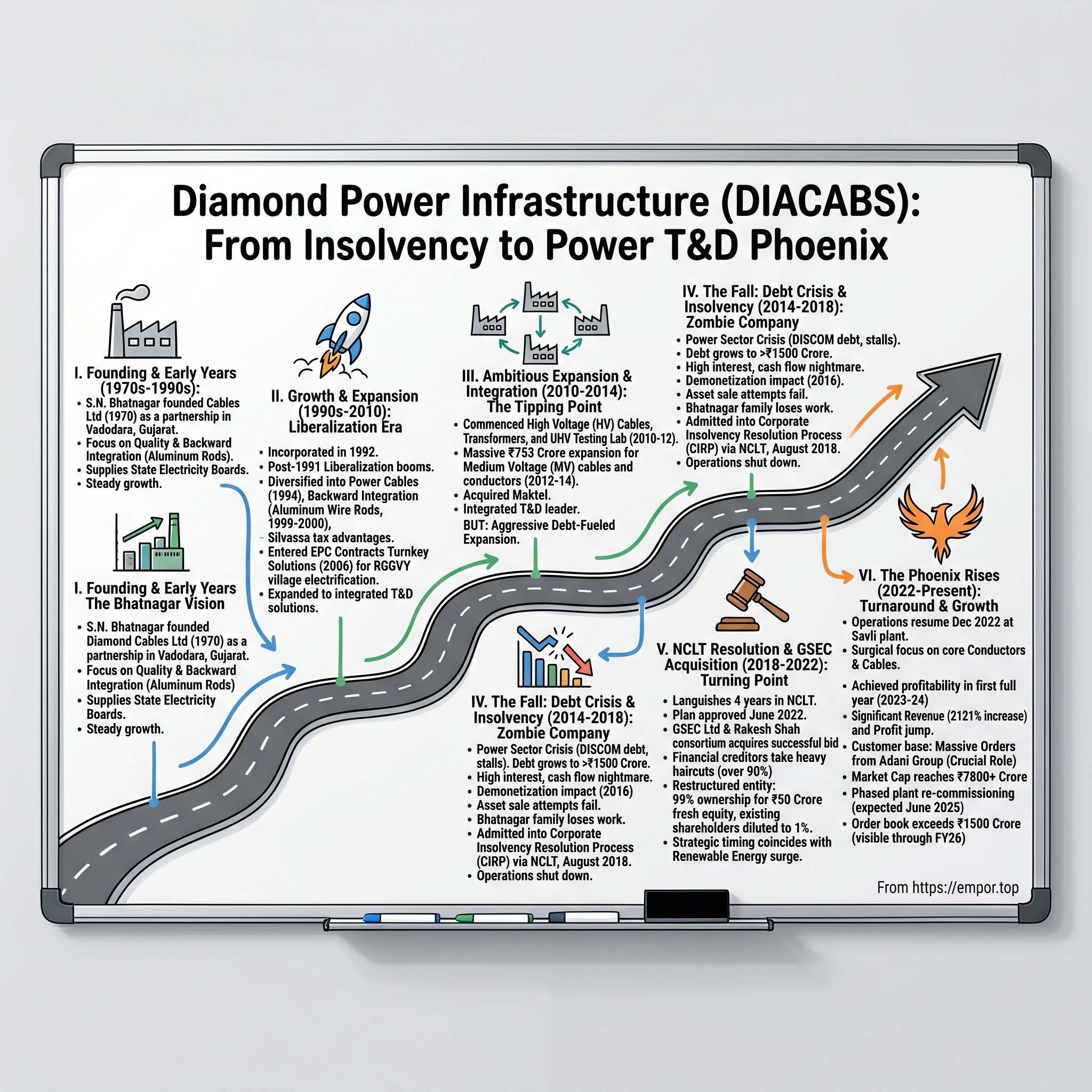
The company's first five decades warrant a brief summary, as its pre-2018 history serves primarily as a cautionary context for its current trajectory. The narrative then focuses on the order book, the balance sheet structure, and the management record. The history begins in a Vadodara workshop in 1970, with a mechanical engineer who had just resigned from his job.
 Subscribe on LinkedIn
II. Origins to Overreach: Diamond Cables to Diamond Power (1970–2014)
Suresh Narain Bhatnagar joined Jaipur Metals & Electrical Limited, a Kamani group company, in 1964 and spent seven years there as a mechanical engineer before resigning to launch his own venture.13 What he founded in 1970 as a partnership called Diamond Cables was an unpretentious business: a small workshop manufacturing aluminium conductor steel-reinforced (ACSR) wire—the grey, braided conductor hanging between transmission towers across India.13
Understanding the distinction between a conductor and a cable is essential to evaluating the company's underlying business model.
A conductor is an uninsulated wire strung overhead on pylons. Typically made of aluminium and sometimes reinforced with a steel core for tensile strength, it functions primarily as a specification-driven commodity. Utilities purchase conductor by the kilometre against standard grades, meaning a manufacturer's margin relies on the spread between raw aluminium input costs and finished product prices, alongside modest premiums for specialized alloys or thermal ratings. A cable, by contrast, is insulated for underground or substation transmission, encased in polymer layers engineered to withstand high electrical stress. Higher voltage ratings—ranging from medium to high and extra-high voltage—entail greater technical complexity, longer qualification cycles, and wider profit margins. While producing 3.3-kilovolt solar cable operates as a low-margin commodity business, manufacturing 220-kilovolt extra-high-voltage cable for urban utilities requires stringent technical qualification, creating a substantial barrier to entry.
Bhatnagar spent three decades expanding along that product hierarchy. The original partnership transitioned into a sole proprietorship in 1984 before incorporating as Diamond Cables Private Limited on August 26, 1992, formally acquiring the business that October.13 Through the late 1990s and early 2000s, the company integrated backward into aluminium and alloy wire rods, drawing its own feedstock to capture an additional processing margin. As conductor capacity expanded, the business rebranded as Diamond Power Infrastructure, broadening its portfolio from wire into insulated cable and engineering, procurement, and construction (EPC) projects.
A pivotal shift occurred in 2006, when Diamond Power began securing turnkey contracts under India's rural electrification initiatives. Previously, the company operated as a pure manufacturer, receiving payment upon product delivery. EPC contracting introduced a fundamentally different risk profile: bidding fixed prices on multi-year projects required carrying material, labour, and subcontractor costs on the balance sheet, with cash inflows dependent on milestone certifications from state electricity boards. While manufacturing consumes working capital in predictable inventory cycles, EPC work ties up capital in extended receivables—exposing the firm to state distribution utilities that historically rank among the slowest payers in the infrastructure sector.
Between 2010 and 2014, the company pursued an ambitious expansion strategy to become a fully integrated transmission and distribution solutions provider, offering conductors, extra-high-voltage cables, power transformers, transmission towers, and EPC execution. It formed joint ventures for 220-kilovolt turnkey projects and constructed a 500-kilovolt cable-testing laboratory—a technical asset essential for qualifying extra-high-voltage cables for high-margin contracts. Alongside these initiatives, it allocated approximately ₹753 crore toward medium-voltage cable and conductor capacity expansion.
The underlying strategic logic aligned with macro trends: India's power grid required extensive modernization, an integrated provider could capture greater project value, and in-house testing facilities established technical credibility. Modern management has since adopted a broadly similar operational model on the same industrial site.
However, the expansion was critically flawed in its capital structure. Diamond Power financed the buildout almost entirely through bank debt while simultaneously increasing exposure to working-capital-intensive EPC projects. The company added manufacturing capacity ahead of contracted demand and against uncollected receivables, relying on financially constrained state utilities for cash flow.
This period highlights a core principle of capital-intensive manufacturing: operational strategy and debt structure are inextricably linked. Diamond Power correctly identified the market opportunity but mismanaged its balance sheet risk, setting up the financial distress that materialized in 2016.
III. The Fall: Over-Leverage, Collapse, and NCLT (2014–2018)
The financial figure that ended the initial iteration of Diamond Power was ₹2,654.40 crore. That was the debt owed to a consortium of 11 public and private Indian banks as of June 29, 2016—credit facilities extended from 2008 onward that the lead bank classified as a non-performing asset in fiscal 2017.12
The Central Bureau of Investigation's (CBI) investigation revealed that the collapse extended beyond operational over-expansion. According to agency filings, the company obtained term loans and enhanced credit limits despite appearing on both the Reserve Bank of India's defaulters list and the ECGC caution list when the facilities were initially sanctioned—the precise warning lists designed to alert lending consortiums to elevated risk.14 Furthermore, the CBI alleged that the company routinely submitted false stock statements to its lead bank, recoding receivables older than 180 days as current assets to artificially inflate the "drawing power" against which it could draw cash credit.14
This mechanism serves as a crucial diagnostic for assessing corporate working capital. When a bank provides working capital facilities, it does not hand over a lump sum. Instead, it allows borrowing based on a calculated percentage of eligible current assets—primarily inventory and reasonably collectible receivables. By standard banking convention, receivables past six months are treated as impaired bad debts. By misclassifying aged receivables as fresh ones, a borrower expands its collateral base and extracts unearned cash, effectively borrowing against money unlikely to ever arrive.
The CBI registered a First Information Report on March 26, 2018.15 Enforcement Directorate searches and tax raids followed within weeks. On the night of April 17, 2018, CBI officers and the Gujarat Anti-Terrorism Squad arrested founder S.N. Bhatnagar and his sons, Amit and Sumit, at a hotel in Udaipur.12 The founder's 50-year corporate arc ended in a police vehicle in Rajasthan.
Insolvency proceedings followed that summer. Bank of India, facing a default of ₹485 crore, petitioned the National Company Law Tribunal. The NCLT's Ahmedabad bench admitted Diamond Power Infrastructure into the Corporate Insolvency Resolution Process on August 24, 2018, appointing Prashant Jain as resolution professional.5 Operations ceased, and the plant sat idle.
The financial fallout left deep structural marks on the company's balance sheet. Severe operational write-downs between fiscal 2015 and 2017—highlighted by a loss of approximately ₹794 crore in fiscal 2017 alone—resulted in cumulative book losses of roughly ₹931 crore.4
Two contrasting implications emerge from this collapse.
First, the core physical manufacturing assets survived. While insolvency restructures balance sheets and wipes out equity, it does not destroy physical infrastructure. Conductor production lines, extrusion equipment, the high-voltage testing laboratory, and 110 acres of industrial land near Vadodara retained their manufacturing utility despite the owner's insolvency. That physical durability made the asset worth acquiring.
Second, the nature of the failure imposes strict analytical scrutiny on subsequent disclosures. Because the original collapse involved alleged misrepresentation of working-capital collateral, evaluating renewed working-capital expansion requires rigorous verification of cash conversion rather than relying solely on reported revenue growth. Though current management is distinct from the founding family, financial analysis of the restructured entity demands consistent scrutiny of cash flows against balance sheet metrics.
By late 2018, Diamond Power retained functional plant facilities, manufacturing licences, and product qualifications, but lacked operational solvency—awaiting a bidder willing to acquire an insolvent asset.
IV. The Resolution: GSEC, Monarch, and Rakesh Shah (2018–2022)
Four years is a long time to spend inside India's corporate insolvency framework. Although the Insolvency and Bankruptcy Code (IBC) was designed to resolve cases within 180 days—extendable to a maximum of 330—Diamond Power Infrastructure spent nearly four years between its 2018 admission and final plan approval. While not unusual for complex Indian resolution cases, four years in court represents a severe operational delay for a manufacturing business whose physical assets and commercial relationships decay while idling.
The winning bidder was not a strategic industrial operator. GSEC Limited, an Ahmedabad-based logistics company, possesses an unusual corporate history: state-founded in 1965 as the Gujarat State Export Corporation, it was privatized under a 2004 government disinvestment program when Rakesh Ramanlal Shah and his family acquired control.16 GSEC's primary operating business is airport cargo handling, serving as a custodian at Ahmedabad International Airport alongside operations in Visakhapatnam, Indore, and Raipur.16 An airport freight handler was effectively taking control of a heavy electrical conductor manufacturer.
The consortium of GSEC and Rakesh Shah secured Committee of Creditors approval with an 89.46% voting majority in early 2022, and the National Company Law Tribunal (NCLT) approved the resolution plan on June 20, 2022.5 The resolution consortium paid ₹501 crore to settle admitted financial claims running into thousands of crores.7 For the bank consortium that was owed over ₹2,654 crore, the settlement represented a steep haircut.
The equity restructuring demonstrates the mechanics of distressed asset resolution. On September 17, 2022, the company reduced its existing paid-up share capital by 99%, shrinking total equity face value from ₹269.71 crore—comprising 26,97,10,679 shares of ₹10 each—down to ₹2.697 crore.17 On the same day, GSEC and its affiliates acquired control by subscribing to 5,00,00,000 fresh equity shares at a par value of ₹10 per share.17
This capital restructuring meant existing equity holders lost 99% of their ownership stakes overnight, while the acquiring consortium gained controlling ownership of an established manufacturing facility at face value. Under India's IBC framework, this process transfers viable productive assets from insolvent control to new capital providers while assigning historical losses to existing stakeholders. Consequently, the post-restructuring ownership structure became heavily concentrated: the new promoter group secured approximately 90% of the equity, leaving public shareholders with a minimal residual float.18
Beyond the corporate takeover, the transaction highlighted a notable familial and commercial connection. Rakesh Shah is married to Priti Adani, sister of Adani Group chairman Gautam Adani.6 The commercial ties between Shah and the Adani Group predated the Diamond Power acquisition: Smartmeters Technologies Private Limited, incorporated in October 2019, operates as a 50:50 joint venture between Adani Total Gas and GSEC, with Adani Total Gas executing a subscription agreement in August 2021 while GSEC manages day-to-day operations.19
From a regulatory perspective, Indian securities law defines related-party transactions through specific statutory relationships that do not explicitly include a spouse's sibling or their separately promoted entities. As a result, subsequent commercial contracts between Adani Group entities and Diamond Power were not required to be disclosed as related-party transactions in annual filings. In September 2024, opposition MP Jairam Ramesh publicly raised this governance structure, noting the ₹501 crore lender recovery, Diamond Power's subsequent market valuation, fiscal 2024 revenue of roughly ₹344 crore dominated by Adani orders, and the absence of related-party disclosures across filings for Diamond Power and ten listed Adani entities.7
From an investment analysis standpoint, this governance framework creates a technical compliance outcome alongside an information asymmetry: the disclosure regime is technically compliant yet informationally inadequate. Related-party transaction disclosures are designed to allow minority shareholders to evaluate whether transactions occur on arm's-length commercial terms. While exchange notifications provide order volumes and delivery schedules, public filings do not supply independent benchmarks to verify whether pricing mechanisms, margin structures, or payment terms match arm's-length market rates. This gap represents an essential structural variable for valuation models.
This structural backdrop leads to a central question: Is the customer relationship a commercial catalyst that enabled a qualified manufacturer to restart idle capacity faster than traditional public tenders allow, or does it represent the primary driver of current demand? Distinguishing between captive order flow and independent industrial competitiveness depends on operational evidence—beginning with the plant's actual manufacturing execution and output capacity.
V. Restart: From Empty Plant to Operating Company (Dec 2022–2024)
Restarting a plant that has sat idle for four years is a genuinely difficult industrial problem, and it is one of the few parts of this story where the evidence is unambiguous and favourable.
Consider what the new owners inherited in September 2022. Extrusion lines that had not been heated in years. A workforce that had dispersed. Product qualifications with utilities that had lapsed or gone stale. Vendor relationships terminated by non-payment. Aluminium rod mills sitting cold. And — a detail we will return to, because it turns out to matter enormously — a very large portion of the fixed assets and receivables sitting under attachment by the Enforcement Directorate, frozen since 2018 as part of the money-laundering proceedings that followed the CBI case.20
Operations resumed in December 2022, with only partial utilisation of the Savli infrastructure.17
The first proof point
The numbers from those first years are small enough to be easy to dismiss, which would be a mistake. In FY2024 — the first full year under new ownership — the company recorded revenue of roughly ₹343 crore and a net profit of about ₹17 crore.3 In FY2025 revenue reached ₹1,115 crore with a net profit of ₹34.5 crore.4
Those are not impressive absolute figures. What they establish is narrower and more valuable: the asset works. A conductor line that has been cold for four years either produces to specification or it does not, and utilities do not accept out-of-spec conductor out of sympathy. Tripling revenue in a single year from a restarted plant, while remaining profitable, is evidence that the physical asset base survived insolvency intact and that the people running it could commission equipment, qualify product, and ship on schedule.
It is also worth noting what those margins say. FY2025's net margin of roughly 3% is thin — the profile of a business selling a lot of low-value-added conductor at commodity spreads while its higher-margin cable lines were still coming up.4 The subsequent margin expansion, which we will examine, is largely a mix story rather than a pricing story, and understanding that distinction matters for judging how durable it is.
The physical base
What sits at Savli is a single integrated site on 110 acres, roughly 30 kilometres from Vadodara, with annual conductor capacity of about 2.5 lakh tonnes — 250,000 metric tonnes — alongside a bank of catenary continuous vulcanisation lines for cable.10
CCV lines are the heart of the cable business and worth one paragraph of explanation. A CCV line is a long, gently curved tube in which a conductor core is coated with polymer insulation and then "cured" — cross-linked at high temperature and pressure so the plastic hardens into a form that will not soften again under load. The curve is the trick: gravity keeps the still-molten insulation concentric around the core as it travels. The longer and better-controlled the line, the higher the voltage rating the finished cable can carry. A CCV line is therefore not fungible equipment; it is the constraint that determines whether a plant can make 3.3kV solar cable or 220kV extra-high-voltage cable, and adding one takes twelve to eighteen months and a serious capital commitment.
By mid-2024 Diamond Power was running five CCV lines and targeting full plant re-commissioning by June 2025.10 Its order book stood at ₹1,505 crore as of July 9, 2024 — and here the story's central problem is already visible in the data. Of that order book, roughly ₹1,309 crore, or about 87%, came from two orders placed by Adani group entities: ₹899.75 crore of AL-59 conductors from Adani Energy Solutions and ₹409 crore of low- and medium-voltage cables from Adani Green Energy.10
So the restart produced two facts simultaneously. The plant could manufacture. And essentially one customer group was buying.
Which brings us to the section that determines everything about the current investment case.
VI. The Adani Order Machine: Building the Current Business
Khavda is not a place people go. It is a stretch of barren salt flat in the Rann of Kutch, in far western Gujarat, close enough to the Pakistan border that the land was never worth farming. Adani Green Energy is building a 30-gigawatt renewable energy complex across 538 square kilometres of it — a project frequently described as the largest single renewable installation under construction anywhere on earth.21
Electricity generated in an uninhabited desert has one problem: nobody lives there. Every megawatt has to be collected from panel arrays and turbines, stepped up, and moved hundreds of kilometres to where load actually exists. That collection and evacuation is not incidental to the project — it is a substantial fraction of its cost, and it is measured in thousands of kilometres of conductor and cable.
Diamond Power's plant is roughly 400 kilometres away.
The order flow
The pattern of orders since 2025 tells the story without commentary. In March 2025 came the ₹214.65 crore conductor letter of intent from Adani Green for the Khavda solar and wind projects.1 In September 2025, a ₹185.16 crore conductor supply order from Adani Energy Solutions, followed within a week by another worth roughly ₹237 crore.2223 In November 2025, ₹276.06 crore of conductors from Adani Energy Solutions for Khavda, and separately cables supplied into the 1,126 MW / 3,530 MWh battery storage facility at the same site.2425
Then in December 2025, the largest single order the company had ever received: a letter of intent from Adani Green Energy worth ₹747.64 crore, covering 2,126 kilometres of 33kV high-voltage cable and 3,539 kilometres of 3.3kV solar medium-voltage cable for Khavda and Rajasthan, with delivery running from January to December 2026.21
In 2026 the flow continued into a third Adani entity, the Mumbai distribution utility: a ₹100.54 crore high-tension cable order for execution from April 2026 to February 2027, and a further ₹45.47 crore order running to May 2027.2627
The order book has compounded accordingly: ₹1,505 crore in July 2024, ₹3,498 crore at the end of March 2026, and ₹3,687.55 crore as of August 11, 2026.102811 That last figure is roughly 1.9 times FY2026 revenue — genuinely unusual visibility for a company this size.
What the operating numbers show
The revenue trajectory has followed. FY2026 closed at ₹1,910 crore, up 71% year on year, with EBITDA of ₹232 crore at a 12.1% margin and net profit of ₹158 crore — a 359% increase driven as much by margin as by volume.4 The fourth quarter alone delivered ₹696 crore of revenue and ₹60.6 crore of profit.29
The most recent reported quarter, Q1 FY2027 covering April to June 2026, produced revenue of ₹690 crore, up 129% year on year; EBITDA of ₹85 crore, up 172%, at a 12.3% margin roughly 200 basis points better than the prior year; and net profit of ₹58.5 crore, up 191%, on earnings per share of ₹1.11.11
What should an investor actually conclude from that?
Three things, and only three. First, the margin expansion is real but it is a mix effect, not evidence of pricing power. Management has been consistent across calls that the shift toward medium-voltage and extra-high-voltage product — which carries better realisations than bare conductor — is what is moving the margin line.11 That is a legitimate and durable-ish driver, but it is bounded: once the mix has shifted, it has shifted, and the incremental margin from here depends on volume absorbing fixed cost rather than on the company's ability to charge more.
Second, EBITDA growing faster than revenue while utilisation stays low is the signature of operating leverage in a plant with heavy fixed costs. That is genuinely the strongest quantitative argument in the bull case.
Third — and this is the part the headline numbers conceal — profit and cash have diverged. Diamond Power generated negative operating cash flow of roughly ₹80 crore in FY2026 despite reporting ₹158 crore of net profit, with working capital absorbing approximately ₹300 crore.29 Debtor days extended from about 70 to 89, and working-capital days from roughly 50 to 82.3 Finance costs surged more than fifteenfold year on year, rising from 0.3% of revenue to 2.1%.29
Given this company's specific history — a bankruptcy that turned on the misrepresentation of receivable ageing to lenders — the working-capital trend is not a footnote. It is the single most important thing to watch, and we will name it as a tracked metric at the end.
The concentration problem, stated precisely
Management now discloses the concentration itself, which is to its credit. On the Q1 FY2027 call in August 2026, the company put Adani group entities at "40% plus" of the current order book, and stated a target of bringing that to 20% by year-end, while noting roughly 670 active customers with more than 200 carrying outstanding orders.11
Two observations about that framing.
The first is that the 40% figure describes the stock of orders, not the flow. The relevant historical measure — roughly 82% of orders booked since April 2023, up from 75% the year before — describes what the business has actually been winning.6 The order-book percentage falls mechanically as Adani orders are executed off the book and newer, smaller non-Adani orders are added. Investors should track inflow, not balance.
The second is that a stated target to reduce concentration is an admission that concentration is a risk management has not yet solved. That is more honest than pretending otherwise, but it does not resolve anything, and the 20%-by-year-end target is aggressive enough that it functions as a near-term credibility test in its own right.
The diversification evidence, weighed
There is real evidence of broadening, and it deserves fair treatment rather than dismissal. Beyond the data-centre order we examine in Section IX, the company won ₹195.48 crore of medium-voltage cable orders placed by Rajesh Power Services — an EPC contractor executing underground cabling for Gujarat's Paschim Gujarat Vij Company — a ₹93.08 crore letter of intent from KPI Green Energy, and a ₹43.94 crore order for 453 kilometres of cable direct from Uttar Gujarat Vij Company.303132
Weigh that honestly. These are genuine third-party wins, they are recent, and they include a direct state-utility customer and an EPC intermediary — two different channels. But they are individually one-third to one-fifth the size of the large Adani orders, and together they amount to a few hundred crore against an order book approaching ₹3,700 crore. The diversification is directionally real and quantitatively early. The verdict the evidence supports is not "concentration solved" and not "concentration is fake progress" — it is that the company has demonstrated it can win non-Adani business at small scale and has not yet demonstrated it can win non-Adani business at the scale that drives the P&L.
Capacity: the engine being built for FY2028
The capital expenditure programme is where management's real conviction shows, because it is being sized for a company roughly four times the current one.
An eighth medium-voltage and extra-high-voltage cable line was commissioned in June 2026. A dedicated copper wire-drawing and copper cable manufacturing line, with installed capacity of 1,500 tonnes per month, began commercial production at Savli on August 20, 2026 — the company's entry into copper conductor cables, a distinct product family from its aluminium heritage.33 A new medium-voltage silane line is due in September 2026 and a fourth aluminium rod mill on October 15, 2026. A fifth CCV line is scheduled for March 2027 and a sixth for December 2027, with a low-voltage copper cable facility targeted before March 2028.11
Against that build-out, management guided FY2027 revenue of ₹4,300–4,500 crore at an 11–13% EBITDA margin, and has publicly projected ₹7,500 crore for FY2028.11
Here is the arithmetic that makes those numbers non-absurd and simultaneously demanding. Current utilisation is approximately 20% on conductors and 34% on cables.11 Management's own FY2027 guidance takes those to roughly 40% and 50–52%, and FY2028 to about 60% on both.11 In other words, the FY2028 revenue target does not require new capacity to be built beyond what is already ordered — it requires existing and committed capacity to be filled. That is a materially lower-risk path than a greenfield expansion story.
But it requires the orders. Roughly doubling revenue in FY2027 and then nearly doubling again in FY2028 means the order book has to keep expanding at something close to its current pace while simultaneously shifting away from its dominant customer — two objectives that pull against each other. Management has never executed at this scale under this ownership. Four years of operating history is a thin base from which to underwrite a four-fold revenue projection, and the honest description of the FY2028 number is that it is an ambition with a capacity plan attached, not a forecast with a contracted backlog behind it.
Which raises the question of whether the demand exists at all, independent of any one buyer.
VII. Industry Structure: Why India's Grid Needs This Company
In the first quarter of calendar 2026, India generated roughly 300 gigawatt-hours of renewable electricity that never reached a consumer. Power generation was curtailed—wind turbines and solar panels were idled—because the transmission network lacked the capacity to transport it.9
That single figure illustrates the central structural bottleneck facing the country's power sector. Generation capacity has expanded faster than grid infrastructure, turning theoretical transmission constraints into physical losses and prompting an unprecedented build-out of transmission lines.
The demand backdrop is real
Power Grid Corporation of India, the state-owned transmission monopoly, began fiscal 2026 with a capital expenditure target of ₹28,000 crore, raised it to ₹32,000 crore in February 2026, and ultimately closed the year at a record ₹35,000 crore—a cumulative 25% increase within twelve months.8 Looking ahead, the utility has guided to approximately ₹82,000 crore in combined capital expenditure across fiscal 2027 and fiscal 2028.8
Long-term projections point to even broader spending. The Central Electricity Authority estimates that evacuating India's non-fossil power generation capacity by fiscal 2036 will require ₹7.9 trillion in transmission investments. Factoring in undersea cables and newly identified links, Power Grid estimates the total industry opportunity pipeline at more than ₹15 trillion, up from a previous range of ₹9.5 trillion to ₹10 trillion.8
Alongside state spending, private transmission developers operating under tariff-based competitive bidding have rapidly expanded project backlogs. Adani Energy Solutions, Diamond Power's primary buyer, has rapidly expanded its project backlog, accumulating a high-voltage direct current (HVDC) scheme valued at approximately ₹25,000 crore,34 an ₹8,500 crore inter-state transmission project in Andhra Pradesh awarded in July 2026,35 and a ₹4,700 crore evacuation project in Maharashtra awarded in August 2026, expanding its transmission order book to ₹54,761 crore.36
This industry context presents a dual dynamic for Diamond Power. On one hand, its principal customer is backed by fully funded, long-dated infrastructure contracts rather than speculative projects. On the other hand, the company remains heavily exposed to the capital expenditure trajectory and financing stability of a single corporate group.
Porter's Five Forces: an honest reading
Supplier power is high and rising, representing a significant near-term risk. Raw aluminium accounts for more than 70% of material costs in overhead conductor manufacturing. Between early 2025 and mid-2026, London Metal Exchange (LME) aluminium prices rose roughly 30–35%, moving from $2,300–$2,600 per tonne in 2024 to over $3,800 per tonne.37 For context, the raw aluminium required for a 500-kilometre, 400kV double-circuit line costs approximately ₹245 crore at current spot prices, up from ₹164 crore in 2024.37 Meanwhile, copper—the key input for Diamond Power's new product line—has traded between $9,000 and $10,500 per tonne, with an additional 2–5% domestic premium.37
Diamond Power partially mitigates metal price volatility because its major contracts are structured on a per-kilometre basis featuring price-variation clauses that pass metal cost changes to buyers.21 However, contractual pass-through is incomplete: price adjustment formulas operate with time lags, expand working capital requirements to carry higher inventory values, and do not cover fixed-price project components.
Buyer power is high. The primary customer base comprises state distribution utilities, Power Grid, and private developers. State utilities historically delay payments, Power Grid uses standardized reverse auctions, and large private developers like Adani command substantial purchasing leverage. This creates a commercial asymmetry: a manufacturer deriving over 40% of its order book from a single conglomerate has limited ability to negotiate favorable payment terms, contributing to the recent extension in debtor days.
Barriers to entry are moderate and segment-dependent. Standard bare conductor manufacturing has low capital and technical barriers. By contrast, extra-high-voltage cable production requires continuous vulcanization lines, specialized high-voltage testing infrastructure, and extensive utility pre-qualification cycles. Diamond Power's 500kV testing facility and legacy certifications provide a structural advantage over new entrants in higher-voltage segments.
Substitution risk is low. High-voltage electrical transmission relies entirely on metallic conductors, with no viable commercial alternative available for grid-scale power movement.
Rivalry is intense and intensifying in high-margin product lines. Polycab India holds roughly 22% of India's organized wire and cable market and has announced plans to expand into extra-high-voltage cables ranging from 220kV to 750kV—directly targeting the segment Diamond Power relies on for margin expansion.3839 The top five domestic manufacturers collectively control 45–55% of the organized market by revenue.38
A 7 Powers read: what is actually defensible
Evaluating Diamond Power through Hamilton Helmer's 7 Powers strategic framework indicates limited structural competitive moats.
The business lacks network economies, as physical transmission products derive no network utility from additional deployments. Branding provides negligible advantage in commodity electrical supplies sold strictly to technical specifications. Switching costs remain modest; utility qualification requirements introduce procedural friction rather than true customer lock-in, and infrastructure developers actively maintain multiple vendor options. Counter-positioning is absent, as the company operates a conventional manufacturing model at a smaller scale than market incumbents.
The company's defensibility relies primarily on a partial cornered resource and prospective scale economies. The cornered resource consists of the 110-acre Savli manufacturing facility—combining integrated rod-to-cable production, high-voltage testing infrastructure, and legacy utility qualifications—acquired out of bankruptcy at a steep discount to replacement cost. However, scale economies are not yet established: at ₹1,910 crore in fiscal 2026 revenue, Diamond Power lacks the purchasing and manufacturing cost advantages enjoyed by larger peers like Polycab (₹28,884 crore) or Apar Industries (₹22,902 crore).4041
Furthermore, the commercial relationship with the Adani group does not constitute a structural moat under economic definitions. A strategic power requires a barrier that competitors cannot replicate at acceptable cost. A major customer relationship, regardless of current volume, remains a commercial agreement rather than an enduring competitive barrier.
The scale gap, and what the market is paying for it
Comparative peer valuation highlights the premium embedded in Diamond Power's market pricing.
Polycab India commands a market capitalization of approximately ₹1,36,800 crore on fiscal 2026 revenue of ₹28,884 crore, net profit of ₹2,708 crore, a return on capital employed (ROCE) of 33.2%, and a price-to-earnings (P/E) multiple near 48.40 Apar Industries—the most direct comparable due to its focus on conductors—trades at a valuation of roughly ₹74,950 crore on fiscal 2026 revenue of ₹22,902 crore, net profit of ₹977 crore, ROCE of 31.1%, and a P/E multiple around 62.41 KEI Industries is valued at about ₹52,900 crore on revenue of ₹11,748 crore, net profit of ₹918 crore, ROCE of 20.1%, and a P/E multiple near 53.42
By comparison, Diamond Power's market capitalization of roughly ₹20,250 crore represents more than a quarter of Apar's valuation despite generating approximately one-twelfth of Apar's revenue, resulting in a trailing earnings multiple nearly double that of its peer.341
Diamond Power's reported ROCE of 26.5% aligns with industry peers.3 However, that figure is calculated on an equity and asset base that remains subject to an unresolved auditor qualification—an issue examined in Section X—which requires caution when assessing capital efficiency.
Equity markets are not valuing Diamond Power based on its current production scale, but as an expanding growth asset. The current valuation multiple assumes that management's fiscal 2028 revenue target is attainable and that operating margins remain resilient during expansion—expectations that will be tested across upcoming quarterly results.
Sustaining this growth trajectory requires substantial working capital financing, a constraint that presented severe operational challenges until mid-2026.
VIII. Fixing the Balance Sheet: The July 2026 QIP
Strip away the order book and the growth rates and look at Diamond Power's balance sheet in June 2026, and you find something odd: a company with a market capitalisation in five figures of crore and a book value per share of negative ₹11.5.3
Negative net worth is not a technicality. It means the accumulated losses of the pre-insolvency era — that ₹931 crore of carried-forward destruction — still exceeded everything the resurrected company had earned and raised since.4 A company in that position cannot borrow cheaply, cannot easily post performance guarantees at scale, and is structurally constrained in how much working capital it can carry. Since working capital is precisely what a rapidly growing cable manufacturer consumes, negative net worth was not a cosmetic problem. It was the ceiling on the growth plan.
A second, unrelated cage opens first
Before the equity fix came a legal one, and its importance is easy to underrate.
On May 6, 2026, a special court in Ahmedabad discharged Diamond Power Infrastructure in proceedings under the Prevention of Money Laundering Act — proceedings that traced back to the CBI's 2018 FIR — with the order received by the company on May 7.20 The practical consequence was the release of fixed assets worth more than ₹1,000 crore and receivables exceeding ₹900 crore that had been under Enforcement Directorate embargo since 2018.20 Roughly ₹1,900 crore of assets, frozen for eight years, became available to the operating company.29
That is an unusual kind of value creation: not earned, not bought, simply unlocked by a court. It also explains part of why the balance sheet had looked so strange — a meaningful share of the asset base was legally immobilised.
The raise
The equity fix came ten weeks later. Diamond Power opened a qualified institutional placement on July 23, 2026 and closed it on July 28, allotting 7.11 crore shares at ₹227 each — a 4.99% discount to the floor price — to raise ₹1,613.97 crore.43 Paid-up equity capital rose from ₹52.70 crore to ₹59.81 crore.43
The book is where this gets interesting. Motilal Oswal Mutual Fund's schemes took the largest clubbed allocation at 1.76 crore shares, or 24.78% of the issue; HDFC Mutual Fund's schemes took 1.32 crore shares, or 18.59%.43 Before the placement, combined foreign institutional and mutual fund ownership in this company was approximately 0.43%.4 By the end of July 2026, domestic institutions held 10.94% and foreign institutions 4.56%.3
That shift deserves careful interpretation, in both directions.
The bullish reading is straightforward: a company with negative net worth and a four-year operating history raised over ₹1,600 crore from long-only institutional investors who conducted their own diligence. Institutions of that size do not allocate at that scale casually, and their arrival converts a stock previously covered mainly by retail-oriented research houses into one with genuine institutional scrutiny.
The sceptical reading is equally available and should be held alongside it. QIPs are placed into momentum; a stock that has roughly tripled is an easier book to build than one that has not; and the allocations, while large in absolute terms, are small positions for funds of that size. Institutional participation is a data point about market judgment, not a verdict on business quality. The historical record is unkind to the assumption that marquee names in a placement book are a substitute for one's own analysis.
What it bought
Management's stated deployment of the ₹1,614 crore is unusually specific, which is itself worth noting: ₹750 crore to working capital, ₹350 crore to repay promoter unsecured loans, ₹325 crore to general corporate purposes, ₹130 crore to the low-voltage cable expansion, and ₹74 crore to equipment and balancing capex.11
Two things stand out.
First, the largest single line is working capital, which confirms the diagnosis: the binding constraint was cash to fund receivables and inventory, not capacity. Second, ₹350 crore — more than a fifth of the raise — repaid unsecured loans from the promoter group. That is a legitimate and clean use of proceeds, and it removes a related-party financing dependency from the balance sheet. It also means that a fifth of the money raised from public institutions went to repaying the controlling shareholder, which is the sort of detail an activist investor would want disclosed prominently rather than found in a call transcript.
The stated effect on the balance sheet was decisive: net worth moved from negative ₹922 crore to positive ₹691 crore, with debt-to-equity at 0.48 and a current ratio of 1.4 times, and management guiding to no substantial incremental debt through March 2028.11
The compliance angle nobody should skip
There is a less flattering reason the QIP happened when it did.
Indian listing rules require at least 25% public shareholding. Diamond Power's public float stood at 15.98% for the quarter ended June 30, 2026.44 Both the NSE and the BSE levied fines of ₹4.55 lakh each for that quarter's non-compliance, which the company disclosed on August 19, 2026.44 This was not the first: for the quarter ended March 31, 2026, the company had already paid fines of ₹5.31 lakh per exchange on May 20, 2026.45
The QIP took public shareholding from 15.98% to 25.97%, restoring compliance and reducing promoter holding to 74.04%.443
The fine amounts are trivial — a few lakh rupees against a ₹20,000 crore company. The pattern is not. A company that misses a basic, entirely foreseeable listing requirement for two consecutive quarters, having flagged its intention to fix it, is telling you something about the priority it assigns to compliance mechanics. Set against a company whose predecessor entity failed amid a bank-fraud investigation, and whose latest audited accounts carry a qualified opinion, it is a data point that belongs in the file rather than being waved away as housekeeping.
So the balance sheet is genuinely repaired, and the repair was partly compelled. Both are true. What the company does with the funded balance sheet is now the question — and management's answer involves a business it was not in a year ago.
IX. New Frontiers: Data Centers as Real Optionality
On July 5, 2026, Diamond Power announced a supply order worth ₹435.71 crore, excluding GST, to deliver approximately 2.1 million metres of high-tension and low-tension power cable for 310 megawatts of data-centre capacity across five Hyderabad projects, designated HYD22 through HYD26, with deliveries scheduled from August 2026 to March 2027.46 The stock locked at its 10% upper circuit limit following the announcement.47
What triggered the market's reaction was not the sheer size of the contract—which remains comparable to several previous Adani orders—but the identity of the buyers. The contracting parties were Larsen & Toubro, Sterling and Wilson, and Blue Star: three established Indian engineering and MEP contractors with no connection whatsoever to the promoter group.46
This distinction carries analytical weight. It represents the first large-scale contract demonstrating that the company can secure major non-Adani business, addressing customer concentration with operational evidence rather than strategic intent.
Why the capability transfers
Data centres represent a natural, high-margin adjacency for a cable manufacturer. A hyperscale facility is essentially an industrial power installation wrapped around computing infrastructure. Electricity arrives at high voltage, steps down through substations and switchgear, and distributes through a dense cable network to server racks that consume far more power per square metre than typical commercial buildings. A 310-megawatt campus requires massive quantities of copper and aluminium cable manufactured to specifications that directly match Diamond Power’s core product lines: high-tension and low-tension cables produced on its existing catenary continuous vulcanisation (CCV) lines and validated in its high-voltage testing laboratory.
Furthermore, the computing demands of artificial intelligence are driving higher power densities per rack, pushing facility designs toward higher-voltage internal distribution. This trend shifts product demand up the voltage curve into medium-voltage cables that carry wider profit margins. The commissioning of the company's dedicated copper cable line in August 2026 directly supports this opportunity, as indoor facility distribution predominantly favours copper over aluminium.33
Rather than a speculative expansion into an unfamiliar sector, this business line applies the plant's core manufacturing capabilities to a rapidly growing customer segment.
Sizing it honestly
Management has set ambitious targets for the segment: ₹750 crore in data-centre revenue for fiscal 2027, a ₹1,000 crore data-centre order book by March 2027, and ₹1,500 crore in orders for fiscal 2028, aiming for data centres to eventually account for 20% of total revenue.11 As of August 2026, data centres represented 11.8% of the company's ₹3,688 crore order backlog.28
Evaluating these targets requires analytical rigor. Generating ₹750 crore in fiscal 2027 revenue from a single ₹435.71 crore contract announced in July 2026 requires winning significant additional orders over the next two quarters from a newly targeted client base. While India’s data centre construction pipeline is expanding rapidly and incumbent cable suppliers face capacity constraints, management has a documented history of setting aggressive targets that outpace operational execution. For instance, the company's fiscal 2025 annual report outlined an intention to run newly established production lines at 100% capacity by fiscal 2027, whereas guidance provided on the first-quarter fiscal 2027 earnings call projected utilization rates of only 40% for conductors and roughly 50% for cables.4811
The data centre initiative is best understood as a viable growth option backed by a single major proof point, offering a credible path toward customer diversification. However, it does not yet represent a fully established second operating pillar. The ₹750 crore fiscal 2027 target remains a management ambition that requires verification against future reported segment revenue before it can be integrated into baseline valuation models.
Which leads to the more general question: how much weight should an investor place on what this management team says it will do?
X. Management & Capital Allocation: Reading the Record
A notable aspect of Diamond Power's earnings call on August 14, 2026, was who did not address investors: the individual controlling the company.
Rakesh Ramanlal Shah sits on the board as a Non-Executive, Non-Independent Director—not as chairman, chief executive, or in any executive role—while continuing to serve as chairman and managing director of GSEC.49 Investor communications on the call were led by Amit Bhatnagar, Head of Corporate Strategy; Pawan Lohiya; and Umesh Chhaya, Whole-time Director, with the session hosted by Monarch Networth Capital.11
While such governance arrangements are common among Indian promoter-controlled enterprises, the structure means that the director whose commercial relationships plausibly drive the largest share of order volume does not directly address market inquiries.
The board, and the independence question
The board is chaired by Maheswar Sahu as an Independent Director, alongside independent directors Rabindra Nath Nayak and Varsha Biswajit Adhikari, with Rakesh Shah and Himanshu J. Shah serving as non-executive promoter directors.49 Sahu and Nayak were both appointed effective September 17, 2022—the date the new capital structure took effect—for three-year terms.49
Although the formal composition appears standard, the governance framework features a specific structural limitation: no independent director is mandated to review commercial terms for contracts with the company's principal customer group, because Indian securities regulations do not classify those transactions as related-party dealings. The formal architecture remains compliant, yet the substantive oversight provided by a related-party evaluation framework is absent. Evaluating the company requires assessing this specific disclosure gap rather than general governance standards.
The finance seat has moved
Executive continuity in key financial positions is critical for working-capital-intensive businesses, making executive turns in the finance office noteworthy. Pawan Lohiya was appointed Chief Financial Officer and Whole-time Director effective July 1, 2024, but stepped down from the CFO position on September 3, 2024, completing a tenure of roughly two months.50 Vinod Jain was subsequently appointed Chief Financial Officer and Chief Risk Officer in February 2025.50
Rapid CFO turnover during an operational turnaround—characterized by negative operating cash flow and an audited qualification—warrants monitoring. While Lohiya remains a whole-time director participating in investor communications, frequent leadership changes in finance add analytical complexity during balance sheet restructuring.
The auditor's qualification
The primary accounting consideration on the balance sheet centers on the statutory auditor's report.
Naresh & Co., the statutory auditor, issued a qualified opinion on Diamond Power's consolidated fiscal 2026 financial results.51 The qualification concerns the Property, Plant and Equipment register, where physical verification, valuation, and reconciliation of holding company fixed assets inherited from the pre-insolvency era remain incomplete. While initial verification and preliminary value allocations have occurred, the final determination of value-in-use and remaining asset lives is ongoing; in the interim, depreciation on legacy assets has been charged at 20% of standard rates.51
This accounting treatment directly impacts reported earnings. Charging one-fifth of standard depreciation understates annual asset expense, elevating reported net profit relative to a fully reconciled asset register—a material difference given book fixed assets of approximately ₹1,165 crore.4 Furthermore, the denominator for return metrics, including the reported 26.5% return on capital employed (ROCE), rests on an asset base that the auditor has explicitly declined to certify.351
This accounting gap stems from the physical legacy of an industrial plant that sat idle under legal attachment for four years, making asset reconstruction complex. Reconciling the asset register and removing the auditor qualification represents a key verifiable milestone for assessing financial quality.
Promises versus outcomes
Assessing management credibility requires comparing historical targets against operational delivery. Over its four-year operating record under new ownership, management's public projections have occasionally outpaced execution.
The fiscal 2025 annual report outlined a "Vision 2030" target of ₹10,000 crore in revenue, driven by volume growth, technical leadership, and international expansion, alongside an objective to run newly established production lines at full capacity by fiscal 2027.486 Guidance has since lowered two of these operational targets.
On capacity utilization, the plant operates at approximately 20% of conductor capacity and 34% of cable capacity, with current guidance targeting 40% and 50–52% respectively for fiscal 2027.11 On international sales, the fiscal 2025 report detailed expansion plans across West Asia, Africa, and South America; on the August 2026 call, management reported that export revenue remained negligible, noting that qualification certifications for Europe and the United States were in progress, initial orders were anticipated in the second half of fiscal 2027, and the first-year export order target was set at ₹500 crore.4811
These adjustments reflect operational recalibration rather than execution failure, as revenue growth, margin expansion, and balance sheet repair have proceeded. However, the record demonstrates that management's initial projections have exceeded near-term delivery on controllable operational metrics, a factor relevant to evaluating the ₹7,500 crore revenue projection for fiscal 2028 and the target of reducing customer concentration to 20%.
During the first-quarter fiscal 2027 call, management provided specific operational details. Addressing early monsoon disruptions to cabling work in Gujarat, management confirmed that the company achieved its internal quarterly revenue target of ₹700 crore, setting expectations for monsoon impacts in the second quarter followed by peak delivery in the third and fourth quarters.11 Management also provided firm dates when questioned on plant commissioning timelines, export qualification steps, and margin stability under higher volumes.11
Capital allocation, and what has not yet been tested
Capital deployment since the restart has remained focused on manufacturing infrastructure. Cash flow has been directed entirely toward plant upgrades—including rod mills, CCV lines, testing infrastructure, and copper processing capacity—with no funds allocated to dividends or share buybacks. For an asset rebuilding operational scale, reinvesting cash into core manufacturing facilities represents a disciplined deployment strategy.
However, four years of operational history during a sector expansion does not fully test capital allocation discipline. Management has not operated through an industry downturn or navigated a period of slowing order growth. Consequently, management's guidance to avoid substantial incremental debt through March 2028 stands as a key financial commitment to monitor against future balance sheet filings.
The activist's case, stated fairly
A cautious investment analysis of Diamond Power highlights several structural factors: rapid top-line growth is anchored by demand from a conglomerate linked to the controlling shareholder by marriage, structured outside statutory related-party disclosure rules. Reported net profit reflects reduced depreciation under a qualified audit opinion, operating cash flow remained negative during fiscal 2026 while working capital expanded, and the company incurred exchange penalties for delayed public float compliance. Furthermore, a portion of the ₹1,614 crore institutional placement was applied to repay promoter loans, while the stock trades at a valuation multiple double that of established industry peers.
Conversely, the operational turnaround case highlights that new management successfully recommissioned a bankrupt manufacturing asset, secured a court discharge unfreezing ₹1,900 crore in assets, strengthened the balance sheet via equity markets, and began securing third-party commercial contracts in expanding sectors like data centers.
Both perspectives are grounded in disclosed data. Resolving whether the company represents a durable manufacturing platform or a concentrated valuation bet depends on operational performance across upcoming quarters.
XI. Playbook: Business & Investing Lessons
Stepping back from the specific details, Diamond Power serves as a compact case study in five recurring market lessons.
A physical asset can outlive the company that owns it. Insolvency destroys financial claims, not manufacturing capability. Conductor lines, extrusion equipment, high-voltage test benches, and industrial land in Gujarat do not lose their functional utility simply because a balance sheet failed. India's Insolvency and Bankruptcy Code is designed to facilitate the transfer of productive assets, and Diamond Power illustrates the framework operating as intended: an idle facility moved from a defaulted borrower to a new sponsor willing to fund a recommissioning, at a transaction price that imposed steep haircuts on legacy creditors.
The corollary is equally significant: buying a distressed industrial asset represents purchasing an option rather than an operating business. The acquiring consortium gained the opportunity to spend capital verifying whether cold machinery could be successfully restarted. That option carried a strike price measured in years of recommissioning expenditure and an outcome contingent on renewable grid demand emerging. While the trade yielded substantial returns in this instance, the broader distribution of outcomes for distressed turnarounds remains wide, and investors should avoid generalizing from a single successful outcome.
A company can repeat historical operational risks under a different capital structure. Diamond Power initially defaulted after expanding debt-financed capacity ahead of firm demand. The company is once again expanding manufacturing capacity ahead of contracted orders—adding a fourth rod mill, additional continuous vulcanization lines, and a copper facility against a fiscal 2028 revenue target nearly four times its fiscal 2026 performance. The key structural distinction lies in the funding mix: the current buildout is funded primarily through institutional equity rather than bank borrowing, with management guiding against significant debt additions. Financing expansion through equity mitigates insolvency risk, but the core execution challenge of filling uncontracted capacity remains if equity market conditions tighten.
Customer concentration acts as an indiscriminate accelerant. A dominant buyer can compress years of commercial growth into a few quarters. However, extreme customer concentration also transfers revenue visibility to a single counterparty's capital allocation committee, grants that buyer substantial leverage over commercial terms, and links the manufacturer's valuation to the financing cycle of an external corporate group. The primary risk of customer concentration is not necessarily contract cancellation, but rather a shift in the customer's capital spending cadence or extended payment terms impacting working capital long before appearing in the order backlog.
Balance-sheet repair through primary equity provides a healthier foundation than debt, provided capital is deployed as signaled. Raising ₹1,614 crore from long-only institutional investors to restore positive net worth is structurally superior to debt-funded expansion, as equity absorbs operational volatility whereas leverage compounds it. However, the true test of balance-sheet quality is not the capital raise itself, but whether operational cash flow stabilizes and working-capital requirements cease consuming liquid reserves over subsequent quarters.
A valuation re-rating that outpaces fundamental earnings growth requires rigorous scrutiny. Diamond Power's market capitalization expanded from roughly ₹5,000 crore in May 2025, when press reports identified the Adani group as one of several prospective suitors, to over ₹20,000 crore in August 2026.523 While top-line revenue and net profit expanded rapidly over the same period, fundamental earnings did not quadruple. The remaining valuation gain reflects multiple expansion—the market's willingness to pay a higher multiple for future earnings expectations. While multiple expansion generates real equity returns, it remains the component of valuation most vulnerable to operational delays or quarterly earnings misses. Distinguishing between operational profit growth and valuation re-rating is essential for evaluating long-term investment sustainability.
XII. Analysis & Bear vs. Bull Case
Myth versus reality
Before examining the bull and bear cases, three widespread assumptions require scrutiny against the operating record.
Myth: Diamond Power's relationship with the Adani Group constitutes a competitive moat. Reality: It is a major customer relationship, and customer relationships are not moats. Industrial utility buyers maintain multiple approved suppliers as standard policy, and nothing in the public record indicates volume guarantees, price protection, or contractual exclusivity. Indeed, management's stated goal is to reduce Adani entities to 20% of the total order book—the opposite of how a company describes an enduring competitive advantage.11 The relationship functions as a valuable commercial catalyst that solved an initial plant restart problem, but it remains contestable.
Myth: The balance sheet has been fully repaired. Reality: The capital structure has been repaired, but cash conversion has not. While net worth turned positive following the equity raise and balance-sheet leverage remains low,11 operating cash flow for fiscal 2026 was negative despite record reported net profit, while receivable collection timelines lengthened.293 Capital structure and cash flow generation represent distinct financial dynamics, and working-capital strain caused the original entity's downfall.
Myth: Unused capacity guarantees future operating leverage. Reality: Low utilization guarantees physical capacity, not financial leverage. Generating operating leverage requires securing orders to fill lines while preserving profit margins. In a commodity-adjacent sector where major competitors are expanding into higher-voltage lines, expanding volume while defending pricing is not guaranteed.39
The bull case
The macroeconomic backdrop provides the strongest support for the optimistic thesis. India's grid infrastructure expansion is a policy-backed effort driven by documented supply shortfalls: renewable generation is routinely curtailed due to transmission bottlenecks, the state grid operator increased its capital expenditure budget three times in fiscal 2026, and official long-term grid investment pipelines have been revised upward by roughly 50%.98 The government's Green Energy Corridor initiative serves as the policy framework channeling renewable power from generation hubs in Gujarat and Rajasthan into transmission equipment contracts.[^53] Diamond Power, producing conductors and high-voltage cables from a facility located near these major development zones, sits directly in the path of this capital expenditure.
Operational performance since the restart demonstrates plant execution. Revenue has roughly doubled in consecutive fiscal years while maintaining profitability, core operating earnings have grown faster than top-line sales, and gross margins have expanded through a favorable product mix rather than one-time accounting gains.411 The current order backlog provides revenue visibility covering nearly two years of production.11
Furthermore, the operational math supporting management's fiscal 2028 targets relies on existing and committed assets. Achieving its long-term revenue ambitions requires filling plant lines already built or under installation rather than constructing greenfield manufacturing facilities—a lower-risk execution path than unbuilt capacity expansion.
The financial foundation has also stabilized. The resolution of money-laundering proceedings unfroze legacy fixed assets and receivables,20 while institutional equity issuance restored positive net worth. In addition, initial contracts in the data center sector—secured with major third-party engineering contractors—provide operational evidence of customer diversification beyond promoter-affiliated buyers.46
Finally, media reports in May 2025 noted that external strategic investors, including the Adani Group, evaluated equity stakes in the business prior to the public equity placement.52 While that transaction did not materialize, it indicates that industry participants have viewed the re-commissioned manufacturing asset as strategically valuable.
The bear case
The primary risk to the company's valuation centers on cash flow generation. Heavy electrical equipment manufacturing requires substantial working capital during rapid revenue expansion. Diamond Power consumed cash faster than it generated operational earnings in fiscal 2026, resulting in negative operating cash flow alongside expanding receivables and rising finance charges.293 While the institutional equity placement provided liquid reserves, achieving management's fiscal 2027 revenue targets at current collection speeds will absorb significant working capital, and management has committed to avoiding major debt expansion.11
Second, customer concentration and disclosure rules create ongoing information gaps. Although no evidence indicates non-arm's-length contract pricing, outside investors lack independent mechanisms to evaluate commercial terms across major orders. Furthermore, historical order inflow data indicate that reliance on affiliated orders increased during the initial turnaround phase.6 Any reduction or delay in the primary buyer's capital expenditure cycle directly impacts the company's operational trajectory.
Third, reported earnings reflect provisional accounting treatments. Fiscal 2026 net income benefited from charging depreciation at one-fifth of standard rates under an ongoing auditor qualification regarding legacy property, plant, and equipment registers.51 Reported profitability and return metrics should be evaluated as provisional until fixed-asset reconciliations are completed.
Fourth, established market leaders are expanding into high-margin segments. Polycab India, with revenue roughly fifteen times larger than Diamond Power, has announced plans to manufacture extra-high-voltage cables up to 750 kilovolts.39 Because Diamond Power's margin expansion relies on shifting production toward higher-voltage lines, aggressive competition from well-capitalized incumbents threatens long-term margin durability.
Fifth, raw material price volatility increases working-capital requirements. With raw aluminium prices rising over eighteen months and accounting for the majority of conductor material costs, price-adjustment contract clauses protect operating margins but expand the cash required to fund inventory and receivables.37
Sixth, governance execution includes recurring operational missteps. Over four years under new ownership, the company incurred stock exchange penalties for non-compliance with public shareholding rules across two consecutive quarters,4445 experienced turnover in the chief financial officer role,50 and retained an auditor qualification on its primary asset register.51 While individually modest, these factors warrant disciplined analytical scrutiny given the predecessor company's history.
Seventh, current market valuation leaves little margin for execution errors. Trading at roughly 103 times trailing earnings—compared to established industry peers valued between 48 and 62 times earnings with larger operating scale and clean audit histories—the stock price reflects ambitious growth expectations.3404142 Any operational delay or failure to meet multi-year guidance poses repricing risks.
The competitive war-game
Evaluating potential long-term outcomes highlights distinct operational paths.
If national transmission investment remains elevated and Diamond Power achieves planned plant utilization, the company could establish itself as a specialized manufacturer generating six to seven thousand crore in annual revenue with low-teens operating margins—a scale comparable to established peers such as KEI Industries, albeit with a shorter operating record.42
If overall grid spending continues but order allocation from its primary buyer declines without equivalent third-party replacement, top-line growth would decelerate below market expectations, placing downward pressure on the company's valuation multiple.
If industry demand remains strong while larger incumbents—such as Polycab, Apar Industries, and KEI—compete aggressively for extra-high-voltage and data center contracts, Diamond Power's smaller balance sheet and shorter commercial track record could constrain its competitive positioning.
As a pure-play electrical transmission manufacturer, Diamond Power offers higher direct sensitivity to grid infrastructure spending than diversified peers whose sales span consumer and light industrial markets. That focused exposure drove the stock's market re-rating, but it also leaves the company without broader commercial buffers should grid expenditure slow.
The three metrics that matter
Tracking Diamond Power's ongoing performance depends on three core operational metrics:
First, the quarterly proportion of new order inflows from non-affiliated customers compared to major counterparty orders. Order inflow composition—rather than static order backlog totals—provides the definitive measure of customer diversification and market competitiveness.
Second, plant utilization rates across conductor and cable production lines. Utilization rates serve as the direct link between installed manufacturing capacity and multi-year revenue projections, offering a transparent benchmark for operational execution.
Third, the ratio of operating cash flow to reported net profit alongside receivable collection days. Given the company's financial history, working-capital conversion represents the earliest indicator of operational health, where persistent cash flow divergence from reported net income would flag emerging balance-sheet strain.
XIII. Epilogue: What the Next Few Quarters Need to Show
Somewhere on 110 acres outside Vadodara, a fourth aluminium rod mill is scheduled to start up in October 2026, and a fifth CCV line is due the following March.11 The land they sit on has now hosted three distinct corporate lives: a founder's fifty-year build, a debt-fuelled collapse that ended in arrests and an eight-year asset freeze, and a four-year restart that has taken the enterprise from an idle shell to a company the public market values above ₹20,000 crore.
Whatever an investor concludes about the valuation, the resurrection itself is a genuinely remarkable piece of Indian corporate history, and worth appreciating on its own terms. Very few companies come back from a 99% capital reduction. Fewer still come back producing.
The next several quarters will settle most of the open questions, and they will do so with specific, published numbers rather than narrative.
The FY2027 revenue guidance of ₹4,300–4,500 crore at an 11–13% EBITDA margin is the first hard test, and it is a demanding one: it requires more than doubling FY2026 revenue in a year whose first quarter was partly rain-affected and whose second is expected to be as well, with the burden of delivery falling on the third and fourth quarters.11 Meeting it would be the strongest evidence yet that this management's targets are forecasts rather than ambitions. Missing it, and how the miss gets explained, would be almost as informative.
The concentration target is the second test. Management has committed to bringing Adani group exposure toward 20% of the order book by year-end, from north of 40%.11 Watch whether that happens because non-Adani inflow genuinely accelerated or because Adani orders simply executed off the book faster than new ones arrived. Those look identical in the percentage and mean entirely different things.
The data-centre target is the third: ₹750 crore of FY2027 revenue and a ₹1,000 crore order book by March 2027, from a base of one large Hyderabad contract.11 This is the vertical with the clearest strategic logic and the least operating history.
And running underneath all three is the quieter question of whether the accounting catches up with the operations — whether the PPE reconciliation completes, the audit qualification lifts, and depreciation normalises to applicable rates without materially changing the earnings picture.51
There is a larger question this company stands in for, and it is the one that should interest investors most. India is going to spend something on the order of ₹15 trillion on transmission infrastructure over the coming decade.8 The open question is how much of that spending gets captured by revived mid-cap specialists with the right assets in the right state, and how much accrues to the larger, better-capitalised incumbents who can fund capacity through any cycle and are now moving into the specialists' best segments. Diamond Power is the sharpest available expression of the first outcome.
What a long-term holder ultimately has to underwrite here is narrower than the growth story suggests. The operating turnaround appears real; the plant works, the products ship, and the margins have improved for identifiable reasons. What is not settled is whether the demand is durable independent of one relationship, whether the cash follows the profit, and whether a multiple built on flawless execution can survive a company that has never yet been tested by a bad year.
References
-
Diamond Power Infrastructure secures INR 214 Cr order from Adani Green Energy — Energetica India ↩↩
-
Diamond Power Infra hits the roof after bagging LoI from Adani Green for Rs 215 crore project — Business Standard, 2025-03-24 ↩
-
Diamond Power Infrastructure Ltd — consolidated financials, shareholding, ratios — Screener.in ↩↩↩↩↩↩↩↩↩↩↩↩↩↩↩
-
Diamond Power Infrastructure Q4 FY26: Stellar Turnaround Masks Structural Concerns — MarketsMojo, 2026 ↩↩↩↩↩↩↩↩↩↩
-
Creditors approve resolution plan of GSEC Ltd for Diamond Power Infrastructure — Insolvency Tracker, 2022-02-06 ↩↩↩
-
Diamond Power Infrastructure: From Bankruptcy to Billion-Dollar Ambition — Pathfinders Trainings, 2025-09-17 ↩↩↩↩↩↩
-
Statement on Diamond Power Infrastructure and the Adani group — Jairam Ramesh on X, 2024-09-11 ↩↩↩↩
-
Power Grid Corp hikes FY26 capex to ₹35,000 Cr for ₹15 trillion pipeline — Whalesbook ↩↩↩↩↩↩
-
India lost 300 million units of renewable energy owing to transmission constraints in Q1 2026 — Ember, 2026 ↩↩↩
-
Diamond Power Infrastructure order book crosses Rs.1,500 crore — TND India, 2024-07-11 ↩↩↩↩↩
-
Earnings call transcript: Diamond Power posts strong Q1 results — Investing.com, 2026-08-14 ↩↩↩↩↩↩↩↩↩↩↩↩↩↩↩↩↩↩↩↩↩↩↩↩↩↩↩↩
-
Rs 2,654 crore bank fraud: CBI arrests Diamond Power promoters from Rajasthan — Business Today, 2018-04-18 ↩↩↩
-
Diamond Power Infrastructure Ltd — company summary — IIFL Capital ↩↩↩
-
Here's how govt agencies cracked Diamond Power Infra fraud — Business Standard, 2018-04-07 ↩↩
-
CBI books Vadodara firm for Rs 2654-crore bank fraud, raids premises — Business Standard, 2018-04-05 ↩
-
GSEC Limited — rating rationale — CRISIL Ratings, 2023-06-12 ↩↩
-
Diamond Power Infrastructure Ltd — Directors' Report — IIFL Capital ↩↩↩
-
Diamond Power Infrastructure — Shareholding Pattern history — Trendlyne ↩
-
Smartmeters Technologies Private Limited — press release — CARE Ratings, 2024-09-12 ↩
-
Diamond Power discharged in CBI and ED PMLA matters — Construction World, 2026-05 ↩↩↩↩
-
Diamond Power Infrastructure secures INR 747.64 Cr transmission cables order from Adani Green Energy — Energetica India, 2025-12 ↩↩↩
-
Diamond Power Infra secures Rs 185 cr order from Adani Energy Solutions — Business Standard, 2025-09-08 ↩
-
Diamond Power Infra gains after securing Rs 237 cr order from Adani Energy Solutions — Business Standard, 2025-09-15 ↩
-
Diamond Power wins Rs 276 cr order from Adani Energy Solutions for Khavda project — Business Standard, 2025-11-25 ↩
-
News and Media — Diamond Power Infrastructure Limited (DICABS) ↩
-
Diamond Power Infrastructure secures Rs. 100.54 crore cable supply order from Adani Electricity Mumbai — ScanX ↩
-
Diamond Power Infra secures INR 45.47 crore cable supply order from Adani Electricity Mumbai — Wire & Cable India ↩
-
DICABS Q1 FY27 investor presentation — order book and utilisation detail — InvestyWise, 2026-08 ↩↩
-
Diamond Power Infrastructure Ltd Q4 FY26 results analysis: PAT jumps 691%, PMLA discharge unlocks assets — Cofacto, 2026-05 ↩↩↩↩↩↩
-
Diamond Power Infrastructure Ltd receives Medium Voltage cable orders worth ₹195.48 crore from Rajesh Power Services Ltd — EquityBulls, 2026-08 ↩
-
Diamond Power Infrastructure Ltd receives LOI from KPI Green Energy Ltd — EquityBulls ↩
-
Diamond Power Infrastructure secures Rs 43.94 crore cable supply order from Uttar Gujarat Vij Company — ScanX, 2026-03 ↩
-
Diamond Power Infrastructure commissions copper wire drawing and copper cable manufacturing line — Business Standard, 2026-08-21 ↩↩
-
Adani Energy Solutions formally acquires India's first HVDC scheme awarded to private sector under TBCB — TND India ↩
-
Adani Energy Solutions wins INR 8,500 crore transmission project in Andhra Pradesh — SolarQuarter, 2026-07-24 ↩
-
Adani Energy Solutions wins Rs 4,700 crore transmission project in Maharashtra — The Shillong Times, 2026-08-26 ↩
-
Power sector faces cost pressure from rising aluminium, copper prices — Business Standard, 2026-06-25 ↩↩↩↩
-
Specialty Cables: Mapping Demand and Capability — Wire & Cable India ↩↩
-
Polycab plans foray in EHV and specialty cables — TND India ↩↩↩
-
Polycab India Ltd — consolidated financials — Screener.in ↩↩↩
-
Apar Industries Ltd — consolidated financials — Screener.in ↩↩↩↩
-
KEI Industries Ltd — consolidated financials — Screener.in ↩↩↩
-
Diamond Power raises ₹1,613.97 crore through QIP, allots 7.11 crore shares at ₹227 each — Free Press Journal, 2026-07-29 ↩↩↩
-
Diamond Power Infrastructure addresses non-compliance with public shareholding norm, pays ₹4.55 lakh fine — Business Upturn, 2026-08-19 ↩↩↩↩
-
Diamond Power pays ₹5.31 lakh fine for Q4 shareholding breach — ScanX, 2026-05 ↩↩
-
Diamond Power Infrastructure bags INR 436 crore order for a data centre project in Hyderabad — Wire & Cable India, 2026-07 ↩↩↩
-
Diamond Power Infrastructure shares rally 10% to hit upper circuit as firm bags order worth ₹436 crore — Upstox, 2026-07 ↩
-
Diamond Power Infrastructure crosses Rs 10,000 crore market cap milestone on surging demand for power cables and conductors — Zee Business ↩↩↩
-
Diamond Power Infrastructure Limited — board members and company profile — MarketScreener India ↩↩↩
-
Diamond Power Infrastructure Limited — board meeting outcomes and leadership changes — InvestyWise ↩↩↩
-
Auditors qualify Diamond Power Infrastructure FY26 results over PPE reconciliation — ScanX, 2026-05 ↩↩↩↩↩↩
-
Adani Group eyes stake in Diamond Power to strengthen its infra capex plans — Outlook Business, 2025-05-26 ↩↩
 LinkedIn
 WhatsApp
 Reddit
 Hacker News
 Email
Email Kindle
 RSS Feed
 Spotify
 Apple Podcasts
 Amazon Music
 Audible
 YouTube