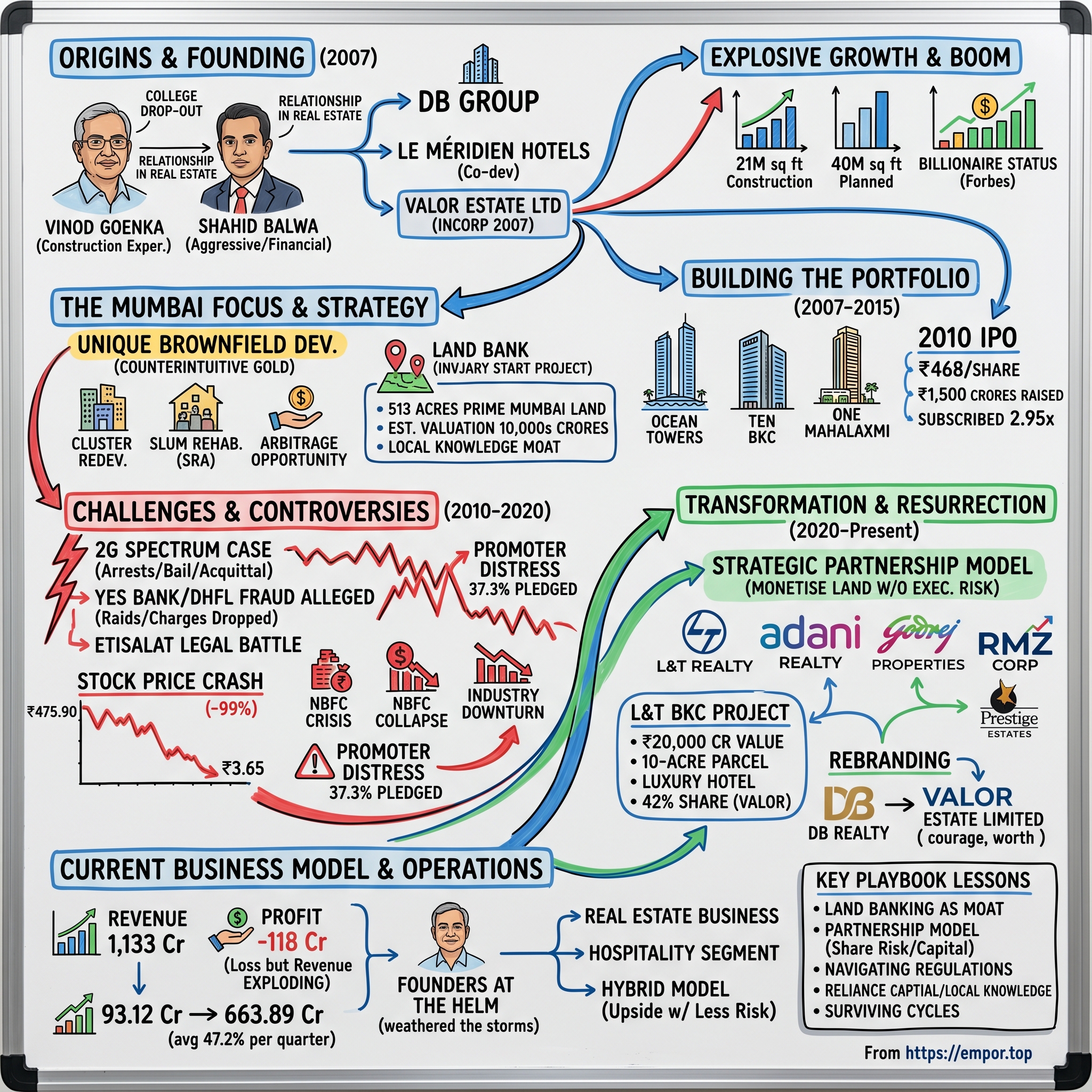
Valor Estate Limited: Mumbai's Brownfield Developer
I. Introduction & Episode Roadmap
On a February morning in 2010, a Mumbai real estate company walked onto the floor of the Bombay Stock Exchange carrying one of the largest property IPOs India had ever seen. D B Realty had priced its shares at ₹468 — the bottom of its band — and raised ₹1,500 crore from institutions that believed Mumbai land values were set for a permanent upward repricing.12 The stock listed at ₹430, an 8% discount to the issue price, while retail investors subscribed to barely a third of the shares set aside for them.2 In hindsight, the public market was signaling skepticism before the founders were willing to accept it.
Ten years and two months later, on April 22, 2020, the same stock traded at ₹3.65.3 Not ₹36.50, but three rupees and sixty-five paise. An investor who bought the IPO and held would have lost over 99% of their principal. Along the way, both promoters were arrested in the 2G spectrum case, the company's name became synonymous with governance failures in Indian real estate, and a land bank widely described as irreplaceable sat largely undeveloped.
This story details what happened next — and examines whether the second act is genuinely different from the first.
Corporate identity. D B Realty Limited became Valor Estate Limited in 2024, a change approved by the board and ratified by shareholders, with the new name taking effect that April.4 The ticker symbols remained unchanged: NSE DBREALTY and BSE scrip 533160.[^5]5 That mismatch — a new corporate identity tied to an old ticker — reflects the broader investment debate surrounding the company. As of late August 2026, the company carried a market capitalisation of roughly ₹5,600 crore at a share price near ₹100, having traded between ₹83.5 and ₹184.8 over the preceding year.67
The core proposition, as management frames it. Valor Estate controls a land bank spanning over 513 acres in and around the Mumbai Metropolitan Region, which management tells investors carries a revenue potential exceeding ₹29,290 crore over a five-to-eight-year horizon.8 Rather than developing that land using its own balance sheet — the capital-intensive model that previously distressed the firm — management has pivoted to selling development rights and area shares to established, well-capitalised partners: L&T Realty, Lodha, Prestige Estates, Adani, Godrej Properties, and RMZ. Valor supplies the land assembly and regulatory approvals, while the partner provides capital, construction execution, and brand equity.
While strategic on paper, this asset-light model carries a specific, testable structural weakness: non-developer land partners receive only the residual economics left by the developer, and cash flows arrive in sharp, unpredictable surges tied to occupation certificates rather than smooth quarterly sales. Valor's financial results highlight this lumpiness. In the quarter ended December 2025, consolidated revenue reached ₹529 crore, generating ₹62 crore in net profit. In the very next quarter, revenue fell to ₹87 crore, resulting in a net loss of ₹59 crore.9 A business whose top line can contract by 84% in ninety days cannot be evaluated on short-term quarterly multiples.
What this episode covers. First, the 2007 founding by Vinod Goenka and Shahid Balwa, two developers who identified unique land assembly opportunities in Mumbai. Second, the mechanics of brownfield development, slum rehabilitation, and cluster redevelopment in a market devoid of vacant land. Third, the IPO, the subsequent collapse, and the decade in which the company's equity shrank to a fraction of its peak value. Fourth, the operational pivot — assessing whether an asset-light approach represents a deliberate strategy or an involuntary necessity for a constrained balance sheet. Fifth, segment economics, the hospitality demerger, and corporate strategy. Sixth, a rigorous evaluation testing each element of the bull case against the company's eighteen-year track record. Finally, the critical metrics investors must track to evaluate progress.
The underlying question is straightforward: is Valor Estate a land bank that has finally unlocked a viable monetization strategy, or one that has spent eighteen years perpetually on the verge of doing so?
 Subscribe on LinkedIn
II. Origins & Founding Story (2007–2010)
Vinod Goenka entered real estate through Conwood Constructions, his father's Mumbai firm, starting in the 1980s as a teenager and learning the trade on construction sites.10 In that era, Mumbai real estate development was driven less by capital markets or architectural design than by navigating regulatory permissions. Success depended on working through municipal bureaucracies, addressing ward-level objections, securing consents from co-operative housing society chairmen, and managing lengthy title disputes.
Goenka spent two decades accumulating that administrative expertise before applying it at corporate scale.
Shahid Usman Balwa brought a complementary background. His family operated across hospitality and construction, and Balwa established a reputation as a fast-moving dealmaker willing to take on complex transactions that more conservative Mumbai builders avoided. The two partners joined forces in the mid-2000s and incorporated D B Realty Limited on January 8, 2007 — combining "D" for the Goenka family's Dynamix group and "B" for Balwa.
The timing coincided with a shift in Mumbai's regulatory environment that reshaped urban land economics. Development Control Regulations governing Floor Space Index (FSI) — the ratio of buildable floor area to plot area — evolved to grant higher density for projects incorporating civic obligations. Redeveloping dilapidated tenanted buildings yielded extra FSI, while rehousing slum residents under Slum Rehabilitation Authority (SRA) schemes unlocked substantially higher ratios.
The mechanics of an SRA project illustrate how this model created value. On a standard one-acre plot with a base FSI of 1.33, a builder could construct roughly 58,000 square feet. If that same acre housed 300 slum families, an SRA scheme allowed the developer to rehouse those families in free permanent apartments — typically 300 to 405 square feet each — at the developer's expense. In return, the state granted the right to build additional "free sale" space for market commercialization, either on-site or off-site, driving effective FSI past 4.0.
Under this framework, acquiring land did not require upfront market-rate capital. Instead, the purchase price was the rehabilitation commitment alongside years spent securing resident consent, clearing litigation, running eligibility surveys, and obtaining municipal approvals. The primary constraints were not initial land acquisition funds, but regulatory endurance, political access, and legal capacity.
Goenka and Balwa moved quickly to deploy this playbook. Between 2007 and 2010, D B Realty assembled land interests across key Mumbai micro-markets, including the Bandra-Kurla Complex, Mahalaxmi, Prabhadevi, Marine Lines, Goregaon, Dahisar, Kandivali, Thane, and Mira Road. Management reported an aggregated development potential exceeding 100 million square feet to investors. However, this metric reflected theoretical buildable area based on unapproved planning assumptions rather than an inventory of fully permitted, saleable real estate.
That gap — between encumbered land control and clear, saleable development rights — would define the company's trajectory over the next sixteen years.
The founders' strategy relied on three core steps: aggregate encumbered land at low entry costs, leverage regulatory channels to convert those encumbrances into high FSI, and fund the holding period with debt.
While regulatory assembly created potential value, debt financing introduced severe structural risk. Land under an unapproved SRA scheme yields no interim cash flow, yet Indian real estate debt during that period carried interest rates in the mid-teens. For every year a project remained stalled in approval pipelines, interest costs compounded against zero cash-generating assets.
Initially, rising Mumbai real estate valuations outpaced these compounding interest expenses, while capital markets showed strong appetite for developer land banks. Capitalizing on those favorable market conditions, the founders moved to take D B Realty public.
III. The Mumbai Land Grab & Brownfield / SRA Economics
To understand why 513 acres in Mumbai represents an unusual asset, start with geography. Mumbai is a peninsula — historically a chain of seven islands, bounded by the Arabian Sea to the west, a natural harbour to the east, and creeks to the north. Unable to expand outward in three directions, the city expands north along two suburban rail corridors into land long since claimed.
The result is a stark urban contrast: Mumbai commands some of the highest land values in the world alongside some of the lowest average living space per person of any major global city. Land is simultaneously valuable and deeply encumbered — bound by rent control tenancies, informal settlements, salt-pan designations, coastal regulation zones, mill-land legacy claims, and title disputes that frequently outlive the original litigants.
Greenfield versus brownfield. In standard property markets, real estate development is relatively straightforward: acquire vacant land at market rates, secure routine approvals, construct, and sell. The primary exposures — demand and construction risk — are legible and bounded in time.
Mumbai brownfield development inverts that model. A developer acquires not clear land, but a claim on land — a development agreement with a housing society, a slum rehabilitation mandate, or a share in a disputed title. The developer then spends years converting that claim into buildable inventory: securing consent from a required majority of eligible slum dwellers, completing an eligibility survey with the Slum Rehabilitation Authority, obtaining a Letter of Intent, an Intimation of Approval, a Commencement Certificate, environmental clearance, height clearance near airports, and coastal clearance near water. Any step can trigger court challenges by aggrieved parties — and in Mumbai, someone is always aggrieved.
In return, the potential payoff is substantial: high-density buildable area on land whose unencumbered market value would otherwise be prohibitively expensive.
Structurally, this process functions as a long-dated option with a continuously paid premium. The developer is long the eventual value of the completed buildable space while remaining short carrying costs, litigation expenses, and time itself. Valor's history illustrates what happens when that option takes far longer to exercise than the underlying debt financing assumed.
Who else plays this game. Macrotech Developers (the Lodha group) is the volume leader in the Mumbai Metropolitan Region — a firm that navigated its own severe leverage crisis around 2020, delevered aggressively, and now operates a high-throughput development model across large townships and premium residential projects. Oberoi Realty sits at the opposite end of the spectrum: executing a smaller number of projects with tight operational focus, a fortress balance sheet, and margins reflecting a refusal to absorb unmanageable complexity. Godrej Properties built a national franchise on the asset-light joint-venture model — supplying brand equity, design, and capital to landowners in exchange for a share of project economics. That makes Godrej less a direct peer of Valor than a blueprint for Valor's development partners. Keystone Realtors, operating under the Rustomjee brand, represents the closest direct analogue: a regional specialist that turned urban redevelopment and rehabilitation into a core operational strength rather than a distress-driven pivot. Sunteck Realty occupies a niche luxury position with a similarly land-first orientation.
Comparing Valor to this peer group highlights its structural positioning. Valor's distinction is not that it engages in redevelopment — Keystone and Lodha both execute complex redevelopments while also constructing and selling the final units. Valor's model focuses on securing and clearing land in the front phase of redevelopment, then transferring execution and monetization of the back phase to external partners.
While a land-clearing model leverages a scarce capability that many developers prefer to outsource, it presents a structural limitation: land-assembly expertise is valuable, but it is neither easily scalable nor renewable at historical cost structures. Valor's 513-acre portfolio was assembled primarily between 2007 and 2010 under regulatory and pricing conditions that no longer exist. As that inventory is monetized through partnerships, replacing it at comparable economics becomes increasingly difficult. Consequently, the asset base driving the company's valuation remains a depleting one unless management demonstrates an ability to replenish it on attractive terms.
That inventory, and the decade required to make it buildable, traces back to the moment public markets were first willing to price in its full potential.
IV. The Peak, IPO, & Initial Portfolio (2010–2011)
When D B Realty opened its initial public offering between January 29 and February 2, 2010, the company set an offer price band of ₹468 to ₹486 per share, eventually pricing the issue at the ₹468 floor.1 Overall demand reached 2.95 times the shares on offer, but subscriber breakdown revealed a sharp institutional split: qualified institutional buyers subscribed 4.47 times their allocation and non-institutional investors 4.25 times, whereas retail investors subscribed just 0.37 times.2 Institutional investors bought into the land bank narrative, while retail investors, closer to local market realities, remained cautious.
The stock made its trading debut on February 24, 2010 at ₹430 per share, an 8.1% discount to the IPO price.2 For a developer raising ₹1,500 crore near the peak of a property cycle, the discounted listing represented an immediate vote of public market skepticism.
Even so, the proceeds provided D B Realty with the largest war chest in its history and a portfolio spanning key Mumbai micro-markets. The lineup featured high-profile addresses: Turf Estate in Mahalaxmi near the racecourse, Ten BKC adjacent to the city's primary commercial district, DB Woods in Goregaon, DB Ozone in Dahisar, Orchid Suburbia in Kandivali, DB Skypark near the international airport, and the Crown project in Thane via a joint venture with Rustomjee. Management touted a pipeline of more than thirty-five projects targeting tens of thousands of buyers.
The ultimate outcome of that 2010 portfolio offers critical empirical context for evaluating the firm's operational track record.
Ten BKC, the company's flagship residential development, did not receive its occupation certificate until the financial year ended March 2026 — sixteen years after the IPO.11 Meanwhile, Turf Estate was never developed directly by D B Realty; in 2023, the company sold its 50% partnership interest in the Turf Estate joint venture to Prestige Estates for ₹197.79 crore,12 while also selling its remaining stake in the BKC office venture for ₹978.70 crore, realizing roughly ₹1,176 crore in total consideration to exit two of its most prominent holdings.13
Together, these outcomes highlight a recurring pattern: D B Realty monetized its marquee 2010 land positions primarily by selling rights to rival developers, while the single flagship asset it retained to completion required a decade and a half to deliver.
The cracks were structural, not incidental. Three compounding vulnerabilities undermined the model.
First, brownfield land requires continuous capital deployment before generating revenue. Each site demanded cash outlays for tenant rehabilitation, dweller consent, eligibility surveys, and legal defense, with all holding costs funded through debt.
Second, regulatory approval timelines proved highly volatile. A project could languish in administrative queues for three years before advancing, or make rapid progress only to be halted by litigation. Navigating such unpredictable schedules required low leverage or long-term equity funding — neither of which D B Realty possessed.
Third, high borrowing costs accelerated balance sheet pressure. The company financed land carry with high-yield debt under the assumption of swift development. As approval delays stretched, compounding interest costs inflated non-yielding asset values, accumulating liabilities that could only be settled through asset sales.
By late 2010, the company's operating model was already under severe strain. In November of that year, the Comptroller and Auditor General of India published its report on 2G telecom spectrum allocations — transforming an operational slowdown into an existential crisis.
V. The Decade of Turbulence: Scams, Debt, & Equity Collapse (2011–2020)
In February 2011, the Central Bureau of Investigation arrested Shahid Balwa at his Bandra residence.14 Balwa and Vinod Goenka were promoters of Swan Telecom, a company at the centre of allegations that 2G spectrum licences had been allocated at prices far below market value through a compromised process. Balwa received bail in late November 2011; Goenka had been granted relief by the Supreme Court days earlier.14
For D B Realty, the consequences were immediate and comprehensive. The stock was hammered as the investigation widened.15 But the share price was the least of it.
Consider what an active criminal investigation does to a business whose entire operating model depends on obtaining discretionary government permissions. Every file involving the company became radioactive. No municipal officer, no SRA official, no environmental clearance authority wanted their signature on a document connected to promoters under CBI investigation. Approvals did not get refused — that would have been a decision. They simply stopped moving.
Simultaneously, the banking system withdrew. Indian lenders in the post-2G environment were acutely sensitive to reputational exposure, and a developer whose promoters were in custody was not a client any credit committee wanted to defend. Credit lines that had been assumed to be renewable were not renewed. Refinancing that had been assumed to be routine became expensive, then unavailable, then available only from non-bank lenders at punitive rates.
This is the central mechanism by which the company was damaged, and it is worth being precise about it because it bears directly on how one should assess the recovery. The 2G case did not destroy D B Realty's assets. The land remained. What it destroyed was the company's access to the two inputs its model required: government permissions and cheap capital. A business built entirely on regulatory access lost regulatory access.
On December 21, 2017, a special CBI court acquitted all the accused in the 2G case, including Balwa and Goenka. The market reaction was instructive — D B Realty's shares rose nearly 20% in a single session.16 Six and a half years of operational paralysis were reversed in a legal sense in one afternoon. They were not reversed in a business sense at all.
The second wave. Before the company could rebuild, it was drawn into the collapse of Yes Bank and DHFL. The CBI's investigation into Yes Bank's exposure to DHFL — which included roughly ₹4,727 crore invested in DHFL's non-convertible debentures and masala bonds between April and June 2018, plus a ₹750 crore term loan to a group company — swept in a loan connected to the D B Realty group.17 Goenka and Balwa were named in a supplementary chargesheet, and lookout circulars were issued against them.
The resolution came on March 15, 2025, when a special court declined to take cognisance of that supplementary chargesheet. The court's reasoning is worth quoting for what it does and does not establish: it found no evidence that the two had any intention to cheat the bank, and noted that the loan amount had been repaid before the chargesheet was even filed. It further directed the CBI to cancel the lookout circulars, observing that there was no purpose in keeping them alive.17
That is a genuine clearance and should be treated as one. It is also, precisely, a finding that the state's case did not clear the threshold for prosecution — not an affirmative finding of exemplary conduct. The honest characterisation is that fourteen years of criminal legal overhang ended without conviction, which removes a discount but does not by itself create a premium.
What the decade did to the equity. The arithmetic is brutal in a way that no narrative should soften. From an IPO price of ₹468 in February 2010 to ₹3.65 on April 22, 2020, the stock lost more than 99% of its value.13 Investors who bought at the offer and held through the trough lost essentially everything.
And crucially, the destruction was not only a matter of sentiment. The company was structurally impaired: carrying cost on non-earning land, interest that could not be serviced from operations, and a promoter group whose ability to raise money against its own shareholding was itself pledged away. Every year of delay converted more of the equity's claim on the land into the lenders' claim on the land.
By 2020, the company had arrived at a position that is more common in Indian real estate than anyone likes to admit: it owned assets of real and possibly great value, and it had no viable path to developing them itself. Someone else was going to have to build.
VI. The Pivot to Joint Ventures & Corporate Rebranding (2020–Present)
The pivot was rational, but it was also born of necessity.
By the early 2020s, the arithmetic facing management was unambiguous. Developing the land bank internally would require thousands of crores in construction capital that the company could not raise at a reasonable cost, deployed over a decade by an organisation that had not completed a flagship project since before its IPO. The alternative was to sell the one asset the company unambiguously possessed — control over scarce, partially cleared Mumbai land — to counterparties with strong balance sheets and execution capabilities.
Management chose the joint-venture path and has pursued it consistently ever since. While investors should credit this consistency, the strategic alternatives available to a balance-sheet-constrained firm were narrow.
The L&T Realty transaction. The pivot's largest deal arrived in late July 2024, when L&T Realty and Valor Estate signed a binding agreement to co-develop a ten-acre parcel in Bandra-Kurla Complex. The project carried a stated gross development value exceeding ₹20,000 crore and total buildable area above 7.5 million square feet, spanning premium residential, commercial space, and a 1,000-key luxury hotel.1819
The underlying deal structure reveals the operational trade-offs. The developed area is split 58:42 in L&T Realty's favour, while Valor retains full ownership of the luxury hotel.18 The ten-acre parcel forms part of a larger thirteen-acre site occupied by approximately 5,500 slum families. Under the agreement, Valor's responsibility is to clear the land and secure development approvals — a process the parties estimated would take twelve to eighteen months.18
Three core analytical implications follow.
First, the 58:42 split quantifies the cost of the pivot. Valor contributed the land — the core scarce asset driving its investment thesis — while surrendering a majority of the buildable space. That concession was the price of acquiring execution credibility from a well-capitalised partner like L&T. While strategically sound, it permanently transfers most of the project's economic upside to the developer.
Second, the ₹20,000 crore headline figure represents estimated gross development value for a project that had not cleared its land at announcement. Gross development value reflects the eventual aggregate retail sales value of built space; it is not immediate revenue, it is not Valor's net share, and it is not discounted for the multi-year development timeline. Treating GDV as an immediate valuation metric remains a frequent analytical misstep.
Third, Valor retained the specific task its operational history shows it struggles to execute on schedule: clearing encumbered land. Relocating 5,500 families within twelve to eighteen months represents an aggressive timeline under Mumbai conditions. The firm making that commitment is the same entity whose flagship Ten BKC project required sixteen years to obtain an occupation certificate.11 This timeline should be treated as a management target rather than a certainty until regulatory approvals materialize.
Lodha, and the shape of the model. In August 2024, following the L&T agreement, Valor announced binding agreements with L&T Realty and Macrotech Developers (Lodha) covering 5.7 million square feet of carpet area. Vice chairman and managing director Shahid Balwa stated that agreements signed with Lodha and L&T over the preceding three months were projected to generate roughly ₹6,000 crore in revenue for the company.20 That figure provides the clearest management benchmark available for evaluating the joint-venture model's potential output.
Prestige: an exit, not a partnership. Market commentary has sometimes mischaracterised Valor's relationship with Prestige Estates. The two groups had previously partnered on a 50:50 commercial joint venture at Aerocity in Delhi, announced in 2019, which offered roughly 0.6 million square feet of leasable space.21 However, the headline BKC office asset — Prestige (BKC) Realtors, representing a potential 2.79 million square feet of Grade A office gross leasable area — is no longer a co-development. In 2023, a Prestige subsidiary acquired the D B group's remaining 50% stake for ₹978.70 crore, while separately buying out the remaining 50% of the Turf Estate joint venture in Mahalaxmi for ₹197.79 crore.1213
Rather than establishing an ongoing development partnership, Valor monetised those holdings through direct asset sales, generating roughly ₹1,176 crore in cash to shore up its balance sheet. While effective for immediate liquidity, outright disposals represent one-time realisations rather than repeatable development cash flows.
Radius Estates. On March 30, 2026, Valor's wholly owned subsidiary MIG (Bandra) Realtors agreed to acquire the entire equity share capital of Radius Estates and Developers from Adani Goodhomes for ₹383 crore in cash, making Radius an indirect wholly owned subsidiary.22 The company's stock rose nearly 17% to an intraday high of ₹97.97 following the announcement.22 Radius had previously entered insolvency; the appellate tribunal in 2024 upheld Adani Goodhomes' resolution plan, which offered approximately ₹76 crore against creditor claims totaling roughly ₹1,700 crore.2223 Because Radius served as the historic counterparty on Ten BKC, the transaction consolidated ownership of a long-entangled asset rather than expanding the land bank into new territory.
The Bhayandar title. On April 30, 2026, the Bombay High Court dismissed an appeal by the Union of India's Salt Department against a 2018 Thane civil court decree, confirming wholly owned subsidiary Miraland Developers' title to approximately 205 acres in Bhayandar, Thane district.24 The litigation spanned over four decades across multiple legal venues, stemming from a special civil suit filed in 2011, dismissed in 2018, and appealed in 2019.24 Shares in Valor appreciated sharply on the ruling.24
Securing unencumbered title to a 205-acre parcel removes legal clouding and adds clear asset value. At the same time, a four-decade legal dispute underscores the prolonged holding periods and litigation risks inherent across brownfield land banks.
The corporate rebranding. In early 2024, the board approved renaming D B Realty Limited to Valor Estate Limited, a change ratified by shareholders that took effect that April.4 While corporate name changes do not alter underlying operational capabilities, the rebranding formally distanced the company's public identity from the initials of its founding promoters after fourteen years of legal proceedings.
The restructured entity emerged with a rebranded identity, reduced leverage, and an asset-light operating model. However, it also held a substantial hospitality portfolio that management subsequently moved to separate through a dedicated corporate transaction.
VII. Segment Deep-Dive & Economics: Real Estate vs. Hospitality Demerger
What, exactly, does Valor Estate sell?
The company does not primarily sell finished apartments or office space. Instead, it sells entitled land — parcels converted through years of legal and administrative navigation from contested claims into buildable, approvable development rights. The buyer is typically another developer, and consideration takes one of three forms: an outright equity sale, a share of partner-generated revenue, or a share of the completed physical area.
Segment 1: Real Estate Development. The economics of this model generate an unusually volatile financial profile.
Under Indian accounting standards, real estate revenue is recognized largely at the point control transfers to buyers — in practice, tied to project completions and occupation certificates rather than steady pre-sales. For a broad-based developer running dozens of projects at staggered stages, these recognitions smooth out over time. For Valor, which relies on a concentrated cluster of massive holdings, results do not average out smoothly.
The financial year ended March 2026 illustrates this pattern. Consolidated revenue for FY26 reached ₹1,593 crore, more than doubling from the prior year, while net profit turned positive at ₹27 crore, reversing a loss of ₹118 crore in FY25.1125 Yet performance was overwhelmingly driven by just two assets: Ten BKC received its occupation certificate and contributed approximately ₹964 crore in revenue, while the Malad East Project Affected Persons (PAP) monetization added roughly ₹453 crore.11
Together, those two projects generated roughly ₹1,417 crore of the company's ₹1,593 crore top line — showcasing extreme revenue concentration.
Quarterly trends within FY26 further highlight this lumpiness. The first quarter produced ₹840 crore in revenue and ₹14 crore in net profit.26 The third quarter delivered ₹529 crore in revenue and ₹62 crore in profit. By the fourth quarter, revenue plummeted to ₹87 crore — an 84% sequential decline — resulting in an operating margin of negative 52.8% and a net loss of ₹59 crore.9 That softness extended into the first quarter of FY27, with the June 2026 quarter generating a consolidated loss of about ₹1.3 crore and a standalone loss of roughly ₹21.7 crore.27
These fluctuations do not necessarily signal operational failure. Rather, they demonstrate that single-quarter results offer little analytical value for a business structured around lump-sum recognitions. The relevant yardstick for Valor is the multi-year cash cycle: entitling land, executing partnership deals, achieving project completions, and collecting cash.
The clearest operational improvement appears on the balance sheet. Consolidated borrowings decreased by ₹1,136 crore during FY26 to ₹746 crore, lowering the debt-to-equity ratio to roughly 0.18 times, while management set a target to achieve a debt-free status across standalone and consolidated operations in FY27.1125 Because excessive leverage triggered the company's prior distress, debt reduction represents the most critical operational milestone in its recent record — though reaching zero debt remains a benchmark management must still deliver.
Segment 2: Hospitality, and the decision to hand it over. Historically, D B Realty operated a hotel portfolio alongside its land development business. Under a corporate restructuring, management separated the two arms by demerging its hospitality and hotel management operations into Advent Hotels International Limited through a scheme approved by the National Company Law Tribunal.28
The demerger structure provided Valor shareholders with one fully paid equity share of Advent Hotels for every ten Valor shares held, using a record date of July 18, 2025.29 Advent listed on November 13, 2025, opening at ₹313 on the NSE against a discovery price of ₹312.70 and at ₹310 on the BSE, establishing an initial market capitalization of roughly ₹1,688 crore.2930 Advent's operating portfolio includes the Grand Hyatt in Goa and the Hilton in Mumbai, alongside development assets including the St. Regis and Marriott Marquis at Delhi Aerocity scheduled to open by FY27.29
On strategic principles, separating hospitality from land assembly is logical. Hotels and land development demand distinct capital structures, display different cyclicalities, and appeal to separate investor bases. Dismantling the conglomerate structure allows each entity to be valued independently. Advent's debut at virtually zero premium to its discovery price indicates that public markets viewed the spin-off as a logical reorganisation rather than a sudden unlock of hidden value.
However, subsequent corporate actions complicate this asset-light narrative. Under the L&T BKC agreement, Valor retained 100% ownership of a planned 1,000-key luxury hotel.18 Furthermore, in 2026, the company won a mandate from the Government of Goa to develop an international convention centre, convention hotel, and associated facilities at Dona Paula under a Design-Build-Finance-Operate-Transfer (DBFOT) model. Following a letter of award dated March 18, 2026, wholly owned special purpose vehicle Blue Crest Properties executed the concession agreement on July 28, 2026, securing a 70-acre leasehold parcel under a 60-year concession requiring a ₹108 crore upfront payment and a work order reported at ₹57.9 crore.313233
These commitments stand in tension with the company's stated pivot. Having demerged its core hotel portfolio in November 2025 to streamline operations, Valor by mid-2026 had recommitted to financing, constructing, and operating a major convention hotel complex under a 60-year DBFOT concession. DBFOT structures represent some of the most capital-intensive, long-duration commitments in real estate infrastructure, placing construction, financing, and multi-decade operational risks back on Valor's balance sheet.
While Dona Paula represents a scarce 70-acre waterfront location in a market short on convention infrastructure, the commitment conflicts with management's positioning of Valor as a capital-light land monetization engine. Investors monitoring management's commitment to capital discipline must weigh these capital-intensive concessions against its public strategy.
VIII. Strategic Framework: Competitive Landscape, Porter's 5 Forces, & Helmer's 7 Powers
Frameworks are useful here precisely because Valor's situation resists intuition: the company looks weak on traditional financial metrics while sitting on an asset base that is, by most accounts, genuinely scarce. Evaluating the firm through structured frameworks clarifies which of these competing dynamics ultimately governs long-term value creation.
Hamilton Helmer's 7 Powers.
Cornered Resource — the strongest claim, and it is real but narrower than advertised. Valor's 513 acres were assembled at 2007–2010 cost under a regulatory regime that has since changed, in a city where equivalent land cannot be bought at any price because it is not for sale.8 The Bhayandar judgment converted 205 of those acres from contested to clean, which materially raises their realisable value.24
The narrowing comes from three directions. First, a cornered resource in Helmer's framework confers persistent differential returns, and Valor's returns have not been differential in a positive direction: return on capital employed sat around 1.6% and three-year average return on equity around 8.5%, with the most recent year slightly negative.6 A resource that produces sub-cost-of-capital returns for a decade and a half is cornered in a legal sense, but not yet in an economic one. Second, the resource depletes — each parcel monetised is gone, and replenishing at similar economics remains unproven. Third, much of the value transfers to partners at signing: the 58:42 BKC split means the majority of the economics on the flagship asset accrue to L&T Realty.18
Process Power — moderate, and genuinely underrated. Navigating SRA consent, eligibility surveys, municipal approvals, and four decades of Salt Department litigation is a capability that takes years to build and cannot simply be purchased. The fact that tier-one developers repeatedly transact with Valor rather than assembling MMR land themselves provides clear market evidence that this capability carries real value. The limitation is that process power here moves slowly — it produces outcomes on a five-to-fifteen-year cadence, capping how rapidly it can compound value.
Counter-Positioning — the weakest of the claims made on Valor's behalf, and one that should be rejected. Counter-positioning in Helmer's framework requires a business model an incumbent cannot adopt without damaging its existing operations. Nothing prevents Lodha, Oberoi, or Godrej from structuring land-only deals; Godrej Properties built a national franchise largely on this joint-venture model with third-party landowners. Valor is not counter-positioned against incumbents. It is supplying a key input to them — creating a supplier relationship rather than a strategic power. Crucially, supplier relationships are priced by relative bargaining strength, which leads directly to the core balance-of-power dynamics.
Brand, Scale Economies, Network Effects, Switching Costs — absent. The brand equity in these projects belongs to L&T, Lodha, and Prestige. Homebuyers purchasing in a Valor-landed development are buying an L&T or Lodha product. There are no network effects in land development and no switching costs binding partners to Valor.
Porter's Five Forces.
Threat of new entrants — genuinely very low. The barrier is not capital alone. It is that equivalent land does not exist to be bought and the required regulatory competence takes a decade to develop. This represents the most favorable force in the analysis.
Bargaining power of buyers — high, and higher than the framework's conventional reading suggests. A standard reading treats homebuyers as the buyers. For Valor, the true buyers are its development partners. In those negotiations, Valor sits across the table from L&T, Lodha, Prestige, and Adani — counterparties with fortress balance sheets, low borrowing costs, national project pipelines, and no immediate urgency. Valor, by contrast, has historically negotiated from a position of balance-sheet constraint. The 58:42 split on the company's premier asset is the visible result of that structural asymmetry.
Bargaining power of suppliers — largely transferred. Cement, steel, and contractor cost inflation are real, but under an area-share structure, those burdens fall on the partner. This represents a tangible structural benefit of the JV model.
Threat of substitutes — low. There is no physical substitute for prime BKC frontage. Corporate India's willingness to pay for that specific address represents the closest thing to durable demand in this story.
Competitive rivalry — high, but indirect. Valor does not compete directly for homebuyers. It competes for partner attention and favorable deal terms against every other landowner in the MMR willing to enter a joint venture.
Putting the frameworks together. The structural picture is a company holding a scarce, appreciating, non-renewable asset, backed by genuine but slow process capability, that captures a minority of the value created because it lacks the balance sheet and credibility to capture more. That is not a trivial enterprise; it is a viable business. However, it represents a materially weaker proposition than "cornered resource plus counter-positioning" implies — and that distinction lies at the heart of the debate surrounding the stock.
Which is why each individual claim deserves to be tested against the empirical record.
IX. Historical Falsification Pass: Stress-Testing Key Thesis Claims
The purpose here is not to assemble a bearish narrative, but to stress-test each pillar of the bull case against disconfirming evidence from Valor's eighteen-year operating history. This pass evaluates whether empirical evidence rejects, narrows, or leaves intact each core investment thesis claim.
Claim 1: The 513-acre land bank is an unmatched value moat.
The primary disconfirming evidence lies in the company's historical realization record. Title to the 205-acre Bhayandar parcel required more than forty years of litigation before being confirmed by the Bombay High Court on April 30, 2026.24 Similarly, Ten BKC — the flagship of the 2010 IPO portfolio, adjacent to Mumbai's premier commercial district — received its occupation certificate in FY26, roughly sixteen years after listing.11 Over the entire period, the land portfolio produced a return on capital employed of about 1.6% and a three-year average return on equity around 8.5%, with the latest year turning marginally negative.6
Verdict: narrowed, substantially. The physical scarcity of the land remains intact, but scarcity has not reliably translated into timely equity value accrual for shareholders. The empirical evidence demonstrates that parcel monetization typically operates on a five-to-fifteen-year horizon, that title and approval friction can consume decades, and that carrying costs erode equity value during extended delays. The revised claim is that Valor holds a scarce, slowly-realizing asset whose per-annum value accrual to equity remains unproven. Validating the stronger thesis requires a consistent run of parcels converting from entitlement to cash realization on a two-to-three-year cadence — a benchmark the company has yet to deliver.
Claim 2: The asset-light JV model drives net profitability.
The disconfirming evidence is visible in the earnings record itself. Valor posted a net loss of ₹90 crore in FY23 and a net loss of ₹118 crore in FY25, before reporting a net profit of ₹27 crore on ₹1,593 crore of revenue in FY26 — representing a net margin below 2%.611 The single high-profit fiscal year in recent history — FY24's net profit of ₹1,317 crore on ₹357 crore of revenue — was driven by exceptional gains from asset disposals, including ₹1,176 crore from the Prestige transactions, rather than operating JV income.612 Excluding disposals, the joint-venture model has yet to demonstrate sustained recurring net profitability, while the 58:42 BKC split illustrates the structural margin surrendered to execution partners.18
Verdict: intact but unproven, with a specific caveat. While FY26 returned to profitability alongside a ₹1,136 crore reduction in borrowings that materially lowered interest drag,11 earnings visibility remains tied to future project completions rather than a proven track record of recurring operating income. Confirming this thesis requires a full fiscal year of substantial net profit generated primarily through area-share or revenue-share joint-venture income rather than asset sales or isolated completion spikes.
Claim 3: Management clean-up and the governance pivot are complete.
Legal clearances have provided tangible relief: the promoters were acquitted in the 2G case in December 2017, and a special court declined to take cognizance of the Yes Bank–DHFL supplementary chargesheet in March 2025, ordering the cancellation of lookout circulars.1617
However, disclosure metrics highlight ongoing governance risks. As of June 2026, promoters had pledged 44.7% of their equity holding — up from the 37.3% level reported in earlier disclosures.6 Promoter shareholding stood at 47.17%, reflecting a decline from 62.81% in March 2020 and an 11.8 percentage point reduction over the trailing three years.6 High pledge levels leave promoter equity vulnerable to share price volatility, where sharp declines can trigger forced sales.
Verdict: narrowed to a legal clearance, not a governance clearance. Criminal proceedings have concluded without conviction, removing a long-standing legal overhang. However, governance metrics that directly affect minority shareholders — specifically a declining promoter stake coupled with heavy equity pledging — have not improved. Confirming a broader governance turnaround requires a sustained, multi-quarter reduction in the pledged share ratio in public disclosures.
Claim 4: Equity de-risking via institutional funds validates the story.
Proponents frequently cite institutional capital raises as external validation. On March 14, 2024, the company allotted 35.67 million shares to qualified institutional buyers at ₹258 per share, raising ₹920 crore from participants including Morgan Stanley Asia (Singapore), BofA Securities Europe, Société Générale, Nomura Singapore, and BNP Paribas Financial Markets.3435
The subsequent market performance presents a clear counter-narrative. By August 2026, the stock traded near ₹100, within a 52-week range of ₹83.50 to ₹184.80.67 Institutional participants in the QIP faced an unrealized decline of roughly 60% two and a half years after allotment.
Verdict: rejected as an endorsement; reframed as a financing event. The QIP was vital for balance sheet repair, directly funding the company's deleveraging. However, institutional participation at higher valuations does not validate operational strategy, particularly when subsequent returns remain deeply negative. Valor's recent progress has relied heavily on equity issuance and asset sales rather than internally generated operating cash — though FY26 operating cash flow of ₹939 crore provides initial evidence of operational cash generation.6
Claim 5: The company is asset-light.
This claim is contradicted by ongoing hospitality and infrastructure commitments. Months after demerging its core hotel portfolio, Valor executed a 60-year DBFOT concession agreement for a 70-acre waterfront parcel in Dona Paula, Goa, committing ₹108 crore in upfront payments to build and operate an international convention center and hotel.3132 Additionally, the company retained 100% ownership of a planned 1,000-key luxury hotel within the BKC development.18
Verdict: rejected as stated. Valor maintains an asset-light framework within its residential development segment, but continues to deploy balance sheet capital into long-duration hospitality and infrastructure projects. The asset-light label applies strictly to its residential joint ventures, not the consolidated corporate entity.
What management is asked, and how they answer. Two recurring friction points dominate investor inquiries: the realistic timeline for clearing 5,500 families at BKC within twelve to eighteen months — an ambitious target relative to historical Mumbai redevelopment cycles — 18 and the timing and quantum of actual cash distributions from partner joint ventures relative to company obligations. On the second point, management provided specific guidance, citing a ₹6,000 crore revenue projection from the Lodha and L&T agreements,20 alongside a target to eliminate net debt in the fiscal year following FY26.11 Given the company's historical record of project delays, these metrics serve as key benchmarks for evaluating management discipline and operational execution.
X. Playbook: Core Business & Investing Lessons
Every company story yields transferable lessons. Valor's are unusually sharp because the company has spent eighteen years running the same experiment under changing market conditions.
1. In a constrained megacity, land is a call option — and options carry holding costs. The intuition that scarce urban land is an automatic winner overlooks carrying expense. Valor's land remained scarce and appreciated throughout the 2010s, yet the equity lost over 99% of its value because the interest on debt funding the carry compounded faster than the option gained value.13 The broader lesson is clear: holding an appreciating asset with high-cost, short-duration debt creates a leveraged bet on timing rather than on underlying asset quality. Long-dated land options require permanent capital.
2. When capital costs are impaired, selling development economics is rational — but expensive. The 58:42 area split at BKC reflects the cost of renting an external balance sheet and brand equity.18 Valor accepted those terms from a position of balance-sheet constraint. Strategic pivots executed under financial pressure carry permanent economic concessions: fixing a capital structure is far easier before necessity forces a deal.
3. Regulatory capability acts as a moat, but operates on a slow timeline. The four-decade Bhayandar title dispute and its 2026 resolution illustrate both sides of regulatory navigation.24 The stamina to clear complex title encumbrances is genuinely valuable, but it unfolds over timescales that exceed typical equity investment horizons. Regulatory moats offer high ultimate terminal value alongside sluggish interim compounding.
4. Promoter pledging remains a central signal, not a footnote. With 44.7% of promoter equity pledged as of June 2026 against a promoter stake that declined from 62.81% in 2020 to 47.17%, insider incentives remain closely tied to share price movements in ways public investors cannot control.6 Pledged share ratios serve as one of the clearest risk indicators in corporate disclosures, requiring continuous monitoring.
5. Corporate demergers simplify operations, but strategy can quickly reverse. Splitting Advent Hotels streamlined the corporate structure, leading to its November 2025 listing at its discovery price.29 Yet within months, Valor recommitted balance-sheet capital to a 60-year hospitality DBFOT concession in Goa.3132 Structural simplification is an ongoing discipline rather than a permanent state, as companies can re-accumulate capital intensity faster than public markets adjust their valuations.
6. Distinguish asset sales from recurring project monetization. Generating ₹1,176 crore from the Prestige transactions created significant cash flow and drove reported profit in FY24.126 However, selling equity stakes provides non-recurring earnings that shrink the asset base driving future growth. Evaluating true operational turnaround requires tracking whether recurring area-share and revenue-share income expands independently of asset disposals.
These lessons converge on a central question about the company's future, where the bull and bear cases directly meet.
XI. Strategic Analysis & Bull vs. Bear Case
The Bull Case
The bull case does not require heroic assumptions. It requires only that a scarce asset finally gets converted at a reasonable pace by partners with a proven track record of execution.
The balance sheet has genuinely changed. This is the strongest and most verifiable pillar of the turnaround thesis. Consolidated borrowings fell by ₹1,136 crore during FY26 to ₹746 crore, lowering the debt-to-equity ratio to roughly 0.18 times, while operating cash flow for the year reached ₹939 crore.116 For a company whose prior distress was driven entirely by debt carry, this represents a structural shift in risk profile rather than a cosmetic adjustment. If management delivers on its commitment to eliminate net debt, the primary mechanism that destroyed equity value between 2011 and 2020 will have been removed. Every other element of the bull case depends on this financial foundation holding.
The partner roster is a market signal that is hard to fake. L&T Realty, Lodha, Prestige, Adani, and Godrej are sophisticated counterparties that rarely enter binding agreements on encumbered Mumbai land without extensive due diligence. Their willingness to underwrite Valor's parcels — reflected in L&T's commitment to a BKC project carrying an estimated gross development value of ₹20,000 crore, and combined agreements with L&T and Lodha covering 5.7 million square feet of carpet area — provides third-party validation of underlying asset quality.1820 In property markets, counterparty actions provide far more reliable evidence than management commentary.
Legal overhangs have lifted in sequence. The promoters were acquitted in the 2G case in 2017, a special court rejected the Yes Bank–DHFL supplementary chargesheet in March 2025 while ordering lookout circulars cancelled, and the Bombay High Court confirmed title to the Bhayandar parcel in April 2026 after four decades of litigation.161724 Each resolution eliminated a specific legal discount. Collectively, they mean that for the first time since 2011, the company's primary constraints are operational rather than judicial.
There is retained upside the JV structure does not give away. Valor retains full ownership of the planned 1,000-key BKC hotel and complete concession economics for the Goa project.1831 If Mumbai's premium hospitality market maintains its trajectory, these represent substantial owned operational assets rather than shared development rights.
The Bear Case
Profitability remains marginal and disposal-dependent. Reporting ₹27 crore of net profit on ₹1,593 crore of revenue in FY26 represents a net margin below 2%, following a net loss of ₹118 crore in FY25.116 Furthermore, the only high-profit fiscal year in recent history — FY24 — depended heavily on asset sales, including ₹1,176 crore from the Prestige transactions, rather than recurring joint-venture development income.612 The joint-venture model has yet to demonstrate a sustained track record of generating predictable operating earnings.
The earnings stream is structurally lumpy in a way that resists standard valuation. Between the third and fourth quarters of FY26, revenue dropped from ₹529 crore to ₹87 crore, shifting an operating profit of ₹62 crore into a net loss of ₹59 crore.9 That weakness extended into the first quarter of FY27, which produced a small consolidated loss.27 Because revenue recognition under Indian accounting standards depends on project completions and occupation certificates, a single administrative delay can swing an entire year's financial results.
Promoter pledging remains a live governance risk. With 44.7% of promoter holdings pledged as of June 2026 against a stake that declined from 62.81% in 2020 to 47.17%, equity pledging represents a key vulnerability for minority shareholders.6 Despite material deleveraging at the corporate balance sheet level, promoter-level pledged shares have not decreased in tandem, and management has not publicly provided a specific de-pledging timeline.
Execution risk sits precisely where the company is historically weakest. Under the BKC agreement, Valor bears the responsibility of clearing 5,500 encumbered families and securing full regulatory approvals within twelve to eighteen months.18 By comparison, the company's flagship Ten BKC project required sixteen years from listing to obtain an occupation certificate in FY26.11 If rehabilitation timelines stretch — as Mumbai slum redevelopments frequently do — project cash flows move further into the future, compounding the discount to present value.
Strategy drift. The Goa DBFOT concession — requiring a 60-year commitment, ₹108 crore in upfront payments, and self-financed construction and operations — represents a capital-intensive infrastructure project undertaken months after demerging the core hospitality arm to increase operational focus.3132 This commitment raises questions as to whether the transaction reflects opportunistic asset acquisition or a return to the capital deployment patterns that historically strained the balance sheet.
Statutory audit rotation. The company appointed Mehta Chokshi & Shah LLP as statutory auditors for a five-year term at its 20th Annual General Meeting, replacing N. A. Shah Associates LLP upon completion of its term since 2021.27 While this transition aligns with mandatory audit rotation norms under Indian corporate law, auditor changes at entities with complex joint-venture and related-party structures remain an important tracking item for governance analysis.
The 3 KPIs That Matter Most
1. Entitled-to-monetised conversion pace. The speed at which land parcels transition from encumbered holdings to cleared, approved sites under active partner construction represents the core operational metric. This conversion cycle dictates how efficiently raw land generates cash flow. In the near term, securing full regulatory clearances and clearing the 5,500 families at the BKC site serves as the primary test of execution capacity.
2. Quarterly promoter pledged percentage. Disclosed quarterly, the proportion of pledged promoter shares offers the most direct measure of insider financial leverage. A sustained reduction from the 44.7% level would indicate that financial friction at the promoter level is resolving alongside corporate balance sheet repair. Conversely, an increase in pledged shares would signal persistent holding-level leverage regardless of reported operating figures.
3. Net debt reduction against public targets. Management committed to achieving a debt-free balance sheet across standalone and consolidated operations in the fiscal year following FY26.11 Meeting this benchmark provides a clear test of management discipline. Investors must track whether debt reduction is driven by recurring operating cash flows or through further land and equity disposals.
XII. Epilogue & "If We Were CEOs"
There is a version of Valor Estate's future that is genuinely compelling, and it does not require the company to match the development scale of Lodha or Oberoi.
In that scenario, Valor accepts its core operational identity: an entitlement specialist in the Mumbai Metropolitan Region that converts contested, encumbered, litigated land into buildable assets for tier-one developers. It does not construct buildings, manage retail sales, or absorb execution risk. Instead, it moves parcels through a legal and regulatory pipeline, structures area-share agreements at terms commanded by land scarcity, and collects residual economics. Executed with discipline, that represents a high-return, capital-light business protected by steep entry barriers.
The company sits closer to that model today than at any prior point in its history. Leverage has dropped, historic criminal proceedings are closed, title on the 205-acre Bhayandar parcel is clean, and the joint-venture partner roster is established. What remains unproven is operational cadence—concrete evidence that land parcels can advance through the approval pipeline on a predictable schedule rather than through sporadic multi-year events.
From an operational leadership standpoint, three priorities take precedence.
First, address the pledge publicly and on a defined schedule. At 44.7% of promoter holding pledged, this represents the largest unforced discount on the equity.6 Institutional investors evaluating the company routinely pause at that figure. A clear, dated de-pledging framework tied to specific cash events would require no capital—only the discipline of public accountability—while removing a primary objection to owning the shares. The absence of such a plan remains a notable gap in investor communications.
Second, report conversion metrics rather than gross development value. Gross development value (GDV) offers limited analytical utility because it measures eventual retail sales for unbuilt projects on land that, in some cases, remains uncleared. Investors require a parcel-by-parcel pipeline tracking acres controlled, titles confirmed, approvals secured, area under active partner construction, and projected cash inflows to Valor by year. For a company whose central thesis is land entitlement, reporting conversion metrics is essential. Without that disclosure, public markets continue to value the business on volatile quarterly earnings that management acknowledges are not representative of long-term value.
Third, clarify the capital discipline trade-off in Goa explicitly. The Dona Paula concession represents a significant asset—70 acres of leasehold waterfront under a 60-year term.31 However, committing balance-sheet capital to an infrastructure project stands in tension with the asset-light strategy articulated during the hospitality demerger. That tension requires explicit clarification: management should specify whether the asset-light model applies strictly to residential development, or explain why this specific project serves as an exception.
The overarching question for investors transcends corporate restructuring. For eighteen years, Valor Estate has controlled land widely recognized as valuable, yet that value has accrued primarily to lenders, litigants, asset buyers, and development partners rather than equity holders. The balance sheet repair and corporate changes implemented since 2024 address the specific mechanisms behind historical value destruction. Whether those structural fixes are sufficient to redirect value creation to equity holders depends on execution over the next three to four years—a question only sustained conversion data will resolve.
XIII. Recent News & Catalysts
2023 — Prestige buyout of the BKC and Mahalaxmi positions. A subsidiary of Prestige Estates increased its ownership of Prestige (BKC) Realtors — owner of a commercial project with 2.79 million square feet of potential gross leasable area — from 50% to 100% by acquiring D B Group's remaining stake for ₹978.70 crore. Separately, Prestige bought the remaining 50% stake in Turf Estate Joint Venture LLP, which was developing a 2.9 million square foot Grade A office project in Mahalaxmi, for ₹197.79 crore.1213 Bringing total consideration to roughly ₹1,176 crore, the transactions represented an outright exit for D B Realty rather than an ongoing co-development partnership.
March 2024 — The ₹920 crore QIP. On March 14, 2024, the company issued 35,666,675 equity shares to qualified institutional buyers at ₹258 per share, raising ₹920 crore from investors including Morgan Stanley Asia (Singapore), BofA Securities Europe, Société Générale, Nomura Singapore, and BNP Paribas Financial Markets.3435 While the capital funded subsequent balance-sheet deleveraging, the stock has since traded well below its issue price.7
2024 — The rebranding. Following board approval and shareholder ratification by special resolution, D B Realty Limited officially changed its corporate name to Valor Estate Limited, with the new name taking effect in April 2024.4
July 2024 — The L&T Realty BKC agreement. Valor signed a binding agreement with L&T Realty to co-develop a ten-acre parcel in the Bandra-Kurla Complex with a stated gross development value exceeding ₹20,000 crore and buildable area above 7.5 million square feet, including a 1,000-key luxury hotel retained 100% by Valor. Developed space is split 58:42 in L&T Realty's favor, while Valor bears responsibility for clearing roughly 5,500 resident families from the site and securing regulatory approvals within twelve to eighteen months.1819
August 2024 — The Lodha and L&T agreements. Valor finalized binding joint-venture agreements with Macrotech Developers (Lodha) and L&T Realty covering 5.7 million square feet of carpet area. Management publicly projected that these combined transactions over the preceding quarter would generate approximately ₹6,000 crore in revenue for the company.20
March 2025 — Yes Bank–DHFL charges rejected. A special CBI court declined to take cognizance of a supplementary chargesheet against promoters Vinod Goenka and Shahid Balwa, finding no evidence of intent to cheat and noting that the underlying loan had been fully repaid prior to filing. The court subsequently directed the cancellation of lookout circulars issued against both executives.17
July–November 2025 — The hospitality demerger and Advent Hotels listing. Valor executed the demerger of its hotel arm, assigning a record date of July 18, 2025, and distributing one share of Advent Hotels International for every ten shares held in Valor. Advent listed on November 13, 2025, opening at ₹313 on the NSE against a discovery price of ₹312.70 and at ₹310 on the BSE, establishing an initial market capitalization of roughly ₹1,688 crore. The demerged entity's portfolio includes the Grand Hyatt Goa and Hilton Mumbai, alongside ongoing developments for the St. Regis and Marriott Marquis at Delhi Aerocity targeted for completion in FY27.282930
March 2026 — The Goa concession award. The Government of Goa's Department of Public Private Partnership issued a letter of award dated March 18, 2026, granting Valor a 60-year Design-Build-Finance-Operate-Transfer (DBFOT) concession for a 70-acre waterfront parcel at Dona Paula to develop an international convention center, hotel, and downstream facilities. The transaction required a ₹108 crore upfront payment and carried a reported work order value of ₹57.9 crore.313233 Wholly owned special purpose vehicle Blue Crest Properties formally executed the concession agreement on July 28, 2026.31
March 2026 — Radius Estates acquisition. On March 30, 2026, wholly owned subsidiary MIG (Bandra) Realtors agreed to acquire the entire equity capital of Radius Estates and Developers from Adani Goodhomes for ₹383 crore in cash. Radius, the original joint development counterparty on Ten BKC, had previously undergone insolvency resolution, where Adani Goodhomes' approved plan provided roughly ₹76 crore against creditor claims totaling ₹1,700 crore. Valor's share price surged nearly 17% to an intraday high of ₹97.97 following the announcement.2223
April–May 2026 — The Bhayandar title judgment. On April 30, 2026, the Bombay High Court dismissed an appeal by the Union of India's Salt Department against a 2018 Thane civil court decree, confirming wholly owned subsidiary Miraland Developers' title to roughly 205 acres in Bhayandar and concluding over four decades of legal disputes. Company shares appreciated sharply on news of the judgment.24
FY26 full-year results. Valor reported full-year FY26 consolidated revenue of ₹1,593 crore — more than double the previous year's top line — and turned net profitable at ₹27 crore compared to a loss of ₹118 crore in FY25. Operational delivery was concentrated in two major projects: Ten BKC secured its occupation certificate and contributed approximately ₹964 crore in revenue, while the Malad East Project Affected Persons monetization added roughly ₹453 crore, alongside initial rental income from Mira Road land. Consolidated debt fell by ₹1,136 crore to ₹746 crore, lowering the debt-to-equity ratio to 0.18 times and supporting management's target of achieving debt-free status across operations in FY27.1125 Demonstrating ongoing quarterly lumpiness, the fourth quarter generated just ₹87 crore in revenue and a net loss of ₹59 crore, pushing the quarter's operating margin to negative 52.8%.9
August 2026 — Q1 FY27 and auditor rotation. On August 14, 2026, the board approved unaudited first-quarter FY27 results, reporting a consolidated loss of about ₹1.3 crore and a standalone loss of roughly ₹21.7 crore for the period ending June 30. The board also recommended appointing Mehta Chokshi & Shah LLP as statutory auditors for a five-year term starting from the 20th Annual General Meeting, succeeding N. A. Shah Associates LLP upon completion of its tenure.27 By late August 2026, Valor traded near ₹100 per share with a market capitalization of approximately ₹5,600 crore, having moved within a 52-week range of ₹83.50 to ₹184.80.67
The key catalysts from here are clear and trackable: regulatory approvals and tenant clearance on the BKC site, the pledge ratio disclosures each quarter, and management's commitment to reach a net-zero debt balance sheet in FY27. Each milestone provides an empirical test of execution. That measurable accountability, more than any strategic narrative, defines the current chapter of Valor Estate's evolution.
References
-
DB Realty fixes IPO price at Rs 468/share — Business Standard, 2010-02-05 ↩↩↩↩
-
D B Realty IPO — Dates, Price, Subscription and Listing Details — Chittorgarh ↩↩↩↩
-
D B Realty Ltd / DBREALTY Share Price History — Business Today ↩↩↩
-
D B Realty Limited will Change its Name to Valor Estate Limited — MarketScreener ↩↩↩
-
Valor Estate Ltd — consolidated financials, shareholding and ratios — Screener.in ↩↩↩↩↩↩↩↩↩↩↩↩↩↩↩↩↩
-
Valor Estate Ltd share price, market cap and 52-week range — Business Standard ↩↩↩↩
-
Valor Estate (D B Realty) Corporate Presentation, Q3 FY25, 2025-02-12 ↩↩
-
Valor Estate Q4 FY26: Sharp Revenue Decline Triggers Loss — MarketsMojo ↩↩↩↩
-
Vinod Goenka — Chairman and Managing Director profile — Valor Estate Limited ↩
-
Valor Estate posts record FY26 revenue, slashes debt as key projects ramp up — TipRanks, 2026 ↩↩↩↩↩↩↩↩↩↩↩↩↩↩
-
Prestige Estates picks up 100% stake in DB Group projects for Rs 1,176 crore — India Infoline ↩↩↩↩↩↩
-
Prestige Group acquires Prestige (BKC) and Turf Estate joint venture for Rs 1,176 crore — Free Press Journal ↩↩↩
-
2G scam: DB Realty, Unitech stocks hammered on NSE — Business Standard, 2011-04-20 ↩
-
Unitech, D B Realty rally up to 20% after 2G case verdict — Business Standard, 2017-12-21 ↩↩↩
-
Court rejects chargesheet against Goenka, Balwa in Yes Bank-DHFL case — Business Standard, 2025-03-15 ↩↩↩↩↩
-
L&T Realty, Valor Estate to co-develop Rs 20,000 crore project in Mumbai's BKC — Business Standard, 2024-07-29 ↩↩↩↩↩↩↩↩↩↩↩↩↩
-
L&T Realty set to co-develop a major project in Mumbai's Bandra-Kurla Complex — L&T Realty ↩↩
-
Valor partners with L&T Realty and Lodha Group for major developments — NBM&CW, 2024 ↩↩↩↩
-
Prestige Estates gains after JV with DB Group for Delhi project — Business Standard, 2019-10-03 ↩
-
Valor Estate subsidiary acquires Radius Estates for Rs 383 crore cash deal — ScanX, 2026 ↩↩↩↩
-
NCLT approves Adani Group's acquisition of Radius Estates — Construction World ↩↩
-
Valor Estate wins Bombay High Court ruling in 40-year land dispute — TipRanks, 2026 ↩↩↩↩↩↩↩↩
-
Valor Estate posts Rs 11.33 billion revenue in FY25 — Construction World ↩↩↩
-
Valor Estate approves Q1 FY27 unaudited results and auditor appointment — InvestyWise, 2026-08-14 ↩↩↩↩
-
Valor Estate announces listing of Advent Hotels shares following NCLT-approved demerger — ScanX ↩↩
-
Valor Estate's demerged arm Advent Hotels lists at Rs 313 on NSE — Moneycontrol via TradingView, 2025-11-13 ↩↩↩↩↩
-
Advent Hotels listing to debut on November 13 after Valor Estate demerger — HDFC Sky ↩↩
-
Valor Estate subsidiary incorporates SPV for Goa convention project — Construction World, 2026 ↩↩↩↩↩↩↩↩
-
Valor Estate secures Rs 108 crore Goa convention centre project — Business Upturn, 2026 ↩↩↩↩↩
-
Valor Estate wins Rs 57.9 crore work order from Government of Goa for International Convention Centre — ScanX, 2026 ↩↩
-
D B Realty raises Rs 920 crore by selling shares to institutional investors — Business Standard, 2024-03-14 ↩↩
-
DB Realty launches QIP to raise up to Rs 920 crore — Moneycontrol, 2024-02-20 ↩↩
 LinkedIn
 WhatsApp
 Reddit
 Hacker News
 Email
Email Kindle
 RSS Feed
 Spotify
 Apple Podcasts
 Amazon Music
 Audible
 YouTube