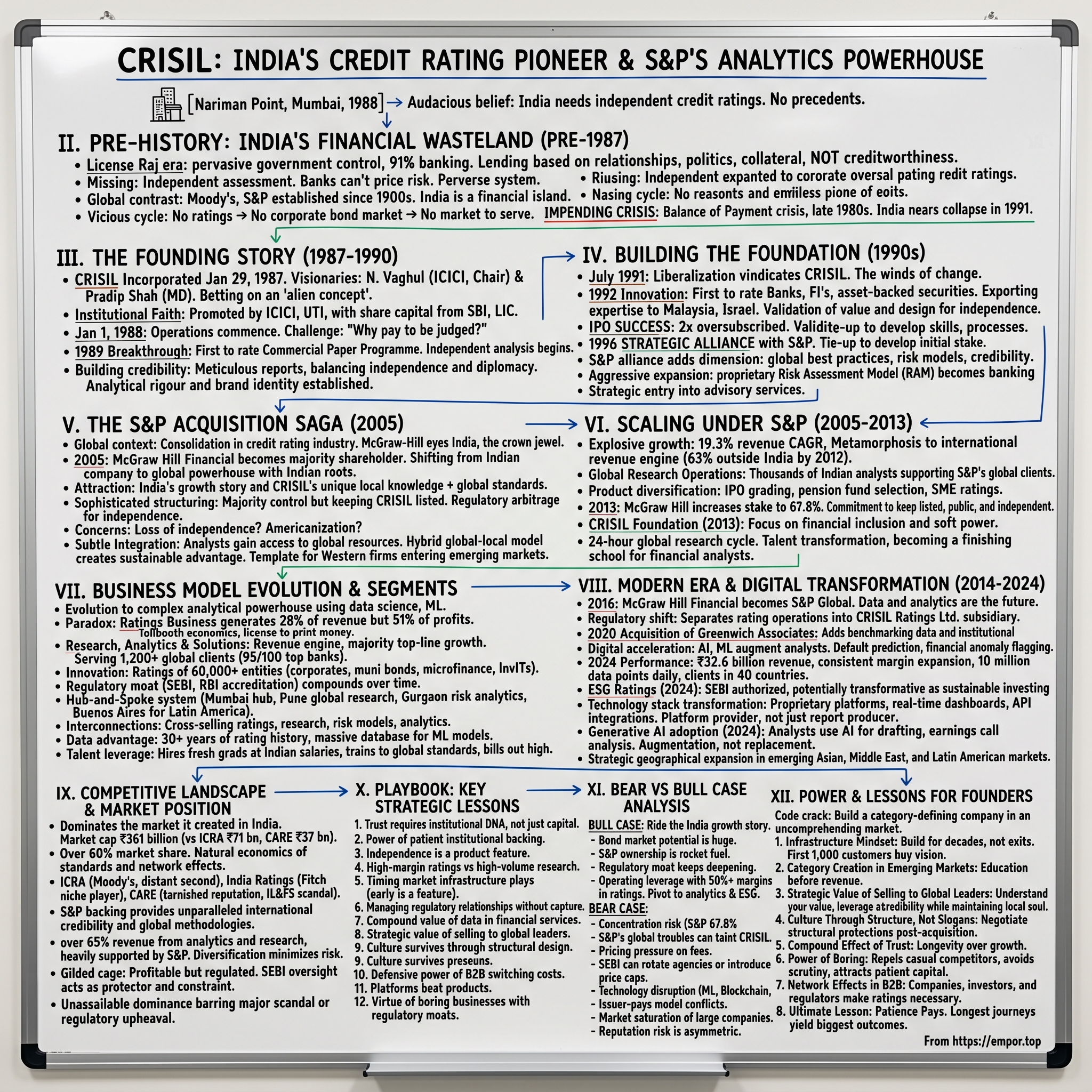
Crisil: The Rating Agency That Quietly Became Something Else
The Idea Nobody Needed: Crisil's First Decade
Picture a small office in Bombay in the first days of 1988. A handful of analysts were hired to do something that had never been done in India: put a letter grade on a company's promise to repay borrowed money. There was one immediate problem: lending rates were administered. Banks and development finance institutions decided who received credit, and at what price, largely by decree. A corporate bond market—the mechanism credit ratings exist to serve—did not meaningfully exist.
Crisil was founded in 1987 as India's first credit rating agency, promoted by the erstwhile ICICI Ltd alongside UTI and other financial institutions, and it commenced operations on January 1, 1988.12 N. Vaghul served as its first Chairman and Pradip Shah as its first Managing Director.1 The company's official history is candid about this early phase, describing the business environment as "far from promising," lending rates as fixed, and credit rating as "an idea that was far ahead of its times."1
This is the part of the Crisil story most investors skip, and it explains everything that came after. A rating agency does not create its own demand. It is a utility attached to a capital market, and it grows only when that market expands—or when a regulator mandates ratings before borrowing can occur. India's rating industry developed almost entirely through regulatory mandates. At the end of the 1980s, the Reserve Bank of India introduced commercial paper to the Indian money market specifically for highly rated corporate borrowers, making a rating the price of admission. Later, debenture issues required ratings from SEBI-registered agencies. When Indian banks adopted the Basel II standardized approach for credit risk from March 2008, the capital a bank had to hold against a loan depended on how an accredited agency graded that loan. Bank loan ratings—an extensive, unglamorous annuity business—were created by capital adequacy rules rather than organic investor demand.
That distinction is critical: the domestic ratings franchise remains downstream of regulation, and Crisil's disclosures still describe it that way, noting that its ratings "are used for computation of capital adequacy for the banking sector."3 Regulatory protection creates a genuine barrier to entry—SEBI licenses only a small group of agencies, and Crisil Ratings Limited is both SEBI-registered and accredited by the RBI as an external credit assessment institution3—but a moat granted by a regulator can also be widened, narrowed, or repriced by that same regulator.
Crisil spent its first decade pursuing two objectives: building analytical credibility in a market without established standards, and waiting for debt markets to mature. Competitors emerged quickly—ICRA in 1991 and CARE in 1994—preventing Crisil's first-mover advantage from becoming a monopoly. The company went public in 1993 with an oversubscribed issue.1 By the mid-1990s, Crisil possessed a public listing, a recognized brand, and a fundamental challenge: a core business bounded by India's corporate debt market, which remained heavily dominated by commercial banks.
The strategic solution was not simply to build a better domestic rating agency. It was to partner with an institution operating on a broader scale.
 Subscribe on LinkedIn
The American Partner: How S&P Came to Own Two-Thirds of Crisil
In 1996, Standard & Poor's—then the ratings arm of McGraw-Hill—entered a strategic alliance with Crisil, acquiring a 9.68% stake the following year.1 For nearly a decade, the relationship remained a technical partnership and a minority holding, establishing a foothold in a market expected to expand over time.
In April 2005, S&P increased its position significantly. It raised its holding in Crisil from 9.48% to 58.5%, paying about $56 million for 3.12 million shares at ₹775 per share in an open offer that closed on April 25, 2005.4 With that transaction, India's first credit rating agency became a subsidiary of a global rating institution, shifting majority ownership from the Indian financial institutions that founded Crisil to a New York parent.
Eight years later, the parent company sought to expand its control. On June 2, 2013, McGraw Hill Financial announced a voluntary open offer to buy up to 15,670,372 shares—representing 22.23% of Crisil's equity—at ₹1,210 per share in cash. If fully subscribed, the roughly $340 million transaction would have increased its stake from 52.77% to 75%.5 The offer price stood at a 29% premium to the prior closing price and roughly 12% above Crisil's all-time high on the National Stock Exchange.5 Harold McGraw III framed the transaction as "a vote of confidence in Crisil, its Board, leadership team and talented employees."5
Shareholders did not tender the full amount requested. When the offer closed, McGraw Hill had acquired 10,623,059 shares—15.1% of the company—for about ₹12.9 billion ($214 million), raising its stake to 67.8% rather than the targeted 75%.6 The outcome provided a clear market signal: despite a 29% cash premium and guaranteed liquidity, shareholders retained roughly a third of the requested shares. Indian institutional holders chose to remain invested alongside a controlling shareholder that had signaled confidence in the company's long-term valuation.
As of recent disclosures, promoter holding—held by S&P Global and its affiliates, principally S&P India LLC—stands at 66.64%.7 The public float accounts for approximately one-third of the company, which has a market capitalization of roughly ₹34,400 crore as of late August 2026, with the share price trading near ₹4,703 within a 52-week range of ₹3,686 to ₹5,115.7
Three main consequences flow from this ownership structure, creating distinct operational trade-offs.
First, Crisil gains capital, analytical methodologies, brand recognition, and access to a global client network through its parent company without direct acquisition costs. Second, minority shareholders own one-third of a business whose primary commercial counterparty is also its controlling shareholder—a structural dynamic with governance implications. Third, foreign majority ownership creates strategic limits in policy-sensitive areas. On an April 2024 analyst call, when asked about Indian policy discussions around reducing reliance on Western credit agencies by allowing domestic firms to assign sovereign ratings, Managing Director Gurpreet Chhatwal declined to elaborate, stating, "I don't think it's possible for us to comment on the sovereign ratings. I think we've been set up as a domestic rating agency."8 If Indian policy eventually reserves sovereign rating franchises for domestic-owned agencies, Crisil's ownership structure would disqualify it from participating. Ownership by a global rating leader provides commercial advantages across most operations, but introduces a constraint in national policy decisions.
Alongside its corporate shifts, Crisil maintained a consistent approach to capital allocation. The company completed two share buybacks—extinguishing 910,000 shares in January 2012 and 511,932 shares in July 20153—and has not issued additional equity since. This record demonstrates low share dilution across a period in which Crisil executed over a dozen acquisitions.
S&P Global, however, did not acquire Crisil solely to operate an Indian rating agency. It gained access to a cost-efficient, high-skill analytical workforce, laying the groundwork for a broader research operation within the firm.
The Second Company Inside the First: Offshore Analytics, 2003–2020
Consider a structural premise that Crisil's leadership tested roughly twenty-three years ago, one that attracted little notice outside the company at the time.
A credit rating relies on analysts reading financial statements, building financial models, drafting reports, and monitoring issuer portfolios year after year. Most of that work is not the ultimate credit judgment. It consists of data collection, model maintenance, peer comparison, and document preparation—tasks that are costly in New York or London, but do not need to be performed there.
That insight laid the foundation for the Global Analytics Centre. It has grown into a major operation, with more than 1,300 staff across seven centers—including locations in India, China, and Colombia—producing over 50,000 credit notes and models and more than 2,500 publications annually, while processing roughly six billion data points each year across more than 70 industry groups.3 Crisil's annual report calls the unit the "largest and key data, analytics, and research partner for S&P Global Ratings."3 On an April 2026 analyst call, CEO Amish Mehta noted that the partnership had entered its twenty-third year.9
The scale of this arrangement is significant. With Crisil employing 5,081 permanent staff at the end of 2025,3 more than a quarter of its workforce serves a single customer: its controlling parent. In practice, the unit operates as an S&P Global division housed within a publicly listed Indian company.
Alongside the Global Analytics Centre, Crisil built a separate offshore analytics franchise for external clients. It acquired INFAC in 2000, EconoMatters in 2003, Irevna in 2005, Chicago-based Pipal Research in 2010, and UK-headquartered Coalition Development in 2012.1 Each transaction fit a single pattern: acquire a specialized analytical boutique with an established Western client base, then shift delivery to India. Coalition proved the most strategically important, offering a proprietary benchmarking dataset rather than basic labor arbitrage. Coalition measured how major investment banks performed relative to peers, division by division, using data submitted by the banks themselves. Because participating institutions relied on the dataset to track competitor performance, the platform created a sticky network effect that proved far more durable than standard offshore outsourcing.
Crisil reinforced this position on December 19, 2019, when it announced the acquisition of Greenwich Associates LLC, adding roughly 150 employees and a complementary dataset spanning commercial banking, asset management, and wealth management to integrate with Coalition.10 While the acquisition price was not disclosed,10 then-MD and CEO Ashu Suyash stated that the transaction would establish Crisil as "the foremost global benchmarking analytics provider for financial services."10
This strategic pivot occurred primarily under Roopa Kudva, who served as CEO from 2007 to 201511 and oversaw Crisil's expansion from a domestic rating firm into a broader analytics provider. Ashu Suyash succeeded her on June 1, 2015, steering the company through the Greenwich acquisition and domestic market disruptions before stepping down in 2021 to start her own venture.12 Under their leadership, Crisil's revenue mix inverted: rating services no longer generated the majority of group revenue.
That structural shift carried distinct financial trade-offs. Offshore analytics is a labor-intensive business that expands primarily with headcount rather than software leverage. Its margins are structurally lower than those of a rating agency, which sells a single published credit opinion across an entire market, whereas analytics firms bill for custom deliverables and analyst hours. In calendar year 2025, Crisil's Ratings segment converted about 44 paise of every revenue rupee into segment profit—a 44% margin—compared to about 22 paise per rupee, or 22%, in the Research, Analytics and Solutions segment.3 The company achieved scale and revenue diversification, but accepted lower overall profitability in return.
Whether that trade proved advantageous depends on the objective. Expanding into analytics enabled Crisil to grow during a decade of sluggish growth in India's corporate bond market. However, the business provided less defensive stability than anticipated. In calendar year 2025, management noted in its annual report that performance in global analytics "was moderated by persistent geopolitical uncertainty and a reduction in discretionary spending among global clients," adding that demand for ESG services and sell-side research remained "muted owing to a slowdown in discretionary spending by clients."3 Selling analytical services to international financial institutions does not insulate a business from market downturns; it exposes it to global financial cycles.
Other capital allocation decisions during this period yielded modest results and required subsequent corporate restructuring. Crisil acquired Bridge To India Energy, a renewable-energy consultancy, in September 2023 for ₹6 crore, merging it directly into Crisil on September 25, 2025, ceasing to exist as a subsidiary.133 Australian benchmarking firm Peter Lee Associates transferred its operations into Crisil Irevna Australia in December 2024 before being deregistered on August 13, 2025, while the board of Coalition Development Singapore approved that entity's closure in July 2025.3 Rather than reflecting strategic failures, these moves represented corporate cleanup across a collection of acquired subsidiaries. They illustrate a pattern of operational consolidation rather than consistent compounding across smaller deals.
That operational record was soon tested by a crisis that had nothing to do with global analytics, and everything to do with the asset underlying Crisil's core business: institutional credibility.
IL&FS and the Year the Ratings Business Lost Its Halo
In August 2018, Infrastructure Leasing & Financial Services—a systemically important infrastructure financier carrying roughly ₹91,000 crore in debt obligations—held the highest credit rating available in India.14 By late September, it defaulted. Within months, debt across the conglomerate plummeted from prime investment grade straight to 'D', signaling default.
The specifics matter, because sector-wide outrage can blur individual conduct. Crisil rated several IL&FS group entities. In January 2019, it downgraded the non-convertible debentures of Jharkhand Road Projects Implementation Company, an IL&FS group road special purpose vehicle, from 'BB (SO)' to 'D'—reflecting non-payment of interest and principal due on January 21, 2019.15 The downgrade came after the default, not before it. Contemporary commentary was withering about that sequence.16 The criticism was straightforward: a rating that reaches default status only after money fails to arrive offers investors no actionable warning.
The institutional response was swift and structural. In November 2018, the Securities and Exchange Board of India (SEBI) introduced a stricter regime requiring agencies to provide far more granular disclosures—on promoter support, subsidiary linkages, and critically, an issuer's liquidity position for meeting near-term payment obligations.17 Regulators subsequently mandated standardized probability-of-default benchmarks for each rating category across one-, two-, and three-year horizons, allowing investors to evaluate performance against a common yardstick, alongside an explicit rating-sensitivities section in every press release.17
Parliament soon weighed in. On February 13, 2019, the Standing Committee on Finance, chaired by M. Veerappa Moily, reported that rating agencies had "ignored the rising debt levels at IL&FS, and continued rating it AAA."14 The committee challenged the industry's foundational business model, warning that under the issuer-pays arrangement—where the entity being graded pays the rating firm—the setup "may lead to a 'conflict of interest' and could result in compromising the quality of analysis or the objectivity of the ratings assigned."14 Its recommendations were sweeping: explore investor-pays or regulator-pays models, enforce mandatory rotation of rating agencies, require multiple ratings for large debt instruments, and lower registration thresholds to spur competition.14
Enforcement followed. In December 2019, SEBI penalized three rating agencies over the IL&FS collapse, fining ICRA and CARE ₹25 lakh each for regulatory violations in rating IL&FS non-convertible debentures.18 In July 2020, SEBI levied an additional ₹1 crore penalty on CARE Ratings in a related matter, which the Securities Appellate Tribunal later reduced to ₹10 lakh.19 Crisil Ratings was not named among the penalized agencies in those specific IL&FS orders, and Crisil's 2025 annual report notes that no penalties or strictures were imposed on the company by stock exchanges, SEBI, or any statutory authority on capital-markets matters over the preceding three years.3 Both statements are narrowly bounded by specific enforcement records and timeframes, rather than a broad endorsement of analytical foresight during the 2018 crisis.
The most consequential structural reform addressed conflict of interest rather than rating accuracy. SEBI mandated a strict separation between credit rating and non-rating advisory businesses. Crisil complied by transferring its entire domestic ratings operations into a wholly owned subsidiary, Crisil Ratings Limited, through a Scheme of Arrangement approved by the National Company Law Tribunal, SEBI, and the RBI, effective December 31, 2020, complete with an independent board.20 Management framed the restructuring at the time by stating that "the segregation has no impact on the company's businesses and its stakeholders."20
Commercially, that assessment has proven accurate. Structurally, however, segregation altered only part of the dynamic. While it insulated rating decisions from consulting and analytics services sold to the same client, it left the issuer-pays model intact. Debt issuers continue to select and pay the rating agency, maintaining commercial leverage through competitive bidding. When an analyst on an April 2026 conference call asked Subodh Rai, Managing Director of Crisil Ratings, to quantify five-year pricing trends, Rai demurred, noting that pricing "is fairly, you know, I'll say a complex subject," that there was "no particular trend that I can share with you," and that "we work on pricing in a very disciplined manner."9 Rather than offering transparency, executive responses on the call repeatedly deflected specific pricing inquiries.
How should investors evaluate the legacy of IL&FS eight years later? For Crisil specifically, the episode represents less of a direct legal liability and more of an industry-wide structural lesson. IL&FS proved that institutional credibility is perishable and vulnerable to industry-wide contagion. Furthermore, regulatory intervention following market failures routinely increases compliance burdens and operating costs rather than shielding incumbent economics. Crisil's regulatory moat remains substantial, but its terms are governed by SEBI—and the compliance cost of holding that license increases after every systemic failure.
What the regulatory narrative masks, however, is the actual engine of Crisil's financial expansion over the past decade. Tracing its revenue leads away from domestic ratings and toward a segment that now generates roughly seven out of every ten revenue rupees.
Research, Analytics and Solutions: The Business That Ate the Company
If you had fallen asleep in 2005 and woken up in front of Crisil's calendar-2025 segment note, you would not recognise the company.
Ratings — the business the firm was named after, the business that made it famous, the business every retail investor still associates with the ticker — generated ₹1,076.63 crore of revenue in calendar 2025. Research, Analytics and Solutions generated ₹2,572.38 crore.3 The tail is now roughly two and a half times the size of the dog.
And the gap is widening. In the June 2026 quarter, RAS revenue grew 30.1% year on year to ₹770.9 crore while Ratings grew 21.4% to ₹305.1 crore.21 Segment profit told a similar story: ₹157.1 crore from RAS, up 32.9%, against ₹135.2 crore from Ratings, up 31.1%.21 Note the asymmetry hiding in those four numbers. RAS produces two and a half times the revenue but only about sixteen percent more profit. Ratings remains, by a wide margin, the better business per rupee of sales. RAS is where the growth is.
What is actually inside the box
Crisil rebranded in January 2025 into four named businesses, which is genuinely useful because the old segment label told you almost nothing.22 Three of the four sit inside RAS.
Crisil Intelligence — formerly Market Intelligence & Analytics — is the India franchise. It is the official valuation provider to all Indian mutual funds, covering roughly ₹205 trillion of Indian debt securities; it says it is trusted by 90% of banks and 70% of asset managers, its risk platforms are used by 16 of the top 20 Indian banks, and its research spans more than 75 sectors backed by over 200 industry risk scores.3 Think of it as the plumbing of Indian institutional finance: when a debt mutual fund needs to know what an illiquid bond in its portfolio is worth today, somebody has to produce a number, and that somebody is usually Crisil. It is a quiet, deeply embedded, high-switching-cost position — arguably the most underappreciated asset in the group.
Crisil Integral IQ — formerly Global Research & Risk Solutions — is the offshore analytics business for global financial institutions: risk, regulatory work, model validation, stress testing, lending solutions, transformation projects. It works with 15 of the top 20 investment banks and 35 of the top 50 commercial banks, delivering from onsite centres in Australia, Switzerland, the UK and the US and offshore centres in Argentina, China, Colombia, India and Poland.3
Crisil Coalition Greenwich is the benchmarking franchise: it serves all of the top 20 investment banks, 21 of the top 25 asset management firms, and 35 of the top 50 commercial banks globally.3
The geography nobody talks about
Here is the fact that reframes the whole company. In calendar 2025, India contributed ₹1,126.68 crore of Crisil's ₹3,649.01 crore of revenue. North America contributed ₹1,425.32 crore and Europe ₹743.23 crore.3
Roughly seven of every ten rupees Crisil earns come from outside India, and North America alone is a bigger market for Crisil than India is.
This is not an Indian financial-infrastructure stock with an offshore kicker. It is a globally exposed analytics company with an Indian regulatory annuity attached. Investors who own it as a play on India's bond market are, arithmetically, owning something else. It also means the rupee is a genuine profit-and-loss variable rather than a footnote: the company's own risk presentation names sharp rupee appreciation against the dollar as one of three front-and-centre risks, mitigated by hedging.9 Calendar 2026 has already demonstrated the point in both directions — a foreign exchange gain of ₹14.4 crore in the March quarter against a loss of ₹5.2 crore a year earlier,9 and a foreign exchange loss of ₹8.2 crore in the June quarter.21
The margin story, and how much of it is real
RAS margins improved to 22.0% in calendar 2025 from a segment result of ₹503.10 crore on ₹2,350.63 crore in 2024.3 Then they jumped: 22.7% in the March 2026 quarter against 18.3% a year earlier, with segment profit up 66.9%.9
Management deserves credit for not letting that number stand unexplained. CFO Dinesh Venkatasubramanian flagged two specific distortions in the first quarter without being asked: the foreign exchange swing, and "the accelerated closure of renewals in one of our global businesses" worth roughly $4.5 million of incremental revenue versus the prior year, which he described as "largely a timing effect" expected to normalise over the rest of the year.9 Duncan McCredie, who runs Coalition Greenwich, gave the same explanation from the business side, attributing strong first-quarter revenue to more multi-year contracts secured through 2025 and a deliberate push to close renewals earlier.9
Pressed later in the call on whether this smoothed out seasonality, the CFO confirmed it should.9 That is a good disclosure practice, and it is the kind of behaviour that builds credibility over time: the company volunteered the reason a headline number looked better than the underlying business.
It also means the single most impressive datapoint in Crisil's recent reporting — a 450-basis-point margin expansion in one quarter — is partly a calendar artefact. Both Mehta and Rai made the same point unprompted on that call, urging analysts to judge the business annually rather than quarterly, because one quarter "may not be indicative of performance of the entire year."9 Investors should take them at their word, including when the quarter is flattering.
What the growth actually rests on
Strip out timing, and the RAS growth story rests on three legs of unequal strength.
The strongest is Coalition Greenwich benchmarking, because the data network effect there is a genuine cornered resource and the November 2025 addition of PriceMetrix extends it into wealth management — a segment growing faster than institutional banking. Crisil Canada Inc. acquired the Toronto-based business, formerly McKinsey PriceMetrix Co., on November 7, 2025 for $33 million, or ₹293.97 crore.3 Of that price, ₹173.84 crore was allocated to identifiable intangibles, principally customer relationships and an information database, and ₹211.64 crore to goodwill; the purchase price allocation was significant enough that the auditors flagged the business combination as a key audit matter, citing the judgement involved in the valuation assumptions.3 That is a normal disclosure for a deal of this type, not a red flag — but it does tell you that most of what Crisil bought is unamortised judgement rather than tangible assets, and that a future impairment test is where the honesty of the price will eventually be settled.
The second leg is Crisil Intelligence, growing with Indian financialisation. Its own analyst-call framing is instructive: Priti Arora walked through Indian mutual fund AUM rising from ₹55 lakh crore in early 2024 to about ₹83 lakh crore by the fourth quarter of 2026, and bank gross NPAs falling from 7.5% in FY21 to roughly 2% by FY26.9 A rising, cleaner, more financialised system needs more valuation, more benchmarks, more risk platforms.
The third leg — Integral IQ — is the weakest, and the company effectively conceded as much in its own annual report language about moderated performance and muted ESG and sell-side demand.3 On the April 2026 call, Amish Mehta's answer on discretionary spending was carefully bounded: no decline in client engagement, no projects cancelled, but "in some places, you might see that there could be more time that one might take while taking decisions," and large investment bank discretionary spend "remains a key monitorable."9 Compare that with the April 2024 call, when discretionary-spend weakness at global financial institutions was the dominant theme of the entire discussion.8 The narrative has genuinely improved, and the improvement is corroborated by the numbers rather than merely asserted. But it improved because the global banking cycle improved, and it can un-improve the same way.
So the calibrated conclusion on RAS is this. The claim that Crisil has diversified into a durable global analytics franchise survives, but in a narrower form than the growth rate suggests: one leg (benchmarking) has a real, defensible data asset; one leg (Indian intelligence) has real embeddedness; and one leg (offshore analytics for global banks) is a competitive services business whose fortunes track other people's cost-cutting cycles. The KPI that would confirm or falsify the strong version is whether RAS margins hold above 22% across a full calendar year once the renewal-timing benefit washes out.
The Ratings Engine Today: Surveillance Annuities and a Bond Market That Won't Cooperate
There is a rhythm to a rating agency's income statement that takes a moment to understand and then explains almost everything.
When a company issues a bond or takes a rated bank loan, the agency earns a one-time fee for the initial rating. For as long as that instrument remains outstanding, the agency earns a smaller annual surveillance fee to keep the rating current. Initial fees are lumpy, cyclical, and competitive. Surveillance fees are an annuity—and crucially, a lagged annuity: this year's surveillance income was built by the prior two or three years of new business.
Subodh Rai laid this out with unusual clarity in April 2026 when an analyst from Kotak asked why Crisil's ratings revenue kept growing 16% to 17% when bond volumes and large corporate credit growth did not seem to support it. Rai explained that growth was "largely driven by a pretty robust surveillance revenue," which in turn "is driven by the new rating revenues performance in prior year," meaning 2026 results reflected strong new business secured in 2024 and 2025.9
That is a satisfying explanation, but it doubles as a warning label. An annuity built on prior-year originations is a trailing indicator. If origination slows for two consecutive years, the surveillance annuity eventually decelerates with a lag—and headline performance looks healthy right up until the slowdown hits.
The bond market is not cooperating
That dynamic highlights the tension in Crisil's recent numbers.
Bond issuance remained flat across calendar 2025 despite a 64% year-on-year surge in the June quarter, as bond yields hardened in the second half of the year.9 Starting in the third quarter of 2025, U.S. tariff actions on India pushed yields higher, prompting banks to offer large corporate borrowers rates attractive enough to substitute bank loans for bonds.9 By the March 2026 quarter, corporate bond issuance fell 12% year on year, the ten-year government security yield rose near 7%, and India's manufacturing Purchasing Managers' Index dropped to 53.9 in March 2026—its lowest level since June 2022.9
Data from SEBI showed corporate bond mobilisation falling 8.4% to ₹9.1 lakh crore in fiscal 2026, marking the market's first annual contraction since fiscal 2022.23
Bank credit, meanwhile, expanded—growing 14.5% year on year as of February 2026 compared to 11.1% a year earlier. Wholesale credit rose 15.1% and industrial credit grew 13.5%, driven largely by small and medium enterprises.9
For Crisil, this shift represents a change in business mix rather than a collapse. Bank loan ratings generate steady revenue, but they are priced differently and behave differently from capital market ratings. Rai's assessment of this substitution was measured: he noted that it reflects a temporary interest-rate differential favoring bank loans, that the relationship has flipped before, and that "I do not think structurally there will be a major change as far as medium term is concerned."9
That answer acknowledges that the ratings segment's immediate revenue driver is a spread relationship between two competing funding markets over which Crisil exercises no control.
Where the ratings segment gets complicated
A secondary structural detail changes how the segment should be evaluated, which the standard binary framing of Ratings versus Research, Analytics and Solutions obscures.
Crisil's Ratings segment includes more than credit ratings alone. The company's segment disclosures define the unit as encompassing "credit ratings for corporates, banks, bank loans, credit analysis services, grading services and global analytical services."3 The Global Analytics Centre—the offshore unit serving S&P Global—is housed within the Ratings segment rather than inside RAS. On the April 2026 analyst call, GAC's performance was reported directly by the head of Crisil Ratings, who noted that the unit "saw growth from new engagements and robust surveillance work delegation from S&P Global Rating Services," contributing to overall ratings segment growth of about 20.2%.9
This reporting structure has two financial implications. First, analyzing the Ratings segment purely as a proxy for domestic Indian credit market activity is misleading, because it combines domestic ratings with an intercompany services contract for a U.S. parent. Second, the segment's 44% operating margin reflects a blend of a high-margin domestic ratings franchise and a cost-plus outsourcing arrangement. The standalone domestic ratings business is likely more profitable than the segment average, but segment margins will naturally shift as the revenue mix between domestic ratings and offshore work evolves.
The competitive position, tested
Crisil Ratings maintains active ratings on more than 7,200 corporate and financial issuers and has rated over 35,000 entities over its operating history.3 The agency pioneered bank loan ratings in India and claims market firsts in rating inflation-indexed debentures, infrastructure debt fund bonds, infrastructure investment trusts, asset-backed securities, municipal bonds, and expected-loss ratings for infrastructure projects.3
A history of product innovation does not automatically translate into pricing power, and public evidence requires a cautious assessment. Rai attributed recent new-business momentum to an "investor preference for best-in-class rating" and noted that Crisil "acquired a lot of new clients at good prices" during the post-pandemic recovery.9 While plausible, these statements cannot be independently verified, as Crisil does not disclose pricing schedules, order backlogs, or client-level economics.
The premise that Crisil commands premium pricing in domestic ratings remains consistent with reported revenue growth, but unconfirmed by explicit disclosure. The claim would be validated if ratings revenue continues to outpace system credit growth through a prolonged downturn; it would be disproven if segment growth slows to match overall credit growth once the surveillance revenue from the 2024–2025 originations rolls off.
That structural reality points to the portion of Crisil's income statement where competitive dynamics play out under entirely different rules—because the business is not won in an open market at all.
The Parent in the P&L: Related-Party Concentration as a First-Class Risk
On the April 2026 analyst call, Arpit Kumar asked what should have been a routine question. With the scope of the Global Analytics Centre engagement expanding, what were the unit economics—specifically, revenue and margins?
Managing Director Amish Mehta was clear about the operational model but declined to provide specific figures. This is a business, he explained, "where we work at a transfer pricing fixed margin on the cost that we incur, and it is benchmarked with, whatever in the industry that we operate."9
When Kumar pressed for the specific margin figure, Mehta declined to elaborate: "We don't disclose that, that is benchmarked with transfer pricing."9
That exchange highlights a critical dynamic in Crisil's investor disclosures regarding its intercompany relationship.
How big is it, really
Crisil's calendar 2025 related-party disclosure lists professional services rendered across a broad roster of S&P Global entities. These were led by Standard & Poor's Financial Services LLC at ₹253.47 crore, S&P Global Ratings Europe at ₹49.91 crore, S&P Global Ratings UK at ₹36.14 crore, S&P Global Market Intelligence LLC at ₹31.65 crore, S&P Global UK at ₹23.40 crore, and S&P Global Inc. at ₹18.57 crore. The list also includes more than a dozen smaller relationships spanning Singapore, Hong Kong, Australia, Japan, Canada, Brazil, Trucost, Kensho, S&P Capital IQ India, and Markit.3 Combined, professional services rendered to the parent group came to roughly ₹476 crore in calendar 2025, up from about ₹389 crore in 2024.3
Crisil's business responsibility report summarizes this concentration: sales to related parties reached 13% of total sales in 2025, up from 12% in 2024.3
This marks a steady multi-year expansion. On the April 2024 call, then-CFO Sanjay Chakravarti noted that GAC's related-party transactions, as separately listed in the 2023 annual report, came "to roughly around 10%-odd of our total consolidated turnover."8
The revenue trajectory shows related-party services expanding from roughly a tenth of consolidated revenue in 2023 to about an eighth in 2025, outpacing overall group growth. Group revenue grew 11.9% in calendar 2025,24 while related-party service revenue rose approximately 22%.3
Management has explicitly targeted this expansion. Mehta noted on the April 2026 call that expanding beyond S&P Global Ratings into other S&P Global divisions "is a part of our conscious strategy," adding that Crisil is establishing specialized centers in program management, research, and technology support. He recalled that "a few years back, we had actually asked all our shareholders to approve a much larger limit, with the hope that we are likely to open more doors. And I think that's something that you are seeing play out."9
That strategy reflects specific corporate approvals. The framework for transactions with S&P group entities, initially approved on December 15, 2014, was expanded at the 37th Annual General Meeting on April 16, 2024. A majority of public shareholders approved a five-year limit permitting up to ₹750 crore in service delivery to parent entities.3
Why a minority shareholder should care
From a credit perspective, the arrangement offers clear strengths. Intercompany analytics represents contracted, recurring, non-discretionary revenue from a highly creditworthy parent. It requires no external sales infrastructure and continued to expand through the 2023–2024 discretionary spending slowdown that affected Integral IQ.
However, transfer pricing mechanisms differ fundamentally from open-market commercial pricing. Transfer prices represent internal cost allocations established through benchmarking studies, set between a parent controlling 66.64% of equity and a subsidiary board chaired by the parent's ratings division president. Crisil's annual report states that all 2025 related-party transactions were conducted in the ordinary course of business on an arm's-length basis, pre-approved by the Audit Committee, and involved no material conflicts of interest,3 supported by an unmodified statutory audit opinion.3
Nevertheless, governance alignment and minority economic optimization carry distinct considerations.
A fixed transfer margin calculated on an underlying cost base determines how operating profits are divided between parent and subsidiary. S&P Global consolidates 100% of the value generated at the global entity level while receiving 66.64% of profits retained within Crisil. Public shareholders hold a one-third interest in Crisil's earnings but possess no claim on parent-level value creation. Because public disclosures omit the specific transfer margin, minority shareholders cannot independently evaluate or benchmark the underlying profitability of these services. Furthermore, regulations bar controlling promoters from voting on material related-party resolutions, leaving public shareholders to vote periodically on aggregate expenditure caps without access to detailed margin data.
A secondary disclosure nuance involves revenue presentation. Crisil's segment disclosures state that no individual external customer accounted for 10% or more of consolidated 2025 or 2024 revenue.3 While technically compliant, this standard obscures the fact that the S&P Global group in aggregate represents the firm's largest commercial relationship, visible only by aggregating individual line items across the related-party disclosures.
Additionally, the parent serves simultaneously as Crisil's largest commercial client and its primary dividend recipient. S&P entities received approximately ₹287.5 crore in dividend distributions from Crisil in calendar 2025.3 Consequently, capital flows from the parent as service payments and returns to the parent through equity distributions under internally established commercial terms.
The calibrated conclusion
These structural arrangements are common among listed subsidiaries operating within global corporate groups, where counterparty credit risk is negligible and intercompany revenues generate realized cash flows.
However, the nature of Crisil's revenue diversification warrants precise framing. Approximately one-eighth of total revenue—growing at nearly double the consolidated rate—stems from a single parent counterparty under an undisclosed margin structure, concentrated in an operational unit employing over 25% of the total workforce. The primary operational risk is not customer loss, but rather the parent's structural role in setting the profitability of the intercompany contract.
Validating the long-term governance balance of this framework depends on two factors. The first is disclosure, specifically whether management eventually provides dedicated margin metrics or segment-level breakdowns for Global Analytics Centre operations—a step executive leadership has repeatedly declined to take on recent earnings calls. The second involves potential shifts in operational scope, such as the repatriation of analytical tasks to parent-owned captive centers, adjustments to transfer pricing terms, or decisions by the parent to execute international acquisitions directly rather than through the listed Indian entity. Addressing this operational boundary on the April 2026 call, Bhavin Vithlani of SBI Mutual Fund queried how acquisition opportunities are allocated between Crisil and S&P Global. Mehta responded that "there is hardly any area of overlap," asserting that opportunities aligning with Crisil's core businesses are evaluated directly within Crisil.9 While executive assurances affirm current practice, they operate alongside existing parent-level governance structures.
This raises an enduring question for public investors: how operational priorities are balanced between global parent strategy and local entity growth.
Who Actually Runs Crisil
A look at the seating chart of a Crisil board meeting illustrates how authority is structured across the organisation.
Yann Le Pallec has served as Chairman of the Crisil board since February 17, 2024.3 Rather than an Indian financial-sector veteran in a ceremonial role, Le Pallec serves as President of S&P Global Ratings—an executive appointment announced on June 27, 2024, and effective November 1, 2024. Having joined S&P in 1999, he oversees more than 2,200 analysts and support staff across 28 countries, covering over a million outstanding ratings worldwide.25
Consequently, Crisil's Chairman leads the global ratings business that acts as Crisil's majority owner, its competitive benchmark, and—via the Global Analytics Centre—one of its largest commercial customers. Crisil's governance disclosures highlight that the roles of Chairperson and Managing Director and CEO are split to reinforce independent board oversight.3 While the separation of titles is formal and distinct, the structural alignment means the Chairman's primary executive responsibility rests with the global parent company.
The CEO
Amish Mehta assumed leadership as Managing Director and CEO on October 1, 2021.12 A chartered accountant by training, Mehta spent two decades in finance and operations outside credit ratings—holding positions at ExxonMobil India, BP/Castrol India, EY, and serving as Chief Financial Officer at Indus Towers—before joining Crisil as President and CFO in October 2014.12 In July 2017, he was named President and Chief Operating Officer, taking responsibility for the Global Analytics Centre, India Research and SME, the innovation hub, and corporate strategy.12
This operational background explains his approach to managing the enterprise. Rather than an analyst advancing through rating committees, Mehta is a finance executive who led the offshore analytics division before assuming top executive leadership.
During earnings calls, Mehta maintains a consistent executive focus, emphasizing domain expertise, proprietary data, client alignment, and margin stability. When analyst Pritesh Chheda sought directional color on growth within Research, Analytics and Solutions or specific order-book metrics, management responded that Crisil targets "consistent growth across all our businesses" while noting, "we don't comment on order books of individual businesses."9 Asked by Anush Kumar about the proportion of analytical workflows powered by artificial intelligence, Mehta explained that AI is deployed across the value chain, adding that "there is no single measure to give you that number."9 Similarly, when Bhavin Vithlani inquired whether the Global Analytics Centre's recent growth rate was sustainable, Mehta declined to provide forward-looking forecasts.9
These responses align with Crisil's formal disclosure policy. At the start of each investor call, the company explicitly states that it refrains from giving specific quantitative guidance and will not disclose operational details on specific business segments or customer contracts.9 Adhering strictly to that policy avoids the risk of missing public targets.
However, strict consistency differs from detailed disclosure. Crisil hosts only one analyst conference call per year, in April, alongside quarterly earnings-update presentations.9 This represents a lower frequency of direct investor interaction than many Indian large-cap peers provide. Consequently, detailed financial evaluation relies heavily on the annual report, which contains granular data on related-party transactions, segment margins, and shifting market demand.
The bench, and the board
Crisil's executive leadership team comprises experienced functional leaders: Gurpreet Chhatwal serves as Chief Operating Officer, Dinesh Venkatasubramanian has served as Chief Financial Officer since October 28, 2024, Subodh Rai heads Crisil Ratings, Priti Arora leads Crisil Intelligence, Duncan McCredie directs Coalition Greenwich, and Suprabha AD oversees Integral IQ. Meanwhile, former CFO Sanjay Chakravarti transitioned to President of Risk and Compliance.39 Reassigning a former CFO to lead risk and compliance helps retain institutional knowledge within senior governance.
The board's independent directors bring substantial regulatory and financial experience. Shyamala Gopinath, a former Deputy Governor of the Reserve Bank of India, served on the board until December 31, 2025, while former State Bank of India Chairman Dinesh Kumar Khara joined as an independent director on September 24, 2025.3 Girish Paranjpe, Amar Raj Bindra, and Nishi Vasudeva complete the independent slate.3 Parent-company non-executive representation has evolved over time: Saugata Saha and Girish Ganeshan served during 2025, and following Saha's resignation, Abhishek Tomar was appointed as an additional director effective July 22, 2026.21
Judging management on behaviour, not language
Evaluating management performance against stated goals offers a clear benchmark of operational track record.
During its April 2024 investor call, management outlined plans to address weakness in global discretionary spending by expanding into private markets, servicing regional financial institutions beyond the top 20 global investment banks, and entering new geographic markets.8 By the April 2026 call, the company reported operational entry into the Middle East, geographic expansion into Canada following the PriceMetrix acquisition, entry into wealth management analytics, and increased client traction among regional banks across Europe, the Middle East, and Asia.9
Management also stated in 2024 that generative artificial intelligence would serve as an operational catalyst rather than a structural threat. Over the subsequent two years, Crisil introduced several proprietary applications—including GenEye Credit for automated credit report creation, DeepMind for loan data extraction, Crisil i360 for macroeconomic and sector intelligence, ICON for credit workflow management, and Myron AI as an internal low-code orchestration layer—while earning 26 industry recognitions in 2025, including 20 from Chartis Research.93
However, industry recognition and software deployments do not automatically translate into direct financial returns. Crisil has not disclosed specific revenue generated by AI applications, pricing premiums, or quantified productivity metrics, declining to provide those details when asked.9 When analyst Balaji Subramanian of IIFL inquired whether Crisil would remain largely insulated from the revenue compression facing global IT services providers, Mehta offered a cautious response, emphasizing efforts to manage structural risks while expanding into adjacent sectors.9 He noted that "we have to keep running at a much faster pace, to be at the same level."9
That candid assessment underscores the ongoing operational demands of maintaining market position. Crisil's leadership team has demonstrated operational discipline by executing targeted strategic initiatives while maintaining strict control over public guidance. For investors, this approach delivers operational execution and predictability, even if segment-level visibility remains limited.
Myth vs Reality
Five recurring stories dominate discussions about Crisil. Each contains a kernel of truth, but several key details do not survive close inspection of the company's filings.
Myth: Crisil is primarily a credit rating agency. Reality: Ratings, including intercompany work for the Global Analytics Centre, generated under 30% of calendar 2025 revenue.3 Crisil is fundamentally a global analytics and benchmarking enterprise with a valuable Indian ratings annuity attached. Its corporate name is now the least representative description of its business.
Myth: Owning Crisil is a leveraged bet on India's corporate bond market taking off. Reality: India's contribution to group revenue was smaller than North America's in 2025.3 When the domestic bond market weakened—with issuance flat in 2025, down 12% in the March 2026 quarter, and national mobilization falling 8.4% in fiscal 2026—ratings revenue continued to expand, supported by surveillance annuities and bank loan ratings.923 The bond market represents a swing factor for a single division within one segment. Investors underwriting a bond-market thesis must also evaluate dollar-rupee exchange rates and the discretionary technology budgets of global investment banks, as those factors exert a larger overall influence on performance.
Myth: The 2020 ratings segregation resolved the industry's conflict-of-interest challenges. Reality: Segregation separated ratings from non-rating advisory businesses.20 It left the issuer-pays model—the core conflict identified by the Parliamentary Standing Committee—completely intact.14 Alternative payment frameworks and mandatory agency rotation were recommended in 2019 but remain unimplemented. This leaves a dormant regulatory overhang across the sector that could resurface during the next major corporate default.
Myth: Crisil's relationship with S&P Global is purely an asset. Reality: The relationship provides methodology, branding, capital, and an expanding revenue stream. However, it also concentrates roughly one-eighth of total revenue in a single counterparty that sets transfer margins, chairs the board, and disqualifies Crisil from any future domestically reserved sovereign rating mandate.38 Both realities coexist within the corporate structure.
Myth: Crisil is an unblemished capital allocator. Reality: Evaluating management's record requires looking past reputation to historical execution. In June 2017, Crisil acquired 2,622,430 shares—an 8.9% stake—in rival CARE Ratings through a Canara Bank bidding process for ₹435.27 crore, averaging ₹1,659.79 per share, framing the transaction as "an investment in the excellent long term prospects of the credit rating sector."2627
Crisil still holds that position. As of December 31, 2025, the holding—comprising 2,622,431 shares of CARE Ratings, carried at fair value through other comprehensive income—was valued at ₹419.56 crore, compared to ₹361.80 crore a year earlier.3
After eight and a half years, a ₹435 crore minority stake in a direct competitor, purchased with shareholder funds, remained carried below its original cost. The investment conferred no board representation, no operational control, and—as the original press release noted—no special governance rights.26 While modest relative to a company generating over ₹1,000 crore in annual pre-tax profit, and though it has recovered from earlier troughs, it represents a passive financial investment that failed to compound over nearly a decade. It sits alongside a portfolio of smaller stakes in NCDEX, the Caribbean Information and Credit Rating Agency, a 4.08% position in Online PSB Loans Limited acquired on June 4, 2025, and a single share of ICRA.3
Crisil's capital allocation track record is neither impeccably disciplined nor reckless. Operating acquisitions have generally been small, strategically aligned, and successfully integrated into the platform, even as certain passive financial holdings underperformed and smaller subsidiaries required eventual consolidation. Investors evaluating major capital decisions—such as the $33 million acquisition of PriceMetrix—should weigh them against this mixed historical record rather than relying on an assumed reputation for capital discipline.
The War Game: Porter, Seven Powers, and the Peer Set
Consider what it would take for a new competitor to challenge Crisil head-on.
Attacking the core domestic ratings business would be nearly impossible. India's licensed rating agencies number in the single digits, and its two largest challengers belong to rival global oligopolists: ICRA is majority-owned by Moody's, while India Ratings and Research is a subsidiary of Fitch. CARE Ratings remains the largest professionally managed independent agency without a single dominant promoter. Virtually every player in the market relies on a global parent or aims to emulate one.
These competitive dynamics are visible across the peer set. ICRA reported ratings and ancillary services revenue up 19.7% in its December 2025 quarter and 15.7% over nine months, alongside a 58.3% quarterly surge in research and analytics.28 That is an incumbent executing the same core formula—combining a domestic rating annuity with offshore analytics for a global parent—with clear success. When an analyst on Crisil's April 2026 earnings call noted that Crisil and its peers were growing faster than underlying market indicators suggested, Subodh Rai declined to comment on competitor dynamics.9 But the implication is clear: if agency revenues outpace rated debt issuance, either pricing is rising across the industry or the pool of rated issuers is expanding. Both dynamics may be at work, though neither is explicitly disclosed.
Porter, applied honestly
Rivalry is moderate in domestic credit ratings but intense in analytics. Rating rivalry is restrained by regulatory licensing, issuer requirements for multiple ratings, and established brand preferences among institutional investors. In contrast, analytics rivalry is severe: Crisil competes against global consulting firms, specialized data vendors, Indian IT service providers, and increasingly, its clients' internal capability centers.
Threat of new entrants remains low in ratings due to regulatory barriers, but high in analytics. Launching a credit rating agency in India requires SEBI registration, RBI accreditation for bank capital rules, and years of historical default data to establish analytical credibility. By contrast, establishing a financial analytics firm requires little more than office space and a team of analysts.
Buyer power mirrors that same divide. Rated issuers possess moderate bargaining power—they choose the agency and compare pricing, which drives commercial competition under the issuer-pays model. Global investment banks purchasing analytics hold substantial buyer power, as evidenced by the discretionary spending freeze in 2023 and 2024. Meanwhile, S&P Global, as Crisil's largest customer, represents a unique category of buyer influence.
Supplier power centers on the specialized labor market. Because the business relies on skilled human capital, Crisil's annual report explicitly identifies the risk of higher-than-optimal employee attrition and key skill gaps.3 Staff turnover improved in 2025—falling to 17.4% for men and 15.4% for women, down from 21.5% and 20.3% in 20243—representing an important operational stabilization in a business where retained analytical expertise drives value.
Substitutes pose the most significant long-term challenge, emerging from two distinct sources.
The first source is the growth of Global Capability Centres. Major global financial institutions increasingly operate in-house analytics centers in India. When asked about this trend, Suprabha AD framed capability centers as a commercial opportunity, noting that foreign firms require external support to establish specialized units or execute rapid regulatory remediation.9 That perspective reflects recent demand, but it also mirrors an incumbent's standard framing of an emerging substitute. An institution establishing a 500-analyst capability center is ultimately making a structural decision to bring work in-house.
The second substitute is generative artificial intelligence, an area where management has provided candid risk disclosures. Crisil's risk presentation explicitly lists two AI-related threats: the emergence of advanced generative models and an inadequate pace of internal AI adoption.9 The threat to offshore analytics is direct: if automated models can synthesize financial statements and draft credit summaries, the labor cost arbitrage between Indian analysts and Western financial centers narrows.
Amish Mehta counters that generic content will commoditize, increasing the relative value of trusted methodology, proprietary datasets, regulatory licenses, and expert human judgment.9 That thesis is logical, and it offers the strongest protection to Crisil's proprietary data assets—including its ratings franchise, Coalition Greenwich benchmarking datasets, and Indian mutual fund valuation services. However, it provides far less protection to standard offshore analytical workflows, where client spending has already shown signs of moderating.
Seven Powers, scored against evidence
Applying Hamilton Helmer's Seven Powers framework highlights a business supported by two strong strategic advantages, two moderate ones, and three that are largely absent.
Cornered Resource represents Crisil's strongest advantage. The Coalition Greenwich benchmarking dataset relies on proprietary contributions from nearly every major global bank, while Crisil's SEBI registration and RBI accreditation represent legally protected assets in India.3 Additionally, Crisil ESG Ratings & Analytics holds a SEBI Category 1 ESG rating license covering most of India's top 1,000 listed companies—another regulatory license, even though ESG services have experienced softer market demand.329
Switching Costs provide a second major advantage. As the official valuation provider for Indian mutual funds, Crisil's analytics are embedded directly into fund NAV calculations and institutional audit trails.3 Replacing that service requires a complex operational migration involving regulatory oversight, auditor approval, and changes to public reporting.
Scale Economies are moderate. Developing a rating methodology or benchmarking dataset once and distributing it broadly offers clear operating leverage; maintaining 1,300 dedicated analysts for a parent company does not.
Branding provides a moderate advantage in Indian credit ratings, where investor preference for Crisil's rating brand supports client retention.9 It is less distinctive in international analytics, where the S&P brand carries greater weight.
Network Economies, Counter-Positioning, and Process Power are absent. The business lacks a network effect where each new user enhances value for existing users; it operates no business model that competitors are structurally prohibited from copying; and it possesses no proprietary manufacturing-style process efficiency.
The composite analysis reveals that Crisil's most defensible advantages are concentrated in its licensed ratings franchise, domestic market infrastructure, and benchmarking datasets—the segments that generate its highest profit margins but slower revenue growth. Conversely, its fastest-growing operations operate where strategic moats are weakest. That dynamic represents the central structural balance of the enterprise, one that AI integration can optimize but not fundamentally alter.
The Bull Case and the Bear Case
Why Crisil wins from here
The bull case rests on four distinct operational mechanisms.
First: the ratings annuity has demonstrated resilience. Through a calendar year of flat bond issuance and a quarter of 12% declines, ratings revenue kept compounding on surveillance fees and bank loan ratings.9 Segment profitability of roughly 44 paise per revenue rupee, sustained across 2024 and 2025, indicates real pricing power and low incremental costs.3
Second: financial infrastructure services compound alongside market expansion. Valuation services for the entire Indian mutual fund industry, fixed-income indices used as benchmarks by passive funds, alternative investment fund benchmarks covering roughly three-quarters of that universe, and risk platforms inside 16 of the top 20 Indian banks represent embedded positions that expand alongside Indian financialization.3 A rise in mutual fund assets under management from ₹55 lakh crore to about ₹83 lakh crore over roughly two years illustrates this underlying tailwind.9
Third: the benchmarking business is expanding into wealth management. The acquisition of PriceMetrix extends Coalition Greenwich from institutional banking into wealth management, where asset growth outpaces traditional investment banking.3 Management's cross-sell strategy—offering corporate, transaction, digital, and wealth benchmarking to existing clients—allows expansion without relying on new customer acquisition.9
Fourth: financial performance reflects high underlying capital efficiency. Calendar 2025 produced ₹3,649.01 crore in revenue, ₹1,041.03 crore in pre-tax profit, ₹766.01 crore in net profit, and earnings per share of ₹104.7 against a net worth of ₹2,026.53 crore—generating a return on equity above 35% with minimal debt and approximately ₹320 crore in cash at year-end.324 Dividends per share increased annually from ₹27 in 2016 to ₹61 in 2025, while earnings per share compounded at roughly 11% annually over that decade.3 Growth accelerated in the first half of 2026, with revenue rising 28.8% to ₹2,133.1 crore and net profit increasing 35.7% to ₹449.7 crore.21
Why the case could break
Related-party concentration forms the primary structural vulnerability. Generating roughly one-eighth of total revenue under an undisclosed transfer-margin structure with a controlling shareholder differs from arm's-length commercial growth. Skeptics argue that an increasing share of expansion reflects parent-level allocation decisions rather than market demand, creating the risk that the stock market values cost-plus intercompany services at the high earnings multiple of an independent high-margin franchise.
The offshore analytics business faces cyclical, competitive, and technological headwinds. Crisil's annual disclosures acknowledged that performance in Integral IQ was moderated in 2025 by reduced discretionary client spending, alongside muted demand for ESG and sell-side research.3 Corporate risk presentations explicitly list advanced generative AI models as an operational threat,9 while leadership noted that the firm must operate at an accelerated pace simply to maintain current performance levels.9 These challenges reflect documented company disclosures rather than external speculation.
Limited reporting transparency heightens governance concerns. Crisil refrains from disclosing pricing schedules, order backlogs, Global Analytics Centre margins, sub-segment revenue breakdowns, or quantified AI revenue contributions, while hosting only one annual analyst conference call.9 For an enterprise whose primary commercial relationship is with its parent company, this reporting structure restricts visibility into underlying operational economics and subsidiary governance.
Regulatory risk remains a persistent structural overhang. Recommendations from the 2019 Parliamentary Standing Committee report—including investor-pays rating models, mandatory agency rotation, and lower registration thresholds to encourage competition—remain unadopted but unresolved.14 A major systemic default could reawaken legislative focus on agency business models and profit structures.
International macroeconomic and currency exposures present earnings sensitivity. With over two-thirds of revenue generated overseas, sharp rupee appreciation directly compresses operating margins.9 Furthermore, Crisil's economic forecasts for 2026 projected baseline Indian GDP growth of 7.1% declining to 6.8% under persistent geopolitical conflict, alongside an estimated 100-basis-point drop in corporate profitability for fiscal 2027.9
The verdict on the thesis, weighed
Evaluating the evidence against each core thesis component leaves three of the four growth drivers intact, albeit with qualifications.
The durability of the rating franchise remains well supported. When tested against weak corporate bond issuance, the segment maintained revenue growth through surveillance fees and bank loan ratings.
The revenue diversification thesis requires qualification. While Crisil has successfully expanded across geographies and products, its client base remains heavily concentrated in financial institutions and increasingly reliant on its parent company. Geographic expansion reduced reliance on domestic debt markets, but it introduced exposure to global banking cycles and international IT spending constraints.
The capital allocation track record presents a mixed picture. Operating acquisitions have been modest and strategically targeted, but passive financial investments—such as the long-held stake in CARE Ratings—have underperformed, while several smaller acquired subsidiaries underwent recent consolidation. The integration of PriceMetrix will serve as an ongoing benchmark for larger international acquisitions.
Finally, the thesis that generative AI presents a net commercial benefit remains unproven. While internal tools have been launched and industry recognitions received, management has not provided explicit revenue attribution or productivity gains.
Evaluating these dynamics against a market capitalization of approximately ₹34,400 crore and calendar 2025 earnings per share of ₹104.7 yields a valuation multiple in the mid-forties.73 This valuation reflects market expectations of a protected, high-margin utility rather than a cyclically exposed analytics provider. The ultimate investment outcome depends on which of those two structural identities dominates Crisil's financial future.
The Numbers That Matter From Here
Three metrics carry more information about Crisil's trajectory than the rest of its disclosure package combined. Each is published; none requires estimation.
One: Research, Analytics and Solutions segment margin, measured annually. The segment finished calendar 2025 at 22.0% before rising to 22.7% in the March 2026 quarter, up from 18.3% a year earlier.39 Management informed investors that part of that improvement stemmed from accelerated renewal timing worth roughly $4.5 million, an effect expected to normalize over the remainder of the year.9 The central question for the full year is whether the margin holds above 22% once that timing benefit washes out. Holding that level would provide empirical evidence of operating leverage and favorable revenue mix. Slipping back toward 20% would indicate that the early 2026 expansion was primarily calendar arithmetic within a competitive services business. This metric should be evaluated on an annual basis, just as Chief Executive Officer Amish Mehta and Managing Director Subodh Rai recommended.9
Two: Ratings segment revenue growth versus rated debt volume expansion. This comparison offers the cleanest proxy for pricing power and market share, addressing a dynamic Crisil does not break out directly. When ratings revenue outpaces the combined expansion of corporate bond issuance and bank credit—as in the March 2026 quarter, when segment revenue grew 20.2% despite a 12% drop in corporate bond issuance and 14.5% bank credit growth9—the difference reflects some combination of realized pricing, share gains, an expanding pool of rated issuers, and trailing surveillance fees from prior originations. Should that growth gap close, the case for a premium pricing franchise weakens. Crucially, because the segment also includes the Global Analytics Centre's intercompany work, a widening gap cannot automatically be interpreted as a domestic pricing win.
Three: Related-party revenue as a share of consolidated revenue. This ratio expanded from roughly 10% in 2023 to 12% in 2024 and 13% in 2025.83 It tracks the single commercial arrangement that minority shareholders can neither inspect nor negotiate. A rising proportion indicates that a larger share of consolidated earnings is set through internal transfer pricing rather than open-market competition—a dynamic that improves earnings predictability while reducing overall valuation quality. Published once a year within the related-party disclosures and business responsibility reporting, it remains a critical metric for determining the earnings multiple the business commands.
Everything else—industry accolades, proprietary software branding, workplace certifications, and quarterly earnings beats—represents background noise. These three metrics define the company's financial story.
References
-
Crisil Integrated Annual Report 2025 — Crisil Limited, 2026 ↩↩↩↩↩↩↩↩↩↩↩↩↩↩↩↩↩↩↩↩↩↩↩↩↩↩↩↩↩↩↩↩↩↩↩↩↩↩↩↩↩↩↩↩↩↩↩↩↩↩↩↩↩↩↩↩↩
-
S&P buys majority stake in Indian rating agency — The Globe and Mail, 2005-05-10 ↩
-
McGraw Hill Financial Seeks to Increase Investment in CRISIL — S&P Global, 2013-06-02 ↩↩↩
-
McGraw Hill Financial Increases Stake in CRISIL to 67.8% — S&P Global, 2013-08-18 ↩
-
Crisil Limited Analyst Conference Call transcript — Crisil Limited, 2024-04-19 ↩↩↩↩↩↩
-
Crisil Limited Analyst Conference Call transcript — Crisil Limited, 2026-04-20 ↩↩↩↩↩↩↩↩↩↩↩↩↩↩↩↩↩↩↩↩↩↩↩↩↩↩↩↩↩↩↩↩↩↩↩↩↩↩↩↩↩↩↩↩↩↩↩↩↩↩↩↩
-
CRISIL to acquire Greenwich Associates LLC — S&P Global, 2019-12-19 ↩↩↩
-
Roopa Kudva quits as CEO of CRISIL after 7-year stint — Business Standard, 2014-09-09 ↩
-
Amish Mehta takes charge as MD & CEO of Crisil — Crisil Limited, 2021-09-30 ↩↩↩↩
-
Crisil to acquire Bridge To India Energy Pvt. Ltd. — Crisil Limited, 2023-09 ↩
-
Standing Committee Report Summary: Strengthening of the Credit Rating Framework in the country — PRS Legislative Research, 2019-02-13 ↩↩↩↩↩↩
-
CRISIL downgrades bonds of IL&FS Transportation Networks unit to 'D' — Business Standard, 2019-01-23 ↩
-
Ever Vigilant, CRISIL and India Ratings Have Downgraded a Firm – After Default — The Wire ↩
-
Sebi issues stricter disclosure regime for credit rating agencies — Business Standard, 2018-11-13 ↩↩
-
IL&FS case: Sebi imposes Rs 25 lakh fine on rating agencies ICRA, CARE — Business Standard, 2019-12-27 ↩
-
SAT pares Sebi's Rs 1 cr penalty on CARE Ratings to Rs 10 lakh — Business Standard, 2021-06-14 ↩
-
Crisil completes SEBI-mandated segregation of ratings — Crisil Limited, 2020-12-31 ↩↩↩
-
Crisil Q2FY26 net profit rises 26.2% to ₹216.5 crore — ScanX, 2026-07-22 ↩↩↩↩↩
-
Crisil unveils a new brand identity — PR Newswire, 2025-01 ↩
-
Corporate bond mobilisation falls 8.4% in FY26: Sebi — The Hans India ↩↩
-
Crisil Limited: Audited financial results for the fourth quarter and year ended December 31, 2025 — Crisil Limited, 2026-02 ↩↩
-
S&P Global Ratings Appoints Yann Le Pallec as Next President — PR Newswire, 2024-06-27 ↩
-
CRISIL buys 8.9% stake in CARE Ratings — Crisil Limited, 2017-06 ↩↩
-
CRISIL buys 8.9% in CARE for Rs 436 cr — Business Standard, 2017-06-30 ↩
-
Crisil ESG Ratings & Analytics Limited gets SEBI nod to offer ESG ratings — Crisil Ratings, 2024-04 ↩
 LinkedIn
 WhatsApp
 Reddit
 Hacker News
 Email
Email Kindle
 RSS Feed
 Spotify
 Apple Podcasts
 Amazon Music
 Audible
 YouTube