Coforge: The Mid-Tier IT Roll-Up Betting $2.35 Billion on AI
I. Introduction & Episode Roadmap
On the morning of July 28, 2026, Sudhir Singh opened Coforge's quarterly earnings call the way he had opened almost every call for nine years — with a recitation of compound annual growth rates. Revenue CAGR of 21.7%. EBIT CAGR of 24.6%. PAT CAGR of 24.1%.13 Then he offered a more revealing statement. Describing how his team had absorbed a company nearly a third of Coforge's size in under ninety days, he explained the method with striking candor: "We immediately and fully integrate both organizations, ask leaders running the acquired firm to leave on Day 1 itself, so we have immediate and complete effective control."13
That is not the language of a partnership. It is the language of a conquest. And it offers a clear window into what Coforge has become.
Eighteen months ago, Coforge was a roughly $1.4 billion Indian IT services firm — respected, fast-growing, and comfortably mid-tier. Today it operates at a run-rate exceeding $2.3 billion, having consolidated its first partial quarter with Encora: consolidated revenue reached $592.2 million for the June 2026 quarter, up 49% year-on-year in rupee terms and 33% in dollars, with profit after tax up 110%.1 The share price trades near ₹1,900, giving a market capitalisation of roughly ₹84,200 crore — just under $9.5 billion — against a 52-week range of ₹1,008 to ₹1,990.2 That represents a stock that has nearly doubled off its low within a year, reflecting a sharp shift in market sentiment.
The primary driver of that shift is that most of the new revenue was purchased rather than earned organically. In December 2025, Coforge agreed to acquire Encora — an AI-native digital engineering firm owned by Advent International and Warburg Pincus — at an enterprise value of $2.35 billion, funded almost entirely by issuing new Coforge shares rather than writing a cheque.3 Layered on top was a $550 million syndicated term loan, the largest acquisition borrowing in the company's history.13 That transaction marked the second transformational deal in two years: Cigniti Technologies, bought for control in 2024, was fully amalgamated into Coforge in May 2026 and dissolved as a separate company.4
This rapid expansion raises a central strategic question. Is Coforge's buy-your-way-to-scale strategy a shrewd early response to an AI disruption threatening the traditional labor-arbitrage model of Indian IT? Or is it an expensive effort by a mid-tier player attempting to out-M&A a structural threat it cannot out-execute?
The overarching narrative tracks several key phases: a software services unit demerged from a computer-training company; a private equity firm taking control of a listed business, rebranding and sharpening it, and exiting with a substantial profit; a management team remaining intact through ownership changes to compound revenue roughly seven-fold in a decade;4 and a chief executive who has publicly targeted $5 billion in revenue by 2030 — an objective requiring revenue to double again in four years, with acquisitions explicitly driving the plan.14
Evaluating this trajectory requires examining the integration claims management makes regarding Cigniti, scrutinizing the dilution mathematics of the Encora deal, sizing the segments objectively, and testing the "AI-led" positioning against execution reality. The defining detail about Coforge is not simply that it grew 29.2% last year.5 It is that a company selling human effort by the hour has spent two years allocating capital as though that core business model is approaching its limits.
To understand why the bet feels so existential, it helps to trace where the company came from — and how little of its original DNA was built around scale.
 Subscribe on LinkedIn
II. Origins in Brief: From NIIT's Software Arm to a Standalone IT Services Company (1981–2019)
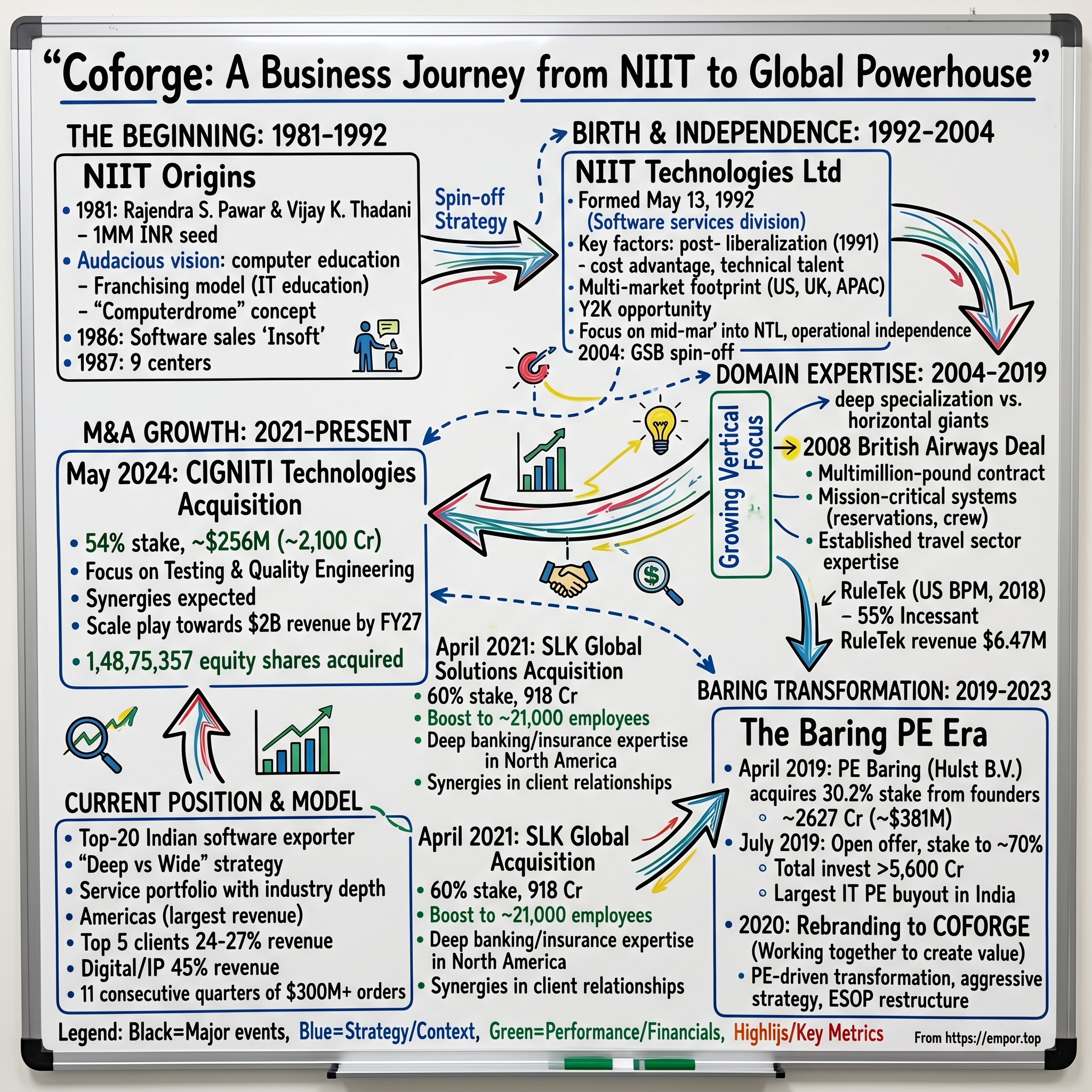
In 1981, India did not have a software industry so much as an aspiration to one. What it lacked most acutely was people. NIIT was established that year explicitly "to help the nascent IT industry overcome its human resource challenges" — a training company, built to manufacture programmers for an economy that had not yet decided it wanted them.6 The model was franchised computer education: storefront classrooms in second-tier cities, standardised curricula, and a brand that Indian parents came to trust the way American ones trusted a driving school. It worked. For a generation of middle-class Indians, an NIIT certificate was the on-ramp to the software boom.
A training company that teaches software eventually notices that its students are being hired by firms billing many multiples of what the courses cost. NIIT built a software services arm, and in 2004 — after a restructuring exercise — NIIT Technologies was demerged from NIIT Ltd and became an independently listed company. From that moment the two businesses drifted apart in character. The parent stayed in education. The child went hunting for enterprise contracts in London and New York.
What is striking, looking back, is the choice NIIT Technologies made about how to compete. The Indian IT playbook of the 2000s was horizontal and volumetric: hire aggressively, staff broadly, serve every industry, and win on cost per engineer. Tata Consultancy Services and Infosys were building organisations of hundreds of thousands of people, and the strategic logic was that scale itself was the moat — a bench deep enough to answer any request-for-proposal in any sector.
NIIT Technologies went the other way. It picked three verticals and refused to be distracted: banking and financial services, insurance, and travel and transportation. By the time Baring Private Equity Asia looked at the business in 2019, that was still exactly how the company described itself — a firm of just over 10,000 people, focused on those three industries, layering data, automation and cloud capability on top of them.7 Deep, not wide. Two decades later that choice is still visible in the revenue mix, and it remains the single most important structural fact about the company.
The bet was not obviously smart at the time. Concentration is risk. A firm that derives a fifth of revenue from airlines is a firm that will have a very bad year when airlines have a very bad year — a proposition that would be tested brutally in 2020. But concentration also buys something a generalist cannot easily replicate: context. When a specialty insurer describes a problem in underwriting workflow, the vendor who has built six of those systems does not need a discovery phase. That shortens sales cycles, raises win rates on proactive proposals, and — critically — lets a small firm sit in conversations that its headcount alone would never earn it.
The relationships that came out of this era became the company's spine. Airline and travel-technology accounts, insurance platform work in the UK, banking and asset-servicing mandates in the United States. These were not transactional staffing arrangements. They were multi-year platform engagements where the vendor learns the client's business well enough that replacing them means re-learning it. Twenty years on, repeat business runs at 95.5% of revenue.8 That number is the compounded residue of the "deep not wide" decision.
There is a useful investor lesson buried in this period, and it is not the one companies usually tell. Vertical specialisation is not automatically a moat. It is a moat only when the domain is complex enough that knowledge accumulates faster than it depreciates, and when clients face real cost in switching. Airline cargo systems, insurance policy administration, and payments infrastructure qualify. Generic application maintenance does not. Coforge's durable advantage — to the extent it has one — was built in exactly the places where the work is annoying, regulated, and hard to describe in a procurement document.
By the late 2010s, though, the specialist had a problem. It was profitable but subscale, growing but not compounding, and — as the offspring of a training company whose promoter group's heart was elsewhere — strategically becalmed. Revenue sat around $400 million.4 Margins were unremarkable. The company needed an owner who wanted something from it.
In April 2019, one arrived.
III. The Baring Private Equity Era: Rebrand, Discipline, Exit (2019–2023)
Private equity buyouts of listed Indian technology services firms were historically rare. Takeover regulations created structural friction: crossing key ownership thresholds triggered mandatory open offers to public shareholders, preventing a clean squeeze-out into a private entity while leaving final control subject to market tender dynamics.
Baring Private Equity Asia proceeded regardless. On April 6, 2019, BPEA agreed to acquire approximately 18.85 million shares — roughly 30% of NIIT Technologies on a fully diluted basis — from NIIT Ltd and other promoter entities at ₹1,394 per share, totaling about ₹2,627 crore, or roughly $381 million. Concurrently, it launched an open offer for up to 26% more at the same price, bringing the total potential consideration to approximately ₹4,890 crore for a 56% controlling stake.7
That transaction structure shaped the company's subsequent governance. Baring was not making a passive growth investment, nor was it funding a full private buyout. By securing operational control while maintaining the public listing, the firm accepted quarterly disclosure requirements and minority-shareholder scrutiny in exchange for avoiding the capital demands of a full privatization. The setup created a distinct incentive structure: management needed to execute a value-creation plan on an accelerated private equity timeline, but under full public market transparency.
Unlike many private equity buyers that install new leadership, Baring retained CEO Sudhir Singh, who had joined two years earlier and had been running the business since. In an industry where sponsors frequently replace executive slates, maintaining leadership continuity proved to be a pivotal decision.
The firm subsequently focused on operational discipline and corporate identity. In May 2020, the board approved a name change, and on August 24, 2020, NIIT Technologies officially began operating as Coforge Limited — severing the last visible link to a training-focused parent brand that carried outdated associations in global enterprise procurement rooms.33 Singh described the name as symbolizing collaborative effort to create lasting value,33 but the commercial objective was broader: shedding the image of an IT training byproduct to position the company as an independent enterprise service provider.
Coforge then added inorganic growth to its strategic playbook. In April 2021, the company signed definitive agreements to acquire 60% of SLK Global Solutions for ₹918 crore, with an agreement to buy a further 20% from Fifth Third Bank after two years. SLK was a business process transformation firm serving North American banking and insurance clients, generating $62 million in revenue in fiscal 2020 and a projected $73 million in fiscal 2021. Notably, Coforge funded the transaction through a combination of internal cash reserves and external debt — establishing an early precedent for leverage-backed expansion.10
SLK was primarily a customer-acquisition and delivery-efficiency transaction rather than a technology play. It brought established financial-services client relationships, expanded lower-cost delivery infrastructure, and provided services that could be cross-sold across Coforge's existing account base. This classic private equity bolt-on model — acquiring adjacent operational scale to extract cost synergies and boost margins — established the playbook for future M&A.
Baring executed its exit with standard private equity timing. In February 2023, the firm sold a 9.8% stake — six million shares at ₹4,050 per share — for ₹2,430 crore. In August 2023, Baring divested its remaining 26.63% stake through block trades at a floor price of ₹4,550 per share (a 7.4% discount to the prior close), realizing approximately ₹7,400 crore and fully liquidating its position.9 Adjusted for Coforge's subsequent five-for-one stock split with a record date of June 4, 2025,28 these sale prices represented a substantial return relative to Baring's 2019 entry price of ₹1,394 per share.
Baring's complete exit left Coforge with an unusual ownership profile for a mid-tier Indian IT firm: zero promoter holding. As of June 2026, domestic institutional investors held approximately 42.6%, foreign institutional investors held 24.3%, and public shareholders held the remaining third.2 With no founding family or parent corporation, Coforge lacks the traditional governance vulnerabilities of Indian mid-caps, such as related-party transactions, promoter share pledging, or hereditary succession.
However, a fully dispersed ownership base also removes structural checks on management. Institutional shareholders vote on governance matters but rarely coordinate to block corporate strategy. In a firm without an anchor shareholder, a long-tenured executive team pursuing ambitious growth goals faces relatively weak external friction when expanding the balance sheet or issuing equity.
That governance dynamic shifts attention back to the executive leadership Baring elected to keep.
IV. Sudhir Singh's Coforge: Strategy, Incentives, and Track Record (2018–2024)
Sudhir Singh grew up moving between army cantonments — his father was an Indian Army officer — and completed an MBA at IIM Calcutta in 1995. His first job was at Hindustan Lever, the consumer goods company that has long functioned as an executive training academy for corporate India. The formative episode he frequently recalls is not a boardroom negotiation but a four-month field stint in Cooch Behar, a remote strip of West Bengal wedged between Bhutan and Bangladesh, living on a minimal daily allowance and learning how products actually move through a market. He has called that period "extremely instructive," teaching him about "execution and making sure that when one commits to a goal or a strategy, one delivers as a team on that strategy irrespective of change, irrespective of constraints."11
That experience provided the origin for a phrase he has since repeated across earnings calls: "an execution intensity that is uniquely our own."4
After six years at Unilever, Singh moved to Infosys in 2001, spending nearly a decade in the United States running key financial services accounts, founding and directing the global payments and cards portfolio within the banking vertical, and heading the South-West region.1112 He then joined Genpact as chief operating officer of its capital markets business. By the time he joined Coforge in May 2017 and assumed the chief executive role, his career combined consumer-goods execution discipline, financial-services domain depth, and the operational integration of acquired businesses.12
The financial record under his tenure appears strong on the surface. A company generating roughly $400 million when the current leadership took over has expanded nearly seven-fold over a decade.4 Fiscal year 2026 alone delivered 29.2% revenue growth in dollar terms, an EBIT margin expansion of 370 basis points to 14.4%, and a 91.6% increase in rupee profit after tax.5
An investor, however, must untangle three distinct drivers behind those headline figures. The first is operational execution through expanding market share within existing accounts. Client-cohort data supports this: in fiscal 2026, top-five client accounts grew 45.8% year-on-year, while accounts six through ten grew 30%. Together, the top ten accounts expanded 40.4%, generating 30.8% of total revenue.4 Growth concentrated within long-standing client relationships reflects deepening wallet share rather than sheer account acquisition. The second driver is acquired revenue, which inflates top-line scale without signaling organic demand. The third is an industry-wide valuation re-rating that lifted mid-tier Indian IT peers across the board — a macro tailwind unrelated to management performance.
Distinguishing among these factors is crucial. If public markets assign a premium growth multiple to what is partially a roll-up strategy, that valuation multiple becomes vulnerable in ways masked by headline financial reports.
Coforge's pre-2024 capital allocation track record remained disciplined by Indian mid-cap standards. Bolt-on acquisitions such as RuleTek, Incessant Technologies, and SLK Global were sized to limit downside risk and targeted specific capabilities or client bases without materially diluting equity. Whether each transaction individually earned its cost of capital remains impossible to verify independently, as Coforge never reported them as standalone financial segments. This lack of segment disclosure has remained a persistent limitation when evaluating the company's decade-long acquisition track record.
The executive incentive structure also warrants examination. For fiscal 2025, Singh's total compensation reached approximately ₹36.1 crore, though cash accounted for only ₹13.9 crore. The remaining ₹22.3 crore represented the perquisite value of stock options, bringing his total remuneration to roughly 361 times median employee pay.12 His direct equity stake remains modest at approximately 0.45% of the company.12
This compensation structure carries dual implications. Optimistically, it aligns executive rewards with equity performance, as the vast majority of pay depends on share price appreciation. Less charitably, heavy reliance on stock options creates asymmetrical risk exposure akin to a call option. Options offer uncapped upside while capping downside losses, failing to impose symmetric financial pain. Such incentives can subtly encourage management to prioritize aggressive growth strategies — including dilutive acquisitions that expand total enterprise value even if per-share gains lag behind.
Target-setting patterns reflect a similar growth bias. After publicly committing to reach $2 billion in revenue, Coforge announced a target in June 2026 of reaching $5 billion by 2030. Reaching that mark requires revenue to double from its current run-rate. Management projects roughly 15% annual organic growth, with acquisitions explicitly budgeted to supply the remaining balance, including an estimated $500 million in purchased revenue.14 Although Singh has pledged to avoid bidding wars for overpriced assets,14 committing to a rigid revenue target with budgeted M&A creates structural pressure to execute transactions on a set schedule — conditions that historically risk overpaying for targets.
A management team's execution is tested not just by strategic commitments, but by how it manages operational setbacks. When Coforge missed expectations in the December 2025 quarter, management responded with detailed financial disclosures rather than vague explanations. Reported profit after tax fell to ₹296.7 crore due to ₹147 crore in exceptional items. On the January 23, 2026 earnings call, Chief Financial Officer Saurabh Goel itemized these costs: ₹118 crore stemming from India's new Labour Codes, ₹13.5 crore in legal expenses for the proposed Encora acquisition, and ₹16.2 crore conservatively provisioned for legal costs related to an August 2023 cybersecurity incident, partially offset by errors-and-omissions insurance.1534 With EBIT margin dropping to 13.4%, Goel maintained full-year guidance of 14% by detailing the required recovery path: achieving a 15% margin in the fourth quarter.34 Coforge subsequently met that threshold, delivering a 16.6% EBIT margin in Q4 and 14.4% for the full year.5
Providing explicit line-item bridges and delivering on restated targets reinforces management's execution claims far more effectively than blaming macro conditions. However, legal expenses from the three-year-old security incident continued into fiscal 2026 — with an additional ₹35 million recognized in the March 2026 quarter8 — while full details of the incident remain undisclosed. That persistent cost highlights a remaining disclosure gap in an otherwise transparent operational record.
The quarterly variance also underscored a core structural reality. A business whose earnings fluctuate based on labor code revisions, currency hedges, and wage shifts remains fundamentally labor-intensive — the precise operational model Singh was already moving to transform through large-scale acquisitions.
V. The Cigniti Acquisition: Control, Then Full Amalgamation (2024–2026)
On May 3, 2024, Coforge's stock fell 10% to ₹4,505 — a nine-month low.16 Investors reacted to twin announcements: fourth-quarter financial results and board approval to acquire up to 54% of Cigniti Technologies at ₹1,415 per share, accompanied by a mandatory open offer.19
The market's skepticism centered less on valuation than on strategic direction. Cigniti's core business was digital assurance and software testing — the precise IT service line most directly vulnerable to generative AI automation.
The strategic dilemma is clear. Writing test cases from software specifications involves structured inputs, defined outputs, and high volume — precisely the work automated coding models excel at replacing. Coforge offered a counter-thesis: that artificial intelligence expansion actually increases demand for specialized testing because autonomous software generation requires human and algorithmic verification. While both dynamics may operate concurrently, their long-term balance remains unsettled. What is certain is that Coforge committed substantial capital to a service line facing structural technology shifts.
Management presented a broader strategic case. Executive leadership asserted that Cigniti would help Coforge reach its $2 billion revenue milestone, establish scaled practices in retail, high-tech, and healthcare, and extend its US presence beyond the East Coast into the Midwest and West Coast.18 For an IT services provider, geographic distribution functions as sales access; acquiring Cigniti granted Coforge entry to corporate procurement teams it had not previously reached.
Coforge built its controlling interest incrementally rather than through a single transaction. On July 4, 2024, the company purchased an initial 11% stake for ₹426 crore. The following day, it acquired an additional 16.9% — comprising over 4.6 million shares at an average price of ₹1,398.50 — for ₹645.85 crore via open-market trades, buying out two major institutional investors and a portion of the founding promoter group.17 Accumulating shares in tranches allowed Coforge to establish control while its mandatory open offer progressed. The final tranche closed on December 20, 2024, securing a 54% controlling stake in Cigniti's expanded voting capital.19
Operational control, however, did not immediately equal full corporate integration. For two years, Cigniti operated as a separately listed subsidiary with minority shareholders. This structure required maintaining duplicate compliance frameworks, carrying a quarterly minority-interest charge on Coforge's income statement, and restricting full operational consolidation. Regulatory approvals from the Competition Commission of India, SEBI, and finally the National Company Law Tribunal cleared in April 2026.18 Coforge set May 16, 2026 as the record date for a one-for-one share exchange, canceling Cigniti shares, issuing replacement Coforge equity, and formally dissolving Cigniti as an independent corporate entity.4
The accounting mechanics of the amalgamation introduced significant transitory distortions into reported earnings. On the fourth-quarter fiscal 2026 earnings call, Chief Financial Officer Saurabh Goel detailed how remeasuring deferred tax balances for the combined entity generated a ₹181 crore tax credit reversal. This non-cash adjustment reduced the reported effective tax rate for the quarter to negative 7%, compared to a normalized 22% baseline. For the full year, reported effective taxes fell to 13% against a normalized 23%, with guidance projecting a return to 23% to 24% in fiscal 2027.4 While fully disclosed, the one-time tax accounting benefit inflated headline net profit without altering cash taxes paid.4
The elimination of minority interest created a similar optical gain. A quarterly charge of ₹53 crore to ₹54 crore against minority holdings dropped to roughly ₹9 crore following full equity allotment — delivering a mechanical increase in net profit attributable to parent shareholders unrelated to underlying operating performance, though diluted by the issuance of new Coforge shares to former Cigniti investors.4
Evaluating the strategic success of the transaction requires separating management claims from independently auditable financial reporting. Coforge reported that Cigniti's operating margin expanded from roughly 11% at acquisition to 19% within six quarters. Management also highlighted commercial milestones, noting that Cigniti secured a $24 million contract within six months of joining Coforge and a $62 million contract within nine months — after never closing a transaction of that scale in its 25-year independent history. Additionally, management reported that annual revenue from Cigniti's top two clients expanded from $25 million to $75 million through cross-selling across Coforge's broader client base.184 Summarizing the outcome, Chief Executive Officer Sudhir Singh stated: "The Cigniti acquisition is a textbook example of a firm making a contrarian bet that has worked out."18
If verified, an 800-basis-point operating margin expansion alongside a tripling of major account revenue would demonstrate effective cross-selling and cost integration.
However, analytical caution is warranted. These financial metrics were disclosed through executive commentary rather than audited segment reporting. Following full legal amalgamation, Cigniti ceased to exist as a reporting segment, eliminating the ability of external investors to independently verify long-term revenue retention or margin trajectories. The reporting trail closed precisely as management used Cigniti as the operational blueprint for an even larger transaction.
An objective assessment indicates that while Coforge successfully executed operational consolidation, cross-sold services, and reduced overhead costs within two years, public disclosures do not provide sufficient granular data to evaluate the long-term return on invested capital. Traceable segment disclosures tracking acquired revenue and margins over several years would be required to validate full capital efficiency — data that current financial reporting formats do not provide.
Nevertheless, Cigniti established the integration blueprint that executive leadership would leverage when proposing its next major expansion.
VI. The Encora Acquisition: A Different Order of Magnitude
The defining deal of Coforge's expansion strategy achieved its scale through pure equity structure: Coforge acquired a $2.35 billion enterprise without spending a single rupee of cash on the purchase price.
On December 26, 2025, Coforge announced an agreement to acquire Encora — a US-headquartered digital engineering firm backed by Advent International and Warburg Pincus — at an enterprise value of $2.35 billion, with equity consideration valued at approximately $1.89 billion, or ₹17,032.6 crore.321 Rather than tapping cash reserves, Coforge issued fresh equity via preferential allotment at ₹1,815.91 per share, representing a 14.5% premium over the pre-announcement closing price. The transaction created 93,796,508 new shares for the sellers, granting them a 21% stake in the expanded company.2021
Consider the financial mechanics of that structure. In a cash transaction, existing shareholders retain complete ownership of a company that trades cash for operational assets. In a fixed-rupee, all-stock deal, shareholders trade equity percentage for scale, with ownership dilution locked at the issue price on signing day. As one detailed transaction analysis noted, in fixed-rupee stock deals, "the issue price is not a detail, it is the deal, because a fixed rupee consideration means the price alone decides how much of the company you hand over." Had the issue price been set 10% lower, the sellers would have received 23.7% of the combined entity; 10% higher, and their stake would have dropped to 20.2%.20
That structure exposed shareholders to market volatility between signing and closing. Between the handshake and the final handover, Coforge's share price dropped sharply. By the time the acquisition completed on April 23, 2026, with Encora consolidating from May 1,22 accounting standards required recording the transaction at the closing market value of ₹1,220 per share — well below the ₹1,815.91 deal price. Chief Financial Officer Saurabh Goel explained on the June quarter earnings call that this market decline reduced recorded balance-sheet goodwill by roughly $600 million compared to initial projections.13
A smaller goodwill balance reduces the risk of future asset impairments, but it also reflects an immediate market repricing. Because Encora's private equity owners contracted to receive a fixed share quantity, the market selloff erased nearly a third of their expected payout value before closing. The $600 million reduction in goodwill stands as a balance-sheet record of equity value lost while the deal was in flight.
Initial market reaction to the deal announcement had been subdued. On December 29, 2025, the first trading session after the news, Coforge stock rose 2.4% intraday before closing flat at ₹1,672.50, following a 10% decline over the prior week.24 Wall Street and Indian brokerages took contrasting views. Motilal Oswal and Kotak maintained Buy ratings with price targets between ₹2,250 and ₹2,500, citing strategic logic while highlighting integration risks and questioning whether earnings per share accretion by fiscal 2027 was achievable. DAM Capital took a more cautious stance, pointing to Encora's premium valuation, its slower organic revenue growth, and potential overhang from private equity selling once lockups expired.24 The subsequent slide toward ₹1,220 reflected a broader valuation contraction across mid-tier IT stocks alongside market scrutiny of Coforge's execution plan.
In exchange for a fifth of its equity, Coforge added significant operational scale. Encora brought approximately $600 million in expected fiscal 2026 revenue at a 19% adjusted EBITDA margin, 9,256 employees, more than 3,100 engineering and AI specialists across Latin America, and forty-five client accounts generating over $10 million in annual revenue.313
The Latin American delivery footprint offered a clear operational advantage that would have required years to build organically. As ISG analyst Stanton Jones observed in late December 2025, "Americas tech and sourcing leaders consistently indicate that time zones are one of the biggest risk factors in their global delivery decisions."23 Serving North American enterprise clients from India introduces a twelve-hour time difference, whereas delivery hubs in Guadalajara or Bogotá operate within standard US business hours. For agile product engineering, nearshore real-time collaboration provides a clear operational edge over offshore batch processing.
Encora also contributed AIVA, a composable agentic AI platform for product engineering, along with client relationships in high-growth sectors where Coforge lacked scale. The transaction added over $170 million in annual recurring revenue across high-tech and another $170 million across healthcare, medtech, and pharmaceuticals, while expanding North American revenue by approximately 50%.8
An independent assessment by Everest Group, published four days after the announcement, acknowledged these strengths while warning of operational integration risks. Everest noted that Encora generated higher revenue per employee than Coforge — roughly $74,000 compared to $69,000 — supporting management's assertion of acquiring higher-quality revenue.31 However, analysts cautioned that absorbing Encora's rapid, autonomous delivery model without "over-governing delivery or slowing execution" would be challenging for an acquirer absorbing a firm one-third its size, raising the risk of diluting the company's focused AI identity.31
This warning highlights a core tension in Coforge's integration playbook. Management's policy of replacing acquired leadership on Day 1 contrasts sharply with preserving Encora's autonomous operating culture. While executive leadership cites rapid integration as essential for capturing financial synergies, industry analysts view that approach as a potential risk to the target's core capabilities. Whether aggressive leadership replacement protects or erodes acquired value remains an unresolved question.
The transaction's debt structure adds a second layer of scrutiny. To retire existing debt within Encora, Coforge initially considered a bridge loan, a term loan, or a qualified institutional placement of up to $550 million.34 Ultimately, the company bypassed equity dilution in favor of a $550 million, three-year fixed-rate term loan at 4.6%.3413 On the January earnings call, Goel assured investors that the borrowing cost remained manageable and that guidance of achieving non-dilutive earnings per share by fiscal 2027 remained intact.34
On the July 2026 earnings call, Goel detailed the loan terms after fully drawing the facility on June 30. Benefiting from a 35% Indian tax deduction, the net effective borrowing cost dropped to 2.99% — roughly 30 basis points above the three-year SOFR rate at signing. Management fixed the rate to insulate the balance sheet from interest rate fluctuations. Principal repayments are structured with $59 million due in fiscal 2027, $209 million in fiscal 2028, $258 million in fiscal 2029, and a final $75 million tranche in early fiscal 2030. Goel also confirmed that the facility contains no restricted cash requirements or operational covenants that would limit strategic flexibility.13
The debt structure is financially efficient: fixed-rate, tax-optimized, and naturally hedged by Coforge's US dollar revenue stream, which enabled the firm to wind down its currency forward contracts.4
Nevertheless, four capital allocation questions confront investors.
First, the transaction compresses return metrics. Prior to the deal, Coforge reported a return on equity of 21.4% and a return on capital employed of 23.5%.2 Adding approximately $1.2 billion in fair-value equity expands the capital base immediately, requiring net income to grow substantially before return ratios recover to historic levels.
Second, intangible asset amortization creates an ongoing drag on reported margins. Coforge recognized approximately $480 million in customer relationship intangibles — nearly 30% of the purchase price — to be amortized over twelve years at $40 million annually.13 This non-cash charge accounts for the 150-basis-point spread between management's projected standalone EBIT margin of 16.5% to 17% and its consolidated margin guidance of 15.5% for fiscal 2027.4
Third, per-share earnings growth remains unproven. While management committed to avoiding EPS dilution in fiscal 2027, initial results show adjusted EPS fell from ₹13.8 in the March quarter to ₹13.3 in the June quarter.13 Although holding earnings per share largely flat while absorbing a 25% equity expansion and new debt service is notable, flat performance is not accretive. The earnings accretion thesis requires further quarters to validate.
Fourth, governance alignment warrants scrutiny. As the largest capital allocation in Coforge's history, the deal was executed by a board without an anchor shareholder in favor of a target backed by Advent International and Warburg Pincus. Under the agreement, Advent secured a board seat alongside its 20% equity stake. As CEO Sudhir Singh noted in January 2026: "We have never had a private equity on our board so far. Once the deal is consummated around April, Advent will join the board. They will have 20 per cent stake. We do plan to work with Advent portfolio companies to see if we can use them as a new channel for driving growth."25
While leveraging a private equity sponsor's portfolio can accelerate client acquisition, combining seller representation, board governance, and commercial cross-selling creates an intricate alignment of interests. Whether future related-party disclosures transparently segment revenue derived from Advent portfolio companies will be a key metric for institutional investors.
Ultimately, the Encora acquisition fundamentally reshaped Coforge's scale and operational profile. That transformation becomes immediately visible in the company's shifting segment mix.
VII. Business Model, Segments, and Competitive Position Today
A close examination of Coforge's financial segment disclosures reveals a contrast between the company's public narrative and its underlying revenue structure.
While management emphasizes rapid vertical diversification and expansion into AI-native digital engineering, the reported metrics show a more traditional revenue foundation. In fiscal 2026, banking and financial services (BFS) contributed 26.5% of total revenue, insurance accounted for 15.0%, and travel, transportation, and hospitality delivered 23.0%. Healthcare and high-tech generated 10.8%, government business outside India represented 7.0%, and remaining sectors—including retail, energy, utilities, and manufacturing—comprised the final 17.7%.8
Two primary conclusions emerge from these disclosures. First, the legacy core continues to anchor the firm, with banking, insurance, and travel combined generating nearly two-thirds of total revenue. Second, while the segment mix shifted over the year, the primary expansion occurred outside artificial intelligence. Travel expanded from 18.3% of revenue in fiscal 2025 to 23.0% in fiscal 2026, growing 62% in dollar terms over the year, while banking and financial services contracted from 30.5% of total revenue to 26.5%.48 The single largest operational shift at Coforge in fiscal 2026 stemmed not from software automation, but from airline sector demand.
Headline figures in newer verticals also require contextual analysis. Healthcare and high-tech reported 98% year-on-year growth in fiscal 2026,4 though this rapid percentage increase originated from a low baseline of 7.0% of total revenue. While this expansion demonstrated that Coforge could execute its vertical-entry playbook in new sectors, the firm remained fundamentally reliant on its core banking, insurance, and travel accounts for revenue scale. The acquisition of Encora significantly altered this vertical balance: by the June 2026 quarter, healthcare and high-tech had jumped to 17.3% of consolidated revenue.13 However, that structural gain reflected purchased inorganic scale rather than organic market expansion.
The banking and financial services vertical presented a distinct headwind, growing just 12% in fiscal 2026 compared to the overall corporate average of 29.2%.4 During the fourth-quarter earnings call, Kotak analyst Kawaljeet Saluja pressed management on the stagnation, observing that banking revenues had remained constrained between $120 million and $123 million for five consecutive quarters, and questioned whether enterprise clients were shifting work to internal Global Capability Centres (GCCs). Chief Executive Officer Sudhir Singh dismissed the systemic threat, clarifying that revenue flatlined because a single top-three banking client paused growth. Singh noted that the account had been assigned to President John Speight's direct oversight and stated that the slowdown had "nothing in our mind to do with the GCC movement," while Speight confirmed that delivery operations were restructured under new leadership.4
Initial results provided early data on that management claim. In the June 2026 quarter, banking and financial services returned to growth, expanding 2.9% sequentially on an organic, constant-currency basis.13 The episode highlighted a structural vulnerability in Coforge's high-concentration model. With the top ten client accounts contributing 30.8% of fiscal 2026 revenue and the top five alone representing 21.0%,8 performance hiccups in a single major relationship directly depress consolidated results. Account concentration enables the deep domain integration that generates 95.5% repeat business, but it also ensures that client-specific operational changes spill over into company-wide financial metrics.
The distribution of client revenue provides the clearest empirical measure of account expansion. At the close of fiscal 2026, Coforge disclosed detailed client tiering for the first time: one account generating over $100 million, three between $50 million and $100 million, nine between $20 million and $50 million, twenty-three between $10 million and $20 million, forty-two between $5 million and $10 million, and 167 between $1 million and $5 million.4 Following the consolidation of Encora in the June 2026 quarter, the $20 million to $50 million tier expanded from nine to fourteen clients, while the $10 million to $20 million tier increased from twenty-three to twenty-nine.13
This client pyramid illustrates Coforge's core organic growth mechanism. Rather than relying primarily on acquiring new logos, the firm focuses on escalating existing enterprise accounts into higher revenue brackets. While account escalation requires lower sales overhead and indicates high client switching costs, overall growth remains capped by the expansion capacity of existing enterprise relationships. This constraint explains why Singh characterized Encora's client base as an expanded "addressable wallet" for cross-selling.4
The first consolidated quarter after the acquisition also altered client concentration metrics, with top-five client revenue share falling to 18.0% and top-ten concentration dropping to 26.1%.13 HSBC analyst Prateek Maheshwari questioned this shift during the earnings call, pointing out that because most Encora revenue sat outside Coforge's top accounts, the acquisition initially diluted overall client concentration. Singh defended the trend by applying the account escalation model to the newly acquired portfolio, noting that one former Encora client had already entered Coforge's top ten with "a path to making it a $50 million-plus account over the next 12 to 18 months," while two others had reached the eleven-to-twenty tier.13 This commitment provides a measurable benchmark for evaluating post-merger cross-selling execution over the subsequent six quarters.
Geographically, the Americas generated 56.9% of fiscal 2026 revenue, Europe, the Middle East, and Africa (EMEA) contributed 28.9%, and the rest of the world accounted for 14.2%.8 The addition of Encora further increases the firm's concentration in the Americas, elevating its sensitivity to foreign exchange volatility and US immigration policies affecting cross-border technology services.
In terms of total scale, mid-tier IT league table rankings in the first half of fiscal 2026 placed LTIMindtree at $2.3 billion in annualized revenue, followed by a tight cluster comprising Coforge at $904 million, Mphasis at $882 million, Persistent Systems at $796 million, and Hexaware at $777 million.27 Coforge stood out primarily through its top-line expansion rate, delivering 36.8% growth compared to 5.0% for LTIMindtree, 6.1% for Mphasis, 18.1% for Persistent, and 7.0% for Hexaware.27 Following the Encora acquisition, Coforge separated itself from the mid-tier cluster, positioning its run-rate between the broader group and LTIMindtree.
However, an objective evaluation requires distinguishing between organic execution and acquisitive expansion. Coforge did not surpass its mid-tier competitors through organic market share gains alone; it expanded its balance sheet to purchase revenue scale. While equity-funded scale provides tangible commercial benefits—including eligibility for larger enterprise RFPs and expanded investment capacity—acquired scale does not reflect superior underlying delivery efficiency, nor can equity dilution be repeated indefinitely without eroding shareholder returns.
A similar analytical scrutiny applies to Coforge's technology differentiation claims. Management highlights a growing portfolio of proprietary assets, including eight AI platforms, twenty-two AI solution assets, over 100 reusable agents and accelerators, more than 11,000 data and AI specialists, and $58 million invested in AI innovation during fiscal 2026.13 The company launched its flagship AI platform, Nuuron, on July 23, 2026, positioning it as an "AI Operating System" built atop legacy tools such as Forge-X, CodeInsight.AI, Data Cosmos, Quasar, and BLUESWAN—the software testing suite acquired through Cigniti.30
Evaluating whether these assets represent genuine software productization or standard IT staffing rebranded under AI terminology yields mixed evidence.
On the skeptical side, financial disclosures do not separate software asset revenue from traditional hourly services. When Motilal Oswal analyst Abhishek Pathak asked management to quantify standalone platform revenue, Singh declined, stating, "We cannot call out a number, which is AI only or AI standalone."13 Instead, management cited a broad metric indicating that 86% of revenue derived from AI-led engineering, data and integration, and cloud services, which Singh acknowledged was "an umbrella surrogate."13 Such composite metrics offer limited analytical precision, particularly given that service-line definitions shifted during the quarter: AI-led engineering expanded by roughly five percentage points while cloud services declined by 2.7 points. Singh attributed these shifts to a classification realignment of cloud engineering revenues alongside Encora's lower cloud exposure.13 Reclassifying legacy engineering contracts under an expanded AI label makes it difficult for external investors to verify independent software demand.
On the supportive side, four operational indicators suggest initial progress toward non-linear revenue delivery. First, outcome-based contracts—where revenue depends on project deliverables rather than billable hours—represent 6% to 7% of total global revenue on a run-rate basis.13 Second, approximately 30% of active client engagements integrate AI assets into delivery workflows.13 Third, during the July earnings call, management outlined three specific outcome-based pricing frameworks: risk-sharing models for legacy modernization tied to successful deployment, monthly subscription tiers for hybrid human-agent delivery teams ("Mod Squads"), and performance fee structures tied to client business outcomes.13 Fourth, in August 2026, HFS Research included Coforge among six global providers exhibiting sustained non-linear revenue growth across four consecutive quarters, citing above-average year-on-year constant-currency revenue per full-time employee and operating margin per employee.32 This independent assessment provides empirical support that revenue is beginning to decouple modestly from billable headcount.
A balanced assessment indicates that Coforge possesses stronger operational evidence of non-linear growth than many mid-tier peers, even if its capabilities fall short of management's platform rhetoric. The company generates higher revenue per employee than industry averages and has initiated outcome-based pricing models across select accounts. However, the thesis that Coforge has transformed into a technology platform firm remains unvalidated by segment reporting. The critical metric for institutional investors going forward will be the trajectory of outcome-based revenue; maintaining a 6% to 7% share over the medium term would indicate that traditional labor billing remains dominant, whereas expansion toward 20% would signal a structural shift in delivery economics.
Whether IT services providers can successfully decouple revenue growth from headcount expansion remains the central strategic question facing the broader industry.
VIII. The GenAI Reckoning: Can a Labour-Linear Business Outrun Its Own Disruption?
There is a slide that does not exist in any Indian IT investor deck, and it is the only one that matters. It would show, on one axis, the number of billable hours the industry sells each year, and on the other, the falling cost of producing a line of working software. For thirty years those two lines moved together, because software was made by people and people were the product. Generative AI is the first technology that credibly threatens to decouple them — and the entire Indian services industry, Coforge very much included, is built on the assumption that they stay coupled.
Sudhir Singh's response to this is not evasion. It is a specific, falsifiable counter-argument, and it deserves to be stated properly before it is tested. He set out the premise in a February 2026 interview: "We believe the age of AI experimentation that we have all been looking at over the last three years is over," with the next generation of enterprises having "their business capabilities defined and executed by a combination of human and AI agents." Usefully for an investor trying to separate observation from prophecy, he also made a checkable near-term claim in the same conversation — that discretionary technology budgets for calendar 2026 appeared broadly in line with 2025 rather than contracting.26
His framing, delivered in the outlook section of the May 2026 call, runs like this: "The deflationary argument assumes code generation is the entire job. It is not. AI-generated code is cheap to build, but it is expensive to own. It is expensive to secure and it is expensive to maintain."4 The analogy he reaches for is cloud migration. Moving workloads to the cloud was, in theory, a one-time project that would shrink the addressable market for infrastructure services. In practice it created an entirely new and larger recurring layer — cloud operations, cost management, security posture, compliance — that services firms have monetised for a decade. Agentic AI, on this view, does the same thing: once autonomous agents run inside a bank's loan-origination process, somebody has to monitor the models, retrain the agents, catch the drift, and prove to a regulator that the whole apparatus behaves.
Coforge has named three demand pools that follow from this: AI-ready data pipelines, agent lifecycle management, and recurring managed services to monitor models and govern agents.4 It is a coherent thesis. It is also, at this stage, mostly a thesis.
The technical scaffolding is worth explaining in plain terms, because it is where the credibility question actually sits. Chief technology officer Lalit Vadhwa — who joined Coforge from Encora — described the core problem on the same call: most enterprise AI pilots never reach production, and the reason is not the model. Pilots run in controlled conditions that hide the failures production exposes. His two named failure modes are worth translating. "Hallucinated domain logic" means the system invents a business rule that sounds plausible and is wrong — an insurance claim rule that does not exist in the policy. "Lost agent coherence in long-running processes" means the AI forgets what it was doing halfway through a multi-step task, the way a very capable intern might if you interrupted them for a week.
Coforge's stated answer is a three-layer reference architecture: a business layer defining goals and use cases, a middle "decisioning" layer that encodes domain rules, ontologies and a knowledge graph so the AI reasons inside the real constraints of the industry, and a bottom composable layer that can swap between hyperscalers, sovereign clouds or model providers.4 Think of it as putting deterministic guardrails around a probabilistic engine — the machine can still be creative, but only inside a fence built from the client's actual rulebook. Delivery runs through "Mod Squads," hybrid pods of senior specialists and AI agents drawn from a library of roughly 110 to 130 agent archetypes, fronted by "forward-deployed engineers" who sit inside the client's environment.413
Does it work? The case studies Coforge publishes are specific enough to be interesting. For a tier-one bank, an AI-led modernisation of 11,000 lines of mainframe COBOL — complete with the copybooks, VSAM files and Assembler dependencies that make legacy banking code so miserable — delivered in half the time the client allowed, executed by one senior forward-deployed engineer, two junior consultants and a set of coding agents.4 For a specialty insurance provider, a migration to Azure that reduced technical debt by 92% with 99.93% field-level accuracy.13 For a global travel technology client, 30% productivity gains and a 22% reduction in manual effort.13
Read those numbers as evidence of capability, not of business model change. A three-person team plus agents replacing a much larger one is exactly what the bear case describes: the same work, delivered with fewer billable hours. Whether that is good or bad for Coforge depends entirely on whether pricing follows effort or follows outcome. Which is why the 6–7% outcome-based revenue figure is the single most important disclosure the company makes, and why its refusal to size platform revenue separately is the single most conspicuous one it declines to make.
The internal evidence is more encouraging than the rhetoric. Between March 2026 and June 2026, Coforge's headcount went from 35,777 to 46,228 — but 9,256 of that came from Encora, leaving organic net addition of 1,195 people against sequential revenue growth that, excluding deliberately exited businesses, ran at 5.2% in constant currency.413 Utilisation held at 82.5% and trailing-twelve-month attrition fell to 10.4%, among the lowest in the industry.13 Low attrition in a services firm is not a soft metric: it means less rehiring cost, less knowledge leakage, and — in a domain-heavy model — less erosion of the client-specific context that is supposed to be the moat.
Now for the disconfirming evidence, which belongs right here rather than in a distant risk section. Three pieces of it come from the company's own disclosures within the last six months.
Management has described the FY27 margin step-up as structural. Singh's words on the May call were that the company would "structurally and permanently reset the margin," and Goel attributed the fourth-quarter jump to SG&A leverage, foreign exchange, lower third-party cost, lower marketing spend and lower ESOP charges, offset by a 60 basis point provision for doubtful debts.4 Some of that is genuinely operational. But some of it is not durable in the ordinary sense, and management said so itself two months later. Asked about wage increases on the July call, Singh replied that outside "a highly select group," Coforge anticipates "no wage hikes at least till the first of January of next year. And that too is uncertain. So we may not have hikes in the current fiscal."13
A services firm that skips its annual wage revision for a year is a services firm carrying a temporary margin tailwind. It is a legitimate lever — attrition at 10.4% suggests the labour market permits it — but it is not a structural reset, and an investor should mentally separate the two. When wage revisions resume, that lever reverses.
The second piece of disconfirming evidence concerns capital allocation, and it is more pointed. In FY26 Coforge built and ran an India business that included data-centre work and government contracts, generating $40–45 million of revenue, roughly $40 million of it in the final two quarters — a genuine step-up, at pass-through economics. Coforge then exited it. On the May call, Goel disclosed that part of the assets from an AI-led data centre built in the first quarter of FY26 had been sold back to the client during the fourth, producing a cash inflow, and that the company would "not sign up such deals" again.4 The India government business, running at roughly $50 million annually, was culled in parallel.13
That is the right decision on margin grounds, and management deserves credit for taking it publicly rather than letting the revenue quietly decay. But it is also, plainly, a business Coforge chose to enter and chose to exit inside about eighteen months, at pass-through margins that were visible from the start. It sits awkwardly next to the framing of a management team that has "delivered unfailingly for nine years on all plans" it has shared.4 It is a small failure against a large record — the peer base rate for abandoned low-margin service lines is not zero — but it is the kind of thing that should temper the reflex to accept "surgical capital allocation" as an established characteristic rather than a claim.
The third piece is the one that undercuts the headline growth optics. Coforge's reported constant-currency sequential growth in the June 2026 quarter was 1.1%. The 5.2% figure management leads with excludes the culled data-centre and India government businesses.13 Both numbers are honest and both were disclosed on the same call. But the 5.2% is a pro-forma construction, and pro-forma constructions have a way of becoming the number everyone quotes.
Finally, the industry-level risk that no amount of execution intensity can fully offset. Coforge's own explanation of the AI opportunity — the managed-services layer, the modernisation surge, the agentic deployment wave — is a bet that the technology market expands faster than per-unit prices fall. Singh has been candid that deflation is real: "Yes, efficiency-related deflation is a reality, but the opportunities around legacy mod, data AI-ready foundations, cloud scalability, MLOps, model hosting, security are real here and now."13 What he cannot know, and what nobody can, is the ratio between those two forces three years out. If AI compresses effort faster than it creates new categories of work, a firm whose revenue is still overwhelmingly priced against effort will feel it regardless of how good its platforms are. And the acquired Cigniti testing franchise — the services line most directly in the blast radius — is now permanently invisible inside the consolidated numbers.
Two nearer-term risks round out the picture, and both are business-mechanism risks rather than macro decoration. The first is travel concentration meeting geopolitics: on the May call, Nuvama's Vibhor Singhal asked whether conflict in the Gulf and the crude price would cause airlines to pull back technology spend, and separately whether Spirit Airlines' troubles would hurt. Singh said the travel vertical continued to perform and that Spirit represented about 10 basis points of budgeted FY27 revenue — a specific, small, checkable number.4 But travel is 23% of revenue and airlines are a famously cyclical customer base; a genuine aviation downturn would be a Coforge event. The second is currency: the company reported $10 million of hedge losses in the June quarter plus a $14 million mark-to-market loss on outstanding hedges to be realised over two quarters, with the hedge book running off entirely beyond the third quarter.13 That is a known, quantified, self-liquidating drag — but it also means reported margins have been absorbing a headwind that will flatter comparisons once it disappears.
Which raises the obvious question: how much of the story the market believes about this company is actually true?
IX. Myth versus Reality
Every fast-growing mid-cap IT firm accumulates a surrounding narrative, and Coforge's is particularly well defined. Five core beliefs drive most market discussions about the stock. Examining each against the company's financial disclosures reveals a more nuanced reality.
Myth: Coforge is an AI company.
Reality: Coforge remains a domain-specialized IT services provider that invested early in AI tools while continuing to price most of its work through traditional labor metrics. Management's headline claim—that 86% of revenue comes from AI-led engineering, data, integration, and cloud—functions as a broad umbrella label for existing service lines, a metric Singh acknowledged was a surrogate rather than a direct measurement.13 The actual AI-specific metrics are far more modest: 30% of active client engagements integrate AI assets into delivery, 6% to 7% of revenue uses outcome-based pricing, and the company allocated $58 million to AI innovation during a fiscal year in which total revenue reached $1.87 billion.135 Spending roughly 3% of revenue on innovation represents a serious commitment that places Coforge ahead of many mid-tier peers, but it does not make it a technology platform firm.
Myth: The margin transformation is structural.
Reality: Only in part. The fourth-quarter fiscal 2026 EBIT margin expansion to 16.6%, up from 12.3% a year earlier, reflects real operational leverage, including holding selling, general, and administrative expenses flat in absolute terms while revenue expanded, alongside exiting low-margin pass-through contracts.4 Furthermore, cutting Encora's general and administrative costs by roughly 40% within its first quarter of ownership reduced combined G&A expenses to 6.6% of revenue.13 These efficiency gains are durable. However, management's margin targets also rely on temporary tailwinds, including postponing employee wage increases until at least January 2027—and potentially skipping them entirely for the fiscal year—alongside currency hedge losses that dissipate after the third quarter.13 A substantial portion of the margin gain is structural, but it is bundled with temporary cost deferrals. The definitive test will be whether fiscal 2028 margins remain at or above the guided fiscal 2027 baseline once wage increases resume, a threshold Singh pledged "will be the minimum" expected from fiscal 2028 onward.4
Myth: Management has never missed.
Reality: The claim holds up well regarding operational targets, representing the strongest argument for optimistic investors. The December 2025 quarter provided a clear test: when EBIT margin dropped to 13.4% against a 14% full-year target, management detailed a precise recovery plan requiring a 15% margin in the fourth quarter, and subsequently delivered 16.6%.345 Management also raised its free cash flow conversion guidance from 70%–80% of net profit to 100%, following a fiscal 2026 performance that generated $135 million in free cash flow compared to $80 million the previous year.4 Conversely, the rapid entry into and exit from low-margin Indian data center and government contracts within eighteen months shows that strategic execution has suffered occasional missteps. Furthermore, publicly committing to reach $5 billion in revenue by 2030 creates rigid growth targets that could incentivize risky acquisitions.14 The management team boasts a solid track record of achieving short-term operational guidance, even as the long-term returns on its capital deployment decisions remain unproven.
Myth: The balance sheet is now stretched.
Reality: The balance sheet carries leverage for the first time, but it remains manageable. The $550 million term loan marks the largest borrowing in Coforge's history, yet it is supported by a business that generated $135 million in free cash flow in fiscal 2026 and expects to convert 100% of net profit into cash going forward.4 The three-year loan amortizes fully by the first quarter of fiscal 2030, carries a tax-optimized effective interest rate below 3%, features a fixed rate without restrictive cash requirements or operating covenants, and is naturally hedged by US dollar revenue.13 The true long-term cost of the Encora acquisition lies not in its debt facility, but in its equity dilution—issuing a 21% stake permanently while absorbing a twelve-year amortization charge against reported net income.
Myth: The Encora deal was expensive.
Reality: Assessing the transaction requires examining how risk was distributed rather than focusing solely on acquisition multiples. At an enterprise value of $2.35 billion against approximately $600 million in expected revenue and a 19% adjusted EBITDA margin, the purchase price appeared high, as highlighted by analysts at DAM Capital.24 However, because Coforge structured the transaction as a fixed-rupee stock exchange, the decline in Coforge's share price between announcement and closing forced the sellers—Advent International and Warburg Pincus—to absorb a mark-to-market loss of roughly one-third of their expected equity consideration value before closing.13 This structure shifted a significant portion of market volatility to the selling private equity firms. In return, existing Coforge shareholders permanently surrendered a fifth of the company's equity and accepted an ongoing intangible amortization drag. Determining whether the acquisition was overly expensive ultimately depends on whether Encora's acquired revenue compounds faster over the next several years than the equity issued to purchase it.
X. The Bull Case, the Bear Case, and the Competitive War Game
Evaluating Coforge's competitive positioning reveals an IT services industry under severe structural pressure, yet it also highlights specific niches where the firm maintains relative insulation.
Rivalry across Indian IT services is intense and structurally entrenched, characterized by dozens of capable vendors, transparent pricing benchmarks, and corporate procurement teams that routinely re-bid contracts. Coforge mitigates this threat by avoiding broad horizontal competition. In specialized niches such as airline cargo systems, specialty insurance platforms, and Duck Creek implementations—where Everest Group recognized the firm as a Leader and Star Performer in 2026 and ISG positioned it as a Leader—the pool of qualified bidders is narrow.13 Its proprietary cargo platform, COSYS+, went live at a major Indian aviation hub in the June 2026 quarter and operates across twenty global airports.13 That software platform footprint provides defensive differentiation against pure staffing commoditization.
Buyer power remains high and continues to expand. Following the Encora acquisition, Coforge's top ten clients generate 26.1% of consolidated revenue, with its largest single account exceeding $100 million annually.134 Enterprise clients deliberately split vendor allocations, while the rapid expansion of client-owned Global Capability Centres (GCCs) in India presents an ongoing insourcing threat to third-party services. Chief Executive Officer Sudhir Singh dismissed GCC expansion as the cause of recent deceleration in banking and financial services, attributing the softness instead to project delays at a single major account.4 While that client-specific explanation is plausible, confirming it requires observing sustained sequential acceleration in banking revenue over subsequent quarters.
Supplier power—represented by engineering talent—has weakened in Coforge's favor due to broader macroeconomic cooling. Trailing-twelve-month attrition falling to 10.4% alongside management's ability to defer annual wage increases indicate a subdued tech labor market.13 While talent supply has historically served as a primary swing factor for operating margins, this cyclical slack offers only a temporary cost buffer rather than a permanent structural advantage.
Threat of substitutes poses the central long-term risk via generative AI automation. Artificial intelligence functions simultaneously as an existential threat to billable engineering hours and as a driver of new enterprise modernization demand. Whether automation-driven price deflation or new AI managed services will ultimately dictate net revenue growth remains an open empirical question.
Threat of new entrants presents a dual dynamic: barrier to entry is high for complex, multi-year enterprise transformation projects, but low within the emerging software tooling layer. While new startups cannot easily displace legacy insurance policy administration vendors, Coforge's internal AI platforms face direct competition from venture-backed AI firms, hyperscaler development tools, and foundation model providers expanding into enterprise workflows.
Applying Hamilton Helmer's 7 Powers framework clarifies the specific mechanisms protecting Coforge's franchise.
Coforge demonstrates its strongest competitive advantage in switching costs. A vendor deeply embedded in a client's cargo, claims, or payment systems over a decade accumulates institutional knowledge that rarely exists in written documentation and cannot be seamlessly transferred during vendor transitions. The company's 95.5% repeat-business rate and steady account migration into higher revenue brackets reflect these high switching barriers.8 Executive Director John Speight highlighted this dynamic during the July earnings call, noting that the firm's primary differentiator is "the institutional knowledge that we have of our customers," which "has come about because of the long tenure we have with our customers."13
The firm holds a partial claim to cornered resources through its long-standing vertical client relationships, featuring a top-ten roster spanning five banking, three travel, one insurance, and one public-sector client, several spanning over a decade.4 It also claims partial process power via an M&A integration framework executed across three transactions at increasing scale. However, Coforge possesses minimal scale economies relative to tier-one giants like TCS or Infosys, lacks network economies, commands no premium branding power in contract pricing, and enjoys no counter-positioning advantage given that peers are pursuing identical AI marketing narratives.
This structural analysis indicates that Coforge's advantage is defensible but localized. The company wins where domain expertise compounds and clients face high friction when re-tendering contracts. It does not possess a broad, company-wide moat against industry incumbents, but rather a collection of specialized positions within niche enterprise verticals. As analysts at Everest Group cautioned, the strategic risk for the expanded entity is diluting its focused domain specialization into an "everything-to-everyone narrative" that erodes its core value proposition.31
The bull case, supported by disclosed execution metrics:
Under continuous leadership, Coforge has compounded revenue at 21.7% and EBIT at 24.6% annually over nine years, a track record rare among Indian mid-tier IT providers.13 Its twelve-month executable order book reached an all-time high of $2.23 billion—up 44.2% year-on-year—excluding order intake from Encora and prospective UK public-sector framework agreements.13 Recent commercial wins include a five-year, $150 million-plus sole-award UK public sector contract and a separate $230 million-plus five-year AI transformation program, the latter secured after the June 2026 quarter closed.41329 Speight confirmed that transition from the incumbent on the UK public sector contract took under four months, deploying more than 300 staff across fifteen to twenty delivery teams.13 Early Encora integration metrics show operational speed: forty-five legal entities migrated onto a single ERP framework on Day 1, general and administrative overhead fell 40%, and Encora delivered a 19.1% EBIT margin in its first partial quarter within Coforge compared to the consolidated 16.0% margin.13 Third-party research confirmed initial non-linear revenue delivery,32 while the balance sheet remains sound: net cash was positive prior to acquisition borrowing, fiscal 2026 free cash flow reached $135 million with ongoing guidance for 100% net profit conversion, and the term loan fully amortizes by early fiscal 2030 at a post-tax cost below 3%.413
The bear case, centered on equity dilution and disclosure gaps:
Approximately one-third of current revenue was purchased through acquisitions over two years, resulting in existing shareholders owning roughly 20% less of the expanded equity base than in 2025.20 Per-share value creation remains unproven, as adjusted net earnings per share moved sideways during the first consolidated quarter post-acquisition.13 Organic constant-currency revenue growth reached just 1.1% in the June 2026 quarter, with the headline 5.2% figure reflecting a pro-forma calculation that excludes exited contracts.13 Near-term margin targets depend partially on postponing employee wage increases.13 In addition, the primary banking vertical grew 12% in fiscal 2026 compared to 29.2% overall growth, leaving performance vulnerable to operational recovery at a single account.4 Key integration metrics—including Cigniti's reported margin expansion from 11% to 19%—remain unverified by independent segment reporting following legal dissolution, a pattern that will repeat with Encora.18 Return on equity and capital employed face mechanical compression as $1.2 billion in equity value expands the balance sheet,213 accompanied by a $40 million annual intangible amortization charge lasting twelve years.13 Private equity sponsors Advent International and Warburg Pincus hold a combined 21% stake with board representation, introducing equity overhang risk alongside potential governance complexities.25 Finally, publicly committing to acquire $500 million in additional revenue to achieve a $5 billion revenue target by 2030 creates structural risk of overpaying for future assets.14
The activist's brief would focus on transparency rather than broad strategy. Institutional investors seeking deeper disclosure could raise four specific inquiries: First, why does a company characterizing 86% of its business as AI-led decline to break out standalone platform software revenue? Second, why are acquired entities not reported as standalone financial segments if M&A execution is a core strategic pillar? Third, what were the precise operational details and insurance recovery terms regarding the August 2023 cybersecurity incident that generated ongoing legal costs into fiscal 2026?34 Fourth, why did chief executive compensation reach 361 times median employee pay, heavily weighted toward equity options, ahead of executing the largest capital allocation transaction in company history?12 Addressing these governance and reporting questions would allow institutional investors to evaluate the firm's long-term risk profile with greater precision.
Ultimately, Coforge's investment thesis hinges on three core conditions. First, the account escalation model must successfully expand newly acquired client relationships into higher revenue tiers, particularly the large Encora accounts targeted by management. Second, recent operating margin gains must persist once standard wage increases resume. Third, contract pricing must shift sufficiently toward outcome-based frameworks so that AI automation converts billable hour compression into a margin tailwind rather than top-line revenue erosion. If acquired assets deliver only market-average growth while the enlarged equity base remains diluted by 21%, the roll-up strategy will fail to generate per-share value.
XI. The Three Numbers That Settle This Story
Much of the coverage surrounding Coforge over the coming years will focus on secondary indicators. Three specific financial disclosures, however, will determine whether its strategy succeeds.
Investors can set aside several high-profile metrics that offer limited analytical value. Cumulative counts of AI platforms, proprietary solution assets, and reusable agents will likely continue to expand, but none of these metrics directly represent revenue. Industry analyst rankings will accumulate—the firm earned over twenty-five AI recognitions in fiscal 2026 alone—yet these awards measure brand positioning rather than commercial conversion.4 Similarly, headline deal announcements, while notable, distribute total contract values across multi-year schedules, making single-quarter order intake an unreliable indicator of near-term execution. Three primary financial metrics provide the true test of operational performance.
One: organic constant-currency revenue growth, reported rather than adjusted. This remains the primary benchmark for underlying demand, yet it is also the most susceptible to selective framing. Having absorbed two major acquisitions without providing standalone segment disclosures, management faces a persistent incentive to highlight pro-forma figures that exclude divested business lines or transactional integration noise. Investors should evaluate unadjusted reported growth and scrutinize pro-forma exclusions. Executive leadership committed that Encora and legacy Coforge would become "indistinguishable" in revenue growth trajectory from the third quarter of fiscal 2027 onward.13 That timeline provides a clear, verifiable test of whether the $2.35 billion acquisition added a self-sustaining growth engine or merely bought temporary top-line scale.
Two: outcome-based contracts as a percentage of revenue, currently 6–7%.13 This figure serves as the single published metric measuring structural changes to the firm's commercial model. Other disclosed indicators—such as platform counts, deployed agents, active client implementations, or broad "AI-led" revenue labels—represent operational inputs or service classifications. Outcome-based revenue measures pricing structure. If generative automation significantly reduces the billable hours required for software delivery, providers relying on time-and-materials billing face revenue compression, whereas firms pricing on deliverables capture margin expansion. The annual trajectory of this metric indicates whether Coforge is successfully decoupling revenue from headcount.
Three: consolidated EBIT margin against the 15.5%-or-better FY27 guidance, and then against FY28.134 Performance against guided fiscal 2027 targets evaluates near-term integration efficiency. Performance in fiscal 2028 will determine whether operating margin expansion reflects genuine structural leverage, as standard employee wage revisions will have resumed and transient currency hedging drags will have fully cleared. Management has affirmed that the guided fiscal 2027 threshold represents the operational baseline for fiscal 2028 and beyond.4 Sustaining these margin levels through normal compensation cycles would validate management's structural claims; failing to do so would indicate that margin expansion relied heavily on temporary expense deferrals.
These three metrics are inherently interconnected. Organic top-line growth achieved without margin expansion suggests that scale was acquired to defend market share through price discounting. Margin expansion achieved without organic growth indicates temporary cost-cutting rather than operational leverage. Finally, achieving both growth and margin expansion without shifting the underlying contract pricing model implies that Coforge is simply executing the traditional labor-arbitrage model more aggressively than industry peers—an operational achievement, but one that fails to justify a software-platform valuation premium.
A fourth indicator offers additional context: the twelve-month executable order book, which reached $2.23 billion in fiscal 2026.13 This metric benefits from consistent historic disclosure and excludes uncommitted enterprise framework agreements. Consistent expansion in executable order backlog driven by organic sales would provide strong empirical evidence that the company's account escalation strategy remains effective.
XII. What Coforge Is Actually Betting
Returning to the statement from the July 2026 earnings call — that leaders of acquired firms are asked to leave on Day 1 — reveals a broader corporate thesis rather than merely an aggressive integration style.
That thesis holds that in an IT services industry being reshaped by artificial intelligence, the scarce assets are neither headcount nor abstract client relationships, but speed and control: the capacity to acquire a technology capability, client roster, or delivery footprint, integrate it into a unified operating framework within a single quarter, and cross-sell it across existing accounts. Coforge’s strategy since 2019 reflects that logic. The rebrand eliminated a legacy positioning handicap; SLK Global added low-cost delivery scale and financial services relationships; Cigniti brought a software testing platform and broader U.S. reach; and Encora contributed nearshore engineering depth along with scale in healthcare and high-tech. Each target was absorbed rapidly and ceased reporting as an independent entity within two years.
The advantage of this playbook is that it converts capital into scale faster than organic expansion allows. The corresponding risk is that it obscures operational auditability. Once acquired entities cease independent financial reporting, assertions regarding transaction performance rely entirely on executive disclosures. Investors are effectively asked to underwrite a growth narrative that, while supported by consolidated headline metrics to date, risks becoming unverifiable if an integration encounters headwinds.
The central strategic paradox is that a historically labor-linear business has deployed $1.89 billion in equity consideration for Encora — alongside a $550 million term loan — to navigate an era where labor-linear business models face structural disruption. If Chief Executive Officer Sudhir Singh’s core premise holds — that agentic AI will generate a managed-services demand layer comparable to cloud migration while specialized domain expertise resists commoditization — acquiring nearshore engineering scale during an industry valuation contraction will prove strategic. If that premise fails, Coforge will have expanded its equity base by 21% to acquire assets vulnerable to technology-driven price deflation.
The empirical evidence supports elements of both perspectives. The initial commitment to vertical specialization built durable client relationships, as demonstrated by a 95.5% repeat-business rate. The operational discipline established under Baring Private Equity accelerated margin growth, and the Cigniti acquisition expanded commercial reach and delivery margins. Conversely, the rapid exit from low-margin Indian data center and government contracts highlighted capital allocation missteps, banking vertical growth stagnated over five consecutive quarters, market repricing erased nearly a third of Encora’s expected equity value prior to closing, and key post-merger performance metrics remain unverified by segment reporting.
Ultimately, Coforge’s investment profile has fundamentally shifted over the past two years. The company evolved from a specialist mid-tier provider with a debt-free balance sheet into a leveraged, diluted roll-up operating at higher scale. It now features an expanded client base, nearshore delivery infrastructure, board representation from private equity firm Advent International, and an executive commitment to double revenue again by 2030.
The ultimate outcome will not be determined by strategic narrative or analyst awards. It will be established through quarterly performance across three core metrics: unadjusted organic revenue growth, the expansion of outcome-based contract pricing, and operating margin stability once standard compensation cycles resume. Whether Coforge’s aggressive M&A execution represents a proactive adaptation to AI disruption or an expensive expansion of a commoditizing asset will be decided on the balance sheet.
References
-
Coforge delivers 49% YoY growth, PAT increases 110% YoY — Coforge Newsroom, 2026-07-28 ↩
-
Coforge Ltd share price, key ratios and shareholding pattern — Screener.in ↩↩↩↩
-
Coforge to acquire Encora. Reaffirms intent to be the leading AI-driven engineering firm for the new era — Coforge Newsroom, 2025-12-26 ↩↩↩
-
Coforge Limited Earnings Conference Call Q4 FY26 transcript — Coforge Investor Relations, 2026-05-05 ↩↩↩↩↩↩↩↩↩↩↩↩↩↩↩↩↩↩↩↩↩↩↩↩↩↩↩↩↩↩↩↩↩↩↩↩↩↩↩↩↩↩
-
Coforge delivers 29.2% YoY growth for FY26, EBIT margin expands by 370bps to 14.4% — Coforge Newsroom, 2026-05-05 ↩↩↩↩↩
-
Baring Private Equity Asia to acquire 30% stake in NIIT Technologies Limited from NIIT Limited and other promoter entities and make an open offer to public shareholders — NIIT, 2019-04-06 ↩↩
-
Investor Presentation and Factsheet Q4 FY26 — Coforge Investor Relations, 2026-05-05 ↩↩↩↩↩↩↩↩
-
Baring PE to sell 27% stake in Coforge worth Rs 7,400 cr via block deals — Business Standard, 2023-08-23 ↩
-
Coforge to acquire 60 pc stake in SLK Global for Rs 918 crore — ANI News, 2021-04-13 ↩
-
Meet Sudhir Singh... the Coforge King — HFS Research / Horses for Sources, 2020-10-19 ↩↩
-
Sudhir Singh: CEO and Executive Director of Coforge — salary, career and profile — StockLens ↩↩↩↩↩
-
Coforge Limited Earnings Conference Call Q1 FY27 transcript — Coforge Investor Relations, 2026-07-28 ↩↩↩↩↩↩↩↩↩↩↩↩↩↩↩↩↩↩↩↩↩↩↩↩↩↩↩↩↩↩↩↩↩↩↩↩↩↩↩↩↩↩↩↩↩↩↩↩↩↩↩↩↩↩↩↩↩
-
Coforge aims to double revenue to $5 bn by 2030, says CEO Sudhir Singh — Business Standard, 2026-06-16 ↩↩↩↩↩
-
Coforge Q3FY26 results: Consolidated profit rises 16% to ₹297 crore — Business Standard, 2026-01-23 ↩
-
Coforge slips 10% post Q4 results, acquisition of Cigniti Technologies — Business Standard, 2024-05-03 ↩
-
Coforge buys 17% stake in Cigniti Technologies for Rs 645 cr via block deal — Business Standard, 2024-07-05 ↩
-
Coforge successfully closes Cigniti acquisition — Coforge Newsroom, 2026-04-30 ↩↩↩↩↩
-
Coforge announces acquisition of 54% stake in Cigniti — Angel One, 2024 ↩↩
-
Coforge bought Encora for $2.35B with zero cash: how an all-stock preferential allotment handed the sellers 21.8% of the buyer — Kautilya ↩↩↩
-
Coforge to buy Encora at $2.35 billion EV through share swap — Bloomberg, 2025-12-26 ↩↩
-
Coforge announces the successful closure of the Encora acquisition — Coforge Newsroom, 2026-04-23 ↩
-
Coforge–Encora: A $2.3B bet on engineering-led AI services — Stanton Jones, ISG, 2025-12-31 ↩
-
Coforge–Encora acquisition: here's what Motilal and Kotak have to say about the ₹17,000 Cr deal — Trade Brains, 2025-12-29 ↩↩↩
-
Coforge CEO Sudhir Singh expects PE investor to open new growth channels — Business Standard, 2026-01-23 ↩↩
-
Era of AI-led experimentation is over: Coforge's Sudhir Singh — Business Today, 2026-02-02 ↩
-
Mid-tier IT firms to outgrow industry giants again in FY26 — Communications Today ↩↩
-
Coforge hits upper circuit as board approves stock split, acquisition — Business Standard, 2025-03-05 ↩
-
Investor Presentation Q1 FY27 — Coforge Investor Relations, 2026-07-27 ↩
-
Coforge launches Nuuron: the AI Operating System for the autonomous enterprise — Coforge Newsroom, 2026-07-23 ↩
-
Coforge-Encora acquisition: the role of engineering in AI-era enterprise transformation — Everest Group, 2025-12-30 ↩↩↩
-
Stop waiting for proof: Services-as-Software is driving non-linear growth — HFS Research, 2026 ↩↩
-
NIIT Technologies is now Coforge — PR Newswire, 2020-08-24 ↩↩
-
Coforge Limited Q3 FY2026 Earnings Conference Call transcript — Coforge Investor Relations, 2026-01-23 ↩↩↩↩↩↩↩
 LinkedIn
 WhatsApp
 Reddit
 Hacker News
 Email
Email Kindle
 RSS Feed
 Spotify
 Apple Podcasts
 Amazon Music
 Audible
 YouTube