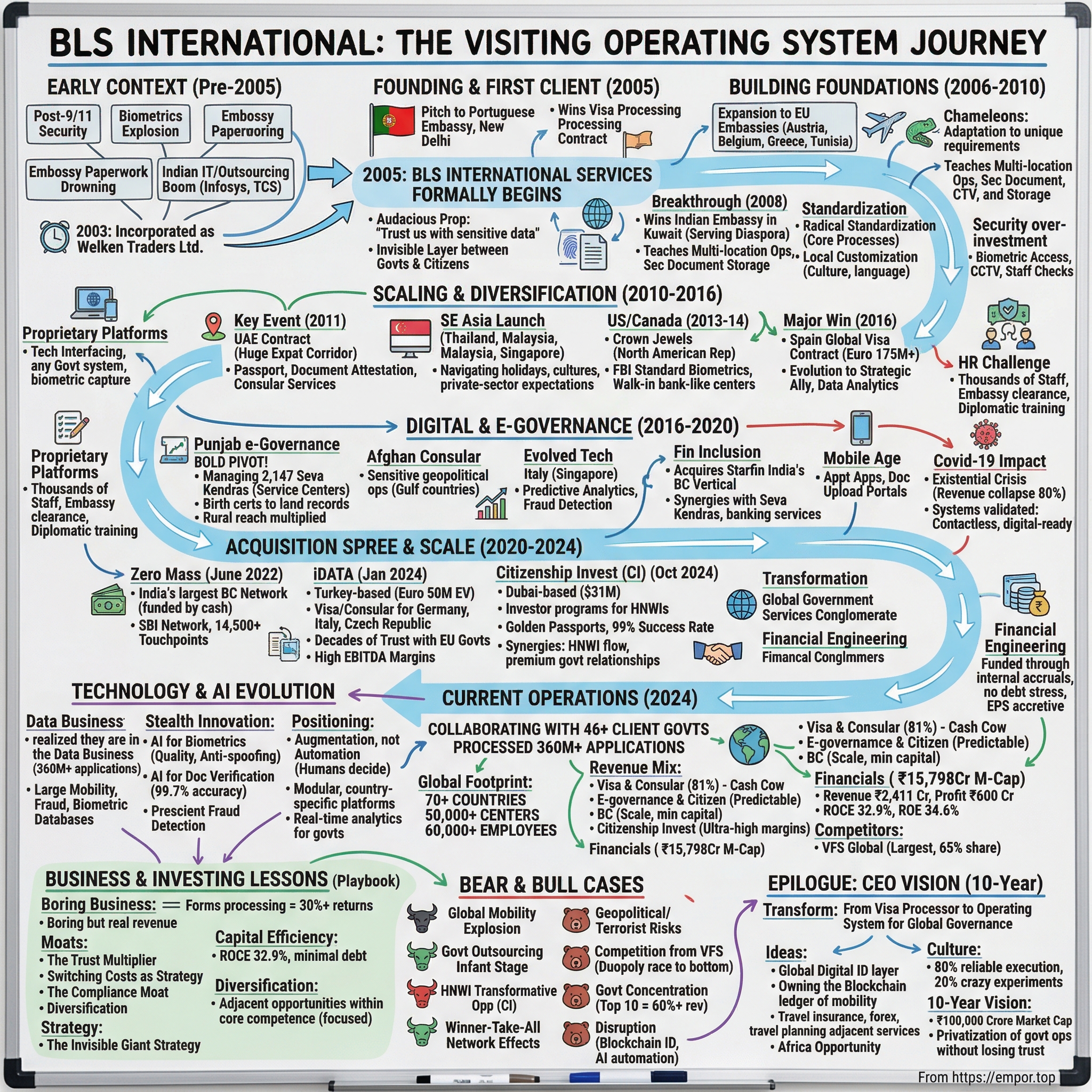
BLS International: The Government-Trust Business Under Stress
I. Introduction & Episode Roadmap
On a Monday morning in late August 2026, traders in Mumbai woke up to a headline written in Spanish. A judge at Spain's Audiencia Nacional, the country's national criminal court, had widened a bribery investigation into the Spanish Consulate General in Algiers — a case in which families had allegedly paid as much as €25,000 for Schengen visas — to encompass the "processing platforms" that scheduled the appointments and handled the paperwork. One of the platforms named in the file was BLS International.1
By the close, BLS shares had fallen 12.7% to ₹236.85 on the BSE.1 The company issued an exchange filing the same day that "categorically rejects any involvement in the alleged irregularities referred to in media reports," and noted that it does not decide who receives a visa — sovereign officials do. BLS's role, the filing stated, is "strictly administrative."1
That distinction is the core of the business — and currently, the heart of its vulnerability.
BLS International Services is one of a small group of specialized contractors worldwide that governments trust to sit between a citizen and a passport. When an applicant applies for a Spanish visa in Lagos or renews an Indian passport in Dubai, they do not walk into an embassy; they visit a storefront run by a contractor. That contractor collects fingerprints, scans bank statements, holds passports overnight, and transmits encrypted files to consular officers who render final decisions. It is a business built on a single asset off the balance sheet: a sovereign government's willingness to delegate the front desk of its border to a private company.
For most of the past four years, that asset compounded impressively. Between FY22 and FY26, BLS scaled revenue from ₹850 crore to ₹2,998 crore and EBITDA from ₹107 crore to ₹819 crore.2 It acquired a Turkish visa operator, a Dubai citizenship-by-investment advisory, and several Indian rural-banking networks, largely using internally generated cash. The market rewarded this growth, driving the stock to an all-time high of ₹521.80 on January 3, 2025.
Then performance pressure mounted. Estonia had terminated a contract in 2023 following document-issuance failures at a BLS facility in Bangkok. In October 2025, India's Ministry of External Affairs — the home-country ministry whose former Passport Seva chief technology officer BLS had hired six weeks prior — debarred the company from participating in its tenders for two years.3 Although the Delhi High Court quashed that order in December,4 the legal victory offered little commercial shield. By July 2026, the Indian Embassy in Abu Dhabi awarded a 15-year mandate serving roughly 4.3 million Indians in the UAE to a competitor.5 Mandates in Kuwait and Singapore were lost as well, followed by the inquiry in Algiers.
With the stock down roughly 54% from its January 2025 peak, trading near ₹238 with a market capitalization of about ₹9,828 crore and a trailing price-to-earnings ratio of 13.9,6 long-term investors face a critical question: Is BLS a fast-growing business experiencing routine scaling friction across more than 80 countries, or is its underlying moat — sovereign trust — eroding in a way that permanently resets core earnings power?
Evaluating the company's trajectory requires examining two competing narratives, both supported by evidence. In the same timeframe that BLS lost its UAE mandate, it secured a five-year global visa contract from Slovakia, renewed its Spanish contract, gained additional mandates from Cyprus, and won a three-year contract from India's Ministry of External Affairs to construct and manage visa application centers in Beijing, Shanghai, and Guangzhou.27 Moreover, the visa segment's EBITDA margin expanded during this period, rising from 34.5% to 40.1%.2
This analysis follows a structured roadmap. It begins with the company's origin — tracing how a 1983 shell entity evolved into a sovereign contractor and why its reverse-merger history matters to prospectus analysis. Next comes the core operating model: the unit economics of outsourced visa processing, oligopoly dynamics, and an objective assessment of BLS's position relative to market leaders. The roadmap then evaluates the acquisition strategy behind its secondary business segment, assessing whether deal pricing reflected strategic discipline. It examines governance, focusing on the 70% promoter ownership and capital allocation track record, followed by a step-by-step review of the sovereign trust crisis. Finally, the analysis stress-tests bull and bear cases through competitive strategy frameworks, reviews operational risk factors, and identifies key quarterly metrics that signal which thesis is taking hold.
That examination begins with an overlooked question: what was BLS International before it entered the visa processing business?
 Subscribe on LinkedIn
II. Origins, Compressed: From Welken Traders to a Visa Outsourcer (1983–2016)
There is no garage in this origin story. There is a shell.
The listed entity that trades today as BLS on the NSE was incorporated in 1983 as Welken Traders Limited, a dormant vehicle that was renamed BLS International Services and used to bring the operating business to market. Investors who search for a traditional IPO prospectus — the roadshow, the price band, the merchant-bank syndicate — will not find one. BLS arrived on the NSE and BSE main boards during the 2016–2018 window through the listed-shell route, rather than a book-built offering.2 That route was a standard path to listing for mid-sized Indian promoters of that era. However, it leaves a thinner historical disclosure trail than a traditional underwriter diligence process, while preserving the promoter family's control without dilution from a primary raise. Both structural elements remain relevant to the company's governance framework today.
The operating story starts in 2005, in New Delhi, with a single embassy.
The global security landscape shifted after September 2001. Consulates were tasked with processing higher applicant volumes alongside heightened biometric capture and document verification standards. Foreign ministries, constrained by fixed legislative headcounts, turned to commercial outsourcing. Pioneered by VFS Global in 2001, the model divided consular operations: contractors managed administrative front-end tasks — reception, document checking, biometrics, fee collection, and courier logistics — while sovereign officers retained sole authority over visa decisions.8
BLS secured its initial contract in 2005, handling visa application intake for the Portuguese Embassy in New Delhi.2 While limited in initial scale — one consulate in one city — government procurement standards prioritize existing track records. The contract established an initial sovereign reference.
Over the following decade, BLS expanded its portfolio across India to include the embassies of Austria, Belgium, Greece, Romania, and Tunisia. It subsequently secured contracts serving Indian missions abroad in Saudi Arabia, Singapore, and the Consulate General of India in Hong Kong.2 Each completed contract served as a reference for subsequent tenders, building a portfolio of audited sovereign operational relationships.
In June 2016, Spain's Ministry of Foreign Affairs and Cooperation awarded BLS a global visa outsourcing contract valued at approximately €175 million.9 The contract expanded BLS's footprint to roughly 129 Spanish visa application centers across 45 countries, transitioning the company from a regional operator into a manager of a sovereign nation's global visa intake infrastructure.
Evaluating a decade-old contract remains relevant to understanding the company's operational baseline and key structural assumptions.
First, execution: the mandate demonstrated BLS's capacity to deploy facilities across multiple jurisdictions, recruit local staff, and adhere to European ministry audit standards. This operational capability established BLS as a viable bidder for major international contracts.
Second, structural risk: the contract model relies on the assumption that sovereign clients, once onboarded, maintain stable long-term vendor relationships. Contracts typically span five to ten years and operate on an exclusive regional basis.2 Contract renewal had historically served as the baseline assumption across the sector.
That assumption faced headwinds beginning in 2023. Before examining those operational challenges, evaluating the underlying economics of the model when fully operational clarifies the financial dynamics of outsourced visa processing.
III. The Core Machine: Visa & Consular Services — Industry Structure and Economics
Picture the physical asset: a leased floor in a commercial building in Casablanca or Kuala Lumpur; rows of numbered counters; a biometric booth; a courier desk; and a queue of applicants clutching document folders, having paid processing fees upfront before any service is rendered.
That upfront payment underpins the financial architecture of the business.
BLS collects processing fees from applicants upfront, before service is rendered, and carries zero receivables from the missions and embassies it serves.2 The result is a structurally negative working capital cycle—customers fund the business—layered on top of an asset-light footprint, as every visa application centre is leased rather than owned.2 A company that collects payments upfront, extends no counterparty credit, and avoids real estate ownership converts profit into cash with high efficiency. In FY26, BLS generated ₹903 crore of cash from operations against ₹819 crore of EBITDA.2 Cash conversion above 100% of EBITDA reflects the operational model functioning as designed.
The visa and consular segment experienced substantial margin expansion over the four-year period. Segment EBITDA margin reached 40.1% in FY26, up from 34.5% in FY25, 22.1% in FY24, 14.8% in FY23, and 14.6% in FY22.2 That represents a 2,550 basis-point expansion in four years for an already cash-generative business. Segment revenue over the same span compounded at 25% annually to ₹1,840 crore, while segment EBITDA compounded 61% to ₹738 crore.2
Management attributed this margin growth to transitioning from a partner-run structure to a self-managed model, reducing reliance on local franchise partners and taking direct control of centres.2 Previously, BLS shared visa center economics with local operators who owned storefronts and employed staff. By bringing centers in-house, BLS assumed fixed costs and operating risks to capture the partner's share of profits. This strategy unlocks margin expansion when application volumes are large and stable enough to absorb fixed overhead, though it also concentrates compliance risk directly within BLS rather than insulating it through partners.
A second driver was price realization. BLS tracks net revenue per application—visa segment revenue minus service costs, divided by applications processed. This metric rose from ₹1,638 in FY22 to ₹3,302 in FY26, roughly a 19% annual increase.2 Applications processed grew from 15.0 lakh to 44.1 lakh over the same four years.2 The core business compounded simultaneously on volume and price, demonstrating pricing leverage in a capacity-constrained market.
However, recent quarterly data shows volume growth stalling. In Q1 FY27, BLS processed 11.3 lakh applications—essentially flat year on year—while net revenue per application rose 11.2% to ₹3,521.10 Visa segment revenue grew 21.6%, and segment EBITDA margin held at 40.3%.10 Thus, revenue growth in the June 2026 quarter came almost entirely from higher revenue per applicant rather than serving more applicants. On the earnings call, Chief Financial Officer Amit Sudhakar attributed flat volumes to geopolitical disruption in Eastern Europe and stated that volumes were broadly stable once new mandates in Belarus, Portugal, Slovakia and Italy were accounted for.11 While geopolitical factors provided context, flat aggregate volume also indicates that contract losses were beginning to offset new wins.
The industry: an oligopoly with one very large member
The competitive landscape requires testing BLS's self-description against industry benchmarks.
The company describes itself as "one of the Top 2 comprehensive end-to-end solutions providers" globally, claiming a 17% market share by value and 10% by volume of the global visa outsourcing market excluding the USA in 2024, sourced to a footnote on its own slides citing "Industry Reports, Research & News Articles."2 A 2024 sell-side initiation report similarly described BLS as the second-largest player with roughly 20% global share, in a field of VFS Global, BLS, TLScontact, CGI and GDIT.12
Comparing BLS with the market leader reveals a significant scale gap. VFS Global reported crossing 300 million cumulative applications in November 2024, operating over 3,400 application centres across 153 countries, serving 69 client governments, and processing 24.1 million applications in calendar 2023—roughly 100,000 a day in early 2024.8 By comparison, BLS processed 4.41 million applications in FY26.2 On core application volume, VFS Global processes roughly five times BLS's volume.
That gap clarifies BLS's positioning as the number-two independent player in a market dominated by a much larger rival backed by deep-pocketed private equity. Blackstone agreed to acquire a majority of VFS Global in 2022,13 and the business has since been valued in the multi-billion-dollar range in secondary transactions. Meanwhile, TLScontact operates inside Teleperformance. BLS is the only one of the major providers that is publicly listed, making its shares the sole vehicle for public equity investors—and the only one whose operational stumbles are marked to market daily.
Investors must also evaluate the "touchpoints" metric in BLS disclosures. The company's headline network figures blend dedicated visa application centres with far more numerous, smaller rural business-correspondent and citizen-service agent points operated by its digital subsidiary.2 Combining rural banking agents in India with biometric Schengen visa centres in international cities expands total count metrics, but these are distinct operational assets that do not bridge the gap with VFS's 3,400 dedicated centres.
Five Forces, honestly applied
Barriers to entry remain high, supporting the core bull case. Bidding for sovereign visa mandates requires stringent security clearances, data-protection compliance, scaled biometric hardware deployment, demonstrated financial capacity, and an established reference list of sovereign clients. BLS holds ISO 27001, 14001, 45001 and 9001 certifications and markets GDPR-aligned architecture as a bidding qualification.2 These prerequisites prevent new entrants from competing without prior government contract references.
Supplier power is low, as primary inputs consist of commercial real estate leases, local staffing, and standard IT infrastructure.
Buyer power represents a key structural vulnerability. Sovereign state clients retain the power to re-tender, terminate, or modify contracts unilaterally, incurring minimal switching costs because applicants absorb front-desk disruptions. Governments can also alter procurement structures; for instance, consolidating multiple regional locations into a single consular center—as proposed by the Indian Embassy in the UAE—resets the competitive field entirely.3 BLS's investor presentations state that "high switching costs underpin long-term contracts and predictable cash flows."2 However, recent contract re-tenders challenge that premise. Exclusive multi-year mandates offer revenue visibility, but exclusivity is a government-granted privilege rather than an enforceable vendor right.
The threat of substitutes develops gradually as governments adopt direct e-visa and self-service digital platforms. Industry projections cited by BLS show the outsourced share of global visa volumes rising from 38% in 2024 to 50% by 2029, with the overall outsourced market growing at roughly 8.8% annually through 2029—a tailwind, if the projections hold.2 However, these third-party projections measure total industry outsourcing penetration rather than individual operator retention. The primary substitution risk is not the disappearance of outsourcing, but rather that standardized, high-value applications migrate to state-run digital rails while contractors retain labor-intensive manual processing.
Rivalry is limited during contract cycles but intense during renewals. Because mandates are exclusive and multi-year, day-to-day price competition does not occur. However, when global mandates expire, qualified bidders compete for winner-take-all awards, where operational issues can prompt clients to switch vendors. BLS noted in its investor presentation that "many major contracts are up for renewal in the next 2 years — opportunity in the range of USD 1–2 Billion."2 While presented as an expansion opportunity, this renewal cycle also represents defensive risk as incumbents protect market share amidst heightened scrutiny.
The core machine represents a cash-generative business tied to sensitive sovereign relationships. Recognizing this dynamic, management initiated a strategy in 2018 to acquire a second operating engine.
IV. The M&A Engine: Capital Deployment and Deal Benchmarking (2018–2025)
Every services company that generates more cash than it can reinvest organically eventually faces the same choice: return the capital to shareholders or acquire other businesses. BLS chose acquisitions, building an M&A portfolio that falls into two distinct categories.
The initial transaction was small enough to pass largely unnoticed. Between 2016 and 2018, BLS acquired Starfin India Private Limited, a business-correspondent operator.2 A business correspondent serves as a Reserve Bank of India–sanctioned solution to a structural challenge: rural India contains far more villages than physical bank branches. Banks appoint third-party agents — typically local shopkeepers equipped with biometric scanners and cash boxes — to open accounts, disburse funds via Aadhaar-authenticated fingerprints, accept deposits, and collect loan installments on behalf of financial institutions. The agent earns a transaction commission, while the bank expands distribution without opening physical branches. Starfin provided BLS an entry point into this network economy, appearing at the time as a minor addition to a visa processing company's portfolio.
That entry point laid the foundation for a broader digital services strategy.
June 2022 — Zero Mass Private Limited. BLS paid approximately ₹105.9 crore to acquire 88.26% of Zero Mass, one of India's larger private business-correspondent networks, later moving toward full ownership at an implied equity value of about ₹120 crore.142 Funded through internal accruals, the deal transformed BLS into one of the largest private business-correspondent networks in India and established the core platform for its digital segment. Today, BLS retains a 90.9% stake in Zero Mass within its corporate structure.2
December 2023, closed July 2024 — iDATA. This transaction represented the most strategic acquisition for BLS's core operating segment. The company paid roughly ₹720 crore for 100% of iDATA Danismanlik Ve Hizmet Dis Tic. A.S., a Turkey-headquartered visa outsourcer operating over 36 application centers across more than 15 countries and serving the diplomatic missions of Germany, Italy, and the Czech Republic.15 In FY23, iDATA generated approximately ₹246 crore in revenue and ₹144 crore in EBITDA — representing a 58% EBITDA margin, materially higher than BLS's visa segment margin at the time.15
At roughly 5x trailing EBITDA for a business more profitable than the acquirer, the transaction reflected disciplined pricing. Management framed the deal as immediately margin-accretive, a claim supported by segment disclosures: BLS's visa EBITDA margin expanded from 22.1% in FY24 to 34.5% in FY25, the year iDATA was consolidated.2 Joint Managing Director Shikhar Aggarwal noted at the time that the acquisition would allow BLS to "build relationships with new Client Governments in Europe, enhance our visibility and consolidate market share."15 Financial results confirm that outcome.
However, one detail from the transaction announcement complicates a common market narrative. The Print reported that the acquisition was funded through "internal accruals and debt."15 Rather than being funded purely from internal cash generation, the deal introduced debt, showing that the narrative of financing all expansion solely through organic cash flow was already incomplete by mid-2024.
September 2024, closed October — Citizenship Invest. BLS acquired 100% of Dubai-based residency- and citizenship-by-investment advisory Citizenship Invest for US$31 million. In calendar 2023, Citizenship Invest generated US$9.6 million in revenue and US$4.4 million in EBITDA — a 45% margin — with revenue growing 28% and EBITDA rising 43% year over year, implying a purchase multiple of roughly 7x trailing EBITDA.16 Managing Partner Iñigo de Luna remained in place to lead the business.16
This acquisition represents a distinctly different asset class. Investment migration is an advisory model selling services to high-net-worth individuals rather than administrative operations provided to sovereign governments. Its revenue profile is lumpier, its regulatory backdrop is volatile — with the European Union progressively tightening rules on golden-passport programs — and its economics rely on relationships with small-state programs. BLS materials size the global investment migration market at approximately US$1.5 billion by 2029, projecting 11% annual growth.2 While substantial, the acquired entity generated US$9.6 million in revenue, making it an optional growth initiative rather than a core operational pillar at group scale. BLS paid a reasonable multiple for a small, high-margin adjacent business whose long-term durability under new ownership remains unproven, particularly as BLS does not break out its standalone performance.
2024–2025 — Aadifidelis Solutions. BLS acquired a controlling stake in digital loan-distribution platform Aadifidelis, with corporate filings reflecting 57% ownership.2 Aadifidelis operates a lead-generation model, originating personal, business, and housing loans for financial institutions in exchange for commissions. The economics feature high transaction volumes paired with low take rates: loan leads originated for financial institutions tripled from roughly ₹11,700 crore in FY25 to ₹36,800 crore in FY26, with BLS explicitly citing the consolidation of Aadifidelis as a primary driver of consolidated revenue growth in FY26.172
July 2026 — Atyati Technologies. BLS E-Services completed the 100% cash acquisition of Bengaluru-based banking-technology and business-correspondent platform Atyati Technologies for ₹156.82 crore.18 Atyati provides services to over 35 banks across a network of more than 25,900 customer service points.18
The transaction metrics warrant scrutiny. Atyati reported turnover of ₹389.9 crore in FY24, ₹395.6 crore in FY25, and ₹375.8 crore in FY26.18 Revenue remained flat over three years before contracting in FY26. BLS paid roughly 0.4x revenue — a valuation reflecting thin operating margins typical of business-correspondent aggregators. The purchase may represent a low-cost acquisition of distribution channels and banking relationships, or it may reflect top-line consolidation that yields limited incremental profit. Because BLS has not disclosed Atyati's EBITDA, the acquisition's strategic value remains a stated objective rather than a demonstrated financial return.
The one that does not fit
In August 2024, BLS agreed to acquire a 51% stake in SLW Media Private Limited, a golf event and sports management company, for ₹80.24 lakh, completing the transaction in October 2024.19 Management stated the deal aimed to integrate golf events with BLS's visa and travel services to position the group as "a global lifestyle and service brand."19
At less than ₹1 crore, the purchase price is immaterial relative to an M&A program measured in hundreds of crores. However, the transaction presents a strategic signaling issue. For a company whose primary asset is sovereign trust and whose central risk is operational scrutiny by foreign ministries, acquiring a majority stake in a golf event promoter to build a "lifestyle brand" diverges from its core positioning. When management outlines its capital allocation hierarchy as organic reinvestment, return-accretive M&A, and dividend distributions, a golf event manager fails to align with any of the three pillars.
Was the money well spent?
Assessing the M&A strategy against management's target of a 17–20% return on acquisitions, confirmed by Shikhar Aggarwal on the Q1 FY27 earnings call, reveals mixed results.11 FY25 marked the peak deployment period, with cash flow statements reflecting ₹899 crore spent on subsidiary acquisitions before moderating to ₹127 crore in FY26.2
Acquisitions in the core visa segment have met financial benchmarks based on available disclosures. Acquiring iDATA at roughly 5x EBITDA coincided with a sustained expansion in visa segment margins over two consecutive years. Similarly, purchasing Citizenship Invest at approximately 7x EBITDA aligned with standard service-sector valuations. While direct change-of-control transaction multiples for competitors like VFS Global are not publicly disclosed, BLS paid disciplined multiples relative to the targets' standalone financials, and iDATA's margin accretion materialized in segment reporting within twelve months.
By contrast, digital segment acquisitions have yet to demonstrate equivalent return on capital. Together, Zero Mass, Aadifidelis, and Atyati expanded the digital business top line, enabling segment revenue to more than double in FY26 while EBITDA grew 16%.17 This performance reflects volume acquisition rather than margin expansion, a trade-off that relies on future operating leverage that has not yet materialized.
Meanwhile, balance sheet risk has shifted toward intangible assets. Consolidated goodwill increased from ₹1,026 crore in March 2025 to ₹1,213 crore in March 2026, representing roughly half of total shareholders' equity.2 This footprint introduces impairment risk: if digital segment profitability fails to improve, potential goodwill write-downs represent a more immediate balance sheet concern than financial leverage.
That brings the analysis to the corporate governance structure overseeing these capital allocation decisions.
V. The Second Engine: Business Correspondent / Digital Financial Inclusion
Walk into a village shop in Bihar or Rajasthan. Beside the shampoo sachets sits a fingerprint scanner and a small thermal printer. A customer presses her thumb against the optical reader and withdraws ₹2,000 from a bank account located thirty kilometers away. The shopkeeper disburses cash from his till, the transaction settles overnight, and he collects a modest commission.
That mechanism—the Aadhaar-enabled Payment System—serves as the backbone for one of the largest financial distribution networks in a developing economy. Having recognized its scale, BLS sought to build a major position within it.
The company now operates a significant stake in this ecosystem through BLS E-Services Limited, a separately listed subsidiary in which BLS International retains a 51.8% equity stake.2 In FY26, the subsidiary reported total income of ₹1,142.8 crore—a 109.7% year-on-year increase from ₹545 crore—generating EBITDA of ₹99.9 crore and profit after tax of ₹69.3 crore.17 Its operational footprint expanded to roughly 155,000 touchpoints, including 45,800 channel service partners, while gross transaction value rose 27.3% to cross ₹1.11 lakh crore.20
At the consolidated group level, digital services revenue more than doubled in FY26 to ₹1,158 crore, up 114% from ₹540 crore in FY25, and now represents approximately 39% of total revenue.2 What began as an ancillary line item now accounts for nearly two-fifths of top-line sales.
Yet one metric defines the central valuation debate surrounding BLS: despite generating two-fifths of revenue, digital services contributed just 10% of consolidated group EBITDA in FY26.2
Two-fifths of top-line revenue yields one-tenth of total operating profit.
The margin problem is not a rounding error — it is getting worse
The segment's profitability profile has compressed over four consecutive fiscal years. EBITDA margins stood at 13.4% in FY23, 14.3% in FY24, 11.3% in FY25, and 7.0% in FY26.2 Over the same timeframe, segment revenue expanded from ₹256 crore to ₹1,158 crore. The business quadrupled its top line while halving its margin. In Q1 FY27, segment margin recovered modestly to 8.2%—up from 7.2% in the prior-year period—as segment EBITDA grew 46% to ₹27 crore, with management targeting a long-term steady-state margin of roughly 8%.11
That 8% target carries structural implications for financial modeling. Management does not project that digital distribution will eventually achieve the high margins seen in the visa division. Instead, guidance anchors the business at roughly 8%. In a growing consolidated entity, expanding an 8%-margin business faster than a 40%-margin business mathematically dilutes group-level margins over time. The margin shift reflects structural product mix rather than a temporary scaling phase.
Consequently, evaluating the group's 27.3% consolidated EBITDA margin requires accounting for this segment blend. Rather than reflecting a consolidated margin poised to trend upward, the group figure represents a weighted average of a high-margin sovereign contractor and a lower-margin digital distributor, with the lower-margin unit generating the faster top-line growth.
There is one very large new contract in here
Disclosures in FY26 highlighted a contract that alters the scale of the digital business: BLS secured a ₹2,055.35 crore work order from the Unique Identification Authority of India (UIDAI) to operate Aadhaar Seva Kendras, along with a ₹100 crore contract from the Bihar state government to establish Permanent Enrolment Centres.2 On the Q1 FY27 earnings call, Chief Financial Officer Amit Sudhakar described the UIDAI initiative as a six-year project representing approximately ₹2,500 crore in total revenue, requiring roughly ₹125 crore in capital expenditure, with Phase 1 complete and Phases 2 and 3 nearing completion. Management expects revenue recognition to begin between Q4 FY27 and Q1 FY28.1011
The UIDAI mandate differs fundamentally from rural banking agency networks. It represents national identity infrastructure executed for a government client—an operational model that aligns closely with BLS's core visa administrative expertise. However, because revenue recognition remains prospective, the mandate represents contract pipeline rather than current financial results. If executed as planned, the contract provides a pathway for margin expansion within the digital segment that does not depend on improving commission rates in rural banking services.
The competitive reality: BLS is not the leader here
Understanding the segment's positioning requires placing its network metrics alongside larger competitors.
Industry peer Spice Money, a rural fintech subsidiary of DiGiSPICE, reported a network of approximately 13 lakh (1.3 million) merchant agents across 2.4 lakh villages, 700 districts, and 6,458 blocks, reaching 95% of India's rural postal codes and serving roughly 2 crore monthly customers.21 Competitors such as PayNearby maintain similarly expansive retail footprints, while the government's Common Service Centre network encompasses hundreds of thousands of village entrepreneurs—a network environment where BLS's own disclosures reference roughly 2 lakh citizen service centres in its broader orbit.2
In comparison, BLS E-Services' network of 155,000 touchpoints and 45,800 channel service partners places it as a smaller participant in the sector.20 The company is not the primary operator in Indian rural financial distribution; rather, it functions as a consolidator building scale in a market where scale leaders dominate, transaction margins are constrained by competition and regulation, and customer retention depends on agent commission structures and software reliability.
In summary, the digital division represents a fast-growing, lower-margin business underpinned by strong government infrastructure capabilities—demonstrated by the UIDAI award—that converts top-line revenue into operating profit at roughly one-fifth the rate of the visa division. Modeling BLS under an assumption of uniform high margins across both divisions risks overstating overall earnings power.
The management team and promoter group making these capital allocation decisions maintain a dominant equity position in the company.
VI. Current Management, Ownership & Capital Allocation
A brief line in a 2024 sell-side initiation report on BLS reveals more about the company's corporate culture than any governance slide. Describing Chairman Diwakar Aggarwal, the report notes 31 years of experience providing technology-enabled services to governments and citizens "with his association with BLS Group since 1983," adding that the parent group was established in 1954 and has diversified across tech-enabled government services, education, petrochemicals, plastics, and infrastructure.12
BLS International is not a startup that grew rapidly around a single visa contract. It is one arm of a seven-decade-old family business group that decided in the mid-2000s that consular outsourcing would drive its next generation of growth. That inheritance shapes its strategic orientation: the patience to spend four years building operational track records before winning major contracts, as well as a centralized governance structure.
Who actually runs it
Diwakar Aggarwal serves as Chairman.2 The 2024 board disclosure listed him as a Non-Executive, Non-Independent Director related to the promoter group, drawing a nominal remuneration of ₹0.27 million in FY24.12
Shikhar Aggarwal is Joint Managing Director and the public face of the enterprise, leading major acquisition announcements and opening earnings calls. Having joined in 2014, he oversees multiple verticals.12 He also serves as Chairman of the listed digital subsidiary, BLS E-Services.17
Nikhil Gupta serves as Managing Director, bringing a background as a chartered accountant with an honors degree in economics from Delhi University to run day-to-day operations.12 Karan Aggarwal sits on the board as an Executive Director with a finance background from the University of Bradford.12 Chief Financial Officer Amit Sudhakar leads technical financial commentary on earnings calls.2
Two features define this executive structure. First, executive compensation remains modest relative to earnings. Gupta and Shikhar Aggarwal drew ₹19.02 million and ₹18.70 million respectively in FY24 — approximately 0.6% of profit after tax each.12 Whatever governance questions exist, value extraction through executive compensation is not among them; the promoter family's financial return is tied primarily to equity ownership.
Second, management authority remains closely held by the promoter family, with no independent outside chief executive officer. The independent directors on the FY24 board included Sarthak Behuria, Ram Sharan Prasad Sinha, Shivani Mishra, Ram Prakash Bajpai, and Atul Seksaria — the last a former senior partner at S.R. Batliboi (EY India), Walker Chandiok (Grant Thornton), and S.S. Kothari Mehta, bringing 36 years of experience in audit and consulting.12 On paper, this establishes a strong audit capability, though subsequent events tested whether oversight proved sufficient.
One executive appointment warrants attention due to its timing. On August 30, 2025, BLS hired Golok Kumar Simli as President of Technology & Innovation. Simli previously served as Principal Advisor and Chief Technology Officer of the Passport Seva Programme at India's Ministry of External Affairs, leading Passport Seva 2.0 and the national e-passport rollout.22
Recruiting the former technology head of the company's primary home-country client brought domain expertise to technical bidding qualifications. However, it also reflected revolving-door hiring practices that attract scrutiny from governance-oriented investors when dealing with key government counterparties. The appointment did not insulate the company from regulatory action: six weeks later, on October 11, 2025, the Ministry of External Affairs debarred BLS from participating in its tenders for two years.34
Ownership and alignment
Promoter shareholding stood at 70.39% as of March 31, 2026, and remained stable through the June 2026 quarter — a modest reduction from 74.24% in March 2019.26 The public float accounts for roughly 29.6% of equity, with institutional holders including Life Insurance Corporation of India, Axis Max Life, Vanguard, iShares Core Emerging Markets, Norway's Government Pension Fund Global, and the Abu Dhabi Investment Authority.2
This concentration of insider ownership aligns the promoter family's wealth directly with equity performance. It also means that on governance, capital allocation, board appointments, or compliance responses, public shareholders lack voting leverage to overrule the promoter group. A 70% voting block retains decisive voting control.
Employee alignment below the promoter level operates through the ESOS-2020 and ESOS-2023 stock option schemes administered via an employees' welfare trust, with the FY26 cash flow statement reflecting ₹11 crore spent by the trust to acquire treasury shares.2 This represents a structured incentive mechanism, though small relative to the total equity base.
Regarding equity encumbrances, BLS investor disclosures do not record promoter share pledges, though no formal pledge statement appears in the reviewed FY26 investor presentation.2 Investors evaluating share encumbrances should consult official exchange filings directly.
How they allocate capital — and how they describe it
The company's dividend history illustrates a clear shift in capital deployment. The dividend payout ratio declined steadily from 15% in FY23 to 13% in FY24, 8% in FY25, and 3% in FY26.6 Cash flow was redirected into expansion, highlighted by the FY25 cash flow statement showing ₹899 crore deployed toward subsidiary acquisitions in a single fiscal year.2 For a company generating a 29.4% return on equity in FY26, retaining capital for reinvestment represents a coherent financial strategy.2 However, investors who entered the stock expecting dividend growth received a strategy focused primarily on M&A reinvestment.
The company's debt profile requires clarification against common market assumptions. The audited consolidated balance sheet records total borrowings of approximately ₹229 crore at March 2025 (comprising ₹204.5 crore non-current and ₹24.9 crore current) and ₹231 crore at March 2026 (comprising ₹178.0 crore non-current and ₹52.5 crore current), representing a stable debt level.2 Financial databases that aggregate interest-bearing borrowings with lease and financial liabilities show liabilities expanding from roughly ₹359 crore to ₹431 crore over the same period.6 In either presentation, balance sheet leverage remained contained.
Concurrently, net cash expanded from ₹928 crore at March 2025 to ₹1,434 crore at March 2026, reaching ₹1,617 crore in the June 2026 quarter with no net debt.210 These metrics indicate that balance sheet solvency does not constitute the primary business risk; rather, valuation risk centers on goodwill carrying values.
Additionally, the narrative of funding expansion entirely without leverage was already incomplete by mid-2024, as disclosures indicated the iDATA transaction was financed through a combination of internal accruals and debt.15 A precise assessment shows BLS funded its acquisition program primarily through operating cash flows, supported by modest debt financing, while maintaining a substantial net cash position.
The credibility test
A more significant governance evaluation centers on management commentary and disclosure framing.
Consolidated EBITDA margin contracted to 27.3% in FY26 from 28.7% in FY25.2 Management commentary accompanying the results described the performance as delivering "a robust FY26 performance, with a consistent overall growth in financials and stabilisation of margins."2 Characterizing a 140 basis-point margin contraction as stabilization reflects promotional framing. Similarly, company presentations highlighted that the 27.3% EBITDA margin had "expanded significantly from 12.6% in FY22" — a multi-year comparison that, while factually accurate, drew attention away from the single-year margin compression.2
These disclosures reflect selective framing rather than financial misrepresentation. A more direct explanation — that consolidated margins declined because BLS expanded a digital segment earning a 7% EBITDA margin faster than its core visa segment earning 40% — aligns with segment disclosures and was largely acknowledged on the Q1 FY27 earnings call, where management guided digital segment margins to roughly 8%.11
For FY27, management issued guidance targeting 20–25% revenue growth, alongside medium-term objectives of 15–20% organic growth and visa segment EBITDA margins near 40%.[^24]10 These operational targets provide clear benchmarks for measuring performance across upcoming quarters.
However, prior management guidance regarding regulatory disclosures faced execution challenges. Following the Ministry of External Affairs debarment in October 2025, BLS assured shareholders that the order "shall not affect the financial/performance of existing operations" and that active contracts would proceed under existing terms.3 Nine months later, the Indian Embassy mandate in the UAE — held by BLS since 2011 — was awarded to a competitor, with the debarment cited as a primary disqualifying factor in the tender process.5
This loss underscores how sovereign regulatory actions can directly impair contract continuity and core revenue streams.
VII. Cracks in the Trust Moat: The 2023–2026 Sovereign Contract Crisis
Estonia is a country of 1.3 million people that chose to market digital residency globally. Its e-Residency program allows a founder in São Paulo or Bangkok to obtain a government-issued digital identity, incorporate an Estonian company, and run it entirely online. The credential is the central asset—meaning the integrity of the issuance process is fundamental to the entire service.
Starting in 2021, Estonia contracted BLS to issue e-Residency cards at pickup points including Tokyo, Bangkok, Singapore, São Paulo, and Johannesburg.24 Estonia's Police and Border Guard Board subsequently discovered that at the Bangkok location, an unauthorized individual had issued documents to an e-resident—a breach of protocol that Estonia's Interior Ministry treated as serious, and which officials indicated had also occurred at other BLS issuing locations.24 The contract was terminated in 2023, and Estonia moved issuance back inside its own foreign missions.24
This was not a pricing dispute, a geopolitical shift, or a change in sovereign strategy. It was an internal control failure at a BLS-operated facility—the exact operational breakdown a security-cleared contractor is hired to prevent. BLS's position, per contemporaneous reporting of company sources, was that the discontinuation stemmed from the unlawful conduct of errant employees, a factor described as beyond the company's control.24
That framing recurs in subsequent events. In a business where sovereign trust is the core offering, employee misconduct reflects an operational failure rather than an external excuse. Robust internal controls designed to prevent bad actors are the product itself.
October 2025: the home ministry
Then came an operational setback that investors had not modeled.
On October 11, 2025, India's Ministry of External Affairs debarred BLS International from participating in tenders issued by the ministry and Indian missions abroad for two years. BLS's stock exchange filing stated the order had been issued "on account of allegations including court cases and complaints of applicants."3
The optics were damaging. BLS is an Indian company with Indian founders and its primary operating presence in India. Weeks earlier, it had hired the ministry's former technology head. Yet its home foreign ministry publicly barred it from bidding. The stock fell sharply on the news. Beyond the immediate reputational effect, the debarment disqualified BLS from bidding on the Indian Embassy's proposed unified consular application center project consolidating services across 14 UAE locations.3
In December 2025, the Delhi High Court set the order aside. BLS informed exchanges that it had "received an order from the Hon'ble High Court of Delhi setting aside the debarment order passed by the MEA," and that the debarment "stands quashed."4
Legally, the outcome was favorable. Commercially, it arrived after procurement momentum had shifted. Sovereign counterparty risk operates on distinct timelines: a government client's regulatory action can disrupt active bidding cycles long before judicial remedies clear the record.
2026: three Indian mandates in one year
Effective July 1, 2026, the Embassy of India in Abu Dhabi awarded its outsourced consular services contract—covering passport renewals, visa applications, Overseas Citizenship of India cards, police clearance certificates, surrender certificates, Global Entry verification, and document attestation across the Abu Dhabi embassy and Dubai consulate—to Alhind Tours and Travels Private Limited for an initial three-year term at 19 UAE dirhams per transaction. BLS had held the mandate since 2011, serving a diaspora community of roughly 4.3 million Indians—about 35% of the UAE's population.5 Alhind planned 16 centres across the emirates and 250–350 hires.5
BLS mandates for Indian missions in Kuwait and Singapore also expired during the same period. While BLS has not quantified the aggregate financial impact in its investor materials, three non-renewals for the same client government within a single fiscal year, following a formal debarment order, reflect a concentrated pattern of contract turnover.
August 2026: Algiers
In April 2026, Spain's Audiencia Nacional, through Central Investigating Court No. 3, ordered an operation that led to the arrest of the chancellor—the second-ranking official—at the Spanish Consulate General in Algiers, along with a local Algerian employee described as a close associate. The alleged scheme sold Schengen visas and permits, with payments in some cases reported at €25,000 per family.19
In late August 2026, the investigation widened to examine partner entities that schedule appointments and process documents, with the judicial file referring to processing platforms such as BLS.9 BLS has held Spain's global visa outsourcing mandate since the 2016 award.9
Two aspects require clear distinction. First, BLS has not been charged. The reporting describes an expanding judicial inquiry, and BLS's position—that it performs administrative functions only and that visa decisions rest solely with diplomatic authorities—is factually correct as a description of the outsourcing model.1 Second, the commercial risk remains real. For a contractor relying on compliance credentials, being named in an international judicial file creates friction with tender committees during upcoming procurement cycles. As of late August 2026, the matter remains unresolved.
Weighing the evidence against the claim
Evaluating the business requires testing management's claims against recent execution.
BLS's FY26 investor presentation states that "high switching costs underpin long-term contracts and predictable cash flows," pointing to multi-year exclusive terms and technology integration as key drivers of contract stickiness.2
Recent history presents a more complex picture. Across a three-year period, five sovereign counterparties took action: Estonia terminated for control failures, India debarred the company and subsequently replaced it across three missions, and Spanish judicial authorities referenced the platform in a criminal inquiry. Conversely, during that same window, BLS renewed its global Spanish mandate, won a five-year global contract from Slovakia, secured Cyprus mandates covering over 15 countries, renewed its MEA attestation contract, and won the three-year China visa centres contract.27
This record clarifies the operational reality of the business. Winning new awards—such as securing the China mandate effective October 14, 2025, just three days after the MEA debarment order dated October 11—demonstrates that BLS retains the technical capacity and qualification credentials to compete for major contracts.74
However, the evidence challenges the idea that incumbency and switching costs make contract renewals automatic. High switching costs affect applicants who navigate new portals, but sovereign ministries bear minimal financial costs when changing vendors. Consequently, contract retention depends on consistent operational compliance rather than structural lock-in. This dynamic is visible in recent volume data: despite new mandate wins, total visa application volumes remained flat at 11.3 lakh in the June 2026 quarter.10
The activist question
The company's corporate governance structure influences how management addresses operational challenges. Promoters hold 70.4% of the equity, aligning insider wealth with equity returns, while executive compensation disclosures show the promoter family is not extracting value through pay.12 However, concentrated ownership can limit independent board oversight, particularly regarding compliance controls across international jurisdictions where operational visibility is lowest.
Between 2023 and 2026, compliance breakdowns occurred in overseas centers, home-country ministry relations, and foreign judicial proceedings. During this same window, management deployed roughly ₹1,000 crore into acquisitions concentrated in a lower-margin digital services segment.
From a strategic perspective, reallocating capital and executive focus toward compliance systems, audit controls, and operational quality in the core visa segment—which generates 90% of group EBITDA—represents a clear operational priority. Expanding quarterly disclosures to detail contract renewal pipelines alongside new tender wins would also provide investors with clearer visibility into franchise stability.
VIII. The Numbers: Growth, Margin Mix, and What They Reveal
Stripped of company context, BLS's FY26 financial statements read like those of a high-performing Indian mid-cap compounder.
In FY26, consolidated revenue expanded 36.7% to ₹2,998 crore, while EBITDA climbed 30.1% to ₹819 crore. Net profit rose 34.1% to ₹724 crore, reflecting a 24.1% net margin.2 Over the four-year period from FY22 to FY26, revenue compounded at 37% annually—expanding from ₹850 crore to nearly ₹3,000 crore—while EBITDA compounded at 66% and net profit at 60%.2 Return on equity reached 29.4% in FY26, as net worth quadrupled from ₹570 crore to ₹2,463 crore over the four-year span.2
These top-line and bottom-line metrics describe a business expanding rapidly on its operational balance sheet.
However, underlying trendlines reveal an emerging divergence. Consolidated EBITDA growth trailed revenue growth—30.1% against 36.7%—reflecting the margin dilution driven by faster growth in the lower-margin digital segment. That gap widened in the June 2026 quarter: while revenue grew 25.3% to ₹890.5 crore and EBITDA rose 23.6% to ₹252.4 crore, net profit increased by just 11.4% to ₹201.6 crore.10 Profit growth decelerated to less than half the pace of top-line revenue expansion.
Three accounting factors explain why net profit growth lagged EBITDA. First, annual depreciation and amortization climbed from ₹30.9 crore in FY24 to ₹76.5 crore in FY25 and ₹93.7 crore in FY26, driven by the consolidation of acquired entities and intangible assets.2 Second, non-controlling interest on the balance sheet increased from ₹288 crore to ₹320 crore, as an expanding share of operating income accrued to minority shareholders in BLS E-Services (51.8% owned) and Aadifidelis (57% owned).2 Third, effective tax rates began normalizing, with management guiding to a long-term effective rate of roughly 12% for FY27, compared with lower historical effective tax rates in prior years.10
Consequently, the slowdown in net profit growth is primarily structural, driven by corporate structure, deal accounting, and tax normalization rather than immediate operational losses appearing in audited financials. However, this dynamic creates a widening gap between consolidated EBITDA and net profit attributable to parent company equity holders, meaning headline EBITDA growth increasingly overstates cash earnings accruing to shareholders.
What the market has decided
Public equity markets have repriced the business accordingly. After touching an all-time high of ₹521.80 on January 3, 2025, the stock fell roughly 54% to trade near ₹238 in late August 2026, bringing market capitalization down to approximately ₹9,828 crore.6 By comparison, the company reported a market capitalization of ₹11,358 crore in its March 2026 investor disclosures, with a public float of 29.6%.2
Trading at roughly 13.9 times trailing earnings and 4.0 times book value—despite generating a 29.3% return on capital employed and a 32.7% return on equity—BLS carries a valuation multiple typical of a cyclical industrial company rather than a capital-light services provider expanding at 25% to 35% annually.6
This valuation compression highlights the central tension facing equity investors. The multiple contraction does not reflect current operational failure; trailing financial performance remains near historical highs. Instead, equity markets have discounted the long-term durability of core earnings. When a government contractor generates 40% segment EBITDA margins on sovereign mandates, and client governments alter procurement awards or terminate contracts, market valuations compress to reflect heightened counterparty risk. A low price-to-earnings ratio alongside high return metrics does not inherently signify an undervalued asset; it reflects market skepticism regarding earnings persistence.
Determining whether current valuation levels represent an overreaction or an accurate repricing depends on how market participants interpret operational disruptions between 2023 and 2026. The key question is whether recent contract non-renewals represent isolated operational control issues within an expanding global footprint, or signal broader erosion of vendor incumbency across a portfolio where "many major contracts are up for renewal in the next 2 years."2 Financial statements alone cannot answer that question; future contract renewal outcomes will determine the trajectory.
Evaluating those structural dynamics provides the basis for assessing the final strategic lessons of the business model.
IX. Playbook: Business & Investing Lessons
Selling to sovereigns is not the same as selling to enterprises, even when the contracts look identical. The surface features of government-to-business outsourcing — multi-year terms, exclusivity, high compliance barriers, and deep process integration — resemble the characteristics investors use to identify sticky enterprise software or industrial-services relationships. The economics diverge in one decisive respect. An enterprise customer that fires its vendor absorbs the switching friction itself, which makes switching costs a real deterrent. A foreign ministry that fires its vendor pushes the friction onto visa applicants, who have no vote in the decision and no alternative supplier. The deterrent that makes commercial switching costs work is structurally absent. BLS's 2025–2026 record provides a clear live case study of that asymmetry in public markets.
A reputational moat has no minimum thickness. Physical infrastructure degrades gradually; a factory does not become worthless overnight. Trust does. What BLS sells to sovereign clients is the assurance of flawless front-desk execution — and an unauthorized document issuance in Bangkok was sufficient to end a national program relationship. When the primary asset is a counterparty's confidence, the loss function is discontinuous. Investors should size positions in reputation-dependent businesses accordingly, and view skeptically any framing that treats compliance spending as overhead rather than essential maintenance capital expenditure on the moat itself.
Blended reporting hides the most critical trends in a multi-segment company. Anyone reading only BLS's consolidated line items in FY26 would have seen 37% revenue growth alongside a modest margin compression, concluding that the enterprise was operating smoothly. The segment disclosures tell a far more nuanced story: profitability in the core visa business expanded significantly, while consolidated margins compressed because a single-digit margin segment expanded at triple-digit rates. Segment EBITDA, rather than segment revenue, makes this mix shift visible. The lesson applies broadly to any company scaling an adjacent business: revenue mix shows where management is focusing capital, while profit mix reveals the underlying cost.
Disciplined acquisition multiples are necessary, but not sufficient. Paying roughly 5x EBITDA for iDATA and 7x for Citizenship Invest reflected disciplined entry pricing based on disclosed target economics. However, an M&A portfolio is evaluated by long-term earnings productivity rather than purchase price — and BLS's digital acquisitions have converted more than a doubling of revenue into a 16% increase in segment EBITDA. Low entry multiples on businesses with thin operating margins yield lower-margin assets rather than sustainable compounding. Strategic discipline relies not only on negotiating transaction prices, but also on declining acquisitions that fail to enhance the consolidated return profile.
Concentrated promoter ownership alters governance dynamics. With a 70% promoter stake, the founding family's economic interests align closely with minority shareholders regarding market valuation, as stock de-ratings impact promoters most directly. While this alignment offers stability, it does not provide public shareholders with a mechanism to redirect operational priorities when compliance oversight requires adjustment. In promoter-controlled entities, evaluating governance involves assessing whether internal oversight functions are empowered to challenge executive decision-making.
Certification and contract awards do not equal immediate cash earnings. BLS's ₹2,055 crore UIDAI work order represents a substantial qualification credential and a sizable total contract value. However, the mandate recognized no revenue through the June 2026 quarter, with revenue generation projected to commence in Q4 FY27 at the earliest.210 The operational lag between winning a government contract and recognizing cash earnings remains a critical factor in financial modeling.
These operational lessons directly inform the competing investment theses for evaluating the company.
X. Bull vs. Bear: Why BLS Wins From Here, and Why It May Not
Think of this section as a war game. Two analysts, same data, opposite conclusions. What would each have to believe?
The bull case
The franchise still qualifies, and qualification is the scarce good. The strongest single argument for the bulls rests on bidding eligibility. Over the same twelve-month span in which BLS faced debarment, lost three Indian mission mandates, and was named in a Spanish criminal file, it also won a five-year global visa outsourcing contract from Slovakia, secured visa mandates from the Embassy of Cyprus spanning multiple regions, renewed its home-country attestation contract, and won a three-year mandate for Indian visa application centers in Beijing, Shanghai, and Guangzhou.223 A contractor that had permanently lost sovereign trust would not assemble that record of new contract wins.
The core is getting better, not worse. Visa segment EBITDA margins reached 40% and expanded over recent years, driven by an operational shift from partner-run to self-managed centers rather than a temporary price increase. Supported by cash conversion above 100% of EBITDA, negative working capital, and a substantial net cash position, the underlying core business maintained strong operating efficiency during the sovereign trust crisis.
The structural tailwind is real. Outsourced penetration of global visa volumes is projected to rise from 38% in 2024 to 50% by 2029, with the outsourced market expanding faster than overall visa application volumes.2 Sovereign governments continue to face the same budgetary constraints and volume pressures that drove the initial wave of consular outsourcing.
Capital allocation on core deals has been rational, and the balance sheet supports further consolidation. Holding more than ₹1,600 crore in net cash alongside annual operating cash flows approaching ₹900 crore, BLS retains the financial capacity to acquire smaller national and regional visa operators without diluting equity holders.210
Optionality is not zero. If executed according to plan, the multi-year UIDAI Aadhaar Seva Kendra award provides a long-term government infrastructure revenue stream in a core administrative domain. Meanwhile, Citizenship Invest offers high-margin exposure to investment migration advisory services. At roughly 14 times trailing earnings, equity markets are pricing in little value from these expansion initiatives.
The bear case
The moat has been tested and partially failed. Five separate adverse events occurred across unrelated sovereign clients within three years, with at least two stemming from internal control breakdowns rather than external political shifts. If incumbency failed to protect a 15-year relationship serving Indian missions in the UAE, standard industry assumptions regarding long-term contract durability overstate revenue stability.
Application volume growth has stalled in the core. Application volumes were essentially flat year on year in the June 2026 quarter, leaving an 11% increase in revenue per application as the main driver of segment growth.10 Price increases and service-mix shifts can sustain top-line growth temporarily, but cannot substitute indefinitely for volume growth if contract non-renewals erode the underlying application base.
Incremental growth is structurally dilutive to consolidated margins. Management guidance anchors long-term digital segment EBITDA margins at approximately 8%, confirming that lower profitability reflects structural business mix rather than a temporary scaling phase.11 As the digital division outpaces the visa unit in top-line growth, consolidated margins will naturally trend downward toward the weighted average of the two segments.
The digital division remains sub-scale and faces margin compression. Consolidated digital revenue more than doubled in FY26 while segment EBITDA rose by just 16%.172 Additionally, recently acquired Atyati Technologies reported contracting revenue in the fiscal year preceding its buyout.18 With consolidated goodwill rising to ₹1,213 crore, carrying values now rest on a segment that has experienced four consecutive years of margin compression.2
The Spanish judicial inquiry presents an ongoing regulatory risk. The primary commercial threat from judicial inquiries is not direct financial penalties, but the potential impact on tender eligibility. Foreign procurement committees evaluating compliance credentials may disqualify bidders named in active proceedings without awaiting formal judicial convictions.
Governance structures lack external balance. With the promoter group holding a 70.4% equity stake, public shareholders lack the voting leverage to redirect capital allocation or enforce compliance changes, leaving exit as their sole recourse if management oversight falls short.
Asymmetric disclosure practices increase downside surprises. New contract awards are promptly reported in exchange filings and press releases, whereas contract non-renewals and debarment orders have historically been surfaced by foreign government notices and media reports. This disclosure asymmetry leaves equity markets vulnerable to sudden valuation adjustments when bad news emerges.
Reading it through 7 Powers
Evaluating BLS through strategy author Hamilton Helmer's 7 Powers framework clarifies which competitive advantages the business actually possesses versus those asserted in investor materials.
Cornered Resource represents the company's most credible advantage, albeit in a specific form. BLS does not own permanent mandates; rather, it possesses a cornered qualification to bid. The combination of sovereign security clearances, ISO certifications, deployed biometric infrastructure, and audited government references is genuinely scarce. The contract awards secured between 2025 and 2026 confirm that BLS retains this bidding capability even under regulatory scrutiny.
Switching Costs represent the advantage most prominently featured in company presentations but least supported by recent events.2 While visa applicants experience friction when navigating new portals, sovereign ministries face minimal direct financial costs when changing vendors.
Scale Economies favor market leader VFS Global rather than BLS. Handling roughly five times BLS's application volume, VFS Global amortizes compliance, technology, and security investments over a significantly larger application base.82
Counter-Positioning is absent, as BLS and VFS Global operate essentially identical administrative outsourcing models.
Network Economies do not apply to core visa processing, where individual applicant transactions remain independent. They exist weakly within the rural business-correspondent network, where agent density improves distribution efficiency, though BLS remains a smaller player in that market.
Branding carries weight with sovereign procurement committees rather than retail applicants, making corporate reputation a critical bidding asset currently exposed to compliance scrutiny.
Process Power presents a compelling operational question. Expanding visa segment EBITDA margins from 14.6% to 40.1% over four years through an operational shift to self-managed centers reflects accumulated process efficiency.2 However, taking direct operational control also concentrated compliance risk directly within BLS rather than insulating it through local partners.
The synthesized diagnosis indicates that BLS possesses a narrower set of structural advantages than market narratives suggest — centered on cornered bidding qualification and operational process efficiency — while the switching costs highlighted in investor materials have been challenged by recent contract non-renewals.
The KPIs that will settle it
Three operating metrics, tracked quarterly, will determine which investment thesis prevails:
1. Visa application volumes. Application volume — rather than top-line revenue — serves as the primary indicator of franchise health. While net revenue per application can support segment revenue temporarily, volume measures actual transaction flow across BLS centers. Volumes were flat year on year in the June 2026 quarter. If volume growth resumes as new mandates in Slovakia, Cyprus, and China ramp up, recent contract losses will have been absorbed; if volumes contract, non-renewals will have impaired the underlying application base.
2. Visa and consular segment EBITDA margin. The 40% segment EBITDA margin represents the primary profit driver for the enterprise, accounting for roughly nine-tenths of group operating profit. Tracking margin stability will indicate whether the self-managed operational model represents a durable process advantage or a temporary margin peak.
3. The sovereign contract ledger: renewals won versus mandates lost. Because contract retention is not reported as a standalone financial line item, tracking vendor changes requires monitoring official procurement releases and government notices. With company disclosures highlighting US$1–2 billion in global contracts up for renewal over a two-year horizon,2 BLS's win rate on upcoming re-tenders will provide the definitive test of its sovereign trust moat.
XI. Risk Radar
Regulatory and political risk sits at the top, and it is realized rather than hypothetical. The mechanism is specific: a sovereign client can terminate, decline to renew, retender on altered specifications, or debar — doing so without a hearing, a commercially meaningful notice period, or any obligation to provide compensation. The Delhi High Court's quashing of the Ministry of External Affairs order demonstrated that legal recourse exists; the subsequent UAE outcome demonstrated that judicial remedies frequently arrive after commercial damage is already done.45
Cybersecurity and data privacy represent the risk that could compound all others. BLS handles passports, biometric records, financial statements, and travel histories for millions of applicants across dozens of jurisdictions, marketing GDPR-aligned processes and ISO 27001 certification as essential bidding qualifications.2 In this sector, a material data breach is not merely an IT incident with a cleanup cost; it directly impairs sovereign trust—the core asset required to win tenders. That vulnerability is particularly acute when compliance controls have faced scrutiny in Spain and contributed to a contract termination in Estonia. Meanwhile, the company reported zero cases of financial fraud, bribery, or corruption in its FY26 ESG disclosure—a self-reported figure covering that period that investors should evaluate alongside, rather than instead of, the Algiers investigation.2
Execution and integration risk is heightened by simultaneous operational demands. BLS has absorbed five major acquisitions since 2022—with the most recent completed in July 2026—while management navigates multi-jurisdiction compliance scrutiny and rolls out a ₹2,055 crore national identity project requiring ₹125 crore in capital expenditure.21810 Executive bandwidth remains a finite resource under substantial operational load.
Technology disruption operates on a longer horizon but moves in the same direction. As sovereign governments construct direct e-visa platforms and self-service digital portals, high-margin, low-touch application workflows are the most easily digitized in-house, potentially leaving commercial contractors to manage labor-intensive manual processing. BLS aims to counter this shift by building those digital systems itself, marketing e-visa platforms, artificial intelligence document verification, and identity management as core capabilities.2 Whether that positioning turns the company into a digital disruptor or leaves it exposed to disintermediation remains an open question.
Geopolitical and currency exposure is inherent to an international operational footprint. Operating across more than 80 countries and serving 46 client governments exposes earnings to foreign exchange translation across a broad currency basket, as well as shifts in bilateral diplomatic relations.2 Management attributed flat visa application volumes in the June 2026 quarter partly to operational disruptions in Eastern Europe—a reminder that geopolitical conflict or diplomatic friction anywhere in the network directly affects aggregate processing volumes.11
Refinancing risk remains low, making balance sheet leverage a secondary concern. With approximately ₹230 crore in borrowings offset by ₹1,434 crore in net cash as of March 2026, the company faces no near-term debt maturity pressure.2 The primary balance sheet variable to monitor is goodwill, which reached ₹1,213 crore and is heavily concentrated in the digital services segment, where operating margins compressed over four consecutive fiscal years. That carrying value represents an accounting assessment subject to future review; any impairment would be a non-cash charge that would nevertheless impact reported book value and market confidence in the M&A strategy.
XII. Epilogue & What to Watch
The next two years present a clear set of signposts that will determine which thesis holds.
The near-term test is Algiers. Spain's investigation will either narrow and clear the administrative processing platforms or escalate toward formal charges. The outcome matters less for potential direct financial penalties than for its impact on BLS's standing in European procurement, where the company holds its largest global mandate. A resolution that leaves BLS unimplicated would remove a major valuation overhang. An escalation, by contrast, would place the central Spanish relationship directly at risk.
The near-term operational test is the renewal calendar. Management has informed investors that major contracts representing $1 billion to $2 billion of opportunity face renewal within two years.2 Over the coming quarters, the key question is not whether BLS can win new mandates — execution in Slovakia, Cyprus, and China demonstrates it can — but whether it can defend its incumbent positions. Every contract renewal announcement and foreign-ministry procurement decision will provide a direct test of the company's sovereign trust moat.
The medium-term test is whether margin compression stabilizes. Consolidated EBITDA margin declined from 28.7% in FY25 to 27.3% in FY26, before recovering to 28.3% in the June 2026 quarter.210 Given the business mix and management's long-term digital segment margin target of roughly 8%, overall margin stabilization would require either the digital division to outperform guidance — likely driven by higher-value UIDAI identity contracts rather than rural banking commissions — or the visa segment to continue expanding margins above 40%. Both outcomes are achievable, but neither is guaranteed.
The longer-term test is whether the digital business builds a durable franchise or remains an acquisition-led roll-up. Compared to Spice Money's network of 1.3 million agents and PayNearby's broad footprint, BLS E-Services operates as a well-funded challenger rather than an industry leader.2120 Building long-term competitive strength depends on expanding government-facing identity and citizen-services infrastructure — where BLS has demonstrated core operational capabilities — rather than competing purely on retail agent commissions. The UIDAI Aadhaar Seva Kendra project serves as the primary test case, with initial revenue recognition expected between Q4 FY27 and Q1 FY28.
Beyond quantitative metrics, governance transparency remains a critical evaluation factor. Throughout recent operational challenges, management's communication presents a nuanced record.
On specific disclosures, BLS responded promptly to formal developments: the Estonia contract discontinuation, the home-ministry debarment and its subsequent court quashing, and the Spanish judicial inquiry were all communicated to stock exchanges without delay, accompanied by an explicit rejection of wrongdoing in the Algiers matter.134
However, public disclosures have omitted broader diagnostic context explaining why internal control breakdowns occurred in overseas facilities, what structural changes were implemented in response, and how similar failure modes will be prevented across an expanding self-managed network. The company's comprehensive FY26 investor presentation outlines technological deployment, margin metrics, industry projections, and ESG initiatives, but omits discussion of recent contract non-renewals. Similarly, during the Q1 FY27 earnings call, management did not address the non-renewal of mandates in the UAE, Kuwait, and Singapore directly, attributing flat application volumes primarily to Eastern European geopolitical disruption while highlighting offsetting new mandate awards.11
This limited commentary can be interpreted in multiple ways. It may reflect standard legal prudence amid active proceedings, a commercial assessment that contract losses remain manageable relative to group scale, or a promotional disclosure approach similar to characterizing a 140 basis-point margin contraction as stabilization.
For long-term investors, future earnings calls will be judged on operational specificity: details regarding internal audit enhancements, named compliance leadership, updated facility oversight protocols, and explicit accounting of lost contract volumes. For an enterprise built on sovereign delegation, transparently demonstrating how operational controls are being reinforced remains the most reliable indicator of whether its core asset — sovereign trust — is being preserved.
XIII. Recent News
Spain's Algiers investigation (August 2026, ongoing). Reports on August 24, 2026, that Spain's Audiencia Nacional had expanded its Schengen visa-fraud probe to examine processing platforms including BLS sent company shares down 12.7% to ₹236.85, prompting an immediate denial from the firm.125 No charges have been brought against BLS, and authorities have disclosed no timeline for resolving the inquiry.
Q1 FY27 results (reported August 11, 2026). BLS reported quarterly revenue of ₹890.5 crore, EBITDA of ₹252.4 crore—a 28.3% margin—and net profit of ₹201.6 crore, with visa segment margins at 40.3% and digital services at 8.2%.1011 Management reiterated a medium-term organic growth target of 15–20%, guiding long-term visa margins to near 40% and digital margins to 8%, with revenue recognition from the UIDAI project expected from Q4 FY27.1011 Application volumes remained essentially flat year on year.
Contract activity. The Indian Embassy mandate in the UAE transitioned to Alhind Tours and Travels on July 1, 2026, ending a relationship dating back to 2011.5 On July 2, 2026, BLS E-Services completed its acquisition of Atyati Technologies.18 Offsetting recent non-renewals, global mandates for Slovakia, regional contracts for Cyprus, the home-country attestation renewal, and the China visa center contract remained active.223
References
-
Visa fraud case: Why BLS International shares tanked 13% today; clarification issued — Business Today, 2026-08-24 ↩↩↩↩↩↩↩
-
BLS International Q4 & FY26 Investor Presentation — BLS International Investor Relations, 2026-05-19 ↩↩↩↩↩↩↩↩↩↩↩↩↩↩↩↩↩↩↩↩↩↩↩↩↩↩↩↩↩↩↩↩↩↩↩↩↩↩↩↩↩↩↩↩↩↩↩↩↩↩↩↩↩↩↩↩↩↩↩↩↩↩↩↩↩↩↩↩↩↩↩↩↩↩↩↩↩↩
-
India debars BLS International from tenders: Will passport, visa services in UAE be affected? — Gulf News, 2025-10 ↩↩↩↩↩↩↩
-
Delhi court lifts two-year debarment on BLS International — Khaleej Times, 2025-12-18 ↩↩↩↩↩↩
-
Indians in UAE to shift to new consular service provider from July 1 as BLS loses key contract — The Pioneer, 2026 ↩↩↩↩↩↩
-
BLS International Services Ltd — consolidated financials and key ratios, Screener.in ↩↩↩↩↩↩
-
BLS International Wins 3 Year Contract from Ministry of External Affairs, India to Establish and Operate Indian Visa Application Centres in China — Business Wire, 2025-10-16 ↩↩↩
-
VFS Global processes its 300 millionth application — VFS Global media release, 2024-11-27 ↩↩↩
-
What is BLS International, the company under scanner in Spain's Schengen visa fraud probe? — Free Press Journal, 2026-08 ↩↩↩↩
-
BLS International Q1 FY27 slides: record revenue, 40% visa margins — Investing.com, 2026-08 ↩↩↩↩↩↩↩↩↩↩↩↩↩↩↩
-
Earnings call transcript: BLS International posts record Q1 revenue — Investing.com, 2026-08-11 ↩↩↩↩↩↩↩↩↩↩
-
BLS International Services Limited — Initiating Coverage Research Report, KJMC Capital Market Services ↩↩↩↩↩↩↩↩↩
-
Blackstone to acquire VFS Global — Blackstone press release ↩
-
BLS International Services to acquire Zero Mass — Business Standard, 2022-06-08 ↩
-
Visa, passport, consular services provider BLS International Services acquires Turkey-based iDATA for Rs 720 crore — ThePrint, 2024-07-09 ↩↩↩↩↩
-
BLS International acquires Citizenship Invest for reported $31 million — IMI Daily, 2024-09-12 ↩↩
-
BLS E-Services FY26 income crosses Rs 1,100 crore; revenue up 110 pc — United News of India, 2026-05 ↩↩↩↩↩
-
BLS E-Services acquires Atyati Technologies for ₹157 cr in an all-cash deal — Business Standard, 2026-07-03 ↩↩↩↩↩↩
-
BLS International acquires 51% stake in SLW Media for Rs 80.24 lakh — Business Standard, 2024-08-31 ↩↩
-
BLS E-Services crosses Rs 10 bn revenue mark in FY26 — Construction World, 2026 ↩↩↩
-
Spice Money's Nanopreneur aka Adhikari Network Flourishes — Spice Money regional press release ↩↩
-
BLS International appoints Golok Kumar Simli as President – Technology & Innovation — CXO Digitalpulse, 2025-08-30 ↩
-
BLS to operate India visa application centres in China under new 3-year contract — Khaleej Times, 2025-10 ↩↩
-
BLS International failed to meet Estonia's issuing procedures for e-Residency card — SchengenVisaInfo, 2023-12 ↩↩↩↩
-
BLS International tumbles amid buzz of visa fraud, company denies claims — Business Standard, 2026-08-24 ↩
 LinkedIn
 WhatsApp
 Reddit
 Hacker News
 Email
Email Kindle
 RSS Feed
 Spotify
 Apple Podcasts
 Amazon Music
 Audible
 YouTube