Bharat Dynamics: The Order Book That Ate the Income Statement
Kanchanbagh, 1970: A Factory Built to Assemble Someone Else's Missiles
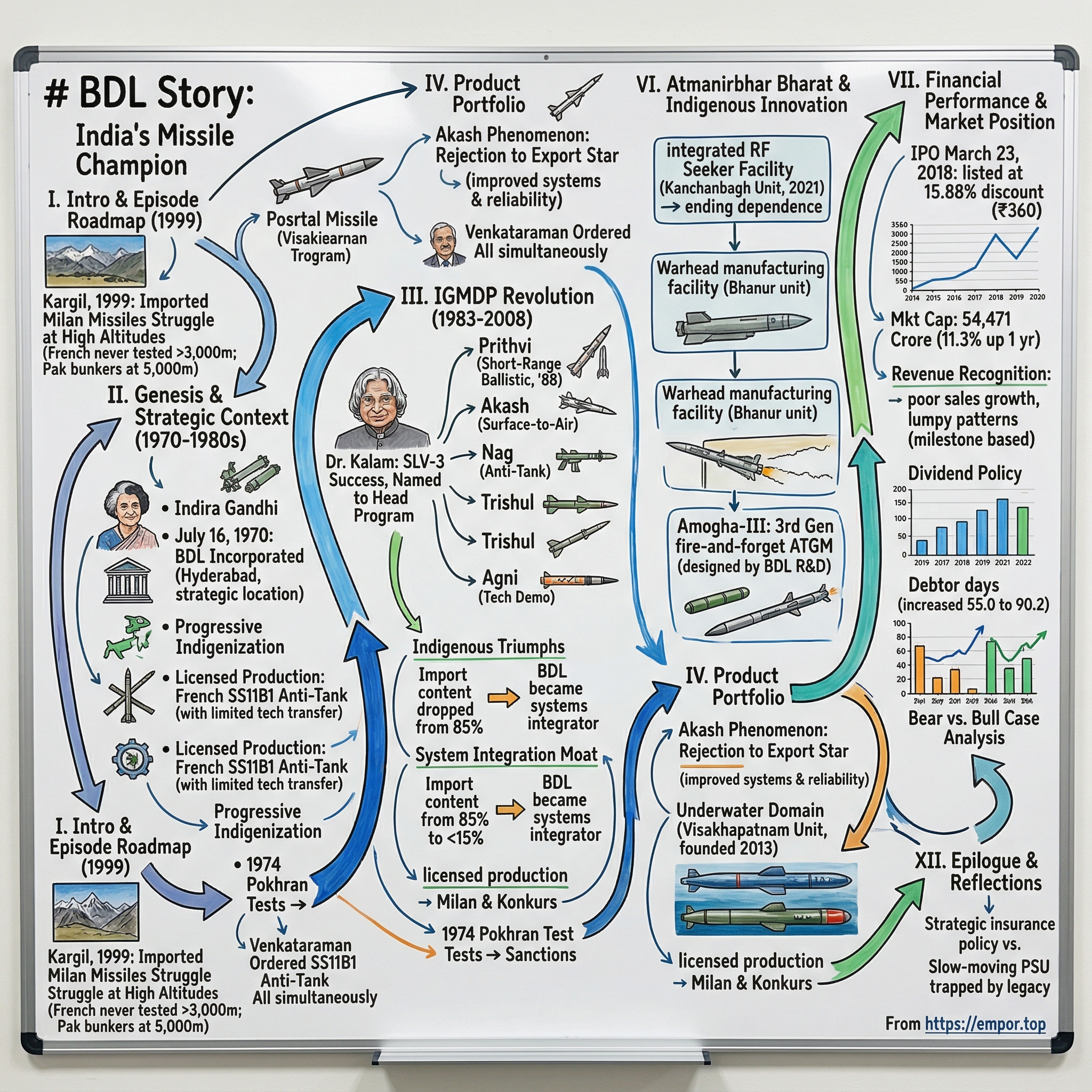
On 16 July 1970, in a walled industrial estate at Kanchanbagh on the southern edge of Hyderabad, the Government of India incorporated a company with one job: to become the manufacturing base for guided missile systems and allied equipment for the Indian Armed Forces.1 It was not founded by an entrepreneur. There was no garage, no term sheet, no charismatic founder sketching on a napkin.
There was a foreign design.
The first product off the line was the SS11B1, a first-generation anti-tank guided missile of French origin.4 Bharat Dynamics Limited — BDL — did not design it. It assembled it, tested it, and handed it to the Army. As the company itself puts it, since inception BDL has worked in collaboration with DRDO and foreign original equipment manufacturers to manufacture and supply missiles to the Indian armed forces.2 Two of its longest-running anti-tank lines, the Milan-2T and the Konkurs-M, descend from European and Russian designs respectively.3
This is the origin fact that explains almost everything that follows. BDL was created as a national insurance policy, not as a business. India in 1970 had just fought two wars in eight years and had discovered that a country which imports its ammunition does not fully control its own foreign policy. The state's answer was to build a factory it owned outright, staff it with engineers it trained, and give it a monopoly on a category of weapons nobody else in the country was allowed to make.
For an investor in 2026, the important consequence is structural rather than sentimental. A company built to execute someone else's design, for a single customer who is also its owner, inherits a very particular economic shape: high strategic importance, low commercial agency. It does not choose its products. It does not set its prices in an open market. It does not pick its customers. It executes.
The physical footprint grew slowly and geographically, in the way that public-sector industrial policy grows in India — one unit per state capable of lobbying for one. Today the company runs four production units: three in Telangana at Hyderabad, Bhanur, and Ibrahimpatnam, and one in Andhra Pradesh at Visakhapatnam, with a fifth under development in Amravati, Maharashtra.1 Each site carries a specialisation. Hyderabad handles surface-to-air missiles, Milan 2T anti-tank missiles, countermeasures, launchers, and test equipment. Bhanur builds the Konkurs-M and the INVAR anti-tank rounds. Visakhapatnam makes light-weight torpedoes and the C-303 anti-torpedo system.3
Understanding what these products actually are matters, because the names are opaque even if the underlying economics are simple. An anti-tank guided missile is a shoulder- or vehicle-launched rocket that a soldier steers onto a target. A surface-to-air missile is a rocket designed to intercept and destroy aircraft or drones mid-flight. A torpedo is the naval equivalent, launched from ships, submarines, or helicopters. All three are single-use consumables: once fired, they must be replaced.
That consumable model is attractive on paper. It mirrors the classic razor-and-blade economic structure: the armed forces purchase launchers and radar hardware once, then buy replacement rounds continuously. This dynamic is why analysts have repeatedly viewed BDL as a long-term compounding story in waiting.
However, the historical record tells a different story. BDL is 56 years old and has held a virtual monopoly in Indian guided missiles for most of that span. Yet its revenue in the fiscal year ended March 2026 was nearly half of what it generated nine years earlier in the year ended March 2017.45
That drop represents the central operational puzzle of the company: how a enterprise with a five-decade head start, a captive national customer, priority product lines, and an order book ten times its annual revenue ended up shrinking.
The explanation begins with the defence program intended to transform its trajectory.
 Subscribe on LinkedIn
The IGMDP Bet and the Long Wait for Akash
In 1983, the Defence Research and Development Organisation launched the Integrated Guided Missile Development Programme—a national effort to design a family of Indian missiles from first principles.4 BDL was named the prime production agency.1 On paper, this was the company's elevation from licensed assembler to national champion. In practice, it offered an education in how long the gap between a laboratory design and an invoice can be.
Consider Akash, the surface-to-air missile system that accounts for the largest single block of BDL's order book. Akash is a truck-mounted air-defense platform using radar to track incoming aircraft and drones before launching interceptors at speeds above Mach 2.8 to engage targets up to 35 kilometres away and 18 kilometres high.7 It functions as a mobile umbrella, protecting high-value assets like airfields, bridges, or armored columns.
Development began in 1983, followed by initial trial firings in 1990 and developmental testing through March 1997. Yet the Indian Air Force received its first missile only in March 2012 and formally inducted the system in July 2015, two months after the Army received its first batch in May 2015.7
That is 32 years from programme launch to induction.
This lead time is not unique to Indian engineering; complex air-defense systems require extended development cycles globally. However, it represents a critical baseline for evaluating BDL's commercial prospects. The modern bull case for the company rests almost entirely on a pipeline of new programmes—including Akash-NG, QRSAM, VSHORAD, MPATGM, vertically launched short-range SAMs, and advanced torpedoes—most of which remain in testing or contract negotiation.
BDL's corporate narrative leaves out these long waits, describing the company as a weapon-system integrator delivering complete solutions with domestic content exceeding 80 to 90 percent across major projects.4 While both claims are true, neither clarifies when technical validation converts into a binding purchase order or realized revenue.
This distinction between technical progress and commercial execution is central to analyzing BDL. In November 2023, a sell-side initiating-coverage report projected order-realisation timelines across BDL's forward pipeline: QRSAM, Dhruvastra, Helina, and NAG were flagged for FY2025–26; Akash-NG and vertically launched short-range SAMs for FY2026–27; and SAAW alongside ULPGM for FY2024–25.3
By late August 2026, execution continued to trail those assumptions. The production contract for QRSAM remained unsigned; although the Defence Acquisition Council granted Acceptance of Necessity in July 2025, Cabinet Committee on Security clearance was still pending, with a decision expected around September 2026.8 Similarly, while Akash-NG completed final user evaluation trials in December 2025, defense industry reports indicated that a major production order remained at least three years away.8
This pattern recurs consistently across programs: the technology works, trial milestones are met, but orders and revenue arrive years after analyst models expect.
The reliance on DRDO also creates structural implications for intellectual property. Because design ownership sits with state laboratories, BDL historically allocated minimal capital to internal research, spending just 1.7 percent of sales on R&D in FY2022.4 R&D spending subsequently expanded to 8.1 percent of sales by FY2026 as the company established RF, laser, aerodynamic, and seeker laboratories while developing its own third-generation man-portable anti-tank missile, Amogha-III.43
However, that statistical rise warrants careful reading: between FY2022 and FY2026, actual R&D expenditure grew from ₹47 crore to ₹198 crore while annual revenue dropped from ₹2,817 crore to ₹2,442 crore.4 Part of the higher spending ratio reflects denominator collapse rather than expanding ambition. Furthermore, proprietary products showcased at defense expositions—including Amogha-III, Sangramika, Sanharika, Dishani, Garudastra, and the drone-delivered Jishnu munition—have yet to generate material revenue within the disclosed order book.34
The conclusion is narrow rather than dismissive. BDL has proven it can industrialise a DRDO design and manufacture it to standard. It has not yet proven it can convert its own intellectual property into a meaningful revenue stream or compress the lab-to-invoice cycle. Any thesis that relies on the new-product pipeline arriving on schedule bets against fifty years of company history.
For the first four decades, none of this presented a public-markets issue, as BDL had no public shareholders. That changed in the spring of 2018.
March 2018: The Government Sells, the Company Shrinks
The Bharat Dynamics initial public offering was not a fundraising. It was a disinvestment.
The issue opened on 13 March 2018 and closed on 15 March, offering 22,451,953 equity shares in a price band of ₹413 to ₹428—with a ₹10 discount for retail investors and employees—raising approximately ₹960.94 crore.9 Every share sold belonged to the President of India, acting through the Ministry of Defence. Not one rupee went into the company's factories.
The context surrounding that offering is documented in BDL's own annual report. In the same financial year as the IPO, the company executed a share buyback, writing off ₹419.99 crore of buyback premium, paying ₹96.90 crore in buyback taxes, and separately issuing bonus shares.5 Paid-up equity capital, which had stood at ₹115 crore in FY2014–15, fell to ₹97.75 crore in FY2015–16 before expanding to ₹122.19 crore and ₹183.28 crore over the following two years.5
Read the sequence plainly: the state extracted cash from the company through a buyback, restructured the capital through bonus issues, and then sold a slice of what remained to the public. This reflects a familiar Indian public-sector capital restructuring playbook, executed under Department of Investment and Public Asset Management guidelines. It does not reflect capital allocation by BDL's management, because management did not make those decisions. The promoter did.
That distinction matters for anyone assessing capital discipline at the enterprise. When BDL pays out roughly 43 percent of earnings as dividends, as it did in FY2026 with a total distribution of ₹180 crore, the primary beneficiary is the 74.93 percent shareholder that also writes the company's purchase orders and appoints its board.410 Minority shareholders ride along; they do not steer.
The market's initial verdict on the offer was lukewarm, and the company's own disclosures document the drop. BDL's FY2018–19 annual report reproduces the monthly share-price record: the stock peaked at ₹421.90 in April 2018, below the ₹428 issue price. By September 2018, it closed the month at ₹281.30—roughly a third below where the government had sold it six months earlier.5
Then came the operational decline. Revenue from operations fell by 33 percent—from ₹4,587.60 crore in FY2017–18 to ₹3,069.35 crore in FY2018–19—while profit after tax dropped from ₹528.15 crore to ₹422.59 crore.5 Management's explanation in the annual report was specific: the drop reflected the completion of the order book for ground support equipment for the Akash weapon system.5
That explanation is worth examining, because it is the same reason, in different words, that the company would offer seven years later. BDL's revenue is not a smooth stream; it is a series of program-shaped lumps. When one contract winds down before the next begins, the income statement drops sharply.
A further detail in that year's filing rarely surfaces in bullish summaries. The FY2018–19 revenue figure was reported after deducting ₹148.98 crore in liquidated damages.5 Liquidated damages are contractual penalties for late delivery. BDL has a documented history—in its own audited disclosures—of being financially penalized by its sole customer for failing to deliver on time.
Any investment thesis premised on a proven delivery track record must reconcile with that penalty.
The order book at the start of FY2019–20 stood at ₹7,258 crore,5 supported by a workforce of 3,034 employees.5 Both figures establish a crucial baseline: over the following seven years, the order book would more than triple while headcount dropped by nearly a third—and revenue remained essentially flat.
The Order Book Decade: How a Flat Business Became a Momentum Stock
Between 2021 and 2023, order announcements arrived in rapid succession. In January 2021, BDL secured a Konkurs-M order worth ₹633 crore, followed two months later by ₹373 crore for MRSAM rear sections and ₹1,188 crore for Milan-2T anti-tank missiles. July 2021 brought a ₹499 crore Akash missile order from the Indian Air Force, while December added ₹471 crore to refurbish IGLA-1M missiles. The scale stepped up in 2022: the Army placed a ₹3,131.82 crore Konkurs-M order in February, and May brought a ₹2,971 crore contract for Astra Mk-I beyond-visual-range air-to-air missiles for the Air Force and Navy.3
Then, in April 2023, came the largest single award in BDL's history: an ₹8,161 crore contract—equivalent to ₹81.6 billion—for two Army air-defence regiments of the Akash system. Each regiment comprised six firing units, complete with missiles, upgraded launchers, ground support equipment, vehicles, and infrastructure.11
The market reaction was rational in direction but extravagant in scale. With India's defence budget expanding, the government released successive positive indigenisation lists banning imports of specified equipment and raised the domestic share of the capital acquisition budget. Because BDL was the sole Indian entity legally positioned to manufacture several of these restricted categories, capital flooded into the stock.3 By September 2023, the order book reached ₹20,766 crore, roughly 9.6 times trailing revenue.3
An order book of that scale presents a fundamental analytical trap: it measures demand, not execution capacity. Book-to-bill ratios provide useful signals when a company is constrained by order flow. When the true constraint is manufacturing throughput, an expanding order book marks a lengthening queue rather than accelerating output.
Sell-side analysts nevertheless modeled the order book as direct future revenue. In November 2023, an initiating coverage report projected revenue of ₹3,202 crore in FY2024, ₹4,250 crore in FY2025, and ₹5,376 crore in FY2026, with earnings per share reaching ₹54.3 on the then-prevailing ₹10 face value—roughly ₹27 on a split-adjusted basis. The report also noted management's public statements to a television interviewer targeting revenue of about ₹5,000 crore in FY2025 and ₹6,000 crore in FY2026.3
Actual performance fell far short of those projections. Revenue reached ₹2,369.27 crore in FY2024 and ₹3,345.05 crore in FY2025, before falling to ₹2,441.79 crore in FY2026, yielding split-adjusted earnings per share of ₹11.47.4
Against management's targeted FY2026 revenue of ₹6,000 crore, the company delivered ₹2,442 crore—about 41 percent of its projection. This gap represents the most telling piece of evidence regarding management credibility. It was not a marginal shortfall caused by an unforeseeable external shock, but a target set by corporate leadership, communicated through sell-side channels, and missed by nearly 60 percent.
The stock, meanwhile, traded on momentum. BDL executed a two-for-one stock split in May 2024, reducing face value per share from ₹10 to ₹5. On a split-adjusted basis, the government's ₹428 IPO price translated to ₹214. By 27 August 2026, the shares traded at ₹1,348.60, giving a market capitalization of roughly ₹49,400 crore.10
That valuation represents a more than sixfold increase over the split-adjusted issue price in just over eight years, delivering a compound annual return exceeding 20 percent. Over that same span, however, annual revenue fell by roughly 47 percent from FY2018 levels, while net profit declined from ₹528.15 crore to ₹420.33 crore.54
Virtually the entire shareholder return since listing has derived from valuation multiple expansion rather than earnings or margin growth. The market simply chose to pay significantly more for a rupee of BDL's earnings than it did in 2018.
Multiple expansion is not inherently invalid; markets often re-rate equities to reflect previously unrecognized long-term potential. Yet multiple expansion is far more fragile than earnings growth because it can reverse without any change in underlying business operations. For BDL, the catalyst that drove valuation multiples to historic highs was not a new contract win—it was a war.
Operation Sindoor and the Combat-Proven Premium
In May 2025, during the short, sharp India-Pakistan exchange conducted under the codename Operation Sindoor, India's air-defence network was tested against incoming drones and guided rockets for the first time in live combat.
The Akash system was part of that network. Indian military briefings during and after the operation credited the indigenous air-defence layer with neutralising aerial threats, and political leadership subsequently cited the operation as proof-of-concept for domestically built weapons. In defence sales, "combat-proven" is the most valuable descriptor in the catalogue, and for a few weeks in mid-2025, the entire Indian defence-manufacturing complex re-rated on it.
Yet this is where market narrative and corporate cash flow diverge most sharply.
A missile performing well in combat reveals something real about the hardware, but almost nothing about the manufacturer's near-term economics. The rounds fired in May 2025 had been paid for years earlier. Replenishment orders, if they materialise, must move through the same Ministry of Defence procurement pipeline that had already taken two years to advance QRSAM from trials to Acceptance of Necessity. Moreover, the systems that performed were designed by DRDO, integrated with radar and command systems supplied largely by Bharat Electronics, and assembled by BDL. The reputational benefit was shared across the industrial ecosystem; the immediate revenue was not automatically BDL's.
The financial results make the point clear. Operation Sindoor took place in the first quarter of FY2026. BDL's revenue in that quarter—April through June 2025—was ₹247.93 crore, against which the company reported profit after tax of ₹18.35 crore.12 For the full financial year containing the most successful live demonstration of its flagship product, BDL's annual revenue fell 27 percent to ₹2,441.79 crore, while profit after tax dropped 23.5 percent to ₹420.33 crore.4
Two further details contextualise the market narrative surrounding combat validation.
First, the export conversion. The Cabinet Committee on Security had cleared the Akash system for export to friendly foreign nations, and by late 2023, BDL reported sales leads from twenty-one countries across its product portfolio.3 Armenia became the initial international customer. Industry reports since 2023 repeatedly cited the Philippines, Brazil, Egypt, and Vietnam as interested buyers, with a Philippine agreement frequently described as imminent.
Yet as of 31 March 2026, BDL's total export order book—encompassing every signed foreign contract across all product lines—stood at approximately ₹417 crore.4 That remains the key metric: despite three years of reported international interest, BDL secured only one major foreign customer, leaving an export backlog equal to roughly two months of its reduced domestic revenue.
Second, the production capacity narrative. Media reports in 2025 described BDL scaling Akash output from fifty or sixty missiles a month up to a hundred. Although BDL does not publish monthly production rates, audited financial disclosures show the actual outcome of that manufacturing push: value of production in FY2026 reached ₹3,214.85 crore against realised revenue of ₹2,441.79 crore, causing total inventory to jump from ₹2,645.11 crore to ₹4,625.64 crore.4
The company built substantially more inventory than it delivered. The missiles exist, but they sit on the balance sheet rather than generating cash.
This offers a calibrated assessment of the combat-proven premium. Operation Sindoor validated the weapon system's performance, but a full year of financial results shows it did not immediately validate the business model. The assertion that combat performance drives near-term earnings remains unproven, awaiting verification through FY2027 and FY2028 order inflows and delivery acceleration. A signed, disclosed export contract of material scale would validate the thesis; another year with an export backlog stuck near ₹400 crore would refute it.
That leads directly to the year that broke the model.
FY2026: The Year the Missiles Were Built but Not Shipped
On 28 May 2026, BDL's board met in Hyderabad to approve the audited accounts for the fiscal year ended 31 March 2026. The results statement was signed by D.V. Srinivas Rao, Director (Technical), who was holding additional charge as Chairman and Managing Director.12 At that moment, the company lacked a permanent chief executive.
The financial results he signed represented the weakest operating performance BDL had reported since listing, characterized by an unusual operational divergence.
Revenue from operations fell 27 percent to ₹2,441.79 crore.4 EBITDA declined from ₹472.3 crore to ₹223.4 crore, compressing the EBITDA margin from 14.1 percent to 9.1 percent.4 Profit after tax dropped to ₹420.33 crore, bringing earnings per share down to ₹11.47.4 Return on equity contracted to 10.2 percent, compared to 17.9 percent in FY2024.4
The downturn concentrated in the fourth quarter. Revenue for the January–March 2026 period dropped 73 percent to ₹480.20 crore, down from ₹1,776.98 crore in the prior-year quarter—historically the company's largest delivery window.12
The underlying operational disconnect appeared in the production figures. Value of production—measuring total factory output including finished goods added to inventory—declined by a more modest 15 percent to ₹3,214.85 crore.4 The ₹773 crore gap between output manufactured and revenue recognized accumulated in working capital, driving inventory turnover from 289 days to 691 days.4
That shift left nearly two years of manufactured inventory sitting in warehouses.
Conversely, receivables improved: trade receivables dropped from ₹1,610.40 crore to ₹727.04 crore, reducing receivable days from 176 to 109.4 The enterprise collected cash for earlier deliveries but failed to convert newly manufactured systems into completed, billable sales.
BDL provided limited public commentary regarding the shortfall, as it does not conduct quarterly earnings calls. The company's investor archive documents only two formal presentations over the preceding two years—one on 27 November 2024 (accompanied by a December 2024 slide deck) and another on 11 June 2026.13 Across that interval, the company recorded peak historical earnings, operated during an active military deployment, and experienced a 27 percent revenue drop without issuing interim investor briefings.
The June 2026 disclosure showed that the order book grew to ₹26,176 crore as of 31 March 2026, up from ₹22,814 crore a year earlier, supported by ₹5,909 crore in new FY2026 contracts and an estimated ₹15,000 crore prospective pipeline for the upcoming year.4
Order intake remained strong; final assembly and delivery represented the primary operational constraint.
The delivery bottleneck stems from system integration requirements. A modern surface-to-air missile functions as a complex assembly. While airframes and rocket motors are produced domestically, high-technology sub-components—such as terminal radar seekers and tracking systems—depend on specialized external vendors. BDL operates primarily as the final integrator.
Under standard defense procurement contracts, revenue recognition and payment occur upon final system delivery and customer acceptance rather than on a percentage-of-completion basis. A delay in receiving a single sub-component prevents final handover, leaving partially assembled hardware in inventory without generating billable revenue. This structural dynamic drove the accumulation of 691 days of inventory.
Resolving vendor delays presents a secondary margin risk. If BDL increases component imports to bypass domestic supply bottlenecks, raw material costs rise and gross margins compress. A future revenue recovery accompanied by declining gross margins would indicate that management cleared the backlog through higher-cost sourcing rather than structural supply chain improvements.
First-quarter results for FY2027 provided an initial, mixed signal. Revenue for the quarter ended June 2026 rose 131 percent year-over-year to ₹572.24 crore, generating profit after tax of ₹118.79 crore and earnings per share of ₹3.24.14 The elevated percentage growth rate reflected comparison against a depressed base of ₹247.93 crore in the prior-year period.
Independent analysis highlighted that first-quarter revenue reached less than half of consensus brokerage projections, with approximately 2.2 percent of the total order book converting to revenue during the period.15 Shailesh Vagerwal, who assumed charge as Chairman and Managing Director on 9 July 2026 after thirty years in the Indian Ordnance Factories Service, characterized the quarter as "exceptional performance in Q1 FY27, supported by its execution capabilities and robust order book."1617
Describing a quarter that missed consensus estimates by half as "exceptional" reflects ongoing gaps in management guidance. While an initial statement does not establish a long-term pattern, it aligns uncomfortably with the company's previously unfulfilled FY2026 revenue target of ₹6,000 crore.
Evaluating the durability of any operational recovery requires assessing execution parameters beyond the primary income statement.
Reading the Balance Sheet: Whose Cash Is It Anyway?
A single breakdown on the income statement reframes Bharat Dynamics' operational profile.
In FY2026, the company reported profit before tax of ₹567.82 crore. Of that total, ₹423.77 crore came from other income,12 with interest income alone generating ₹311.94 crore.12
Stripping out treasury earnings reveals an operating business that generated roughly ₹147 crore in pre-tax profit on ₹2,442 crore of revenue—an operating margin in the low single digits. Nearly three-quarters of BDL's reported pre-tax profit in FY2026 stemmed from cash sitting in bank deposits rather than manufacturing missiles.
That dynamic persisted into FY2027. In the quarter ended June 2026, other income of ₹103.44 crore accounted for the majority of the company's ₹165.63 crore pre-tax profit.14
Understanding where that cash originates requires looking past the asset column. The company holds cash and cash equivalents of ₹863.31 crore alongside other bank balances of ₹3,846 crore, totaling roughly ₹4,700 crore against a net worth of ₹4,240.97 crore with essentially no debt.12
The liability side reveals the economic ownership of that capital. Other non-current liabilities stood at ₹3,627.75 crore and current provisions reached ₹2,755.45 crore, out of total liabilities of ₹10,020.53 crore on a balance sheet of ₹14,261.50 crore.12 A large portion of those liabilities consists of customer advances for unfulfilled contracts.
In practice, the Ministry of Defence pays BDL in advance, BDL places those prepayments into bank deposits, and the resulting interest income generates the majority of BDL's reported profits.
While customer advances are standard for sovereign defence contractors, they redefine the nature of BDL's cash pile. That capital represents float against undelivered obligations rather than surplus funds available for reinvestment or distribution. If the company accelerates delivery into its backlog as planned, that float unwinds, taking interest income down with it. Bullish projections that celebrate the cash reserves while anticipating rapid backlog conversion implicitly forecast the contraction of three-quarters of current pre-tax profit.
Beyond treasury float, two accounting judgments in the FY2026 filings warrant attention, both highlighted by external auditors.
Statutory auditors Tej Raj & Pal issued an unmodified opinion on the FY2026 standalone results, accompanied by an emphasis of matter.12 The auditors noted that inventory included ₹83.27 crore—virtually unchanged from ₹83.31 crore the prior year—that had remained unmoved for over five years after being procured for firm orders or letters of intent subsequently short-closed by the customer. Although BDL's internal accounting policy requires redundancy provisions for aged inventory, management made no write-down, arguing that customer advances of ₹362.34 crore received against those contracts exceeded the acquired assets.12 The same disclosure and emphasis of matter recurred in the limited review for the quarter ended June 2026, which otherwise identified no material misstatements.146
While management's decision is defensible on its stated logic, the underlying operational detail tests a core assumption of the order-book thesis. In past instances, BDL's customer has issued firm orders and letters of intent, prompted material procurement, and later short-closed the contracts. The order book is not an absolute guarantee of revenue conversion, but a production queue subject to the discretion of a monopsonist with a history of cancellations.
The second judgment involves disclosure limits rather than asset valuation. Exempted by the Ministry of Corporate Affairs from segment reporting as a government defence enterprise, BDL does not break down revenue, margins, or growth across its surface-to-air missile, anti-tank missile, torpedo, or countermeasure divisions.12 Because investors cannot evaluate unit economics across distinct weapon lines while revenue fluctuates sharply on contract timing, analytical weight falls almost entirely on the overall order book—the primary metric management discloses, and one that has proven least predictive of near-term revenue.
One minor administrative item reflects transparent reporting: the notification of India's four consolidated labour codes on 21 November 2025 created an additional employee-benefit liability of ₹7.04 crore, which the company quantified and disclosed.12 While financially negligible, measuring and disclosing the obligation rather than leaving it vague signals sound reporting quality.
Taken together, these balance-sheet dynamics do not indicate financial distress or aggressive accounting; BDL remains unleveraged and solvent. However, they demonstrate that the reported return on equity of 10.2 percent overstates operational profitability, as a significant portion of equity simply earns deposit interest on customer funds.4
This leads directly to the core structural question: how much commercial agency does an enterprise retain when its sole customer is also its controlling owner?
One Customer, Nomination Contracts, and the Limits of a Moat
The core bull thesis for Bharat Dynamics rests on a simple premise: as the sole designated domestic manufacturer of guided missiles, it possesses an unassailable competitive moat.
The first half of that premise is largely accurate. The second half requires rigorous scrutiny, because a monopoly supplier facing a single monopsony buyer does not enjoy pricing power. It engages in a negotiation.
Start with customer concentration. The Ministry of Defence and the Indian armed forces account for more than 80 percent of BDL's revenue on average.3 Contracts are typically awarded on a nomination basis rather than through competitive bidding—the government selects BDL to build a system and then negotiates the price.3 The government also holds a 74.93 percent equity stake in the enterprise.10 The same single institution appoints the chairman, determines the procurement budget, defines indigenisation mandates, and audits the books, as BDL's audited financial statements are subject to supplementary review by the Comptroller and Auditor General of India.12
In strategic frameworks such as Hamilton Helmer's 7 Powers, this setup does not represent a classic "Cornered Resource." A true cornered resource generates economic surplus for the enterprise that holds it. Here, the state entity that corners the resource is the very same customer capturing the surplus—extracting value through negotiated pricing, required dividend payouts, or decisions to expand the vendor base.
That last lever is the critical active variable. India's stated policy of Atmanirbhar Bharat—or self-reliance—is designed to foster domestic manufacturing, not merely protect public-sector undertakings. That mandate explicitly embraces the private sector. In the FY2026–27 Union Budget, defence spending rose 15.19 percent to ₹7.85 lakh crore, with capital outlays for the armed forces expanding 21.84 percent to over ₹2.19 lakh crore. Of that capital budget, roughly ₹1.85 lakh crore was earmarked for equipment acquisition, with ₹1.39 lakh crore specifically set aside for domestic defence procurement.18
Crucially, "domestic defence industries" is not synonymous with state-owned defense units. Private industrial conglomerates—including Adani Defence and Aerospace, Larsen & Toubro, Bharat Forge, and Solar Industries—are competing directly for those procurement funds, backed by policy shifts that raised the foreign direct investment limit in defence to 74 percent under the automatic route.3
The Quick Reaction Surface-to-Air Missile (QRSAM) programme illustrates both this multi-vendor architecture and its economic realities. Under the overall ₹30,000 crore Anant Shastra programme, Bharat Electronics serves as the lead systems integrator for radar and command networks, BDL manufactures the missile rounds, and private player Larsen & Toubro supplies the mobile launcher vehicles.19 BDL's allocated share is reported at ₹11,000 crore to ₹12,000 crore for approximately one thousand missiles, with initial production deliveries intended to span seven to eight years.8
Three analytical takeaways emerge from this structure:
First, the prospective award is substantial relative to BDL's base. An ₹11,000 crore allocation represents more than four years of the company's FY2026 revenue.
Second, BDL functions as a component manufacturer rather than the overarching systems integrator. Bharat Electronics leads the contract, controlling the high-margin radar, command, and control electronics—the proprietary hardware carrying the strongest competitive defensibility—while BDL supplies the consumable interceptor rounds.
Third, the contract remains unsigned. As of late August 2026, Cabinet Committee on Security approval was still pending, having slipped from "coming weeks" expectations in June to a projected September timeframe.198
A direct operational comparison between the two state defence enterprises underscores these structural differences. Facing the same customer, budget environment, and policy framework, Bharat Electronics expanded FY2026 revenue by 16.15 percent to ₹27,479.63 crore and net profit by 14.38 percent to ₹6,048.48 crore, backed by a ₹73,882 crore order book as of 1 April 2026.20 BDL's revenue shrank 27 percent over the same period.4
This peer comparison provides a stringent test of the thesis that BDL's performance is simply a victim of macro procurement lumpiness. While lumpy order flows are real, they did not prevent Bharat Electronics from compounding earnings. The divergence reflects business model control: Bharat Electronics commands an electronics-heavy portfolio built on proprietary capabilities and managed vendor chains, whereas BDL operates an assembly-focused model reliant on complex external sub-component deliveries.
Bargaining power exhibits a clear structural asymmetry. When BDL experiences delivery delays, its monopsony customer can enforce contractual penalties, such as the ₹148.98 crore in liquidated damages deducted in FY2018–19.5 Conversely, if the customer short-closes an order after BDL has procured raw materials, BDL carries the stranded inventory on its balance sheet. Both mechanisms transfer operational and financial risk directly onto the manufacturer.
The measured conclusion is straightforward: BDL's protected status operates as a barrier to entry rather than a source of pricing power or economic profit. While its regulatory position prevents private competitors from usurping its incumbent missile programs, it does not guarantee the conversion of those programs into steady earnings growth. Peer results demonstrate that this execution bottleneck is enterprise-specific rather than industry-wide. The narrow version of the moat thesis that withstands empirical evidence suggests BDL will almost certainly remain India's primary missile assembler in 2035—yet that monopoly status offers no guarantee regarding the return on capital it will generate along the way.
If the primary domestic customer will not yield premium margins or smooth revenue recognition, the classic corporate remedy is international expansion—a strategic promise Bharat Dynamics management has highlighted for over a decade.
The Export Mirage
In February 2023, BDL announced an export order worth ₹2,050 crore.3 It was the largest foreign award in the company's history, transforming the export narrative from long-standing aspiration into tangible commercial evidence. By 30 September 2023, the export order book stood at ₹2,600 crore, contributing roughly 10 percent of overall revenue.3
Then came the financial year that appeared to validate the bullish case. On 2 April 2025, BDL issued a press release reporting provisional turnover for FY2024–25 exceeding ₹3,300 crore—a 40 percent increase—driven by headline export turnover that surpassed ₹1,200 crore, up from ₹161 crore the prior year. New order intake reached ₹6,668 crore, expanding the total order book to approximately ₹22,700 crore.21
At over ₹1,200 crore, international shipments generated roughly 36 percent of BDL's total revenue that year. For an enterprise that had operated primarily as a domestic supplier for fifty-five years, that surge looked like a structural inflection point. In reality, it reflected the concentrated delivery of a single large contract.
The subsequent year clarified the distinction. As of 31 March 2026, BDL's export order book had contracted to approximately ₹417 crore.4
The export backlog, which had stood at ₹2,600 crore in September 2023, shrank by roughly 84 percent in two and a half years. Although BDL continues to highlight a broad catalog of potential export offerings—including the Akash SAM, light-weight torpedoes, countermeasure dispensing systems, NAG, Konkurs-M, SAAW, Astra, and Helina/Dhruvastra—potential remains the operative word.4
Placing that decline against the national context provides the definitive test of the export narrative. On 2 April 2026, official data showed Indian defence exports reaching a record ₹38,424 crore in FY2025–26, up 62.66 percent from ₹23,622 crore a year earlier, with defence public sector undertakings contributing 54.84 percent of the total and private players accounting for 45.16 percent.22
While India's aggregate defence export market expanded by nearly ₹14,800 crore in a single year, BDL's international backlog collapsed.
This contrast offers clear empirical evidence regarding BDL's market positioning. The contraction occurred not during an industry downturn, but during the strongest expansion in Indian defence export history. Nor was it a structural headwind unique to state-owned enterprises, as government reporting showed public-sector defense units capturing the majority share of export growth. BDL simply failed to participate in the broader market expansion.
Valid mitigating factors exist. Missile exports require Cabinet-level diplomatic clearances beyond management control, sovereign procurement cycles remain protracted, and the FY2025 revenue spike reflected delivery on a single concentrated relationship—widely identified in defense reporting as Armenia's acquisition of the Akash system, though BDL has not officially disclosed the counterparty or contract value. Lumpy project delivery naturally produces sharp peaks and troughs.
However, mitigation cannot fully obscure the historical record. The Cabinet Committee on Security cleared the Akash system for export to nine friendly nations prior to November 2023, while BDL reported active sales leads across twenty-one countries.3 By late 2023, prospective buyers prominently featured the Philippines, Brazil, Egypt, and Vietnam. Two and a half years later—and following a live combat demonstration of the hardware—the remaining export backlog stands at just ₹417 crore.
The assessment of BDL's export optionality requires precise calibration. The narrative of an imminent, high-growth international business is refuted by the record: three years of disclosed leads yielded one converted customer and an export backlog smaller than when the story began. The narrower thesis that survives is that BDL possesses the manufacturing capability to execute a large foreign contract when awarded, as demonstrated by its FY2025 performance. Securing subsequent orders remains an unproven, binary event rather than a predictable commercial trend.
The decisive metric going forward remains straightforward: the annual export order book figure BDL discloses in its reporting. Unless that figure expands to several multiples of ₹417 crore over the next two reporting cycles, the export expansion thesis must be considered closed.
Beyond commercial execution and market bottlenecks, BDL's structural position—as a state-owned, strategically vital enterprise with thin governance mechanisms—introduces an additional category of risk unrelated to weapon manufacturing.
Governance Without an Audit Committee
On 28 May 2026, the board of a listed defense enterprise with a market capitalization approaching ₹50,000 crore approved its audited annual accounts. It did so without a functioning audit committee.
The explanatory note in the results filing laid out the situation in plain administrative terms: the audit committee could not be reconstituted following the expiration of independent directors' tenures because mandatory quorum requirements under the Companies Act, 2013 and SEBI Listing Obligations were not met. Because BDL is a government-owned enterprise, appointing directors falls entirely under the purview of the Government of India—a process the filing described as "currently under process." In the absence of a duly constituted committee, the full board reviewed and approved the financial statements itself.12
An identical note appeared on 14 August 2026, when the board approved the first-quarter results for FY2027.14
An audit committee serves as the primary mechanism for minority shareholders to secure independent oversight of financial disclosures, auditor independence, and related-party transactions. Its ongoing absence across consecutive reporting cycles—at an enterprise whose audit disclosures carry an active emphasis of matter regarding unprovided inventory—represents a meaningful governance lapse rather than a procedural footnote.
Market regulators have treated the omission as a clear regulatory breach. The National Stock Exchange and BSE penalized BDL ₹5,42,800 each for non-compliance with Regulation 17(1) during the quarter ended 31 December 2025, issuing notices on 27 February 2026 that were publicly disclosed on 2 March 2026.23 Penalties escalated in subsequent cycles: the exchanges imposed further fines of ₹6,96,200 each for the quarter ended 31 March 2026, followed by ₹13,03,900 each in August 2026.24
The company's response highlights the structural divide in public-sector oversight. BDL stated that director appointment authority rests solely with the President of India through the Ministry of Defence, noted it would seek a waiver on grounds of impossibility of compliance, and indicated that non-compliance would persist until the government appoints the required independent directors.23
While factually precise, the response acknowledges a structural governance constraint that corporate management cannot resolve and minority shareholders cannot influence through voting.
Two contextual factors prevent overstating this flaw. First, board vacancy is a sector-wide issue stemming from government appointment processes rather than a failure specific to BDL; peer entity Bharat Electronics similarly reported six independent director vacancies pending Ministry of Defence appointments.20 Second, statutory auditors issued an unmodified opinion, financial accounts remain subject to supplementary audit by the Comptroller and Auditor General of India, and no public evidence indicates accounting irregularities.
Nevertheless, governance gaps compound alongside leadership turnover. BDL lacked a permanent chief executive when its FY2026 audited accounts were approved. Shailesh Vagerwal's appointment order was issued on 18 June 2026, and he assumed charge as Chairman and Managing Director on 9 July 2026.16 While BDL's published board directory listed whole-time, government, and independent directors, the company's regulatory filing on 14 August 2026 confirmed that the audit committee remained unformed due to missing independent quorum—a discrepancy that highlights the primacy of formal regulatory filings over website directories.2514 Additionally, a board seat reserved for a serving DRDO official became vacant following superannuation on 1 July 2026.24
These governance dynamics limit traditional avenues for shareholder engagement. With government ownership at nearly 75 percent, minority investors cannot alter board composition, compel quarterly earnings calls, or reshape capital allocation. Without segmented division reporting, analyzing line-item profitability remains difficult. Institutional ownership trends reflect these constraints: foreign institutional holdings declined from 2.29 percent in December 2025 to 1.69 percent by June 2026, while domestic institutions held 11.53 percent and public shareholders held 11.85 percent.10
The steady reduction in foreign institutional ownership serves as a key signal in a stock where minority shareholders exercise limited structural influence, leaving market pricing largely driven by domestic institutional and retail demand.
With the operational and governance record established, evaluating BDL requires directly examining the prevailing investment narratives surrounding the company.
Myth versus Reality
Myth: A ₹26,176 crore order book at roughly eleven times revenue guarantees years of growth.
Reality: It guarantees years of work, provided components arrive. BDL's order book expanded from ₹7,258 crore in April 2019 to ₹20,766 crore in September 2023 and ₹26,176 crore in March 2026 — more than tripling — while annual revenue over the same span fell from ₹3,069 crore to ₹2,442 crore.534 The historical correlation between the order book and realized revenue has been weak. Moreover, the order backlog is not contractually immutable: the FY2026 financial statements document firm orders and letters of intent that the customer short-closed, leaving ₹83.27 crore of five-year-old inventory on the balance sheet.12
Myth: Operation Sindoor was a step-change for the company.
Reality: It was a step-change for the weapon's reputation and, so far, for the stock price. The fiscal year containing the operation produced BDL's lowest annual revenue as a listed enterprise, while the export order book that combat validation was expected to unlock finished that year at roughly ₹417 crore.4 While future replenishment or export orders may still materialize, eighteen months after the operation, the thesis remains a prospect rather than an operational result.
Myth: BDL is an indigenisation champion with 80 to 90 percent local content, insulated from supply-chain risk.
Reality: Domestic content exceeding 80 to 90 percent across major projects is management's disclosed metric, and the measurement itself is not in dispute.4 However, high domestic sourcing is not equivalent to vertical integration. Critical radar seekers and tracking systems are manufactured by outside Indian laboratories and suppliers, and the execution bottleneck in FY2026 occurred precisely because BDL could not force those external partners to meet its delivery schedule. Localizing a supply chain is fundamentally different from controlling it.
Myth: The company is cash-rich and therefore financially strong.
Reality: The cash reserves are real, but a substantial portion consists of customer prepayments for undelivered systems. The interest earned on those deposits generated roughly three-quarters of BDL's FY2026 pre-tax profit.12 Accelerating backlog conversion will unwind those advance balances, shrinking both treasury float and interest income. The balance sheet offers financial safety, but of a different kind than reflected in headline profit numbers.
Myth: Defence PSUs are structurally protected from private competition.
Reality: Government policy is actively dismantling that protection. The ₹1.39 lakh crore domestic capital acquisition budget for FY2026–27 is open to private defense contractors, foreign direct investment limits in defence have expanded to 74 percent under the automatic route, and on the flagship QRSAM programme, BDL builds the interceptor rounds while Bharat Electronics serves as lead integrator and Larsen & Toubro supplies the mobile launchers.18319 India's defence manufacturing model is being unbundled, and BDL holds the assembly component.
Myth: Management has a track record of delivering on guidance.
Reality: Disclosed performance shows a clear mismatch. Revenue targets of approximately ₹5,000 crore for FY2025 and ₹6,000 crore for FY2026 were publicly communicated by executive leadership in a television interview and detailed in sell-side coverage in November 2023.3 BDL actually delivered ₹3,345 crore and ₹2,442 crore in those respective years.4 The company's public disclosures offer no formal reconciliation of that gap.
Myth: The stock has been a great investment because the business has been a great business.
Reality: Operating performance tells a different story: BDL earned less net profit in FY2026 than in FY2017 — ₹420.33 crore against ₹524.06 crore — on roughly half the revenue.45 Shareholder returns compounding above 20 percent annually from the split-adjusted IPO price have been driven entirely by valuation multiple expansion.910 Market re-ratings and underlying business growth are separate dynamics, and only one reflects corporate execution.
With the myths cleared, the competitive question can be framed properly.
The War Game: Five Forces, Seven Powers, and the Private-Sector Squeeze
Running Bharat Dynamics through Michael Porter's Five Forces framework reveals an unusual picture: the overall industry structure is highly favorable, yet the company captures very little of the economic value.
Buyer power is extreme. A single customer accounting for more than 80 percent of revenue, which also owns three-quarters of the equity, awards contracts by nomination, sets indigenisation rules, appoints the board, controls export clearances, and has historically levied liquidated damages and short-closed contracts.3512 In a conventional commercial industry, this concentration alone would eliminate a competitive moat. Here, it is the defining operational reality.
Barriers to entry are formidable. Missile manufacturing requires government licenses, secure production facilities, security-vetted personnel, decades of qualification testing, and a customer willing to grant final system certification. No startup can displace BDL on the Akash platform. This entry barrier is real and durable.
Supplier power is higher than the vertical-integration narrative implies. The FY2026 operational shortfall occurred because external suppliers exercised power over BDL's income statement by failing to deliver radar seekers and tracking systems on time. When a single delayed subsystem defers revenue recognition for an entire weapon assembly, the external component supplier effectively holds a call option on quarterly performance.
Substitution is rising and represents an underrated force. Modern air and land warfare is being reshaped by loitering munitions, one-way attack drones, and layered counter-drone systems. Threats that an Akash battery was designed to engage can now be defeated more economically by anti-aircraft artillery, electronic jammers, or low-cost interceptors. BDL is participating in this shift—it has developed drone-delivered munitions and lists artificial-intelligence-based defence technologies among its R&D priorities.13 However, a manufacturer whose flagship product is a ₹3 crore to ₹5 crore class interceptor faces structural pressure when the target is a drone costing a fraction of that amount. Cost-per-kill economics are increasingly shaping procurement decisions, and BDL's product portfolio remains weighted toward the expensive end of the spectrum.
Rivalry is intensifying and taking a different shape. The relevant competition is not a direct rival missile assembler. Rather, it is the reallocation of defense procurement budgets—toward private integrators, drone and counter-drone specialists, electronic warfare providers, and Bharat Electronics' electronics-led share of joint programs.
Evaluating BDL through Hamilton Helmer's Seven Powers framework provides an even sharper analytical lens for the enterprise.
Scale economies: limited. Fixed-cost absorption improves with production volume—and the margin collapse to 9.1 percent in FY2026 on falling revenue demonstrates operating leverage working in reverse—but no evidence indicates a proprietary cost curve that competitors cannot reach.4
Network economies: none.
Counter-positioning: none. BDL is the incumbent state enterprise; if anything, agile private entrants are counter-positioning against its slower production cycles.
Switching costs: genuine and arguably the strongest power in BDL's portfolio. Once an armed force qualifies a missile system for a platform, integrates it into training, spare-parts logistics, and operational doctrine, and builds inventory, replacing the supplier requires a multi-year effort. Regiments do not re-tender weapon platforms casually.
Branding: not applicable in a government nomination-based procurement system.
Cornered resource: partial. BDL holds designated production agency status for DRDO designs and licensed foreign technology. However, the underlying intellectual property belongs to state laboratories, and the government retains the legal authority to reassign production rights to other manufacturing entities.
Process power: this is where empirical evidence from FY2026 is most damaging. Process power requires complex operational capabilities executed so reliably that competitors cannot replicate them. Managing 691 days of inventory, enduring a 73 percent fourth-quarter revenue decline, and shrinking while a sector peer expanded revenue by 16 percent during the same fiscal year facing the same customer do not demonstrate process power.420
The composite reading: BDL possesses formidable entry barriers and genuine switching costs, but virtually no other power within Helmer's taxonomy. High barriers to entry and strong switching costs protect an incumbent position; they do not automatically generate returns above the cost of capital. A return on equity of 10.2 percent, flattered by interest income earned on customer prepayments, provides the arithmetic proof.4
A direct competitor comparison reinforces the point. Bharat Electronics and BDL serve the same single buyer under the same national policy framework. Yet Bharat Electronics expanded net profit by 14 percent in FY2026 while building an order backlog near ₹74,000 crore; the other shrank.204 Similarly, Hindustan Aeronautics operates in an adjacent aerospace segment with the same primary customer without exhibiting comparable revenue volatility. If macro procurement bottlenecks were the sole constraint, performance across all three state defense contractors would track similarly. The contrast shows that BDL's bottlenecks are internal.
That contrast sets up the final question: under what operational conditions does the BDL investment thesis work from here, and what signals would indicate that it does not?
The Bull Case, the Bear Case, and What Would Break Each
The bull case, stated at its strongest.
India is in a multi-year rearmament cycle, driven by a defence budget that expanded 15.19 percent in a single year and a capital acquisition allocation up around 24 percent, of which ₹1.39 lakh crore is ring-fenced for domestic industry.18 Air defence is the highest-priority category after a live conflict demonstrated its necessity. BDL is the country's designated missile production agency with an order book of ₹26,176 crore and a stated pipeline of around ₹15,000 crore for the current year.4
The FY2026 revenue collapse was a working-capital event, not a demand event—factories produced ₹3,215 crore of value against ₹2,442 crore of recognised revenue, leaving ₹4,626 crore of inventory as finished or near-finished product waiting to convert.4 If component bottlenecks clear, revenue recognition catches up mechanically, operating leverage reverses in the company's favour, and margins recover from a 9.1 percent trough.
On top of that base sits the QRSAM award, potentially ₹11,000 to ₹12,000 crore for BDL—larger than four years of current revenue—plus Akash-NG, VSHORAD from the new Amravati facility, and a combat-validated export product with named prospects across four continents.8191
The bear case, stated at its strongest.
Revenue in FY2026 was half the FY2017 level and profit after tax was lower than in FY2017.45 Across nine years, a tripled order book, a national indigenisation push, and a live military conflict, the business produced negative net earnings growth. The market capitalisation sits at roughly ₹49,400 crore against ₹2,442 crore of revenue and ₹420 crore of profit, with the shares trading at about 95 times trailing twelve-month earnings and roughly 11.6 times book value.10
Three-quarters of pre-tax profit is treasury income on customer advances that unwinds as the backlog converts.12 The operating business, stripped of that, earns a low-single-digit margin, with return on equity falling to 10.2 percent from 17.9 percent two years earlier.4 Meanwhile, headcount has fallen from 3,034 in March 2019 to 2,101 in March 2026—a 31 percent reduction—at a company that says it plans to scale production dramatically.54
The customer can short-close contracts and levy penalties, and has done both.125 The export thesis has gone backwards during the best export year in Indian history.422 The company has no audit committee, escalating exchange fines, no quarterly earnings calls, no segment reporting, and a chief executive who took office seven weeks before the most recent results.12241316 The single largest catalyst, QRSAM, has been "imminent" since 2023 and remains unsigned, with deliveries once signed stretching over seven to eight years.38
Weighing them.
The bull case is not a fantasy. The inventory build is real, it is documented, and it does mechanically convert if components arrive. Q1 FY2027's 131 percent revenue growth, however flattered by a collapsed base, is directionally consistent with a backlog beginning to move.14
But the bull case requires believing that a specific execution problem, which this company has now demonstrated across multiple cycles—FY2019, FY2024, and FY2026—is transient this time. And it requires paying roughly 95 times trailing earnings for that belief, at a company that has grown earnings not at all over nine years and whose closest comparable, facing identical conditions, did not have the problem.1020
The most defensible position is neither bullish nor bearish but conditional. BDL's protected position is durable and its demand is genuine; what is unproven is its ability to convert either into growing, high-quality earnings. The valuation embeds the conversion as though it were proven. That is the gap.
The risks that actually matter, mechanically.
Execution and supply chain. The dominant near-term risk. If seekers, radars, and other bought-out subsystems continue to arrive late, inventory days stay elevated and revenue stays deferred. If BDL solves it by importing components, gross margin compresses and the indigenisation narrative weakens. Watch margin and revenue together, not separately.
Customer concentration and policy. A reprioritisation of the defence budget, a widened vendor base for missiles, or another short-closed contract hits revenue directly with no diversification to cushion it.
Technology substitution. Cheap drones and cost-per-kill economics could shift procurement away from expensive interceptors faster than BDL's portfolio adapts.
Governance and key personnel. Sequential leadership gaps, an unconstituted audit committee, escalating exchange penalties, and the impossibility of shareholder-driven remedy.122324
Valuation and flows. At roughly 95 times trailing earnings with foreign institutional holding at 1.69 percent and declining, the price is supported by domestic sentiment toward a defence theme.10 Sentiment is not a fundamental support.
Disclosure. No segment reporting, no quarterly calls, and two investor presentations in the eighteen months spanning the company's best year and its worst.1213 The information asymmetry is structural.
None of that resolves the question. But three numbers, tracked over time, largely do.
What to Actually Track
For most companies, the temptation is to track every operational metric. For Bharat Dynamics, the limited disclosure regime makes that impossible—there is no segment reporting, no quarterly earnings call, and no formal management guidance. What remains is a small set of published figures that carry almost all the analytical signal, and they must be read against each other rather than in isolation.
One: inventory days.
This is the single most critical operating metric for BDL today, inverting standard manufacturing logic. Normally, expanding inventory signals softening demand; here, it reflects the opposite bottleneck—factories built systems they could not ship because sub-components or customer sign-offs were missing.
Inventory turnover expanded from 214 days in FY2022, 267 in FY2023, 305 in FY2024, and 289 in FY2025 to 691 days in FY2026.4 Historically, BDL operated in a band of roughly 200 to 300 days. The FY2026 figure is more than double the upper bound of that baseline.
The bull and bear cases hinge on how this metric evolves. If the working-capital backlog is resolving, inventory days should drop sharply through FY2027 and FY2028 as ₹4,626 crore of stockpiled hardware converts into customer deliveries, raising revenue as inventory unwinds. If inventory remains above 500 days while revenue recovers only modestly, the operational bottleneck is structural, and the ₹26,176 crore order book must be heavily discounted.
Inventory movement must also be cross-checked against gross margins. Inventory falling while gross margins hold firm indicates management stabilized domestic vendor supply chains. Inventory falling while gross margins compress indicates BDL imported its way around bottlenecks—a lower-quality operational fix that introduces cost pressure and policy risk for a company whose core proposition is indigenisation.
Two: the export order book, as disclosed annually in the investor presentation.
This metric presents the clearest test of international expansion. BDL's export backlog fell from ₹2,600 crore in September 2023 to approximately ₹417 crore as of March 2026, even as total Indian defence exports expanded 62.66 percent to a record ₹38,424 crore over the same span.3422
Every element of the export narrative—combat validation in Operation Sindoor, reported sales leads across twenty-one nations, Cabinet export approvals for nine countries, and prospective buyers in the Philippines, Brazil, Egypt, and Vietnam—resolves into this single published figure. If the export order book rebounds into thousands of crores, international optionality was real and the FY2026 drop was a timing mismatch. If it lingers in the low hundreds of crores, the export thesis should be discounted regardless of reported foreign interest.
A useful cross-check appears in BDL's annual flash press release, which explicitly disclosed full-year export turnover in April 2025.21 Export turnover records what was delivered; the export order book indicates what will follow.
Three: order inflow, and specifically the signing of QRSAM.
The critical metric is order inflow rather than order book depth. Cumulative backlog has expanded for years without driving top-line growth, rendering it an unreliable leading indicator. Inflow reveals whether the customer is actively committing new capital, and at what velocity.
Order inflow reached ₹6,668 crore in FY2025 and ₹5,909 crore in FY2026, against a projected current-year pipeline of approximately ₹15,000 crore.214 The Quick Reaction Surface-to-Air Missile (QRSAM) production contract—where BDL's allocation is reported at ₹11,000 crore to ₹12,000 crore—represents the central pillar of that pipeline, remaining pending for Cabinet Committee on Security clearance after receiving Acceptance of Necessity in July 2025.8
Two factors will define the impact of that contract when awarded. First is execution timing—a programme slated in November 2023 sell-side research for FY2025–26 realization remained unsigned by late August 2026.38 Second is delivery phasing, as reported seven-to-eight-year delivery schedules mean annual revenue contributions will be far more gradual than headline contract values suggest.8
A signed QRSAM contract would mark a genuine commercial milestone, but on projected delivery timelines, it will not transform FY2027 or FY2028 revenue. Treating the award as an immediate earnings catalyst rather than a backlog addition repeats the analytical error that misjudged BDL's order book over the past seven years.
Everything else—the rising R&D ratio, the greenfield Amravati facility, trade exposition product reveals, and reported overseas interest—is secondary context. The long-term performance of Bharat Dynamics will be determined by how these three metrics unfold across upcoming audited disclosures.
References
-
Initiating Coverage: Bharat Dynamics Ltd — HDFC Securities, 2023-11-28 ↩↩↩↩↩↩↩↩↩↩↩↩↩↩↩↩↩↩↩↩↩↩↩↩
-
Investor Presentation, June 2026 — Bharat Dynamics Limited, 2026-06-10 ↩↩↩↩↩↩↩↩↩↩↩↩↩↩↩↩↩↩↩↩↩↩↩↩↩↩↩↩↩↩↩↩↩↩↩↩↩↩↩↩↩↩↩↩
-
Annual Report 2018-19 — Bharat Dynamics Limited ↩↩↩↩↩↩↩↩↩↩↩↩↩↩↩↩↩
-
BDL Q1 FY27 saw higher revenue and profit, with a final dividend proposed and inventory risks noted — Quartr via TradingView, 2026-08-14 ↩
-
Akash Surface-to-Air Missile (SAM) System — Airforce Technology ↩↩
-
India Preparing To Launch Massive QRSAM And Akash-NG Missile Production Cycle — Indian Defense News, 2026-08 ↩↩↩↩↩↩↩↩↩
-
India awards contracts for Akash and BrahMos missiles, plus more ships — Defense News, 2023-04-07 ↩
-
Audited Standalone Financial Results for the quarter and year ended 31 March 2026 — Bharat Dynamics Limited, 2026-05-29 ↩↩↩↩↩↩↩↩↩↩↩↩↩↩↩↩↩↩↩↩↩
-
Unaudited Financial Results for the quarter ended 30 June 2026 — Bharat Dynamics Limited, 2026-08-14 ↩↩↩↩↩↩
-
Bharat Dynamics Q1 FY27: Rs 26,176-Cr Order Book, 2.2% Converted — NiftyTrader, 2026-08-14 ↩
-
Shailesh Vagerwal Takes Charge as CMD of Bharat Dynamics Limited — Elets eGov, 2026-07 ↩↩↩
-
Bharat Dynamics Q1 FY27 Results: PAT and Revenue Growth — Indian Masterminds, 2026-08 ↩
-
Defence in Union Budget 2026-27 — Press Information Bureau, 2026-02-03 ↩↩↩
-
India's Biggest Indigenous Air Defence Deal? ₹30,000 Crore Anant Shastra QRSAM Explained — Indian Masterminds, 2026-06-30 ↩↩↩↩
-
BEL FY26 Results: Revenue Up 16%, PAT ₹6,048 Cr, Dividend — PSU Connect, 2026 ↩↩↩↩↩
-
Press Release — Highlights of Performance for FY 2024-25 — Bharat Dynamics Limited via NSE, 2025-04-02 ↩↩↩
-
India's Defence Exports Hit Record Rs 38,424 Crore In FY 2025-26: Rajnath Singh — ETV Bharat, 2026-04-02 ↩↩↩
-
Bharat Dynamics Faces ₹5,42,800 Fine Each From NSE & BSE For December 2025 Quarter Non-Compliance — Free Press Journal, 2026-03-02 ↩↩↩
-
Bharat Dynamics Ltd — company news and exchange disclosures, ScanX ↩↩↩↩
 LinkedIn
 WhatsApp
 Reddit
 Hacker News
 Email
Email Kindle
 RSS Feed
 Spotify
 Apple Podcasts
 Amazon Music
 Audible
 YouTube