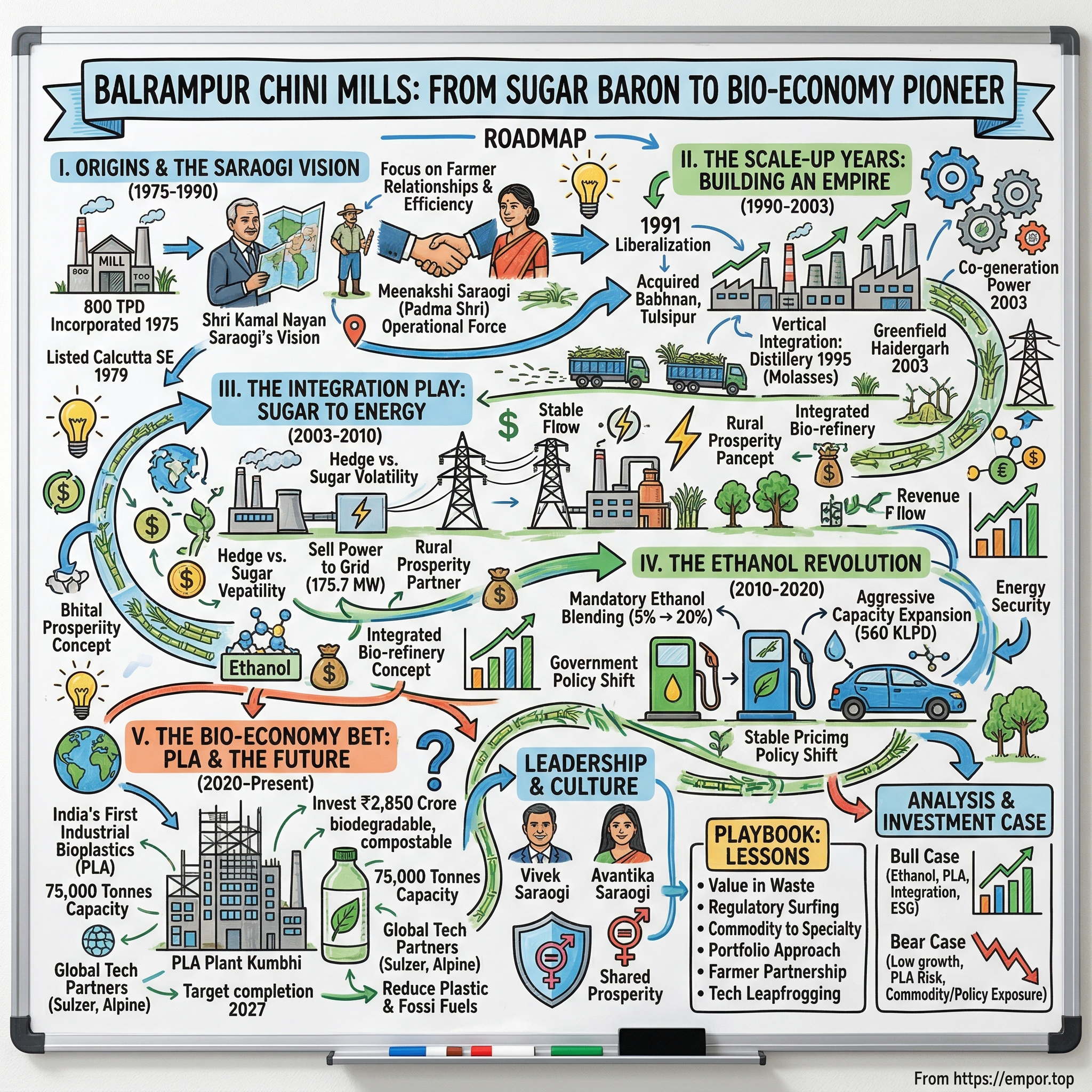
Balrampur Chini Mills: From Sugar Baron to Bio-Economy Pioneer
I. Introduction & Episode Roadmap (15–20 min)
On a February morning in 2025, the Chief Minister of Uttar Pradesh stood on a leveled patch of ground beside a sugar mill in Kumbhi, Lakhimpur Kheri district, to lay a foundation stone. The mill behind him had been crushing cane since 2007. The facility planned in front of him was unprecedented in India: an industrial-scale plant designed to convert sugar into plastic — not conventional fossil-fuel plastic, but polylactic acid, a compostable polymer. The announced investment stood at ₹2,850 crore, which the state government described as a first-of-its-kind commitment.12
It was a striking scene for a company whose founding act, 50 years earlier, had been the acquisition of a single 800-tonne-per-day sugar factory in eastern Uttar Pradesh.3 The ceremony framed the central question surrounding Balrampur Chini Mills Limited: is this the moment a commodity processor fundamentally transforms its business model, or is it the moment it bets three times its annual operating cash flow on a market that barely exists in India?
Stripped of narrative, Balrampur Chini Mills is an integrated sugar producer operating 10 factories across Uttar Pradesh. Its infrastructure includes an aggregate cane-crushing capacity of 80,000 tonnes per day, distillery capacity of 1,050 kilolitres per day, and saleable cogeneration capacity of 175.7 megawatts.4 For the fiscal year ending March 2026, the company reported standalone revenue of ₹6,271.15 crore — up 15.8% — along with earnings before interest, taxes, depreciation, and amortization of ₹741.28 crore and profit before tax of ₹523.70 crore.5 Yet consolidated total comprehensive income fell to ₹380.35 crore and basic earnings per share dropped to ₹18.74, as a ₹30-per-quintal increase in Uttar Pradesh's state-mandated cane price absorbed the company's volume gains.5 That divergence captures the sugar industry in miniature: revenue expanded while profitability contracted, driven by a raw-material input price the miller does not control.
As of late August 2026, equity markets valued the company at roughly ₹13,856 crore, trading at about 37 times trailing earnings and 3.2 times book value — valuations a traditional sugar miller generating a 9.3% return on capital employed would rarely command on its own.6 The premium reflects expectations surrounding the company's bioplastics venture. Market participants are not paying 37 times earnings for legacy sugar operations; they are pricing in an option on Balrampur Bioyug, an 80,000-tonne-per-annum polylactic acid complex nearing mechanical completion at Kumbhi. The project's gross capital cost has been revised upward to ₹3,080 crore, with management expecting commercial production to commence in the second half of fiscal 2027.47
That growth option is substantial, but it remains unproven. By the end of July 2026, the company had spent approximately ₹2,180 crore of its capital budget, completing 92% of civil works and 68% of equipment erection.4 Management informed investors that the preliminary lactic acid unit is scheduled for commissioning in October 2026, followed by the main PLA facility in December.8 However, the company has not quantified the addressable domestic market it plans to serve. When asked during an August 2026 earnings call about the potential market size for biodegradable pan masala packaging, Executive Director Avantika Saraogi stated that the company had "not been able to find verified data on this," noting that estimating a figure "would be irresponsible."8 Consequently, investors are underwriting a plant sized at roughly 20 times India's existing annual PLA consumption based largely on anticipated regulatory mandates and early customer product trials.
The path to this transition runs through seven key inflections. First was the Licence Raj era, when a single mill in an infrastructure-poor district of eastern Uttar Pradesh learned that a sugar producer's primary asset is securing a reliable cane supply from local farmers. Second was the post-1991 expansion, during which Vivek Saraogi acquired distressed mills across the state, integrating distilleries and bagasse-fired power generation. Third came the severe downturn of 2013 to 2016, when elevated state-mandated cane prices coincided with a sugar glut, causing the integrated model to suffer consecutive quarterly losses. Fourth was the ethanol expansion, as national blending targets transformed a molasses byproduct into a core profit driver. Fifth was 7 December 2023, when the Indian government abruptly banned the use of sugarcane juice and syrup for ethanol production, highlighting the regulatory risks inherent in distillery returns.9 Sixth is the current ₹3,080 crore diversification into the bio-economy. Finally, there is the present moment, marked by record domestic sugar prices and a stock that has more than doubled from its 52-week low, as Balrampur Chini prepares to test commercial demand for bioplastics.610
The strategic reality is straightforward: Balrampur Chini Mills possesses an established track record in a legacy business subject to strict external controls, alongside an unproven position in a bioplastics sector no Indian company has yet operated at commercial scale. The following analysis examines both.
 Subscribe on LinkedIn
II. Origins & The Saraogi Foundation (1975–1990) (20–25 min)
Balrampur is not an obvious place to build an industrial enterprise. It sits in the Terai belt of eastern Uttar Pradesh, near the Nepal border, on alluvial soil rich in sugarcane yield but poor in infrastructure. In 1975, when Kamal Nayan Saraogi's family consolidated the Balrampur sugar factory into a newly incorporated entity, the plant crushed 800 tonnes of cane a day.3 By comparison, that same site now crushes 12,500 tonnes daily and carries 53.05 MW of cogeneration capacity.3 The parent company remains a West Bengal corporate entity in the public registry — Balrampur Chini Mills Limited, CIN L15421WB1975PLC030118, with its registered office on A.J.C. Bose Road in Kolkata, anchoring a Marwari trading legacy to an agricultural asset four hundred miles away.4
The legal origin provides critical context for the company's long-term governance record. Under an indenture of conveyance, the land, buildings, assets, and entire workforce of the sugar factory were transferred from Balrampur Commercial Enterprises Limited to BCML, ending BCML's status as a subsidiary of BCEL.3 The company listed its shares on the Calcutta Stock Exchange in 1979.3 This five-decade history of public disclosure established a long, verifiable operational track record.
The economics of a controlled commodity. Sugar in India was historically an allocation system rather than a free market. Mills were required to sell a specified portion of their output to the government at administered rates for the public distribution system — known as levy sugar — while selling the remaining volume as free-sale sugar only within government-mandated quotas and release windows. Miller profitability was constrained on both ends: companies controlled neither input costs, output pricing for levy quotas, nor the timing of inventory sales. Working capital management was therefore a structural requirement rather than a discretionary treasury decision, as millers purchased an entire year's raw sugarcane supply over a four-month crushing season, converted it into storable crystals, and waited for regulatory clearance to release inventory.
Cane area reservations created additional operational boundaries. Regulations in Uttar Pradesh assign each mill a designated command area, obligating local growers to sell to that mill while requiring the mill to purchase their crop. State rules also enforce a minimum distance between competing factories. While this framework created a geographic moat preventing competitors from building mills within an established catchment area, it operated as a dual commitment: the mill secured an assured raw-material supply, and farmers gained a guaranteed buyer. However, because state authorities set the State Advised Price above the central government's Fair and Remunerative Price, raw-material input costs were dictated by political considerations rather than market dynamics.
The 24-hour clock. The biological reality of sugarcane distinguishes it from standard industrial commodities. Once harvested, sucrose within the stalk rapidly degrades through chemical inversion, reducing total recoverable weight. Delaying processing by even a single day results in an unrecoverable loss of sugar content. Consequently, a sugar mill functions less as a conventional manufacturing plant and more as a time-sensitive logistics network, pulling hundreds of thousands of tonnes of cane from surrounding fields on a precise hourly schedule. Millers cannot source raw materials outside their zone, and farmers cannot store harvested inventory; both remain bound to a tight processing window.
This operational urgency makes payment discipline a core strategic advantage. Growers who receive prompt payment within statutory timelines reseed sugarcane densely for subsequent harvests. Conversely, farmers facing prolonged payment delays from financially strained mills pivot to alternative crops like wheat or paddy, driving a collapse in mill crushing volumes two seasons later that cannot be quickly reversed. As payment arrears spread across Uttar Pradesh during the 1980s, BCML prioritized prompt grower settlements, effectively deploying working capital to guarantee long-term supply security.
Historical performance demonstrates the concrete impact of this strategy. During the 2025–26 crushing season, total cane processed across Uttar Pradesh declined by 7% year-over-year, whereas BCML crushed 5.2% more, reaching 1,043 lakh quintals.11 This 12-percentage-point outperformance relative to the state average highlights how grower goodwill secures raw-material volume. However, volume security does not insulate the company from regulatory cost pressures. In that same season, Uttar Pradesh raised the State Advised Price from ₹370 to ₹400 per quintal, compressing BCML's net profitability.5 The agricultural moat protects crushing volumes, but state regulation retains control over the underlying cost structure.
By the late 1980s, BCML had established its foundational profile: a single-site processor with strong local field relationships, operating within a tightly regulated framework, with future growth dependent on acquiring distressed competitor mills. Economic liberalization in the early 1990s provided the catalyst for that expansion.
III. Liberalization, Scaling & Early M&A (1990–2003) (25–30 min)
The 1991 economic reforms did not deregulate India's sugar sector. Instead, they deregulated the surrounding industrial framework — capital controls, licensing restrictions, and the administrative approvals required for expansion. For a family business operating a single efficient factory with deep local agricultural insight, the primary operational constraint shifted from regulatory permission to capital allocation.
Vivek Saraogi assumed operational leadership during this transitional period. Representing the third generation of the founding family, the St. Xavier's College commerce graduate became one of the youngest presidents of the Indian Sugar Mills Association.12 His public communication style has remained distinct among Indian corporate promoters: direct on investor calls, willing to dismiss widely circulated industry estimates as ungrounded, and candid when technical queries fall outside his immediate expertise.811 That executive demeanor provides important context for evaluating management guidance.
The acquisition playbook. The expansion pattern established during the 1990s was structured and repeatable: acquire small, undercapitalized mills possessing established cane catchments, then modernize and expand processing capacity rather than constructing greenfield facilities.
In 1990, BCML acquired a controlling stake in Babhnan Sugar Mill Limited, which then crushed 1,000 tonnes of cane per day. The entity was merged effective 1 April 1994, and the facility was progressively expanded from 2,500 tonnes per day in the 1992–93 season to 10,000 tonnes per day.3 In 1999, the company acquired control of Tulsipur Sugar Company Limited near Balrampur, which operated with an initial capacity of 2,500 tonnes per day. That business was merged effective 1 April 1999 and subsequently expanded to 7,000 tonnes per day alongside a 9.0-megawatt cogeneration unit.3 Through these transactions, two modest regional mills were expanded into a combined 17,000 tonnes per day of crushing capacity.
The strategic rationale extended beyond acquiring distressed assets at attractive valuations. Brownfield expansions in the sugar sector offer a major operational advantage over greenfield developments: an assigned command area. A new facility must recruit growers and wait several seasons for sugarcane acreage to mature. By contrast, an acquired mill provides an immediate grower base, allowing the acquirer to focus capital on improving plant throughput and extraction efficiency from existing fields. Multiplying capacity several-fold on an established license and catchment area proved substantially more capital-efficient than building from a bare field.
The first pivot: from sugar to by-products. The more consequential strategic shift of this decade required smaller initial capital outlays. In 1995, BCML commissioned a distillery at Balrampur with a capacity of 60 kilolitres per day.3 At the time, this represented an unglamorous capital allocation choice. Molasses — the viscous residue remaining after sucrose crystallization — was a low-value byproduct that millers typically sold to regional liquor producers at minimal margins. Fermenting molasses into rectified spirit and industrial alcohol enabled the company to capture a second commercial margin from raw sugarcane it had already purchased.
Eight years later, the company targeted a second byproduct stream. In 2003, BCML commissioned its first bagasse-fired cogeneration plant. Bagasse — the fibrous sugarcane residue left after juice extraction, generating roughly 300 kilograms per tonne of crushed cane — had traditionally been burned in low-pressure boilers solely to produce process steam. BCML installed high-pressure boilers to generate electricity beyond internal operational requirements, exporting the surplus power to the state grid under long-term tariffs. An input previously treated as an operational waste or low-grade fuel source became a metered, revenue-generating line item.
Neither initiative was revolutionary in isolation, but both executed the same underlying logic: because the primary sugarcane input was purchased at state-mandated prices, extracting additional saleable products from residual biomass captured incremental margins on a fixed cost base. That principle established the foundation of the integrated bio-refinery model the company operates today — a model later extended to its bioplastics venture under higher technical complexity.
However, the expansion of the 1990s left an essential strategic question unanswered: whether stacking byproduct revenues around a price-controlled commodity could effectively insulate earnings during severe industry downturns. The subsequent decade tested that model directly.
IV. The Integrated Model: Sugar, Power & BIFR Turnarounds (2003–2014) (35–40 min)
Between 2004 and 2007, Balrampur Chini Mills shifted strategies: rather than relying solely on acquisitions, it built greenfield integrated complexes. Each facility was designed from inception to combine cane crushing, power generation, and — where local cane density justified it — distillery capacity on a single site. Haidergarh was commissioned first in 2004 at 4,000 tonnes of cane per day (TCD) with a 20.25-megawatt (MW) cogeneration plant, later expanded to 5,000 TCD and 23.25 MW. That same year, a 60-kilolitre-per-day (KLPD) distillery was added at Babhnan, eventually expanded to 100 KLPD, alongside a Babhnan cogeneration facility that grew from 3 MW to 27.76 MW.3 Akbarpur followed in 2005 at 7,000 TCD and 18 MW of power capacity. Mankapur arrived in 2006 at 8,000 TCD with 34 MW of cogeneration and a 100 KLPD distillery. Kumbhi and Gularia were commissioned in 2007 at 8,000 TCD each, carrying 20 MW and 31.3 MW of cogeneration respectively — both of which were subsequently expanded.3
In parallel, the company continued its targeted acquisition strategy. It purchased an integrated unit in Rauzagaon from Dhampur Sugar Mills — initially operating at 7,500 TCD and 12 MW, later expanded to 8,000 TCD and 25.75 MW — and acquired a 53.96% stake in Indo Gulf Industries Limited. Indo Gulf's 3,000 TCD sugar unit at Maizapur was demerged and integrated into Balrampur Chini before the remaining Indo Gulf stake was fully sold in 2017.3 Maizapur was subsequently expanded to 4,000 TCD alongside a 10 MW cogeneration plant.
Three analytical insights emerge from this expansion period. First, Balrampur Chini demonstrated an ability to build and execute large-scale greenfield projects on schedule — relevant evidence when evaluating its execution capability for a ₹3,080 crore bioplastics complex. Second, management proved willing to exit non-core assets when strategic alignment ended, as shown by the clean divestment of the Indo Gulf stake. Third, the company concentrated its entire operating footprint within Uttar Pradesh. Ten sugar mills situated within a few hundred kilometres share agronomy teams, seed development programs, engineering staff, and executive oversight. That regional density generates tangible logistics and operating efficiencies, while concentrating regulatory, political, and weather risks within a single state.
Khalilabad: the distressed-asset case. In the 2012–13 fiscal year, Balrampur Chini absorbed Khalilabad Sugar Mills Private Limited, a financially distressed unit, through India's Board for Industrial and Financial Reconstruction (BIFR). The regulator approved the Modified Draft Rehabilitation Scheme by an order dated 14 August 2013, with retroactive effect from an appointed date of 1 April 2012. Balrampur Chini issued one of its shares for every twenty Khalilabad shares, allotting 526,894 shares in a transaction valued at roughly ₹34.4 million.13 While financially minor relative to the balance sheet, the transaction demonstrated an important organizational capability: navigating statutory rehabilitation processes to acquire distressed capacity and integrate regional cane supply areas at favorable valuations.
Testing the integration hypothesis. The assertion that an integrated business model fully insulates a sugar miller from cyclical downturns represents a longstanding thesis in the sector. However, the company's historical financial performance provides clear disconfirming evidence.
Through 2013 and 2014, the Uttar Pradesh state government repeatedly increased the State Advised Price for sugarcane while domestic sugar prices slumped under a national supply surplus. Balrampur Chini had already operationalized distillery and cogeneration capacity across its estate, but this operational hedge proved insufficient. The company reported a net loss of ₹9.77 crore for the quarter ending June 2013, a net loss of ₹122.11 crore for the September 2013 quarter — compared to a profit of ₹48.88 crore in the prior-year period — and a net loss of ₹50.76 crore for the December 2013 quarter.1415 The financial strain persisted into the following fiscal year: the company recorded a net loss of ₹63.90 crore in the quarter ending September 2014, concluding the fiscal year ending March 2015 with a consolidated net loss of ₹58 crore.146
The underlying mechanism explains why integration failed to prevent these losses. During that period, byproduct revenues from power and alcohol were modest relative to core sugar sales. More fundamentally, both byproduct streams depended on the same raw material input whose price was administratively inflated. When state-mandated cane prices rise, the implicit cost of the resulting molasses and bagasse increases accordingly, as both are co-products of sugarcane purchased at the mandatory rate. Vertical integration diversifies output products, but it does not diversify raw material input costs. A processor reliant on a single price-controlled input remains exposed to margin compression whenever input costs decouple from market-driven output prices.
Evaluating the model's limits. The operational evidence refutes the claim that vertical integration immunizes a miller against industry downturns. Instead, integration functions more narrowly: it increases total value extraction per tonne of crushed cane and accelerates cash conversion, thereby improving through-cycle returns and moderating the severity of cyclical troughs. However, it cannot prevent losses when state-mandated input costs rise during periods of weak output pricing. A key metric tracking this dynamic is the sugar segment's profit before interest and tax (PBIT) margin during seasons when cane prices increase without a corresponding rise in sugar realizations. In the quarter ending June 2026, after absorbing the state cane price hike alongside firm sugar realizations, Balrampur Chini's sugar segment PBIT margin stood at 3.16%.4 In periods when output prices soften, that margin contracts into negative territory.
That structural vulnerability provided the strategic context for the policy changes of the subsequent decade, which management and equity markets viewed as a path toward structural margin expansion.
V. The Ethanol Revolution: Policy Tailwinds & Capacity Explosion (2014–2023) (45–50 min)
The policy shift that reshaped the Indian sugar industry originated not within agriculture, but in the Ministry of Petroleum and Natural Gas's balance-of-payments considerations.
India imports the vast majority of its crude oil. Replacing petrol with domestically produced ethanol retains foreign exchange while supporting agricultural incomes across rural constituencies. The Ethanol Blended Petrol programme thus served a triple policy mandate: energy security, import substitution, and farm income support. The central government initially established a 10% blending target, later accelerating it to 20%. Crucially for corporate capital allocation, the government introduced administered, feedstock-differentiated prices at which state-owned oil marketing companies would purchase ethanol.
This pricing structure created the operational mechanism. During sugarcane processing, millers can divert sucrose at distinct stages. Extracting all crystallizable sugar leaves C-heavy molasses, yielding maximum sugar and minimum alcohol. Diverting earlier produces B-heavy molasses, sacrificing a portion of sugar output for a richer residue with higher ethanol yields. Diverting at the initial extraction stage ferments sugarcane juice or syrup directly into ethanol, foregoing sugar production entirely. Central pricing compensated millers based on the sucrose sacrificed along each route. For the 2025–26 ethanol supply year, administered procurement prices stood at ₹57.97 per bulk litre for C-heavy molasses, ₹60.73 for B-heavy molasses, and ₹65.61 for sugarcane juice or syrup, while grain-based routes were priced separately at ₹64.00 for damaged food grain, ₹60.32 for surplus rice from the Food Corporation of India, and ₹71.86 for maize.4
For sugar millers, this policy framework reshaped economics along two primary dimensions: operational profitability and working capital structure.
First, ethanol generated higher realization per tonne of cane than sugar across most seasons, rendering the distillery segment disproportionately profitable relative to its revenue contribution. In fiscal year 2026, Balrampur Chini's distillery segment generated ₹1,720.97 crore in revenue — slightly over one-fifth of segment revenue — while delivering ₹203.27 crore in segment profit before interest and tax (PBIT) at an 11.81% margin, compared with the sugar segment's 9.35% margin.45 In the quarter ending June 2026, which reflected seasonal crushing patterns, the divergence widened, with the distillery segment posting a PBIT margin of 14.90% against 3.16% for sugar.4
Second, the shift fundamentally altered working capital dynamics. Sugar production is an inventory-heavy model requiring millers to manufacture across four months, store product for up to twelve months, and finance working capital through short-term debt. By contrast, ethanol operates as a short-cycle receivable business under fixed tenders with state oil marketing companies. Converting sugarcane into rapidly collected receivables rather than slow-turning inventory reduced structural debt requirements across the balance sheet. Consequently, long-term borrowings for Balrampur Chini's existing operational business stood at ₹75.25 crore as of 30 June 2026, against a total market capitalization of approximately ₹13,856 crore.46
The build-out. Balrampur Chini expanded its distillation footprint accordingly. The company commissioned a 160 kilolitres per day (KLPD) distillery at Gularia, later expanded to 200 KLPD; increased capacity at its original Balrampur distillery from 160 KLPD to 330 KLPD; and commissioned a fifth distillery at Maizapur rated at 320 KLPD.3 Total aggregate distillery capacity reached 1,050 KLPD, ranking among the largest footprints in Uttar Pradesh.43 For fiscal 2026, the company produced approximately 27 crore bulk litres of ethanol, compared with a nameplate capacity capable of delivering 34 to 35 crore litres annually, according to Chief Financial Officer Pramod Patwari.11 This unutilized capacity — representing roughly one-quarter of installed volume — reflects the impact of shifting regulatory restrictions rather than operational constraints.
National blending limits and demand ceilings. For the 2025–26 ethanol supply year, oil marketing companies contracted approximately 1,048.4 crore bulk litres. Cumulative supply through 30 June 2026 reached 717.29 crore litres, achieving a national petrol blending rate of 19.99%.4 In the prior supply year, actual delivery reached roughly 1,003 crore litres against contracted volumes of 1,131.7 crore litres, yielding a blending rate of 19.24%.4 These metrics underscore two key industry dynamics: India has largely reached its 20% national blending target, and actual industry supply routinely falls short of contracted volumes, indicating that contracted figures represent a demand ceiling rather than a guaranteed floor.
Once national blending reaches the 20% policy mandate, incremental demand for ethanol ceases to depend on private distillation capacity and becomes entirely reliant on further regulatory increases to the blending target. Patwari acknowledged this structural limitation during an investor call for fiscal 2026, stating that at the industry level, "definitely there is an overcapacity," with proposed remedies dependent on policy decisions to lift demand beyond E20 through E85 and E100 flex-fuel pathways.11 While vehicle manufacturers have displayed prototypes and a draft notification has been circulated for public comment, these initiatives remain regulatory proposals rather than active commercial revenue streams.11
Administrative price risk. In addition to volume constraints, pricing dynamics present ongoing margin pressures. Administered prices for B-heavy molasses and sugarcane juice-route ethanol remained unadjusted for three consecutive supply years through 2026, even as state-mandated sugarcane prices increased twice over the same period.115 Executive Director Vivek Saraogi highlighted this margin squeeze during a May 2026 earnings call, citing "the absence of revision of ethanol prices under the juice and B-heavy route for the last 3 years, despite higher cane costs and operational expenses."11 The company structured its November supply tenders on the expectation of an upward price revision. CFO Pramod Patwari subsequently noted the miscalculation, stating, "we were hoping that it would get revised. It did not get revised. There was enough indication to say it would be."11 Saraogi added that management would take "a lot more cautious" approach in subsequent bidding cycles.11
This margin contraction underscores a key risk in administered commodity markets: a company operating with government-set input costs and government-set output prices possesses minimal pricing power when the two regulatory mechanisms diverge. That vulnerability became fully apparent in December 2023.
VI. The December 2023 Ethanol Shock & Policy Volatility (30–35 min)
On 7 December 2023, the Ministry of Consumer Affairs, Food and Public Distribution issued an immediate directive prohibiting sugar mills and distilleries from utilizing sugarcane juice or sugar syrup for ethanol production during the 2023–24 supply year, invoking clauses 4 and 5 of the Sugar (Control) Order, 1966. The stated objective was to secure domestic sugar availability and curb retail food inflation.9
The operational impact on millers was immediate. The 2023–24 crushing season was already under way, with processors having established their feedstock allocations, tender commitments, and output ratios months in advance. Because distillery infrastructure configured for direct juice conversion cannot be instantaneously reconfigured, sugarcane earmarked for high-realization ethanol was redirected toward white sugar crystallization, increasing supply within a market regulators had determined was oversupplied.
Days later, the ministry partially reversed its position, issuing a revised order that permitted the use of both cane juice and B-heavy molasses subject to an aggregate annual sugar diversion cap of 17 lakh tonnes.16 This rapid policy shift underscored the regulatory volatility governing the sector, where administrative interventions can abruptly alter corporate operational strategy.
What it did to BCML. During an investor call in February 2024, Managing Director Vivek Saraogi outlined the financial consequences of the policy shift. National gross sugar production was tracking between 33.2 million and 33.3 million tonnes, while approved diversion was capped at 1.7 million tonnes, leaving net production near 31.5 million to 31.7 million tonnes. Factoring in an opening stock of roughly 5.6 million tonnes and domestic consumption of 28.5 million tonnes, projected closing inventory for 1 October 2024 stood between 8.7 million and 8.8 million tonnes.17 Saraogi noted that the mid-season policy change "compelled companies to adjust their mid-season strategies resulting in production of more sugar than was initially anticipated," adding that "sugar will be held for a longer period of time instead of being promptly converted into cash flow through the sale of ethanol. This would add an additional cost as more working capital would be required and therefore a higher interest burden."17
Compounding this disruption, the Uttar Pradesh government raised the State Advised Price for sugarcane from ₹350 to ₹370 per quintal during the same season.17 Central policy curtailed high-margin output options, while state regulation expanded input costs within the same crushing cycle.
Saraogi publicly attributed the policy interventions to "a reaction towards the election from both the Governments, center and state," observing that pessimistic early crop estimates had "stoked a little too much of fear in the Government's mind."17 Subsequent policy adjustments corroborated his assessment of supply conditions, though the episode illustrated how political considerations introduce recurring regulatory friction into sugar processing operations.
The falsification: who owns the returns on a distillery? These events challenge the investment thesis that ethanol provides a predictable, market-decoupled annuity growth vector.
The economics of Balrampur Chini's 1,050 kilolitres per day of distillery capacity remain governed by three external regulatory mechanisms. First, feedstock regulations determine permissible conversion routes — restricted in December 2023, partially reinstated under quantitative caps, and subject to ongoing policy adjustments. Second, procurement prices per bulk litre are government-set and remained frozen across the two highest-value routes for three consecutive supply years despite rising operational expenses.11 Third, off-take volumes are dictated by oil marketing company tenders acting as a monopsony buyer — highlighted by the industry supplying 128 crore bulk litres below contracted volumes in the last completed supply year.4 Feedstock rules, output pricing, and purchase volumes all operate outside corporate control.
Looking forward, management guidance reinforces this operational dependency. During an August 2026 earnings call, with domestic sugar inventories low and realization prices elevated, Saraogi noted that while policy had not been formally announced, "it is reasonable to assume that there will be no diversion allowed towards B and juice" for the upcoming season, leaving only the lower-value C-heavy molasses route.8 Industry reports similarly indicated that authorities were evaluating constraints on sugarcane diversion for 2026–27 to stabilize domestic sugar availability.18 As a result, the company's distillery segment operates under ongoing risk of regulatory route restrictions.
Verdict. The evidence indicates that ethanol distillation functions not as a market-decoupled annuity, but as a heavily regulated, policy-allocated revenue stream. Nevertheless, the segment provides a vital second demand channel for sugarcane, accelerating working capital conversion and raising overall value recovery per tonne over full agricultural cycles. Furthermore, operational trade-offs exist: when sucrose diversion is restricted, sugar production increases, which can support realizations during periods of tight supply. As Saraogi remarked during the August 2026 call, the combination of higher cane prices, potential diversion restrictions, and firm sugar realizations could still yield a net positive outcome for integrated millers.8 However, that dynamic depends entirely on sustained strength in sugar pricing.
The key metric monitoring this balance is the distillery segment's profit before interest and tax (PBIT) margin alongside capacity utilization. If diversion restrictions reduce Balrampur Chini's ethanol output below the 27 crore bulk litres produced in fiscal 2026 while average realizations remain near ₹60 per litre, distillery profit contributions will contract, shifting overall earnings dependence onto sugar market prices that remain subject to external regulation.411
This ongoing regulatory exposure highlights the strategic rationale behind expanding into non-regulated product categories, such as bioplastics, where pricing remains unconstrained by state administration.
VII. The Bio-Economy Bet: Balrampur Bioyug & PLA Bioplastics (2024–Present) (40–45 min)
On 21 February 2024, ten weeks after the ethanol order, BCML held a conference call that had nothing to do with sugar prices. Saraogi opened it by telling shareholders that the team had been researching the subject "over three to four years," that the board had approved roughly ₹2,000 crore for a 75,000-tonnes-per-annum polylactic acid plant, and — the line that framed everything after — that "this represents the single largest investment in the history of our Company."19
What PLA actually is. Start with the chemistry, because the investment case rests on it. Sugar is fermented into lactic acid, the same molecule that makes yoghurt tart and that accumulates in muscles during exercise. Two lactic acid molecules are then joined into a ring called lactide, purified, and polymerised — strung into long chains — to produce polylactic acid. The result is a rigid, clear thermoplastic that behaves in a converter's moulding or thermoforming machine much like conventional polystyrene or PET. The difference is what happens at the end of life: PLA breaks back down into lactic acid, which occurs naturally, and under industrial composting conditions it disappears rather than persisting for centuries.
Two nuances matter for anyone assessing the market. First, PLA is compostable under specific conditions rather than casually biodegradable in any environment — a distinction Avantika Saraogi addressed directly on the announcement call, arguing that Indian summer temperatures make the practical outcome more favourable than the European framing implies.19 Second, PLA rarely goes into a product neat. Converters blend it with other biopolymers — PBAT for softness and flexibility, PHA for faster degradation — to tune properties. Management's argument is that these are complementary rather than competitive materials that "feed off each other's demand."19 That is a reasonable technical claim, though it also means BCML's realisation per kilogram depends on formulations it does not control.
The scale problem, stated honestly. BCML sized this plant against the global market, not the Indian one. On the 2024 call the company put worldwide PLA production at roughly 300,000 to 400,000 tonnes per annum.19 For reference, NatureWorks' Blair, Nebraska facility has a nameplate capacity of about 150,000 tonnes, and TotalEnergies Corbion's integrated plant at Rayong, Thailand runs at approximately 75,000 tonnes. BCML's 80,000 TPA would therefore be among the two or three largest single PLA assets on the planet, built by a company that has never made a polymer.
Avantika Saraogi's market argument was that India's bans on nineteen categories of single-use plastic cover roughly five million tonnes of material, at least half of which could be replaced by PLA in neat or compounded form, making 75,000 tonnes "a blip in that kind of a market."19 The counter-argument writes itself: those bans predate the plant and have been imperfectly enforced precisely because substitutes were scarce and expensive. Management's own framing concedes the price gap — PLA is "maybe around double" conventional plastic, and the economics only work "when there is a ban in place."19 Strip that down and the demand thesis reduces to a single dependency: enforcement of Indian plastic regulation.
Execution: what has actually been delivered. This is where the project earns credit. BCML signed definitive documents with Sulzer AG for the core production technology — lactide synthesis, lactide purification, and polymerisation — with Alpine Engineering GmbH for technical guidance, and with Jacobs Solutions India for engineering, procurement and construction management.2021 It hired Stefan Barot, a chemical engineer with over thirty-five years of experience including thirteen in bioplastics, formerly of Total Corbion and a past president of European Bioplastics, to run the project.19 It joined European Bioplastics as a member.22 It invested in Konkan Speciality Private Limited, an established Indian bioplastics compounder, to secure downstream conversion capability.19
The physical build has tracked reasonably. The foundation stone was laid at Kumbhi on 22 February 2025.1 By 31 July 2026 the company had spent about ₹2,180 crore, with model review 94% complete, civil erection about 92% complete, equipment erection about 68% complete, roughly 92% of domestic equipment ready, and more than 3,000 people on site.4 Against an original plan of "around 2 to 2.5 years to be executed" from February 2024, commissioning of the lactic acid section in October 2026 and PLA in December 2026 represents a slip of a few months on a first-of-its-kind chemical plant in India.198 That is a respectable execution record, and it should be said plainly.
The cost, and how it grew. The budget went from around ₹2,000 crore at announcement to ₹2,850 crore at the foundation-stone stage to ₹3,080 crore as revised in 2026 — roughly 54% above the original figure.1917 Capacity was simultaneously optimised upward from 75,000 to 80,000 TPA, so the escalation is not purely inflationary; per-tonne cost rose from about ₹2.67 crore to about ₹3.85 crore, which still leaves a material real increase.4 Funding is now structured as ₹1,650 crore of debt and ₹1,430 crore of equity and internal accruals, the latter topped up by a ₹450 crore preferential share issue.4
What is genuinely de-risking, and what is not. Uttar Pradesh announced a Bio Plastic Industrial Policy on 4 October 2024 under which companies investing ₹1,000 crore or more receive a 50% capital subsidy on eligible investment disbursed over seven years, 5% interest subvention for seven years, 100% net SGST reimbursement for ten years, ten-year electricity duty exemption and stamp duty exemption, capped in aggregate at 200% of eligible investment; Invest UP has issued a Letter of Comfort confirming eligibility subject to commercial operations commencing.4 A 50% capital subsidy on a ₹3,080 crore project is not a marginal sweetener — it is potentially half the asset. This is the single most important underappreciated fact in the entire investment case.
But read the fine print, because it explains a guidance number that otherwise looks arbitrary. The capital subsidy is linked to a Gross Capacity Utilisation Multiple: in the first year the multiple is 1 only if actual production reaches 40% of installed capacity, and in subsequent years the threshold rises to 75%.4 Now recall Avantika Saraogi's guidance on the August 2026 call that from January to March 2027 the company expects "around 40% on average capacity utilisation," describing it as a target that "should be easily achievable."8 That 40% is not a modest operational estimate plucked from the air. It is the subsidy threshold. And the 75% required from year two onward is a considerably harder bar for a plant selling into a market that management itself cannot size.
Market seeding: activity versus revenue. The commercial groundwork is real and it is documented. BCML has been importing PLA resin to supply Indian compounders and converters — visible in the accounts as a ₹23.58 crore purchase of stock-in-trade in the June 2026 quarter alone, against ₹3.72 crore a year earlier.4 It reports having targeted more than 175 customers, catering to over 100, with more than 30 trial projects running and 25-plus completed. BIS standards have been approved for PLA straws and bags, with mandate development underway for water bottles under 500ml and cutlery. It has developed BOPLA — biaxially oriented PLA film — domestically for the first time. It launched "Bioyug on Wheels," a mobile demonstration unit, in Mumbai in May 2025, and secured its first government institutional order from the Lucknow Cantonment Board for compostable garbage bags, 300ml PLA bottles, 3D-printed compostable pens and folders.4
Now weigh it. A first institutional order for garbage bags and pens is a marketing milestone, not an offtake book. The company states a "project pipeline exceeding 80,000 tonnes per annum anticipated by end of 2027" — note the words "pipeline" and "anticipated."4 Pressed in May 2026 on whether any binding offtake agreements existed, Saraogi declined to give specifics, saying "it is not proper to announce each and every agreement" and that everything was "nearing finalization."11 More revealing was Patwari's candid correction of an earlier assumption: the company had thought it would convert existing PLA importers into customers ahead of production, but learned that "they are okay with our quality and they are waiting for the production to hit the market, then only they will replace the existing ones. They are not ready to replace their current supplier base with us, as of now."11
That is the honest state of play. Technical qualification is largely done — converters have confirmed BCML's resin runs on their existing machines without modification.11 Commercial conversion has not started, because buyers will not switch suppliers until there is a plant actually shipping.
The margin question, and the best question any analyst asked. BCML has guided to an aspiration of 35% EBITDA margin on PLA, and Patwari clarified that this excludes the state incentives, which sit below the EBITDA line as lower depreciation and lower net interest.11 On the May 2026 call an analyst from Aurora Wealth Advisors put the obvious challenge: TotalEnergies Corbion started in this space at around 35% margins, is now at roughly 12%, and has put its PLA asset up for sale; Chinese producers are running at about 15% EBITDA. Why would BCML earn 35%?11
Management's answer was specific and worth taking seriously. The plant sits inside a sugar complex, so feedstock sugar and bagasse fuel arrive at the doorstep with no freight cost; bagasse-fired power is materially cheaper than grid or fossil energy, especially with crude elevated; and, they argued, Corbion splits lactic acid and PLA production across separate entities and therefore does not capture the full integrated value chain.11 Saraogi went further: on scale and with crude where it is, "I assure you we will be lowest cost."11
The logic is sound as far as it goes. Integrated feedstock and captive biomass energy are real structural cost advantages, and they are the same advantage that made molasses and bagasse profitable forty and twenty years ago. But two caveats bound it. India is not a low-cost sugar producer — a point Saraogi himself has conceded on prior calls — so the feedstock advantage is logistical rather than absolute.11 And when an investor asked whether a rival Indian sugar company could replicate the model, Saraogi answered honestly: "Yes, they will have that same sugar available and same bagasse available," with BCML's edge reduced to two years of research and group scale.11 The technology is licensed from Sulzer, which also supplies NatureWorks.2320 There is no cornered resource here. There is a head start.
Verdict. The claim that PLA is an immediate high-margin growth driver is not supported. What the evidence supports is narrower and still substantial: BCML has executed a large, technically complex greenfield project close to schedule at 54% above original budget, has secured a state incentive package that could offset roughly half the capital cost if utilisation thresholds are met, has technically qualified its product with converters, and has no binding offtake volumes. The confirming or falsifying events are unusually crisp: actual PLA production and dispatch in the March 2027 quarter against the 40% utilisation guidance, and disclosed contracted volumes for FY28 against the 75% subsidy threshold. Until then this is optionality, correctly priced only by someone who has decided how much a first-mover position in an unenforced regulatory market is worth.
VIII. Segment Breakdown, Unit Economics & Financial Anatomy (35–40 min)
Strip away the bio-economy narrative and ask a simple question: where does the money actually come from?
The answer, in the year to March 2026, was overwhelmingly sugar. The sugar segment generated ₹5,507.23 crore of revenue and ₹514.66 crore of segment profit before interest and tax, a 9.35% margin. The distillery segment generated ₹1,720.97 crore of revenue and ₹203.27 crore of PBIT, an 11.81% margin.4 Cogeneration barely registers as a separate revenue line because most of the power is consumed internally; what reaches the grid is modest. In FY26 the mills generated 82.79 crore units of electricity and exported 36.73 crore units at an average realisation of ₹4.54 per unit — a little over ₹165 crore of gross external power revenue against a group top line eight times that size.4
So the headline segment picture is roughly three-quarters sugar, a little over a fifth distillery, and a rounding error of exported power. But the profit picture is where the interesting distortion sits, and it moves violently by quarter.
Why the quarterly numbers lie. Saraogi opened the August 2026 call by explaining, with some patience, that a sugar company's quarters are not comparable to each other. The first quarter is off-season, with essentially no production; profitability is driven entirely by the carrying cost and realisation of inventory made in the previous season. The second quarter has no production at all. The third has partial production. The fourth carries the bulk of it.8 Any investor annualising a June-quarter number is producing fiction.
This is visible in the segment margins. Sugar's PBIT margin was 14.31% in the March 2026 quarter and 3.16% in the June 2026 quarter — same mills, same cane, same management, a difference of eleven percentage points created by the calendar.4 The company itself puts a note on its results slides recommending annual evaluation.4
The recovery number, and why it is the field's report card. Sugar recovery is the percentage of a tonne of cane that ends up as crystallised sugar. In FY26, BCML's gross recovery was 11.24%, marginally below the prior season's 11.28%.11 That sounds like noise. It is not. On roughly 1,031 lakh quintals of cane crushed in the financial year, four basis points of recovery is thousands of tonnes of sugar produced from cane already paid for at ₹400 per quintal.45 Recovery is close to pure margin.
There is a second recovery figure worth understanding, because the two get confused. "Pre-sacrifice" recovery — 11.23% in FY26 — measures what the cane could have yielded had none of it been diverted. "Net" recovery — 9.28% — measures what actually crystallised after the juice and B-heavy molasses sent to the distillery are deducted.4 The gap between the two is the ethanol diversion, expressed in sugar terms. In FY26 that gap amounted to a deliberate sacrifice of 7.74 lakh quintals of sugar via the B-heavy route and 12.37 lakh quintals via the syrup route.4 When the government bans diversion, that sacrifice reverses and net recovery jumps toward the pre-sacrifice number. That is the mechanical reason management believes a diversion ban is survivable: it converts alcohol back into sugar at a moment when sugar happens to be scarce.
The internal transfer price — a detail worth knowing. BCML charges its own distillery for the molasses it consumes. Those transfer prices rose sharply into FY27: B-heavy molasses from ₹1,150 to ₹1,360 per quintal and C-heavy from ₹600 to ₹800.4 This is not cosmetic. It shifts reported profit between segments and it means distillery margins in any given quarter partly reflect an accounting policy rather than an economic outcome. When an analyst pressed on exactly this in August 2026 — noting a roughly 20% jump in transfer pricing alongside apparently resilient distillery margins — Patwari explained that Maizapur's expenditure had been retained in the sugar division because the intention was to run it on sugar rather than juice, and Saraogi added the useful caution: "apples to apples, this may not look comparable."8 Investors comparing distillery margins across years without adjusting for transfer pricing are comparing two different things.
Feedstock diversification is real and under-discussed. The most interesting operational shift in FY26 was that BCML stopped being a purely cane-based distiller. Of its ethanol output, 9.66 crore bulk litres came from B-heavy molasses and 8.44 crore litres from the syrup route — but 4.75 crore litres came from maize and 0.84 crore litres from rice.4 Grain-based ethanol at Maizapur gives the company a route that is entirely independent of cane diversion policy, and it is priced higher: ₹71.86 per litre for maize against ₹60.73 for B-heavy.4 On the August call, an analyst sketched a scenario in which a full diversion ban still allowed roughly 10 crore litres from C-heavy plus another 9 to 10 crore litres from grain, and Saraogi's response was that the assumption was "not too much off the mark."8 That is a materially better downside than the December 2023 episode implied, and it reflects capital spent since.
The balance sheet. For most of its recent history BCML has been close to debt-free on its operating business. Long-term borrowings for the existing business stood at ₹75.25 crore as of 30 June 2026, with ₹22.25 crore repaid in the quarter.4 The PLA project sits alongside it as a separate stack: ₹1,086 crore drawn against a planned ₹1,650 crore, with ₹183 crore drawn in the June quarter alone.4 Repayment on the project loan does not begin until the December 2028 quarter, in twenty equal quarterly instalments — a structure that gives the plant roughly two years of operation before principal amortisation starts.4 The company has hedged part of its exposure with interest rate swaps, which produced a notional mark-to-market loss of ₹4.57 crore in the June quarter even though the actual carry on the contracts was favourable by about 21 basis points.4
Credit agencies have not flinched. CRISIL rates the long-term facilities AA+ with a stable outlook and the short-term A1+; India Ratings mirrors that at IND AA+/Stable and IND A1+.4 A AA+ rating maintained through the largest capital programme in a company's history is a meaningful third-party signal that the leverage is proportionate to the cash flows — though rating agencies, it should be said, are assessing default risk, not whether the plant will earn its cost of capital.
Cash flow tells the real story of the last two years. Operating cash generation has been healthy and improving: ₹425.16 crore in FY25 and ₹599.47 crore in FY26. Investing outflows were ₹880.43 crore and ₹946.66 crore in those same years, and financing was a net inflow of ₹455.31 crore and ₹347.28 crore.4 Read plainly: for two consecutive years the company has spent roughly 1.6 times its operating cash flow on capital expenditure and funded the gap with external money. That is the correct and unglamorous description of what building a ₹3,080 crore plant does to a ₹6,000 crore revenue company.
Valuation, and what it embeds. As of late August 2026 the shares traded around ₹655 for a market capitalisation of roughly ₹13,856 crore, at about 37 times trailing earnings and 3.2 times a book value of about ₹205 per share, with trailing return on capital employed of 9.28% and return on equity of 9.54%.6 Three-year average return on equity has been 11.3%, and five-year sales growth 5.44% — the profile of a decent, cyclical, capital-intensive processor.6
A company earning single-digit returns on capital does not trade at 37 times earnings because of its sugar business. It trades there because the market is capitalising something that does not yet appear in the accounts. That is neither irrational nor safe. It simply means the valuation contains a claim — about PLA volumes, PLA margins, and PLA subsidy capture — that the next four quarters will begin to settle, and that the reported earnings base offers no cushion against.
IX. Competitive Landscape & Structural Moat Analysis (30–35 min)
India's sugar sector is structurally divided by geography, ownership structures, and political economy.
In Maharashtra and Karnataka, grower-owned cooperative societies dominate. These mills are often tied to local political interests, operate at smaller scale, and remain heavily exposed to monsoon variability. In Uttar Pradesh, the primary structural model among efficient operators is the large private integrated complex: companies operating clusters of factories sized between 5,000 and 12,500 tonnes per day, equipped with captive cogeneration and distillery facilities operating within state-administered command areas.
While the Uttar Pradesh framework enables superior asset utilization and operational scale, it creates a concentrated regulatory exposure: a single state government unilaterally establishes the raw sugarcane input price across all regional processing assets simultaneously.
Where BCML sits. Operating ten factories with an aggregate crushing capacity of 80,000 tonnes per day, Balrampur Chini Mills is the largest private miller focused on Uttar Pradesh by crushing scale.4 Triveni Engineering & Industries offers the closest structural peer comparison. In fiscal 2026, Triveni reported consolidated net profit after tax of ₹268.7 crore — up 12.3% — as cane crushing fell 8.8% to 8.25 million tonnes due to weak yields in western Uttar Pradesh and cane diversion to alternative sweeteners, offset by record alcohol output of 236,510 kilolitres, up 18.2%, supported by an 860-kilolitre-per-day distillery footprint.24
A direct comparison highlights Balrampur Chini's operational differentiation during that same period: while Triveni's crush contracted by 8.8% and total sugarcane processing across Uttar Pradesh fell by 7%, Balrampur Chini expanded its crushing volume by 5.2%.1124 Geographic factors contributed to this variance, as eastern Uttar Pradesh experienced more favorable moisture conditions than the western region, with Vivek Saraogi noting that lighter rainfall in the company's catchment zone supports sucrose recovery.8 However, long-term investments in cane development, varietal management, and grower payment reliability also drove this outperformance. In a sector where millers are legally restricted from purchasing raw cane outside assigned command areas, expanding crushing volumes while statewide production contracts represents an effective gain in market share.
Beyond Triveni, peer comparisons in Uttar Pradesh include smaller operators such as Dhampur Sugar Mills and Dwarikesh Sugar Industries, both running efficient operations at lower aggregate scale. Shree Renuka Sugars operates under a distinct model, combining eight integrated mills totaling 46,000 tonnes per day of crushing capacity and 1,250 kilolitres per day of distillation capacity with port-based refining operations under its parent company, Wilmar, though historical debt levels and overseas asset write-downs have maintained volatility in its reported earnings.25 Notably, none of these peer millers has committed capital to bioplastics manufacturing.
Hamilton Helmer's 7 Powers, applied to the business.
Scale economies — present, but structurally bounded. Operating ten clustered facilities within Uttar Pradesh generates tangible cost efficiencies per tonne through reduced cane haulage distances, unified agronomy and engineering teams, and centralized regulatory engagement, as reflected in the company's crushing outperformance. However, because raw sugarcane costs are set by state mandate and dominate total operating expenses, economies of scale apply primarily to the remaining 15% to 20% of non-cane operating costs.
Process power — operational strengths alongside varietal challenges. Balrampur Chini's field agronomy capabilities represent a key competitive strength, as demonstrated by its management of the Co-0238 cane variety cycle. The high-yielding Co-0238 variety once accounted for roughly 90% of the company's cane area, driving statewide sugar recovery rates for a decade before becoming vulnerable to red rot disease in the seasons leading up to fiscal 2024.3 In response, management transitioned its crop mix, expanding non-Co-0238 varieties from 28% of planted area in the 2020–21 season to 54% in 2022–23 and 75% in 2023–24, thereby reducing Co-0238 below 5% by 2024–25 — establishing a balanced varietal distribution across its command area.3 Persuading growers to replace a historically lucrative variety reflected strong agricultural extension services and farmer trust.
However, replacement varieties have not fully restored historical recovery levels. When asked in May 2026 when sucrose recovery might return to peak Co-0238 performance, Saraogi acknowledged that matching those levels "looks tough," while noting that "this looks like the bottom."11 While agronomic execution mitigated systemic crop losses, it has not yet restored historical peak yields.
Counter-positioning — an early lead rather than a structural barrier. The thesis that established petrochemical producers cannot enter polylactic acid manufacturing due to existing fossil fuel infrastructure remains unproven. Global chemical producers can license the same Sulzer technology deployed by Balrampur Chini, which Sulzer has previously supplied to international PLA manufacturers such as NatureWorks.2023 Furthermore, Saraogi acknowledged during investor discussions that competing integrated sugar producers in India possess "that same sugar available and same bagasse available" for feedstock and captive power.11 Consequently, Balrampur Chini's competitive position rests on a two-year head start, a state incentive package linked to a project reaching 92% civil completion, and commercial trial relationships across more than 175 potential clients — advantages that constitute an operational lead rather than an insurmountable barrier to entry.411
Cornered resource — constrained by regulation. Command area allocations provide guaranteed regional cane access, but they do not constitute proprietary assets. They carry a statutory obligation to purchase all offered sugarcane at state-mandated prices.
Switching costs, network effects, and brand power — limited across core segments. Refined sugar remains a standardized commodity sold to fragmented wholesale markets. Ethanol is supplied under structured tenders to three state-owned oil marketing companies. In bioplastics, downstream converters remain hesitant to alter existing procurement channels until commercial volumes enter full production.11
Porter's five forces analysis.
Bargaining power of suppliers — high and institutionalized. Sugarcane growers operate with regulatory backing via Uttar Pradesh's State Advised Price, which increased from ₹350 to ₹370 per quintal during the 2023–24 season and to ₹400 per quintal for 2025–26, with Saraogi conceding during an August 2026 earnings call that with state elections approaching, "in all probability, now definitely there will be some hike."1758
Bargaining power of buyers — fragmented in sugar, concentrated in ethanol. In the sugar segment, buyer power is low, as output is sold to a broad network of wholesale traders. In ethanol, buyer power is highly concentrated: three state-owned oil marketing companies procure volume under administered prices determined by the central government, which also regulates allowable conversion feedstocks.
Threat of new entrants — low in legacy sugar, moderate in bioplastics. Greenfield entry in sugar processing is constrained by regulatory minimum distance rules between factories, command area allocations, and substantial capital expenditure requirements. In bioplastics, entry barriers depend on capital availability and technology licensing, both of which can be secured by established market participants.
Threat of substitutes — governed by policy and price differentials. In sugar, alternative sweeteners represent a minor share of domestic consumption. In ethanol, substitute risks stem primarily from policy shifts, including vehicle electrification trends or potential caps on national blending targets. In bioplastics, PLA competes with paper, alternative polymers such as PBAT and PHA, and low-cost conventional plastics in regions where environmental regulations are loosely enforced.
Competitive rivalry — geographically segmented in sugar, high in ethanol. Regional command areas minimize direct competition for sugarcane among sugar millers. Conversely, distillery competition remains elevated, as industrywide processing capacity exceeds current policy blending targets.11
Ultimately, Balrampur Chini's primary operational strengths — agricultural engagement, regional scale, and byproduct integration — are concentrated in legacy commodity segments governed by administrative price controls. Its long-term margin profile will depend on executing its bioplastics venture, a non-regulated sector where commercial operations have yet to commence.
X. Management, Governance & Capital Allocation Audit (25–30 min)
There is a moment on the August 2026 earnings call that captures the Balrampur management style better than any biography could. An analyst asks Avantika Saraogi to size the biodegradable pan masala packaging market. She declines, saying reliable data does not exist and that quantifying it "would be irresponsible" — then adds, to the analyst, "If you have any verified numbers, I would actually like to get them from you instead."8
That is not evasion. It is an executive publicly refusing to manufacture a total addressable market for a project on which the company's valuation depends. Investors should weigh it accordingly, in both directions: it is a strong signal on integrity and a stark one on visibility.
The people. Vivek Saraogi has run this business through every regime India's sugar policy has produced. Third generation in the family, a commerce graduate from St. Xavier's College in Kolkata, and among the youngest presidents the Indian Sugar Mills Association has had, he is described by his own company as the pioneer of the cane-based agri complex in Uttar Pradesh.12 His call manner is combative in a specific way — he pushes back hard on market narratives he thinks are lazy, dismissing an inflated inventory estimate as "rumour-mongering which creates excessive speculation," and he refuses to give guidance he does not have, telling an analyst in August 2026 simply, "No, I will not hazard a guess today."8
Avantika Saraogi is the fourth generation, a Scripps College graduate with honours, with over thirteen years of experience and an active role in the industry association.12 Her portfolio is the part of the company that is new: she handles the PLA product, application development, customer trials and the regulatory conversation around bioplastic mandates, and she is the executive who fields the technical questions on barrier properties, biodegradation testing and polymer grades.811 Pramod Patwari, the Chief Financial Officer, handles the arithmetic — transfer pricing, incentive accounting, the debt schedule — and is the executive most willing to correct management's own earlier assumptions in public.11
In May 2026 the board approved re-appointing Vivek Saraogi as Chairman and Managing Director for five years from 1 April 2027, and Avantika Saraogi as Whole-time Director for five years from 1 January 2027, both subject to shareholder approval.26 Succession, in other words, is planned but not imminent: the fourth generation is being given the new business to build while the third generation retains the chair.
Ownership. The promoter group holds about 42.86% of the equity, essentially unchanged from around 40.94% in March 2017 — a stable, substantial, family stake with no dual-class structure and no creeping consolidation.6 The balance is a healthy institutional float. For an Indian mid-cap, that ownership profile is unremarkable in the best sense: aligned, undramatic, and unlikely to produce a governance surprise.
Now the capital allocation record, tested properly. The comfortable version of the BCML story is that management is conservative, debt-averse and shareholder-friendly. The record supports parts of that and complicates others, and the complication is recent.
On the returns side, the evidence is strong and unusual for an Indian family business. Over the seven years to FY24, the company completed six equity buybacks with a cumulative payout of ₹1,009.49 crore including ₹110.73 crore of tax, alongside cumulative dividends of ₹420.75 crore.3 Six buybacks in seven years is not a gesture; it is a policy. It shrank the share count during the ethanol upcycle, and it is the single best piece of evidence that this management does not hoard capital for its own sake. The company has continued to pay dividends through the capex, declaring an interim dividend of ₹3.50 per share for FY26.27
Then the direction reversed. Having bought back roughly ₹1,000 crore of its own stock, BCML committed ₹3,080 crore — roughly 70% of its net worth — to a single greenfield project in a business it has never operated, funded with ₹1,650 crore of new debt and a ₹450 crore equity issue.476 The preferential allotment of 93,16,771 shares at ₹483 each was approved by the board on 23 April 2026 and cleared at an extraordinary general meeting on 20 May 2026 with 99.97% of votes in favour.7
Three observations about that issue, in ascending order of importance.
First, the promoters participated for ₹193 crore, which Saraogi described as "proportionate to their current holding," concluding that "there is no dilution."11 That phrasing needs a footnote of its own: there is no dilution of the promoter percentage. Existing non-promoter shareholders who did not participate were diluted, as they always are in a preferential issue.
Second, the issue price was struck in April 2026 under SEBI's formula-based floor, which references trailing volume-weighted average prices. By late August the stock traded around ₹655.6 Promoters and the invited institutions therefore bought at a price set before a substantial re-rating. That is how preferential issues work and it is not evidence of impropriety — but it is a real transfer of value to participants that a minority shareholder is entitled to notice.
Third, and most substantively: a company that spent seven years returning capital because it had no better use for it has, in under thirty months, swung to raising both debt and equity for one project. That is not a criticism of the project. It is the accurate characterisation of the risk posture. The word "conservative" no longer describes this balance sheet's intent, even if the AA+ ratings and the ₹75 crore of legacy operating debt still describe its condition.
The non-core asset an activist would ask about. BCML owns 30.47% of Auxilo Finserve Private Limited, an education-focused lender, accounted for as an associate. The economics have been excellent: an investment of ₹175 crore at an average cost of ₹10.59 per share is carried at an implied ₹959.40 crore based on Auxilo's last equity round at ₹58.04 per share.4 Auxilo delivered FY26 revenue of ₹675.76 crore and profit after tax of ₹116.87 crore, with gross non-performing assets of 0.52% and capital adequacy of 29.74% as of June 2026.4
A roughly five-and-a-half-fold markup is a good outcome by any standard, and it belongs in any fair audit of this management's capital allocation. But it also invites the obvious activist question, which was in fact asked on the FY26 call by an investor who could not find the relevant disclosure and was directed to take it offline.11 Why does a sugar and bioplastics company own a third of an education finance NBFC? There is no operating synergy. It is a well-timed financial investment sitting inside an industrial balance sheet, worth roughly 7% of market capitalisation on the company's own stated basis, whose value most investors are not tracking.
The generous reading is that it is unrecognised value. The skeptical reading is that a company about to spend seventy percent of net worth on a first-of-its-kind chemical plant has capital tied up in an unrelated lender. Both readings are defensible; the disclosure, at least, is there in the quarterly deck for anyone who reads to slide thirty-three.
XI. Primary Evidence: Earnings Call Transcripts & Q&A Dynamics (20–25 min)
Balrampur Chini's earnings calls are structurally revealing because management keeps prepared remarks brief. Managing Director Vivek Saraogi typically speaks for ten minutes before opening the floor, while Chief Financial Officer Pramod Patwari refrains from repeating the quarterly presentation. As a result, roughly 80% of each transcript consists of question-and-answer exchanges. Unscripted responses provide the primary empirical evidence of how leadership manages operational volatility.
February 2024: the policy shock, narrated in real time. The third-quarter fiscal 2024 call offers a clear view of how sudden regulatory shifts disrupt operations. Saraogi outlined the national sugar balance line by line, explaining how the central government's restriction on sugarcane juice diversion forced mid-season strategy changes: producing more white sugar than planned, holding inventory longer, expanding working capital requirements, and incurring higher interest costs.17 Asked for ethanol guidance, Patwari provided near-term figures but declined to project the subsequent year, noting that forecasting fiscal 2025 was difficult because government policy remained uncertain.17 The exchange highlighted how policy dependency constrains forward visibility even for major market participants.
February 2026: a forecast that did not hold. On the third-quarter fiscal 2026 call, Saraogi presented an internal estimate of 325 lakh tonnes of gross national sugar production, 35 lakh tonnes of sucrose diversion, and net output of 290 lakh tonnes against domestic consumption of 288 lakh to 290 lakh tonnes — projecting a balanced market without inventory buildup.28 By the May 2026 call, production realities had shifted: gross production reached roughly 31 million tonnes, diversion was capped at 3 million tonnes, and net output fell to 28 million tonnes. After initially announcing export quotas in November 2025, the central government prohibited exports once yields in Maharashtra, Uttar Pradesh, and Karnataka fell short of expectations, resulting in only 7 lakh tonnes shipped.11
Saraogi addressed the variance directly, noting that closing national inventory had fallen to 43 lakh tonnes — which he called "probably the lowest stock level which I remember seeing in my recent living memory" — while adding that "there is no alarm at this stock level."11 Balrampur Chini's own allocated export quota of 5.21 lakh quintals went largely unused, with only about 0.90 lakh quintals exported and 4.31 lakh quintals swapped for domestic sales quotas.4 While management acknowledged the shift transparently without attributing it to weather, the one-million-tonne error in a ten-week forecast underscored the inherent difficulty of predicting sugar market balances.
May 2026: evaluating PLA margins. The fiscal 2026 full-year call featured extensive discussion on the bioplastics expansion, which Saraogi summarized as "a very detailed interaction on PLA."11 A notable exchange occurred when an analyst from Aurora Wealth Advisors cited global precedents — pointing to TotalEnergies Corbion's margin contraction and asset sale, alongside Chinese producers operating at mid-teens EBITDA margins — and questioned how Balrampur Chini expected to achieve a 35% EBITDA margin.11 Management responded by pointing to structural cost advantages: captive sugarcane feedstock, zero inbound freight, bagasse-fired power, and full value-chain integration. Patwari separately clarified that the 35% EBITDA target excludes state capital incentives, which are recognized below the EBITDA line as lower depreciation and interest expenses.11
August 2026: planning for policy restrictions. By the first-quarter fiscal 2027 call, management's focus shifted from defending ethanol allocations to adapting to potential route restrictions. Saraogi advised analysts to model operations assuming no sugarcane juice or B-heavy molasses diversion for the upcoming season. He confirmed that the mills could run entirely on C-heavy molasses and that the Maizapur facility had been configured to process sugar in addition to grain ethanol. Weighing the trade-offs, he argued that higher state cane prices and diversion restrictions would be offset by firmer sugar realizations, remarking that "net we should come out as a winner."8 When pressed on whether the sugar realization benefit would substantially exceed the lost ethanol margin, he offered a measured qualification: "Maybe not much more, but yes, it could be more."8
The pattern in the divergence. Across these interactions, prepared remarks consistently emphasize theme phrases — integrated complexes, evolving market dynamics, maximum biomass recovery, and long-term bio-economy alignment. The subsequent Q&A sessions, by contrast, focus on granular operational mechanics: transfer pricing formulas, barrier properties of packaging films under extended logistics, biodegradation testing validation at CIPET Bhubaneswar, regulatory mandate uptake rates, and the timing of central decisions on frozen ethanol procurement prices.4811
This structural split highlights the value of analyzing earnings calls: while opening statements articulate corporate identity, unscripted responses reveal actual operating realities.
XII. Historical Falsification Pass & Risk Radar (25–30 min)
Two of the three core investment claims have already been tested against historical evidence in this analysis, and both verdicts hold: vertical integration moderates industry downturns but cannot fully offset state-mandated input price increases, while ethanol distillation operates as a policy-allocated revenue stream rather than an independent growth annuity. Both theses were refined by empirical evidence from Balrampur Chini's operational history rather than abstract debate.
What follows presents additional evidence regarding those two dynamics before evaluating the third major claim in detail.
Fresh evidence on the ethanol claim. The strongest disconfirming evidence is no longer the sudden December 2023 feedstock ban; it is the prolonged regulatory stillness that followed. Procurement prices for ethanol produced from B-heavy molasses and direct sugarcane juice remained frozen for three consecutive supply years, even as Uttar Pradesh raised mandatory sugarcane prices twice over the same period.115 Balrampur Chini submitted its November tenders anticipating an upward price adjustment that did not materialize, absorbing the resulting margin compression and acknowledging the miscalculation to investors.11 While a sudden administrative ban represents an isolated shock that financial models can absorb, a three-year procurement price freeze reflects a structural reality regarding market power: the state buyer controls real asset profitability.
Fresh evidence on the PLA claim. Beyond execution milestones and customer trials, the most rigorous test of the bioplastics venture comes from global margin history. Established international polylactic acid (PLA) producers have experienced material margin contraction, an industry precedent that analysts put directly to management without factual rebuttal.11 Balrampur Chini's strategic counter rests on operational feedstock integration rather than proprietary polymer chemistry. That distinction is fundamental: the company is betting on becoming the lowest-cost producer in a commoditizing polymer market, rather than offering a unique, non-substitutable product. Low-cost positioning in commodity markets can yield strong returns, but it depends entirely on operating volume, and volume requires a mature, receptive market.
Claim three: "management maintains strict debt aversion and conservative capital allocation."
The affirmative evidence for historical discipline remains compelling. Balrampur Chini's legacy operating business carries minimal long-term debt. Completing six equity buybacks across seven fiscal years alongside regular dividend distributions demonstrates a consistent commitment to returning surplus capital rather than accumulating idle cash. Similarly, management divested its non-core stake in Indo Gulf Industries rather than retaining it for balance-sheet scale, while acquiring Khalilabad's distressed assets for a nominal sum. Furthermore, credit rating agencies have maintained AA+ ratings throughout the current expansion program.
Conversely, the disconfirming evidence demonstrates that debt aversion represents a period-specific strategy rather than an immutable corporate trait. Balance-sheet leverage expanded during the mid-2010s downturn as working capital borrowings financed inventory through consecutive quarterly losses. More recently, management committed to a strategic pivot requiring ₹1,650 crore in project debt and a ₹450 crore equity issue for a single complex, reversing seven years of net capital returns to equity holders.
Verdict: the claim is narrowed, not rejected. Management maintains capital discipline during steady-state operations and returns excess cash when internal opportunities are limited, as evidenced by its buyback record. However, leadership is willing to leverage the balance sheet substantially to execute a strategic transformation, undertaking the largest capital deployment program in the company's history. Falsifying or confirming evidence will emerge over the near term: specifically, whether project debt remains capped near the planned ₹1,650 crore rather than escalating alongside a capital expenditure budget that has expanded 54%, and whether the company resumes share buybacks following plant commissioning or continues seeking external capital.
A fourth claim worth testing: agronomic process power. The red rot disease outbreak provided a clear operational test of whether Balrampur Chini's field organization possesses structural process power or merely benefits from favorable regional growing conditions. The empirical verdict is largely positive but strictly bounded. Management identified the systemic threat, transitioned its sugarcane portfolio from a 90% concentration in the Co-0238 variety to under 5% across four seasons, and subsequently expanded crushing volume while statewide production and peer throughput contracted.31124 However, sucrose recovery rates have not returned to historical Co-0238 peak levels, and management does not anticipate a full recovery in the near term.11 Balrampur Chini's agronomic capabilities effectively prevent agricultural failures, but they have not yet demonstrated the ability to deliver sustained, outsized yield gains under non-peak conditions.
Risk radar — mechanisms, not labels.
The policy squeeze. Regulatory exposure represents the primary structural risk, operating through three distinct government channels. The Uttar Pradesh state government dictates raw sugarcane input costs via the State Advised Price, raising rates twice across three seasons with regional elections scheduled for early 2027 by management's assessment.85 The central government controls ethanol procurement prices, which remained frozen through the 2025–26 supply year across the two highest-realization feedstocks.4 Concurrently, the central government sets the statutory sugar minimum selling price, which has remained fixed at ₹31 per kilogram since February 2019 despite industry assertions that production costs approach ₹40 per kilogram and formal petitions requesting a floor between ₹39 and ₹42 per kilogram.2930 Operating under three administered pricing mechanisms outside corporate control directly compresses operating margins whenever input cost increases decouple from output price adjustments.
Agronomy and climate. Sugarcane is a fifteen-month crop cultivated within a single geographic region. Disease outbreaks, pest infestations, or unseasonal rainfall patterns directly impair crushing volumes, sucrose recovery rates, and distillation output simultaneously, as all three operations rely on the same raw material base. Consequently, management consistently advises that crop yields cannot be reliably evaluated before September in any given harvest cycle.118
PLA absorption and import competition. The Kumbhi facility's 80,000-tonne annual capacity represents a substantial fraction of global PLA production. Should domestic regulatory mandates for compostable packaging materialize slower or more narrowly than management anticipates, excess output must be exported into international markets where established global manufacturers with fully amortized assets possess the ability to price aggressively. Executive leadership noted that rising conventional plastic prices have supported PLA pricing levels.11 Nevertheless, domestic demand absorption remains partially dependent on elevated crude oil pricing.
Financing and execution. Debt service on ₹1,650 crore in project loans accrues regardless of whether plant utilization reaches planned operational targets. The state capital subsidy that enhances project economics remains strictly contingent on achieving capacity utilization thresholds that the company has no prior experience meeting in polymer manufacturing.4 Furthermore, the bioplastics division reported pre-operational net losses of ₹16.72 crore in fiscal 2026 and ₹9.84 crore in the June 2026 quarter alone, reflecting ongoing customer sample distributions and market development expenses.4 These initial outlays are modest, but segment overhead will expand significantly once depreciation commences on the ₹3,080 crore asset.
Concentration. Every mill, the distilleries, the cogeneration units and the PLA plant sit in Uttar Pradesh. There is no geographic hedge anywhere in this business.
XIII. Investment Spine: Bull vs. Bear & Critical KPIs (25–30 min)
On 4 August 2026, Balrampur Chini Mills' shares reached a 52-week high of ₹664.80. Later that month, Indian sugar stocks rallied by up to 18% after the central government imposed stricter stockholding limits on bulk consumers ahead of the festive season, following a 10% monthly increase in wholesale sugar prices to between ₹4,750 and ₹4,800 per quintal.10 The stock had previously traded at a 52-week low of ₹393.55.6
This wide trading range within a single year captures the market's shifting expectations. Evaluating Balrampur Chini requires separating its legacy operational performance from the speculative premium attached to its bioplastics initiative.
Why BCML wins from here. The bullish thesis rests on three core pillars:
Operational performance. Balrampur Chini has established a five-decade record of operational execution across changing policy environments. The company expanded its crushing volume while statewide production and peer output contracted, maintains minimal legacy debt on its operating business, and has historically increased value recovery per tonne of sugarcane through periodic byproduct integration.
Cyclical supply dynamics. Low domestic inventory levels and elevated wholesale sugar prices provide near-term market support. If sugarcane juice and B-heavy molasses diversions are restricted for the upcoming season, processing capacity will redirect toward white sugar, offsetting lost ethanol production with increased sugar output during a period of firm market pricing.810 Management expects that firm sugar realizations will mitigate the combined impact of higher state cane prices and feedstock diversion limits.8
Bioplastics growth option. The valuation premium pricing the stock at 37 times earnings reflects expectations surrounding Balrampur Bioyug. If the facility achieves commercial commissioning on schedule, meets the 40% initial and 75% subsequent capacity utilization thresholds required to secure state capital subsidies, and achieves management's targeted 35% EBITDA margin on projected full-capacity revenue of ₹2,000 crore, the enterprise would fundamentally transform its earnings base.411 However, each of these conditions remains unproven at commercial scale.
Why the case breaks. Conversely, the bearish counter-thesis highlights three distinct vulnerabilities:
Regulatory margin compression. The primary structural risk remains administrative cost inflation. If Uttar Pradesh increases the State Advised Price for sugarcane ahead of upcoming state elections while central authorities leave statutory sugar minimum selling prices and ethanol procurement rates unchanged, operating margins will contract across legacy processing units. This cost-price squeeze has recurred across previous cycles, resulting in net losses during the mid-2010s.
Slow bioplastics commercialization. If commercial adoption ramps slower than planned due to unenforced single-use plastic mandates or delayed customer conversion, the company faces substantial operational drag. Under a slow ramp-up, Balrampur Chini would absorb full depreciation and interest charges on the ₹3,080 crore facility, fail to meet the 75% capacity utilization threshold required for state capital subsidies, and be forced to export surplus resin into international markets dominated by established low-cost producers.
Valuation multiple contraction. Trading at 37 times trailing earnings alongside a 9.3% return on capital employed, the stock offers minimal downside protection if the bioplastics venture encounters execution delays or fails to deliver projected margins. Current equity valuations already price in successful project execution, leaving the stock vulnerable to any operational setback.
The activist counter-argument. From an activist investor's perspective, the central challenge is straightforward: an enterprise generating single-digit returns on capital from legacy sugar processing has allocated 70% of its net worth toward an unproven polymer venture in a market whose size executive management declines to quantify, while holding an unintegrated 30.47% stake in an education finance lender. From this perspective, the halt in share buybacks and the shift toward debt and equity financing require binding customer offtake agreements to justify the risk posture.
In response, management can point to a project build tracking close to schedule, a state capital subsidy framework designed to absorb up to half of eligible project costs if utilization targets are achieved, and a refusal to issue speculative market estimates without verified commercial data.
The three key performance indicators.
First, sugarcane crushed and pre-sacrifice recovery rates. Crushing volume measures grower payment discipline and field supply security relative to Uttar Pradesh state benchmarks, while pre-sacrifice recovery indicates whether newly introduced sugarcane varieties are restoring sucrose content lost during the Co-0238 red rot infestation.
Second, distillery production volume and blended ethanol realizations. Tracking volume alongside average realization per bulk litre reveals both capacity utilization across the 1,050 kilolitre-per-day distillery footprint and net profitability under central feedstock pricing policies, distinguishing temporary diversion limits from structural margin compression.
Third, actual PLA dispatch volumes relative to state subsidy thresholds. Evaluating commercial progress requires tracking physical product dispatches rather than project pipelines or customer trial counts. Achieving 40% average capacity utilization in the initial operational year and 75% in subsequent years represents the essential benchmark for unlocking the state government's capital subsidy incentives.4
XIV. Epilogue: The Indian Bio-Refinery of 2030 (15–20 min)
Fifty-one years separate the two scenes. In 1975, a Marwari family in Kolkata took ownership of a single sugar factory near the Nepal border that crushed 800 tonnes of cane per day, operating in an economy where state controls dictated output sales and quotas. By 2026, the company operates ten mills crushing a hundred times that daily volume, five distilleries, a network of bagasse-fired boilers exporting power to the grid, and a greenfield chemical plant designed to convert sucrose into a compostable polymer.43
The underlying logic across five decades has been consistent: because raw sugarcane is purchased at a state-mandated input price, management's primary operational lever is maximizing value recovery per tonne of crushed cane. Molasses was processed into industrial alcohol in 1995. Bagasse was converted into metered grid power in 2003. Molasses and sugarcane juice were channeled into fuel-grade ethanol during the 2010s. Now at Kumbhi, sucrose is slated for conversion into bioplastics. Each strategic shift sought to move the company further from a low-margin commodity and closer to an unconstrained end market.
Yet complete pricing autonomy has remained elusive. Every historical revenue stream eventually became subject to state oversight—sugar MSP set by the central government, sugarcane SAP by the state government, electricity tariffs by state regulators, and ethanol prices by the ministry. For investors, the strategic significance of polylactic acid lies less in its environmental attributes and more in its commercial pricing structure: output rates are currently unconstrained by government decree.
Whether unconstrained pricing proves advantageous or risky remains to be demonstrated. A market free of price administration is also a market devoid of administrative price floors. For five decades, Balrampur Chini's returns were capped by regulatory intervention but periodically protected by it—the same authorities that froze the statutory sugar minimum selling price at ₹31 per kilogram also restricted import competition, mandated national ethanol blending rates, and established a captive buyer pool for alcohol.29 In bioplastics, the company forfeits both regulatory ceilings and government guarantees, relying instead on a state capital subsidy framework that requires meeting high operational utilization targets.
That transition offers a broader strategic insight for analyzing industrial commodity processors. Enterprise durability across policy cycles depends less on financial hedging than on controlling a secured physical feedstock supply while expanding downstream product applications. The raw material base constitutes the core asset; the product mix serves as a series of growth options. Balrampur Chini's primary asset remains its sugarcane command area in eastern Uttar Pradesh, which has anchored its operations for half a century. Refined sugar, ethanol, cogeneration, and polylactic acid simply represent alternative allocation choices for that underlying agricultural biomass.
Empirical verification will emerge over the coming quarters. Management schedules the preliminary lactic acid facility for commissioning in October 2026, followed by the main polylactic acid line in December, targeting initial commercial production between January and March 2027 at an estimated average capacity utilization of 40%.8 Sustained commercial performance will ultimately depend on physical product dispatches and customer repeat orders.
For investors, evaluating Balrampur Chini requires balancing two distinct realities: the company represents an efficiently operated legacy agricultural processor, yet its equity valuation reflects expectations for an unproven bio-economy enterprise.
References
-
Balrampur Chini lays foundation stone for India's first PLA biopolymer manufacturing facility — Business Standard, 2025-02-22 ↩↩↩
-
First-of-its-kind investment, says Chief Minister Yogi Adityanath on Rs 2,850-crore deal between UP govt and Balrampur Chini Mills — The Tribune, 2025-02 ↩
-
Integrated Annual Report 2023-24 — Balrampur Chini Mills Limited, 2024-07 ↩↩↩↩↩↩↩↩↩↩↩↩↩↩↩↩↩↩
-
Q1 FY27 Results Presentation — Balrampur Chini Mills Limited, 2026-08-11 ↩↩↩↩↩↩↩↩↩↩↩↩↩↩↩↩↩↩↩↩↩↩↩↩↩↩↩↩↩↩↩↩↩↩↩↩↩↩↩↩↩↩↩↩↩↩↩↩↩↩↩
-
Balrampur Chini Mills revenue rises 15.8% in FY26 as margins face cane cost pressure — ChiniMandi, 2026-05 ↩↩↩↩↩↩↩↩↩
-
Balrampur Chini Mills Ltd — Consolidated Financials, Ratios and Shareholding — Screener.in ↩↩↩↩↩↩↩↩↩↩
-
Balrampur Chini Mills raises Rs 450 crore via preferential issue, revises PLA project capex to Rs 3,080 crore — ChiniMandi, 2026 ↩↩↩↩
-
Q1 FY27 Earnings Conference Call Transcript — Balrampur Chini Mills Limited, 2026-08-12 ↩↩↩↩↩↩↩↩↩↩↩↩↩↩↩↩↩↩↩↩↩↩↩
-
Govt bans sugarcane juice, syrup for ethanol making in 2023-24 supply year — Business Standard, 2023-12-07 ↩↩
-
Sugar stocks Bajaj Hind, Dwarikesh, Dhampur soar up to 12%; hit 52-wk highs — Business Standard, 2026-08-24 ↩↩↩
-
Q4 & FY26 Earnings Conference Call Transcript — Balrampur Chini Mills Limited, 2026-05-18 ↩↩↩↩↩↩↩↩↩↩↩↩↩↩↩↩↩↩↩↩↩↩↩↩↩↩↩↩↩↩↩↩↩↩↩↩↩↩↩↩↩↩↩↩↩
-
Balrampur Chini Mills Limited completed the acquisition of Khalilabad Sugar Mills (P) Ltd. — MarketScreener, 2013-08-14 ↩
-
Balrampur Chini reports net loss of Rs 122.11 cr in Q2 — Business Standard, 2013-10-31 ↩↩
-
Balrampur Chini reports Rs 50.76 crore loss in Q3 — Business Standard, 2014-02-06 ↩
-
Govt issues revised order to allow use of sugarcane juice for making ethanol in 2023-24 — Deccan Herald, 2023-12 ↩
-
Q3 & 9M FY24 Earnings Conference Call Transcript — Balrampur Chini Mills Limited, 2024-02-15 ↩↩↩↩↩↩↩
-
Sugar price surge may hit ethanol output as mills eye better returns — Business Standard, 2026-08-04 ↩
-
Conference Call Transcript — Polylactic Acid (PLA) Project — Balrampur Chini Mills Limited, 2024-02-21 ↩↩↩↩↩↩↩↩↩↩
-
Balrampur Chini Mills partners with global players for its upcoming PLA-Bioplastics manufacturing facility — ChiniMandi ↩↩↩
-
Sulzer to deliver polylactic acid production technologies to Balrampur Chini Mills — Indian Chemical News ↩
-
Member portrait: Balrampur Chini Mills Limited — European Bioplastics e.V. ↩
-
Sulzer PLA bioplastics production technology selected for NatureWorks' new plant — Sulzer, 2022-01-13 ↩↩
-
Triveni Engineering FY26 PAT rises 12% to Rs 269 crore; distillery business drives growth — ChiniMandi, 2026-05 ↩↩↩
-
Outcome of Board Meeting — Balrampur Chini Mills Limited, 2026-05-15 ↩
-
Balrampur Chini Mills recommends interim dividend of 3.50 rupees/share — MarketScreener, 2025-11 ↩
-
Q3 & 9M FY26 Earnings Conference Call Transcript — Balrampur Chini Mills Limited, 2026-02-11 ↩
-
Government hikes Minimum Selling Price (MSP) of Sugar to Rs. 31 per Kilo for the year 2019-20 — Press Information Bureau, 2019 ↩↩
-
Sugar industry calls for price hike to Rs 39.14 per kg to help cut losses — Business Standard, 2024-10-29 ↩
 LinkedIn
 WhatsApp
 Reddit
 Hacker News
 Email
Email Kindle
 RSS Feed
 Spotify
 Apple Podcasts
 Amazon Music
 Audible
 YouTube