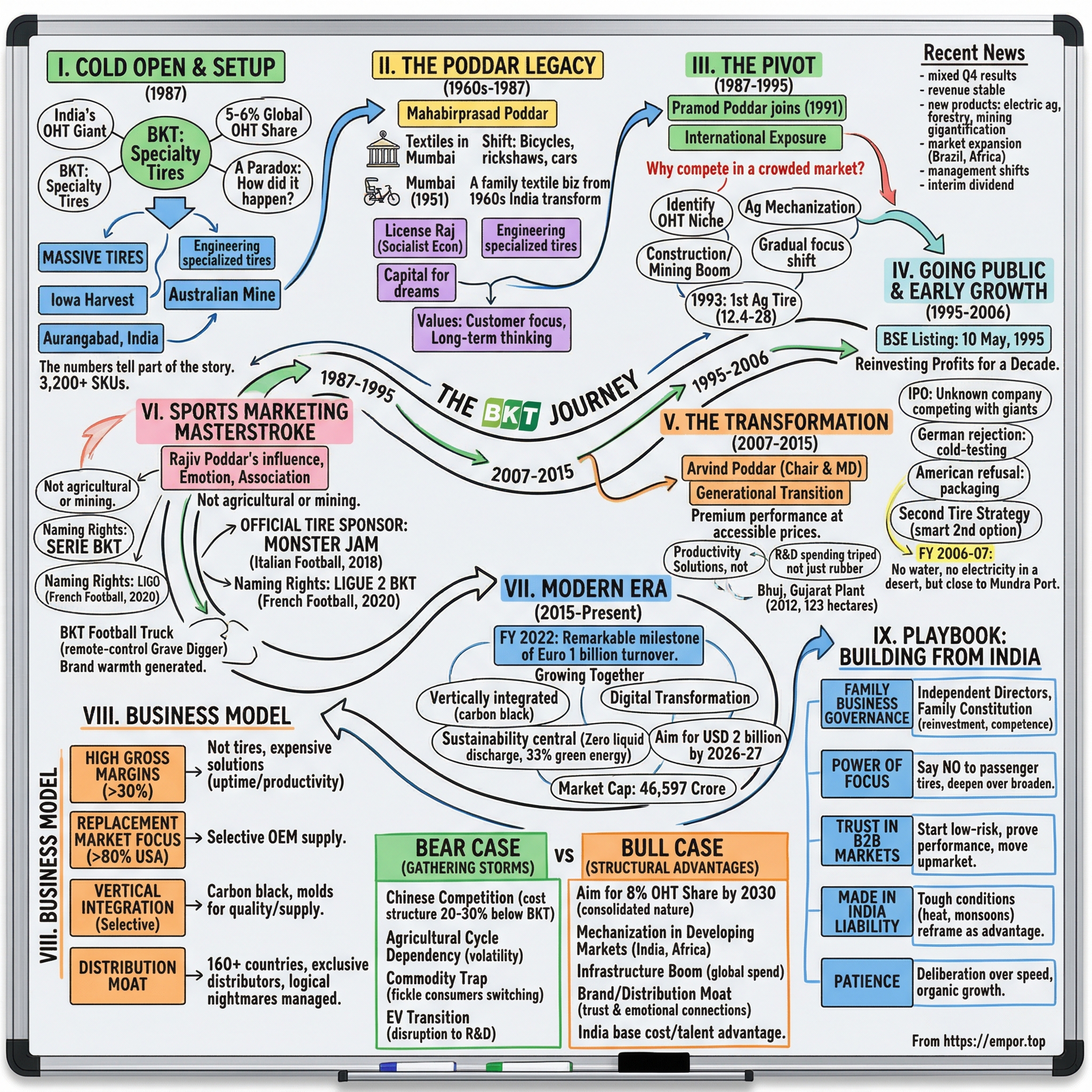
Balkrishna Industries: The Untold Story of India's Off-Highway Tire Giant
I. Cold Open & Episode Setup (10-12 min)
Somewhere in the Kutch desert of Gujarat, on land that a company brochure once described as barren ground lacking water and electricity, stands a plant that few Indian investors have visited and few European farmers recognize — even though many drive on its tires today.1
Those tires do not belong on passenger cars. They fit tractors pulling seed drills across Normandy, telehandlers in Bavarian dairy yards, articulated dump trucks in Chilean copper pits, and skid steers in Texan feedlots. They are heavy, slow, highly specialized products. A single agricultural radial can weigh more than a small motorcycle. The maker behind them — Balkrishna Industries Limited, marketed globally under the BKT brand — built a distinct profile in Indian manufacturing by turning away from the domestic vehicle market to focus almost exclusively on overseas niche segments for twenty-five years.
The scale is substantial, though easy to misjudge. For the financial year ended March 2026, Balkrishna reported standalone revenue of roughly ₹10,820 crore and a net profit of ₹1,222 crore, shipping 317,356 metric tonnes of off-highway tires.2 The company estimates its share of the global specialty tire market at 5% to 6%, selling across more than 160 countries with a catalogue of over 3,600 stock-keeping units — not total inventory items, but distinct product lines, each requiring dedicated tooling, compound formulations, and load-speed specifications.31
That SKU count defines the operational model. Far from being a sign of unmanaged portfolio complexity, it forms the core of the company's competitive claim. Producing 3,600 tire varieties requires constant mould changes and short production runs, creating operational friction that traditional high-volume passenger-car plants avoid. For a Western factory optimized for millions of identical units, that variety adds prohibitive cost. For facilities in Bhuj or Bhiwadi operating with lower tooling and labor overheads, that complexity serves as a defensive barrier.
The investment thesis rests on three core premises. First, Balkrishna identified a structural gap as global tire majors shifted capital toward high-volume on-road segments, leaving low-volume, high-complexity off-highway demands under-served. Second, a competitive Indian cost structure and dedicated greenfield capital deployment enabled the firm to capture that demand at strong margins — reaching an operating margin of roughly 25.5% in FY25 despite manufacturing what remains an industrial rubber product.3 Third, it built brand recognition in a commodity B2B market through unconventional sponsorships, from monster truck rallies to second-division European football leagues.
Each premise requires scrutiny against the company's recent operational performance. In 2023, operating margins contracted by nearly six percentage points under pressure from elevated freight and raw material costs. In 2024, shipment volumes declined. Across 2025 and 2026, a 50% U.S. tariff temporarily disrupted access to a key agricultural export market. By 2026, management sought shareholder approval to enter the crowded commuter-tire market — the very segment its founders previously chose to avoid.
Key strategic questions follow: how effectively niche specialization shields capital from commodity price cycles, where Indian manufacturing cost advantages originate in tooling and capital efficiency, why an industrial supplier invested heavily in sports marketing, and how a promoter family holding a 58% equity stake allocates capital as its core market matures.4
 Subscribe on LinkedIn
II. The Poddar Heritage & Strategic Pivot: From Rickshaws to Off-Highway Niche (1960s–1995) (35-40 min)
The Poddars were not originally tire manufacturers. They came from a Marwari trading and textile background — a lineage tied to the wider Siyaram Poddar group, whose businesses historically spanned fabrics, yarn, home furnishings, and paper.5 Balkrishna Industries Limited was incorporated in Mumbai in 1961, a vintage reflected in its corporate identification number.3 For its first quarter-century, the business remained small and largely unremarkable.
Company history dates its operational foundation to 1987, when founder chairman M.P. Poddar inaugurated Balkrishna's first tire plant in Aurangabad, Maharashtra.1 As current chairman Arvind Poddar later recalled, his father Mahabirprasad and uncle Suresh set up the facility to produce two- and three-wheeler tires — covering bicycle, scooter, and auto-rickshaw rubber for the Indian domestic market.6 It was a high-volume, low-margin segment, entering a domestic market on the verge of intense competition.
That starting position was fraught. By the late 1980s, India's tire market was dominated by established players with deep distribution networks — including MRF, Apollo, CEAT, and JK Tyre. These incumbents commanded superior brand recognition and dealer relationships compared to a new entrant from Aurangabad. In a market where scale dictated survival, Balkrishna lacked volume, facing a long-term risk of structural margin compression.
The strategic shift began in 1991 when Arvind's cousin, Pramod Poddar, joined the business and recognized that domestic commuter segments were saturating.6 He pointed the company toward an untapped global niche: off-highway tires. By 1995, Balkrishna formally commenced production of off-highway tires.1
The strategic opportunity lay in market structure rather than overall size. Off-highway tires represented a modest market compared to passenger car tires, but offered an asymmetric advantage. Global tire majors such as Michelin, Goodyear, and Bridgestone optimized automated production lines for maximum capital return, prioritizing high-volume runs of uniform product lines. By contrast, agricultural and earthmoving tires required hundreds of distinct tread patterns and sizes, low batch volumes, and frequent mould changes. For global majors, managing such complexity created operational friction; for a smaller manufacturer, that inconvenience represented an accessible entry point.
Balkrishna chose to redirect its capital away from domestic commuter tires to focus almost entirely on off-highway exports. While corporate lore often frames this pivot as a stroke of foresight, it was a practical response by a small firm selecting a segment where it could compete effectively. This strategy relied on classic counter-positioning: major incumbents had little financial incentive to retaliate, as defending low-volume specialty segments would disrupt their high-margin, automated operations.
Establishing a foothold required prolonged execution. Management noted publicly that the initial decade yielded modest growth while the company established market presence, with significant traction arriving only around 2007 through focused investments in product quality and branding.6 Gaining credibility meant convincing European distributors that an Indian facility could maintain tight engineering tolerances for demanding agricultural conditions, while meeting technical standards established for Western manufacturers.
That regulatory preparation created a lasting operational advantage. Balkrishna was among the early tire manufacturers to comply with the European Union's REACH chemical regulations, later securing REACH SVHC compliance certification across its product lines.3 This early groundwork bolstered distributor confidence in European markets, providing a competitive safeguard when regulatory compliance requirements tightened.
This formative era established the business model Balkrishna maintains today: distributing through independent networks rather than company-owned retail, focusing strictly on a single proprietary brand rather than white-label contract manufacturing, and accepting gradual volume expansion to preserve pricing discipline. Arvind Poddar emphasized this single-brand focus, stating that the company relies exclusively on the BKT brand and does not contract-manufacture for third-party brands.6 In an Indian industrial export sector heavily reliant on white-label manufacturing, building a proprietary brand was an unconventional path.
The strategic lesson from this pivot lies in its operational constraint: maintaining success as a low-cost producer of high-complexity products requires sustaining both cost efficiency and flexible manufacturing capabilities. If cost advantages erode, operational complexity becomes a financial burden — a strategic tension that shaped the company's expansion over the following decade as it sought premium margins in developed markets.
III. Going Public, Export Bet, & The SKU Complexity Engine (1995–2008) (40-45 min)
The years between the off-highway pivot and the 2008 global financial crisis were critical to establishing Balkrishna's operational foundation. During this period, the company built the manufacturing and commercial infrastructure that supported its subsequent international growth.
Physical capacity expanded incrementally. Balkrishna commissioned a plant in Bhiwadi, Rajasthan, in 2002, and broadened its product line in 2003 to include all-terrain vehicle, turf care, and earthmoving tires. In 2004, the company introduced its Agrimax radial agricultural tire range, marking its entry into radial technology. A second Rajasthan facility opened in Chopanki in 2006. By 2009, annual revenue had surpassed ₹1,000 crore.1 Management benchmarked progress during this phase primarily in European currency to reflect its primary export destination, with revenue reaching approximately €84 million in FY07.6
While Balkrishna's shares trade on Indian stock exchanges, public equity markets played a secondary role in funding its growth. Rather than repeatedly issuing shares to finance expansion, the company funded capital expenditures primarily through internal cash flows and bank debt. This capital allocation strategy allowed Balkrishna to expand manufacturing capacity without significant equity dilution.
A pivotal decision during this period involved customer selection. Rather than prioritizing original equipment manufacturers (OEMs), Balkrishna focused on the aftermarket replacement segment. That balance has remained consistent: replacement sales generated roughly 72.8% of revenue in FY25 compared to 25.7% from OEMs, following a similar distribution of 71.1% replacement revenue in FY24.3 By volume, replacement accounted for 71.0% and OEMs accounted for 27.7% over the first nine months of FY26.1
This emphasis on the replacement market shaped both profitability and risk exposure. OEM procurement departments leverage purchasing scale to negotiate strict pricing terms. In contrast, replacement buyers—such as farmers and equipment operators purchasing tires during equipment maintenance windows—typically exhibit lower price sensitivity. Furthermore, relying on independent aftermarket sales mitigates customer concentration risk. While losing an OEM contract can eliminate a substantial portion of production volume overnight, a distributed network of regional dealers limits reliance on any single client.
This approach required Balkrishna to build its own brand presence and international distribution network. While replacement sales remained the primary focus, Balkrishna also cultivated selective OEM partnerships, earning "Excellence Level" recognition under Caterpillar's Global Supplier Excellence Recognition program for four consecutive years.1 Nevertheless, the company's core commercial focus remained in the replacement market, underpinning its margin profile.
Underpinning Balkrishna's operational structure was its high-SKU manufacturing model. In high-volume passenger tire manufacturing, production lines run continuously on uniform sizes to minimize downtime. In off-highway manufacturing, where thousands of product variants exist, frequent mould changes are standard. Changing a tire mould requires stopping the line, replacing multi-tonne tooling, re-calibrating curing presses, adjusting rubber compounds, and testing output specifications.
Executing this flexible production model cost-effectively relied on two key advantages. First, Balkrishna established in-house tooling production, operating a dedicated mould manufacturing plant and a drum fabrication facility in Bhuj.3 Internalizing tooling design and fabrication reduced the marginal cost of introducing new sizes to raw materials and engineering time, avoiding the expense and lead times of third-party toolmakers. Second, lower hourly labor and capital overheads in India reduced the financial penalty associated with line downtime during mould transitions.
However, this manufacturing approach represents an operational lead rather than a permanent technological moat. Flexible production relies on general manufacturing practices rather than patented technology. Competing manufacturers in Asia have established similar capabilities, with credit rating agency CARE Ratings explicitly citing cost-competitive Asian suppliers as an active constraint on Balkrishna's pricing flexibility.3 Balkrishna's advantage lies in its cumulative library of moulds, product homologations, and established distributor relationships—a commercial barrier that requires continuous reinvestment as market competition evolves.
By 2008, Balkrishna had validated its core strategy: an Indian manufacturer could capture profitable market share in developed economies by focusing on downtime-sensitive industrial replacement segments. The remaining question was whether the company could replicate this business model at significantly larger volumes—a challenge that prompted its next major capital deployment.
IV. The Mega-Capex Gamble: Building Bhuj & Cost Arbitrage Scale (2008–2017) (50-55 min)
In 2016, when journalists toured the newly completed Bhuj complex, company guides underscored what the site had been beforehand: barren desert lacking water and electricity.7 While designed to highlight corporate ambition, the detail pointed to the central risk of the project. Balkrishna chose not to build its flagship plant within an established industrial cluster offering an existing labor pool and ready utilities. Instead, it selected Kutch — a district severely damaged by a major earthquake in 2001 — acquiring 300 acres for a committed capital investment of approximately $500 million.7
For a company whose total annual revenue had only recently crossed ₹1,000 crore in 2009, the project represented far more than a routine capacity expansion; it was a high-stakes corporate wager.1
The location offered three main strategic advantages. First was port proximity. Kutch sits adjacent to Mundra and Kandla, two of India's major maritime gateways. For an exporter shipping the vast majority of its volume overseas in containers, a short haul to the quay reduced lead times and working capital requirements in ways internal factory efficiencies alone could not replicate. Second was land availability and state industrial policy. Rather than securing space for a single plant, Balkrishna acquired land at a scale that built in operational flexibility, allowing the site to later absorb an internal carbon black complex, a mould manufacturing plant, and subsequent brownfield expansions without additional land acquisition hurdles. Third, purchasing greenfield land in an underdeveloped district secured low upfront land costs, helping minimize the capital outlay per tonne of installed capacity.
The rollout unfolded over several years. Company records show commercial operations at the greenfield Bhuj facility beginning in 2015, followed by a brownfield expansion adding 50,000 metric tonnes per annum (MTPA) at the site in 2022. In parallel, Balkrishna expanded capacity at Waluj in Maharashtra, commercializing a 30,000 MTPA facility in 2021 and increasing Waluj capacity to 55,000 MTPA in 2023.1 Management describes Bhuj as the largest off-highway tire manufacturing facility in Asia, incorporating nearly 1,500 quality checks into the production process.7 The facility subsequently received a five-star rating in the British Safety Council's occupational health and safety audit.1
Contrary to common assumptions, Balkrishna did not construct its primary vehicle dynamics testing ground at Bhuj. Instead, the company inaugurated a dedicated testing facility at NATRAX — the National Automotive Test Tracks — in Indore, which is rated as Asia's second-largest test track complex.1 This arrangement carries clear operational implications for research and development: by leasing access to a national-scale testing track rather than replicating it in-house, Balkrishna preserved capital, though it placed reliance on shared public infrastructure into its testing schedule.
The strategic timing of the Bhuj investment becomes clearer when contrasted with broader industry moves during the same period.
Between 2016 and 2018, the global off-highway tire sector underwent rapid consolidation through major acquisitions. In March 2016, Yokohama Rubber agreed to acquire Alliance Tire Group — an off-highway specialist with manufacturing operations in India — for $1.2 billion, completing the transaction in July of that year.8 Two years later, in July 2018, Michelin agreed to purchase Canadian off-road specialist Camso for $1.45 billion, closing the deal that December.9 In total, two primary global competitors spent approximately $2.6 billion to acquire off-highway market share in under three years. Over the same timeframe, Balkrishna expanded its footprint organically using internal cash flows and greenfield construction.
This contrast highlights distinct strategic trade-offs. Developing greenfield capacity avoids goodwill accumulation, integration friction, and M&A valuation premiums, yielding a lower capital cost per tonne compared to purchasing asset portfolios at peak multiples. However, organic expansion carries notable operational risks: multi-year construction delays, market demand shifts prior to commissioning, and the reality that new physical plants arrive without immediate customer relationships, distribution channels, or an installed base. While Balkrishna executed its greenfield deployment successfully, the strategy required managing substantial capital risk.
Subsequent industry developments further complicated the debate over organic expansion versus acquisition.
In 2024, Michelin sold the Camso brand and two manufacturing facilities in Sri Lanka to Indian manufacturer CEAT for approximately $225 million, retaining select assets from the original purchase as it narrowed its focus toward radial products.10 That partial divestment by a global major within six years of a multi-billion-dollar transaction underscored the shifting boundaries of specialty tire portfolios, while demonstrating how Indian manufacturers continued to acquire cost-competitive production assets.
Alongside capacity expansion, technological shifts — specifically radialization — reshaped the market during this period. Unlike traditional bias-ply tires built from overlapping diagonal fabric layers, radial tires feature internal cords running perpendicular to the direction of travel, reinforced by a steel belt below the tread. In agricultural operations, radial tires provide greater sidewall flex, creating a broader, flatter contact patch that reduces soil compaction, runs cooler, and improves fuel efficiency. As tractor horsepower increased and soil conservation gained regulatory and operational priority, European agricultural markets shifted rapidly toward radial technology. Producing radials requires higher capital investment and manufacturing precision, but yields higher selling prices and operating margins.
The Bhuj complex was engineered specifically to capitalize on radial adoption. That technical capability also enabled Balkrishna to enter higher-barrier market segments: the company cites itself as the sole Indian manufacturer to produce all-steel radial tires up to 57 inches in diameter, spanning bias and radial configurations for heavy mining equipment.1 While this milestone demonstrates technical capability rather than dominant market share, it expanded the company's addressable product ceiling.
For investors, the Bhuj development established two central operating principles: Balkrishna demonstrated the ability to construct large-scale industrial assets without overleveraging its balance sheet, while maintaining a capital expenditure per tonne of capacity significantly below Western competitors. However, expanding physical output solved only part of the commercial equation. Capturing premium market share required convincing agricultural and industrial buyers in developed markets that an Indian tire brand offered equivalent reliability to established Western incumbents — a challenge that drove the company's next strategic push into global brand marketing.
V. Counter-Positioning & B2B Brand Building: The Sports Marketing Masterstroke (2014–2021) (30-35 min)
Consider the commercial challenge Balkrishna faced when entering Western markets. A procurement manager at a European equipment dealership selecting tire brands evaluated an Indian manufacturer with capable products, limited historical presence, and lower wholesale pricing than Western incumbents. In B2B industrial sales, a lower price point does not automatically win orders; it often signals unverified quality to risk-averse dealers. Where traditional industrial B2B marketing relies on trade shows, technical datasheets, and dealer margin incentives, Balkrishna adopted an unconventional route: sponsoring American monster truck racing.
BKT has served as the official tire partner of Monster Jam since 2014.11 At first glance, sponsoring monster trucks appears misaligned with selling agricultural rubber, as Monster Jam trucks do not run standard farm radials. However, the arena audiences in regional markets—such as Tulsa or Des Moines—include agricultural contractors, equipment operators, farmers, and fleet mechanics. These attendees directly purchase or influence replacement tire decisions, encountering the brand in an environment that emphasizes durability and heavy-duty performance rather than discount pricing.
The company extended this targeting strategy to Europe. In 2018, BKT became the title sponsor of Italy's second-tier football league, renamed Serie BKT—a partnership initially signed for three seasons and subsequently renewed in July 2024 through 2028.1213 In 2020, the company secured title sponsorship for France's second division, Ligue 2 BKT.14 By 2023, Balkrishna integrated both promotional channels, deploying a remote-controlled miniature of the Monster Jam truck Grave Digger as the official match-ball carrier for Ligue 2 fixtures.11
Focusing on second-division football reflected deliberate audience targeting rather than high-profile brand vanity. Top-tier leagues such as Serie A and Ligue 1 command higher rights fees and attract urban, global audiences. In contrast, Serie B and Ligue 2 clubs operate in regional centers—including Cremona, Bari, Guingamp, and Amiens—located within agricultural hinterlands where machinery demand originates. Balkrishna secured concentrated coverage within core user demographics at a fraction of premier league sponsorship rates.
The sports marketing portfolio continued to broaden. BKT entered a four-year agreement with the Royal Spanish Football Federation (RFEF) as the official sponsor of Spanish referees and official tire partner of the Copa del Rey Final. It secured naming rights for Cricket Australia's men's ODI and T20I series against India in October 2025, and signed as the official tire partner for all five Women's Premier League franchises during the 2026 season—the Mumbai Indians, Royal Challengers Bengaluru, Delhi Capitals, Gujarat Giants, and UP Warriorz. In the domestic Indian market, the company appointed cricketer Ravichandran Ashwin and actor Ranveer Singh as brand ambassadors.1
The geographic shift across these endorsements mirrors Balkrishna's evolving corporate strategy. Initial sponsorships targeted European and North American buyers to establish credibility for an Indian export brand. Subsequent investments—spanning Indian cricket, domestic entertainment figures, and the WPL franchises—aim directly at Indian consumers, reflecting the company's intention to enter the domestic passenger vehicle market.
Management articulated this broader strategy in an investor presentation, stating that brand-building investments "will now generate greater value across a wider revenue base."1 For investors, amortizing fixed marketing expenditures across new product categories represents a potential efficiency gain. However, skeptics view the statement as a post-hoc justification for expanding beyond Balkrishna's core off-highway niche into competitive consumer segments.
Evaluating how much of Balkrishna's margin profile stems from brand equity is complicated by limited financial disclosure. The company does not break out price realization between brand-loyal and price-sensitive sales channels, and management declined on an earnings call to disclose dealer margins, citing corporate policy.15 Nevertheless, financial performance offers indirect evidence: Balkrishna sustained operating margins near 25.5% in FY25 despite not being the sector's technology leader, distributing primarily through independent dealers who can substitute suppliers, and competing against established global majors including Michelin, Bridgestone, and Yokohama-owned brands.3 Pure price-takers rarely maintain such margin differentials over extended periods.
In the replacement market, BKT's brand acts primarily as an entry mechanism rather than a luxury price driver. While it does not enable premium pricing on par with tier-one Western majors, brand recognition provides independent dealers the commercial confidence to stock and recommend BKT products over low-cost Asian alternatives. This brand protection remains vulnerable: marketing exposure cannot offset delivery failures, quality defects, or price increases beyond market tolerance.
Brand strength influences pricing realization, but offers no defense against raw material cost volatility. With raw materials representing the majority of production expenses, managing input costs required direct operational intervention—prompting Balkrishna's next vertical integration strategy.
VI. Backward Integration & Hidden Engine: The Carbon Black Expansion (2018–Present) (35-40 min)
If a tire is sliced in half and its ingredients sorted by weight, two materials dominate: natural and synthetic rubber, and carbon black—a fine black powder that forms the structural foundation of the compound.
Carbon black serves as a vital reinforcing filler. Produced by burning heavy petroleum feedstock in a controlled, oxygen-starved furnace, its microscopic carbon particles bond into the rubber matrix to provide abrasion resistance and structural integrity. Without it, a tire tread would wear down within a few hundred kilometers. Excluding rubber itself, carbon black is the single largest component in a tire compound by weight. Because its pricing tracks crude oil, it introduces commodity price volatility that tire manufacturers cannot directly control.
That volatility directly shapes Balkrishna's cost structure. Raw materials account for 65% to 70% of total sales costs in the tire industry, with BKT's primary inputs—natural rubber, synthetic rubber, carbon black, and specialized chemicals—all traded as global commodities.3 To illustrate the volatility, average natural rubber prices rose 28% from roughly ₹156 per kilogram in FY24 to about ₹200 per kilogram in FY25. Prices peaked at ₹238 per kilogram in August 2024 before easing to ₹184 per kilogram by December 2025.3 For a business operating at a 25% margin while allocating two-thirds of its costs to raw materials, absorbing a 28% input surge requires either immediate price pass-through or direct control over key input production.
Balkrishna chose internal production, scaling its backward integration to a degree that effectively created a major chemical manufacturing operation alongside its tire business.
Company milestones record internal carbon black self-sufficiency achieved in 2020 following Phase 2 completion at Bhuj, followed by capital investments for specialty carbon materials completed in 2024.1 The board subsequently approved an expansion costing approximately ₹800 crore, raising total capacity from 200,000 to 360,000 metric tonnes per annum—adding 95,000 tonnes to an existing 265,000-tonne base—which was commissioned in the first quarter of FY27.161715 Within that capacity, 30,000 metric tonnes are dedicated to high-value advanced carbon materials targeting non-tire applications such as paints, plastics, and inks.3
This backward integration yields three distinct economic effects that warrant separate analysis.
First is supply security and freight efficiency. In its credit assessment, CARE Ratings explicitly noted that backward integration "reduces both input and transportation costs and structurally supports the margins."3 The logistics advantage is significant: carbon black is low-density and bulky, making long-distance transport to Kutch from third-party suppliers far more costly than co-located manufacturing.
Second is captive energy generation. Producing carbon black yields high-temperature tail gas as a byproduct, which can be harnessed to generate steam and electricity. Balkrishna constructed co-generation power units around this process, with the latest expansion adding 24 megawatts to bring total captive power capacity at Bhuj to 64 MW.1615 By utilizing this waste stream, the company offsets a substantial portion of the power costs required for tire manufacturing, providing a permanent operational cost advantage.
Third is merchant revenue generation. Balkrishna sells surplus carbon black to external customers, with management indicating that third-party sales represent roughly 10% of current operations, targeting a sustained 10% revenue contribution by FY30.151 To manage the division, the company appointed Ashish Kumar Dutta, an industry executive with 36 years of experience, including leadership roles at Lubrizol.15
The strategic question is whether external sales act as an expanding margin driver or represent a lower-margin volume expansion. Merchant carbon black remains a commodity chemical sold to industrial buyers—including competing tire makers—subject to market overcapacity and crude-linked pricing cycles. Consequently, it operates with a lower margin profile than specialized off-highway tires. Management's guidance confirms this dynamic: the company projects blended operating margins between 23% and 25% following the full commercialization of its 2030 strategic plan.1 Compared to the 25.55% operating margin generated by the core business in FY25, management's blended target indicates that expanding external chemical sales is at best margin-neutral and likely modestly dilutive.3
This places the investment in perspective. The captive portion—encompassing raw material security, eliminated freight expenses, and co-generated power—provides structural support to gross margins, setting Balkrishna apart from non-integrated specialty peers. Conversely, merchant sales represent an asset-utilization strategy that management frames as business diversification. While both elements coexist, assertions that carbon black expansion will automatically expand consolidated gross margins lack disclosure support, as the company does not break out segment-level profitability and overall guidance points toward margin compression.
Furthermore, backward integration does not eliminate commodity risk; it shifts exposure upstream. Balkrishna remains reliant on crude oil derivatives for petroleum feedstock. Carbon black market prices fell 2% in FY25 and declined 7% year-over-year during the first nine months of FY26 as crude prices moderated.3 While falling input costs lower tire production expenses, they simultaneously reduce merchant chemical revenues, muting the financial hedge when tire margins require the least support. Ultimately, vertical integration stabilizes supply chain logistics far more than it insulates earnings.
This distinction becomes critical when evaluating performance, as recent macro shocks provide a clear test of how much of Balkrishna's profitability stems from structural competitive advantages versus favorable market cycles.
VII. Stress-Testing the Moat: Freight Shocks, European Destocking, & Disconfirming Evidence (2021–2024) (45-50 min)
Every high-margin specialty business eventually faces a fundamental question: does its profitability stem from genuine structural advantages, or simply from favorable market conditions? For Balkrishna Industries, the test arrived in rapid succession: a global shipping crisis, a European agricultural slowdown, geopolitical trade barriers, and aggressive competitor consolidation. Evaluating how the business weathered these shocks reveals the boundaries of its competitive moat.
Falsification Test 1: Centralized Indian manufacturing as an unassailable cost advantage
The claim. Concentrating production entirely within low-cost Indian facilities provides Balkrishna with an unassailable cost structure that global competitors cannot match.
The disconfirming evidence. In FY22, Balkrishna generated an EBITDA margin of 25.9% on total income of ₹8,419 crore, delivering a net profit of ₹1,411 crore. In FY23, total income rose 20% to ₹10,072 crore and volumes grew 4% to 301,181 metric tonnes—yet EBITDA declined 7% to ₹2,028 crore. The operating margin contracted to 20.1%, while net profit fell 24% to ₹1,079 crore. By the third quarter of FY23, the EBITDA margin bottomed at 19.1% and quarterly net profit dropped to ₹100 crore, representing a 4.5% net margin for a company that generated 16.8% a year earlier.18
The primary driver was ocean freight. As container shipping rates surged, Balkrishna's centralized Indian manufacturing model exposed its supply chain: every tire shipped to international markets carried an inflated freight bill. Freight expenses rose to approximately 14% of revenue in the second quarter of FY23 before moderating to about 9% in the third quarter.[^19] For context, freight costs normalized to roughly 5% of revenue in the June 2026 quarter.15 For a company targeting 25% operating margins, a swing in freight costs between 5% and 14% of revenue absorbs more than a third of operating profit during severe disruptions.
The verdict. The claim fails in its absolute form. Balkrishna's manufacturing cost advantage is real at the factory gate, but is partially eroded at the port. Its landed-cost competitiveness in Europe and the Americas represents a net calculation: Indian production efficiencies minus global maritime logistics costs. Competitors with local European manufacturing—such as Yokohama TWS, Michelin, and legacy Trelleborg plants—do not carry this ocean freight penalty on European sales. Freight as a percentage of revenue serves as the key metric for tracking this dynamic, with sustained levels above 8% to 9% eroding the cost arbitrage.
Falsification Test 2: Geographic and agricultural concentration
The claim. Balkrishna maintains a resilient, globally diversified revenue base spanning more than 160 countries.
The disconfirming evidence. Measuring revenue by value rather than country count reveals significant concentration. Europe generated 45.1% of revenue in FY25, down from 47.1% in FY24, while the Americas contributed 15.2%.3 By segment, agriculture accounted for 59.9% of FY25 revenue, while off-the-road applications represented 36.6%.3 Consequently, roughly six of every ten rupees stem from a single end market, and nearly half originate from a single continent, exposing the company to European agricultural demand cycles.
This vulnerability materialized in FY24. Following the shipping crisis, European equipment dealers reduced elevated inventory levels built up during earlier supply chain disruptions. As destocking took effect, Balkrishna's shipment volumes contracted from 301,181 tonnes in FY23 to 292,628 tonnes in FY24.181 Management characterized the slowdown as inventory destocking in Europe, noted stronger relative performance in the U.S., and projected modest volume growth for FY25.[^19]
The verdict. The claim is rejected as stated: Balkrishna is broadly distributed across geographic markets, but remains concentrated within a single end-market cycle. More recent operational data shows progress toward diversification. In the June 2026 quarter, India accounted for 39.7% of total sales volume compared to Europe's 38.4%—marking the first quarter domestic volumes exceeded European shipments, up from a 36.3% domestic volume share across FY26 as a whole.1915 However, an asymmetry remains: domestic sales represent a higher proportion of volume than of total revenue due to lower average selling prices in India. Consequently, volume diversification currently outpaces profit diversification, making the geographic revenue split the critical metric for investors to monitor.
Falsification Test 3: Trade barriers and regulatory retaliation
The claim. Balkrishna maintains open access to Western replacement markets based on its competitive pricing position.
The disconfirming evidence. Commercial trade risks fall into two categories: trade-remedy proceedings and broader geopolitical tariffs.
Trade-remedy actions have created administrative overhead rather than material financial damage. U.S. antidumping and countervailing duty orders on select Indian off-the-road tires have remained in effect since 2017 and were renewed in 2023. As a mandatory respondent in administrative reviews, Balkrishna consistently secured low duty rates. In preliminary review results published in June 2026 covering calendar year 2024, the U.S. Department of Commerce calculated a net countervailable subsidy rate of 0.50% ad valorem for Balkrishna, compared to 9.30% for ATC Tires and 4.90% for unreviewed companies.20
Conversely, broader geopolitical tariffs caused substantial disruption. A 25% U.S. reciprocal tariff took effect on August 7, 2025, and increased to 50% on August 27, 2025, raising landed costs for Indian tire exports.3 With the U.S. market historically generating about 10% of company revenue, a 50% tariff rendered direct sales financially unviable. The Americas' share of revenue dropped to 13.9% during the first nine months of FY26 from 16.4% a year earlier, as Balkrishna absorbed tariff costs that could not be passed to customers, compressing margins.3
Subsequent trade policy shifts altered the tariff landscape. The U.S. removed the additional 25% Russia-related duty effective February 7, 2026, while bilateral discussions outlined a proposed 18% reciprocal tariff framework. On February 20, 2026, the U.S. Supreme Court struck down the reciprocal tariff structure, resulting in a temporary 10% global import tariff valid for 150 days.3 By the June 2026 quarter, management reported that U.S. tariffs had stabilized at 10%, noted improving U.S. demand, targeted restoring the U.S. market to 10% of total volume in FY27, and confirmed that tariff refund applications had been submitted.1521
The verdict. The claim fails. While Balkrishna has successfully managed targeted anti-dumping reviews, reliance on a single-country export base leaves access to key international markets vulnerable to bilateral trade policy. Resolution of the U.S.–India trade framework remains the key variable, as credit rating agencies such as CARE note that U.S. margin realization will remain uncertain until final terms are established.3
Falsification Test 4: Scale competitors cannot compete with Indian manufacturing costs
The claim. Global tire majors are structurally incapable of competing with Indian manufacturing cost structures in specialty markets.
The disconfirming evidence. In March 2022, Trelleborg agreed to sell Trelleborg Wheel Systems to Yokohama Rubber for €2.1 billion. The transaction cleared global regulatory reviews in March 2023 at a final valuation of €2.074 billion and closed on May 2, 2023, forming Yokohama TWS.2223 Combined with its 2016 acquisition of Alliance Tire Group, Yokohama assembled a dedicated off-highway platform featuring European production facilities, established OEM partnerships, and extensive distribution networks.
The verdict. Industry competition presents a nuanced picture. Global majors can leverage European manufacturing footprints to serve regional OEMs without incurring ocean freight or import tariffs. However, market shifts also reflect portfolio rationalization by Western producers, as demonstrated by Michelin's 2024 sale of the Camso brand and Sri Lankan production plants to CEAT for approximately $225 million as part of a focus on radial technology.10 Industry consolidation highlights that high-complexity, low-volume manufacturing remains challenging to operate efficiently from high-cost domestic locations, reinforcing Balkrishna's original focus on flexible production.
Consequently, the claim holds in narrowed form: while Western competitors struggle to match Indian production costs in bias and mid-tier product lines, they maintain advantages in proximity, OEM integration, and trade protection within European and North American markets.
In summary, stress-testing Balkrishna's operating model indicates that its competitive moat is narrower and more cyclical than headline 25% operating margins suggest. Nevertheless, core operational metrics have demonstrated resilience. Shipment volumes recovered to 315,273 tonnes in FY25 and reached a record 317,356 tonnes in FY26, while operating margins normalized to 25.55% in FY25 before tariff pressures reduced FY26 margins to 22.7%.132 The structural model has absorbed significant external shocks without impairing long-term capacity; the remaining evaluation rests on management's capital allocation strategy as core export markets mature.
VIII. Current Management, Governance, & Capital Allocation: Arvind & Rajiv Poddar (35-40 min)
Balkrishna's board composition summarizes its governance structure: eight directors, four of whom are independent to satisfy Indian listing regulations, two female directors, and at the top, a father-and-son executive team.13
Arvind Poddar, Chairman and Managing Director, led the business throughout its transformation from a regional manufacturer into a global exporter. He executed the strategic pivot into off-highway tires and committed to the flagship Bhuj plant when annual revenue was a fraction of the project's cost. In public accounts of company history, he presents an unsentimental view of Balkrishna's trajectory—a slow initial decade, a growth inflection point around 2007, and a strict commitment to single-brand marketing.6 His operating style contrasts with the more promotional executive profiles common among Indian mid-cap peers.
Rajiv Poddar, his son, serves as Joint Managing Director and acts as the primary public representative for corporate strategy. Leading investor earnings calls, he frames the company's 2030 expansion strategy as being "built on solid foundations, modularity, and organic growth."24 Individually, he is the company's largest single shareholder, holding a 27.71% equity stake.4 The broader promoter group holds a collective 58.29% stake, while institutional investors hold 35.39% and retail public shareholders hold 6.32%.4 Notably, the promoters reported no pledged or encumbered shares during FY26—a significant disclosure in Indian corporate governance, where share pledging has historically triggered financial distress.25
This concentrated ownership structure presents the classic trade-offs of Indian family-managed enterprises, exhibiting both capital discipline and governance friction.
On balance, the company's capital allocation track record demonstrates consistent financial discipline. Overall gearing improved to 0.31 times debt-to-equity at the end of FY25 from 0.35 times, driven by retained profits rather than equity dilution.3 Interest coverage remained strong at 21.30 times in FY25.3 Return on capital employed recovered from roughly 17.3% during the FY23 freight shock to approximately 21.5% across FY24 and FY25.26 In FY25, the business generated ₹2,401.61 crore in gross cash accruals against ₹334.78 crore in debt repayment obligations due over the following four quarters.3 Capital expenditure has been financed primarily through internal cash flows alongside modest debt. Reflecting this cash flow generation, CARE Ratings upgraded Balkrishna's long-term rating to CARE AA+ with a Stable outlook for a proposed ₹750 crore non-convertible debenture issue in March 2026, up from CARE AA with a Positive outlook.3
That debt issuance warrants examination beyond the rating upgrade. A firm that historically maintained a near net-debt-free balance sheet issued NCDs in multiple tranches at an average coupon of roughly 7.45%, with maturities spanning three, four, and five years.3 Net debt expanded from ₹895 crore on March 31, 2026, to ₹1,725 crore by June 30, 2026, driven by gross debt of ₹4,690 crore against cash reserves of ₹2,965 crore.2115 While total leverage remains manageable, the trajectory signals a shift from purely organic self-funding toward a debt-financed expansion phase. CARE's rating report explicitly specified that sustained liquidity deterioration or a weakened financial risk profile from large capital expenditures or acquisitions could trigger a negative rating action.3
Conversely, executive compensation represents the company's most persistent corporate governance concern.
Disclosures from FY22 highlight the concentration of board pay. Chairman Arvind Poddar received ₹45.54 crore while Joint Managing Director Rajiv Poddar received ₹44.42 crore. Combined, the two promoter executives drew ₹89.96 crore, representing 98.77% of the total ₹91.08 crore paid across the entire board. In contrast, non-promoter executive director Vipul Shah, a 27-year veteran of the firm, received ₹0.78 crore with no variable pay for at least three consecutive years. Arvind Poddar's compensation equaled 819 times median employee pay and represented 3.23% of net profit—substantially above the Nifty Midcap promoter executive average of roughly 2.10% of net profit and 167.7 times median employee pay.27
Proxy advisory firm Stakeholders Empowerment Services concluded that the compensation framework favored promoter executives and advised shareholders to seek clarification from the Nomination and Remuneration Committee chair—an independent director whom the firm separately recommended voting against.27
Institutional investors expressed clear pushback. At the 2021 annual general meeting, the resolution reappointing Arvind Poddar as Chairman and Managing Director drew votes against from 63.18% of participating public institutional shareholders and 62.15% of total public voters, yet passed due to the promoter family's 58% voting block.27
Subsequent years showed partial, contested adjustments. In FY25, Arvind Poddar's total compensation reached ₹47.54 crore, including ₹42.00 crore in commission—equivalent to 1.95% of profit before tax—with variable performance pay exceeding 85% of the total.28 Ahead of the July 2026 annual general meeting, the board proposed capping his annual compensation at the lower of 2.50% of net profits or ₹35 crore, representing a 26% reduction from FY25 levels.28 Institutional Investor Advisory Services nonetheless recommended voting against the proposal, citing uncapped travel and lodging expense reimbursements; Balkrishna responded that these payments covered legitimate business travel, disclosing historical reimbursements of ₹0.96 crore in FY23, ₹0.41 crore in FY24, ₹0.82 crore in FY25, and ₹0.33 crore through December 2025.28
Evaluating this remuneration structure yields two contrasting conclusions for long-term investors. On one hand, promoter pay is largely performance-linked; commission varies with corporate earnings, declining when profits fall. On the other hand, management's decision to defend uncapped travel reimbursements under ₹1 crore annually suggests an unyielding posture toward minority shareholder feedback, even while introducing a ₹35 crore compensation ceiling.
Management's execution credibility presents a divided picture. Physical project execution has proven strong: the greenfield Bhuj plant was constructed, carbon black facilities were commissioned, and brownfield expansions at Waluj and Bhuj met published schedules.1 However, near-term financial guidance has repeatedly overshot actual performance—exemplified by unpredicted inventory destocking in FY24 and repeated margin revisions during freight and tariff disruptions.
In response, management shifted toward withholding forward guidance. During the June 2026 earnings call, management declined to provide forward volume guidance, share currency hedging details, specify the timing of U.S. tariff refunds, or disclose dealer margins.15 This information-light posture could be interpreted as a pragmatic response to macroeconomic volatility—or as a lack of transparency while seeking shareholder support for a ₹6,800 crore capital expenditure program in unfamiliar market segments.
That tension remains central to how public markets evaluate Balkrishna's governance and capital allocation trajectory.
IX. The Vision 2030 Pivot: The TBR/PCR Controversy & Optionality Bets (2024–Present) (40-45 min)
Under Balkrishna's "Vision 2030" framework, management targets standalone revenue of approximately ₹23,000 crore by FY30—roughly 2.2 times its FY25 base of ₹10,600 crore, representing a five-year compound annual growth rate near 17%. Management projects this revenue across three segments: approximately 70% from core off-highway tires, 10% from third-party carbon black sales, and 20% from new domestic tire categories.1 In dollar terms, this outlines a $2.6 billion revenue target supported by roughly $400 million in capital expenditure, funded primarily through internal accruals.24
The expansion of the core off-highway segment remains straightforward. Ongoing capital expenditure of 35,000 metric tonnes per annum (MTPA) alongside debottlenecking increases total tire capacity from 360,000 MTPA to 425,000 MTPA. Management asserts this expansion will support an 8% global market share in off-highway tires—up from its current 5% to 6% range—with a 10% global share remaining a longer-term objective to be pursued through modular, phased investments.13 Additionally, regulatory filings reveal broader long-term environmental clearances for the Kutch site, covering tire and tube capacity up to 600,000 tonnes per annum, carbon black up to 660,000 tonnes per annum, captive power expansion from 40 MW to 160 MW, and additional facilities for wheel rims, dipped fabric, and moulds.29 These filings represent statutory headroom rather than committed capital outlays.
The most debated component of the 2030 plan is the company's entry into consumer and commercial road tires.
Balkrishna is entering the truck-and-bus radial (TBR) and passenger car radial (PCR) markets in India. The strategic plan focuses on premium passenger car radials and commercial vehicle radials, prioritizing the domestic replacement market. The commercial vehicle radial pilot launched in the fourth quarter of FY26, with the passenger car radial pilot scheduled for the third quarter of FY27. Management targets a 5% domestic market share and approximately ₹5,000 crore in revenue by FY30, accounting for 20% of total sales.130 The company has also relaunched two-wheeler tires.21 By the end of FY26, Balkrishna had established roughly 90 distributors, launched a "U-Forward" 24/7 roadside assistance program in June 2026, and outlined a deliberate, phased dealer expansion tied to production scale.2115
This strategic pivot presents a striking historical parallel: thirty years after abandoning domestic commuter tires to escape a low-margin price war against established incumbents, Balkrishna is redeploying capital into those very same markets against the same entrenched competitors.
Sell-side analysts have voiced immediate skepticism. Nuvama Research noted that building a presence in domestic TBR and PCR segments will prove challenging due to intense competition from established mass-market incumbents, highlighting the underlying margin disparity: domestic commuter tire manufacturers typically report EBITDA margins below 15%, compared to Balkrishna's historical operating margins near 25%.30 From a capital allocation standpoint, committing resources to segments generating 15% margins risks diluting incremental returns on capital, regardless of absolute revenue growth.
Management defends the strategy through three primary arguments.
First, geographic risk mitigation. With Europe accounting for 45% to 47% of revenue and the U.S. market subject to trade policy shifts, establishing a substantial domestic revenue stream insulated from ocean freight volatility and import tariffs offers strategic option value—a rationale underscored by the 2025–2026 U.S. tariff disruptions.
Second, asset utilization. Management contends that existing investments in brand equity, carbon black production, raw material sourcing, and physical infrastructure can be leveraged across larger volumes, reducing fixed overhead per unit as production scales.1
Third, targeted positioning. Rather than competing for low-margin OEM fitments, Balkrishna is focusing specifically on premium replacement channels, replicating the aftermarket distribution model that drove its off-highway success.
Counterarguments, however, carry equal weight.
While geographic diversification is a valid objective, Balkrishna's core off-highway expansion—targeting an increase in global market share from 5–6% to 8%—already presents a substantial growth runway within a high-margin segment where the company possesses established brand equity and distribution networks. Allocating 20% of its FY30 revenue target to domestic commuter segments forces Balkrishna to compete without clear manufacturing cost advantages, brand heritage, or dealer networks against entrenched incumbents such as MRF, Apollo, and CEAT.
Furthermore, brand leverage may not extend seamlessly across product categories. BKT built its reputation as a specialized off-highway producer operating where volume manufacturers avoided complexity. Translating brand equity from agricultural and industrial markets into domestic passenger car tires presents positioning risks, as sponsorship visibility in international sports does not automatically drive consumer purchasing decisions in domestic commuter markets.
Historical execution offers limited precedent for entering consumer markets. Balkrishna's historical growth relied on adjacent expansions: adding tire sizes, entering sub-segments within off-highway markets, and vertically integrating raw material inputs. Competing in mass consumer categories requires distinct commercial capabilities in consumer marketing and retail distribution networks. The group's 2015 demerger of its paper board business into Balkrishna Paper Mills reflected a corporate strategy centered on core manufacturing focus.5 Moving into domestic passenger tires represents a departure from that long-standing focus.
In contrast, product options within the core off-highway segment remain aligned with the company's established manufacturing moat.
Rubber tracks. High-horsepower agricultural machinery increasingly utilizes continuous rubber tracks to distribute equipment weight over a broader contact patch and minimize soil compaction. Balkrishna has commercialized rubber tracks, and the board approved a dedicated manufacturing facility scheduled to become operational in the second half of 2026.131 This initiative places Balkrishna in direct competition within a niche category that Michelin entered through its Camso acquisition before partially divesting select assets—a segment characterized by high technical requirements and demanding manufacturing economics.
Ultra-large mining radials. The 51-inch and 57-inch all-steel radial market represents a high-barrier segment within off-highway tires, historically dominated by global majors such as Michelin and Bridgestone. Balkrishna reports being the sole Indian manufacturer to develop all-steel radial technology up to 57 inches, offering a product range spanning bias and radial configurations for mining applications, and identifies global mining as an accessible expansion opportunity.1
However, technical development differs from commercial adoption. Global mining fleet operators subject ultra-large tires to rigorous qualification processes to avoid operational downtime on heavy haul equipment. Balkrishna does not report mining tire revenues separately; off-the-road applications collectively accounted for 36.6% of FY25 revenue across construction, earthmoving, port, and mining segments.3 Until the company demonstrates sustained order volumes or major fleet approvals, ultra-large radials represent operational optionality rather than a proven driver of immediate revenue.
Balkrishna's Vision 2030 strategy thus presents three distinct trajectories: ongoing capacity expansion in its core off-highway business, backward integration that provides operational cost support while remaining broadly margin-neutral on external sales, and a domestic diversification initiative that trades capital efficiency for geographic risk reduction. Evaluating the long-term impact of this strategy depends on the structural economics governing global tire manufacturing.
X. Business Model, Industry Economics, & 7 Powers / 5 Forces Deep-Dive (45-50 min)
Behind Balkrishna's strategic evolution lies a distinct operating model governed by clear revenue and cost drivers.
The revenue engine. Agricultural tires dominate production, accounting for 58.2% of total shipment volumes in the first nine months of FY26, while off-the-road applications represent 38.1% and other categories make up the remaining 3.7%. Channel distribution remains focused on aftermarket sales, with replacement demand generating 71.0% of volume compared to 27.7% from equipment manufacturers. By geographic volume in the June 2026 quarter, India represented 39.7%, Europe 38.4%, the Americas 12.3%, and the rest of the world 9.6%.119 However, revenue distribution skews more heavily toward developed export markets, with Europe generating 45.1% of FY25 revenue compared to 15.2% from the Americas, reflecting higher selling price realizations in export destinations relative to domestic sales.3 Tracking the divergence between volume distribution and revenue contribution provides a key indicator of geographic product pricing power.
The cost engine. Raw materials constitute 65% to 70% of production costs, led by natural rubber, synthetic rubber, and carbon black.3 Maritime freight serves as the primary margin swing factor, fluctuating from approximately 5% of revenue during stable logistics periods to roughly 14% at the height of the container crisis.15[^19] Labor expenses remain relatively low but show upward pressure, rising 18% year-over-year in the June 2026 quarter due to Gujarat statutory minimum wage hikes, annual salary increments, and workforce additions for expanding business divisions.15 Foreign exchange movements create direct earnings volatility in both directions, illustrated by a ₹36 crore foreign exchange loss in the June 2026 quarter at an average euro-to-rupee rate of 102, contrasted with past fiscal years when realized currency gains added over ₹250 crore to reported revenue.1518
Evaluating Balkrishna's competitive position through formal strategic frameworks highlights both the strengths and structural boundaries of its business model.
Hamilton Helmer's 7 Powers
Scale Economies — present but bounded. Balkrishna is not the largest tire manufacturer globally, but functions as a major producer within a specialized niche. Its scale advantage stems specifically from managing portfolio complexity, running over 3,600 SKUs at production volumes that justify dedicated internal tooling and compound formulation, operating facilities with lower capital expenditure per tonne of capacity than Western or acquisition-built peers.1 The boundary of this advantage is geographic: centralized domestic manufacturing creates scale efficiencies at the factory gate, but does not eliminate ocean freight or international trade tariff exposures in European and North American markets.
Process Power — structural and internally developed. Operating in-house mould design and fabrication facilities at Bhuj alongside internal drum manufacturing allows Balkrishna to determine the cost and lead time of introducing new tire sizes internally rather than relying on third-party suppliers.3 This capability reflects cumulative organizational expertise rather than proprietary patents, creating an operational barrier that requires time and capital to replicate—though cost-competitive Asian producers continue to invest toward building similar capabilities.3
Counter-Positioning — historically decisive, currently diminished. Balkrishna's initial market entry relied on counter-positioning: major Western producers had little economic incentive to pursue low-volume specialty tires that would disrupt their high-volume, automated factory lines. However, global consolidation—including Yokohama's formation of Yokohama TWS—demonstrates that major competitors have responded, narrowing the counter-positioning advantage Balkrishna held during its initial expansion phase.
Switching Costs — asymmetric across buyer segments. In heavy mining applications, equipment operators face substantial switching costs, as haul truck tire failures risk costly machinery downtime and require rigorous supplier qualification. In contrast, standard agricultural replacement markets carry minimal switching costs, with farmers largely buying available dealer inventory. Consequently, Balkrishna's brand investment serves to secure distributor shelf space and customer consideration where technical switching barriers are low.
Cornered Resource — weak, with partial asset protections. Key raw inputs such as natural and synthetic rubber are globally traded commodities. Captive carbon black production of 360,000 MTPA does not represent a cornered resource, but functions as a vertical integration strategy that stabilizes input supply and reduces logistics overhead.16 The primary operational asset that functions like a cornered resource is the company's extensive library of proprietary moulds and technical product homologations accumulated over decades.
Branding — effective in an industrial specialty category. Brand recognition in B2B replacement markets allows Balkrishna to command premium-adjacent pricing relative to budget Asian alternatives, though it does not provide the pricing power of tier-one Western incumbents.
Network Economies — absent. The business model gains no direct network effects as customer adoption increases, as individual machinery tire performance functions independently of wider fleet usage.
Porter's Five Forces
Bargaining power of buyers — highly bifurcated by channel. In the replacement market, distribution across thousands of independent dealers in more than 160 countries prevents individual buyer concentration and supports operating margins.3 Conversely, original equipment manufacturers hold significant purchasing leverage, exercising strict pricing demands and competitive re-tendering. Balkrishna mitigates buyer power by capping OEM sales at roughly a quarter of volume while maintaining strong technical supplier ratings.1 Entering domestic consumer tire segments could increase exposure to channels where buyer leverage is higher.
Threat of new entrants — low in complex specialty segments. Capital requirements for custom tooling, compound formulations, regulatory homologations, and global dealer distribution present substantial entry barriers for high-SKU specialty tires. However, barriers remain lower in entry-level bias-ply segments, where budget Asian exporters compete primarily on price.
Threat of substitutes — low for pneumatic tires, rising in rubber tracks. While off-highway machinery requires pneumatic tires for standard operations, rubber tracks represent an increasingly viable substitute in high-horsepower farming. Balkrishna's investment in dedicated track production serves as a proactive defense against product substitution in core agricultural markets.
Supplier power — moderate and partially mitigated. Backward integration into carbon black eliminated price exposure on a primary structural input, though natural and synthetic rubber remain price-taking commodity exposures managed through diversified vendor sourcing.1
Rivalry — intense and escalating. Competitive intensity remains elevated across global markets, driven by Yokohama's integrated platform, Michelin's radial specialty operations, CEAT's acquisition of the Camso brand, and low-cost Asian manufacturers. Credit rating agency CARE notes that ongoing industry rivalry limits overall pricing flexibility, requiring Balkrishna to maintain continuous differentiation in product performance and dealer service.3
The KPIs that actually matter
Three core performance metrics serve as primary indicators of operational health.
One: quarterly off-highway sales volume in metric tonnes and its year-on-year change. Physical shipment tonnage provides an unadjusted measurement of market demand and share expansion, independent of price realizations, product mix, or foreign exchange fluctuations. Reaching a record quarterly volume of 93,770 metric tonnes in the June 2026 quarter—up 16% year-over-year—demonstrates volume momentum; a return to contracting tonnage would challenge management's market share growth thesis.19
Two: reported standalone EBITDA margin compared against management's 23% to 25% guidance band. Management set this margin range as its target following full commercialization of its strategic plan.1 With standalone EBITDA margins standing at 22.7% for FY26 and 20.61% in the June 2026 quarter, sustained performance below the target band would signal either margin dilution from new product segments or unmitigated cost pressures from freight, tariffs, and raw materials.219
Three: domestic on-highway revenue progression relative to the ₹5,000 crore FY30 target. This metric measures execution on the company's major strategic pivot into consumer and commercial vehicle tires. With management framing FY27 as a foundational portfolio-building year ahead of expanded commercial scaling from FY28 onward, revenue trajectory beginning in FY28 will demonstrate whether the diversification strategy achieves its commercial targets.15
Additionally, monitoring the Americas' volume share provides a key secondary metric to assess the ongoing recovery of North American distribution following trade tariff adjustments.
XI. Bull vs. Bear Case & Key Investment Traps (25-30 min)
Bull Case
One: the off-highway share gain is arithmetically modest and operationally credible. Moving from a 5% to 6% global specialty share to 8% requires expanding manufacturing capacity from 360,000 to 425,000 metric tonnes per annum — an expansion Balkrishna has already funded and possesses a proven track record of executing.13 Rather than betting on an unproven product category, the plan relies on existing customers purchasing larger volumes from an established supplier that expanded market share through two industry downturns. Operating performance in the June 2026 quarter — marked by record shipment volumes of 93,770 metric tonnes, a 18% to 19% domestic market share, 7% to 8% in Europe, and 3% to 4% in the U.S. — remains aligned with that trajectory.19
Two: backward integration and captive power provide a structural cost cushion unavailable to non-integrated specialty peers. Operating 360,000 metric tonnes of annual carbon black capacity alongside 64 megawatts of co-generation power at Bhuj permanently insulates a portion of the cost structure from third-party supplier markups and grid electricity tariffs.1615 Crucially, this vertical integration represents an operational floor rather than a margin multiplier, as management's target EBITDA band of 23% to 25% explicitly accounts for these operational savings.
Three: the domestic volume expansion offers genuine geographic risk mitigation. Domestic shipment volumes surpassed European sales for the first time in the June 2026 quarter, coinciding with a 50% U.S. tariff that temporarily rendered roughly a tenth of global sales unviable.193 Absorbing a major market disruption in North America while setting quarterly volume records demonstrates operational resilience across diversified regions.
Four: technical capabilities in radialization and ultra-large tires secure positions in high-barrier segments. The ongoing industry conversion from bias-ply to radial tires across high-horsepower agriculture and mining represents a multi-decade shift toward higher-value products, where Balkrishna maintains established manufacturing capabilities across both configurations.1
Bear Case
One: margin dilution is built directly into management's financial guidance. Management's projected operating margin target of 23% to 25% sits below the 25.55% realized by the core off-highway business in FY25.13 Furthermore, management expects 20% of FY30 revenue to originate from domestic commuter segments, where independent industry research indicates average EBITDA margins remain below 15%.30 The bear thesis does not require disputing corporate projections; it requires evaluating the lower-margin mix implicit in those targets.
Two: European agricultural demand remains the dominant driver of cyclical earnings. Europe generated 45.1% of FY25 revenue, while agriculture accounted for 59.9% of total sales.3 The volume contraction in FY24 demonstrated how rapidly a European dealer destocking cycle depresses consolidated earnings.1
Three: centralized single-country manufacturing creates ongoing exposure to international trade policy. The multi-stage trade sequence across 2025 and 2026 — progressing from a 25% U.S. tariff in August 2025 to 50% three weeks later, followed by partial rollbacks, a Supreme Court ruling, and a temporary 10% global rate — illustrates a volatile trade regime.3 Balkrishna cannot establish North American or European production facilities without relinquishing the Indian manufacturing cost advantage that underpins its business model.
Four: capital intensity is rising alongside debt levels in a cyclical industry. Planned capital expenditures total approximately ₹6,800 crore through FY29, with ₹3,800 crore deployed by June 2026 and an additional ₹2,500 crore to ₹3,000 crore budgeted for FY27.1915 Consequently, net debt expanded toward ₹1,725 crore, supported by non-convertible debenture issuances.153 Annual depreciation has simultaneously escalated, reaching ₹568 crore during the first nine months of FY26 compared to ₹497 crore in the prior-year period, placing structural pressure on return metrics.1
The activist's stress test
A rigorous capital allocation analysis highlights four key areas of scrutiny.
Capital allocation. Balkrishna generates operating margins near 25% and a return on capital employed around 21.5% within its core off-highway operations. However, management has not disclosed incremental return on capital metrics for its proposed passenger car radial lines. Management's stated position that it does "not anticipate a significant decline in ROCE as full potential is achieved" remains a forward-looking assertion unbacked by segment-level economics in a market where established peers earn lower returns.1
Governance. Two promoter executives historically absorbed up to 98.77% of total board compensation, prompting 63.18% of participating public institutional shareholders to vote against the Chairman's reappointment in 2021 and leading proxy advisory firms to recommend against executive remuneration proposals ahead of the July 2026 annual general meeting.2728 Management's response — implementing a ₹35 crore annual compensation cap while disclosing historical travel reimbursements below ₹1 crore — represents an incremental adjustment under institutional pressure rather than a proactive governance reform.
Disclosure. Financial disclosures omit segment profitability for carbon black, revenue breakdowns for mining tires, dealer margin structures, currency hedging terms, and forward volume guidance. While individual omissions can be defended on grounds of commercial sensitivity, the cumulative lack of disclosure prevents independent external verification of Vision 2030 targets.
Strategic consistency. After spending three decades avoiding price competition in commodity commuter tires, Balkrishna plans to allocate a fifth of its FY30 revenue target to those exact segments. While management frames the pivot as geographic risk mitigation and overhead amortization, entering high-volume, lower-margin categories represents a departure from the company's foundational focus on complex, high-margin niches.
The risk radar, restricted to what is material
Cyclical demand slowdowns in European agriculture represent the primary near-term operational risk. Input-cost inflation remains an active margin factor: management reported raw material price increases of 4% to 5% in the March 2026 quarter, projected additional increases of 7% to 8%, and noted a 5% increase on a cost basis in the June 2026 quarter with an estimated 2% margin impact in subsequent periods.2115 Geopolitical trade barriers and ocean freight volatility present ongoing structural risks to centralized export manufacturing. Commercial execution in domestic commuter tires represents the primary operational uncertainty. Currency risk is managed through forward contracts and foreign-currency borrowings that provide a natural operational hedge, though specific contract terms remain undisclosed.315 Environmental and regulatory compliance provides a modest operational safeguard: Balkrishna's REACH compliance, GPSNR membership supporting European Deforestation Regulation standards, zero-liquid-discharge systems at Bhuj and Waluj, and an S&P Global ESG score of 58 align with Western corporate procurement standards.31 Finally, technology disruption remains low, as agricultural and industrial heavy equipment continues to depend on physical pneumatic tires and rubber tracks.
XII. Playbook & Key Investing Lessons (20-25 min)
One: The most valuable strategic move is often a subtraction. Balkrishna's defining decision was not something it built, but something it refused to pursue. Exiting the domestic commuter tire market in the 1990s cost the company access to the largest volume pool in its home market, but secured thirty years of pricing power in an under-defended niche. For investors, the broader lesson is to evaluate what a company has chosen not to do, and to monitor whether that strategic discipline remains intact—as it often erodes quietly after periods of high profitability.
Two: SKU complexity is an asset only while the cost of managing it remains structurally lower than competitors'. Managing 3,600 product varieties provides a moat for a manufacturer with lower tooling, changeover, and engineering overheads, but becomes a liability without that cost edge. The durability of complexity as a moat depends entirely on maintaining that underlying cost differential. Balkrishna's advantage is real, though partially offset by ocean freight and import tariffs at landed ports, while competing Asian producers continue to narrow the gap.
Three: Organic greenfield expansion can outperform acquisition-led consolidation, but execution context is critical. Balkrishna built its Bhuj complex for roughly $500 million while two global competitors spent a combined $2.65 billion acquiring market share—a contrast that ultimately favored the organic builder, as evidenced by the partial divestment of one of those acquired platforms.78910 However, this outcome stemmed from strategic sequencing: Balkrishna expanded capacity into an established demand trend with an existing customer base. Deploying organic capital into an unfamiliar market carries far higher execution risk—the precise challenge facing the company's current entry into domestic road tires.
Four: Watch for the moment a niche champion decides its core market is too small. Across mid-cap industrial companies, value destruction frequently occurs during this transition phase. The primary risk is not the scale of capital expenditure, but whether the new venture leverages genuine competitive advantages from the core business. Shared raw material procurement and brand equity are helpful but limited assets; entering target markets without established manufacturing cost advantages, brand history, distribution networks, or technical differentiation creates a formidable operational hurdle regardless of management quality.
Five: Treat management guidance as an operational ceiling rather than a baseline. The most revealing metric in Balkrishna's 2030 strategic plan is not its ₹23,000 crore revenue target, but its projected operating margin range of 23% to 25%, which acknowledges that post-expansion profitability will at best match—and likely trail—its historical levels.1 When an optimistic long-term plan implies flat or declining margins on a significantly expanded capital base, top-line growth is achievable, but long-term value creation remains an open question.
Six: Corporate governance arithmetic supersedes corporate governance rhetoric. With promoter ownership standing at 58.29%, a 63% institutional vote against a board resolution cannot alter the voting outcome.427 In this ownership structure, minority shareholders do not exercise voting control; they choose whether to align with family control. While concentrated promoter ownership has historically supported the long-horizon capital deployment required to construct facilities like Bhuj, governance dynamics should be factored into valuation rather than overlooked.
The company that emerges from this operational record is neither the uninterrupted compounder of the bull case nor the cautionary tale of capital misallocation of the bear case. It remains a capable industrial manufacturer operating with a narrower, more cyclical moat than headline historical margins suggest, led by a promoter family with a strong track record of project execution and a contested record of executive compensation, currently committing substantial capital to expand beyond its core niche. Whether this campaign yields strategic diversification or margin dilution will ultimately be determined by three key indicators: physical shipment volumes, standalone operating margins, and domestic road tire revenue progression.
XIII. Earnings Call & Transcript Guide for the Writer (15-20 min)
For analysts examining the primary sources, company earnings call transcripts warrant careful attention across three specific periods, where comparing disclosures over time reveals key operational shifts.
The destocking and freight cycle (FY23 into FY24). The May 2023 investor presentation details the financial impact of shipping disruptions: fiscal 2023 EBITDA fell to ₹2,028 crore at a 20.1% margin, down from ₹2,182 crore and 25.9% in fiscal 2022, with earnings reaching a trough in the third quarter of fiscal 2023 at a 19.1% margin and ₹100 crore in quarterly profit.18 Crucial to analyze in the accompanying commentary is the evolution of management's explanation—moving sequentially from ocean freight inflation to European dealer inventory liquidation and adverse weather—alongside the tracking of freight expenses, which dropped from roughly 14% to 9% of revenue over two quarters.[^19] The core analytical question is whether management anticipated European destocking before volume contraction occurred in fiscal 2024, or responded after the impact materialized.
The Vision 2030 and on-highway entry calls (FY26). The fourth-quarter fiscal 2026 earnings call on May 9, 2026, outlined the company's long-term expansion framework, combining a ₹6,800 crore total capital outlay, a fresh ₹2,000 crore board authorization, the truck-and-bus radial pilot launch, and a ₹5,000 crore domestic on-highway revenue target.221 Evaluating the analyst question-and-answer session reveals how executive management addressed margin dilution concerns, providing context for the January 2026 investor presentation's 23% to 25% blended margin target—the company's most explicit disclosure on long-term profitability.1 These projections contrast directly with sell-side research highlighting that incumbent domestic road tire competitors typically generate margins below 15%.30
The tariff and recovery quarter (Q1 FY27). The first-quarter fiscal 2027 call on July 30, 2026, offers the clearest operational snapshot of the ongoing recovery: physical volumes reached a record 93,770 metric tonnes, generating revenue of ₹3,409 crore at a 20.61% operating margin, while domestic sales surpassed European volume share for the first time, ocean freight normalized to 5% of revenue, raw material costs rose 5% with an expected 2% margin impact, and U.S. tariffs stabilized at 10% alongside submitted refund claims.1519 Equally significant is the information management withheld, declining to disclose currency hedge rates, tariff refund timelines, dealer margin structures, or forward volume guidance.15 For a business asking investors to fund a major strategic expansion, unstated operational details provide insight as valuable as public disclosures.
References
-
Balkrishna Industries Ltd. — Investor Presentation, January 2026 (BSE corporate filing) ↩↩↩↩↩↩↩↩↩↩↩↩↩↩↩↩↩↩↩↩↩↩↩↩↩↩↩↩↩↩↩↩↩↩↩↩↩↩↩↩↩
-
Balkrishna Industries Reports Audited Financial Results for the Quarter and Year Ended 31st March 2026 — ScanX, 2026 ↩↩↩↩
-
Balkrishna Industries Limited — Rating Press Release, CARE Ratings Ltd., 2026-03-05 ↩↩↩↩↩↩↩↩↩↩↩↩↩↩↩↩↩↩↩↩↩↩↩↩↩↩↩↩↩↩↩↩↩↩↩↩↩↩↩↩↩↩↩↩
-
Balkrishna Industries Ltd. Latest Shareholding Pattern — Promoter, FII, DII, Mutual Fund — Trendlyne ↩↩↩↩
-
Balkrishna Paper Mills Ltd — Company Summary, IIFL Capital ↩↩
-
BKT Chairman looks back at foundations and growth in the off-highway tire market — Recycling Product News ↩↩↩↩↩↩
-
Bhuj Plant — Another milestone in BKT history — NBM&CW, 2016 ↩↩↩↩
-
Yokohama Is Acquiring Alliance Tire Group — Modern Tire Dealer, 2016-03-25 ↩↩
-
Michelin completes $1.45 billion acquisition of Camso — Tire Business, 2018-12-20 ↩↩
-
Why Did Michelin Sell The Camso Off-Road Tire Brand? — Yahoo Finance ↩↩↩
-
Football: BKT named title sponsor of Italy's Serie B — Tyrepress, 2018-07 ↩
-
BKT and Italian Serie B's Partnership Renewed until 2028 — Tyreman Magazine, 2024-07-02 ↩
-
Earnings call transcript: Balkrishna Industries rises on Q1 2027 growth — Investing.com, 2026-07-30 ↩↩↩↩↩↩↩↩↩↩↩↩↩↩↩↩↩↩↩↩↩↩
-
BKT Expands Carbon Black Production Capacity to Enhance Self-Sufficiency and Sustainability — TyreNews.co.uk ↩↩↩↩
-
Balkrishna Industries completes ₹800 crore carbon black expansion project — Business Upturn ↩
-
Balkrishna Industries Ltd — Investor Presentation, May 2023 (BSE corporate filing) ↩↩↩↩
-
Balkrishna Industries Q1 FY27 slides: record volumes, India leads — Investing.com, 2026-07 ↩↩↩↩↩↩↩↩
-
Certain New Pneumatic Off-The-Road Tires from India: Preliminary Results of Countervailing Duty Administrative Review; 2024 — U.S. Department of Commerce, Federal Register, 2026-06-25 ↩
-
Balkrishna Industries Ltd (BOM:502355) Q4 2026 Earnings Call Highlights: Record Volumes Amidst Rising Costs — GuruFocus, 2026-05 ↩↩↩↩↩↩
-
Yokohama Rubber and Trelleborg Wheel Systems obtain approval for EUR 2,074 million merger in Off Highway Tyres market — Compass Lexecon, 2023-03-28 ↩
-
Yokohama Rubber Completes Acquisition of Trelleborg Wheel Systems Holding AB — The Yokohama Rubber Co., Ltd., 2023-05-02 ↩
-
Balkrishna Industries Confirms NIL Encumbrance by Promoters for FY26 — ScanX ↩
-
Balkrishna Industries 2023-24 Annual Report Analysis — Equitymaster ↩
-
Balkrishna Industries Ltd — SES Proxy Advisory Report, 60th AGM, Stakeholders Empowerment Services, 2022-07-07 ↩↩↩↩↩
-
Balkrishna Industries Response to IIAS Voting Recommendation on Director Re-Appointment — InvestyWise, 2026 ↩↩↩↩
-
Balkrishna Industries Eyes Massive Kutch Expansion to Fuel 2030 Growth Targets — Autocar Professional ↩
-
Balkrishna Industries commits ₹3,500 cr to drive ₹23,000 cr revenue by 2030 amid global trade shifts — Autocar Professional ↩↩↩↩
-
BKT gears up to make more rubber tracks — Tractors and Machinery ↩
 LinkedIn
 WhatsApp
 Reddit
 Hacker News
 Email
Email Kindle
 RSS Feed
 Spotify
 Apple Podcasts
 Amazon Music
 Audible
 YouTube