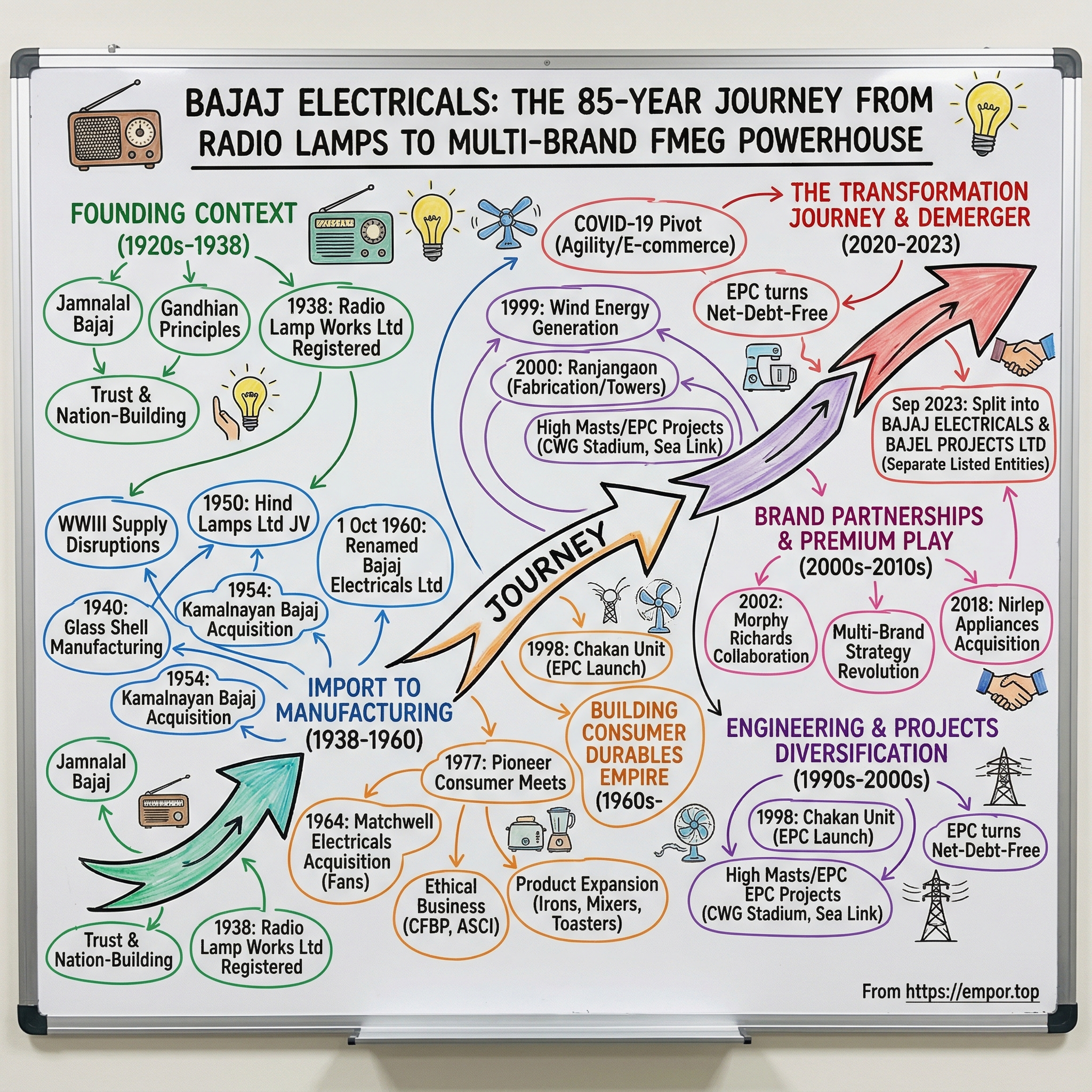
Bajaj Electricals: The 88-Year Journey from Radio Lamps to a Multi-Brand FMEG Contender
I. Introduction & Cold Open
On the evening of August 6, 2026, shortly after 6:15 p.m. Mumbai time, Shekhar Bajaj opened his company's quarterly earnings call as he had done dozens of times before—courteously, unhurriedly, and with the measured tone of an executive who had steered the business since Indira Gandhi was Prime Minister. He cited input cost inflation, uneven summer demand, and calibrated price hikes before highlighting a metric that would have seemed modest in almost any other year: the company's operating margin had recovered to 6.6% from 2.5%.1
What gave that improvement weight was the fiscal year preceding it. In the twelve months ending March 31, 2026, Bajaj Electricals—a company whose brand has been attached to Indian mixer grinders, irons, and ceiling fans for three generations—operated at a loss. Consolidated revenue fell 7.6% to ₹4,461 crore, leading to a net loss of ₹91 crore compared to a net profit of ₹133 crore the prior year.2 Its core consumer products division suffered a sharper downturn, swinging from an operating profit of roughly ₹123 crore to an operating loss of about ₹49 crore.3 For the first time in the post-demerger era, the smaller lighting division carried the entire company.
That inversion serves as the analytical core of this story. The consensus narrative on Bajaj Electricals—frequently echoed in brokerage reports and corporate framing—holds that a legacy industrial conglomerate successfully shed its capital-intensive infrastructure arm in 2023 to re-emerge as a focused consumer goods enterprise with a trusted brand, an expansive distribution footprint, and a clean balance sheet. That sequence of events is factually accurate. Effective September 1, 2023, the 1:1 demerger of Bajel Projects Limited removed the power transmission and distribution engineering division from the books.45 The balance sheet remains minimally leveraged: as of March 2026, the company held roughly ₹159 crore in debt against cash and investments that management reported at ₹934 crore.26
What the prevailing narrative fails to address is that separating a consumer business from an industrial anchor does not automatically make the consumer operation competitive. Three years after the separation, revenue remains below pre-demerger levels, the five-year sales trajectory is slightly negative, and the stock has compounded at roughly negative 22% annually over five years. That decline leaves the company with a market capitalization of about ₹3,840 crore against a book value per share of ₹138 and a return on capital employed of 2.89%.2 By contrast, peer benchmark Havells India generated a 25% return on capital over the same period on ₹22,528 crore of revenue, commanding a market capitalization roughly twenty times larger.7
The central question is not whether Bajaj Electricals possesses corporate heritage. The company was registered on July 14, 1938, and its 2026 annual report marked its 87th.89 Rather, the crucial issue is what eighty-eight years of brand equity and a distribution network spanning over 200,000 retail outlets across 19,000 pin codes deliver in 2026—when venture-backed startups produce modern ceiling fan motors and quick-commerce platforms deliver products in ten minutes, bypassing the distributor networks that took Bajaj three generations to construct.9
The company's management has offered candid assessments during earnings calls. In May 2026, when asked about the fan segment, Managing Director and CEO Sanjay Sachdeva stated plainly: "We know we are not competitive in fans. We recognize that."6 That admission highlights the strategic challenges running through the organization.
The roadmap ahead examines an industrial family's origins starting with a lamp importer connected to an Italian supply chain; the License Raj era, when product scarcity functioned as a moat; a four-decade diversification into infrastructure engineering that eroded returns; a premium-brand license that took twenty-four years to convert into ownership; a cookware acquisition that failed to deliver; a hard-fought demerger; the abrupt departure of the CEO who executed it; and a new management team working to prove that its legacy distribution network is an active asset rather than an artifact.
 Subscribe on LinkedIn
II. The Bajaj Legacy & Founding Context (1920s–1938)
Jamnalal Bajaj entered business at eleven years old with no formal higher education, technical training, or inherited industrial base. What he brought was a merchant's instinct and a close relationship with Mahatma Gandhi, who called Jamnalal his fifth son. Jamnalal built a commercial enterprise anchored on the principle of trusteeship—that a business operates as a trustee of society's capital rather than a vehicle for maximizing private wealth.10
That philosophy carried concrete commercial value. In an early-twentieth-century Indian economy lacking consumer protection laws, product liability standards, or formal regulatory oversight, a family name synonymous with integrity served as an implicit warranty. The Bajaj name signaled a reliable counterparty. Decades later, the company's chairman's letter still invokes that heritage, and its chief executive officer has explicitly cited the goal of combining the founding family's long-term relationship orientation with modern execution.9 Whether that inherited trust still generates pricing power in 2026 remains an open question, but in the pre-independence era, it was a central asset.
The corporate entity itself did not originate within the Bajaj family. On July 14, 1938, Kishenchand Kaycee registered Radio Lamp Works Limited alongside a board featuring Vidya Prakash, Ved Prakash, and Lala Shiv Raj. Its initial business model was narrowly defined: import Italian-manufactured radio lamps and distribute them across India.8 It operated strictly as a trading firm reliant on a single overseas supply source and one product line.
Commercial operations began in 1939—a turbulent time to launch an enterprise dependent on Mediterranean shipping lanes.8 When Italy entered World War II shortly thereafter, the company's supply chain collapsed. Maritime routes closed, foreign exchange was strictly rationed, and a business anchored entirely on import distribution lost its sole product line.
Rather than liquidate, the promoters adapted by integrating backward into manufacturing. In 1940, they established Kaycee Glass Works Limited to manufacture glass lamp shells domestically, setting up a production facility in Shikohabad, Uttar Pradesh.8 Driven by necessity rather than deliberate strategy, the trading business transformed into a domestic manufacturer.
Leadership underwent a sudden transition when Jamnalal Bajaj died in 1942. His twenty-eight-year-old son, Kamalnayan Bajaj, assumed control of the group.8 The younger Bajaj took charge of a nascent business house amid a world war, political upheaval during the independence movement, and a disrupted supply chain.
Over the following decade, the company refined its industrial approach. In 1950, Kaycee Glass Works formed Hind Lamps Limited as a joint venture with four major European lighting manufacturers: Philips, Associated Electrical Industries (AEI), General Electric, and Crompton Parkinson.8 This partnership executed import substitution through collaboration, bringing international technological leaders into domestic production—a model that anticipated India's post-independence industrial policy.
For modern investors, the founding era demonstrates both an enduring strength and an underlying vulnerability. The core strength lay in distribution and brand trust, built atop licensed or shared manufacturing capabilities. The persistent vulnerability is that a company reliant on distributing third-party technology remains exposed whenever technological differentiation becomes the primary driver of competition. In 1940, that challenge centered on glass lamp shells; in 2026, it centers on brushless DC fan motors.
III. Radio Lamp Works Era: Import to Manufacturing (1938–1960)
By the late 1950s, the name Radio Lamp Works no longer reflected the enterprise's expanding product line. Having broadened its scope to include fans, irons, and water heaters under Bajaj family stewardship, the board formally renamed the enterprise Bajaj Electricals Limited on October 1, 1960.8 Calculated from its 1938 incorporation, the company's 2026 disclosures marked its 87th annual report—reconciling references in secondary commentary that describe an 85-year corporate history.9
The rebrand signaled a transition from an importer with secondary lines into a consumer durables house with lighting as one of several core categories. This corporate repositioning coincided with the consolidation of India's License Raj, an economic framework that altered industrial competitive dynamics.
Under industrial licensing, enterprise growth required government authorization to manufacture, expand production capacity, import raw materials, or adjust product mixes. Essential industrial inputs—including copper, aluminum, and steel—were centrally allocated rather than acquired on open markets. Price controls applied across multiple categories, and foreign imports were largely restricted.
In this environment, competitive position depended heavily on regulatory factors rather than product differentiation. First, licensing access dictated market entry and expansion. Second, raw material allocations determined operational continuity, allowing firms with secure quotas to run factories while competitors faced downtime. Third, physical distribution served as the primary bottleneck; with demand structurally outstripping supply, commercial success turned on product availability rather than consumer acquisition. Formal marketing remained limited in an era preceding commercial television and widespread print circulation.
Bajaj Electricals maintained advantageous positioning across these areas. Backed by the standing of its promoter family, the firm maintained effective access to industrial licensing authorities. Throughout the 1950s and 1960s, management systematically established exclusive distributor arrangements across tier-one and tier-two towns. In a supply-constrained market, distributors receiving steady inventory generated consistent margins, reinforcing distribution network stability.
Beyond commercial distribution, the company established its institutional presence through high-profile public initiatives. In 1962, it introduced India's first indigenous astronomical telescope, unveiled by Prime Minister Lal Bahadur Shastri at Jantar Mantar in Delhi.8 In 1963, marking twenty-five years of operations, the firm held its inaugural Dealer Meets in the presence of Maharashtra Governor Vijaya Lakshmi Pandit.8 These initiatives served as public demonstrations of domestic technical capability while formalizing channel partner relations.
Financial management during this period remained conservative. Capital expenditure was financed primarily through internal accruals, debt levels were kept low, and voting control remained concentrated within the promoter family—a structure that persists with promoters holding 62.70% of equity as of June 2026.2 For public shareholders, this ownership structure presents distinct trade-offs: it insulates the company from hostile takeovers and supports multi-decade planning, while leaving minority investors with limited influence over capital allocation strategy short of divesting.
The distribution and licensing advantages that established Bajaj Electricals' market position between 1960 and 1990 were closely tied to regulatory protections and economic scarcity. When market deregulation began in 1991, established brand recognition and distributor relationships offered initial stability, but the underlying mechanisms supporting its market position shifted. The post-liberalization environment required advanced product engineering, cost optimization, and active brand investment, setting up an extended transition as the enterprise adjusted to open market competition.
IV. Building the Consumer Durables Empire (1960s–1990s)
Picture a hall in a mid-sized Indian city in 1977. Rows of folding chairs face a front table displaying a Bajaj mixer grinder, an electric iron, and a table fan. In those chairs sit housewives—the primary end users of these appliances—asked systematically what they liked, what broke, and what they wished were designed differently. The company designated these gatherings Consumer Meets, pioneering the format in 1977.8
Stripped of period detail, the program represented early ethnographic product research, undertaken roughly two decades before Indian consumer firms routinely adopted such practices. In a market where demand consistently outpaced supply and manufacturers could sell virtually whatever they produced, soliciting consumer feedback was economically unnecessary. That choice signaled how the organization viewed its role: Consumer Meets served as a practical application of trusteeship, treating customers as stakeholders rather than passive demand curves. The initiative extended the logic of the Dealer Meets format established in 1963 one link further down the distribution chain.8
Guiding the enterprise through this expansion was Ramkrishna Bajaj, who served as Managing Director from 1970 to 1980 and subsequently as Chairman until his death.8 In 1966, four years before becoming Managing Director, he founded the Council for Fair Business Practices—a self-regulatory body through which Indian companies voluntarily committed to standards of conduct at a time when state enforcement capacity was minimal.8 That initiative reflected a leadership philosophy focused on institutional reputation and ethical self-regulation alongside commercial expansion.
Under Ramkrishna Bajaj and his successors, the product portfolio broadened across the three categories that still define the enterprise: fans, small domestic appliances, and lighting. Lighting production scaled from incandescent bulbs to fluorescent lamps, while fan capacity expanded in part through the acquisition of smaller domestic producers. By its golden jubilee in 1988, revenue reached ₹71 crore—a modest figure by contemporary standards, but one that represented a major national consumer franchise in the final years of India's pre-liberalization economy.8
Two developments at the turn of the 1990s reshaped the company's trajectory. First, leadership consolidated under Shekhar Bajaj, grandson of Kamalnayan Bajaj. Having assumed the chief executive role in 1980, he became Chairman in 1994.8 His multi-decade tenure spanning over forty years represents one of the longest executive tenures in Indian corporate history, providing deep institutional continuity while leaving the enterprise closely tied to his strategic stewardship.11
Second, in fiscal 1993–94, Bajaj Electricals partnered with the American power tool maker Black & Decker to manufacture and market power tools and appliances through a dedicated entity, Black & Decker Bajaj Private Limited.12 The strategy mirrored the Hind Lamps partnership four decades earlier: leverage an international partner's engineering standards and product design while supplying domestic distribution. Bajaj Electricals acquired its partner's 50% stake in fiscal 2000, renaming the unit Bajaj Ventures, before fully divesting the operation in fiscal 2013.
That cycle—partnering with a global brand, buying out the venture, and ultimately exiting—reflects a recurring operational pattern. The company later executed variations of this approach with Morphy Richards, converting a 2002 licensing agreement into a full brand acquisition in 2026, and with Nirlep, where a 2018 acquisition led to an exit review by 2025. Over four decades, Bajaj Electricals repeatedly attempted to assemble capability through joint ventures and acquisitions, yielding a mixed track record that contextualizes its current capital allocation strategy.
The economic liberalization of 1991 fundamentally altered the market landscape. As import barriers fell, industrial licensing was abolished, and foreign competitors entered India, domestic rivals expanded production without regulatory constraints. The artificial scarcity that had sustained Bajaj Electricals' distribution advantage dissolved. The company retained strong household brand recognition and a nationwide distribution footprint, but its product engineering had never faced open-market competition.
Faced with these headwinds, executive leadership made a strategic choice that shaped the next quarter-century. Rather than concentrating capital on consumer product engineering and brand positioning against newly empowered competitors, Bajaj Electricals directed its expansion into a fundamentally different domain: infrastructure engineering.
V. The Engineering & Projects Diversification: The EPC Drag & Triumph (1990s–2010s)
In January 1998, Bajaj Electricals commissioned a manufacturing unit at Chakan, near Pune.8 In September 1999, it added a 2.8 MW wind energy generation unit, and between 2000 and 2001, it constructed specialized fabrication and galvanizing plants at Ranjangaon, also near Pune, to produce high masts, monopoles, and lattice transmission towers.12
These heavy steel structures were destined for stadiums, highways, and national electricity grids. A company previously known for selling mixer grinders and irons to households was now executing heavy fabrication for industrial clients, expanding into engineering, procurement, and construction (EPC) contracting for power transmission and rural electrification networks.
The commercial logic appeared persuasive. India entered an infrastructure capital expenditure cycle in the 2000s, driven by massive state-sponsored rural electrification initiatives that promised substantial order books. Having built a presence in commercial lighting, expanding into large-scale projects like lighting bridges and stadiums seemed adjacent. Crucially, project revenue provided large, lump-sum additions that outpaced the steady but modest growth of the consumer durables business.
The division secured several high-profile contracts. Bajaj Electricals illuminated the Delhi Commonwealth Games venues in 2010 and lit the Bandra–Worli Sea Link, the cable-stayed bridge in Mumbai.12 It also won extensive state power distribution contracts across rural India. To investors in 2010, the pivot looked opportune: a mature appliance brand had attached an infrastructure engine at the height of a national capex cycle.
However, the assumption that EPC contracting would generate durable, high-margin growth alongside the consumer division proved flawed. The fundamental issue lay in the working-capital mechanics of infrastructure projects, which consumed cash for nearly two decades.
When Bajaj Electricals sold an appliance to a retail distributor, cash collection occurred within weeks. By contrast, constructing rural power networks for state electricity boards required purchasing steel, conductors, and cables upfront, paying contractors to erect transmission towers over extended periods, and submitting bills to state-owned utilities for certification. Payments faced prolonged delays, followed by years of waiting for "retention money"—a contractual portion withheld until final project commissioning. Every phase of this cycle required working capital funded directly from the parent company's balance sheet, exposing the enterprise to state utilities with structurally weak finances and little incentive for prompt settlement.
This structural drain accumulated on the balance sheet. By fiscal year 2019, Bajaj Electricals carried more than ₹2,000 crore in total borrowings.11 For context, that debt load exceeded half of the company's 2026 market capitalization of roughly ₹3,840 crore.2 Interest obligations absorbed the operating profits generated by the consumer business, driving return on equity—which typically reaches high double digits for asset-light consumer brands—into single-digit territory.
In effect, a cash-generative consumer business was financing state electricity board receivables at negative net margins. The financial impact was two-fold. First, capital that could have funded appliance product development, brand equity, and modern distribution channels remained locked in unbilled revenue and delayed government receivables. Second, capital markets consolidated the high-margin consumer business with the capital-intensive contracting unit. Priced on a blended basis, Bajaj Electricals traded at a persistent valuation discount to pure-play consumer peers.
Ultimately, the infrastructure diversification failed to produce high-margin enterprise growth. Instead, it overburdened the balance sheet, requiring a decade of capital preservation and corporate restructuring to resolve. Rather than creating commercial synergies with the consumer division, the contracting business absorbed cash during a period when key competitors established dominant market shares. During its post-liberalization expansion phase—the period in which peer Havells India built a ₹22,000 crore consumer and industrial electricals business—Bajaj Electricals remained tied to financing government infrastructure receivables.7
Before undertaking the structural separation of its infrastructure division, management pursued another expansion strategy: acquiring and licensing consumer brands.
VI. M&A, Premium Play & Brand Partnerships (2000s–2020)
In 2002, Bajaj Electricals signed a technical collaboration and trademark licensing agreement with British appliance brand Morphy Richards—one of several international tie-ups struck in the early 2000s alongside Midea, Trilux Lenze, Delta Controls, and Ruud Lighting.8 The agreement granted Bajaj the right to sell Morphy Richards-branded appliances in India in exchange for royalty payments. Without committing capital to factory acquisitions or capitalizing goodwill, the company secured a premium market positioning that would have required substantial time and capital to build organically.
The strategic timing coincided with an expanding urban upper-middle class seeking modern appliance aesthetics. Because the core Bajaj brand was firmly established in mass-market volume categories, extending it upmarket risked diluting its positioning. Operating a separate foreign brand offered a clear solution. Morphy Richards served as Bajaj's vehicle in premium breakfast appliances, coffee makers, and design-forward kitchen products, developing into a meaningful revenue driver over the next two decades. As late as fiscal 2025, management reported high double-digit growth for the brand.13
However, trademark licensing carries an underlying structural limitation: marketing investments, distributor development, and consumer goodwill ultimately build equity in an asset owned by a third party. The licensee remains exposed to renewal risks and ongoing royalty obligations that reduce net margins. In March 2022, Bajaj signed a renewed trademark licence agreement, which was novated to Glen Electric Limited—part of Ireland's Glen Dimplex Group—effective December 1, 2022.14 Company disclosures framed the agreement as a fifteen-year extension,8 leaving Bajaj reliant on licensed intellectual property two decades after entering the category.
By contrast, the 2018 acquisition of Nirlep Appliances represented outright ownership from day one, though it ultimately proved to be a challenging capital allocation decision.
Nirlep was an early pioneer of non-stick cookware in India, with production facilities in Aurangabad (now Chhatrapati Sambhajinagar), an established brand, and dedicated retail distribution. Bajaj Electricals announced the acquisition on June 15, 2018, structuring the transaction in two tranches for approximately ₹80 crore, including equity and assumed debt. The initial tranche closed on September 1, 2018, with Bajaj acquiring 79.85% of equity for ₹30.70 crore in cash. The remaining shareholders exercised a put option on September 1, 2021, requiring Bajaj to purchase the remaining 19.78% stake and turning Nirlep into a wholly-owned subsidiary.15
Management's original rationale assumed that non-stick cookware was closely adjacent to small kitchen appliances, enabling Bajaj to leverage its existing distribution footprint while acquiring specialized manufacturing capabilities. However, channel synergies failed to materialize.
Addressing the acquisition's performance during the August 2025 earnings call, Chief Financial Officer E.C. Prasad acknowledged the mismatch: "Nirlep is a totally different GTM. And we have realized that instead of focusing too much on different spaces, it is better to concentrate on our core, because Nirlep is a totally different go-to-market. There is no synergy, and the factories of Nirlep were making losses."16
Seven years after the transaction, executive commentary confirmed that the anticipated channel alignment was largely absent. Non-stick cookware is primarily distributed through traditional utensil outlets and specialized kitchenware shops rather than the electrical goods dealers who sell fans, irons, and water heaters. Furthermore, the cookware market offered limited pricing power, characterized by intense price competition from unorganized manufacturers and strong shelf competition from established specialists such as TTK Prestige and Hawkins.
By fiscal 2026, the board approved an in-principle restructuring of the Nirlep operations, which management characterized as "a drag on our financial results."16 Media reports in November 2025 noted preliminary discussions regarding a potential sale of the business. In its audited financial results for the fiscal year ended March 31, 2026, Bajaj recognized an exceptional impairment provision of ₹26.44 crore against the goodwill of the Chhatrapati Sambhajinagar unit, following an independent valuation under Ind AS 36.17
These developments highlight broader balance sheet considerations. First, the goodwill impairment was partial. As of March 31, 2026, Bajaj Electricals retained ₹190.01 crore in goodwill associated with Starlite Lighting Limited and Nirlep Appliances—both of which had been merged into the parent entity. Statutory auditors S R B C & Co LLP designated goodwill impairment testing as a key audit matter, observing that recoverable value estimates rely on discounted cash flow projections where discount rates, growth assumptions, and margin forecasts carry "inherent uncertainty."9 This balance sheet item represents approximately 5% of the company's market capitalization, linking valuation directly to the achievement of forward-looking operating targets. Second, while the auditors issued an unmodified opinion on the fiscal 2026 statements, they separately highlighted inventory provisioning as a key audit matter, noting allowances of ₹47.95 crore against total inventory holdings of ₹533.52 crore.93
During the same period, the broader competitive landscape underwent significant structural changes. Havells expanded its multi-category platform by acquiring Crabtree and Lloyd. Crompton Greaves Consumer Electricals emerged as an independent entity after its corporate demerger, concentrating capital on category leadership in fans while Bajaj remained engaged in financing power transmission projects. Concurrently, peers such as Orient Electric, V-Guard, and Philips expanded across overlapping appliance categories. Pure-play competitors systematically directed their capital and executive oversight toward consumer electricals, contrasting with Bajaj's dual focus during the expansion era.
By 2018, the operational necessity of separating the consumer business from legacy infrastructure operations had become clear. The subsequent section details the execution of that structural break—and the leadership transition that accompanied it.
VII. The Turnaround, Corporate Restructuring & Demerger of Bajel Projects (2020–2023)
In August 2018, Managing Director Anant Bajaj died of cardiac arrest at age forty-one, just two months after assuming the role.11 The loss dismantled a succession plan years in the making. Shekhar Bajaj, then in his mid-seventies, lost both his son and designated successor. Anuj Poddar, who had joined the board as an executive director earlier that year, was elevated to lead the company under conditions the chairman later described as "the challenging task of onboarding Anuj Poddar without the opportunity for a proper handover."11
Poddar inherited severe operational strain: debt exceeded ₹2,000 crore, the infrastructure order book absorbed cash faster than it generated returns, receivables from state power utilities were mounting, and within eighteen months, pandemic lockdowns disrupted retail networks nationwide.
Over the next four years, executive leadership executed a systematic operational turnaround. The engineering division stopped chasing contract volume and adopted what management described as a calibrated-risk bidding strategy, prioritizing the execution and collection of existing orders. Management rationalized overhead, pruned low-margin stock-keeping units, consolidated supply chain operations, and funneled cash collections into debt reduction rather than expansion. By fiscal 2022, Bajaj Electricals had retired its borrowings, achieving a debt-free balance sheet that it broadly maintained through 2026.11 Clearing that leverage was the critical prerequisite for separating the engineering business from the consumer entity.
The corporate demerger followed in 2023. On June 8, 2023, the National Company Law Tribunal approved the scheme of arrangement separating Bajaj Electricals from its infrastructure business, newly named Bajel Projects Limited. Following receipt of the certified order in July, the demerger took effect on September 1, 2023.4 Shareholders received one Bajel Projects share for every Bajaj Electricals share held, with entitlement fixed in mid-September 2023.5 To maintain operational continuity, Bajaj Electricals licensed its trademark to Bajel Projects for a transitional period.
The transaction reshaped Bajaj Electricals' balance sheet. The company derecognized roughly ₹568 crore of net worth and transferred approximately ₹238 crore in cash to Bajel Projects, establishing a net payable of about ₹221 crore between the entities.4 More importantly, the separation transferred a category of operational exposure off Bajaj Electricals' books: project execution risks, performance guarantee liabilities, and the multi-year payment cycles from state utilities that had burdened the enterprise for two decades.
The strategic delay preceding the split remains a key governance insight. Forbes India reported that executive leadership had discussed separating the businesses internally for eighteen years before executing the plan.11 The structural drag was understood for nearly two decades, yet corporate action materialized only after a debt crisis and a family tragedy forced the decision.
For investors, that timeline illustrates an organizational pattern of prolonged deliberation before exiting underperforming assets. A similar delay marked the portfolio review of Nirlep Appliances, which began in earnest in 2025—seven years after its acquisition and several years after operational losses became apparent. The historical pattern reflects timely diagnostic awareness paired with delayed operational execution.
The operational performance immediately following the demerger challenged the conventional narrative that structural separation automatically unlocks shareholder value. Removing the infrastructure drag eliminated a key operational burden, but it did not immediately catalyze growth. In fiscal 2024, the first post-demerger year, revenue stood at ₹4,639 crore with a net profit of ₹131 crore, compared to ₹4,889 crore in revenue and ₹216 crore in net profit during the final pre-demerger year.2 Fiscal 2025 brought modest top-line recovery to ₹4,826 crore and a net profit of ₹133 crore, while disclosures showed an EBITDA margin of 7.5%, effectively flat year over year.4 Two years after becoming a standalone consumer enterprise, operating margins remained constrained and revenue growth muted.
By mid-2025, the demerger stood as a necessary, well-executed structural correction that nevertheless fell short of restoring growth on its own. Shortly thereafter, the chief executive who oversaw the transformation departed.
VIII. The Multi-Brand Architecture & FMEG Competitive Landscape (2023–Present)
From four brands to two
For a couple of years, the strategy slide looked elegant. Bajaj for the mass and aspirational market — mixer grinders, irons, water heaters, induction fans. Morphy Richards for premium kitchen and lifestyle. Nirlep for cookware. And Nex, launched in 2023, as a technology-first premium brand aimed squarely at the high-efficiency fan segment where Bajaj was losing ground.8 Four brands, four price tiers, minimal cannibalisation. Management described it as a "house of brands" approach in the fiscal 2025 annual report, and Nex delivered roughly five-fold revenue growth that year off a small base, onboarding around 324 direct dealers.4
By the fiscal 2026 annual report, published in mid-2026, the architecture had quietly collapsed to two. "On brand architecture, we now operate a clear two-brand strategy," Sachdeva wrote in his first full-year message as CEO. "The BAJAJ brand — refreshed in identity and positioning — serves the mass and aspirational segments. Morphy Richards, now fully owned by us, addresses the upper mid-market and emerging premium lifestyle segment."9 Nirlep is under strategic realignment or exit. Nex, which management had earlier described as a distinct premium play, was reframed on the October 2025 call as "a subset" of the two-brand structure.18
This is a meaningful and under-discussed change. A four-brand portfolio requires four sets of marketing budgets, four product roadmaps, four channel strategies and four P&Ls. For a company generating roughly ₹4,500 crore of revenue with low single-digit margins, that was almost certainly too much complexity to fund properly. Consolidating to two is defensible — arguably overdue. But investors should note that the multi-brand thesis that appeared in bull cases through 2025 has been retired by management itself, and that Nex, the answer to the technology disruption in fans, has been demoted from a brand to a product line.
Buying the brand it had rented for twenty-four years
On September 23, 2025, the board consented in principle to acquiring the Morphy Richards brand outright. On March 16, 2026, the definitive agreements were executed.14
The structure is worth understanding because it is a textbook piece of brand economics. Bajaj Electricals acquired the trademarks, domain names, social media accounts and associated goodwill — collectively the Business Intellectual Property — from Glen Electric Limited for India, Nepal, Bhutan, Bangladesh, the Maldives and Sri Lanka, on an absolute, perpetual and irrevocable basis, including the right to sue for past and future infringement. The existing trademark licence was simultaneously terminated by mutual consent, with outstanding royalties of GBP 641,780.14 payable to the seller.14
The consideration was ₹141.40 crore net to the seller, payable in three instalments: ₹49.00 crore on the transfer date, ₹49.00 crore by March 31, 2027, and ₹43.40 crore by March 31, 2028. Including withholding tax and stamp duty the total consideration cost was ₹168.00 crore; including 18% GST — recoverable as input tax credit — total cash outflow was ₹197.47 crore. Currency risk on the GBP conversion sits with the seller.14
What did shareholders get? They eliminated a perpetual royalty leakage, secured terminal value in a brand they had spent twenty-four years building in India, and gained the freedom to develop products for South Asian markets without a licensor's approval. Those are real benefits, and the deal is structurally sensible.
What should give an investor pause is the disclosure and the sequencing. When an analyst asked on the October 2025 call how large the royalty saving would be — the single number needed to evaluate whether ₹141 crore was a good price — the CFO declined, calling it "sensitive information as far as the competition is concerned."18 The same executive stated the acquisition would be "value accretive from day one."18 Accretive relative to what discount rate, against what royalty base, over what horizon? Not disclosed. An investor is therefore asked to accept an eight-figure capital commitment on faith, in a year when the company posted a consolidated loss.
One further term matters and is easy to miss: under the sale agreement, until the consideration is paid in full, Bajaj Electricals may not transfer, dispose of or encumber the intellectual property, and rights revert to the seller in defined circumstances.14 The ownership is perpetual on paper from March 2026 but is not fully unencumbered until the final instalment settles in March 2028. It is closer to a purchase on instalment than to a clean, closed acquisition, and the balance of the payments will land in two fiscal years when the consumer business is still trying to prove it can earn its cost of capital.
The war game: who actually wins in Indian FMEG
Set Bajaj Electricals against the field and the picture is uncomfortable.
Havells India generated ₹22,528 crore of revenue in fiscal 2026 with net profit of ₹1,689 crore, an operating margin around 10%, return on capital employed of 25% and return on equity of 19%. Its market capitalisation of roughly ₹76,745 crore is about twenty times Bajaj Electricals'.7 Havells is the proof point that a branded Indian electricals company can earn genuinely high returns on capital — which removes the excuse that the category itself is structurally low-margin.
Crompton Greaves Consumer Electricals is the more instructive comparison, because it is closer in size and shares the fan-centric exposure. It generated ₹8,096 crore of revenue in fiscal 2026 at roughly 10% operating margin — but reported a net loss of ₹231 crore, driven by a large one-time charge.19 Crompton's fiscal 2026 demonstrates that Bajaj's bad year was not entirely idiosyncratic; the sector faced a genuinely difficult demand environment. It also demonstrates that Crompton was earning a 10% operating margin while having a bad year, and Bajaj Electricals was not.
Then there is Atomberg Technologies, and it deserves a proper explanation because the technology is the whole story. A conventional ceiling fan uses an induction motor: alternating current creates a rotating magnetic field, which drags the rotor along. It is cheap, robust, and wastes a great deal of energy as heat. A brushless DC motor — BLDC — replaces that with permanent magnets and electronic switching, controlled by a small circuit board that energises the coils in precise sequence. The result is a fan that uses roughly half the electricity for the same airflow, runs quieter, and can support remote controls and smart features because there is already a computer inside it.
Atomberg built its entire business on that single insight — a venture-funded challenger, privately held and not required to publish audited results on the same cadence as its listed rivals, that has nonetheless become the reference brand in the fastest-growing part of the fan market. Bajaj's own management estimated on the August 2026 call that BLDC now accounts for between 30% and 35% of the industry, and Chief Operating Officer for Consumer Products Vishal Chadha acknowledged the company is "slightly under-indexed versus the industry."1
That understates it. In May 2026, Chadha told analysts the company had "lost a bit of market share" in fans, "primarily because we are still not as good on our BLDC performance as we would like it to be."6 Sachdeva was blunter, adding that the traditional induction fan segment where Bajaj is strong "is not growing," while "the segment which is growing is BLDC and this is where we have gaps."6 In August 2026 he confirmed fans remained the one large category where the company was losing share, with corrective actions intended to claw it back "in next two or three quarters."1
This is the sharpest test of the moat thesis in the entire business. If eighty-eight years of brand trust and 200,000 retail touchpoints constitute a durable competitive advantage, they should have been sufficient to prevent a venture-backed newcomer from redefining the most important category the company sells. They were not.
Porter and Helmer, applied honestly
Run the five forces. Buyer power is high and rising: switching costs for a ceiling fan or a mixer grinder are effectively zero, price sensitivity in tier-three and rural markets is acute, and modern trade and e-commerce platforms aggregate demand and squeeze supplier margins in a way a thousand independent dealers never could. Supplier power is moderate but volatile — copper, aluminium and engineering plastics drive the bill of materials, and management disclosed input cost inflation of 6% to as high as 13% across categories in the June 2026 quarter, with coolers worst affected.1 Threat of substitutes is low within categories but high within technologies, which is precisely the BLDC problem. Rivalry is intense and includes competitors with materially better cost positions and marketing budgets.
Threat of new entrants is where the structural change is most severe, and it deserves elaboration. Historically, entering Indian appliances required factories and a distribution network — both of which took a decade and enormous capital. Today a well-funded team can outsource manufacturing to contract producers, buy demand through digital advertising, and distribute through e-commerce and quick commerce. The two moats that protected incumbents — capital-intensive manufacturing and physical distribution — have both been substantially disintermediated. Bajaj's own disclosure illustrates the shift: e-commerce contributes roughly 15% to 18% of revenue depending on the quarter, quick commerce is around 8% to 10% of that e-commerce number and growing rapidly, and alternate channels in aggregate now represent about 45% of the business against 55% for traditional trade.1
Against Hamilton Helmer's seven powers, the honest assessment is thin. Scale economies: real but not decisive — the company is a fraction of Havells' size and lacks the volume to out-purchase it. Branding: genuinely present, and the strongest of the seven — the Bajaj name still commands recall and trust, and management claims number-one position in mixer grinders and number-two in water heaters.9 But branding as a Helmer power requires the ability to charge a premium, and a company reporting a segment operating loss while raising prices 3% to 10% is not demonstrating that ability.6 Cornered resource: the Morphy Richards IP now qualifies in a limited, geographically bounded way. Counter-positioning, switching costs, network economies: essentially absent. Process power: this is the one the BLDC episode directly refutes — a company with genuine process power converts technology shifts into advantage, and this one has spent three years playing catch-up in its own core category.
The defensible conclusion is that Bajaj Electricals has one real power — brand — currently unsupported by the pricing evidence that would prove it, sitting on top of a distribution asset that is large, expensive to maintain, and declining in strategic relevance as consumer purchasing migrates online.
IX. Playbook: Key Business & Capital Allocation Lessons
1. Conglomerate demerger discipline
The Bajel separation offers a clear case study in corporate finance, clarifying a mechanism that is frequently misunderstood. A demerger does not create value in isolation. Rather, it removes structural barriers to value recognition and enables rational capital allocation. When a consumer goods enterprise and an infrastructure contracting business share a single balance sheet, contracting operations consistently absorb internal cash flows—not because they generate superior returns, but because delayed collections and active execution sites create immediate operational urgency. In corporate operations, urgency routinely displaces strategic priority.
The more significant lesson centers on operational timing. Executive leadership evaluated separating the two businesses internally for roughly eighteen years before executing the plan.11 The economic cost of that delay—a decade of constrained investment in consumer products during a peak growth cycle in Indian consumer demand, compounded by interest expenses on over ₹2,000 crore of debt—exceeded the valuation adjustment delivered by the eventual separation. The primary strategic takeaway is that the cost of corporate delay compounds continuously, while boards systematically underestimate its long-term impact.
2. Royalty versus IP ownership in brand licensing
Trademark licensing provides an efficient entry structure, but it rarely functions as a sustainable long-term model. Entering the premium appliance segment through a licensed British brand in 2002 offered a capital-light, low-risk strategy: had Indian consumers rejected the brand positioning, Bajaj Electricals could have exited while risking only initial marketing expenditures.
Over time, however, commercial success alters those underlying economics. As a licensee invests in brand equity, the resulting value accrues to an asset owned by a third party. Meanwhile, ongoing royalty obligations reduce net operating margins, and contract renewal deadlines create operational risk across product roadmaps. Eventually, acquiring ownership becomes the logical path—yet the purchase price directly reflects the equity the licensee built, making an buyout more expensive after successful execution.
Bajaj Electricals operated under license for twenty-four years before securing ownership. The ₹141.40 crore headline acquisition cost and ₹197.47 crore gross cash outflow effectively repurchased brand equity built through two decades of company-funded marketing.14 While evaluating whether an earlier acquisition would have proven more economical is difficult without access to historical royalty schedules, the underlying financial principle remains clear: trademark licensing offers low entry costs but high exit costs, with the ultimate buyout valuation rising alongside the brand's market success.
3. The trap of M&A in commoditised categories
The acquisition of Nirlep Appliances demonstrates that in a commoditized consumer market, brand equity lacking a structural cost or manufacturing advantage functions as an operational drag rather than a competitive asset.
Evaluating an adjacent acquisition requires testing three fundamental criteria. First, does the target entity utilize a shared go-to-market model? For Nirlep, the channels diverged significantly, as the company's chief financial officer acknowledged on an earnings call seven years after the transaction.16 Second, does the business possess a structural cost or technological advantage over unorganized manufacturers? In Indian aluminum non-stick cookware, such differentiation is minimal. Third, can the parent enterprise command a sufficient price premium to absorb the acquired cost structure? In this category, pricing power remained constrained.
The ₹26.44 crore goodwill impairment recognized in fiscal 2026 served as the formal accounting acknowledgment of commercial misalignments that had developed years earlier.17 Across consumer mergers and acquisitions, anticipated distribution synergies represent a common transaction rationale yet remain among the most difficult to realize, as retail channels that appear complementary on a balance sheet often operate on fundamentally different commercial mechanics in practice.
4. Multi-brand portfolio management in FMEG
While theoretical portfolio frameworks suggest that a multi-brand architecture allows an enterprise to address distinct price points without diluting core brand equity, practical operational constraints present different challenges. Each distinct brand adds fixed overhead—including dedicated marketing budgets, product development cycles, channel management, and inventory holdings—that cannot be easily scaled down during downturns.
With annual revenues of roughly ₹4,500 crore and operating margins in the low single digits, Bajaj Electricals struggled to adequately fund four separate brand architectures. Consequently, the core mass-market brand sustained volume while the licensed premium brand captured growth, leaving smaller brand initiatives undercapitalized. Management's decision to consolidate to a clear two-brand structure in its fiscal 2026 annual report represented an operational adjustment to align corporate architecture with sustainable financial capacity.9
Ultimately, brand portfolio expansion must be governed by the scale of an enterprise's gross profit pool rather than the theoretical availability of market price tiers.
X. The Historical Falsification Stress Test & Bear vs. Bull Case
Testing the claims against the record
Claim 1: Eighty-eight years of distribution and brand trust constitute an unassailable moat.
The disconfirming evidence is direct because it emerges from the core categories the distribution footprint is built to protect. Over five years, revenue has compounded at roughly negative 1% annually, while the share price has declined by about 22% per year.2 The company's network—spanning more than 2,000 channel partners, over 200,000 retail outlets, and 778 consumer care centres across 19,000 pin codes—is genuinely among the deepest in Indian consumer electricals.9 Yet it failed to prevent market share losses in ceiling fans to competitors Crompton and Atomberg. Nor did it prevent a 12.2% revenue contraction in the consumer products division in fiscal 2026, even as the company's smaller lighting business grew 9.5%.9
A mechanical explanation partially tempers this criticism. A substantial portion of the fiscal 2026 consumer downturn was self-inflicted: management deliberately curtailed shipments to distributors to clear excess channel inventory following two consecutive weak summer seasons. In the December 2025 quarter, consumer products revenue dropped from ₹994.01 crore to ₹776.81 crore—a decline of roughly 25%. On the February 2026 earnings call, Shekhar Bajaj characterized the reduction as "a conscious and prudent action aimed at restoring channel health" rather than evidence of "any structural weakness."320
That framing is partly accurate and partly self-serving, as analyst questioning on the call made clear. Natasha Jain of Phillip Capital observed that industry peers reported margin expansion on winter appliances during the same quarter, questioning why Bajaj experienced such a sharp decline. Manoj Gori of Equirus noted that if market share gains were genuine, Bajaj's channel inventory should have been in better shape than competitors', whereas peers delivered superior quarterly results.20 A destocking campaign explains the timing and depth of the revenue drop, but it does not explain why the channel became overloaded initially—a failure of demand forecasting and sell-in discipline—nor does it explain market share losses in fans, which management attributed to product competitiveness rather than inventory levels.
Verdict: Narrowed sharply, not rejected outright. The distribution network remains a tangible operational asset; it allows the company to roll out adjacent categories like wires and switchgear into existing channels at low incremental cost, and it enabled the lighting business to expand 9.5% during a difficult year. However, it does not constitute a moat in the economic sense, as it neither prevents product substitution nor confers pricing power. The valid version of the claim is more modest: Bajaj Electricals possesses a distribution and brand footprint that lowers the cost of entering adjacent categories, provided the underlying products are competitive. The test for this claim is immediate—if fan market share does not stabilize within the two-to-three-quarter window management committed to publicly, the brand-and-distribution thesis fails in the category where it should be strongest.1
Claim 2: The demerger plus professional leadership guarantee margin expansion toward 8–10%.
The empirical record does not support a guaranteed outcome. Three fiscal years after the infrastructure separation, consolidated operating performance has weakened. Fiscal 2026 EBITDA fell 41.1% to ₹213 crore, and the company reported a net loss.212 Exceptional charges highlighted underlying operational issues: ₹28.72 crore for statutory gratuity and leave encashment adjustments following the government's notification of four Labour Codes on November 21, 2025; ₹26.44 crore in Nirlep goodwill impairment; and ₹29.31 crore to write down moulds and dies following an annual review of expected economic benefits.17
That final item is particularly telling. Writing down moulds and dies represents an explicit recognition that physical tooling for manufactured products failed to generate anticipated commercial returns. It represents a capitalized record of unsuccessful product investments, directly echoing questions posed by analyst Manoj Gori in May 2026. Gori noted that substantial research and development outlays during Anuj Poddar's tenure had yielded little visible bottom-line benefit, asking why a fresh round of investment would produce a different result.6 Sanjay Sachdeva responded that future product innovations would target "at the right price point with the right margins"—a logical diagnosis of past missteps, but an unproven projection of future performance.
Executive turnover further complicates the leadership thesis. Anuj Poddar, who engineered the debt reduction and structural demerger, resigned at a board meeting on July 17, 2024, to pursue an external opportunity, stepping down effective September 30, 2024—just ten months after completing the five-year restructuring.22 Chairman Shekhar Bajaj assumed interim executive oversight before the board appointed Sanjay Sachdeva on March 28, 2025, for a three-year term effective April 15, 2025.23 Finance leadership experienced similar turnover: CFO E.C. Prasad departed during fiscal 2026, Suketu Shah served as interim CFO, and Ashween Anand—formerly CFO of Tata Starbucks—assumed the role on May 16, 2026.3 In August 2026, the company created a new Chief Growth and New Business Officer role, appointing Unilever veteran Krishnan Sundaram.17
This management sequence highlights a clear shift in corporate rhetoric. In May 2025, five weeks after taking office, Sachdeva told analysts that "the strategy decade of Bajaj Electricals is a winning one and it's showing results," adding, "I do not intend to change it, neither the strategy nor the priorities."13 Within twelve months, the company executed major channel destocking, impaired tooling and goodwill, initiated a strategic review of Nirlep, and collapsed its four-brand structure down to two. These strategic shifts indicate that early executive endorsements of inherited corporate plans warrant cautious evaluation by investors.
Verdict: Rejected as stated, with a qualified recovery thesis intact. The assertion that structural separation guarantees margin expansion is refuted by three years of financial results. What survives is that the structural prerequisites for margin recovery are now present: zero net debt, a robust cash balance, normalized channel inventory, and a proven ability to extract cash from working capital. Conclusive evidence of a turnaround requires sustained segment margin expansion across a full four-quarter operational cycle including a peak summer period, rather than a single quarterly uptick.
Claim 3: M&A and new-category expansion strengthen the growth vectors.
The company's historical record in mergers and acquisitions remains poor. The Nirlep acquisition failed to deliver expected commercial synergies, the Black & Decker joint venture was bought out and eventually divested, and acquired goodwill has required impairment. Against this backdrop, the organization is simultaneously integrating the Morphy Richards intellectual property purchase while expanding into three new categories—switchgear introduced in late 2025, solar solutions announced in December 2025, and wires launched in February 2026—all housed within the lighting division and dependent on contract manufacturing.206
When analyst Natasha Jain asked on the February 2026 call what would convince electrical dealers to switch to Bajaj wires given established incumbents like Polycab and Havells, Lighting Solutions COO Rajesh Naik cited "brand strength, which is there, and the quality of what we are going to offer, which comes along with the brand. The trust which is created on that basis."20 Asked whether production was outsourced, Naik confirmed that third-party manufacturers produce the line to Bajaj specifications.20
This strategy mirrors the approach taken with non-stick cookware in 2018: relying on brand reputation to enter a commoditized market dominated by integrated, scale-advantaged manufacturers. While management reported initial market response above expectations without disclosing specific sales figures,1 investors must evaluate these category expansions as speculative options with historically low conversion rates rather than established growth drivers.
Governance questions intensified during the August 2026 earnings call when Sachdeva outlined the new Chief Growth Officer's mandate, stating that "there are more areas when we see around, and we see that there are possibilities, we as a company to expand" beyond core lighting and consumer appliances toward building "a company which is of a different kind and a different size" over a five-year horizon.1 For an enterprise that spent two decades and accumulated over ₹2,000 crore in debt navigating industrial diversification—and has yet to demonstrate consistent economic returns in its core operations—signaling further expansion presents a key strategic risk for shareholders to monitor through future capital deployment.
The bear case
Growth has stagnated for five years. Five-year revenue compounding is flat to slightly negative, with fiscal 2026 top-line revenue of ₹4,461 crore remaining below fiscal 2023 levels.2 In an economy expanding at high single digits in nominal terms, flat sales represent ongoing market share loss.
The margin structure remains uncompetitive. The consumer products division recorded an operating loss in fiscal 2026, whereas direct peers generated operating margins around 10%.3719 Executive guidance projects operating margins of 6% to 7% over the next two years, explicitly ruling out a return to 10% margins within that window.1 This candid outlook leaves Bajaj trailing peer profitability benchmarks over the medium term.
Technology risks are active and acknowledged. Management explicitly conceded that the company remains under-indexed in brushless DC technology within ceiling fans, one of its largest product lines.16
Execution risk is heightened by executive churn. Navigating a corporate turnaround alongside a CEO replacement, interim chairman management, two CFO transitions, and the creation of a new growth office within twenty-four months introduces substantial organizational friction.2223317
Capital allocation discipline remains unproven under current leadership. Management committed roughly ₹197 crore in gross cash outlay to acquire brand rights without disclosing underlying royalty savings, retains ₹190 crore in goodwill flagged as a key audit matter, and has signaled plans for further corporate expansion.1491
Category expansion into wires and switchgear enters commoditized markets. Entry into these segments relies on outsourced manufacturing and brand positioning against entrenched competitors possessing superior scale and cost structures.20
The bull case
The balance sheet eliminates insolvency risk. Holding ₹159 crore in debt against ₹884 crore in cash and surplus investments as of June 2026, alongside two consecutive years of negative working capital, provides the financial flexibility to fund operational restructuring without equity dilution.2176 Cash generated from operations reached ₹619 crore in fiscal 2026 despite reported net losses, demonstrating strong underlying working capital conversion.9
The lighting division provides profitable growth. The lighting segment expanded 9.5% in fiscal 2026 and delivered a record 8.5% operating margin, reaching 8.7% in the December 2025 quarter.96 Management anticipates double-digit segment margins as legacy low-margin professional contracts expire.1 Because lighting currently generates the company's total operating profit, its performance provides critical earnings support.
First-quarter fiscal 2027 results show operational recovery. Revenue rose 2.3% to ₹1,089 crore, profit before tax increased to ₹66 crore from ₹2 crore year-over-year, consumer products returned to profitability with a 3.9% operating margin, and company-level operating margin reached 6.6%.171 Gross margin expanded 130 basis points overall and 220 basis points in consumer products, driven by product mix optimization and commercial pricing discipline.1
Full ownership of Morphy Richards eliminates royalty friction. The brand generated double-digit growth in the first quarter following the acquisition, permanently removing royalty drag on margins.1
Promoter alignment supports long-term value creation. With a 62.70% equity stake, the founding family's incentives align with long-term capital preservation, demonstrated by maintaining a ₹3 per share dividend through a loss-making fiscal year.23
Weighing it
The bear case relies on five years of audited financial performance and documented operational hurdles. The bull case rests on early signs of quarterly recovery, balance sheet strength, and solid performance within the lighting division. Both perspectives present valid arguments. Investors should evaluate first-quarter fiscal 2027 performance cautiously, recognizing that results benefited from favorable prior-year comparisons—including a ₹6.68 crore ex-gratia charge at the Nashik facility—and an ₹8.78 crore real estate gain, ahead of the seasonally critical summer quarter.17
XI. Strategic Horizon: Management Credibility, Risk Radar & Forward Direction
The people, assessed on behaviour rather than biography
Shekhar Bajaj has chaired or led the company since 1980.8 The case for his stewardship rests on continuity through severe operational adversity: a family tragedy, a corporate debt crisis, pandemic disruptions, and a structural demerger that had eluded the board for eighteen years. The case against is that his tenure also encompasses the entire infrastructure contracting venture and the two decades during which pure-play competitors built superior consumer franchises. When Anuj Poddar departed, the octogenarian chairman assumed interim executive responsibilities—demonstrating personal commitment while simultaneously highlighting a corporate succession framework that has stalled twice.
Sanjay Sachdeva presents a strong professional background on paper: an electrical engineer from IIT Delhi with a management degree from IIM Calcutta, alongside a global career at Unilever spanning India, China, Brazil, North Africa, the Middle East, Russia, and Japan.1323 Sixteen months into his appointment, his operational track record reveals distinct contrasting signals.
On the credit side, Sachdeva has demonstrated notable candor in public disclosures. His admissions—that the company lacks competitiveness in fans, that the fan challenge stems primarily from operational execution, that legacy lighting contracts signed prior to wartime commodity inflation compressed margins, and that a 10% consumer segment margin was likely never achieved in corporate history—contrast with typical executive narrative management.16 He has also framed internal ambitions cautiously, telling analysts that an 8% to 10% top-line growth target represents an operational benchmark rather than a formal financial forecast.1
On the debit side, his early endorsement of the inherited corporate strategy in May 2025 was followed within twelve months by its substantial reversal. Furthermore, the fiscal 2026 annual report described Nirlep as undergoing "a comprehensive strategic realignment to stabilise performance and restore growth momentum"—language that stands in sharp contrast to the chief financial officer's public statements acknowledging zero channel synergy and loss-making factories, as well as reported divestment discussions.916 Investors must monitor whether formal annual filings and quarterly conference calls continue to present divergent narratives.
Ashween Anand brought packaged-goods financial discipline from Mondelez, Colgate-Palmolive, and Tata Starbucks upon assuming the CFO role.3 Her initial public commentary offered precise disclosures: when asked on the August 2026 call why operating cash flow turned negative in the June quarter, she attributed the outlay directly to withholding tax and GST compliance obligations connected to the Morphy Richards IP transaction, while outlining a 50-to-60-day working capital target alongside seasonal inventory dynamics.1 Clear, verifiable explanations provide a constructive signal regarding financial transparency.
The risk radar, restricted to what actually bites
Input cost inflation with constrained pass-through. Management disclosed raw material cost inflation ranging from 6% to 13% across product lines, prompting price adjustments of 3% to 10% implemented across the March, April, and May 2026 quarters—while acknowledging that price hikes failed to fully offset input cost pressures.16 In price-sensitive mass appliance categories, price increases risk volume contraction, forcing management to trade off operating margin against market share. Although Sachdeva indicated in August 2026 that no further major price adjustments were planned for the remainder of the fiscal year, he explicitly cautioned that market conditions could shift within two months.1
Geopolitical supply disruption. Management repeatedly cited international conflict affecting raw material pricing and component availability—specifically natural gas constraints and printed circuit board supply shortages that directly curtailed ceiling fan production during the June 2026 quarter.1 Because printed circuit boards house the control electronics for energy-efficient brushless DC fans, supply disruptions hit the exact product category where the enterprise is working to close a competitive gap. This represents an active operational constraint rather than a hypothetical macroeconomic risk.
Weather dependence. Seasonal cooling appliances—comprising fans and air coolers—typically account for 20% to 25% of consumer product sales, but generated roughly half that historical proportion in fiscal 2026.20 With a quarter of consumer revenue tied to the timing and temperature profile of the Indian summer, earnings remain structurally volatile; consecutive weak summer seasons were the primary catalyst for recent channel inventory accumulation.
Channel migration. As quick-commerce platforms expand, the economic model of traditional distributor networks faces structural pressure. Management's strategic decision to prioritize net transaction contribution over traditional channel protection is analytically sound, but commercially sensitive for an enterprise historically grounded in dealer relationships.1
Rural demand and microfinance stress. Management noted in May 2025 that microfinance institutions—a key financing mechanism for entry-level rural appliance purchases—had not resumed full lending activity, creating an external drag on mass-market demand outside corporate control.13
Geographic concentration. Management disclosed in August 2026 that the company maintains its strongest market position in Eastern India while remaining under-indexed in Southern markets.1 Because Southern India represents one of the highest-income and fastest-growing consumer durables regions in the country, relative underperformance there presents both an ongoing market share risk and a primary geographic expansion opportunity.
The three metrics that actually matter
Evaluating the company's operational trajectory depends on three primary performance indicators rather than broad metrics.
Consumer products segment operating margin, tracked over a full four-quarter cycle. This metric serves as the primary gauge of operational recovery. The consumer segment recorded an operating loss in fiscal 2026 before recovering to a 3.9% operating margin in the June 2026 quarter.317 Management has targeted a 6% to 7% company-level operating margin over two years, with an ultimate objective of reaching 10%.1 Because historical challenges stemmed from profitability rather than top-line distribution scale, sustained margin performance evaluated on an annual basis offers the clearest evidence of structural progress.
Fan category market share. Ceiling fans represent the enterprise's largest single product category, the primary site of technological disruption, and the subject of an explicit management commitment to stabilize market position within two to three quarters of August 2026.1 Market share stabilization would demonstrate that established brand equity and distribution infrastructure can withstand technological shifts. Continued market share loss, by contrast, would undermine the competitive moat thesis in the company's core product line.
Cash conversion—operating cash flow relative to reported net income. The enterprise generated ₹619 crore in operating cash flow during a loss-making fiscal 2026 while maintaining negative working capital for two consecutive years.96 This cash discipline reflects working capital controls established during corporate restructuring. Any emerging divergence between reported net income and operating cash generation would serve as an early warning of channel loading or uncollected inventory expansion.
XII. Epilogue & Reflections
There is a particular kind of Indian company that everyone's grandmother trusted and nobody's fund manager owns. Bajaj Electricals has spent the last decade trying to stop being that company.
The distance travelled is real. An enterprise that began in 1938 importing lamps from Italy, pivoted to manufacturing when a world war severed its supply line, became a household name in an economy of shortages, and spent two decades financing state electricity boards, has arrived in 2026 as something structurally simpler: two segments, two brands, no meaningful debt, and a management team recruited from the packaged-goods industry rather than promoted from within.
But the story does not resolve into triumph, and it would be dishonest to write it that way. The demerger removed a structural drag rather than creating a growth engine. The four-brand architecture was retired before it was proven. A cookware acquisition was written down. Tooling for products that failed to sell was impaired. The company was out-engineered in ceiling fans by a newcomer a fraction of its age, as its own chief executive acknowledged on an earnings call. Fiscal 2026 marked the first loss-making year of the post-demerger era—occurring three years after the corporate restructuring intended to prevent that outcome.
What eighty-eight years of brand equity has genuinely bought this company is time. Not immunity—the fan business proves that—but time. A distributor in a small town still stocks Bajaj products because his father did. A household still recognises the name. Those relationships absorbed a decade of underinvestment, a debt crisis, a leadership tragedy, a pandemic, a channel destocking that erased a quarter of segment revenue in three months, and a loss-making fiscal year—and the company still generated ₹619 crore of operating cash and held the number-one position in mixer grinders.9 Very few companies receive that much room to be wrong.
The obligation that comes with that room is to eventually be right. The June 2026 quarter suggests the current leadership team may be closer than the previous three years implied: the consumer products segment returned to profitability, gross margins expanded on product mix rather than price increases alone, and the lighting business continued to compound.171 A single quarter does not constitute an investment thesis, but it marks the first period in recent years where operational performance aligned with strategic guidance.
The broader takeaway for long-term investors is clear: corporate longevity is distinct from competitive advantage. Eighty-eight years of survival demonstrates organizational resilience, but it does not guarantee that an enterprise can generate returns above its cost of capital in a modernized market. Bajaj Electricals has proven its resilience conclusively, but its competitive advantage remains unproven—and the ultimate valuation of this business will depend on which of those two realities the next three years validate.
XIII. Conference Call & Primary Transcript Guidance for Downstream Synthesis
Examining Bajaj Electricals' earnings transcripts in sequence from mid-2024 through mid-2026 reveals a distinct evolution in corporate narrative, shaped in large part by persistent questioning from sell-side analysts.
The post-demerger baseline (fiscal 2024 into fiscal 2025). During this period, analyst questioning centered on why structural separation had failed to expand operating margins. Despite operating with a clean balance sheet, no engineering infrastructure drag, and a focused consumer portfolio, EBITDA margins remained constrained at roughly 7.5% on flat revenue.4 Management attributed the subdued profitability to upfront investments in product development, brand building, and go-to-market distribution channels. That rationale faced critical re-evaluation two years later when an impairment of moulds and dies delivered a stark verdict on how effectively those capital outlays had converted into commercial returns.17
The transition period (fiscal 2025 calls). Following Anuj Poddar's departure in mid-2024, Chairman Shekhar Bajaj personally led quarterly calls, introducing Consumer Products Chief Operating Officer Vishal Chadha and emphasizing operational continuity.22 By May 2025, newly appointed CEO Sanjay Sachdeva outlined operational headwinds, noting that logistics expenses remained elevated despite a 100-basis-point reduction over the prior year and reporting that 115 of 117 eligible workers accepted a voluntary retirement scheme at the Nashik facility.13 Furthermore, disclosures showed advertising and brand investment at 2.4% of revenue, down slightly from 2.5% the prior year—a modest commitment for a firm pursuing a premiumization strategy, landing at less than half the marketing intensity of leading Indian consumer peers.
The reset year (fiscal 2026 calls). Operational disclosures grew progressively more candid throughout fiscal 2026. In August 2025, management announced the restructuring of Nirlep, accompanied by the CFO's admission that the acquisition lacked channel synergies.16 In October 2025, following board approval to acquire the Morphy Richards intellectual property, management claimed the deal would be value-accretive from day one while withholding specific royalty savings, and noted that products launched within the preceding two years generated roughly 40% of revenue—a strong innovation metric that nevertheless contrasted with subsequent tooling write-downs.18 By February 2026, during an aggressive channel destocking phase, analysts directly challenged management's assertions of stable market share against strong competitor performance.20 In May 2026, executive commentary acknowledged uncompetitiveness in ceiling fans, persistent channel inventory in air coolers, quarterly operating cash flow of ₹400 crore driven equally by inventory and receivables liquidation, and future capital expenditure guidance set at less than half historical levels.6
The inflection call (August 2026). The quarterly call provided precise margin guidance when analyst Achal Lohade of Nuvama questioned the timeline for achieving 9% to 10% consumer operating margins. CEO Sanjay Sachdeva outlined a two-year horizon to reach 6% to 7% margins before attempting a longer progression toward 10%, clarifying that initial margin recovery would proceed quickly through immediate operational efficiencies, while subsequent gains would require extended execution.1 This pragmatic breakdown established clear benchmark expectations for tracking the company's operational recovery.
Across two years of disclosures, a consistent divergence emerged between formal corporate statements and executive Q&A exchanges. While prepared remarks from the chairman emphasized brand heritage and market stability, answers from operating executives revealed specific operational friction: the chief operating officer conceded market share losses in fans during the same call in which leadership proclaimed stability, and the chief financial officer acknowledged absent channel synergies in an acquisition that formal reports characterized as undergoing strategic realignment.6169 Consequently, the conference call transcripts—particularly the unscripted analyst exchanges—serve as the primary empirical record for evaluating the company's operational trajectory.
References
-
Transcript of the Q1 FY27 Earnings Conference Call — Bajaj Electricals Limited, 2026-08-06 ↩↩↩↩↩↩↩↩↩↩↩↩↩↩↩↩↩↩↩↩↩↩↩↩↩↩↩
-
Bajaj Electricals Ltd — financial statements, ratios and shareholding — Screener.in ↩↩↩↩↩↩↩↩↩↩↩
-
Audited Standalone and Consolidated Financial Results for the quarter and year ended March 31, 2026, with press release and management appointments — Bajaj Electricals Limited, 2026-05-15 ↩↩↩↩↩↩↩↩↩
-
Demerger of Bajaj Electricals Ltd — share entitlement ratio announcement, Angel One, 2023-09-14 ↩↩
-
Transcript of the Q4 FY26 Earnings Conference Call — Bajaj Electricals Limited, 2026-05-20 ↩↩↩↩↩↩↩↩↩↩↩↩↩↩↩
-
Havells India Ltd — financial statements and ratios — Screener.in ↩↩↩↩
-
Company Timeline — Bajaj Electricals India ↩↩↩↩↩↩↩↩↩↩↩↩↩↩↩↩↩↩↩↩
-
Bajaj Electricals Limited Annual Report FY 2025-26 (87th Annual Report) ↩↩↩↩↩↩↩↩↩↩↩↩↩↩↩↩↩↩
-
Bajaj Group — Heritage and History of Jamnalal Bajaj and Radio Lamp Works ↩
-
Bajaj Electricals: Sailing the winds of change — Forbes India ↩↩↩↩↩↩↩
-
Bajaj Electricals Ltd — Company History and Management Profiles — Business Standard ↩↩↩
-
Transcript of the Q4 FY25 Earnings Conference Call — Bajaj Electricals Limited, 2025-05-12 ↩↩↩↩↩
-
Execution of Definitive Agreement for the acquisition of the 'Morphy Richards' Brand — Bajaj Electricals Limited disclosure to BSE, 2026-03-16 ↩↩↩↩↩↩↩
-
Bajaj Electricals completes acquisition of subsidiary Nirlep, buys remaining stake in cookware brand — Business Today, 2021-09-02 ↩
-
Transcript of the Q1 FY26 Earnings Conference Call — Bajaj Electricals Limited, 2025-08-07 ↩↩↩↩↩↩
-
Unaudited Financial Results for the quarter ended June 30, 2026, with press release and Regulation 30 disclosures — Bajaj Electricals Limited, 2026-08-06 ↩↩↩↩↩↩↩↩↩↩↩
-
Transcript of the Q2 FY26 Earnings Conference Call — Bajaj Electricals Limited, 2025-10-31 ↩↩↩↩
-
Crompton Greaves Consumer Electricals Ltd — financial statements and ratios — Screener.in ↩↩
-
Transcript of the Q3 FY26 Earnings Conference Call — Bajaj Electricals Limited, 2026-02-09 ↩↩↩↩↩↩↩↩
-
Bajaj Electricals Ltd — Management Discussions — India Infoline ↩
-
Intimation regarding the resignation of Mr. Anuj Poddar as Managing Director & Chief Executive Officer — Bajaj Electricals Limited disclosure to BSE, 2024-07-17 ↩↩↩
-
Appointment of Mr. Sanjay Sachdeva as Managing Director & Chief Executive Officer — Bajaj Electricals Limited disclosure to BSE, 2025-03-28 ↩↩↩
 LinkedIn
 WhatsApp
 Reddit
 Hacker News
 Email
Email Kindle
 RSS Feed
 Spotify
 Apple Podcasts
 Amazon Music
 Audible
 YouTube