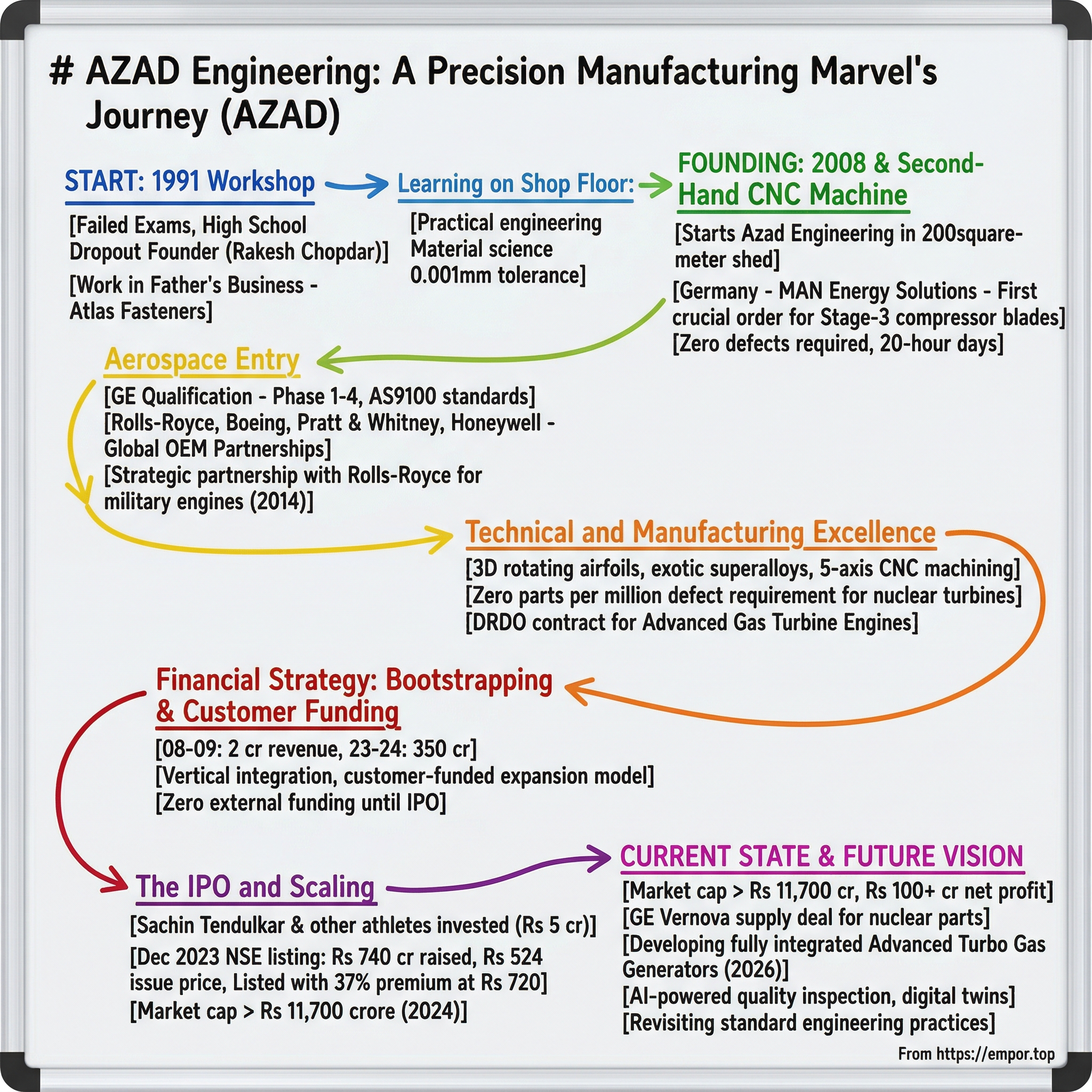
Azad Engineering: The Untold Story of India's Precision Manufacturing Marvel
I. Introduction & The Opening Mystery
On a humid morning in Jeedimetla — an industrial suburb on the northern edge of Hyderabad where the roads are cratered, the power supply is temperamental, and the air smells faintly of cutting oil — a truck pulls out of a gated compound carrying a crate. Inside that crate is a set of metal objects roughly the size of a human hand, twisted into shapes resembling frozen sculptures of wind. They will be flown to Baden, Switzerland; Takasago, Japan; or Derby, England. There, they will be bolted into machines that spin at over 3,000 revolutions per minute in temperatures hot enough to melt the very alloy from which they are forged. If one component fails, a turbine disintegrates, or an aircraft engine sheds a blade at 30,000 feet.
That is the high-stakes industry in which Azad Engineering Limited operates. The reason the company warrants serious attention, however, is not just the metallurgy. It is the arithmetic.
As of late August 2026, Azad traded around ₹2,850 per share on the NSE, giving it a market capitalisation of roughly ₹18,400 crore — approximately $2.1 billion — against trailing twelve-month revenue of about ₹640 crore and trailing net profit of roughly ₹140 crore.1 That evaluates to a price-to-earnings multiple in the 130x range and a price-to-sales multiple above 28x.1 For context, contract manufacturers rarely command such software-like valuation multiples. Azad does not own the design rights to the parts it produces, does not sell to consumers, and possesses no recurring subscription revenue or network effects. Its customers are among the largest and most sophisticated industrial conglomerates on earth, maintaining total pricing power on every contract.
The first mystery of this business is therefore financial: why is public capital pricing a mid-sized Indian machine shop as though it were a global monopoly?
The second mystery centers on leadership. Rakesh Chopdar left formal schooling after Class 10 and went to work at sixteen on the floor of his father's fastener workshop.7 He is not a trained engineer, nor a returning executive with an elite overseas degree. He learned metalworking directly on the shop floor. Yet between the lathe and the public listing, he built an enterprise that Mitsubishi Heavy Industries selected as a single-source supplier for hot-section gas turbine nozzle vane segments14 — a category of component that global original equipment manufacturers (OEMs) historically withheld from Indian machine shops.
The third mystery represents the core analytical question of this story, as it determines whether the stock is worth ₹2,850 or ₹850: is the moat real, and does the cash ever show up?
The financial tension is stark. In FY26 — the fiscal year ended March 2026 — Azad reported consolidated revenue of ₹603 crore, up 31.8%, and net profit of ₹133.6 crore, up 54.4%, with EBITDA margins reaching 36.9% on a clean audit report.1823 On paper, these figures present one of the most profitable industrial profiles in India. In the same fiscal year, however, cash flow from operations stood at negative ₹123 crore, while capital expenditure reached roughly ₹573 crore, resulting in free cash flow of approximately negative ₹690 crore.16 Every rupee of reported accounting profit — plus substantial additional capital — was absorbed by physical capacity expansion.
Such heavy reinvestment is not inherently alarming. Expanding precision manufacturing capacity ahead of a ₹6,500 crore order book aligns with standard capital deployment for a firm with verified long-term demand visibility.17 However, it means the investment case depends entirely on an unproven transition: converting a contracted order book and physical machinery into realized cash flow. Qualification does not equal commercialization, and signed long-term contracts do not guarantee cash collection.
The narrative trajectory traces this evolution: from a 200-square-metre shed in Hyderabad with a single second-hand CNC machine to a decade of failed first article inspections; through the rigorous qualification barriers that global OEMs enforce around rotating parts; past a pre-IPO balance sheet backed by structured credit from Piramal and DMI; across a high-profile ₹5 crore investment by a prominent cricketer; through an 80x-subscribed IPO and a ₹700 crore QIP; culminating in July 2026, when the company delivered the Indian defence establishment's first fully indigenous turbojet engine.15
The story begins where every precision manufacturing enterprise starts — with a founder working to overcome initial industry skepticism.
 Subscribe on LinkedIn
II. The Unlikely Founder: Rakesh Chopdar & The Atlas Shop Floor (1983–2007)
The corporate registry reveals a detail missing from official press releases. The legal entity trading today as Azad Engineering Limited was incorporated on 14 September 1983 in Andhra Pradesh under the name Ajad Engineering Private Limited.8 Yet the company's annual report dates its founding to 2008 under Rakesh Chopdar.2 Both statements are accurate, reflecting a dormant family engineering vehicle from the early 1980s that was repurposed twenty-five years later into a high-precision supplier.
The business the Chopdar family operated was Atlas Fasteners in Hyderabad—producing nuts, bolts, studs, and washers. Fasteners represent the most commoditised tier of metalworking, where purchasing decisions hinge entirely on price, product specifications are standardized, and competitors include local machine shops alongside overseas exporters.
Into this low-margin environment stepped Chopdar, who left school after Class 10 and began working at sixteen in his father's workshop.7 The company's founder message outlines this period, stating that he "started working at age 16 in his father's workshop after leaving high school," crediting those years with establishing "hard work, humility, and innovation" as core operating values.7 Press accounts document approximately twelve years on the shop floor before Chopdar branched out, mastering toolmaking, custom fixtures, manual lathe operation, and the precise behavior of specialized metal alloys under varying cutting speeds.
That practical grounding carried direct commercial relevance. In precision machining, component success depends less on digital CAD designs than on methoding—the operational technique of securing parts against cutting deflection, sequencing material removal to prevent residual stress warping, and replacing cutting tools before surface wear compromises tolerances. These skills are rarely acquired in academic classrooms; they are built through trial, error, and scrapped components. For this industry, a shop-floor apprenticeship provided Chopdar with a practical advantage over traditionally credentialed competitors.
The Aerofoil Epiphany
The strategic shift occurred when Chopdar examined an imported turbine aerofoil. Unlike standard fasteners, an aerofoil is a complex, three-dimensional component whose geometry is governed by fluid dynamics rather than simple dimension tables. The underlying insight was economic: while fasteners involved a relentless price war, aerofoils required rigorous customer qualification—a technical barrier that few Indian machine shops in the early 2000s were equipped to clear.
This pivot marked a decisive strategic reorientation. However, evaluating this origin narrative requires examining how well management's claims align with historical execution.
Testing the Claim: Did Twelve Years on the Floor Give Him a Blueprint?
The claim: A dozen years of hands-on shop-floor experience provided the technical foundation needed to build an advanced aerospace and turbine supplier.
The disconfirming evidence: Shop-floor experience alone did not generate an advanced industrial supplier for many years. The Atlas-era operation lacked computer-numerical-control (CNC) automation, exotic-alloy heat treatment, vacuum furnaces, AS9100 aerospace quality certifications, and direct relationships with global OEMs. Technical intuition yielded no scalable aerospace business until external capital funded computer-controlled machining from 2008 onward. Even after that shift, financial returns remained modest for another decade.
What survives: Practical shop-floor mastery was necessary—providing Chopdar with the hands-on skill to diagnose why a prototype component failed an OEM audit—but it was far from sufficient. The primary constraint on Azad's growth was never technical intuition, but access to capital and tier-one OEM relationships.
This distinction is central to assessing the company's trajectory. Because historical growth depended on capital scale and qualification access rather than sole founder ingenuity, the core analytical question is whether the balance sheet can sustain ongoing capacity expansion while maintaining OEM allocations.
Chopdar established the independent operation in 2008.
III. The Founding & The Second-Hand CNC Machine: 2008–2015
Consider the initial setup: a rented shed spanning roughly 200 square metres, a single second-hand three-axis computer numerical control (CNC) milling machine, and a founder in his twenties with no formal engineering degree, institutional backing, or established customer base.7 In the company's own telling, Chopdar started as "a CNC machine operator" in his own firm — effectively operating as a one-person workforce.7
Understanding the gap between a standard three-axis machine and the complex components Chopdar sought to produce illuminates the ambition of the effort.
Why Three Axes Isn't Enough
A basic three-axis CNC machine moves a cutting tool along three linear dimensions: X, Y, and Z — left to right, forward to back, and up and down. This setup is effective for producing parts with flat faces, straight edges, and simple pockets, such as mounting brackets, equipment housings, and structural plates.
A three-dimensional rotating aerofoil presents far greater technical complexity. Its surface features continuous curvature and a gradual twist along its length, designed to maintain optimal aerodynamic efficiency across varying rotational speeds between the root and the tip. Machining such geometry requires continuous orientation adjustments so the cutting tool remains perpendicular to a constantly shifting contour. This demands four-axis or simultaneous five-axis machining, where the workpiece or cutting head rotates continuously while translating along multiple axes under a single continuous toolpath.
By analogy, three-axis machining resembles writing on a flat sheet of paper. Simultaneous five-axis machining is akin to writing on a sphere as it rotates in hand — maintaining uniform pressure without lifting the pen while cutting to tolerances measured in fractions of a human hair.
Azad's progression from three-axis to four-axis and ultimately five-axis simultaneous capability between 2008 and 2015 formed the technical foundation of this era. This transition required investing in sophisticated machinery, developing advanced computer-aided manufacturing (CAM) programming skills, designing custom fixturing, and instituting strict metrology protocols to verify dimensional accuracy.
The First Orders — and What Isn't Disclosed
The company's regulatory filings and annual reports do not disclose the identity, date, or monetary value of its initial turbine aerofoil order. Available records indicate a gradual entry process involving trial batches for thermal power turbine components, followed by an extended period of quality rejections over dimensional tolerances and surface finish. Such hurdles represent standard entry barriers for new suppliers in precision turbine manufacturing.
The financial results reflect this extended ramp-up. By FY21 — thirteen years after its founding — Azad recorded annual revenue of ₹120.5 crore and adjusted EBITDA of ₹37.6 crore.2 This scale underscored modest growth over its first decade, indicating that the rapid compounding highlighted in recent valuation multiples developed primarily after FY21 rather than during the initial shop-floor phase.
Testing the Claim: The Flawless Bootstrap
The claim: Retail narrative accounts frequently describe Azad as a self-funded enterprise that built high-return capacity entirely out of operating cash flow from day one.
The disconfirming evidence: The historical capital structure indicates a heavy reliance on high-cost debt financing. By the time of its initial public offering, the company carried sufficient debt that ₹138 crore of a ₹154 crore borrowing facility was allocated for repayment using fresh issue proceeds.6 Additionally, two structured credit investors — Piramal Structured Credit Opportunities Fund and DMI Finance — held a combined stake of roughly 10% prior to the listing, exiting entirely through the offer for sale.6 Finance costs remained substantial through FY24, reaching ₹47.3 crore against EBITDA of ₹117.5 crore — absorbing roughly 40% of operating profit just two years prior to current fiscal reporting.2
What survives: The historical record demonstrates that Azad operated under capital constraints rather than strict self-funded discipline. The business relied on refurbishing equipment, staggering expansion phases, and securing structured credit to fund capital expenditure. While this represents a common trajectory for growing middle-market industrial enterprises, it differs from a self-sustaining bootstrap model and highlights an ongoing reliance on external capital markets — evidenced by its 2023 IPO and 2025 QIP — to fund physical expansion.
By 2015, Azad had assembled necessary machinery and built foundational process knowledge. However, establishing long-term commercial value in high-precision manufacturing required clearing a final barrier: securing formal qualification certificates from global original equipment manufacturers.
IV. Breaking into the Global Aerospace Elite: OEM Qualification & The Moat Engine (2015–2021)
In every turbine OEM's supply chain, one document carries more weight than any machine on Azad's floor: the First Article Inspection report. It certifies that a specific part, manufactured by a specific supplier on a specific machine using specific tooling and mill-certified material, has passed a complete quality audit. Once signed, the manufacturing process is frozen.
Understanding the mechanics of this frozen process is essential to evaluating how public markets price the business.
The Qualification Citadel
When a global OEM qualifies a rotating turbine part, it is approving far more than a blueprint—it is certifying an entire manufacturing recipe. Once frozen, the supplier cannot alter the machine assignment, holding fixtures, tool geometry, coolant blend, heat treatment cycle, or raw material source without undergoing complete re-qualification. The rationale stems from basic physics: a rotating aerofoil inside a gas turbine is a life-critical component operating under extreme thermal and mechanical stress. If a part fails in service, it destroys the engine, leaving OEMs with zero tolerance for undocumented process variation.
This qualification barrier creates a three-step gate that typically spans three to five years for complex components:
- Tooling and methoding design. The supplier designs custom fixtures and CAM toolpaths from scratch, absorbing unpaid engineering hours.
- Prototype metallurgical audit. Sample components undergo destructive testing—sectioning, etching, and pulling to failure—to verify grain structure, tensile strength, and fatigue resistance under thermal cycling.
- The freeze. The OEM grants formal approval, locking the manufacturing parameters.
This frozen process functions simultaneously as a commercial moat and a capital trap. It serves as a moat because an OEM that has invested years and capital qualifying Azad on a part family is reluctant to repeat that process simply to save a modest percentage on unit costs. Conversely, it acts as a trap because Azad must absorb all development and holding costs during the multi-year qualification phase without any guarantee of commercial revenue.
Building the Portfolio
Azad moved through that qualification gate repeatedly. By FY25, the company disclosed more than 1,700 qualified parts across 45-plus specialised manufacturing processes. This portfolio spans gas, steam, and nuclear turbine components for energy clients, alongside engine parts, auxiliary power units, unison rings, actuator assemblies, and structural components for aerospace platforms such as the Boeing 737, the Airbus A320 and A350 families, and the Gulfstream G550.2
That portfolio of 1,700 qualified parts represents a key proxy for the company's operational durability. Each approved part functions akin to an annuity protected by engineering and legal switching barriers. A competitor cannot displace an incumbent supplier merely by underbidding; it must persuade the OEM to re-open a closed, multi-year qualification process.
The customer list includes tier-one global industrial conglomerates: GE Vernova, Siemens Energy, Mitsubishi Heavy Industries, Honeywell Aerospace, Rolls-Royce, Baker Hughes, BHEL, and nuclear operator EDF.218 In FY25 alone, Azad disclosed major customer commitments: two GE Vernova agreements totaling $165.5 million, Siemens Energy contracts worth €90.1 million, an $83 million five-year contract and price agreement with MHI, and a $16 million Phase-1 award from Honeywell Aerospace.2 The GE Vernova commitments comprised two distinct deals: a six-year, $112 million agreement for rotating and stationary airfoils in advanced gas turbines announced on 16 January 2025,12 and a six-year, $53.5 million agreement running through 2030 with GE Vernova's Steam Power Services unit for nuclear, industrial, and thermal power airfoils, announced on 4 May 2025 alongside the inauguration of a 7,600-square-metre facility built to serve it.13 Azad also describes itself as supplying OEMs that control roughly 75% of the global land-based turbine market.2
Testing the Claim: Is the Single-Source Moat Unassailable?
The moat claim: OEM qualification establishes an unassailable single-source position because switching costs are prohibitive for buyers.
The disconfirming evidence: Industrial buyers maintain explicit multi-sourcing policies. Tier-one OEMs such as GE, Siemens, and Rolls-Royce have spent years—particularly following pandemic-era supply disruptions—deliberately dual-sourcing critical component families across different geographies to ensure no single supplier can halt a production line. Consequently, qualification grants a supplier the right to compete for volume, rather than a guaranteed allocation. When Azad upgraded its relationship with MHI, being named a "Single Source Supplier Partner" for hot-section nozzle vane segments was announced on 26 March 2026 as a rare distinction worth a separate exchange filing.14 Companies do not issue regulatory filings for standard operational terms. The filing demonstrates that single-sourcing remains an exception within Azad's order book rather than the default baseline.
A second indicator appears in the company's financial disclosures. Azad's expected credit loss allowance on trade receivables roughly doubled in FY25, rising from ₹36.39 million to ₹72.15 million.2 While small in absolute terms, an expanding allowance warrants observation for a business selling to investment-grade multinational customers.
What survives: The competitive moat is real but more circumscribed than popular retail narratives suggest. High switching costs exist for specific qualified parts, providing an incumbency advantage on follow-on components within the same engine program. However, Azad lacks broad pricing power, and volume allocations remain at the discretion of OEM purchasing departments. The confirming or falsifying evidence will hinge on realized per-part pricing over time and contract renewal volumes. The March 2026 MHI renewal provides an encouraging benchmark: the incremental agreement was valued at roughly ₹651 crore ($73.47 million), bringing total contracted MHI value to about ₹1,387 crore.14 This expansion indicates a core customer deepening its commitment rather than seeking alternative suppliers.
Qualification, however, represents only part of the operational challenge. The remaining hurdle is executing precise volume production on the factory floor.
V. Technology, Metallurgy & Manufacturing Physics: Precision at 30,000 Feet
The core engineering challenge of turbine component manufacturing stems from basic thermal physics. The alloys used in the hot section of a modern gas turbine are engineered to retain structural integrity at temperatures exceeding the melting point of standard steel. Certain turbine blades operate in gas streams hotter than the alloy's own melting temperature, surviving only because cool air is routed through microscopic internal channels and bled across the surface to form a thin insulating thermal barrier.
This environment creates distinct operational demands for high-precision machining.
Why Superalloys Fight Back
Azad processes specialized alloys including titanium, Inconel, Nimonic, high-chromium steels, and nickel-based superalloys.2 While these metals perform reliably under extreme thermal stress, they present significant technical obstacles during machining because they retain heat and resist thermal softening.
- Poor thermal conductivity. In standard carbon steel, cutting friction dissipates largely through metal chips. In nickel-based superalloys, thermal energy remains concentrated at the cutting edge, rapidly degrading cutting tools.
- Work hardening. The mechanical force of cutting hardens the metal's surface layer. Subsequent cutting passes encounter progressively tougher material, accelerating tool wear.
- Chemical reactivity. Materials such as titanium react chemically with cutting tools at elevated temperatures, causing microscopic welding of chips to tool edges.
Consequently, tool life when cutting superalloys is measured in minutes rather than hours, converting cutting tool replacement into a significant operational cost. This dynamic highlights the practical nature of Azad's manufacturing moat: a proprietary operational database of cutting speeds, feed rates, coolant formulas, and tool sequences built over nearly two decades of shop-floor iteration.
The Chain: Forge, Treat, Cut, Prove
Producing a finished aerofoil requires a multi-stage manufacturing sequence designed around structural physics:
Near-net-shape precision forging. Rather than machining an aerofoil from a solid billet, the initial form is forged close to its final dimensions. Beyond reducing raw material waste, forging aligns the metal's internal grain flow along the component's contour, improving fatigue resistance under millions of operational stress cycles.
Vacuum heat treatment. Forging and machining induce internal mechanical stresses that can cause component distortion or thermal fatigue failure during operation. Vacuum heat treatment relieves these stresses while preventing surface oxidation.
Five-axis machining and electrical discharge machining. The external aerofoil contour is sculpted using simultaneous five-axis CNC milling machines. Microscopic internal cooling channels and surface film holes—inaccessible to traditional cutting tools—are created via Electrical Discharge Machining (EDM), which erodes high-hardness alloys using precision electrical sparks.
Metrology and non-destructive testing. Automated Coordinate Measuring Machines (CMM) verify dimensional tolerances against CAD models, while blue-light optical scanning maps full surface geometry. X-ray computed tomography and non-destructive testing inspect for internal voids and surface micro-cracks before final dispatch.
The Boundary That Actually Matters
A critical analytical distinction separates technical manufacturing capability from long-term investment value.
Producing an individual prototype component that passes quality inspection demonstrates technical capability. Converting that technical benchmark into sustained enterprise value requires commercial capability: scaling production to tens of thousands of units annually while controlling scrap rates, managing cutting-tool consumption to protect unit economics, and maintaining margins under annual contractual price step-downs typical of global OEM agreements.
Azad's recent financial reporting reflects strong current execution. Consolidated EBITDA margins reached 36.9% in FY26 and 37.6% in the first quarter of FY27—elevated levels for a contract machining vendor—with operating margins expanding alongside roughly 30% top-line revenue growth.183 Management attributed the margin expansion in early FY27 primarily to the qualification of domestic raw material suppliers and the internalisation of additional manufacturing processes.3
However, these operating margins are occurring during an initial volume expansion while new facilities are ramping up. Capital expenditure additions have begun to affect bottom-line results: in the first quarter of FY27, EBITDA rose 32.1% year-over-year while net profit grew 21.2%, as capital depreciation and financing costs outpaced revenue expansion.3 This divergence illustrates the financial mechanics of building physical capacity ahead of order volume, reinforcing why top-line operating margins alone do not complete the valuation assessment.
Which brings the analysis directly to the balance sheet.
VI. The Capital Allocation Crucible: Debt, Dilution, and Working Capital Intensity (2018–2023)
Understanding why Azad consumes cash requires examining its physical supply chain. The specialty alloy bars converted into turbine blades are imported from a small selection of approved mills on extended lead times, requiring upfront payment long before finished components are invoiced.
During the manufacturing phase, parts remain bound up in work-in-progress across multi-stage machining, heat treatment, and metallurgical inspection. Finally, at the terminal end of the cycle, tier-one global OEMs represent creditworthy but slow-paying customers.
Together, these three factors yield the defining characteristic of Azad's operating profile: a working capital cycle that continuously absorbs growth.
The Numbers Behind the Squeeze
Management disclosed on the Q1 FY27 earnings call that the working capital cycle was running at roughly 170 to 180 days, while noting that finance costs would remain elevated until the second half of FY27.3 While not a crisis level for heavy precision manufacturing, this duration represents a structural requirement of the business rather than a temporary operational delay.
The financial burden of this model was evident prior to listing. In FY24 — the fiscal year spanning the initial public offering — finance costs reached ₹47.3 crore against ₹117.5 crore of adjusted EBITDA.2 Lenders effectively absorbed roughly two out of every five rupees of operating profit. This debt service explains why pre-IPO net profit margins lingered in the high single digits to mid-teens even as EBITDA margins approached 30%, with the spread representing interest expense on machine-tool financing.
The choice of financing instruments reflected the company's historical bargaining position. To acquire five-axis machining centres before generating supporting operating cash flows, Azad relied on structured credit. Piramal Structured Credit Opportunities Fund and DMI Finance held a combined stake of roughly 10% prior to the IPO, exiting entirely through the offer for sale for ₹260.85 crore and ₹34.18 crore, respectively.6 Structured credit typically serves as a bridge when commercial lenders restrict exposure and public equity markets remain inaccessible.
Testing the Claim: Capital Discipline
The claim implicit in the current narrative: Azad has maintained disciplined capital allocation.
The disconfirming evidence: The promoter group diluted its ownership stake twice within twenty-seven months at widely divergent valuations. The December 2023 IPO was priced at ₹524 per share.4 A subsequent Qualified Institutions Placement (QIP) in February 2025 was priced at ₹1,280 — representing a 1.8% discount to the SEBI floor price and a 5.6% discount to the prior closing price — raising ₹700 crore while diluting equity by roughly 8.5%.10 Consequently, promoter holding stood at 55.84% as of June 2026,1 down materially from post-listing levels. Meanwhile, total debt was not permanently eliminated: total borrowings stood at ₹238.3 crore in March 20252 before expanding to roughly ₹474 crore by March 2026.1
What survives: These actions do not signal poor capital allocation; issuing equity into market strength at elevated multiples represents a conventional corporate finance strategy. Furthermore, ₹525 crore of the ₹700 crore QIP proceeds was explicitly designated for capital expenditure on machinery and process automation, with the remaining ₹156.2 crore allocated for general corporate purposes within regulatory caps.2 However, the record demonstrates that Azad operates as a capital-intensive enterprise that has yet to fund its expansion out of internal cash generation. Rather than achieving self-funded compounding, the company relies on periodic external financing to sustain physical growth. The key benchmark for investors remains whether operating cash flow will eventually cover annual capital expenditure.
Before public markets funded this expansion, however, the company required broader market recognition. That turning point involved a high-profile athlete.
VII. The Pre-IPO Star Power & Public Listing: Sachin Tendulkar to $2B+ Valuation (2023–2024)
In March 2023, a Hyderabad precision machining company with roughly ₹250 crore of revenue executed an unexpected capital strategy: it placed cricket icon Sachin Tendulkar on its shareholder register.
Tendulkar acquired 438,000 shares at an average price of ₹114 — an outlay of approximately ₹5 crore.9 He was joined by badminton champions PV Sindhu and Saina Nehwal and by boxer Nikhat Zareen.9
Viewed cynically, the arrangement resembled a marketing deal disguised as an equity investment. Practically, it achieved its commercial goal. Azad Engineering transformed from an obscure business-to-business supplier into "the Sachin Tendulkar company" in the minds of Indian retail investors—nine months before requiring public equity participation. By the time of the public offer, Tendulkar's stake was valued at roughly ₹22.9 crore at the issue price.9
From an analytical standpoint, two realities coexisted. First, celebrity backing provides no technical verification of manufacturing quality or factory-floor scrap rates. Second, high-profile investor visibility meaningfully reduced Azad's cost of capital at a pivotal moment, representing a practical form of value creation.
The Offer
The initial public offering opened on 20 December 2023 with a price band of ₹499–524 per share and closed on 22 December.4 The issue raised ₹740 crore in total: a ₹240 crore fresh issue alongside a ₹500 crore offer for sale.6 Fresh capital was allocated strictly to balance sheet de-leveraging and physical growth—₹138 crore to repay existing borrowings out of ₹154 crore in targeted facilities, and ₹60 crore for capital expenditure.6
Demand across institutional and retail categories was exceptionally strong. Overall subscription came in at 80.65 times, with the qualified institutional buyer portion booked 179.66 times and the non-institutional category 87.61 times.5 Anchor investors had already committed ₹220.79 crore on 19 December, with 42.13 lakh shares allotted at the top of the price band to twenty institutions.9
On its trading debut on 28 December 2023, the stock delivered a 37.4% listing premium, opening at ₹720 on the National Stock Exchange against the ₹524 issue price.5
The Re-rating
The subsequent valuation shift represents the core financial development following the listing.
At the initial public offering price, Azad was valued at roughly ₹5,500 crore. By August 2026, that market capitalization had reached about ₹18,400 crore.1 Revenue over roughly the same period grew from ₹341 crore in FY24 to ₹603 crore in FY26—an increase of about 77%.118 Net profit expanded from ₹59 crore to ₹134 crore, roughly a 2.3-fold increase.1
While net profit grew 2.3 times, market capitalization expanded 3.3 times over the same period. The majority of shareholder returns thus stemmed from multiple expansion rather than pure earnings growth. The price-to-earnings multiple moved from roughly 35x on pre-IPO earnings to about 130x on trailing earnings.1
Markets re-rate industrial enterprises when evidence suggests higher growth durability and expanding competitive moats. Between 2024 and 2026, investors priced in distinct operational milestones: winning single-source hot-section component contracts from Mitsubishi Heavy Industries, commissioning dedicated manufacturing facilities on schedule, and maintaining elevated operating margins alongside top-line expansion.
However, a price-to-earnings ratio near 130x establishes a demanding operational threshold. Public markets are no longer pricing a standard contract manufacturer; they are evaluating a protected industrial franchise expected to deliver sustained 30% annual compounding over the next decade.
VIII. Current State, Segment Breakdown & Core Business Economics (FY25–FY26)
Stripping away the market narrative reveals the operational reality of the business as of August 2026.
The Financial Picture
The fiscal year ended March 2026 represented the strongest income-statement performance in the company's history. Consolidated revenue reached ₹602.98 crore, a 31.8% increase, while profit after tax expanded 54.4% to ₹133.56 crore. On a standalone basis, top-line sales grew 30.3% to ₹590.38 crore with net profit up 49.3% to ₹132.16 crore.18 Full-year earnings before interest, taxes, depreciation, and amortisation (EBITDA) margin stood at 36.9%, finishing the fourth quarter at 36.7%.18
Results for the first quarter of FY27, reported on 8 August 2026, extended this top-line trajectory, generating standalone revenue of ₹170.5 crore (up 26.8%), EBITDA of ₹64 crore (up 32.1%) at a 37.6% margin, and net profit of ₹36.4 crore (up 21.2%), yielding earnings per share of ₹5.63.3 This growth occurred against a demanding baseline: in the first quarter of FY26, revenue had reached a then-record ₹135 crore with a 36.1% EBITDA margin and a 22.3% net profit margin, compared to 17.4% the year before that.19 While operating efficiency improved, net profit margin narrowed year over year from 22.3% to 21.3%, illustrating that bottom-line gains began lagging operating growth as new capacity costs accumulated.
Two structural dynamics explain this financial divergence.
First, margin expansion stems from a specific operational shift. Management attributed the 150 basis point EBITDA margin gain in the first quarter of FY27 to qualifying domestic raw material suppliers—specifically naming Sunflag and Istarwire—and insourcing additional steps in the manufacturing chain.3 Replacing imported specialty alloys with domestic supply offers a tangible margin lever, reducing both direct material costs and the working capital tied up in international transit. The validity of this strategy will be verified in future quarters by whether raw material expense continuously falls as a percentage of sales.
Second, net profit is decelerating relative to operating income. Net profit grew 21% year over year in the first quarter of FY27 compared to 32% EBITDA growth. The divergence reflects rising depreciation from newly commissioned facilities and sustained borrowing costs, which management expects to remain elevated through the second half of FY27.3 Concurrently, non-operating income dropped from ₹9.1 crore to ₹4.0 crore due to foreign currency fluctuations, while employee expenses rose from ₹29 crore to ₹42 crore as headcount expanded ahead of anticipated plant utilization.22 These cost pressures reflect a capital-heavy expansion phase rather than the seamless profit compounding priced into a 130x earnings multiple.
Return metrics underscore this tension through contrasting accounting methodology. Azad disclosed an adjusted ROCE of 20.7% for FY25, but that calculation explicitly excludes capital work in progress, capital expenditure advances, and cash balances from total capital employed.2 On an unadjusted basis, total return on capital employed sits closer to 12%.1 While the adjusted metric measures the yield on operational assets, the unadjusted figure reflects total invested shareholder capital. Over time, overall enterprise compounding depends on whether total committed capital achieves those higher operational returns.
Segment Reality
An examination of segment performance highlights a gap between public perception and revenue composition.
Energy and Oil & Gas remains the core driver of the enterprise. In FY25, the division generated ₹358.6 crore—representing 79% of total revenue—and grew 26% year over year.2 In FY26, its revenue share rose further to 81.5% of full-year sales.18 This division manufactures compressor airfoils, stationary vanes, and specialized precision components for thermal, gas, and nuclear turbine manufacturers.
Aerospace & Defence remains an emerging growth driver rather than the primary revenue source. The segment generated ₹80.7 crore in FY25, accounting for 17.9% of revenue after expanding 84.1% year over year from a 12.9% share in FY24.2 In FY26, segment revenue crossed ₹100 crore for the first time.18
This trajectory presents a key distinction from market expectations. Expanding from ₹80.7 crore to approximately ₹100 crore represents 24% annual growth—below the company's overall top-line expansion of 32%. Consequently, the division's revenue contribution contracted slightly in FY26 to roughly 17%, meaning the business segment commanding premium market valuation grew slower than the core energy division during the fiscal year.
Performance in the first quarter of FY27 reversed this trend, with Aerospace & Defence expanding 38.4% year over year compared to 21.6% growth in Energy and Oil & Gas.3 Sustaining this relative acceleration remains vital to validating the segment's growth thesis.
International sales generate the vast majority of revenue. Foreign markets accounted for 91.9% of FY25 sales, up from 87.5% in FY24, spanning more than twelve countries including the United States, United Kingdom, Germany, Japan, Saudi Arabia, and Singapore.2 While confirming global customer adoption, this export dominance introduces currency volatility that directly affected non-operating income in the first quarter of FY27.
Customer Concentration — The Correction
Audited disclosures clarify common market assumptions regarding customer concentration. In FY25, Azad's top five customers generated ₹231.5 crore of total revenue of ₹452.9 crore, representing approximately 51%. The single largest client accounted for ₹63.1 crore, or roughly 14%, and exactly one customer exceeded 10% of total sales.2
While lower than external estimates alleging a 75% to 80% concentration, customer revenue remains concentrated in absolute terms. Furthermore, buyer reliance is increasing: the top five clients generated 45% of FY24 revenue, indicating a six-percentage-point rise in concentration within a single fiscal year as Azad expanded its wallet share among core accounts.2
This customer structure carries clear commercial implications. Order deferrals or contract restructurings from major buyers such as GE Vernova, Siemens Energy, or Mitsubishi Heavy Industries would impact 10% to 15% of company revenue—a manageable operational shock rather than an existential threat. However, the broader risk stems from market correlation: these prime buyers operate within the same global power generation and aerospace capital equipment cycles. Customer diversification across buyers exposed to identical macro demand drivers provides limited insulation during an industry downturn.
The Capacity Build
The ongoing capital program represents the largest physical expansion in Azad's history. Building upon roughly 20,000 square metres of existing operational manufacturing space, the company's Phase-1 development at Tunikibollaram in Hyderabad adds approximately 94,899 square metres of new capacity.2 Azad inaugurated two customer-dedicated facilities in FY25—a 7,200-square-metre plant for Mitsubishi Heavy Industries in March 2025 and a 7,600-square-metre plant for GE Vernova in April 2025—before commissioning four additional facilities during FY26, including a Baker Hughes plant in April 2026.2183
During the Q1 FY27 earnings call, management outlined the long-term operational objective: establishing eight dedicated customer plants at Tunikibollaram, with each facility designed to generate between ₹150 crore and ₹180 crore in revenue at full utilization.3 At capacity, this expansion represents approximately ₹1,300 crore in potential top-line contribution from the new site alone, more than doubling current operational scale, with total infrastructure construction reported as 70% to 80% complete.17
This expansion highlights both the growth thesis and the primary execution challenge. Operating eight new facilities requires securing component allocations to fill installed capacity. Management explicitly acknowledged this risk, identifying execution—specifically "simultaneously building factories, scaling capacity, hiring personnel, and fulfilling existing contracts"—as the company's primary operational hurdle.3
IX. Defense & Space Optionality: Separate Technical Milestones from Revenue Realization
On 22 July 2026, an engine was handed over in Hyderabad that India had been trying to build for the better part of four decades.
The Gas Turbine Research Establishment — GTRE, the DRDO laboratory in Bengaluru that has carried India's aero-engine ambitions since the Kaveri programme began in the 1980s — took delivery of the country's first indigenous expendable turbojet engine in the 350 kg thrust class.15 GTRE designed it. Azad Engineering manufactured, assembled, integrated, and delivered the complete engine, having been named GTRE's sole industry partner and production agency under a long-term contract awarded in May 2024.15
The engine itself is deliberately unglamorous, and that is the point. It is a single-spool turbojet with a four-stage axial compressor, an annular combustor, a single-stage uncooled axial turbine, and a fixed-area exit nozzle.15 An uncooled turbine means no internal cooling passages — a simplification allowable only when an engine is not engineered for long-term service. Expendable engines power long-range cruise missiles, loitering munitions, and unmanned aerial vehicles, where primary design constraints are unit cost, compactness, and single-flight reliability rather than thousands of hours of service life.15
For Azad, the strategic significance is real and specific: it moved the company across the line from component supplier to system integrator. Manufacturing an airfoil to a client's frozen process is a contract machining business. Assembling, integrating, and delivering a complete engine is a different business with distinct economics — capturing higher value per unit while establishing a customer relationship that is far more difficult to displace.
Alongside this milestone sit two additional optionality bets. Rolls-Royce signed a long-term contract in January 2024 for complex components for military aircraft engines, a seven-year arrangement that sent the stock up 25% over two sessions11; Azad's FY25 annual report separately describes a long-term engagement with Rolls-Royce plc for civil aircraft engine components across full lifecycle programmes.2 Additionally, Azad has publicly discussed supplying high-precision components to the space sector, though it has not disclosed revenue from that activity.
Testing the Claim: Will Defence Double the Business?
The thesis claim: Defence and space contracts will transform Azad's revenue base over three to five years.
The disconfirming evidence, drawn from Azad's own conversion record: The GTRE contract was awarded in May 2024. The first engine was delivered in July 2026 — consuming twenty-six months of engineering bandwidth to produce a single unit.15 On the Q1 FY27 earnings call, management stated that weapon testing was expected within four to six weeks of delivery, and that production scale-up "ranges from double-digit to four-digit units."3 That range spans two orders of magnitude, reflecting significant uncertainty regarding commercial volume timelines. Meanwhile, the entire Aerospace & Defence segment — which encompasses commercial aerospace components for Boeing and Airbus platforms alongside defence contracts — generated roughly ₹100 crore in FY26, accounting for about one-sixth of total company revenue.18
Indian defence procurement features an established history of extended development cycles, multi-stage field trials, budget-driven timing slips, and modest initial production volumes. GTRE's own Kaveri programme serves as a primary example. A supplier's operational execution does not alter a sovereign buyer's institutional procurement behavior.
A second structural factor warrants evaluation. When a company's primary buyer is the state, monopsonist bargaining power directly influences the durability of any competitive advantage. Government indigenisation policies that created this opportunity for Azad can similarly foster secondary vendors over time, as vendor-base expansion remains an explicit public procurement policy.
What survives: The defence thesis should be narrowed rather than dismissed entirely. Delivering the turbojet engine provides genuine technical validation that Azad can integrate a complete propulsion system — a capability demonstrated by few private Indian manufacturers, and one that expands the scope of programs for which it can bid. However, this delivery remains a technical milestone rather than an immediate financial driver, and the company's historical conversion timelines suggest that converting engineering benchmarks into material revenue takes years rather than quarters. A clear disconfirming or validating test will be whether the turbojet program yields a disclosed series production order with defined unit quantities and contract values within the next four to six quarters. Without such an order, market valuation will continue to reflect defence optionality well ahead of its financial realization.
X. The Strategic & Competitive Framework: Hamilton Helmer's 7 Powers & Porter's 5 Forces
Evaluating Azad Engineering through structured strategy frameworks clarifies where its operational advantages lie and how external forces shape its competitive position and valuation.
Hamilton Helmer's 7 Powers
Process Power — the primary and probably the only strong power. Helmer defines Process Power as an embedded organizational capability that enables superior product performance or lower costs, resisting replication because it can only be built through extended operational practice. At Azad, this power rests on an accumulated body of methoding knowledge across more than 1,700 qualified parts and over 45 specialized processes2—knowing which custom fixtures stabilize thin-walled components, which tool sequences maintain micro-inch tolerances in Inconel, and how to reduce scrap rates on complex blade families. A competitor purchasing identical five-axis CNC machinery lacks this institutional memory. Nearly two decades of trial, error, and scrapped components represent the true acquisition cost that incoming rivals cannot readily buy.
Switching Costs — genuine, but on a part-by-part basis. The frozen manufacturing process makes vendor displacement costly for OEMs on parts already qualified. However, this protection remains bounded: while it secures existing production allocations on qualified engine programs, it does not guarantee future contract awards nor does it confer pricing power.
Scale Economies — emerging at best, and currently working against the company. Operating leverage depends on fixed-cost absorption across the expanding Tunikibollaram complex, where capacity remains in a buildout phase. With eight planned customer-dedicated facilities designed to generate between ₹150 crore and ₹180 crore in annual potential revenue each3 against a business generating under ₹700 crore in annualized sales, plant utilization remains the primary constraint. Until those facilities achieve higher volume throughput, installed capacity functions as an operational overhead drag rather than a competitive power.
Counter-Positioning — absent. Azad does not employ a business model that established global incumbents are structurally disincentivized to copy. Instead, it delivers high-precision contract machining similar to international peers such as Howmet Aerospace, Doncasters, and Pietro Rosa TBM, relying primarily on a lower-cost Indian manufacturing base. This represents a traditional cost-advantage rather than counter-positioning, and one that could narrow over time as domestic engineering wages rise.
Cornered Resource, Branding, Network Economies — not applicable. These strategic powers are absent in business-to-business contract manufacturing. Stating this explicitly clarifies that the stock's high valuation multiple is pricing in operational execution rather than structural monopoly protections such as network effects or consumer brand equity.
In sum, Azad possesses one robust strategic power in process expertise and a moderate position in part-level switching costs. While these advantages justify a premium over commoditized machine shops, whether they support a price-to-earnings multiple near 130x remains a question beyond the scope of Helmer's framework.
Porter's Five Forces
Bargaining power of buyers: HIGH, and this is the binding constraint. Azad's primary customers—GE Vernova, Siemens Energy, Mitsubishi Heavy Industries, Rolls-Royce, Honeywell, and Baker Hughes2—are industrial conglomerates with massive balance sheets negotiating against a supplier generating roughly ₹600 crore in annual revenue. These buyers routinely enforce multi-year contracts containing mandatory annual price reductions, while maintaining explicit multi-sourcing rights to shift volume across global vendors. Consequently, Azad's elevated operating margins depend on the ongoing allocations of customers with dominant bargaining leverage.
Bargaining power of suppliers: MODERATE-HIGH. Raw materials such as specialty titanium and nickel-based superalloys are sourced from a limited group of OEM-approved global mills. Because raw material origins form part of the locked manufacturing process, Azad cannot unilaterally switch to lower-cost vendors. This structural constraint explains the strategic importance of the domestic supplier qualification initiatives management highlighted in the first quarter of FY27, which aim to reduce reliance on foreign mills and improve material margins.3
Threat of new entrants: VERY LOW. Substantial capital requirements, three-to-five-year qualification timelines, stringent AS9100 quality certifications, and a limited pool of specialized five-axis programming and metrology talent create formidable entry barriers, insulating incumbent suppliers from new domestic entrants.
Threat of substitutes: LOW. Combustion turbines offer no direct substitute for precision-machined metal aerofoils. While additive manufacturing is advancing for specialized internal components, it poses no immediate threat to high-stress, high-rotation structural components over the medium term.
Competitive rivalry: MODERATE. Global competition includes established international vendors such as Howmet Aerospace, Doncasters, and Pietro Rosa TBM. Domestically, public comparisons often cite MTAR Technologies, Dynamatic Technologies, and PTC Industries. However, operational overlaps are limited: PTC focuses primarily on investment casting, Azad specializes in high-precision machining, and MTAR manufactures assemblies for space, nuclear, and clean energy applications.24 These peers contend more for investor attention than for identical customer purchase orders.
This broader valuation context is instructive. High valuation multiples are common across the Indian precision engineering sector, with MTAR quoted above 200 times trailing earnings following its fourth-quarter FY26 results.24 Viewed against this industry cohort, Azad's multiple of 130 times trailing earnings is not an anomaly. However, whether the broader sector's valuation remains sustainable is an open question, and any cohort-wide re-rating would impact all market participants.
XI. Management & Governance Audit: Incentives, Credibility, and Single-Founder Risk
In FY25, the company's board comprised eight directors, split evenly between four executive and four independent members.2 Rakesh Chopdar serves as Chairman, CEO, and Whole-time Director, while his wife, Jyoti Chopdar, serves as a Whole-time Director alongside executive director Vishnu Malpani. The independent directors are Michael Joseph Booth, Subba Rao Ambati, Madhusree Vemuru, and Deepak Kabra, who was appointed in January 2025. Financial oversight rests with Chief Financial Officer Ronak Jajoo, while MSKA & Associates serve as statutory auditors.2
The most significant governance adjustment occurred with the appointment of Murali Krishna Bhupatiraju as Managing Director on 3 January 2025, regularised by shareholders at an extraordinary general meeting on 28 January 2025.2 Bhupatiraju brings over twenty-five years of metal-forming and operational leadership, having served as President and CFO of Bharat Forge America, CFO of Dyson Corporation, and General Manager at Gerdau Macsteel, with academic degrees from Ohio State, Michigan State, and Georgia Tech.2 Bringing in an executive with extensive experience managing North American OEM relationships directly addresses key-person dependency on the founder.
As of June 2026, promoter equity holding stood at 55.84%, while foreign institutional investors held 13.30% and domestic institutional investors held 10.32%.1 This structure maintains clear voting control with the promoter group while reflecting an expanding institutional investor base.
Say/Do Audit
Promised: use IPO proceeds to extinguish high-cost debt and expand net margins. Status: Delivered, then partially reversed. Following the public listing, annual finance costs dropped from ₹47.3 crore in FY24 to ₹17.9 crore in FY25, driving an expansion in net profit margin from 17.2% to 19.5%.2 By the close of FY25, Azad maintained a net cash balance sheet, holding ₹695.9 crore in cash against ₹238.3 crore in total borrowings.2 However, total debt expanded back to roughly ₹474 crore by March 2026 to fund ongoing capital expenditure,1 with management projecting elevated finance costs through the first half of FY27.3 The initial balance-sheet deleveraging was achieved, but debt reduction proved temporary as physical expansion accelerated.
Promised: expand the aerospace share of overall revenue. Status: Partially delivered. The company secured notable order wins across the segment, including a long-term contract with Rolls-Royce in January 2024,11 the Honeywell Phase-1 award,2 and the GTRE turbojet integration contract.15 However, revenue conversion has lagged contract signing: the Aerospace & Defence segment's share of total revenue contracted in FY26 before rebounding in the first quarter of FY27.183 Management has framed its overall 25% top-line growth guidance as conservative, anchoring expectations to facility stabilization rather than projecting an immediate aerospace surge.17
Unresolved: cash conversion and working capital intensity. Cash generation presents the central financial challenge. Operating cash flow stood at negative ₹6.95 crore in FY24, turned positive at ₹53.7 crore in FY25, and dropped sharply to negative ₹119 crore in FY26.16 Relative to FY26 EBITDA of roughly ₹222 crore, cash conversion remained negative, with standalone filings indicating that working capital absorbed approximately ₹300 crore during the fiscal year.18 Management attributed this cash drain primarily to inventory accumulation ahead of new facility commissioning.17
While inventory pre-building is typical during major capacity additions, the key analytical question is how much working capital reflects temporary pre-production stock versus extended collection cycles. Debtor days expanded to 189 days by March 2026,1 indicating that trade receivables lengthened even as the customer portfolio shifted toward tier-one global OEMs.
Governance Flags
The FY25 annual report discloses two regulatory compliance matters.
First, the BSE and NSE each levied a fine of ₹11,800 for non-compliance with Regulation 23(9) of SEBI LODR Regulations regarding the delayed consolidated disclosure of related-party transactions for the half-year ended 31 March 2024, which the company paid.2 Second, the promoter group submitted its required annual declaration under Regulation 31(4) of SEBI SAST Regulations after the deadline, prompting a clarification request from the BSE.2
While financially immaterial, these events reflect administrative adjustments as secretarial infrastructure catches up with public listing requirements. The company separately confirmed that no material related-party transactions occurred during FY25.2
Regarding contingent liabilities, Azad disclosed a customs exposure of ₹75.11 million tied to Advance Authorisation and Export Promotion Capital Goods (EPCG) licences. Management stated that export obligations were largely fulfilled and attributed the delay in securing export obligation discharge certificates to procedural reviews by the government norms committee.2 Additionally, the company faces a tax demand for FY20 and FY21 under GST regulations, having settled a portion and appealed the remainder in November 2024.2 These disputes represent manageable operational exposures relative to total assets, though they remain unresolved.
Independent credit evaluations have trended positively. CARE Ratings assigned a CARE A-; Stable long-term rating in November 202420 and upgraded the credit profile to CARE A; Stable, along with a CARE A2+ rating for short-term facilities, in July 2025.21 This rating upgrade during an active capital expansion phase provides third-party credit validation, balancing the near-term cash flow deficits.
XII. Bull vs Bear Case & The Skeptical Investor Stress Test
Why Azad Wins From Here
The supply chain realignment is structural, not cyclical. Western turbine and aero-engine OEMs spent decades sourcing precision machining from Eastern Europe and China. The last five years have made that untenable for reasons that are geopolitical rather than economic, and India is the largest available alternative with the requisite engineering labour. Azad is not the cause of this shift; it is a beneficiary of it. The evidence that it is real is not in a consultant's slide, it is in the contracts: $165.5 million from GE Vernova across two agreements2, €90.1 million from Siemens Energy2, and MHI escalating from a five-year $83 million LTCPA2 to an incremental eight-year agreement of about ₹651 crore taking total contracted MHI value to ₹1,387 crore.14 These are OEMs voting with multi-year commitments.
Order visibility is exceptional for a company this size. The order book stood at ₹6,080 crore at FY252 and approximately ₹6,500 crore at FY26, with management describing five-to-six-year fulfilment visibility, split roughly $400 million-plus energy, $200 million aerospace and defence, and $100 million oil and gas.17 Against ₹603 crore of FY26 revenue, that is over ten years of current revenue under contract. Long-term agreements are not firm purchase orders, and volumes flex — but the order book is a real constraint on how badly this can go in the near term.
Operating leverage is the mechanism that would justify the multiple. If eight dedicated plants each fill to the ₹150–180 crore level management describes,3 revenue roughly triples off the current base without a proportional increase in fixed cost, and the depreciation and finance charges that are currently suppressing net margin get absorbed. That is the arithmetic path from a 22% net margin to something higher.
Margins are expanding, not compressing, through the ramp — 36.9% for FY26 and 37.6% in Q1 FY27, with an identified cost mechanism in domestic input qualification.183 For a supplier facing annual price-down clauses, expanding gross margin through a scale-up is meaningful evidence that the process knowledge is producing real cost advantage rather than just accounting flattery.
What Could Break It
Valuation leaves no margin for error. At roughly 130x trailing earnings and over 28x trailing sales,1 the market has capitalised a decade of near-flawless execution into today's price. This is the dominant risk, and it does not require anything to go wrong operationally — it only requires growth to decelerate from 30% to 20%. In a stock priced on terminal-value assumptions, a single quarter of order deferral can compress the multiple far more than it dents earnings. It is worth noting that the market has already shown its reflexes here: the shares fell 6.5% on one occasion despite 50% year-over-year net profit growth, because the growth was not enough.25
Free cash flow has been negative in every one of the last five fiscal years. FY22 through FY26: negative ₹96 crore, negative ₹96 crore, negative ₹82 crore, negative ₹240 crore, negative ₹691 crore.16 That is not a blip; it is the operating characteristic of the business as run to date. Every rupee of reported profit since listing has been reinvested and then some, funded by an IPO, a QIP and rising borrowings. The bull case requires this to invert. There is no historical instance of it having inverted.
Execution risk on eight simultaneous plants is the operational bear case, and it is management's own stated concern.3 Building factories, qualifying processes in them, hiring and training precision machinists in a market where that skill is scarce, and doing it while executing on existing contracts — any of these slipping produces underutilised fixed assets carrying full depreciation. Infrastructure was described as 70–80% complete in mid-2026,17 meaning the hardest part of the utilisation curve is still ahead.
Buyer power is the permanent tax on this business. Everything Azad earns is earned inside contracts written by counterparties fifty times its size, with price-down clauses and multi-sourcing rights. Margin expansion today does not mean margin retention tomorrow.
Demand correlation. Gas turbine demand is currently strong globally, driven substantially by data-centre power buildout and by gas as a transition fuel. That is a cycle. Azad's energy segment is 81.5% of revenue.18 A power capex downturn would hit the majority of the business simultaneously, and the five-customer concentration would not diversify it.
The Activist's Line of Attack
A skeptical long/short investor would build the short case on three pillars, and it is worth articulating them honestly.
First, earnings quality. Reported profit growing 54% while operating cash flow goes negative ₹119 crore is the pattern that invites scrutiny, whatever the explanation. The activist would want the inventory build reconciled line by line against commissioned-but-not-ramped capacity.
Second, the adjusted ROCE presentation. Reporting a 20.7% return that excludes CWIP, capex advances and cash — when the whole strategic story is about deploying capital into CWIP — is a presentation choice that flatters exactly the metric the story depends on.2 The unadjusted figure near 12%1 is closer to the shareholder's actual experience.
Third, the gap between narrative and mix. The aerospace and defence story dominates the coverage; energy and oil and gas dominates the revenue, and increased its share in FY26.18 The re-rating has been priced on the segment that is 17% of the business.
None of these are accusations of impropriety. The audit was clean, the disclosures are reasonably detailed, and management has been candid about working capital and execution on calls. They are the places where the bull case is thinnest and where the evidence will arrive first.
The Three KPIs That Matter
Everything above reduces to three things worth tracking each quarter. Not calculated here — the reader should watch them as they are reported.
1. Cash conversion: operating cash flow as a proportion of EBITDA. This is the single most important number for Azad. The bull case says FY26's negative operating cash flow was inventory build for a ramp and will unwind. The bear case says working capital intensity is structural. Only this ratio, sustained over several quarters, settles the argument. Paired with it: net working capital days, against management's stated 170–180.3
2. Revenue per commissioned facility, or fixed asset turnover on the new estate. Management has given the yardstick: ₹150–180 crore per dedicated plant at full utilisation.3 As each of the eight comes online, the question is how quickly it approaches that band. Slow fill means depreciation without revenue, and it is where the operating leverage thesis lives or dies.
3. Aerospace & Defence revenue share. The valuation premium rests on a mix shift that has not yet happened in the annual numbers. Watch whether the segment sustains the 38% growth of Q1 FY27 and pushes its share above 20%, or reverts to growing in line with the company.
XIII. Playbook: Core Business & Manufacturing Lessons
1. Capabilities before credentials — but only where capability is the binding constraint. Chopdar's shop-floor apprenticeship produced an operator-founder who could stand at a machining center and diagnose why a prototype component failed an OEM quality audit. In precision machining, where critical operational knowledge is tacit and developed through shop-floor trial and error, practical mastery carries clear value. Yet this principle carries an important caveat: practical intuition alone left the enterprise small for more than a decade, because the primary constraints were capital and tier-one customer access. Technical expertise is essential, but founders must remain clear-eyed about which barrier is actually limiting scale.
2. High qualification barriers create defensible moats — but demand significant advance capital. A three-to-five-year qualification timeline requiring unbilled engineering hours and offering no revenue guarantees imposes a severe capital burden. That same friction renders the resulting position defensible, as competitors lacking capital reserves are excluded. Businesses with high customer acquisition friction paired with long-term customer retention feature strong operational moats. However, that financial burden hits the balance sheet years before contract cash flows arrive—explaining why Azad relied on high-cost structured credit, an initial public offering, and a subsequent QIP to finance its physical expansion.
3. Target structural barriers rather than commodity volume. The strategic decision to transition from standard industrial fasteners to complex turbine aerofoils illustrates the value of targeting technical entry barriers over pure volume. While both products involve metalworking, fasteners face intense price competition from domestic and international suppliers. Aerofoils, by contrast, require simultaneous multi-axis machining and strict OEM qualification, restricting competition to certified vendors. The decisive strategic move was not seeking efficiency gains within a commoditized market, but reallocating capital to an adjacent category protected by technical qualification barriers.
4. In capital-intensive manufacturing, accounting profit and cash flow diverge, and only cash funds physical expansion. Elevated operating margins offer limited financial security when the working capital cycle stretches to 180 days and annual capital expenditure reaches roughly ₹573 crore.16 In heavy precision manufacturing, reported net income can obscure the cash absorbed by working capital and plant construction. Evaluating industrial enterprises requires treating operating cash flow as the primary metric, with the income statement serving as a secondary narrative. The durability of Azad's valuation over the coming quarters will depend on converting reported profit into realized cash flow.
5. Certification validates capability, but commercialization requires repeatable volume. The expendable turbojet engine delivered to GTRE represents a major engineering milestone, confirming Azad's evolution from a component supplier to a system integrator. However, delivering an initial engine demonstrates technical capability rather than commercial scale. Analytical rigor requires crediting technical achievements for the capabilities they prove while withholding commercial valuation credit until repeatable, profitable series production is established.
XIV. Closing Reflections & What to Watch
A broader macro narrative explains why Azad Engineering commands attention out of proportion to its roughly ₹600 crore revenue base.
For decades, India's export identity rested primarily on IT services and generic pharmaceuticals: software delivered across borders and small molecules manufactured at scale. High-precision hardware—where a dimensional error measured in microns can cause catastrophic mechanical failure—was long considered outside the country's manufacturing footprint. Azad is among a handful of domestic enterprises challenging that paradigm. Foreign buyers generate roughly 92% of its revenue,2 linking its production directly to global energy and aviation supply chains. Moreover, in July 2026, the company delivered India's first indigenously manufactured expendable turbojet engine.15
These milestones establish a distinct profile within Indian industry, explaining the initial market enthusiasm around the enterprise.
Yet market enthusiasm and investment valuation remain separate matters. Azad has demonstrated technical and commercial capability: passing demanding qualification audits across tier-one OEMs, maintaining operating margins while expanding top-line revenue by 30% annually, integrating complete propulsion systems, and securing multi-year customer commitments. What remains unproven is sustained financial conversion—specifically, demonstrating that this capability can generate positive free cash flow rather than absorb capital, that eight new facilities can achieve management's targeted utilization rates, and that the higher-margin aerospace revenue mix will materialize in audited results.
The company is approximately ten years into a multi-decade industrial expansion, yet public markets are pricing the equity as if that transition were already complete. This is not an indictment of the underlying business, but a realistic assessment of where the empirical evidence sits today.
Three operational metrics will ultimately determine the investment outcome: first, whether operating cash flow begins converting EBITDA into realized cash at a sustainable rate; second, whether the new Tunikibollaram facilities ramp toward their target of ₹150 crore to ₹180 crore in annual revenue each; and third, whether Aerospace & Defence revenue outpaces overall company growth over sustained consecutive quarters. Tracking these metrics in upcoming earnings reports will provide the definitive answer to the company's valuation mystery.
References
-
Azad Engineering Ltd — Consolidated Financials, Ratios and Shareholding — Screener.in ↩↩↩↩↩↩↩↩↩↩↩↩↩↩
-
Annual Report 2024-25: Precision Powers Progress — Azad Engineering Ltd, 2025 ↩↩↩↩↩↩↩↩↩↩↩↩↩↩↩↩↩↩↩↩↩↩↩↩↩↩↩↩↩↩↩↩↩↩↩↩↩↩↩↩↩
-
Azad Engineering Ltd (NSE:AZAD) Q1 2027 Earnings Call Highlights — GuruFocus via Investing.com, 2026-08 ↩↩↩↩↩↩↩↩↩↩↩↩↩↩↩↩↩↩↩↩↩
-
Azad Engineering IPO opens on Dec 20, price band set at Rs 499-524 a share — Business Standard, 2023-12-15 ↩↩
-
Azad Engineering shares list with 37% premium at Rs 720 apiece on NSE — Business Today, 2023-12-28 ↩↩
-
Azad Engineering IPO — Date, Price, Issue Structure and Objects of the Issue — Chittorgarh, 2023 ↩↩↩↩↩
-
Azad Engineering Limited — Corporate Profile and Incorporation Details (CIN L74210TG1983PLC004132) — The Company Check ↩
-
Azad Engineering subscribed 80.6 times, Tendulkar now owns 438,000 shares — Business Standard, 2023-12-22 ↩↩↩↩
-
Azad Engineering Eyes Rs 700 Cr Via QIP At Rs 1,280 Per Share — BW Businessworld, 2025-02 ↩
-
Azad Engineering shares hit record high on contract with Rolls-Royce — Business Today, 2024-01-30 ↩↩
-
Azad Engineering wins multi-year order worth USD 112 million — Business Standard, 2025-01-15 ↩
-
Azad Engineering Inks $54 Million Pact with GE Vernova's Steam Power Services — Outlook Business, 2025-05-04 ↩
-
Azad Engineering Secures 8-Year MHI Contract for Key Turbine Parts — Whalesbook, 2026-03-26 ↩↩↩↩
-
DRDO, Azad Engineering deliver India's first 350kg thrust turbojet engine — Airforce Technology, 2026-07 ↩↩↩↩↩↩↩↩
-
Azad Engineering (NSE:AZAD) Cash Flow Statement, FY2022–FY2026 — StockAnalysis.com ↩↩↩↩
-
Azad Engineering Ltd (NSE:AZAD) Q4 2026 Earnings Call Highlights — GuruFocus via Yahoo Finance, 2026-05 ↩↩↩↩↩↩
-
Azad Engineering Limited: Scaling Growth Through Operational Excellence in FY26 — Q4 FY26 Earnings Conference Call Transcript, InvestyWise, 2026-05-16 ↩↩↩↩↩↩↩↩↩↩↩↩↩↩↩
-
Azad Engineering Q1 FY26 Earnings Results: Revenue up 40%, Net Profit surges 71% YoY — AlphaStreet, 2025-08 ↩
-
CARE Rating assigns 'A-' rating to the LT facilities of Azad Engineering with 'stable' outlook — Business Standard, 2024-11-08 ↩
-
Azad Engineering credit rating upgraded to CARE A; Stable — Moneycontrol via TradingView, 2025-07-25 ↩
-
Azad Engineering Q1 FY27: Revenue +27%, margin 37.6% — Multibagg Market Pulse, 2026-08 ↩
-
Azad Engineering Reports Strong FY26 Results: ₹133.5 Cr Profit, ₹603 Cr Revenue, Clean Audit — Whalesbook, 2026-05 ↩
-
Azad Engineering Vs MTAR Technologies: Which Aerospace And Defence Play Offers Better Growth Visibility? — Trade Brains ↩↩
-
Azad Engineering Shares Plummet 6.5% Despite Delivering 50% Growth in Net Profit YoY — Trade Brains ↩
 LinkedIn
 WhatsApp
 Reddit
 Hacker News
 Email
Email Kindle
 RSS Feed
 Spotify
 Apple Podcasts
 Amazon Music
 Audible
 YouTube