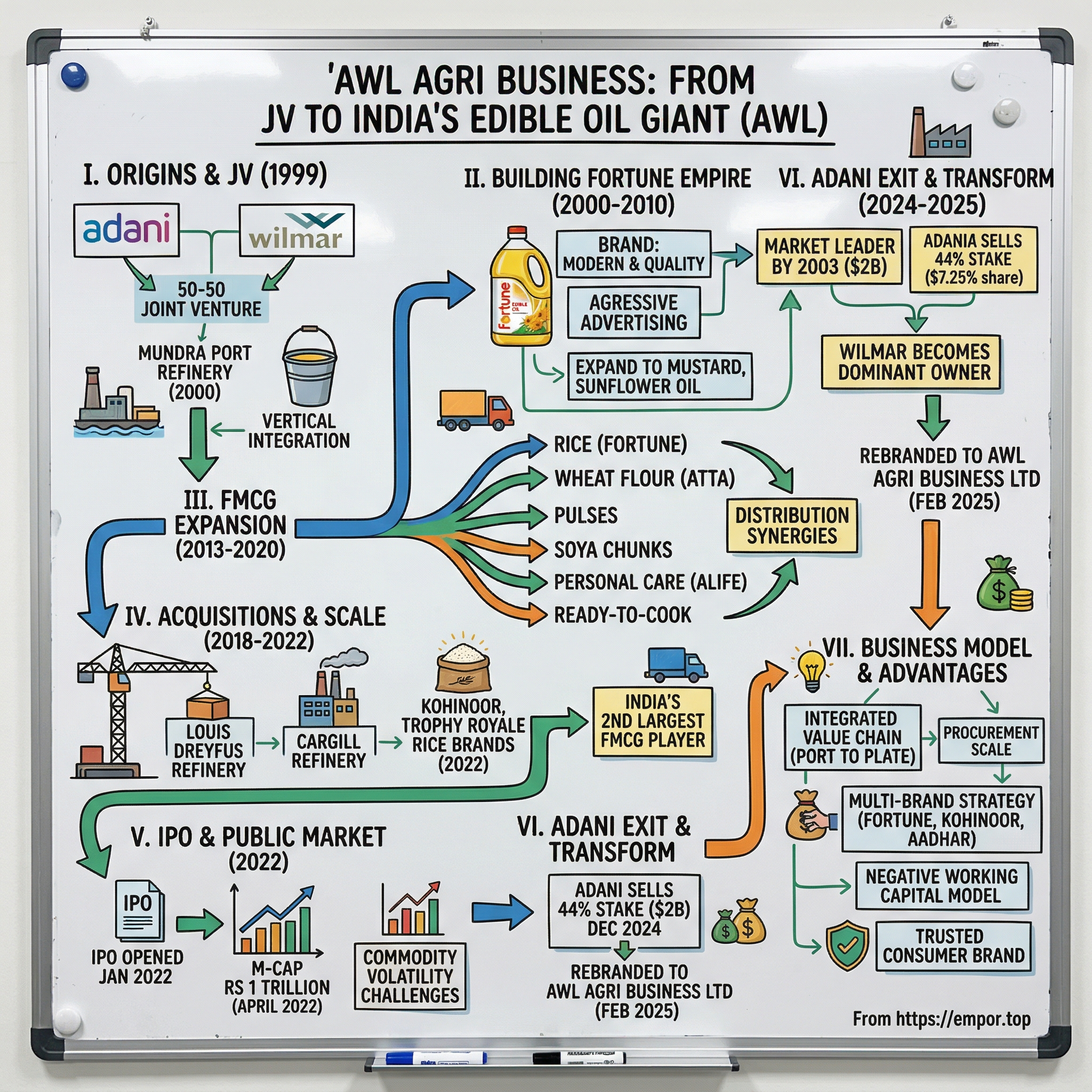
AWL Agri Business: From Adani-Wilmar Joint Venture to Fortune's Bet on Indian Food
I. Introduction & Episode Roadmap
On a Friday in late November 2025, a block of shares changed hands on the National Stock Exchange that ended a 26-year corporate relationship. Adani Commodities LLP sold its final 7% stake in AWL Agri Business at ₹275 a share, marking the Adani Group's complete exit from the cooking oil business.1 The buyer of most of that stake was the company's founding partner, Singapore-listed Wilmar International. The stock fell about 4% on the news.1
That was a surprising market reaction to a clean corporate resolution. Typically, when an infrastructure conglomerate known for balance-sheet complexity exits a consumer business to hand control to a focused operator, investors cheer. Here, they sold. By August 2026, the shares trade around ₹200 — below the ₹230 listing price from February 2022, and well below the ₹275 to ₹305 range at which Wilmar and institutional buyers acquired control.23 The market's reaction reflects deeper skepticism.
AWL Agri Business Limited is one of India's largest packaged-goods companies by revenue. For the fiscal year ending March 2026, it reported revenue of ₹74,731 crore (roughly $8.5 billion) on sales volumes of 6.8 million tonnes.4 Its flagship brand, Fortune, is India's largest edible oil brand. The company estimates Fortune reaches more than 135 million households — about one in three Indian families — through a distribution network of 2.6 million retail outlets.5 In the domestic edible oil sector, AWL held a market-leading 19% share as of FY24, with top positions in soybean, mustard, and rice bran oil.[^6]
Yet on that ₹74,731 crore in revenue, the company generated ₹1,045 crore in net profit — a thin net margin of 1.4% — and a return on equity of roughly 10.7%.46 These figures reflect the economics of a commodity refiner and distributor rather than a high-margin consumer staples enterprise.
The central narrative of AWL revolves around an unresolved tension. Built to import crude palm, soy, and sunflower oil from Indonesian and Argentine ports, refine it in India, and distribute it at high volume on paper-thin spreads, AWL has spent nearly a decade trying to reframe itself as a branded food and Fast-Moving Consumer Goods (FMCG) company deserving higher valuation multiples. While its progress in packaged food is real, its profit and loss statement shows that commodity refining still dominates the business.
Compounding this transition is an unprecedented governance shift for a major Indian consumer firm: over 11 months, a 50/50 joint venture between an Indian infrastructure group and a Singaporean agribusiness became a majority-owned subsidiary of the Singaporean partner. With the Indian partner departed, the company renamed, and its long-serving chief executive transitioned to a new role, the critical question is whether operational strategy will change alongside the corporate identity.
This analysis examines the initial logic of the joint venture, the port-based refining network constructed between 2000 and 2018, the acquisition strategy intended to drive the food pivot, the January 2022 IPO, the staged Adani exit across 2024 and 2025, current segment economics, the import-duty policies that heavily influence quarterly earnings, and the long-term investment case.
The narrative begins with two chairmen, a breakfast, and a port.
 Subscribe on LinkedIn
II. Origins: The 1999 Joint Venture
Late in 1998, the heads of two very different businesses sat down to breakfast. On one side was the Adani Group of Ahmedabad, then primarily a commodity trading house with an ambitious, half-built private port at Mundra on the Gujarat coast. On the other was Wilmar, a Singapore-based agribusiness trader founded in 1991 by Kuok Khoon Hong and Indonesian palm oil merchant Martua Sitorus.7 According to Angshu Mallick — who joined the venture at its inception and ran it for the next twenty-six years — the two chairmen realized over that meal how neatly their assets fit together: Wilmar had palm oil production and processing expertise; Adani had a port.8
The alignment was not merely conceptual. India was, and remains, structurally short of cooking oil, importing roughly two-thirds of what it consumes.9 Crude palm oil arrives by ship from Indonesia and Malaysia; crude soybean oil from Argentina and Brazil; sunflower oil from the Black Sea region. Controlling the discharge point for those vessels unlocks the cheapest link in a long supply chain. A refinery situated directly on a deepwater jetty avoids inland trucking and rail expenses while eliminating double-handling. In a business where operating margins are measured in a few thousand rupees per tonne on product selling for tens of thousands, that logistics differential is not a rounding error. It is the business model.
Kuok Khoon Hong brought the supply side. A nephew of Malaysian tycoon Robert Kuok, he built Wilmar from a five-employee trading company with S$100,000 of paid-up capital into one of the world's largest palm oil plantation owners and processors, spanning operations from Indonesia and Malaysia to Uganda, Ghana, and Nigeria.710 He is routinely described in the trade press as the dominant figure in global palm oil.10 What he offered the Indian venture was global sourcing scale — the ability to buy crude oil at volume pricing — alongside refining technology and the risk-management discipline of a firm reliant on commodity spreads. (Sitorus left the Wilmar group in 2018; Kuok has remained its controlling figure.7)
Structured as an equal partnership, the joint venture launched the Fortune brand into an overwhelmingly unbranded market. Indian consumers traditionally bought cooking oil loose, ladled from bulk tins at neighborhood kirana stores into brought containers. Quality was unverifiable, adulteration was widespread, and consumers had no recourse. Fortune's proposition was simple yet transformative: a sealed pouch, consistent quality, and a trusted brand name.
Beyond the origin story lies a fundamental structural reality. For twenty-six years, the company's identity, governance, and strategic direction were shaped by its equal 50/50 partnership. Neither founder could consolidate the entity or unilaterally redeploy its capital. Board representation remained balanced, and related-party sourcing from Wilmar operated, at least formally, as arm's-length transactions between equal shareholders.
With the partnership now dissolved, every one of those structural constraints has been removed. The question for investors is whether twenty-six years of operating history under joint control offers a reliable guide for how the company will perform under single-owner direction.
III. Scaling the Core: Refineries, Distribution, Brand (2000–2018)
Consider the physical scale of the business as it took shape by the middle of the 2010s. A vessel berths at Mundra, where crude palm oil is pumped directly into storage tanks at what the company describes as India's largest port-based edible oil refinery.5 The crude oil is refined, bleached, deodorised, packed into one-litre pouches and 15-litre jerry cans, and loaded onto trucks. Those trucks travel to a network of regional depots — with the company operating 118 stock points positioned so that a depot sits roughly every 250 kilometres across the country.5 From those stock points, products move through more than 10,000 distributors and sub-distributors to reach a retail network that today numbers around 2.6 million outlets.5
There is nothing glamorous about this operation. It is fundamentally a high-volume logistics engine with a consumer brand attached to the front. Yet two core structural features emerged during this growth phase that analysts would later identify as the company's competitive moat.
The first was the coastal refining position. Inland refiners must absorb domestic freight costs on imported crude oil; a coastal refiner avoids inland transport entirely on raw materials. In a category where operating performance hinges on the gross spread between crude imports and packaged output, saving a few hundred rupees per tonne compounds into substantial profit across multi-million-tonne volumes.
AWL expanded this footprint through targeted asset acquisitions rather than relying solely on greenfield builds. In June 2017, it agreed to buy the Haldia refining facility of Gujarat-based Gokul Refoils & Solvent for ₹290 crore in cash, completing the transaction that October; the unit had generated roughly ₹1,684 crore in revenue for the fiscal year ending March 2017.11 Paying less than 20% of annual sales for an operational refinery on the eastern seaboard established a clear pattern. AWL followed with additional capacity deals: an edible oil refinery in Paradip from Cargill India in 2018, a rice processing plant in Ferozepur from Ferozepur Foods that same year, and a refinery in Nellore from Louis Dreyfus in 2019.12 These acquisitions bought refining volume and geographical reach in an industry consolidating from a fragmented base. The modest purchase prices also indicated that sellers were eager to exit low-margin pass-through assets. Today, the company operates nearly 100 manufacturing units, anchored by what it calls India's largest integrated food complex at Gohana in Haryana.5
The second feature was the depot-and-distributor network, which laid the foundation for AWL's subsequent strategic pivot. Once a truck is routinely dispatched to a regional depot, and once a local distributor stocks Fortune cooking oil across hundreds of kirana stores, the marginal cost of adding adjacent packaged staples to that route is minimal. Products such as wheat flour, rice, besan, soya chunks, and sugar could piggyback on the established oil distribution system. This approach mirrored how global beverage and consumer goods companies leverage anchor distribution routes to launch secondary categories. Angshu Mallick, drawing on his early career at the Gujarat Cooperative Milk Marketing Federation (Amul), built distribution partnerships designed for longevity, with many key distributors remaining with the company for over two decades.8
By 2018, AWL had built an extensive physical platform and established Fortune as a leading market brand. However, that scale did not generate high profitability. In the fiscal year ending March 2019, revenue reached ₹28,797 crore, but net profit stood at ₹376 crore — reflecting a net margin of roughly 1.3%.6 Working capital demands remained heavy, as refining imported commodities required financing months of inventory in transit and storage, resulting in modest return metrics.
This performance illustrated a key lesson: market leadership in a commoditised category does not automatically grant pricing power. Fortune had won the branding race in a previously unbranded market, but the reward was volume dominance rather than expanded profit margins. Management's response, beginning around 2018, was to deploy capital into higher-margin packaged food categories where brand equity could yield superior economics.
IV. The Diversification & Acquisition Playbook (2018–2022)
A company's true strategic priorities are best revealed by where it allocates capital. Between 2018 and 2022, AWL initiated a series of transactions intended to shift its identity from a commodity refiner into a branded packaged-foods enterprise. In May 2022, it announced the acquisition of the Kohinoor basmati rice brand from McCormick Switzerland GmbH, along with the Charminar and Trophy brands and the Kohinoor ready-to-cook and ready-to-eat portfolio in India.13 The deal provided AWL with an established, premium basmati brand to complement its existing Fortune rice line.
The transaction terms underscored the modest pricing of the acquired assets. The three brands were reported to be valued at approximately ₹115 crore against combined annual sales of roughly ₹300 crore — representing a purchase price of under 0.4 times annual revenue.13
This valuation stood in sharp contrast to broader deal metrics across the Indian packaged-food sector. In January 2024, Tata Consumer Products agreed to acquire Capital Foods — maker of Ching's Secret and Smith & Jones — for ₹5,100 crore against estimated fiscal 2024 revenue of ₹750 crore to ₹770 crore, a multiple of roughly 6.6 to 6.8 times sales.14 Similarly, AWL's acquisition of GD Foods, owner of the Tops brand of sauces and convenience products, was struck at an enterprise value of ₹603 crore against approximately ₹400 crore in revenue — about 1.5 times sales — with management noting on an FY25 earnings call that the business carried gross margins above 50%.15
The low multiple paid for Kohinoor reflects a dual reality. On one hand, it demonstrated capital discipline, allowing AWL to avoid overpaying for brand assets in a market where aggressive deal valuations frequently erode shareholder value. On the other hand, compressed acquisition multiples often reflect underlying brand fatigue. A legacy global spice company like McCormick surrendered Kohinoor at under half a year's sales because the brand was losing momentum. The gap between 0.4 times sales and nearly 7 times sales was not merely a function of negotiation; it signaled a structural difference in asset quality and growth trajectory.
Subsequent operating performance provides evidence for both interpretations. Kohinoor has expanded, helping drive a 40% year-over-year revenue increase in the company's rice portfolio for the June 2026 quarter, with management identifying both Kohinoor and Fortune as double-digit growth drivers.1617 Yet basmati remains a highly competitive market dominated by established specialists. AWL's basmati market share reached 7.7% in the September 2025 quarter, up from 7.3% — steady progress, but far from category dominance.18 Furthermore, the broader Food & FMCG division generated a segment return on capital employed of roughly 6% in the June 2026 quarter, well below management's stated long-term target of 20% to 25% or higher.17 Four years into the strategic pivot, the branded-food platform continues to generate lower returns on capital than the underlying commodity operations it was designed to diversify away from.
This divergence highlights an enduring identity crisis that continues to shape AWL's market valuation: is the company a branded food enterprise burdened by a large refining division, or a commodity edible oil processor with a secondary food portfolio? In the June 2026 quarter, edible oils generated ₹15,465 crore in revenue, compared to ₹1,726 crore for Food & FMCG and ₹2,857 crore for Industry Essentials.17 Edible oils still account for roughly 77% of total sales. The persistent gap between this fundamental product mix and management's FMCG narrative remains a central driver of the stock's valuation discount.
That disconnect was never more evident than on the day AWL went public.
V. Going Public: The 2022 IPO
In early August 2021, Adani Wilmar filed its draft red herring prospectus with the Securities and Exchange Board of India (SEBI), seeking ₹4,500 crore entirely through a fresh issue with no selling shareholders.19 Within three weeks, the regulator placed the offer in abeyance. SEBI disclosed no official reason, but contemporary press reports attributed the hold to an ongoing investigation into flagship entity Adani Enterprises, under regulations that permit freezing approvals for related entities for up to 135 days.20 Consequently, the cooking oil business had its access to public capital delayed by regulatory scrutiny involving a separate group entity sharing a promoter. When the offer launched in January 2022, the issue size was reduced by 20% to ₹3,600 crore, within a price band of ₹218 to ₹230 per share.2122 The offer opened on January 27 and closed on January 31, 2022, subscribed 17.4 times on strong high-net-worth demand. It priced at the upper ceiling of ₹230, raising ₹3,600 crore in what was then the largest primary issue brought to market by the Adani Group.233
Marketing surrounding the listing framed AWL as India's second-largest Fast-Moving Consumer Goods (FMCG) company by revenue, behind only Hindustan Unilever. While arithmetically defensible based on top-line revenue, that comparison was economically misleading. FMCG revenue rankings carry weight because standard consumer staples deliver gross margins in the 30% to 40% range, double-digit EBITDA margins, low capital intensity, and pricing power that holds through input-cost cycles. AWL's revenue, by contrast, remained overwhelmingly reliant on edible oil—a high-volume category where retail prices track raw material import costs with a lag of a few weeks, operating more as a commodity spread business than a branded enterprise.
Public markets quickly recognized the distinction. The stock listed on February 8, 2022, at a discount to its issue price—an unusual debut for an offering subscribed over 17 times—before rebounding 8% intraday.24 A period of intense volatility followed: the stock reached a record high within weeks before undergoing a 25% decline by late February. In January 2023, following the publication of the Hindenburg Research report on the Adani Group, AWL's shares fell approximately 15% across three sessions and 18.5% over four, triggering lower price limits.25
This sell-off highlighted a key structural dynamic. The Hindenburg allegations centered on accounting and governance across other Adani Group entities, not AWL's core operational business. AWL's refineries, transport fleets, and distribution networks continued operating normally, yet the stock fell as public shareholders priced in promoter-level governance risks. This reaction demonstrated a clear conglomerate overhang, which later formed a central argument for investors when the Adani Group eventually exited the venture.
Post-listing financial scrutiny focused on these structural realities. Analysts highlighted AWL's thin net margins, near-total pass-through of raw material costs, and return on equity well below traditional consumer staples peers. By October 2023, management reported to the market that second-quarter profitability was under pressure from falling edible oil prices—demonstrating that declining input costs can squeeze margins when high-cost inventory must be processed and sold at lower market prices.26
This valuation tension has persisted. Four and a half years after listing, the stock trades at a trailing price-to-earnings multiple in the low twenties.6 While reasonable in isolation, this multiple applies to a thin profit pool relative to total sales, as investors decline to accord the company the premium sales multiples typical of branded consumer staples. Public markets have consistently valued AWL according to its commodity-driven financial results rather than its FMCG branding.
This persistent valuation discount set the stage for a structural realignment of the company's quarter-century-old ownership framework.
VI. The Adani Exit: From Joint Venture to Wilmar Subsidiary (2023–2025)
Initial indications of an ownership restructuring surfaced in November 2023, when trade reports indicated that ITC—the consumer conglomerate that had exited edible oil two decades earlier by selling ITC Agro Tech to ConAgra Foods—was considering a re-entry by acquiring Adani's roughly 44% stake, then valued in press reports at $2.5 billion to $3 billion.27 Reports also noted that Adani was holding discussions with several potential buyers, including Wilmar, multinational consumer goods firms, and financial investors such as GQG Partners and the Qatar Investment Authority.27 Neither party confirmed the discussions, and no transaction with ITC materialized.
Two key analytical insights emerged from these unconsummated talks. First, an established branded consumer goods operator evaluated the asset but elected not to purchase it—challenging the assertion that AWL's distribution network represents an underappreciated consumer staples franchise. Second, the price trajectory indicated shifting expectations: while Adani initially sought $2.5 billion to $3 billion for its 44% holding in late 2023, the total proceeds realized across the entire staged exit amounted to ₹15,707 crore (roughly $1.8 billion).1 The final valuation fell significantly short of initial target expectations.
The formal divestment process launched on December 30, 2024, when Adani Enterprises announced plans to exit its entire stake.2829 The transaction was structured in two components. The first was an Offer for Sale (OFS) to public investors designed to address regulatory compliance: with Adani and Wilmar jointly holding nearly 88% of the company, AWL exceeded India's maximum promoter holding limit and faced a statutory deadline to reduce promoter ownership to 75%.30 The second component involved a negotiated sale to Wilmar for the remaining position—up to 31.06%—at a price capped at ₹305 per share, with the final volume contingent on market absorption during the OFS.31
When the OFS opened on January 10, 2025, at a floor price of ₹275 per share, secondary market reception proved subdued.31 The stock declined to its lowest point since February 2022, trading below the floor price.32 Adani ultimately sold a 13.5% stake through the offering, generating ₹4,850 crore.33 The execution demonstrated market resistance to absorbing large volumes at the initial promoter valuation targets.
The remaining divestment unfolded across sequential tranches throughout 2025. In July, Adani Enterprises and Wilmar finalized terms for Wilmar's Singapore-based subsidiary, Lence Pte. Ltd., to acquire up to 20% at ₹275 per share—a ₹7,150 crore transaction requiring approval from the Competition Commission of India.34 Adani separately sold a 10.42% stake into the open market across eleven tranches. On November 11, 2025, Wilmar announced it would acquire a 13% stake for approximately $526.5 million,35 completing the purchase of 168,958,219 shares on November 19 to increase its indirect stake to 56.94% and establish AWL as a majority-owned subsidiary.36 The original shareholders' agreement governing the joint venture was formally terminated simultaneously.37 On November 20, 2025, Adani completed its exit by selling its final 7% stake through a block trade to domestic mutual funds and foreign institutional investors at ₹275 per share.1
Parallel to the equity restructuring, the company altered its corporate identity. In February 2025, shareholders approved changing the corporate name from Adani Wilmar Limited to AWL Agri Business Limited.38 While the Adani prefix was removed from corporate filings and exchange disclosures, the flagship consumer brand, Fortune, remained entirely unchanged—underscoring that commercial brand equity resides with the consumer product rather than the corporate holding entity.
Governance changes culminated in an executive leadership transition announced on November 3, 2025. AWL disclosed that Shrikant Kanhere, previously Deputy CEO and Chief Financial Officer, was appointed Managing Director and Chief Executive Officer for a three-year term, while Angshu Mallick—who had served as CEO since 1999—was redesignated Executive Deputy Chairman through March 31, 2027.3940 Pankaj Goyal assumed the interim CFO role before being confirmed as Chief Financial Officer effective July 31, 2026.40
Evaluating this transition requires distinguishing structural strategic shifts from operational continuity.
The principal structural shift involves governance and decision-making rights. Transitioning from a 50/50 joint venture bound by shareholder consent to a 56.94%-owned subsidiary consolidates control with Wilmar. The Singaporean parent can consolidate financial results, dictate capital allocation, and establish strategic priorities without requiring joint-venture consensus. Additionally, the departure of Adani nominee directors removes the promoter-level governance overhang that previously affected share price performance during group-wide market stress.
Conversely, operational leadership remains largely continuous. Kanhere has served in senior executive roles at the firm since 2013, while Mallick continues to provide strategic guidance on the board. The company's core operational infrastructure—including distributor agreements, regional depots, processing refineries, and product portfolio architecture—remains intact under the existing executive team.
However, the ownership consolidation introduces a distinct governance consideration regarding related-party transactions. On its June 2026 earnings call, management stated that approximately one-third of AWL's edible oil requirements are sourced directly from Wilmar, describing the arrangement as operating on arm's-length terms enhanced by access to Wilmar's global market intelligence and research capabilities.16 Under the prior equal joint-venture structure, Adani's equal equity stake provided an internal check on procurement pricing from Wilmar. With Wilmar now holding majority control and minority public shareholders owning roughly 43% of the equity, transfer pricing oversight on a major component of raw material input costs relies on independent board governance rather than balanced shareholder interests.
Market valuation following the ownership transition highlights an ongoing divergence between institutional transaction prices and public trading levels. While Wilmar and institutional investors acquired shares at prices ranging from ₹275 to ₹305 during the 2025 restructuring, the stock trades near ₹200 in August 2026.2 This spread indicates that equity markets remain cautious, weighing whether strategic controlling buyers paid a premium for long-term operational control or whether public markets are discounting an enterprise that has eliminated its dual-promoter complexity. Assessing these competing views requires evaluating the company's underlying segment profitability and operating economics.
VII. Inside the Business Today: Segments, Industry Structure, Competitive Position
Consider the three months ending June 2026, the quarter management presents as proof of its strategic transition. AWL reported revenue of ₹20,048 crore, up 18%; normalized EBITDA of ₹693 crore, up 34%; profit before tax of ₹478 crore, up 51%; and profit after tax of ₹351 crore, up 48%, on a 7% expansion in volume to 1.7 million tonnes.1741 The stock rose on the announcement.41 Chief Executive Shrikant Kanhere framed the performance in the language he has maintained since taking office, asserting that AWL had consciously transformed from predominantly an edible oil refiner into a diversified food and FMCG company.16
A closer examination of the product mix, however, reveals a more nuanced financial reality.
The three segments, honestly sized
Edible Oils generated ₹15,465 crore of the ₹20,048 crore quarter top line—roughly 77%. While segment revenue grew 15%, volume expanded by just 2%, meaning higher prices drove the remainder of the growth.17 The real catalyst was margin expansion: EBITDA per tonne in oils reached ₹5,030, a 30% increase year over year.17 That figure warrants scrutiny, as management's own full-year guidance targets ₹4,000 to ₹4,500 per tonne.16 In short, the standout quarter resulted from operating 12% to 25% above what management considers a sustainable rate. Viewed through this lens, the 48% jump in net profit reflects a favorable cyclical window rather than a permanent structural shift in the core business.
Food & FMCG generated ₹1,726 crore—about 8.6% of revenue—up 22% on an 18% volume increase, delivering an EBITDA margin of 6%, or ₹104 crore in segment EBITDA.17 Within the category, rice revenue rose 40%, while the Tops sauces and convenience line grew 23%.16 Chief Financial Officer Pankaj Goyal emphasized to analysts that Food and FMCG remains the company's highest priority for capital allocation and management focus.16
Industry Essentials—comprising oleochemicals, castor derivatives, specialty chemicals, and de-oiled cake—delivered ₹2,857 crore in revenue, up 28%, with EBITDA surging 47% on a 13% gain in volume.17 This business-to-business division holds dominant domestic market positions, as AWL ranks as India's largest castor oil manufacturer and its leading processor and exporter of oleochemicals and palm derivatives.5 Management noted that specialty chemicals account for roughly 40% of segment revenue, driven by both organic expansion and targeted deals, such as the July 2024 agreement to acquire a 67% stake in Gujarat surfactant producer Omkar Chemical Industries at an enterprise value of ₹56.25 crore—a move explicitly intended to advance downstream oleochemical derivatives alongside Wilmar, the world's largest oleochemical producer.1642 That strategic alignment showed Wilmar's industrial influence shaping AWL's operations well before the Singaporean firm acquired majority control. Still, at roughly 14% of total revenue, the segment remains secondary to the core investment narrative.
Myth vs. reality: the "FMCG transformation"
The prevailing market consensus contends that AWL is executing a steady transition from low-margin commodity oil refining toward higher-margin branded packaged food, justifying a valuation re-rating as the mix shifts. A review of disclosed execution tests that thesis against management's own benchmark commitments.
During the fiscal 2025 earnings call in April 2025, management projected that Food & FMCG revenue would reach ₹10,000 crore by fiscal 2027, after crossing ₹6,000 crore in fiscal 2025.15
Subsequent performance fell short of that trajectory. In fiscal 2026, Food & FMCG revenue reached ₹6,473 crore, representing 9% annual growth.4 Quarterly performance within that year proved uneven: revenue in the June 2025 quarter grew just 4% to ₹1,414 crore,43 while September 2025 quarter segment volumes contracted 10% year over year, which management attributed to intense regional competition.18 Growth recovered in early fiscal 2027 to 22%—off a base of roughly ₹6,500 crore—against updated annual management guidance of 18% to 20% revenue growth.16 Compounding that revised guidance forward puts fiscal 2027 Food & FMCG revenue at approximately ₹7,700 crore. As a result, the segment will miss the ₹10,000 crore target set two years earlier by nearly a quarter, a reality implicit in management's revised outlook.
This shortfall does not mean the transformation is illusory. Food & FMCG is expanding faster than the core oil business, gaining retail shelf space, and generating a 6% EBITDA margin in a category previously expected to remain EBITDA-neutral during an extended investment phase.15 Rather, the transition is progressing more slowly than management forecasted and remains too small to alter consolidated earnings power. Accounting for 8.6% of top-line revenue, a segment growing at 20% adds less than two percentage points to overall group growth. Transforming AWL's economic profile requires Food & FMCG to represent a fundamentally larger share of total sales—a shift that will take many years at current expansion rates, far longer than implied by management's long-term targets.
Management's target of reaching ₹100,000 crore in revenue and ₹4,000 crore in EBITDA by 2030 illustrates this reality.16 Generating ₹4,000 crore in EBITDA on ₹100,000 crore in sales yields an EBITDA margin of 4%. That target structure mirrors AWL's current operational profile rather than a high-margin consumer staples business; in fiscal 2026, the company generated ₹2,343 crore in operational EBITDA on revenue of ₹74,731 crore, representing a 3.1% margin.4 Taken at face value, management's long-range guidance outlines a larger iteration of its existing low-margin model featuring modest operational efficiencies, rather than an economic re-rating into branded consumer staples.
The distribution moat, tested
The cornerstone of AWL's competitive thesis rests on its distribution infrastructure: total retail reach of 2.6 million outlets, direct coverage approaching 9.7 lakh stores—expanding by roughly 5,000 outlets per quarter—more than 63,000 covered rural towns, and a network of 118 regional depots.175 This scale generates clear unit-cost advantages by spreading fixed logistics costs across massive trade volumes, reinforced by entrenched retail relationships.
Commercial evidence supports this distribution advantage. AWL maintains strong traction across modern trade and digital channels. In the June 2026 quarter, quick-commerce volumes expanded 56% while alternate channels grew 27%. On digital platforms, the company claims market shares of 46% in soya nuggets, 29% in edible oil, 28% in besan, 21% in maida, and 17% in sugar.17 Simultaneously, branded export volumes rose 86% and hotel, restaurant, and catering (HoReCa) channel sales grew 31%.17
However, three operational metrics challenge the strength of this distribution moat.
First, profitability metrics show limited pricing power. If distribution scale and brand equity conferred genuine pricing power, gross margins would expand over time. Instead, key performance indicators—such as gross margins near ₹11,000 per tonne and EBITDA around ₹3,500 per tonne recorded in the September 2025 quarter—remain consistent with historical levels.18 Management explicitly directs analysts to evaluate per-tonne spreads rather than percentage margins due to commodity price volatility. Between fiscal 2019 and fiscal 2026, revenue grew from ₹28,797 crore to ₹74,731 crore—a 2.6-fold increase—while net profit rose from ₹376 crore to ₹1,045 crore, a 2.8-fold gain.6 Because profit grew in line with top-line sales, seven years of network expansion and brand building produced minimal operating leverage, demonstrating that scale protects volume rather than unit margins.
Second, market share remains vulnerable at lower price points. In the September 2025 quarter, management disclosed a 50 basis point market share loss resulting from duty-free edible oil imports from Nepal under the South Asian Free Trade Area agreement—an arbitrage window that management acknowledged government policy cannot easily eliminate, creating persistent pressure in border states.18 Similarly, management reported a 1.3% market share decline in palm oil during fiscal 2025 as elevated raw material prices prompted price-sensitive consumers to trade down.15 A brand possessing true pricing power does not surrender 130 basis points of market share in its primary category when raw material costs rise.
Third, the 10% volume contraction in Food & FMCG during the September 2025 quarter due to regional competition tests the cross-selling model.18 The central thesis of brand extension assumes that consumer trust in Fortune cooking oil transfers directly to wheat flour, rice, and besan, with shared distribution lowering route-to-market costs. When regional competitors successfully capture market share in those adjacent categories, logistics efficiency functions as an operational cost benefit rather than an insurmountable competitive barrier.
In summary, AWL's distribution network provides a substantial cost and reach advantage, securing its position as a national leader and supporting growth in emerging channels like quick commerce. However, it does not confer structural pricing power. Sustained expansion in per-tonne EBITDA during periods of stable or declining commodity prices, alongside an increase in Food & FMCG return on capital employed from 6% toward management's 20% target, would be required to alter this assessment.17
Industry structure
Applying Porter's Five Forces framework clarifies the structural dynamics of the edible oil and packaged food market.
Supplier power is moderate to high. India imports approximately two-thirds of its cooking oil requirements,9 with palm oil sourced primarily from Indonesia and Malaysia, both of which frequently adjust export duties and domestic supply mandates. AWL mitigates this exposure through its strategic procurement arrangement with Wilmar, securing volume access and trade intelligence while creating a concentrated related-party supply structure.
Buyer power remains high. End consumers demonstrate acute price sensitivity across purchasing channels, kirana retailers exhibit limited brand loyalty, and modern trade and quick-commerce operators maintain substantial bargaining power alongside expanding private-label offerings.
Threat of substitutes is low for cooking oil as an essential commodity, but high within product categories. Consumers readily shift among palm, soybean, sunflower, mustard, and rice bran oil based on relative pricing, explaining why palm oil cost spikes directly impact market share.
Barriers to entry are moderate. While refining assets require significant capital, distribution presents the primary barrier—though competitors such as Patanjali, Emami Agrotech, and Bunge India (Sundrop) have established national footprints. The primary growth opportunity for branded refiners lies in converting unbranded loose oil consumers. The September 2025 tax reform, which simplified goods and services tax rates into 5% and 18% brackets while reducing taxes on packaged foods like ghee, provides a modest tailwind for market formalization.44
Outside India, international operations provide minor growth optionality. AWL operates two refineries in Bangladesh under the Rupchanda brand and exports to over 50 countries.5 In fiscal 2026, branded export revenue exceeded ₹450 crore, growing 70% year over year.4 While expanding rapidly, international sales represent under 1% of total revenue.
Ultimately, the primary driver of AWL's near-term earnings resides outside market competition, depending directly on trade policy choices enacted by the central government.
VIII. The Government's Hand on the Scale: Import Duty Policy & Margin Volatility
On September 14, 2024, the Government of India raised the basic customs duty on crude palm, crude soybean, and crude sunflower oil from zero to 20%, increasing the effective landed duty to about 27.5%. Simultaneously, basic duties on refined palm, sunflower, and soybean oil rose from 12.5% to 32.5%, creating an effective rate of roughly 35.75%.45 The stated policy goal was to support domestic oilseed farmers facing weak prices and assist soybean and rapeseed growers in achieving minimum support prices.45 Within days of the hike, government officials advised edible oil trade associations to hold maximum retail prices steady until existing inventory imported under the previous lower tariff rates was fully processed.46
This single policy intervention created immediate operational friction for refiners like AWL. Because the company maintains several weeks of crude oil inventory in transit and storage tanks, the replacement cost of that stock jumped by roughly 20 percentage points overnight, creating temporary book gains. However, government pressure to freeze consumer prices delayed the pass-through of higher costs. As duty-paid raw materials eventually flowed through the supply chain, retail prices increased and consumer purchase volumes softened. Furthermore, the widening spread between crude and refined import duties shifted trade arbitrage, altering the cost competitiveness of AWL's domestic refineries against imported refined oil.
Eight and a half months later, on May 30, 2025, the government reversed course by halving the basic duty on crude palm, soybean, and sunflower oil from 20% to 10%—lowering the effective duty to about 16.5%—in a direct effort to reduce retail cooking oil prices.47[^49] The reversal flipped the inventory equation: high-duty raw material acquired during the prior regime had to be processed and sold into a rapidly repricing, lower-duty market.
This regulatory policy cycle serves as the primary driver of AWL's quarterly profit volatility. Quarterly earnings depend heavily on the direction and timing of government duty adjustments—variables over which management has no control and against which financial markets provide no direct hedge. Unlike underlying commodity prices, tariff shifts reflect agricultural ministry policy decisions balancing domestic farmer incomes against retail food inflation.
The financial evidence clearly illustrates this policy-driven volatility. Fiscal 2025 proved exceptionally profitable, generating operational EBITDA above ₹2,700 crore—up 119% year over year—and net profit of ₹1,200 crore, delivered alongside record earnings in the edible oil segment.15 Fiscal 2026 subsequently absorbed the tariff unwind: although annual revenue expanded 17% to ₹74,731 crore, operational EBITDA contracted 6% to ₹2,343 crore and net profit dropped to ₹1,045 crore.46 Sequentially, the policy transition disrupted quarterly performance throughout fiscal 2026: net profit fell 24% to ₹238 crore in the June 2025 quarter despite a 21% top-line gain;43 net profit fell 21% to ₹245 crore in the September quarter as edible oil segment profit before tax dropped 55%;1848 and December quarter net profit declined to ₹269 crore from ₹411 crore in the prior-year period.49 Once inventory levels rebalanced, profitability rebounded rapidly: the March 2026 quarter registered 40% EBITDA growth and a 54% surge in net profit,450 followed by 48% net profit growth in the June 2026 quarter.17
In this operating model, top-line revenue acts as a commodity price index, while net profitability functions largely as a derivative of government trade policy.
Testing how management explains it
A central question for investors is whether management offers precise, quantified explanations when profit margins fall short, or attributes performance to generic commodity volatility. An analysis of quarterly earnings calls between June 2025 and June 2026 indicates a commendable level of operational transparency, albeit with a notable strategic caveat.
Management's operational disclosure has demonstrated meaningful specificity. On the September 2025 earnings call, leadership quantified market share losses from duty-free Nepal imports at roughly 50 basis points, identified the structural trade agreement constraints preventing regulatory intervention, specified the affected border state geographies, and explicitly cautioned that the headwind would persist.18 Similarly, during the fiscal 2025 call, management disclosed a 1.3% market share loss in palm oil driven by consumer price sensitivity, outlining a recovery strategy focused on value-tier flanker brands and retail expansion to recapture 20 to 30 basis points.15 On the same call, management directly attributed lower fourth-quarter margins to inventory losses and internal aggressive pricing decisions—a rare level of candid reporting for listed consumer companies.15
This analytical discipline extends to management's preferred reporting metrics. Across multiple calls, executives have instructed analysts to evaluate per-tonne gross margins and per-tonne EBITDA rather than percentage margins, arguing that percentage metrics are distorted by underlying raw material price fluctuations.18 This framing is economically sound and presents a more rigorous benchmark for evaluating operating performance.
The primary qualification to this transparency lies in the gap between operational candor and long-term strategic target-setting. The same management team that details quarterly margin mechanics set a ₹10,000 crore Food & FMCG revenue target for fiscal 2027 that appears out of reach by a wide margin.15 Furthermore, leadership continues to promote a ₹100,000 crore revenue goal for 2030 paired with an EBITDA target that implies no structural margin expansion whatsoever.16 A clear pattern emerges: operational reporting remains reliable on near-term mechanics, but strategic guidance trends toward promotional long-term targets. For investors, this offers a clear practical guideline: rely on quarterly operational disclosures, but apply a discount to long-range projections.
Government import policy is not a secondary regulatory risk; it is the central determinant of corporate profitability. Tariff decisions remain entirely beyond management's control, and a Food & FMCG division accounting for just 8.6% of revenue cannot insulate consolidated earnings in the medium term. Any investment framework for AWL Agri Business must evaluate leadership through this structural reality.
IX. Current Management, Ownership & Capital Allocation
The company's shareholding register reflects the scale of its ownership restructuring over the past two years. In March 2024, the joint promoters held 87.88% of the equity, while foreign institutions owned 0.77%, domestic institutions held 0.29%, and public shareholders held 11.08%. By June 2026, with Wilmar operating as sole promoter, promoter ownership fell to 56.94%, while foreign institutional holding rose to 21.10%, domestic institutional holding increased to 8.46%, and public ownership stood at 12.91%.6 Over roughly 27 months, a 31-percentage-point equity stake transferred from a dual-promoter framework into the hands of institutional investors, driven primarily by foreign inflows.
Wilmar holds its stake through Lence Pte. Ltd., with ultimate control resting with Kuok Khoon Hong.3610 As a result, AWL's strategic direction is now determined by a Singapore-listed agribusiness whose primary capabilities lie in large-scale oilseed crushing, refining, and global trading rather than branded consumer packaged goods—a structural reality that frames discussions of its ongoing FMCG transformation.
The chair
The non-executive Chairman is Dorab Erach Mistry, who assumed the position on November 4, 2022, after joining the board as an independent director in June 2021, and was proposed for a second five-year term starting in June 2026.51 Mistry brings an unconventional background to the role. Rather than a traditional consumer goods executive or commercial banker, he is a long-serving director of Godrej International and a prominent analyst of global vegetable oil markets.52 Appointing a vegetable oil market specialist aligns with an enterprise whose earnings depend heavily on palm oil price cycles and import duty shifts. However, whether market analysis expertise translates into guiding a branded consumer-goods transformation remains an open question for institutional investors.
The chief executive
Managing Director and Chief Executive Officer Shrikant Kanhere, a chartered accountant who joined the firm in 2013, served as Deputy CEO and CFO before assuming executive leadership.3940 His appointment signals operational continuity rather than a strategic pivot, with management maintaining existing targets through his initial quarters. Kanhere has reinforced the company's focus on Food & FMCG expansion while highlighting quick commerce as a structural shift in consumer buying behavior rather than a simple distribution channel.16 AWL's early entry into digital platforms is supported by its leading online market shares in soya nuggets, besan, and edible oils.17
Whether a finance-focused chief executive will alter capital allocation discipline remains an evolving test. Annual capital expenditure guidance stands at approximately ₹700 crore—an increase from the ₹500 crore to ₹600 crore of annual maintenance and debottlenecking spending under prior guidance—allocated across edible oil refining capacity, food processing conversions, and specialty chemical facilities.1615 Simultaneously, total borrowings decreased from ₹2,396 crore in March 2023 to ₹1,109 crore in March 2026, delivering balance-sheet deleveraging that mitigates working-capital exposure inherent in commodity imports.6 Capital allocation discipline was further reflected in the May 2026 transaction for the Madhur sugar brand. Rather than acquiring the asset outright, AWL executed supply, brand-licensing, and employee-transfer agreements with Shree Renuka Sugars, assuming marketing, logistics, and distribution responsibilities effective July 1, 2026, while Renuka retained brand ownership and manufacturing assets.53 Although commercial terms were undisclosed, management outlined an annual revenue target of ₹700 crore to ₹800 crore from the agreement.16
This asset-light arrangement allows the company to leverage its existing distribution routes for a low-margin commodity without incurring balance-sheet goodwill. At the same time, relying on licensing agreements underscores that the distribution infrastructure excels at moving high-volume staples efficiently, rather than creating structural pricing power for proprietary brands.
The first dividend
For fiscal 2026, the board recommended a maiden final dividend of ₹1 per share, which was paid in August 2026.454 Across approximately 130 crore shares and ₹1,045 crore in net profit, the distribution represents a payout ratio of roughly 12% and a dividend yield near 0.5%.6
Initiating a dividend after four years of public listing marks an intentional signal to a newly institutional shareholder base. However, a 12% payout ratio declared during a year of declining net profit does not yet constitute a formal capital-return framework. Assessing whether this dividend represents a permanent capital allocation policy will require observing payout consistency across future commodity cycles.
The alignment question
As of the latest reporting period, return on equity stood at approximately 10.7% and return on capital employed at 18.3%, with segment ROCE recorded at roughly 14% in Edible Oils, 15% in Industry Essentials, and 6% in Food & FMCG.617 While a double-digit return on equity is standard for a commodity processor, it trails traditional consumer staples benchmarks. Furthermore, segment disclosures indicate that consolidated return metrics are currently constrained by the Food & FMCG division, which remains in an intensive investment phase.
Executive equity alignment remains limited, as senior management holds no material direct equity in the business, tying incentive structures primarily to Wilmar's controlling interest. For public shareholders, this ownership structure presents distinct dynamics. Wilmar maintains a substantial financial commitment in the entity, aligning its interest with long-term equity performance. However, because Wilmar also supplies roughly one-third of AWL's raw material inputs, public shareholders rely on independent board oversight and transparent related-party reporting to safeguard minority interests now that the equal joint-venture monitoring mechanism has been dissolved.
X. Playbook: Business & Investing Lessons
Strip away the corporate specifics and AWL offers a set of transferable lessons that challenge conventional business wisdom.
Category leadership and pricing power are distinct, and the second does not automatically follow from the first. Fortune won the branding race in Indian edible oil comprehensively, reaching one in three households and securing the largest market share in the industry.5[^6] Yet seven years of market leadership produced profit expansion almost exactly in line with top-line growth.6 Brand leadership in a category where products are chemically identical across suppliers and raw materials are globally quoted commodities secures volume and retail shelf space. It does not grant the power to defend prices when raw material costs drop. Investors evaluating leading commodity brands must look closely at substitution elasticity within the category.
Infrastructure advantages are real and durable, but ultimately self-limiting. The Mundra refining setup gave AWL a genuine landed-cost advantage over inland refiners for years. However, in a pass-through commodity business, input-side savings flow to consumers over time as competitors establish their own coastal capacity and market pricing competes away the differential. The port facility remained an essential operational asset, but it ceased to function as a structural moat.
Distribution represents the most durable moat in Indian consumer staples — though it serves as a cost moat rather than a pricing moat. The distribution structure with the Madhur sugar brand illustrates this dynamic cleanly. AWL's most valuable asset proved more effective as a logistics service leveraged alongside an established sugar producer than as a vehicle for extracting premium prices on proprietary lines.53
Brand extension is a testable hypothesis, not an established fact. The assumption that Fortune's consumer trust in cooking oil carries over seamlessly to packaged rice, wheat flour, besan, and soya chunks has been tested since 2018. Operating metrics reveal a mixed record: a packaged food segment expanding faster than the core business with a 6% EBITDA margin and a 6% return on capital employed, but one that surrendered 10% of its volume in a recent quarter to regional competitors.1718 Brand halo effects are frequently assumed; rigorous evaluation requires measuring them against underlying segment returns.
Acquiring assets cheaply is distinct from creating value. The comparison between acquiring the Kohinoor portfolio at under 0.4 times sales and Tata Consumer's purchase of Capital Foods at roughly 6.6 times revenue highlights an important strategic lesson.1314 Both valuations reflected market realities. Rather than framing the outcome as simple capital discipline versus overpayment, transaction multiples in branded consumer goods reflect an asset's growth potential and margin profile. A low purchase price often represents a market consensus on limited structural momentum.
Joint ventures eventually reach resolution, requiring investors to re-underwrite the business model. For twenty-six years, AWL operated under a balanced governance equilibrium. The departure of its Indian co-promoter simultaneously eliminated a conglomerate valuation discount and shifted strategic risk directly to its controlling Singaporean parent. Investors evaluating joint-venture platforms must anticipate how operations will function when partner dynamics shift, as joint ventures rarely remain unchanged when single-owner control takes over.
An initial dividend provides a signal, not a policy. Recommending a dividend of ₹1 per share on ₹1,045 crore in net profit indicates that the board intends to signal capital discipline to public markets.4 Evaluating whether this distribution represents a permanent capital allocation framework requires observing payout consistency across future commodity cycles.
XI. Bull vs. Bear Case
Bull case
The bull thesis rests on four distinct pillars, each supported by specific operational evidence.
First, category leadership with extensive reach. AWL holds roughly 19% of the domestic edible oil market—the largest single position in India—with top positions in soybean, mustard, and rice bran oil, alongside a top-three stance in palm and sunflower oil.[^6] This processing platform is supported by an entrenched distribution network of 118 regional depots, over 10,000 distributors, 2.6 million retail outlets, and coverage across more than 63,000 rural towns—a physical reach that new entrants cannot easily duplicate.517
Second, governance simplification. The market volatility following the Hindenburg report demonstrated that AWL's equity previously carried a conglomerate discount unrelated to its core operations.25 That discount has largely dissolved with the exit of the Adani Group, leaving a focused global agribusiness as sole promoter. Institutional ownership expanded from under 1% to nearly 30% over 27 months, signaling growing institutional confidence under single-owner control.6
Third, accelerating expansion in packaged foods. In the June 2026 quarter, Food & FMCG revenue expanded 22% on an 18% volume gain—led by a 40% increase in rice sales—while management designated the segment as its primary capital allocation priority.1617 Digital and quick-commerce channels showed notable momentum, with quick-commerce volume up 56% and digital market shares reaching 29% in edible oil and 46% in soya nuggets, positioning the company well in rapidly growing consumer channels.17
Fourth, emerging capital discipline. Total borrowings fell by more than half between March 2023 and March 2026, the company adopted an asset-light licensing structure for the Madhur sugar partnership, management initiated a maiden dividend, and consolidated return on capital employed reached the high teens.653
Bear case
The bear counter-argument interprets the same underlying evidence through a more skeptical lens.
First, the valuation disconnect. Trading near ₹200 in August 2026, the stock remains below its ₹230 listing price and well beneath the ₹275 to ₹305 range at which Wilmar and institutional investors acquired control.2331 Although Wilmar invested at a substantial premium based on its long-term operational view, public markets continue to price the stock at a discount to controlling transaction levels.
Second, financial metrics show limited operating leverage or pricing power. Between fiscal 2019 and fiscal 2026, top-line revenue expanded 2.6 times while net profit grew 2.8 times—demonstrating that profit growth simply tracked volume rather than expanding unit margins.6 Furthermore, a 1.3% market share loss in palm oil during raw material price surges, alongside a 50-basis-point loss to duty-free Nepalese imports, highlights that consumers readily switch brands when prices change.1518
Third, quarterly profit stability remains heavily dependent on government policy. The September 2024 import tariff increase and subsequent May 2025 reduction shifted effective import duties from roughly 5.5% to 27.5% and back to 16.5% over twenty months.4547 Management has no financial mechanism to hedge against regulatory tariff changes, leaving quarterly earnings exposed to policy shifts.
Fourth, the branded packaged food transformation remains small relative to the total business. Food & FMCG accounts for just 8.6% of revenue while generating a segment return on capital employed of roughly 6%, and management's revised growth trajectory implies missing its earlier ₹10,000 crore revenue target for fiscal 2027 by nearly a quarter.171516 Moreover, management's own long-term guidance of ₹100,000 crore in sales and ₹4,000 crore in EBITDA for 2030 implies a 4% EBITDA margin—reflecting the economics of a high-volume distributor rather than a high-margin consumer staples enterprise.
Fifth, executive and governance changes are concentrated in a compressed timeframe. Over a twelve-month period, the company appointed a new Chief Executive Officer, confirmed a new Chief Financial Officer, transitioned to single-promoter ownership under Wilmar, and adopted a new corporate name. While early operational messaging has maintained continuity with prior guidance, leadership under the new governance structure has only a short operating track record.
The activist's questions
A rigorous institutional analysis highlights four critical governance and operational questions for the consolidated enterprise.
First, related-party procurement transparency. With approximately one-third of raw materials sourced directly from Wilmar, institutional investors require clear disclosure regarding pricing benchmarks and independent validation to ensure arm's-length terms now that equal joint-venture oversight no longer exists.16
Second, long-term ownership intentions. Wilmar holds a 56.94% controlling stake following the termination of the original joint-venture agreement.3637 Public shareholders must evaluate whether Wilmar intends to expand AWL as an independent, publicly listed Indian entity or eventually consolidate full ownership, particularly given the valuation gap between controlling transaction prices of ₹275 to ₹305 and public trading levels around ₹200.
Third, capital allocation hurdles in packaged food. The Food & FMCG division has absorbed capital and brand acquisitions since 2018 while generating a segment return on capital employed of 6%.17 Investors must monitor whether segment returns progress toward management's long-term targets of 20% to 25% or whether persistent low returns prompt a recalibration of capital deployment.
Fourth, reporting definitions for operational earnings. While segment disclosures and per-tonne metrics provide operational detail, the company presents normalized EBITDA alongside statutory metrics.17 In a business subject to substantial inventory repricing, evaluating the specific adjustments included in normalized figures remains essential for assessing underlying profitability.
The frameworks, briefly
Evaluating AWL through Hamilton Helmer's 7 Powers framework indicates that the company possesses clear scale economies in processing and distribution, alongside a partial cornered resource in Wilmar's global procurement network. However, it lacks network effects, counter-positioning, switching costs—given that consumers switch cooking oil brands with minimal friction—or true branding power in the form of a durable price premium. This limited set of competitive advantages aligns with a business earning a modest 10.7% return on equity rather than the premium returns of high-margin consumer brand owners.6
Under Michael Porter's competitive framework, the structural constraints facing AWL remain high buyer power and intense rivalry across easily substitutable commodities. In contrast to peers like Marico, which generates superior profit margins on smaller volumes by positioning brands like Saffola at the premium health-focused end of the market, AWL has pursued volume scale over gross margin expansion. While a volume-driven strategy secures market leadership, it delivers the financial profile of a commodity distributor rather than a high-margin consumer staples enterprise.
XII. Current Risk Radar
Import duty policy. Import duty policy remains the primary operational variable for the business.4547 The ongoing risk is symmetric and unpredictable: the central government historically raises tariffs to protect domestic farmer incomes and reduces them to curb consumer food inflation. Because both agrarian and consumer constituencies represent permanent political priorities, trade policy shifts will continue to trigger unhedged inventory volatility.
Commodity and supply-chain risk. In August 2026, management disclosed that the company had increased its edible oil inventory buffer from the standard 30 to 35 days up to 40 to 45 days to insulate operations from potential shipping disruptions tied to Middle East and Russia-Ukraine tensions.9 For an enterprise importing roughly two-thirds of its raw material requirements over long maritime routes, this buffer provides operational security. However, expanding inventory ties up working capital and heightens inventory loss exposure if global commodity prices decline while cargoes remain in transit. Although management stated that the margin impact remains manageable under prevailing price trends,9 holding expanded inventory represents an active trade-off where sudden price drops can compress quarterly earnings.
Competitive risk. Competitive pressure presents two distinct threats. First, value-tier competition from Patanjali and regional processors can squeeze volumes, as seen when Food & FMCG volumes contracted in the September 2025 quarter.18 Second, the category faces the potential entry of a well-capitalized conglomerate; ITC was linked to potential acquisition discussions in 2023 as part of its interest in branded commodities.27 Given ITC's financial resources and nationwide distribution infrastructure, a formal entry by a major peer could alter market dynamics.
Execution risk. Concurrent transitions across executive leadership—including the appointment of a new CEO and CFO—alongside the shift to single-promoter control coincide with an ongoing attempt to expand the packaged food division. The primary stabilizing factor is that the executive appointments represent internal promotions, preserving operational continuity.3940
Governance and related-party risk. With Wilmar consolidating majority control, governance oversight shifts from a balanced joint-venture structure to independent board monitoring of related-party transactions, particularly in raw material procurement.
Regulatory and compliance risk at the operating level. In August 2026, media reports highlighted a Food Safety and Standards Authority of India (FSSAI) adjudication order issued by a Goa District Magistrate regarding declared vitamin A and D levels in a sample of Fortune Fryola sunflower oil. AWL issued a regulatory filing on August 8, 2026, clarifying that it had not received a certified copy of the order, that the inquiry pertained to micronutrient fortification levels rather than food safety, that added vitamins naturally degrade over time and under varied storage conditions, and that management anticipated no material financial impact.55 While financially minor, the incident illustrates the operational compliance risks inherent in managing high-volume consumer staples, where recurring quality-control disputes can erode brand trust over time.
What is not a material risk here. Certain standard corporate risks remain limited. Refinancing risk is low following balance-sheet deleveraging,6 while technological disruption poses little threat to a core agricultural processing and refining enterprise. Identifying these factors emphasizes that AWL's risk profile is relatively short and concentrated around trade policy, input costs, and execution.
XIII. Epilogue & What to Watch
AWL Agri Business was built around a singular operational capability: moving imported vegetable oil from deepwater berths to Indian kitchens at industry-leading low costs, handling nearly seven million tonnes annually. The financial result of that operational scale is a 1.4% net margin and a 10.7% return on equity.46
For eight years, management has argued that the same transport routes, regional depots, and consumer brand can support higher-margin packaged food, driving a structural re-rating of the company's valuation multiple. Operating evidence over that period shows that while this transition is occurring, it is progressing slowly and has yet to materially alter consolidated financial results. Food & FMCG accounts for 8.6% of total revenue, generates a 6% return on segment capital, and expands at roughly 20% annually.17 The segment is on track to miss the fiscal 2027 revenue target established in 2025.15 Furthermore, management's long-range 2030 targets for revenue and EBITDA describe an expansion of the existing low-margin model rather than a structural shift into high-margin consumer staples.16
The departure of the Adani Group removes the promoter-level conglomerate discount, leaving a clear view of the core enterprise: a high-volume commodity processor and distributor controlled by Wilmar, with an attached, slowly compounding branded-food option. Whether the equity commands a premium hinges on the value assigned to that food option against ongoing import-duty policy exposure. Wilmar demonstrated its valuation stance by deploying capital directly at ₹275 to ₹305 per share, whereas public equity markets have priced the stock around ₹200 for eighteen months.
The three things that settle the argument
Food & FMCG revenue mix and segment ROCE. The critical metrics are the division's share of total revenue and its return on capital employed, rather than top-line growth rates off a modest 8.6% revenue base. The division currently generates roughly a 6% return on capital, well below management's long-term target of 20% to 25%.17 A genuine business mix shift requires simultaneous expansion in both revenue share and segment returns.
Edible oil EBITDA per metric tonne. Evaluating per-tonne EBITDA isolates operational performance from underlying commodity price fluctuations.18 In the June 2026 quarter, edible oil EBITDA reached ₹5,030 per tonne, exceeding management's full-year guidance range of ₹4,000 to ₹4,500 per tonne.1716 Maintaining performance above this guided range across a complete cycle—including periods of unfavorable tariff adjustments—would provide empirical evidence of structural margin expansion rather than temporary cyclical benefits. A return to the lower end of the range would confirm a standard cyclical pattern.
Consolidated return on equity, alongside dividend consistency. Return on equity stands at approximately 10.7%.6 Delivering returns at this level during a favorable operating period indicates that the business retains the economic characteristics of a commodity distributor. Furthermore, dividend distributions across fiscal 2027 and fiscal 2028 will reveal whether the maiden fiscal 2026 payout represents the establishment of a durable capital-return policy or a single distribution to a newly institutional shareholder base.4
For institutional investors, evaluating the company's re-rating narrative requires two empirical indicators: margin expansion that persists through unfavorable tariff cycles, and a branded-food division large enough to influence consolidated financial performance. Neither condition has been satisfied to date, though both remain trackable through ongoing quarterly disclosures.
XIV. Recent News
Q1 FY27 results, July 30, 2026. AWL reported first-quarter revenue of ₹20,048 crore, up 18% year over year, while normalized EBITDA rose 34% to ₹693 crore and net profit jumped 48% to ₹351 crore as total sales volumes grew 7% to 1.7 million tonnes.1741 Segment performance was led by Food & FMCG revenue of ₹1,726 crore—a 22% increase delivering a 6% EBITDA margin—alongside a 30% surge in edible oil EBITDA per tonne to ₹5,030 and a 28% revenue gain in Industry Essentials with EBITDA rising 47%.17 For fiscal 2027, management guided for 18% to 20% growth in Food & FMCG revenue, 5% to 6% edible oil volume growth at ₹4,000 to ₹4,500 per tonne of EBITDA, 8% to 9% volume growth in Industry Essentials, overall volume expansion of 8% to 9%, and capital expenditure of roughly ₹700 crore.16 Management also reiterated its long-range 2030 targets of ₹100,000 crore in revenue and ₹4,000 crore in EBITDA.16 The stock gained following the announcement.41
Ownership. Wilmar International holds a 56.94% controlling stake through Lence Pte. Ltd., following the completion of its 13% share purchase on November 19, 2025. The Adani Group finalized its exit through a 7% block trade the following day, formally terminating the original joint-venture shareholders' agreement.36137 As of June 2026, institutional shareholding stood at approximately 21% foreign and 8% domestic.6 No additional stake changes or delisting proposals have been announced.
Food & FMCG portfolio. AWL assumed marketing, distribution, and supply-chain operations for Shree Renuka Sugars' Madhur refined sugar brand under agreements executed on May 28, 2026, and effective July 1, 2026. While Renuka retains brand ownership and manufacturing assets, management targets ₹700 crore to ₹800 crore in annual revenue from the undisclosed commercial deal.5316 Recent product additions include Fortune Biryani Special rice and refreshed Chakki Fresh Atta packaging during the quarter, following the launch of the Fortune Premio premium oil line in fiscal 2026.174
Governance and capital return. Pankaj Goyal was confirmed as Chief Financial Officer effective July 31, 2026, after serving as interim CFO following the November 2025 leadership transition.40 The company paid its maiden final dividend of ₹1 per share for fiscal 2026 on August 6, 2026.454
Operations and compliance. On August 6, 2026, management disclosed that the company had expanded edible oil inventory cover from 30–35 days to 40–45 days to protect against geopolitical supply disruptions.9 On August 8, 2026, AWL filed a regulatory clarification regarding reported food safety authority adjudication proceedings on vitamin fortification levels in a sample of Fortune Fryola sunflower oil, stating it had not received a certified copy of the order and expected no material financial impact.55
Policy. The effective import duty on crude edible oils has remained at approximately 16.5% since the government lowered tariffs on May 30, 2025, with no subsequent policy changes announced.47[^49] The goods and services tax restructuring that took effect on September 22, 2025, maintained a 5% rate on most edible oils while reducing tax rates on packaged food adjacencies, including ghee, from 12% to 5%.44
References
-
Adani Group sells remaining 7% stake to exit AWL Agri Business; stock down 4% — Business Today, 2025-11-21 ↩↩↩↩↩
-
AWL Agri Business Ltd Share Price — Business Standard, 2026-08-25 ↩↩↩
-
Adani Wilmar finalises issue price of Rs 3,600 cr IPO at Rs 230 per share — Business Standard, 2022-02-04 ↩↩↩
-
AWL Agri Business achieves Rs 74,731 crore revenue in FY26 with strong Q4 growth — Business Upturn ↩↩↩↩↩↩↩↩↩↩↩↩↩
-
AWL Agri Business Ltd — Financials, Ratios, Shareholding — Screener ↩↩↩↩↩↩↩↩↩↩↩↩↩↩↩↩↩↩
-
Angshu Mallick, Managing Director & CEO of Adani Wilmar — The CEO Magazine ↩↩
-
AWL Agri Business raises edible oil stocks to 45 days amid supply fears — Whalesbook, 2026-08-06 ↩↩↩↩↩
-
Why billionaire Kuok Khoon Hong is the 'palm oil king' — Gulf News ↩↩↩
-
Adani Wilmar Limited completed the acquisition of Haldia undertaking from Gokul Refoils & Solvent Ltd. — MarketScreener, 2017-10-13 ↩
-
Adani Wilmar acquires Basmati rice brand Kohinoor — Business Today, 2022-05-03 ↩↩↩
-
Tata Consumer to acquire Capital Foods, owner of 'Ching's Secret' and 'Smith & Jones' brands, for Rs 5,100 cr — Business Today, 2024-01-12 ↩↩
-
AWL Agri Business Ltd Full Year 2025 Earnings Call Highlights — GuruFocus via Yahoo Finance, 2025-04-29 ↩↩↩↩↩↩↩↩↩↩↩↩
-
Earnings call transcript: AWL Agri Business posts strong Q1 2027 growth — Investing.com, 2026-07-30 ↩↩↩↩↩↩↩↩↩↩↩↩↩↩↩↩↩↩↩↩↩
-
AWL Agri Q1FY27 slides: food growth drives 34% EBITDA surge — Investing.com, 2026-07-30 ↩↩↩↩↩↩↩↩↩↩↩↩↩↩↩↩↩↩↩↩↩↩↩↩↩↩↩↩
-
AWL Agri Business Ltd Q2 2026 Earnings Call Highlights — GuruFocus, 2025-11-04 ↩↩↩↩↩↩↩↩↩↩↩↩
-
Adani Wilmar files DRHP for Rs 4,500 crore IPO; proceeds to be used for expansion — Business Today, 2021-08-02 ↩
-
SEBI puts Adani Wilmar IPO on hold due to probe against Adani Enterprises — Business Today, 2021-08-20 ↩
-
Adani Wilmar fixes IPO price band at Rs 218-230 per share — Business Standard, 2022-01-21 ↩
-
Adani Wilmar Limited DRHP (2021 IPO offer document) — HDFC Bank ↩
-
Adani Wilmar IPO subscribed 17.4 times on heavy HNI, shareholder interest — Business Standard, 2022-01-31 ↩
-
Adani Wilmar soars 8% post tepid debut — Business Standard, 2022-02-08 ↩
-
Hindenburg effect: Adani Wilmar shares stuck in lower circuit; down 15% in three sessions — Business Today, 2023-01-30 ↩↩
-
Q2 profitability under stress on lower edible oil prices, says Adani Wilmar — Business Standard, 2023-10-05 ↩
-
ITC considers re-entry into edible oil market with Adani Wilmar stake acquisition — BW Retail World, 2023-11-29 ↩↩↩
-
Adani Enterprises to divest its entire 44% stake in Adani Wilmar — Business Standard, 2024-12-30 ↩
-
AEL to exit Adani Wilmar JV; signs agreement with Wilmar International — Adani Enterprises Newsroom ↩
-
Adani Enterprises to exit Adani Wilmar JV, to raise USD 2 billion — The Tribune, 2024-12-30 ↩
-
Adani Wilmar OFS: Stock in focus as floor price set at Rs 275 — Business Today, 2025-01-10 ↩↩↩
-
Adani Wilmar hits lowest level since Feb 2022, falls below OFS floor price — Business Standard, 2025-01-13 ↩
-
Adani Wilmar OFS: Conglomerate raises Rs 4,850 crore from 13.5% stake sale — Business Today, 2025-01-10 ↩
-
Wilmar International seeks CCI nod to acquire 20% stake in AWL Agri Business for Rs 7,150 cr — Outlook Business ↩
-
Wilmar International announcement on AWL stake increase — Wilmar International, 2025-11-11 ↩
-
Wilmar International completes its acquisition of 13% of AWL — SGX announcement, 2025-11-19 ↩↩↩↩
-
AWL Agri Business ends shareholders agreement as ACL sells 13% stake to Lence — Angel One, 2025-11-19 ↩↩↩
-
Adani Wilmar gets shareholders' nod to change firm name — Business Standard, 2025-02-25 ↩
-
Disclosure of Change in Management — AWL Agri Business, NSE filing, 2025-11-03 ↩↩↩
-
AWL Agri Business: Shrikant Kanhere appointed as Managing Director and CEO — Reuters via TradingView, 2025-11-03 ↩↩↩↩↩
-
AWL Agri Business jumps after Q1 PAT climbs 48% YoY to Rs 350 cr — Business Standard, 2026-07-31 ↩↩↩↩
-
Adani Wilmar to buy 67% stake in Omkar Chemicals, aims to expand footprint — Business Standard, 2024-07-11 ↩
-
AWL Agri Business posts 21% YoY revenue growth in Q1 FY26 to INR 17,059 cr — MediaBrief, 2025-07 ↩↩
-
Soaps, powder, coffee, diapers, biscuits, ghee, oil to be cheaper as companies extend GST 2.0 benefits — Deccan Herald, 2025-09 ↩↩
-
Govt raises import tax on crude, refined edible oils to support farmers — Business Standard, 2024-09-14 ↩↩↩↩
-
Centre advises Edible Oil Associations to maintain MRP of oil till availability of stocks imported at 0% and 12.5% BCD — Press Information Bureau, 2024 ↩
-
India cuts crude edible oil duty to 10% to control prices, aid demand — Business Standard, 2025-05-31 ↩↩↩↩
-
AWL Agri Business clocks PAT of Rs 245 crore in Q2; sales volume up 7% QoQ — Business Standard, 2025-11-03 ↩
-
AWL Agri Business posts record LTM revenue of Rs 71,497 crore; Q3 FY26 revenue rises 10% YoY — MediaBrief, 2026-02 ↩
-
AWL Agri Business reports FY26 results: Rs 1 dividend, 54% PAT growth — IndiaIPO ↩
-
Reappointment of Independent Directors — AWL Agri Business, 2025-11-24 ↩
-
Shree Renuka Sugars ties up with AWL Agri Business to market and distribute Madhur sugar — ChiniMandi, 2026-05-28 ↩↩↩↩
-
AWL Agri Business clears FY26 results, declares dividend and confirms leadership continuity — TipRanks ↩↩
-
AWL Agri Business clarifies on FSSAI penalty news — Business Upturn, 2026-08-08 ↩↩
 LinkedIn
 WhatsApp
 Reddit
 Hacker News
 Email
Email Kindle
 RSS Feed
 Spotify
 Apple Podcasts
 Amazon Music
 Audible
 YouTube