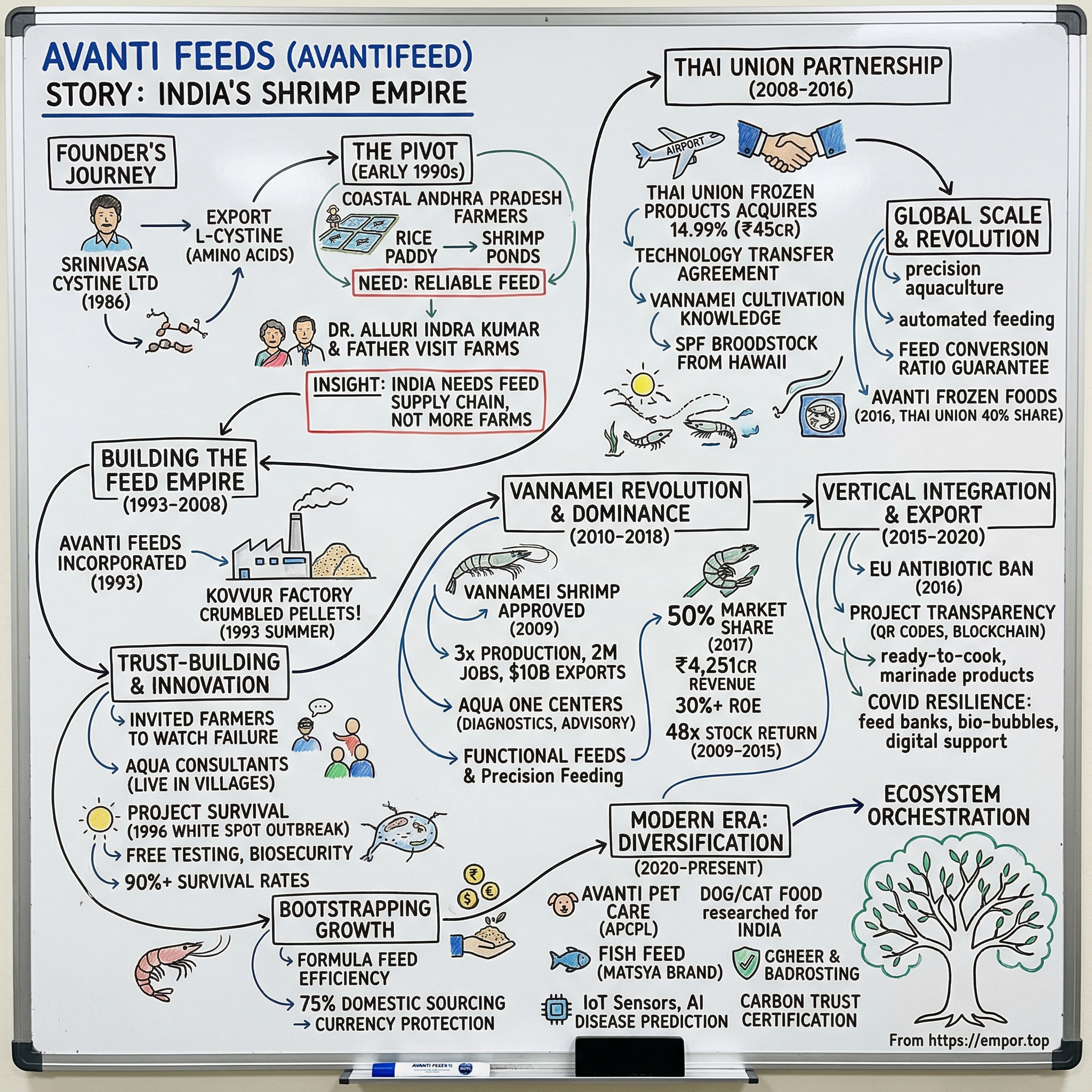
Avanti Feeds: India's Shrimp Empire and the Limits of Scale
I. Introduction & Episode Roadmap
Drive east out of Rajahmundry in coastal Andhra Pradesh, past the last of the paddy fields, and the landscape stops being agricultural in any recognisable sense. The ground turns into a grid of rectangular ponds, each one a shallow, opaque green rectangle a metre and a half deep, edged by mud bunds wide enough for a motorcycle. Paddlewheel aerators churn the surface day and night, throwing up a fine mist and a mechanical whirring that carries for kilometres. At four in the morning, headlamps move along the bunds as farmers cast throw-nets to check on the animals below. What they are farming is Litopenaeus vannamei — the Pacific white leg shrimp — an animal native to the eastern Pacific coast of Latin America that had no business being in India at all until a little over fifteen years ago.
Somewhere in that grid, in a warehouse behind a dealer's shopfront, sit stacked polypropylene sacks printed with names like Manamei, Prostar and Titan.1 Roughly one out of every two kilograms of commercial shrimp feed sold in India comes out of a plant owned by a company headquartered in Hyderabad that most Indian consumers have never heard of, that sells nothing directly to consumers, and that was founded by a chemical engineer whose first business extracted an amino acid from human hair.
The performance metrics highlight why the company draws institutional attention. In the financial year ended March 2026, Avanti Feeds reported consolidated revenue from operations of ₹6,066 crore, up 8.34% year on year, and consolidated net profit of ₹657 crore, up from ₹557 crore.2 Shrimp feed sales volumes reached 562,060 metric tonnes, supporting management's estimate of a 51% to 53% share of the domestic shrimp feed market.2 Consolidated borrowings stood at roughly ₹10 crore against consolidated equity of ₹3,708 crore, representing an almost debt-free balance sheet.2 Return on capital employed was approximately 24%, while return on equity reached around 18%.3 The company's market capitalisation, at a share price near ₹827, stood at roughly ₹11,264 crore.3
Yet longer-term and recent quarterly metrics reveal underlying friction. The five-year sales compound annual growth rate stood at about 8%.3 Feed segment revenue in FY26 slipped slightly from ₹4,397.67 crore to ₹4,366.81 crore even as volume expanded, reflecting lower average realisations per metric tonne.2 In the quarter ended June 2026, consolidated net profit attributable to owners dropped to ₹103.30 crore from ₹178.29 crore in the prior-year period. During the same quarter, EBITDA margin fell from 13.33% to 5.57%, even as top-line revenue expanded 18.3%.4 Volume growth coexisted with margin compression.
That divergence — between commanding market share and limited pricing power — presents the central analytical question: does a roughly 52% market share in Indian shrimp feed provide a durable competitive moat, or does it reflect a large-scale position in a commodity processing model whose margins are constrained upstream by raw ingredient costs like soybean meal and fishmeal, and downstream by global shrimp pricing set in Guayaquil and Washington?
A secondary question emerges from Avanti's operational execution. The company followed conventional strategic playbooks: securing feed technology through an international partnership rather than internal development, building distribution and technical support capabilities, and integrating selectively into hatcheries and processing while avoiding direct exposure to farm-level production risks. It maintained financial discipline across three decades. Yet its performance shows how market leadership can remain exposed to broader industry volatility. The company serves as an instructive case study in distinguishing market share dominance from structural industry attractiveness.
The route from here
First, the origin: how a business extracting L-Cystine from human hair produced leadership focused on practical farm-level feed requirements. Second, the catalyst: the strategic partnership with Thailand's Thai Union Group and the regulatory shift approving vannamei shrimp in India. Third, the expansion phase, during which feed market share grew from roughly a seventh of the market to over half. Fourth, an evaluation of the company's competitive moat against margin stress points in 2018, 2019, 2022, and 2026, alongside structural competition from Ecuador and US trade measures. Fifth, the relative economics of the feed and processing segments. Sixth, capital allocation dynamics, including cash reserves of nearly ₹2,000 crore, legacy non-core investments, and initial entries into pet food and Latin American markets. Seventh, core valuation frameworks, bull and bear cases, and key operating metrics for monitoring the business.
The trajectory began not with aquaculture, but with industrial chemistry.
 Subscribe on LinkedIn
II. Origins & The Hair-to-Amino-Acid Precursor (1986–2002)
From keratin to aquafeed
In southern Indian temple towns, pilgrims tonsure their hair as an act of devotion. Collected, auctioned, and sold onward by the ton, most of this hair supplies global markets for wigs and hair extensions. A smaller fraction enters chemical processing plants because human hair contains roughly 14% cystine by weight — a sulphur-bearing amino acid used in pharmaceuticals, food processing, and bakery dough conditioners.
That was the industry Alluri Indra Kumar entered as a chemical engineer. He began his career running Srinivasa Cystine Private Limited, an export-oriented unit that had been manufacturing L-Cystine from human hair since 1986.5 Extracting pharmaceutical-grade amino acids by hydrolysing keratin at scale presented significant technical hurdles. The business also faced structural limits: raw material supply was finite and fragmented, end markets were niche, and operating margins remained tight.
Indra Kumar identified an intellectual bridge between amino acid chemistry and the nutritional requirements of shrimp.5 Formulating aquafeed is fundamentally an exercise in assembling specific protein profiles: shrimp require precise amino acid ratios delivered in pellets that remain intact underwater for hours. While most early Indian feed entrepreneurs came from trading or agriculture, Indra Kumar brought process chemistry expertise to aquafeed formulation.
Timing reinforced that technical transition. Following India's 1991 balance-of-payments crisis, economic liberalisation prompted an official push to expand marine exports to earn hard currency, making shrimp aquaculture a policy priority. Anticipating that feed — rather than land or labor — would become the primary constraint on Indian shrimp farming, Indra Kumar incorporated Avanti Feeds in January 1993 and signed a technical collaboration with Taiwanese feed company Pintai the same year.5 Commercial production began in 1994 with an installed capacity of 10,000 metric tonnes.5 That initial volume represented less than 2% of the company's current annual sales.
The black tiger trap
Avanti's early operations were modest, regional, and tied entirely to Penaeus monodon, the native black tiger shrimp. Black tiger shrimp grow large and commanded premium prices in Japan and Europe, creating early fortunes for Andhra aquaculture operators in the late 1980s.
However, the species presented severe biological vulnerabilities. Black tiger shrimp require low stocking densities, feature a long grow-out cycle, and proved highly susceptible to White Spot Syndrome Virus (WSSV). In intensive monoculture ponds of cold-blooded invertebrates lacking adaptive immune systems, warm water and shared irrigation canals allowed pathogens to spread rapidly. An outbreak of WSSV caused total crop loss across adjacent farms within days. Because shrimp cannot be vaccinated, farmers relied entirely on biosecurity exclusion and early detection.
Repeated white spot outbreaks swept the coastal belts of Andhra Pradesh and Tamil Nadu through the late 1990s, forcing farmers to abandon ponds and default on debts. Feed companies that had extended credit to smallholders frequently collapsed alongside them.
This systemic risk shaped the industry's structural economics. Indian shrimp farming operated primarily through smallholders who managed a few ponds using savings, informal loans, and trade credit while absorbing all biological risks. Unhedged and largely uninsured, a single failed crop wiped out a farmer's annual income. Feed companies bore direct credit exposure as the primary input suppliers selling on credit terms. Crop failures resulted not only in lost future sales but also in uncollectible receivables from prior seasons, making working capital management the decisive factor in survival.
Avanti navigated this environment through capital discipline and practical operational choices. Avoidance of high leverage during the black tiger expansion preserved solvency when disease struck, a conservative posture that became a permanent balance-sheet characteristic. Moreover, Avanti did not thrive immediately in the black tiger era; feed mill operations only gained traction around 2000,6 leaving the company sub-scale and regionally confined for nearly a decade. Survival stemmed as much from modest scale and low debt as from explicit strategy.
During this period, Avanti established two enduring operational habits: maintaining an almost debt-free balance sheet and providing direct technical support to farmers. To differentiate its products, Avanti deployed technical staff directly to pond bunds to test water quality, monitor stocking, and advise on feeding schedules.
By the early 2000s, Avanti still lacked a high-growth engine. With black tiger production capped by disease, industry expansion depended on introducing an alternative species — a shift that required navigating regulatory hurdles with the Indian government.
III. The Catalyst: Thai Union Alliance & The Vannamei Pivot (2008–2014)
The fight over an exotic species
Around 2008, Indian aquaculture faced a regulatory impasse. Officials from the Coastal Aquaculture Authority and the Ministry of Agriculture remained cautious due to past ecological disruptions caused by non-native species. Industry advocates, meanwhile, pushed to import Litopenaeus vannamei, the Pacific white leg shrimp, proposing to cultivate it in coastal ponds at far higher stocking densities than traditional black tiger shrimp.
Regulators resisted introducing a non-native crustacean into open coastal ecosystems without strict biosecurity safeguards. The industry's case relied on Specific Pathogen Free (SPF) broodstock. Rather than harvesting wild parent shrimp that carried marine viruses, SPF lines were cultivated in closed, biosecure breeding facilities in Hawaii and Florida, screened over multiple generations to remain certifiably free of specified pathogens. Industry representatives argued that importing SPF broodstock under strict quarantine and licensing controls would contain disease risks while revitalising the sector.
The regulatory shift followed in 2009 when the Indian government approved the commercial cultivation of Litopenaeus vannamei after sustained lobbying and pilot trials.7 Avanti's leadership participated actively in advocating for the policy change. While pivotal for Avanti, the approval was an industry-wide regulatory decision rather than a proprietary advantage, giving every domestic competitor equal access to the species.
The introduction of vannamei fundamentally altered domestic aquaculture economics. First, vannamei tolerated significantly higher stocking densities, increasing biomass output per hectare. Second, its shorter grow-out cycle allowed farmers to raise more crops annually. Third, it converted feed more efficiently, lowering the Feed Conversion Ratio—the kilograms of feed required per kilogram of harvested shrimp. For feed manufacturers, higher stocking density expanded the addressable market immediately, as total feed demand depended on biomass output per hectare rather than total pond area. Indian intensive vannamei farms eventually reached yields of 5 to 10 metric tonnes per hectare per year, contrasting sharply with the lower-density, extensive pond systems in Ecuador.8
Buying a formulation partner
A second pivotal event turned the regulatory shift into a company-specific capability. In 2009, Avanti sold a minority stake to Thai Union Group, a global seafood manufacturer, to secure financing and technical expertise for transitioning from black tiger to vannamei feed formulations.7 Operating in Thailand, where vannamei had been farmed commercially for years, Thai Union's feed division possessed established formulations, process engineering standards, and disciplined raw material procurement practices.
The partnership provided two main operational advantages: water stability and batch consistency. Water stability ensures feed pellets retain structural integrity underwater long enough for bottom-feeding shrimp to consume them. Rapidly disintegrating pellets fail to nourish the crop and instead decompose, triggering algal blooms, depleting dissolved oxygen levels, and creating conditions that foster disease. Consistency ensures uniform performance across production batches and regional distribution points, reducing crop risk for farmers operating on 90- to 120-day cycles with substantial working capital at stake.
In parallel, Avanti established a direct distribution and field support network rather than relying on a conventional sales force. Indian shrimp feed is distributed through dealers who manage local inventory and extend harvest-settled credit, serving as critical financing intermediaries. To complement dealer networks, Avanti built a technical field services organization. The company maintains a field staff of more than 250 personnel providing advisory services from pond preparation through harvest under a Technical After Sales Service program, operating on-site testing laboratories, conducting regional farmer training, and offering a 48-hour complaint resolution commitment.1
This service infrastructure mitigates farm-level production risk and supports brand loyalty, though it does not represent a proprietary moat. Major competitors in the Indian aquafeed market—including CP Aquaculture India, Growel, Godrej Agrovet, and The Waterbase—deploy comparable operating models built around field technicians, testing labs, and dealer credit networks.9 Consequently, market leadership depends more on operational scale and execution quality than on an exclusive service model.
By the mid-2010s, Avanti aligned its species transition, technical partnership, dealer network, and field service organization just as national shrimp production began to expand rapidly, establishing the operational foundation for its subsequent growth phase.
IV. The Golden Era: 15% to 50% Market Share & Moat Construction (2014–2018)
An investor who bought Avanti Feeds shares in 2013 and held them through 2017 witnessed one of the strongest market runs in Indian mid-cap history. The company became a staple on retail investor forums and stock-screening lists, with its rapid appreciation leading many to extrapolate its growth far into the future.
The operating story behind the stock chart
That market enthusiasm rested on real operational expansion. Revenue doubled in three years, rising from ₹1,709 crore in FY15 to ₹3,393 crore in FY18, while net profit quadrupled from ₹116 crore to ₹466 crore.3 Bottom-line growth outpacing revenue reflected simultaneous operating leverage and margin expansion: rising sales volumes filled newly built processing plants, supported by favorable raw material prices.
Underlying this performance was a self-reinforcing operating cycle. Improved feed formulations yielded higher survival rates and lower conversion ratios for farmers. Better farm yields reinforced dealer preference; because dealers absorbed local inventory risk and extended credit to farmers, they prioritized trusted brands. Higher dealer volume, in turn, expanded Avanti's purchasing scale for its key raw inputs—soybean meal and fishmeal—yielding a modest unit-cost advantage. That cost edge funded further technical field services, completing the loop.
Yet this cycle carried a structural vulnerability: every step depended on farmer profitability. When farm-level economics are favorable, the cycle accelerates. When farmers face losses, the dynamic reverses. A farmer operating at a loss does not pay a premium for high-quality feed; instead, they stop stocking ponds entirely. Under those conditions, even a commanding market share provides limited protection against a shrinking overall market.
The subsequent valuation expansion reshaped shareholder returns. Investors priced a business growing earnings at 60% annually as a structural compounder rather than a commodity processor, assigning it an elevated valuation multiple. Markets extrapolated a growth surge driven by a one-time species transition—a single step-change in feed demand per hectare—as if it were a permanent annual growth rate. The business itself had not engaged in aggressive accounting; rather, public markets mispriced a temporary tailwind as enduring structural growth.
Two moves upstream and downstream
Alongside market share expansion, Avanti pursued selective vertical integration through two targeted initiatives.
The first was entering the hatchery segment. A shrimp crop begins with post-larvae—millimeter-scale juveniles produced in hatcheries from imported SPF broodstock. Because pathogen-contaminated seed dooms a pond before feeding begins, hatchery seed quality dictates harvest success. Entering hatcheries allowed Avanti to supply quality-controlled seed while engaging farmers earlier in the production cycle; securing the seed sale at stocking positioned the company as the natural feed supplier when feeding decisions followed. While hatcheries remain a minor revenue contributor—generating ₹12.46 crore in FY26, down from ₹21.68 crore, against total consolidated revenue exceeding ₹6,000 crore10—the business serves as a strategic customer acquisition tool.
The second was processing integration. In 2016, Avanti's board approved a joint venture in which Thai Union Group acquired a 40% stake in Avanti Frozen Foods Private Limited—until then a wholly owned processing and export subsidiary—for ₹125 crore, or roughly $18.5 million.11 The transaction valuation was derived from an independent assessment of the existing processing business plus the investment cost of a new plant under construction at Yerravaram in East Godavari district, which opened in the second half of 2016.11 Thai Union sought to diversify its global shrimp sourcing away from Thailand, where raw material availability had experienced disruptions.11
Through this transaction, Avanti sold a minority stake in its downstream operation to its upstream technology partner at a valuation partially based on an uncompleted asset. In exchange, Avanti secured a partner with global seafood distribution, maintained alignment with Thai Union, and raised capital. The structure capped Avanti's economic participation in the export business at 60%, a rational trade-off given that feed offered higher returns than processing. The financial impact is clear in the FY26 results: Avanti Frozen Foods reported revenue of ₹1,689.46 crore and net profit after tax of ₹130.30 crore, with two-fifths of those earnings attributable to Thai Union.2
Avanti Frozen Foods established US-FDA-compliant processing capacity focused on value-added items—such as cooked, marinated, breaded, skewered, and shrimp ring formats—targeting a primary customer base in the United States, alongside distribution in Europe, Japan, China, and the Middle East.1 Value-added processing offered higher differentiation than commodity raw frozen shrimp, providing custom specifications, direct client relationships, and longer switching cycles.
By March 2018, operational expansion appeared established, with Avanti holding approximately 43% of the Indian shrimp feed market.12 Shortly thereafter, however, market dynamics began to shift.
The initial sign of change was corporate rather than operational. In March 2018, Thai Union Group sold Avanti Feeds shares valued at ₹1,047 crore.13 A primary strategic partner monetizing a substantial portion of its equity holding near peak cycle metrics foreshadowed broader structural shifts ahead.
V. Falsification Pass: The 2018 Margin Collapse, Commodity Volatility & The Ecuador Shock (2018–2022)
How to stress-test a moat
Evaluating a company's competitive moat requires testing each core thesis against historical performance during periods of industry stress. Examining disconfirming evidence alongside each load-bearing claim clarifies where structural advantages hold and where they break down.
Claim 1: A ~50% share of Indian shrimp feed confers pricing power.
The fiscal year 2019 performance provides a clear stress test, as an input cost surge coincided with a downstream price drop after Avanti had established market dominance. Raw ingredient costs spiked, with fishmeal prices rising from an average of roughly ₹90 per kilogram in FY18 toward ₹120 per kilogram, alongside parallel increases in soybean meal.14 At the same time, farm-gate prices for raw shrimp fell due to expanding global supply and heavy inventory buildup in the United States.14 As a result, feed segment operating margins contracted by about 4.7 percentage points year over year to roughly 14% in the March 2018 quarter, causing quarterly net profit to dip despite higher sales volumes.14
Over the full fiscal year, net profit dropped 34% from ₹466 crore in FY18 to ₹307 crore in FY19, even as top-line revenue edged up from ₹3,393 crore to ₹3,488 crore.3 Revenue grew slightly while net earnings contracted by a third. Equity markets reacted by repricing the entire sector; in June 2018, shares of Avanti and rival Waterbase extended their declines amid broader growth concerns.15 The pressure continued into the following year, with Avanti's shares falling further after the December 2019 quarter delivered a 35% year-over-year drop in net profit.16
The underlying mechanism is straightforward. Avanti possesses the technical capability to raise feed prices, but raising them during a farm-level downturn harms its customer base. When farm-gate shrimp prices drop below a farmer's break-even point, higher feed costs cannot be absorbed or passed down the supply chain. Instead, marginal farmers cease operations, leaving ponds unstocked and reducing the feed manufacturer's total volume base. High market share does not deliver pricing power when customer unit economics turn negative and producers can temporarily exit the market.
This dynamic recurred in FY22, when net profit dropped to ₹245 crore from ₹397 crore in the previous year, despite top-line revenue growing from ₹4,101 crore to ₹5,036 crore.3 The pattern emerged again in the quarter ended June 2026: consolidated revenue expanded 18.3% to ₹1,899.86 crore, yet consolidated EBITDA dropped 50.9% to ₹105.10 crore as operating margins shrank by 7.76 percentage points to 5.57%.4 Within the feed division, revenue rose 26.8% to ₹1,561.71 crore, but segment profit plunged from ₹182.2 crore to ₹65.3 crore.4 Higher volume again failed to protect operating margins.
Verdict on Claim 1: Historical data invalidates the strong form of this claim. Avanti's market share does not confer pricing power in the conventional sense of maintaining or expanding margins through raw ingredient cycles. Instead, the evidence supports a narrower conclusion: scale provides procurement advantages and a balance sheet strong enough to survive cyclical downturns that impair smaller competitors, allowing margin recovery when input costs normalize, as demonstrated in FY25 and FY26. This represents a survivorship and recovery advantage rather than structural pricing power. The key indicator to monitor is whether the margin compression observed in June 2026 reverses as feed price adjustments take effect or persists into FY28.
Claim 2: India, and therefore Avanti's volume base, will keep compounding with global shrimp demand.
The primary counter-evidence stems from Ecuador's rising competitiveness.
Ecuador operates on a production model distinct from India's. While Indian farmers cultivate small, high-density ponds yielding 5 to 10 metric tonnes per hectare annually, Ecuadorian farms utilize vast, low-density ponds producing roughly 1 to 5 metric tonnes per hectare.8 India achieves higher output per hectare, but Ecuador achieves lower cost per kilogram, which dictates global benchmark pricing. Lower stocking density requires less artificial aeration, drastically reducing electricity expense—the largest controllable operational cost in intensive farming. It also lowers disease vulnerability by reducing crowded conditions, enables automated acoustic feeding systems, and benefits from decades of selective genetic breeding alongside shorter sea routes to North America and Europe. Together, Ecuador, China, India, Vietnam, and Indonesia account for roughly 74% of global shrimp supply, with India ranking as the third-largest producer and second-largest exporter behind Ecuador.8
This cost advantage depressed global prices. Average international shrimp prices fell from approximately $9.10 per kilogram in 2017 to about $6.90 per kilogram in 2023, before leveling off near $7.40 per kilogram in 2024 due to temporary supply bottlenecks rather than structural shifts.12 Concurrently, Avanti's feed sales volume grew modestly from 555,248 metric tonnes in FY25 to 562,060 metric tonnes in FY26, representing an expansion of roughly 1.2%.2 Measured against an installed production capacity of 600,000 metric tonnes across five units—and an additional 175,000 metric tonne line at Bandapuram approved in 2018—volume growth has plateaued below nominal plant capacity.1
Verdict on Claim 2: Rejected in its general form. Indian shrimp volume growth does not function as an automatic compounding engine; rather, it reflects a global market share battle where India faces cost pressure from Latin America. A more defensible thesis is that Avanti's feed volumes track overall Indian farmed shrimp output, which grows at low single-digit rates. Sustained feed volume growth above mid-single digits would signal a regain in competitiveness, whereas multi-year stagnation near 560,000 metric tonnes reinforces the volume ceiling.
Claim 3: Downstream integration into processing insulates the group from feed cyclicality.
The first obstacle is biological: Enterocytozoon hepatopenaei (EHP), a microsporidian parasite infecting the shrimp's digestive system. EHP poses a distinct commercial challenge because, unlike White Spot Syndrome Virus, it causes severe growth stunting rather than immediate mortality. Infected shrimp continue consuming feed at normal rates while failing to gain weight, forcing farmers to incur full feed costs for undersized harvests that command lower market prices. First identified in Thailand in 2004, the parasite spread across Asia and Latin America, causing estimated economic losses of $560 million in India between 2018 and 2019.17 For feed suppliers, EHP increases effective feed costs per kilogram of harvested biomass while reducing farm-level revenue.
The second challenge involves escalating U.S. trade measures. In March 2024, the U.S. Department of Commerce issued a preliminary affirmative countervailing duty determination on Indian frozen warmwater shrimp covering subsidy reviews from April 2022 through March 2023,18 finalizing rates in the mid-single digits in October 2024.19 These duties added to long-standing antidumping orders subject to annual administrative reviews, which saw final results for 2023–2024 released in February 2026 and preliminary results for 2024–2025 issued in May 2026.2021
Trade pressures escalated significantly in August 2025 when the United States raised tariffs on Indian imports to 50%, superimposing reciprocal duties onto existing trade remedies. Shrimp producers in Andhra Pradesh—which accounts for the vast majority of India's export volume—confronted severe market disruption, prompting the state's chief minister to request central government support.22 Frozen seafood shipments valued near $2 billion were heavily affected.23 During the Q1 FY26 earnings call, management noted that the 50% duty was "too high for us to absorb, so we are passing it on to customers," while indicating that immediate supply chain realignments prevented an abrupt collapse in shipments.24 Management also affirmed that the company rejected illegal transshipment through third countries to bypass duties.24
A legal resolution occurred on February 20, 2026, when the U.S. Supreme Court ruled that tariffs imposed under the International Emergency Economic Powers Act exceeded executive authority, directing a refund of collected duties.25 Indian exporters across seafood, textiles, and gemstones initiated recovery proceedings for more than $1 billion in invalid duties.23 In its FY26 annual report, Avanti estimated potential tariff refunds of $15 million to $20 million for Avanti Frozen Foods, which serves as the importer of record for its U.S. distribution.226 Because duty refunds accrue strictly to the importer of record, this operational structure allowed Avanti to claim funds directly, whereas peer exporters depended on overseas buyers to pass back recovered capital.23
Verdict on Claim 3: Rejected as framed, though with important operational nuances. Downstream processing does not insulate the parent company from feed market volatility; rather, it introduces a separate cyclical engine subject to distinct international trade and biological risks. However, the FY26 results illustrate counter-cyclical timing: processed shrimp revenue expanded from ₹1,180.27 crore to ₹1,689.46 crore, and in the June 2026 quarter—when feed segment earnings contracted—processing segment profits rose from ₹18.3 crore to ₹29.5 crore despite lower segment revenue.24 Downstream integration offers non-correlated revenue timing rather than pure downside stabilization. Furthermore, the anticipated $15 million to $20 million tariff refund represents a non-recurring legal recovery rather than underlying operational expansion.
VI. Current State & Business Economics: Feed vs. Processing (2022–Present)
Where in the chain the money actually sits
Understanding Avanti's current economics requires analyzing where value accumulates across the aquaculture supply chain and where the company concentrates its capital.
The production cycle begins with post-larvae produced in hatcheries, followed by 90 to 120 days of pond feeding. Once harvested, raw shrimp are sold at the pond edge to processors at globally determined farm-gate prices, then processed, frozen, containerized, and shipped to overseas buyers in Boston or Rotterdam. Avanti operates near both ends of this chain—manufacturing feed at the front end and processing frozen seafood near the tail—while avoiding direct farm ownership. That operational boundary avoids the segment where biological hazards concentrate and return on capital is weakest.
The feed business. Aquafeed remains the core profit engine, accounting for roughly 72% of consolidated revenue and the vast majority of net earnings. In FY26, the feed segment generated ₹4,366.81 crore in revenue with a segment margin of 12.79%, up from 11.98% in the previous year.2 The underlying unit economics are straightforward yet rigid. Feed pellets consist primarily of protein derived from soybean meal and fishmeal, bound with wheat flour. Fishmeal pricing depends on small pelagic catches, oceanic conditions off Peru, fishing quotas, and competing global livestock demand, while soybean meal prices track Indian crop yields and international agricultural markets.
Because neither raw ingredient can be hedged effectively at scale or substituted without altering pellet nutrition, feed manufacturing operates essentially as a spread business defined by the gap between delivered protein costs and the feed prices farmers can absorb. Plant utilization, logistics, and dealer commissions influence performance at the margin, but the raw material spread dictates overall profitability.
This structural reliance on raw material spreads explains the volatility in Avanti's financial results. When protein input costs soften, as occurred across FY25 and much of FY26, operating margins expand quickly and profit growth outpaces top-line gains. In FY25, net profit reached ₹557 crore on revenue of ₹5,599 crore, rising in FY26 to ₹657 crore in net profit on ₹6,066 crore in revenue, with operating margin expanding from 14.93% to 16.61%.23 Conversely, when input costs escalate rapidly, margins compress just as quickly, as seen in the June 2026 quarterly results.
A closer examination of the FY26 segment data reveals a key nuance behind the headline results: feed revenue slipped slightly even as sales volumes expanded, indicating a lower average realized price per tonne. Reducing realisations during a year of high overall profitability suggests Avanti passed input cost savings along to farmers—whether to preserve pond stocking activity or to counter rival market pressure. In either interpretation, the dynamic highlights the limits of pricing power. On the Q4 FY26 earnings call, management characterized the period as a challenging season for aquaculture due to rising raw ingredient costs, with Joint Managing Director C. Ramachandra Rao noting that feed price increases were under evaluation and expected within a week or ten days.26 The operational lag between rising ingredient costs and feed price adjustments remains the primary determinant of short-term margins.
The processing business. Downstream operations through Avanti Frozen Foods generated ₹1,689.46 crore in FY26 revenue with net profit after tax of ₹130.30 crore.2 At a net margin of approximately 7.7%—compared to the feed division's 12.8% operating margin—processing yields lower structural returns, consumes greater working capital per rupee of sales, and carries international trade risk. Although processing's expanding share of group sales bolstered top-line growth in FY26, it diluted the overall profitability mix.
Customer concentration in processing remains geographic rather than client-specific, with the United States historically serving as the primary export destination. Recent disclosures show efforts to broaden geographic reach, with exports to China increasing 24% and sales to the European Union rising 36% year on year in FY26.27 During the Q1 FY26 earnings call, management detailed plans to target buyers in Japan and Europe to mitigate trade policy exposure.24 However, geographic reallocation faces commercial hurdles, as U.S. buyers generally offer higher realisations for value-added formats, while European and Japanese markets maintain established importer relationships and distinct regulatory standards.
Hatcheries and ancillary operations contribute marginally to financial results, with hatchery revenue totaling ₹12.46 crore in FY26.10
The working capital dimension nobody discusses
Working capital management forms a critical yet less visible element of the company's operating economics. Because aquafeed reaches farmers through dealers who provide crop-cycle credit, feed manufacturers absorb the sector's financial cadence. During favorable seasons, receivables clear promptly following harvest. During crop downturns, receivables age, forcing feed manufacturers to choose between tightening credit terms at the expense of market share or extending credit to distressed farms.
Avanti's substantial cash reserves function as an operational shock absorber in this environment. While holding large liquid balances dampens return on equity, it prevents the company from being forced to restrict dealer credit during downturns. Leveraged competitors experiencing financial strain must prioritize immediate liquidity, often curtailing credit when dealers need it most and risking long-term market share loss. Avanti's balance-sheet strength has thus supported its market position across industry cycles, balancing the drag on equity returns against capital protection.
Two broader structural factors characterize the current profile. First, segment disclosures remain high-level relative to the company's market scale; published reports detail segment revenue and operating results, but omit granular metrics such as plant utilization rates, brand-level volumes, regional realisations, dealer network counts, or channel-wise receivable aging schedules. Second, credit rating assessments highlight financial structure over operational predictability: India Ratings & Research affirmed an IND AA-/Stable rating, reflecting low debt leverage rather than earnings stability in an agri-commodity processing model.31
Taken together, these operational dynamics define Avanti as a market-leading, virtually debt-free industrial processor whose profitability depends on commodity price spreads and international trade environment rather than internal pricing control. Domestically, market share remains strong, but external factors constrain margins. While a return on capital employed of roughly 24% and a return on equity near 18% reflect efficient operating performance, the gap between ROCE and ROE highlights the impact of accumulated cash reserves on the balance sheet—setting the stage for examining the company's capital allocation strategy.
VII. Capital Allocation, Treasury Cash, & Optionality Reality Check
What is the cash for?
Every mature promoter-led Indian business eventually raises a core capital allocation question for minority shareholders: what is the cash for?
Avanti presents an unusually stark case. Against consolidated equity of ₹3,708 crore, the company maintains cash and short-term investments of roughly ₹1,940 crore alongside consolidated borrowings of about ₹10 crore.228 Retained earnings and reserves stood at ₹3,272 crore at the end of FY26.3 Functionally, cash and liquid investments represent more than half of total equity.
The people. Dr. Alluri Indra Kumar remains chairman and managing director more than three decades after founding the business; C. Ramachandra Rao serves as joint managing director and company secretary, and A. Venkata Sanjeev serves as executive director, representing generational succession within the founding family.29 The promoter group controls 43.23% of the equity, with the largest single block—26.64%—held through Srinivasa Cystine Private Limited, the company's original amino acid predecessor.330 The twelve-member board includes four independent directors, five non-executive directors, and three executive directors, meeting five times during FY26.31
Management's operating style reflects enduring conservative principles: minimal leverage across three decades of industry cycles, non-exposure to direct farming risks, and avoidance of debt-funded acquisitions. Dividends have remained steady, with the board recommending a final dividend of ₹10 per share for FY26. Representing approximately 25.33% of standalone net profit and a total cash outflow of ₹136.25 crore, the payout marked the company's largest dividend distribution in a decade.210
However, balance-sheet conservatism does not automatically equate to optimal capital allocation. Evaluating management's capital efficiency against disclosed investments reveals notable deviations from its core operational focus.
The power investments. Over time, Avanti deployed capital into three power generation assets that yielded poor operational results. Srivathsa Power Projects Private Limited remained non-operational through FY26 due to the chronic unavailability of natural gas under the government's administered price mechanism, leaving the gas-fired facility stranded for years.32 Patikari Power Private Limited—a 16-megawatt hydroelectric plant on the Beas River in Himachal Pradesh in which Avanti held a 25.89% associate stake—sustained severe infrastructure damage from a cloudburst on July 1, 2025, destroying its access road, dam site, and powerhouse. Consequently, Avanti recognized an exceptional impairment of ₹10.65 crore on a standalone basis and ₹12.97 crore on a consolidated basis.23132 Avanti had initially acquired its stake in the hydroelectric plant years earlier during a period of sluggish feed sales.33 Finally, during FY26, the company divested its windmill assets as part of an effort to clean up non-core holdings.32
While these write-downs are small relative to an equity base exceeding ₹3,700 crore, the underlying pattern remains analytically significant. A management team recognized for operational discipline in aquafeed repeatedly allocated capital to energy projects outside its core expertise, resulting in assets that were ultimately stranded, impaired, or divested. This historical record provides a sobering baseline for assessing the company's recent diversification initiatives into unfamiliar sectors.
Optionality bet one: pet food. The theoretical rationale for entering pet food appears logical: Avanti possesses three decades of animal nutrition formulation experience and industrial extrusion infrastructure, dry pet kibble utilizes similar extrusion processes, and India's pet care market expands at approximately 20% annually.12 Announced in 2023, the venture was structured as a partnership with Thailand's Bluefalo Company Limited under a technical know-how agreement, with Avanti establishing a majority-owned subsidiary and outlining an ambitious product roadmap spanning pet kibble, grooming items, shampoos, and wellness products.42 By FY26, Avanti Pet Care Private Limited—60% owned by Avanti—had launched the "Avant Furst" brand across 13 cities using 31 distributors, with a dedicated manufacturing plant near Hyderabad scheduled for commercial production by early 2028.2 Total planned capital expenditure for the initiative ranges between ₹130 crore and ₹150 crore.12
However, execution timelines and product scope have experienced delays relative to initial targets. At launch in 2023, project completion was projected within two years.42 Three years later, the primary manufacturing facility remains uncommissioned, with commercial operations deferred to early 2028.2 The commercial roll-out has also narrowed: initial sales focused exclusively on cat food, dog food lines were deferred, and ancillary wellness categories mentioned at announcement have not materialized in financial disclosures.43 While timeline extensions are common when establishing consumer infrastructure, the gap between initial guidance and project delivery underscores the need for measured expectations.
Financial results reflect the segment's nascent scale. In FY26, Avanti Pet Care recorded revenue of ₹4.21 crore against a net loss of ₹4.76 crore,2 including fourth-quarter sales of ₹1.51 crore.26 During the Q4 FY26 earnings call, management reported current outsourced production capacity of 100 metric tonnes with a target of reaching 800 metric tonnes by year-end while awaiting plant completion.26 Generating roughly 0.07% of Avanti's consolidated top line, the pet care division currently represents a negligible portion of overall operations.
Crucially, the competitive dynamics of consumer pet food differ fundamentally from commercial aquafeed. Incumbent brands such as Pedigree and Drools control approximately 76% of the domestic market.12 Commercial shrimp feed is a business-to-business input sold through credit-extending regional dealer networks to commercial farmers evaluating yield metrics. In contrast, pet food is a fast-moving consumer product driven by brand affinity, distributed via modern retail, e-commerce, and veterinary channels, and sustained through heavy marketing expenditure. Consequently, Avanti's core strengths in raw material procurement, bulk extrusion, and regional B2B dealer distribution provide limited crossover advantages, while its acknowledged lack of consumer branding experience presents a key operational challenge.12
Accordingly, pet food represents a long-dated call option rather than an immediate earnings driver. Given management's past performance in non-core capital deployment, the venture warrants minimal valuation credit until it establishes commercial scale and sustainable contribution margins. The critical benchmark for investors will not be plant commissioning in early 2028, but whether sales volume and gross margins can support the marketing investments necessary to compete against established multinational and domestic incumbents.
Optionality bet two: Ecuador. On April 1, 2026, Avanti's board approved a $3 million investment to acquire a 10% stake in Thai Union Feedmill Ecuador—an entity formed to manufacture and distribute aquafeed in Ecuador.34 The investment aligns with Thai Union Group's February 2026 announcement of a $55 million commitment to construct an Ecuadorian feed facility, designed to expand its feed subsidiary's production capacity by approximately 80%, with commercial operations scheduled for 2028.34
Strategically, this investment represents a practical acknowledgement of shifting global aquaculture growth toward Latin America. Rather than resisting Ecuador's rising market share in global shrimp production, Avanti has utilized its long-standing partnership with Thai Union to gain minority exposure to the region's expanding feed market.
At $3 million (roughly ₹26 crore), the commitment is modest relative to Avanti's ₹1,940 crore treasury. The investment provides a 10% stake in a plant targeted for 2028 completion in a market where Avanti lacks direct distribution networks, farmer relationships, and local brand presence. Financially, the deal functions as a low-cost, long-duration option on Latin American feed demand rather than a transformative strategic pivot.
The treasury question. These diversification initiatives leave the fundamental question of Avanti's ₹1,940 crore cash balance unaddressed. Liquid treasury holdings earning low single-digit after-tax yields create a mathematical drag on overall capital efficiency, pulling return on equity down toward 18% despite operating return on capital employed reaching approximately 24%.328 During the Q4 FY26 earnings call, management confirmed that no major capital expenditure is planned for the next two years, prioritizing internal capacity utilization instead.26 Consequently, cash reserves are not earmarked for near-term organic expansion.
This capital structure raises several key questions for institutional investors. First, with no significant capital expenditure planned and strong operating cash generation, the rationale for maintaining a modest dividend payout ratio of roughly 25%—without complementary share buybacks during cyclical valuation troughs—remains unexplained. Second, if cash reserves are intended as a strategic buffer, past non-core power investments raise legitimate questions regarding long-term reinvestment returns. Third, administrative compliance disclosures highlight minor execution gaps: during FY26, Avanti spent ₹3.69 crore on corporate social responsibility against a mandated ₹8.19 crore, transferring the remaining ₹4.50 crore to an unspent CSR account for ongoing projects.31
Conversely, maintaining substantial liquidity offers structural protection in a highly volatile sector where farm-level solvency crises recur periodically. Balance-sheet liquidity provides the same downside protection that preserved solvency during disease outbreaks in the late 1990s and margin crashes in 2018–2019. In essence, Avanti remains over-capitalized for normal operating conditions but well-positioned for severe industry downturns. Investors must decide whether sacrificing incremental equity returns for balance-sheet safety represents acceptable value in an inherently cyclical market.
VIII. Strategic Frameworks: Helmer's 7 Powers & Porter's 5 Forces
Hamilton Helmer's 7 Powers, scored honestly
Strategic frameworks are useful only when applied with a willingness to score low. Applied generously, almost any company can claim several powers. Applied strictly, most possess at most one or two, and the analytical value lies in identifying precisely where that advantage resides.
Scale Economies — real, but narrower than advertised. Avanti's purchasing scale in soybean meal and fishmeal is genuine: as the largest single buyer of shrimp feed inputs in India, it commands favorable terms, priority allocations during market shortages, and efficient transport logistics across fragmented agricultural commodity markets. Yet structural limits exist. Because soybean meal and fishmeal are exchange-referenced commodities, even a dominant buyer captures only a modest procurement advantage of a few percentage points rather than a transformative cost gap. The advantage is evident in Avanti's feed segment margins consistently outperforming listed peers across industry cycles; its limits are equally clear from the nearly 7.8 percentage point EBITDA margin drop observed in a single quarter.4 Score: moderate-to-high, and cyclically variable.
Process Power — plausible, unproven from outside. The formulation and manufacturing expertise informed by Thai Union represents the most frequently cited source of Avanti's operational edge. The core mechanisms—water stability, pellet consistency, and feed conversion efficiency—directly affect farm yields. However, external verification remains limited. Avanti does not publish brand-level feed conversion ratios, and independent, large-scale trial data comparing Indian feed brands is not publicly available. Furthermore, the competitive field includes CP Aquaculture India, a subsidiary of Thailand's Charoen Pokphand Group, which possesses at least as deep a technical lineage in vannamei feed formulation as Thai Union.9 Consequently, claims of process superiority rely heavily on market share and farmer preference, which may reflect distribution strength and buyer inertia as much as proprietary formulation. Score: probable but not independently verifiable.
Cornered Resource — weakening, and this deserves emphasis. The bullish investment thesis often treats the Thai Union partnership as a cornered resource. However, shareholding history tells a more nuanced story. Thai Union monetized Avanti shares worth ₹1,047 crore in March 2018.13 In March 2025, Thai Union Asia Investment Holding sold a 4.4% stake—totaling 59.77 lakh shares at ₹728 per share for ₹435.15 crore—to IIFL Facilities Services, halving its entity-level holding from 8.77% to 4.37% and reducing Thai Union Group's combined equity stake from 24.21% to 19.81%.35 Meanwhile, Thai Union is committing $55 million to build a new feed facility in Ecuador, where Avanti holds only a 10% minority participation—meaning the international partner is allocating its primary growth capital to India's main global competitor while inviting Avanti as a minority co-investor rather than a central partner.34
This trend does not indicate an abrupt end to the alliance; Thai Union maintains a substantial 19.81% equity position, a 40% stake in Avanti Frozen Foods, and active operational ties. Nevertheless, a strategic partner gradually divesting equity over eight years while directing major capital commitments to a competing geography signals that the Indian entity no longer serves as its sole strategic focus. Score: medium and declining. This shift represents a central, under-analyzed risk to the technology-advantage narrative.
Switching Costs — modest and asymmetric over time. A farmer mid-crop faces high immediate switching costs; altering feed brands mid-cycle disrupts water chemistry and risks spoiling an active 90- to 120-day crop that cannot be restarted. Once harvest completes, however, product-level switching costs fall close to zero. The primary remaining friction is the dealer credit relationship, which binds farmers through harvest-settled financing rather than product lock-in. Score: low-to-medium, with credit serving as the primary anchor.
Brand Power — regionally real, economically limited. Brand names such as Manamei, Prostar, Profeed 3M, Titan, and High Boost enjoy strong trust among farmers across coastal Andhra Pradesh and Odisha.1 However, genuine brand equity is measured by the ability to sustain a price premium during market downturns. The falling realisations coexisting with expanding sales volumes in FY26 demonstrate that brand trust does not translate into sustained pricing power when farm economics come under strain. Score: medium.
Network Effects — essentially absent. Regional word-of-mouth creates localized brand adoption, but this reflects local reputation rather than a true network effect. An additional farmer adopting Avanti feed does not enhance the product's utility or value for existing users. Score: low.
Counter-Positioning — absent. Avanti's operational model—combining technical field services, dealer credit networks, and scale procurement—represents the standard industry playbook, executed at greater scale. Competing incumbents face no structural or business-model barriers preventing them from deploying the same approach. Score: none.
In sum, Avanti possesses one clear power in procurement scale economies, one probable power in process engineering, and one eroding power in its international partnership. That combination represents a resilient competitive position, but not an unassailable fortress.
Porter's Five Forces
Threat of new entrants: low. Constructing commercial extrusion plants requires substantial capital, formulation expertise takes years to refine, and—most critically—a new entrant must secure space within established dealer networks that provide the credit farmers depend on. Building a 500,000-metric-tonne feed business from scratch presents formidable structural barriers.
Bargaining power of suppliers: high, and this is the dominant force. Producers of soybean meal and fishmeal operate as global or regional price-setters. As a processing company without backward integration into oceanic fisheries or oilseed farming, Avanti remains a price-taker on key raw ingredients. This structural dynamic dictates overall operating margin volatility.
Bargaining power of buyers: medium, and structurally unusual. Individual smallholder farmers possess negligible negotiating leverage. Collectively, however, their power is decisive: the choice to leave ponds unstocked during unprofitable cycles imposes a strict ceiling on feed pricing. Buyer power is thus exercised through production abstention rather than direct contract negotiation, masking its impact until volume declines occur.
Threat of substitutes: low. Intensive vannamei farming at commercial scale cannot rely on natural pond nutrients, making formulated feed indispensable. Relevant substitution risks exist primarily at two other levels: alternative feed ingredients, such as insect meal, single-cell proteins, or algal oils displacing fishmeal—which represents a cost optimization opportunity for early adopters rather than a threat to overall feed demand—and geographic substitution, where global buyers source shrimp from Ecuador instead of India, constraining Avanti's overall addressable market.
Competitive rivalry: high. Major competitors including CP Aquaculture India, Godrej Agrovet, The Waterbase, and Growel actively contest the remaining half of the domestic feed market.9 Periodic price competition during farm-level downturns prevents the market leader from converting dominant volume share into structural margin expansion.
Both strategic frameworks reach a consistent conclusion: Avanti maintains a strong competitive posture within its domestic market, but the structural economics of the aquafeed sector limit its long-term pricing power.
IX. Bull vs. Bear Case & Skeptical-Investor Stress Test
The bull case, stated at its strongest
The most compelling argument for Avanti Feeds starts with industry structure. Avanti stands as the commanding leader in a duopoly-adjacent domestic market, controlling more than half of Indian shrimp feed sales and demonstrating a clear capacity to hold that position across multiple industry cycles. From FY18 through FY26, the company's market share expanded from roughly 43% to between 51% and 53% — gaining ground precisely during periods of severe sector distress.122 Market share gains achieved during industry downturns provide strong evidence of a genuine cost and operational advantage. While weaker competitors struggled to fund dealer credit and field advisory services when farm-gate economics faltered, Avanti's financial strength allowed it to sustain customer support and capture market share.
Second, Avanti's unleveraged balance sheet functions as an active commercial weapon rather than merely a conservative buffer. In an industry where feed distribution relies on dealers extending harvest-settled credit to smallholders, extended crop downturns delay cash collections. Unencumbered by debt service or covenant constraints, Avanti can continue financing dealer networks while credit-constrained competitors are forced to retrench. Zero debt directly converts into market share retention.
Third, the financial model demonstrates strong operational gearing during commodity recoveries. When key protein ingredient costs normalize, operating margins recover rapidly, driving sharp earnings expansion, as demonstrated in both FY25 and FY26.3 For cyclical investors, the margin compression in the June 2026 quarter — where consolidated EBITDA margin fell to 5.57% — represents a cyclical trough under peak raw material cost pressures rather than a permanent structural decline.4
Fourth, the company's growth options carry low financial risk. The $3 million equity commitment in Ecuador and the ₹130 crore to ₹150 crore capital outlay for pet food represent modest allocations relative to total cash reserves.1234 Neither initiative requires commercial success to maintain the core business; if either matures successfully, it provides incremental upside excluded from current baseline valuation models.
The bear case, stated at its strongest
The bear case centers on a structural volume ceiling. In FY26, domestic feed sales volume expanded just 1.2% against nominal installed capacity of 600,000 metric tonnes.21 Suitable land for Indian coastal pond development is largely saturated, while increasing stocking density heightens farm exposure to Enterocytozoon hepatopenaei (EHP) and viral outbreaks. With domestic volume growth slowing, the five-year revenue compound annual growth rate of roughly 8% — bolstered by price realisations and processing expansion — represents a structural trajectory rather than a temporary lull.3
Furthermore, Ecuador's cost advantage represents a permanent structural challenge rather than a temporary cyclical shift. Ecuador benefits from lower energy expenses due to low-density pond aeration, advanced genetic lines, large scale, and geographic proximity to North American and European markets. Although granular cost-per-kilogram data remains unverified by standardized industry disclosures, the global price impact is evident: average international shrimp prices declined from $9.10 per kilogram in 2017 to the $7.00 per kilogram range in recent years.12 A lower global benchmark price permanently reduces the maximum feed cost Indian farmers can absorb.
Trade policy presents a persistent regulatory headwind for downstream operations. While the U.S. Supreme Court invalidation of emergency tariffs provides immediate duty refunds, the broader U.S. antidumping and countervailing duty framework remains fully operational, undergoing annual administrative recalibrations.2021 U.S. domestic producer groups remain active litigators. Investors must treat the U.S. market as carrying a permanent regulatory friction, avoiding the capitalization of non-recurring tariff refunds into standard valuation multiples.
Capital allocation remains the primary concern for institutional investors. Disclosed plans indicate no major capital expenditure over the next two years, yet Avanti holds roughly ₹1,940 crore in cash and liquid investments while maintaining a modest dividend payout ratio near 25%.2628 Historically, non-core allocations — including a gas-fired plant lacking fuel supply, a hydroelectric facility damaged by flooding, and a divested wind asset — resulted in stranded capital, write-downs, and portfolio exits.313233 Concurrently, Thai Union Group has reduced its equity position across two separate market transactions while committing primary growth capital to new production capacity in Ecuador.133534 Finally, corporate disclosures omit operational granularity: segment reporting covers revenue and profit but excludes plant utilization rates, brand-level volumes, dealer counts, and regional realisations needed to verify claims of technical pricing power.
The activist's file
An institutional activist evaluating Avanti would focus on the gap between operational performance and capital management, advancing four primary criticisms.
First, the capital structure lacks strategic optimization. By holding over half of its equity in low-yielding liquid investments while generating high returns on operating capital, the company effectively operates an efficient aquafeed business alongside a conservative cash fund, incurring a conglomerate valuation discount.
Second, historical capital allocation outside core operations does not justify unconstrained board discretion. Non-core deployments have yielded weak financial returns, while the entry into consumer pet food targets a market dynamic far removed from Avanti's B2B industrial experience.
Third, financial disclosures lag reporting standards for a market-leading entity, concealing key metrics required to evaluate competitive moats.
Fourth, while legal compliance and ownership transparency remain clean, governance structure is concentrated: the twelve-member board includes three executive directors and only four independent directors, offering limited oversight for a company where the founding family controls 43% of equity and has led operations for over three decades.331
In response, management can cite thirty-three years of financial stability and zero defaults in a highly volatile sector. However, balance-sheet safety does not fully explain why payout ratios remain capped at 25% during periods lacking capital expenditure requirements.
Weighing it
The bull and bear cases evaluate distinct operational variables. The bull thesis addresses positional quality, supported by verified market share expansion, balance-sheet strength, procurement scale, and operational recovery gearing. The bear thesis focuses on market scale and volatility, highlighted by plateauing volume growth, Latin American cost competition, ongoing trade litigation, and raw material cost exposure.
Avanti represents a financially secure market leader operating within a mature domestic industry. The core valuation question is not whether the operating business is high quality — its return on capital demonstrates that it is — but what valuation multiple is justified for a low-single-digit volume grower subject to commodity margin swings, whose primary long-term growth option is a 10% minority stake in an Ecuadorian facility scheduled for 2028 completion. At approximately 21 times trailing earnings following a strong earnings period, the stock's valuation reflects significant optimism.3 As industry analysts observed regarding FY25 performance, cyclical margin recoveries driven by temporary raw material cost relief do not equate to structural business expansion.12 The margin compression observed in the June 2026 quarter confirmed that structural limitation.
For the bull case to regain momentum, Avanti must demonstrate sustained volume growth above mid-single digits, establish pricing power during input cost spikes, or execute a value-accretive capital allocation move — such as a share buyback or strategic acquisition. Conversely, the bear thesis will solidify if feed volumes remain stalled near 560,000 metric tonnes, Thai Union further reduces its ownership stake, or pet food diversification consumes capital without establishing commercial scale.
X. Epilogue & Key Investment KPIs
Return to the ponds at four in the morning. The paddlewheels turn, the throw-net comes up, and a farmer counts animals in the dark to decide whether to keep feeding or harvest early. Everything in the company's trajectory — the human hair chemistry, the regulatory fight over an exotic species, the Thai partnership, the ₹1,940 crore in liquid investments, and the U.S. Supreme Court ruling on a tariff statute — resolves into that decision, made hundreds of thousands of times each year across coastal India.
Avanti Feeds built an efficient infrastructure to serve that farm-level decision, only to find that total stocking decisions across India have plateaued. The company achieved near-complete dominance during a structural growth wave — the vannamei expansion from 2010 to 2018 — before market demand reached a ceiling. What remains is a resilient industrial processor: high returns on capital, virtually zero leverage, entrenched distribution networks, and an operating team focused on downside risk management in a volatile sector. What the empirical evidence does not support is a structural compounder with an extended organic growth runway or durable pricing power.
Management's operational track record shows consistent execution alongside notable capital allocation reservations. Guidance has historically remained conservative and achievable — for example, the FY26 feed volume target of 560,000 metric tonnes provided during the Q1 FY26 earnings call landed at 562,060 metric tonnes.242 Management's explanations for performance deviations have remained grounded in specific raw material cost movements. Furthermore, disclosures regarding trade litigation, including an explicit refusal to engage in illegal transshipments and detailed estimates of potential tariff refunds, were more forthcoming than standard industry practice.2426 Analytical reservations stem from capital allocation rather than plant operations: three underperforming non-core power investments, substantial treasury balances without clear strategic deployment, and an entry into consumer pet food where B2B operational advantages offer limited crossover utility.
Three metrics that carry the weight
Three key performance indicators carry primary analytical weight for monitoring the business.
First: annual shrimp feed sales volume in metric tonnes. Volume tracks whether domestic aquaculture is expanding, plateauing, or contracting, with Avanti's majority market share making its output a reliable industry proxy. The baseline figure is FY26's 562,060 metric tonnes.2 Stagnant or declining volumes through FY27 and FY28 would confirm that domestic production constraints are structural rather than cyclical, indicating the asset should be valued for cash generation rather than growth. Conversely, sustained volume expansion above mid-single digits would challenge the volume ceiling thesis.
Second: the feed segment margin, as a proxy for the raw material spread. The historical sequence highlights margin sensitivity, moving from 11.98% in FY25 to 12.79% in FY26, before the June 2026 quarterly profit drop to ₹65.3 crore on segment revenue of ₹1,561.71 crore.24 Investors must monitor the time required for price adjustments to restore segment margins toward the low teens. A rapid recovery would support the thesis of cyclical cost pass-through. Extended margin compression over several quarters would signal that price competition or farm-level distress is blocking cost recovery.
Third: India's share of U.S. shrimp import volumes relative to Ecuador, alongside annual U.S. antidumping and countervailing duty determinations. This external variable drives farm-gate prices, influencing feed pricing and operating margins downstream. Evaluating this factor requires tracking U.S. Department of Commerce rulings and import data rather than corporate disclosures. A sustained loss of U.S. market share to Latin American producers or higher duty rates in administrative reviews would compress margins across the domestic industry, irrespective of Avanti's internal execution.
Secondary factors — including pet food distribution expansion, construction schedules for the Ecuadorian feed mill, hatchery revenues, and liquid treasury growth — remain ancillary to these three primary metrics.
The risks that are actually mechanical
Differentiating specific operating risks from generic industry uncertainties clarifies the core investment thesis.
Climate exposure represents a direct operational risk rather than a secondary consideration. Shrimp farms operate along cyclone-vulnerable coastlines with stocking schedules tied to monsoon cycles; management explicitly noted during the Q1 FY26 earnings call that heavy rainfall and disease outbreaks temporarily slowed farming activity.24 The company has experienced physical weather losses directly, as demonstrated by the July 2025 cloudburst in Himachal Pradesh that destroyed its associate hydroelectric facility.32 Rainfall variability impacts farm stocking decisions immediately, altering feed sales volume within a single operating quarter.
Raw material price volatility functions as a core structural driver of the processing business model rather than a general macroeconomic factor.
Technological disruption presents little immediate threat to physical feed extrusion, but long-term shifts in alternative protein sources — such as insect meal or single-cell proteins displacing fishmeal — warrant monitoring. Alternative ingredients offer cost optimizations for early adopters and cost pressures for laggards, though Avanti has provided minimal disclosure regarding its research in substitute raw materials.
Conversely, refinancing and capital structure risks are minimal, representing the direct operational benefit of the debt-free balance sheet policy noted for capital drag in routine operating conditions.
Finally, key-person concentration represents an under-analyzed structural vulnerability. Dr. Alluri Indra Kumar has guided the company for thirty-three years, led the industry initiative to secure regulatory approval for vannamei shrimp, and anchors the primary relationship with Thai Union. While executive succession plans are visible with second-generation family leadership on the board, the specific combination of process chemistry expertise and regulatory influence that drove Avanti's expansion remains difficult to replicate.
XI. Transcripts & Management Messaging Guide
For investors seeking the direct narrative rather than the distilled annual report version, recent earnings calls carry essential management disclosures when evaluated in sequence.
The Q1 FY26 call, held in August 2025, serves as the primary tariff record. Delivered immediately after the United States raised tariffs on Indian goods to 50% — impacting roughly 55% of Indian shrimp exports — the session captured management reasoning under acute regulatory uncertainty.24 Three disclosures warrant close attention. First, management's statement that a 50% duty was too high to absorb and had to be passed on to buyers provided explicit pricing insight. Second, the observation that near-term volume damage would remain limited because global supply chains cannot reconfigure immediately proved operationally accurate. Third, management explicitly rejected illegal transshipment through third countries to bypass duties, establishing a baseline to monitor against subsequent trade data. The call also established FY26 guidance targets of 560,000 metric tonnes of feed and 17,000 metric tonnes of processed exports.24
The Q4 FY26 call, held in mid-2026, provides a clear case study in operating margin dynamics. Management reported consolidated gross income of ₹1,516 crore for the quarter — up 4.77% sequentially — alongside profit before tax of ₹184 crore, which represented a 17.12% sequential decline and a 12.8% year-on-year contraction as feed segment profit dropped 19% quarter on quarter under raw material cost pressures.26 Characterizing the period as "a challenging season for the aquaculture industry due to rising feed raw material prices," leadership committed to evaluating feed price adjustments "within a week or ten days," highlighting the operational lag that governs quarterly margin recovery.26 Additionally, management signaled capital discipline by ruling out major capital expenditure for two years, outlined expected reciprocal tariff refunds of $15 million to $20 million, and reported outsourced pet food capacity of 100 metric tonnes toward an 800-tonne target.26
The Q1 FY27 call, held on 27 August 2026, followed quarterly financial results showing revenue expanding 18.32% while net profit declined 37.37%.436 Executive leadership — including Chairman and Managing Director Dr. A. Indra Kumar, Joint Managing Director C. Ramachandra Rao, and Executive Director A. Venkata Sanjeev — addressed key operational developments.29 Three analytical questions dominate this period: the extent to which announced feed price increases were realized in the market, whether farm stocking held steady through monsoon disruptions, and whether margin expansion in processing reflected sustainable product mix improvements or temporary tariff adjustments.
Prepared remarks versus analyst Q&A
The two halves of Avanti's conference calls display a consistent structural divergence. Prepared remarks routinely emphasize balance-sheet stability, market leadership, farmer extension services, and quality certifications. Conversely, analyst Q&A sessions focus on three strategic friction points: capital return policies regarding cash reserves, international competitiveness against Ecuador's lower-cost production model, and the commercial execution of pet food, where the Hyderabad manufacturing facility is targeted for commercial production by early 2028.2 Management responses on capital allocation and international competition have frequently remained descriptive rather than strategic, focusing on current industry conditions rather than long-term structural interventions — a dynamic investors should monitor for potential strategic shifts.
For primary research, Avanti publishes annual reports, financial results, conference call transcripts, and analyst presentations through its investor relations portal,3738 with regulatory filings accessible via the BSE and NSE exchanges.3940 Comparing the FY19 annual report — published following the 2018 margin collapse — with the FY26 report offers a practical study in corporate messaging: evaluating management disclosures across two distinct commodity downturns highlights which elements of the business model remain structurally durable and which reflect underlying industry cycles.41
References
-
Shrimp Feed Manufacturers in India — Avanti Feeds, Feeds Division ↩↩↩↩↩↩
-
Avanti Feeds Annual Report FY 2025-26: Consolidated Revenue Grows 8.34%, Net Profit Rises to Rs. 65,680.22 Lakhs — ScanX ↩↩↩↩↩↩↩↩↩↩↩↩↩↩↩↩↩↩↩↩↩↩↩
-
Avanti Feeds Ltd — Consolidated Financials and Key Ratios, Screener.in ↩↩↩↩↩↩↩↩↩↩↩↩↩↩
-
Avanti Feeds Q1 Results: Net Profit Falls on Margin Squeeze — ScanX ↩↩↩↩↩↩↩↩
-
Value Creator: How Avanti Feeds Continues to Grow — Forbes India ↩↩
-
Global Scenario of Shrimp Industry: Present Status and Future Prospects — Aquaculture Magazine, 2025-04-28 ↩↩↩
-
An Outlook on Indian Shrimp Feed Industry and Manufacturers — Feed & Additive Magazine ↩↩↩
-
Highest Dividend In A Decade: Shrimp Feed Manufacturer Reports FY26 Results — DSIJ ↩↩↩
-
Avanti Feeds to Sell Stake in Frozen Food Unit to Thai Union Group for $18.5m — DealStreetAsia, 2016 ↩↩↩
-
Avanti Feeds: Chasing Growth Beyond Shrimp Dominance — Value Research ↩↩↩↩↩↩↩↩↩↩
-
Thai Union Group Public Co Sells Stake Worth Rs 1,047 Cr in Avanti Feeds — Business Standard, 2018-03-12 ↩↩↩
-
Avanti Feeds Ltd.: Event Update — Edelweiss Investment Research ↩↩↩
-
Avanti Feeds, Waterbase Extend Fall on Growth Concerns — Business Standard, 2018-06-04 ↩
-
Avanti Feeds Sinks After Q3 Profit Slumps 35% YoY — Business Standard, 2020-02-05 ↩
-
Shrimp Farming: Advances, Challenges and Opportunities — World Aquaculture Society ↩
-
Certain Frozen Warmwater Shrimp From India: Preliminary Affirmative Countervailing Duty Determination — US Federal Register, 2024-03-25 ↩
-
Frozen Warmwater Shrimp From India: Final Affirmative Countervailing Duty Determination — US Federal Register, 2024-10-28 ↩
-
Certain Frozen Warmwater Shrimp From India: Final Results of Antidumping Duty Administrative Review; 2023-2024 — US Federal Register, 2026-02-09 ↩↩
-
Certain Frozen Warmwater Shrimp From India: Preliminary Results of Antidumping Duty Administrative Review; 2024-2025 — US Federal Register, 2026-05-04 ↩↩
-
US Tariffs: Andhra Shrimp Farmers Stare at Uncertainty — Deccan Herald ↩
-
$1 Billion and Counting: Indian Exporters Begin Receiving US Tariff Refunds — Outlook Business ↩↩↩
-
Avanti Feeds Ltd Q1 2026 Earnings Call Highlights — GuruFocus via Investing.com ↩↩↩↩↩↩↩↩
-
U.S. Shrimpers Respond to the Supreme Court Ruling on Tariffs — Southern Shrimp Alliance ↩
-
Avanti Feeds Ltd Q4 2026 Earnings Call Highlights: Navigating Growth Amid Rising Costs — GuruFocus via Yahoo Finance ↩↩↩↩↩↩↩↩↩↩
-
Avanti Feeds Limited Q4 FY26 Investor Conference Call Highlights — InvestyWise ↩
-
Avanti Feeds Hosts Q1FY27 Earnings Call on August 27 — ScanX ↩↩
-
Avanti Feeds Ltd Share Price and Shareholding — ICICI Direct ↩
-
Avanti Feeds Files FY 2025-26 Annual Report and 33rd AGM Notice With Exchanges — ScanX ↩↩↩↩↩↩
-
Avanti Feeds Files Business Responsibility and Sustainability Report for FY26 — ScanX ↩↩↩↩↩
-
Avanti Feeds Buys Half Stake in Power Company After Reporting 17.4 Percent Drop in Sales — SeafoodSource ↩↩
-
India's Avanti Feeds Expands to Ecuador With 10% Stake in Thai Union's $55m Feed Mill — Undercurrent News, 2026-04-02 ↩↩↩↩↩
-
Avanti Feeds Shares Jump 10%, Hit 52-Week High; Thai Union Group Sells 4.4% Stake for ₹435 Crore — Upstox, 2025-03 ↩↩
-
Avanti Feeds Reports Q1 Consolidated Net Profit of 1B Rupees vs 1.78B YoY, Revenue at 19B Rupees — Sahi ↩
-
Avanti Feeds Financial Reporting and Annual Reports — Avanti Feeds Investor Relations ↩
-
Avanti Feeds Investor and Analyst Conference Call Transcripts — Avanti Feeds Investor Relations ↩
-
Avanti Feeds Limited Stock Price and Corporate Filings — BSE India ↩
-
Staying On Course — Avanti Feeds Limited 26th Annual Report 2018-19 ↩
-
Indian Shrimp Manufacturer Makes Moves Into Pet — GlobalPETS ↩↩
-
Avanti Pet Care Enters Pet Food Market With Avant Furst, Plans Manufacturing Expansion — PetfoodNation ↩
 LinkedIn
 WhatsApp
 Reddit
 Hacker News
 Email
Email Kindle
 RSS Feed
 Spotify
 Apple Podcasts
 Amazon Music
 Audible
 YouTube