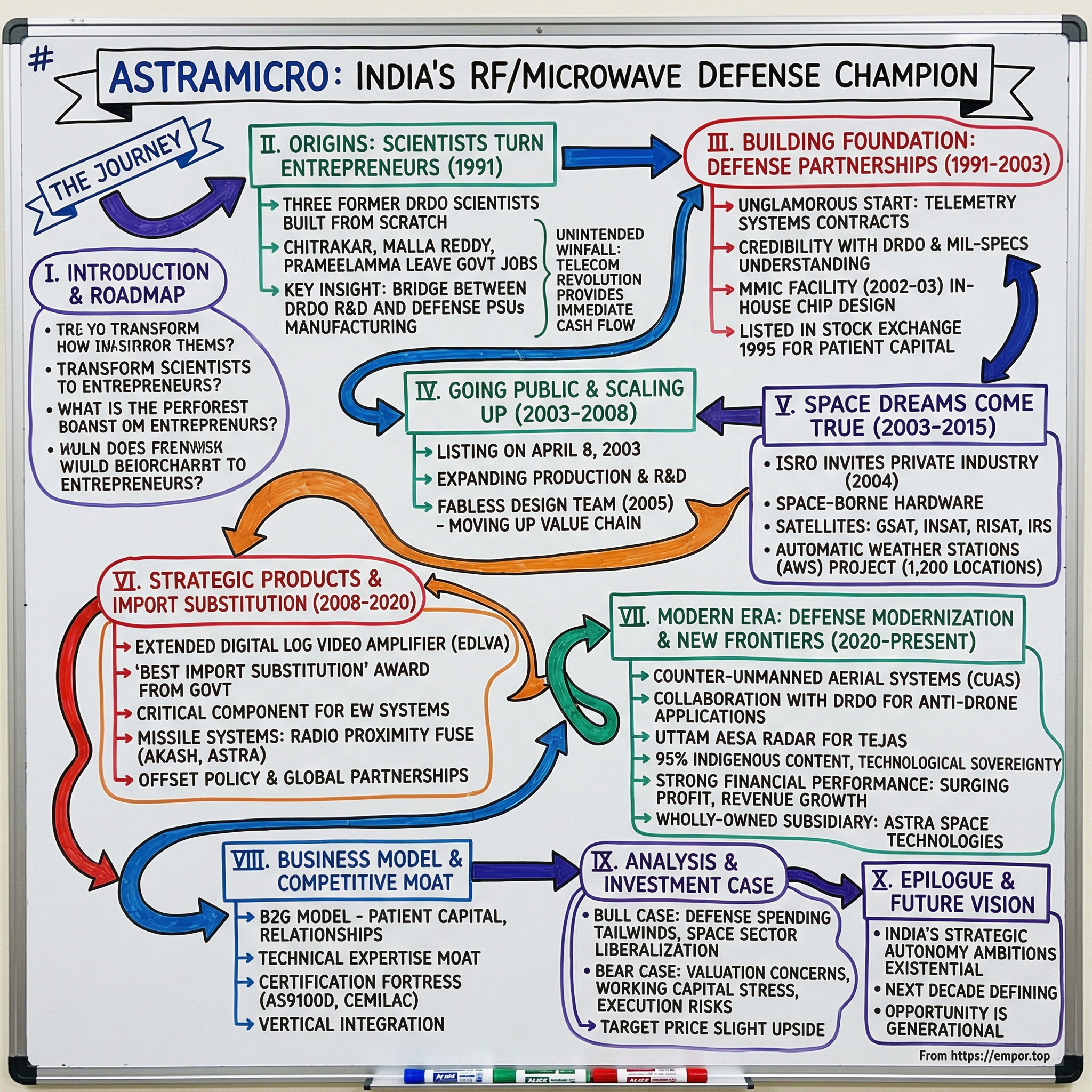
Astra Microwave Products: India's RF/Microwave Defense Champion
I. Introduction & Episode Roadmap
On the morning of July 31, 2026, a mid-cap defense electronics company headquartered in Hyderabad achieved a milestone in its 35-year history: it secured a single contract larger than its entire existing order book.
The customer was Hindustan Aeronautics Limited. The scope covered 122 Advanced Array Assembly Units and 121 Interface Frames for the Uttam Active Electronically Scanned Array radar—the indigenous fighter radar designed for the Tejas Mk1A. The contract was valued at ₹2,205.23 crore over a five-year execution schedule.1 Following the announcement, Astra Microwave Products' shares jumped as much as 14% to a record high, roughly doubling its total order book to approximately ₹4,300 crore.2
For a company that spent its first two decades as a Tier-2 supplier—shipping amplifiers, switches, and transmit/receive modules to government research laboratories for assembly by state-owned integrators—this contract marked a structural shift in its business model. Astra moved from supplying components for third-party systems to manufacturing the core signal-processing hardware for India's primary fighter radar.
However, eleven days later, on its Q1 FY27 earnings call, management reported an 11% year-on-year decline in quarterly revenue to approximately ₹176 crore, alongside a 24% drop in profit after tax, demonstrating the operational challenges of converting a record backlog into immediate quarterly billings.3 The stock dropped roughly 9% following the report.4 This sharp divergence between order intake and quarterly execution illustrates the core dynamics governing the business.
The company as it stands today. Astra Microwave Products Limited trades on the National Stock Exchange under ASTRAMICRO and on the BSE under scrip code 532493. As of late August 2026, the stock traded at around ₹1,707, representing a market capitalization near ₹16,200 crore against a book value of roughly ₹138 per share—a price-to-earnings multiple in the mid-80s and a price-to-book ratio above 12.5 Consolidated FY26 revenue stood at ₹1,163 crore, with an operating profit of ₹334 crore and a net profit of ₹193 crore.5 These financial figures reflect a specialized niche enterprise whose valuation incorporates substantial long-term growth expectations.
What the company actually does. Core to Astra's operations is the design and manufacturing of radio-frequency (RF) and microwave hardware used for detection, electronic warfare, and military communications. In radar systems, signal transmission and reception depend on hardware that generates RF pulses, transmits them through an antenna, captures faint return echoes, and amplifies the signals while suppressing background noise. Astra designs and builds these front-end modules—including amplifiers, mixers, filters, phase shifters, and transmit/receive units—across frequencies ranging from 30 MHz to 40 GHz.6 Similar to the optical sensor in a camera, the physical front end determines signal quality before downstream processing software receives the data. This underlying technology serves satellite transponders, weather radars, electronic countermeasure suites, missile seekers, and software-defined radios, placing Astra components on ISRO satellites, India Meteorological Department installations, air-defense missiles, and fighter aircraft radar arrays.
The central tension. The structural bull case rests on expanding domestic defense procurement: India's domestic defense production reached ₹1,77,995 crore in FY2026, defense exports grew nearly 63% year-on-year to ₹38,424 crore, and the government targets ₹3,00,000 crore in domestic production by FY2029, supported by five Positive Indigenisation Lists banning imports across 5,012 defense items.7 This policy framework mandates domestic procurement across defense programs.
Conversely, the bear case centers on buyer monopsony and working-capital terms. Astra sells primarily into a single buying ecosystem comprising the Ministry of Defence, DRDO laboratories, and state-owned defense public sector undertakings such as BEL and HAL. These institutional customers set technical specifications, control inspection gates, establish milestone sign-offs, and dictate payment schedules. In FY2025, Astra recorded receivables of 273 days, which remained elevated at 216 days in FY2026 despite working-capital cleanup efforts.8 Extended collection cycles require the business to fund significant working capital relative to its annual revenue.
Additionally, three strategic questions require evaluation: whether a corporate structure in which promoters own 6.54% of the equity functions as an owner-operated entity or a professionally managed enterprise without an anchor investor;9 whether the proposed demerger of the Space, Meteorology, and Hydrology division—which generated ₹157 crore (13.58%) of FY26 revenue—represents value realization or reflects limited scale in non-defense segments;10 and whether a subsystem manufacturer can successfully scale into a primary system integrator given public-sector dominance in prime contracting.
The analytical roadmap. The narrative follows a structured path: first, the company's 1991 founding by three former government laboratory scientists addressing state supply bottlenecks; second, its expansion into space-qualified component manufacturing; third, its evolution through 2010s missile electronics and international joint ventures; and fourth, its recent order surge and corporate restructuring. Subsequent sections analyze the economics of government defense contracting, evaluate competitive moats under customer monopsony, audit capital allocation, and assess the key operational metrics governing the company's valuation.
The story begins with engineering specialists establishing domestic capabilities to replace imported military electronics.
 Subscribe on LinkedIn
II. Origins: DRDO Scientists Turn Defense Entrepreneurs (1991–2003)
Hyderabad in 1991 was a peculiar place to launch a defense electronics company. In one sense, it was an ideal location: the city hosted a dense cluster of Defence Research and Development Organisation (DRDO) laboratories—including the Defence Electronics Research Laboratory, the Research Centre Imarat, and the Defence Research and Development Laboratory—staffed with specialists skilled in microwave physics. In another sense, the environment presented major operational hurdles: these laboratories designed sophisticated hardware but had limited avenues for series production. Manufacturing defense electronics in India meant dealing almost exclusively with state-owned Bharat Electronics Limited (BEL), where procurement queues were long, commercial priorities lay elsewhere, and interest in low-volume prototype development was minimal.
P.A. Chitrakar had spent more than two decades inside that state-run R&D ecosystem. A physics postgraduate from Mysore University with an MTech in advanced electronics from JNTU Hyderabad, he built his career as a scientist at the Defence Electronics Research Laboratory, specializing in microwave component design.11 The core problem he and his co-founders identified was not a technological deficit, but a translation gap. While DRDO scientists could design individual couplers, limiters, and low-noise amplifiers, converting those laboratory prototypes into fifty identical, environmentally qualified, and repeatably manufactured production units required a different operational discipline—one demanding precise tooling, strict process control, and an ability to tune hardware that behaves radically differently at 12 GHz than at 2 GHz.
In September 1991, as economic liberalization began dismantling the License Raj, three scientists with backgrounds in RF, microwave, and digital electronics incorporated Astra Microwave Products as a private limited company in Hyderabad.6 While the timing appears strategic in hindsight, it was driven largely by necessity. India's broader economy was opening, but defense procurement remained tightly restricted; private sector participation in defense manufacturing was not formally permitted until 2001. For its first decade, Astra operated in a market where its principal customer was legally the sole buyer and its primary competitor was owned by that customer's parent ministry.
The lab-to-PSU treadmill. The business model that emerged was less a long-term strategy than an adaptation to institutional constraints. A DRDO laboratory would define a technical requirement, and Astra would design and manufacture the subsystem, iterating through joint testing cycles that often spanned several years. The laboratory would then integrate the subsystem into a complete weapon system. If the platform passed user evaluation, the core technology was transferred to a Defense Public Sector Undertaking (DPSU) for series production. At that point, Astra became an approved Tier-2 vendor supplying the subsystem to the DPSU at prices negotiated by the state integrator.
This sequence explains much of Astra's financial profile over the subsequent three decades. The company absorbed upfront development risks and engineering costs, while state-owned prime contractors captured the higher systems-integration margins. Winning a design contest merely positioned Astra as a component supplier to an entity that, if production volumes scaled sufficiently, possessed strong incentives to manufacture the hardware in-house.
Buying the barrier to entry. What set Astra apart was its willingness to invest in specialized physical infrastructure that few private Indian firms were willing to fund. Microwave engineering is uniquely sensitive to physical tolerances: at 40 GHz, a signal's wavelength is approximately 7.5 millimeters, meaning the physical geometry of a solder joint forms an active part of the circuit. Because design validation cannot rely solely on software simulations, manufacturing requires anechoic chambers, near-field and far-field antenna test ranges, EMI/EMC testing facilities, environmental stress screening hardware, and clean rooms. Today, Astra operates four manufacturing units in Hyderabad, seven Class 10,000 clean rooms, one Class 100,000 clean room, functional test capabilities across the 30 MHz to 40 GHz band, and more than 500 RF instruments.6 The foundations of this manufacturing footprint were established during the 1990s, when capital was scarce and commercial returns were speculative.
This capital commitment formed the basis of Astra's process capability. Rather than relying on proprietary patents, the company built an operational lead on the decade of specialized manufacturing experience required to run a qualified microwave production line.
Life as a Tier-2 vendor in the 1990s. The operating realities of that first decade shaped the corporate culture that persists today.
Astra's primary client contact was typically a research scientist rather than a professional procurement officer. Technical specifications arrived as complex physics problems subject to frequent modification. Cash collection depended on formal acceptance, which required laboratory sign-off on custom-built hardware. Consequently, annual revenue fluctuated based on how many programs reached testable milestones, driven by defense budget allocations in New Delhi rather than Astra's operational capacity or product quality.
To mitigate this concentration risk, the company broadened its product catalog rather than relying on a single program or relationship. It combined build-to-specification contracts where Astra retained the design IP, build-to-print manufacturing based on customer blueprints, and eventually monolithic microwave integrated circuit (MMIC) design and assembly.6 Offering a wide component portfolio served as the primary hedge against an indivisible institutional customer base.
Physical expansion followed the same incremental pattern. What began as a single production unit expanded into multiple facilities, with each addition funded by active program cash flows.6 The cumulative result is an enterprise that reports having supported India's space program and contributed to roughly 35 radars, 25 satellites, and 15 strategic defense projects—an unusually broad footprint for a company of its revenue scale, and the direct product of three decades of accepting varied RF contracts across the domestic defense ecosystem.5
Testing the founding myth. A common narrative suggests that early co-development work with DRDO provided Astra with an unassailable first-mover advantage. However, the historical record indicates a more nuanced reality. Early entrant status brought minimal pricing power, as public sector buyers dictated contract terms. Nor did it guarantee steady volume, since programs were subject to annual funding approvals, scope changes, or cancellations. Furthermore, it offered no immunity from geopolitical shocks. Following the Pokhran-II nuclear tests in May 1998, international sanctions restricted India's access to dual-use technologies. This shift created dual effects for Astra: it spurred domestic demand via import substitution, while simultaneously disrupting the supply of foreign semiconductors and test equipment required for its own manufacturing.
Ultimately, Astra's early DRDO engagements established qualification status—entry onto approved vendor registries that potential competitors needed years to replicate—without guaranteeing attractive economic returns. Qualification remains a necessary asset, but as subsequent financial performance demonstrates, it does not constitute a standalone economic moat when defense program funding cycles tighten.
By the early 2000s, Astra possessed an established manufacturing process and a growing component catalog, but faced a structural limit: defense procurement alone was too volatile to sustain long-term growth. Management consequently turned toward the adjacent satellite and space sector.
III. The Space Pivot & Public Listing: Hardware in Orbit (2003–2010)
A historical clarification is necessary before analyzing this era. Astra Microwave states on its website that it became publicly traded in 1995, four years after incorporation—not in the early 2000s.6 Its BSE scrip code, 532493, is consistent with a later listing on that exchange, and the stock is quoted today on both the BSE and NSE.5 While the exact sequence of exchange listings is not detailed in available filings, Astra entered the 2000s as a listed entity with access to public equity markets. It utilized that capital to qualify hardware for satellite missions—an operational hurdle far higher than raising equity.
Why space is different. Terrestrial defense electronics must withstand extreme vibration, thermal swings, and electromagnetic interference. Space hardware requires all of those protections alongside vacuum tolerance, radiation shielding, and complete physical immutability—once launched, in-orbit repairs are impossible. A satellite transponder failure eighteen months into a fifteen-year mission renders the entire asset obsolete. Consequently, qualification demands complete component traceability, process freezing, and months of thermal-vacuum cycling and radiation screening. Quality systems are certified to aerospace standards, with Astra holding AS9100D and ISO 9001:2015 certifications.6
Astra spent the 2000s meeting these requirements, securing a role in India's space program that has spanned roughly a quarter-century. The company supplied transponders, transmit/receive modules, and telemetry subsystems for ISRO satellites, eventually establishing a dedicated space-qualified R&D facility in Bengaluru alongside its Hyderabad manufacturing plants.6 Astra reportedly supplied nearly 90% of the electronics for the RISAT imaging satellite in 2015 and has cumulatively executed more than ₹750 crore in ISRO orders over the partnership's lifetime.12
The move up the stack. A more consequential transition during this period was strategic rather than technical. Astra shifted from marketing individual components from a catalog to assembling integrated RF front-end subsystems, taking responsibility for the interfaces between parts rather than leaving integration risk to the customer.
This distinction is central to the business model. A discrete component supplier competes primarily on unit pricing and remains easily replaceable. Conversely, a qualified subsystem supplier becomes embedded in the client's platform architecture, where replacing a module requires re-qualifying downstream systems. Ascending the integration ladder shifts relationships from commodity sales to embedded partnerships, improving gross margins as buyers pay for engineering expertise rather than pure fabrication. Astra's strategic path since 2003 reflects a continuous effort to move from components to subsystems, radar arrays, and eventually complete systems.
The MMIC question. One capability from this period highlights how Astra's technical ambitions exceeded its financial returns: monolithic microwave integrated circuits (MMICs).
An MMIC integrates a high-frequency circuit—including amplifiers, switches, and phase shifters—onto a single semiconductor die rather than discrete boards. MMICs make modern phased-array radars viable by fitting hundreds of transmit/receive channels into tight fighter-jet radomes. Because India historically imported MMICs, they represented both a strategic vulnerability and a high-priority target for import substitution.
Astra pursued this through two avenues: building internal MMIC production capability and establishing Aelius Semiconductors, a wholly owned fabless design house in Singapore, in 2015.6 Owning chip design aimed to capture the core cost structure of phased arrays. However, commercial returns have proven difficult to verify, as filings do not report Aelius as a material standalone revenue source. On the Q1 FY27 earnings call, management framed MMIC exports to the United States and Europe as an opportunity expected "within a couple of years"—a timeline for commercialization that has remained essentially unchanged for several years.3
This gap between establishing a technical capability and generating material commercial revenue recurs across Astra's history.
Where the prestige stopped and the economics began. A critical analysis reveals a clear divergence between technical prestige and financial contribution. While space qualification represents Astra's most prominent technical milestone, its contribution to the income statement remains modest.
In FY26, more than two decades after launching its space initiative, the Space, Meteorology, and Hydrology divisions together generated approximately ₹157 crore in revenue, accounting for 13.58% of total turnover.10 The standalone space segment generated approximately ₹110.6 crore.12 Over two decades of orbital operations produced a division equal to roughly one-eighth of total corporate revenue, operating in a sector management characterizes as high-margin but lacking the scale required to move consolidated returns.
The underlying economics explain this structural limitation. Satellite manufacturing is batch-driven and irregular, characterized by single payload contracts separated by long lulls. Production volume is measured in units rather than thousands, requiring high engineering hours per revenue rupee for bespoke designs. Furthermore, the customer base is effectively limited to a single state agency operating under fixed Union Budget allocations. This structure creates significant quarterly lumpiness, with space and meteorology revenue swinging from 2% to 3% of sales in early quarters of FY26 to 19.5% in the fourth quarter.12
For investors, technical certification and commercial scale follow distinct trajectories; securing the former does not guarantee the latter. Astra spent a decade qualifying hardware for spaceflight, establishing a niche that yields roughly ₹110 crore annually. When examining the proposed corporate demerger in Section V, this revenue ceiling frames the strategic logic behind separating the division.
In the meantime, the segment that scaled substantially was Astra's parallel defense business, which focused on supplying microwave hardware for missile and tactical military platforms.
IV. Strategic Sub-Systems, Offsets & The Israeli Partnership (2010–2020)
The 2010s represented the most instructive decade in Astra Microwave’s history—a period in which the company demonstrated its technical model, experienced a severe cyclical downturn, and ultimately rebuilt its operating foundation.
Getting inside the missile
The technical requirements of missile guidance illustrate Astra's expansion into tactical hardware. In the terminal phase of flight, a surface-to-air missile relies on precise range detection to trigger its warhead at the point of closest approach, compensating for targets where direct physical impact is unfeasible. This function is executed by a radio proximity fuse—a miniature radar operating in the missile nose section that measures target distance while enduring launch acceleration, ground clutter, and electronic jamming.
Astra developed and manufactured the radio proximity fuse for the Akash surface-to-air missile.13 The company expanded its tactical electronics portfolio by producing command guidance units, transponders, and phased-array seeker subsystems across multiple Indian missile programs.14 In parallel, Astra indigenized the Extended Digital Log Video Amplifier in collaboration with the Defence Electronics Research Laboratory—a receiver component for electronic countermeasure suites that addressed foreign import restrictions.
This product shift carried significant strategic implications. Unlike aircraft radar arrays that remain in service for decades, missile electronics represent consumable hardware requiring ongoing stockpile replenishment upon deployment. Supplying missile electronics allowed Astra to complement one-time capital equipment contracts with higher-volume, recurring production runs.
The weather stations, and why they mattered
Parallel to its military contracts, Astra developed a non-defense business line in meteorological infrastructure. Partnering with ISRO, the company deployed automatic weather stations across more than 1,200 remote Indian locations utilizing satellite uplink transmission.12 Astra subsequently manufactured Doppler weather radars and wind profilers for the India Meteorological Department (IMD), completing over ₹330 crore in cumulative weather infrastructure contracts.12
While smaller in scale than the defense segment, this business served two distinct strategic purposes. Operationally, it required Astra to deploy and maintain a distributed national hardware network rather than delivering unintegrated subsystems to state contractors. Commercially, it established revenue streams outside the defense procurement budget. The business line has continued to yield contracts: in December 2025, Astra secured a ₹171.38 crore IMD order for six klystron-based S-band polarimetric Doppler weather radars, automatic weather stations, and disdrometers, structured under an 18-month delivery schedule, a three-year warranty, and a seven-year comprehensive maintenance contract.15
This long-term service model—combining upfront equipment fabrication with extended maintenance contracts—established a structural blueprint for recurring service revenue.
The Rafael joint venture: what was promised, what arrived
During this period, India’s defense offset policy mandated that foreign prime contractors winning large defense tenders reinvest a portion of contract values into domestic manufacturing. This framework incentivized international suppliers to partner with domestic private firms for localized technology transfer.
In August 2015, Astra established Astra Rafael Comsys Private Limited (ARC), a joint venture with Israel's Rafael Advanced Defense Systems. Astra holds a 50% equity stake, Rafael holds 49%, and individual shareholders associated with Astra hold the remaining 1%.16 ARC constructed a 48,000-square-foot manufacturing facility in Hyderabad's Hardware Tech Park to produce military-grade software-defined radios based on Rafael's BNET broadband IP radio architecture.17
Unlike traditional military radios with fixed hardware waveforms and encryption protocols, software-defined radios process signal architecture through software. This allows operators to reconfigure frequency bands, waveforms, and security protocols via software updates without replacing underlying physical hardware, creating a modular communications platform.
Contract wins eventually materialized, including a ₹255.88 crore Ministry of Defence award in December 2024 for 93 software-defined radio units and associated hardware.18
However, commercial scaling required an extended timeframe. Incorporated in 2015, ARC generated ₹236.7 crore in revenue by FY2024, expanding 3% to ₹244.1 crore in FY2025.19 The enterprise required nine years to reach approximately ₹245 crore in annual sales during a major national tactical communications overhaul. In March 2026, credit rating agency ICRA downgraded ARC's bank facility ratings.19
The operational trajectory of ARC demonstrates that international technology partnerships remain constrained by the multi-year procurement and testing schedules of the domestic defense ecosystem.
The collapse nobody talks about
The financial trajectory of the late 2010s highlights the cyclical volatility inherent in Astra's primary market.
In FY2015, Astra reported consolidated revenue of ₹622 crore, net profit of ₹63 crore, and a return on capital employed of approximately 29%.5
By FY2019, annual revenue declined 53% to ₹293 crore, while net profit dropped 84% to ₹10 crore.5 Operating margins contracted to 10%, and standalone net profit fell 75.27% year-on-year in the quarter ending March 2019.20 The downturn began earlier in the cycle, with Q1 FY2017 revenue falling 43% year-on-year to ₹56.82 crore.21 Return on capital employed decreased from 29% in FY2015 to 13% by FY2020.5
This contraction reflected the underlying structure of Astra's customer base. The FY2015 financial peak was substantially driven by export and offset orders for international equipment manufacturers. When those specific project cycles concluded before domestic defense programs reached volume production, revenue contracted. Operating as a component manufacturer dependent on discrete project cycles without recurring aftermarket contracts exposed the business to sharp revenue fluctuations.
It required until FY2022 for consolidated revenue to exceed FY2015 levels, and until FY2023 for net profit to recover.5
This historical contraction provides essential context for evaluating Astra's contemporary backlogs and financial performance. Program visibility, indigenization mandates, and expanding order books remain subject to the funding, inspection, and delivery timelines of state defense customers. Whether current backlogs prevent similar cyclical dips depends on whether major platform contracts transition into sustained multi-year production runs.
Astra entered the 2020s with a broader portfolio of specialized sub-assemblies, positioned for subsequent shifts in domestic defense procurement policy.
V. The Modern Defense Boom: Uttam Radar, Missile Seekers & Demergers (2020–Present)
When policy became a purchase order
The policy shift arrived in 2020, combining the vocabulary of self-reliance with the mechanics of an import barrier.
Under the Atmanirbhar Bharat framework, the Ministry of Defence began notifying Positive Indigenisation Lists—schedules of defense hardware prohibited from foreign import after specified dates. More than 15,700 defense items have since been converted to indigenous production through the government's SRIJAN portal. This includes 3,204 items drawn directly from the indigenization lists, supported by innovation initiatives like iDEX, which has engaged roughly 676 startups, small enterprises, and individual innovators while signing 551 design and development contracts.7
The effect on procurement was mechanical rather than persuasive. State-owned defense contractors that previously weighed an Indian subsystem against a foreign alternative based on price and technical risk no longer had an import option for listed items. Domestic suppliers shifted from optional alternatives to mandatory program partners.
Macroeconomic data aligns with this structural change. Indian defense production reached a record ₹1,77,995 crore in FY2026, advancing toward the government's target of ₹3,00,000 crore by FY2029.7 Astra's revenue mix mirrored this national pivot. Credit rating agency CRISIL noted that domestic contracts expanded to approximately 90% of Astra's total revenue in FY2026, up from 68% in FY2024, while emphasizing that domestic business generated higher profitability than international sales.22
That margin dynamic inverts common export assumptions. For Astra, international sales largely comprised low-margin, build-to-print manufacturing for foreign original equipment manufacturers. Pivoting back to domestic defense programs represented a move up the value chain, serving as the primary driver behind consolidated operating margins expanding from 12% in FY2022 to 29% in FY2026.5
Uttam: the program that changes the scale
An Active Electronically Scanned Array (AESA) radar replaces the mechanically rotating antenna of older systems with a stationary panel containing hundreds or thousands of individual transmit/receive (T/R) modules. Each module functions as an independent radar transceiver. By adjusting the phase of each element electronically through software, the system steers radar beams instantaneously without mechanical moving parts. This architecture allows the radar to track multiple targets concurrently, switch frequencies rapidly to resist electronic jamming, and degrade gracefully if individual elements fail.
For a hardware supplier, this technology multiplies addressable unit volumes. Where a mechanically scanned radar requires a single central transmitter, an AESA array requires hundreds of tightly calibrated T/R modules per aircraft. Fighter radar represents the most module-intensive application in defense electronics, aligning with India's planned fleet expansion of the indigenous Tejas fighter.
This demand materialized in July 2026, when Hindustan Aeronautics Limited awarded Astra a ₹2,205.23 crore contract to supply 122 Advanced Array Assembly Units and 121 Interface Frames over a five-year timeline.1 On the Q1 FY27 earnings call, Joint Managing Director M.V. Reddy characterized the contract as "the single largest order in the history of Astra," noting that it "effectively doubled our entire order book."3 Management outlined an execution schedule beginning with 12 units by September 2027, scaling to an average of more than 25 units annually, with an internal goal of fulfilling the order by FY2031.3
Astra's exposure extends across multiple defense platforms. On the same earnings call, management reported emerging as the lowest (L1) or second-lowest (L2) bidder for the Active Antenna Array Unit on the Advanced Medium Combat Aircraft (AMCA) fifth-generation fighter initiative. The company also detailed work on the Su-30 electronic warfare upgrade, a Tejas electronic warfare pod subsystem, deliveries for the Light Combat Helicopter, and anticipated initial production orders for the Quick Reaction Surface-to-Air Missile (QRSAM) system.3
Combined, these programs represent the radio-frequency hardware across a major portion of India's planned military aviation and air defense additions. If executed according to schedule, Astra's revenue content per aircraft will expand significantly beyond its historical component supplier role. Management quantified these ambitions during the earnings call, targeting order intake between ₹8,000 crore and ₹10,000 crore over the next five to six years, while projecting five-year revenue execution equal to "six to seven times" annual turnover—a volume management claimed would surpass Astra's cumulative output over its first 33 years.3
These targets remain management projections rather than guaranteed outcomes. The sharp revenue contraction Astra experienced between FY2015 and FY2019 underscores the operational risks of relying on aggressive government defense delivery timelines.
The new vectors
Beyond fighter radar arrays, management is positioning three additional product categories for long-term expansion: anti-drone countermeasure systems, ground-based defense radars, and satellite communication terminals. In July 2026, Astra conducted field demonstrations of an "electromagnetic wall" and a vehicle-mounted anti-drone system, which management described as first-of-their-kind domestic products.3 The company is also developing front-end hardware for coastal surveillance radars and radio-frequency modules for military and commercial satellite communication terminals.
From an analytical standpoint, these initiatives represent long-term optionality rather than immediate revenue streams. A successful field demonstration establishes technology readiness, but bridging the gap between prototype testing and a funded procurement contract in the Indian defense sector routinely requires multiple years. The multi-year lag in scaling the Astra Rafael Comsys joint venture serves as a relevant internal precedent.
The demerger, and what it admits
On February 27, 2026, Astra's board of directors granted in-principle approval to evaluate demerging its Space, Meteorology, and Hydrology division.23 The proposed transaction transfers the division to a wholly owned subsidiary, Astra Space Technologies, on a share-swap basis with no cash consideration, establishing an identical shareholder structure and separate listings on the BSE and NSE.24 The corporate entity converted to a public limited company and was renamed Astra Space Technologies Limited effective August 19, 2026.25 Management targets operational independence by April 1, 2027, with final corporate completion scheduled for the first quarter of FY2028, subject to regulatory approvals from the National Company Law Tribunal (NCLT), SEBI, and stock exchanges.24
Following the separation, the parent company will concentrate on defense radar electronics, electronic warfare suites, and telemetry systems. Astra Space Technologies will inherit the space and meteorological hardware portfolio. Management projected that the standalone space company will generate over ₹300 crore in its first full year of independent operation, achieving profit-before-tax margins between 18% and 20%, and announced plans to launch its own satellite within six months of listing.3
From a bullish perspective, the demerger represents a value-unlocking initiative. A publicly traded, pure-play space enterprise remains rare in the domestic market, while the defense parent sheds a division with distinct capital requirements and delivery timelines.
A more critical assessment highlights structural limitations. Corporate divisions are typically separated when synergy benefits prove minimal. Despite receiving significant engineering talent and management oversight for two decades, the space, meteorology, and hydrology business accounted for just ₹157 crore, or 13.58% of consolidated revenue, in FY2026.10 The demerger reflects a strategic realization that maintaining a volatile, sub-scale division inside a corporate structure tasked with rapidly scaling defense radar manufacturing risks diluting focus across both units.
Furthermore, management's timeline to launch a proprietary satellite within six months of listing represents an ambitious operational target. Given Astra's historical pattern of converting technical milestones into commercial revenue over extended periods, this initiative warrants conservative evaluation.
The handover
The final element of corporate restructuring involves executive leadership. Astra announced that Managing Director S. Gurunatha Reddy will step down from the chief executive post at the close of business on September 30, 2026, while remaining on the board as an executive director to lead Astra Space Technologies.26 Joint Managing Director Dr. M.V. Reddy will assume the role of Managing Director effective October 1, 2026.27 On the Q1 FY27 earnings call, Gurunatha Reddy noted to analysts, "This is my last interaction with you as a managing director."3
While the executive succession is structured and pre-announced, it introduces operational transition considerations. Gurunatha Reddy, a Fellow Chartered Accountant with 33 years of financial management experience, steps down from primary leadership precisely as the company begins funding the largest working-capital build in its corporate history.11 Incoming Managing Director Dr. M.V. Reddy brings an electronics engineering background, an MBA, and 28 years of experience in marketing and business operations across defense, space, and telecommunications—a commercial and technical background assuming control when the company's chief operational challenge centers on manufacturing scaling and cash collection rather than order generation.11
That operational challenge defines the next phase of the business.
VI. Business Model, Segment Breakdown & Financial Economics
A single financial detail framing Astra Microwave’s income statement highlights its core operational dynamic: in FY2025, the company reported ₹1,051 crore in revenue and ₹151 crore in profit after tax—yet recorded negative ₹90 crore in operating cash flow.5 22 A profitable, high-margin defense supplier consumed cash equivalent to roughly 60% of its reported net income.
This cash burn reflects the mechanics of its underlying business model rather than accounting irregularities.
Where the money comes from
Astra’s revenue structure comprises a dominant defense franchise, a space and meteorology division undergoing demerger, and a modest export operations tail.
Radar electronics represent the primary growth driver. On the Q4 FY26 earnings call, management indicated that radar systems accounted for nearly 60% of consolidated revenue.28 As of June 30, 2026, the standalone order book of ₹2,156 crore comprised 71.3% defense and public sector contracts, 26.3% space projects, 2.0% exports, and 0.4% meteorological orders by end customer. Categorized by contract type, serial production orders represented 65.7%, development contracts accounted for 14.3%, export orders made up 8.0%, and maintenance and services comprised 12.0%.8
The contract-type distribution marks a structural shift in earnings quality. With nearly two-thirds of backlog in serial production, revenue depends increasingly on repeatable manufacturing rather than speculative R&D. Furthermore, the 12% allocation to maintenance and services establishes recurring annuity revenue independent of new tender awards—a model exemplified by the seven-year maintenance agreement accompanying the IMD radar contract. Expanding this high-margin service share directly mitigates the cyclical revenue shocks that affected the company in FY2019.
Prior to the Uttam radar award, the consolidated order book as of June 30, 2026, stood at ₹2,849.09 crore, including ₹243.67 crore in service orders, before the HAL contract expanded total group backlog to approximately ₹4,300 crore.29
The margin story is real, and partly explained
Astra’s consolidated operating margin expanded steadily from 12% in FY2022 to 18% in FY2023, 21% in FY2024, 26% in FY2025, and 29% in FY2026.5 Net profit grew from ₹38 crore to ₹193 crore over the same period.5 In Q4 FY26 alone, the company generated ₹488 crore in consolidated revenue, ₹162 crore in EBITDA at a 33.3% operating margin, and ₹106 crore in net profit—a 44% year-on-year increase.30
Three distinct factors drive this margin expansion:
- Product Mix Shift: Transitioning from low-margin, build-to-print export assembly toward high-margin, proprietary domestic defense designs—a dynamic explicitly underscored by credit rating agency CRISIL.22
- Operating Leverage: High fixed capital overhead in anechoic chambers, test suites, and specialized engineering staff ensures that incremental manufacturing volume flows directly to operating income.
- Program Pricing Phase: Initial production batches for newly qualified subsystems command premium pricing before state procurement agencies initiate formal cost-reduction reviews.
Management acknowledged during the Q1 FY27 earnings call that initial production margins on large-scale awards like the Uttam contract may involve volume-based trade-offs.3 Large-scale radar production is likely to yield lower percentage margins than the current custom product mix, compensated for by higher absolute profit volume and lifecycle aftermarket services. Financial models projecting quarterly EBITDA margins of 33% across a multi-year fighter-radar production ramp risk overestimating peak margin sustainability.
The working capital trap, in mechanical detail
Converting reported accounting profits into realized cash flow requires navigating three operational constraints in Astra's cash cycle.
First, development timelines span three to seven years from initial technical specification to serial production approval, requiring the supplier to absorb upfront R&D and engineering costs. Second, inventory requirements demand early procurement of long-lead radio-frequency semiconductors and specialized components. Because components qualified for a specific defense platform cannot be reassigned to other programs, inventory remains illiquid throughout build and testing phases. CRISIL measured gross current assets net of cash at approximately 500 days, with inventory holding periods at 286 days and receivables at 273 days.22
Third, customer payment milestones represent the primary bottleneck. Defense public sector buyers release funds only after formal inspection and acceptance sign-offs by state authorities. Consequently, while revenue is recognized upon product delivery, cash realization awaits institutional approval. In FY2025, this administrative gap resulted in 273 debtor days.8
This working-capital structure increased short-term debt from ₹60 crore in FY2020 to ₹424 crore in FY2025, elevating financial gearing from 0.21x in FY2024 to 0.39x in FY2025 and reducing interest coverage from 6.80x to 4.87x.5 22 Working capital credit facility utilization averaged 91% during the six months ending May 2025.22 Consequently, the business operated near its credit line limits despite reporting strong accounting profitability.
FY2026: a genuine improvement, and how to read it
Financial performance in FY2026 reflected operational progress. Consolidated operating cash flow turned positive to ₹387 crore, supported by standalone cash generation of ₹370 crore compared to negative ₹99 crore in FY2025.5 28 Debtor days declined from 273 to 216, inventory days reduced from 213 to 193, and the cash conversion cycle tightened from 459 days to 374 days.8 Total borrowings decreased from ₹424 crore to ₹288 crore.5 Consequently, CRISIL revised its credit rating outlook from Stable to Positive on December 11, 2025, while reaffirming its CRISIL A/A1 ratings across an enhanced bank facility limit of ₹1,536.5 crore.22
This improvement reflected working-capital collection efforts alongside operational efficiency. However, management clarified during the Q1 FY27 earnings call that reduced interest expense stemmed from temporary positive cash reserves and minimal overdraft usage, cautioning that "as we move forward in Q3 and Q4, again, the pressure builds up on working capital," with full-year working-capital metrics expected to realign with FY2026 levels.3
A cash conversion cycle of 374 days still exceeds a full calendar year. While FY2026 performance narrowed working-capital requirements, the upcoming Uttam radar ramp—requiring upfront inventory build ahead of state inspection milestones—presents familiar working-capital pressures.
The Q1 FY27 warning shot
The June 2026 quarterly results illustrate these operational sensitivities. Standalone revenue declined 11% year-on-year to ₹176 crore, EBITDA decreased to ₹33 crore with operating margins contracting from 19.5% to 18.8%, and net profit fell 24% to ₹10 crore as net margins dropped from 6.6% to 5.6%.8 Management attributed the quarterly shortfall to customer inspection delays, extended specification sign-offs, component supply chain constraints, and internal development adjustments, while confirming that underlying demand remained intact.3
These factors reflect customer monopsony dynamics in practice: inspection schedules and specification sign-offs remain outside supplier control, directly influencing quarterly revenue recognition. Additionally, component availability challenges reflect broader international defense supply chain constraints acknowledged by management.3
Ultimately, quarterly financial results provide an incomplete measure of operational health, as reported figures reflect customer administrative workflows alongside manufacturing output. Annual backlog conversion rates and working-capital efficiency remain the primary metrics for assessing performance.
VII. Playbook & The 7 Powers Moat Assessment
Every defense electronics company claims a competitive moat, typically framed around vendor qualification barriers. Hamilton Helmer’s economic framework provides a clearer lens by asking whether a competitive advantage produces persistent differential returns—not merely whether the business is difficult to replicate.
Applied to Astra Microwave, three of Helmer's seven powers are partially evident, one is contestable, and the entire assessment is ultimately governed by an unlisted counter-power: customer monopsony.
Process Power: the strongest claim
Process power describes an operational advantage embedded in organizational routines that competitors cannot easily copy even if they understand the methodology. This represents Astra's most defensible position.
High-frequency radio-frequency engineering remains stubbornly empirical. Above 10 GHz, computer simulations cannot fully predict real-world behavior, leaving the gap between a functional module and a marginal one dependent on accumulated manufacturing craft: understanding substrate performance across thermal profiles, refining soldering processes to survive space-grade screening, and calibrating arrays so hundreds of elements match precisely. That tacit knowledge resides with experienced technicians and engineering teams, built over decades of trial and iteration.
The primary evidence supporting this claim is Astra's qualification record: deployed hardware across radar, satellite, and strategic programs, alongside a manufacturing estate capable of full testing up to 40 GHz and certified for space applications.6 A well-funded entrant could purchase equivalent equipment, but replicating fifteen years of production yield optimization presents a far higher hurdle.
However, process power protects an operational footprint rather than setting market prices. Astra’s return on capital employed between FY2015 and FY2026 ranged from a peak of 29% down to 13% before recovering to 20.3%.5 A process advantage coexisting with returns on capital that halve during cyclical downturns reflects an economic structure where pricing power is dictated by external buyers.
Switching Costs: high, but narrower than advertised
Once an Astra subsystem is qualified within a military platform, replacing it requires re-qualifying downstream system integration—a multi-year process program managers avoid whenever possible. This dynamic explains why defense supplier relationships often endure across decades.
The limitation of this advantage is that switching costs protect an installed program rather than future contract awards. Each new defense platform requires a fresh competitive bid, and India's defense electronics sector now includes multiple qualified private bidders. Consequently, lock-in applies per contract rather than per customer.
Counter-Positioning: moderate and eroding
Astra’s historical advantage against state-owned defense contractors relied on engineering agility and cost efficiency: leaner project teams, faster prototyping cycles, and a willingness to execute low-volume development projects that larger public-sector units found commercially unattractive. That operational agility enabled DRDO laboratories to utilize private development partners for three decades.
Under Helmer’s definition, counter-positioning requires that incumbents cannot adopt the challenger’s model without harming their core business. In this market, nothing prevents state-owned integrators like Bharat Electronics Limited (BEL) from expanding internal RF module fabrication, nor does it prevent private entrants from competing on identical terms. The advantage reflects an early operational lead rather than a structural barrier.
Cornered Resource: overstated
Potential candidates for a cornered resource include proprietary RF intellectual property and specialized engineering talent concentrated in Hyderabad. While both are valuable assets, neither is strictly cornered. Hyderabad’s RF engineering talent pool developed primarily around DRDO institutions and remains accessible to any firm establishing local operations. Furthermore, traditional scale economies, network effects, and brand equity provide minimal differentiation in institutional defense contracting.
The counter-power: monopsony
The dominant dynamic shaping Astra's economics is customer monopsony, which falls outside the standard seven powers framework.
Astra sells overwhelmingly into a single institutional buying ecosystem: the Ministry of Defence, DRDO laboratories, and state-owned Defense Public Sector Undertakings (DPSUs). This buyer establishes technical specifications, controls qualification testing, manages tenders, dictates pricing, inspects finished goods, and determines payment schedules. Domestic contracts generate approximately 90% of Astra's revenue, with the vast majority tied to government entities.22
This market structure imposes three operational constraints:
Deliberate vendor-base expansion. Government procurement policy actively discourages single-source private reliance. Competitors such as Data Patterns, Paras Defence, and DCX Systems regularly bid on adjacent subsystem projects, supporting the policy goal of a diversified domestic industrial base rather than a single protected supplier. For instance, Data Patterns closed FY26 with a record order book of roughly ₹2,062 crore and full-year revenue growth above 30%, while Paras Defence reported FY26 revenue of ₹476.57 crore and a 52% surge in net profit to ₹89.46 crore.31 32 33 These peers compete directly in identical procurement categories.
The customer as competitor. BEL serves simultaneously as Astra’s largest distribution channel, its integration partner on key platforms, and a major competitor capable of manufacturing modules in-house. Subsystems that reach high production volumes become candidates for internal production by a state integrator possessing a larger balance sheet, a policy mandate, and direct relationships with end users. This dynamic limits Astra's ability to transition from a subsystem supplier into a primary system integrator, as prime contracting slots remain largely occupied by state enterprises.
Payment leverage. As established in the financial analysis, a single buyer ecosystem capable of maintaining vendor payment cycles at 273 days of receivables exerts substantial operational leverage over supplier balance sheets.
Porter's five forces, briefly
Buyer power remains dominant due to customer concentration. Supplier power is moderate and rising, as Astra relies on imported RF semiconductors and specialized test equipment amid global defense supply constraints and export controls—a dependency management highlighted on the Q1 FY27 earnings call.3 Barriers to entry are high in technical execution but lowered by policy initiatives designed to qualify new domestic suppliers. Product substitutes are limited within active weapon programs but abundant during new program selections. Competitive rivalry among private defense electronics specialists continues to intensify as capital enters the sector.
The calibrated verdict
The premise that Astra holds an unassailable position in domestic RF and microwave defense electronics is not borne out by historical data. A enterprise with an unassailable market position does not experience a 53% revenue contraction over four years, nor does it carry customer receivables extending up to nine months.
The more measured assessment holds: Astra possesses specialized process capabilities developed over decades, securing its position as one of a select group of domestic suppliers qualified for high-frequency airborne and space systems. That technical capability ensures participation in major national defense programs. However, it does not translate into independent pricing power, nor does it insulate operating returns when platform funding cycles fluctuate.
The long-term test of Astra's economic moat lies in whether gross and operating margins remain stable as Uttam radar production scales and state integrators expand internal RF manufacturing capacity. Margin compression during volume delivery would indicate that qualification status remains the primary barrier, whereas sustained margin stability would provide empirical evidence of a durable competitive moat.
VIII. Management Credibility, Capital Allocation & Historical Falsification
There is a number in Astra Microwave's shareholding pattern that would stop most Indian equity investors mid-sentence.
As of June 2026, the promoter group held 6.54% of the company. Foreign institutional investors held 10.74%, domestic institutions 16.09%, and public shareholders 66.64%, spread across roughly 117,894 shareholders.5 The promoter stake has been stable at that level across recent quarters, with none of it pledged.9
What a 6.54% promoter stake actually means
In the Indian context, where family promoters routinely hold 50-75% and the entire governance architecture assumes a controlling owner, 6.54% is close to a structural anomaly. It cuts several ways at once, and it is worth being precise about which effects are real.
The genuine positive is that Astra is effectively a professionally-managed company. There is no controlling family extracting value through related-party arrangements, no dynastic succession problem, and no dominant shareholder whose interests diverge from the float. The board reflects this: chairman Dr. Avinash Chander is a former Director General of DRDO and Secretary of Defence R&D; independent directors include a former Secretary to the Government of India, a former Indian Revenue Service officer with a defence and strategic studies background, and a serial technology entrepreneur who founded and sold M*Modal.11 That is a substantive board by Indian mid-cap standards.
The genuine negatives are three. Management wealth is tied to compensation and options rather than to a large equity stake, which weakens the alignment between executive decisions and per-share outcomes. There is no shareholder with both the incentive and the votes to intervene if execution deteriorates. And a company of this strategic significance with a 6.54% anchor is theoretically exposed to accumulation by an outside party—a live consideration in a sector where control of qualified defense vendors carries policy sensitivity.
There is also a subtler governance observation worth noting without overstating: the presence of a former DRDO Director General as chairman of a company whose principal customer is DRDO is common practice in Indian defense, brings genuine domain expertise, and is exactly the kind of arrangement that a skeptical investor should hold in view when assessing how independently the board challenges management on customer relationships.
Capital allocation: the equity question
Astra has funded its working-capital-hungry growth substantially with equity. In May 2025 the board convened an extraordinary general meeting to approve a preferential issue, and the company raised ₹174 crore through 20.14 lakh convertible warrants priced at ₹864 each, with 25% payable upfront—₹43.5 crore received—and the balance on conversion within 18 months.34 35 Subscribers included Radhakishan Damani, Gopikishan Damani, whole-time director Atim Kabra, and Ratnabali Equity.36 CRISIL, in December 2025, treated the ₹174 crore raise as part of the company's funding plan.22
The favorable reading is that marquee investors subscribing at ₹864 signalled conviction, and that warrant structures with 25% upfront are less immediately dilutive than a straight placement.
The critical reading is that this was equity raised to fund working capital in a business generating negative operating cash flow at the time—the FY2025 operating cash outflow of ₹90 crore sits directly alongside it.5 Issuing shares to finance receivables is the most expensive form of financing available, because it permanently dilutes ownership to fund a temporary asset.
Management appears to know this. On the Q1 FY27 call they stated that "equity is to be respected and is a very expensive form of capital" and said the company would not dilute shareholders for working capital needs.3 That is the correct principle. It is also a statement made fifteen months after doing approximately that, and it is precisely the kind of commitment that should be tracked rather than accepted. The Uttam ramp will pressure working capital from FY2027; whether the company funds that build from operating cash flow and debt, or returns to the equity market, is the single cleanest test of this stated discipline available in the next two years.
A note on capital discipline elsewhere: Astra has deployed capital into subsidiaries and joint ventures including Astra Defence Technologies, Aelius Semiconductors and the Rafael joint venture.6 Detailed segment-level returns on those investments are not separately disclosed in the materials reviewed here, which is itself a disclosure gap an activist would press on. What can be said is bounded: neither the semiconductor subsidiary nor the joint venture has yet produced the contribution that justified the investment, on the evidence examined here, and the joint venture's trajectory is documented directly below.
Testing the claims against the record
Three claims are material to the investment case. Each deserves the strongest disconfirming evidence in the company's own history, and a verdict.
Claim one: deep DRDO and DPSU relationships protect profit realization.
The disconfirming evidence is the cash record. Across FY2019 to FY2025 the company generated positive operating cash flow in only two of seven years, with outflows of ₹7 crore in FY2020, ₹25 crore in FY2021, ₹25 crore in FY2023, ₹182 crore in FY2024 and ₹90 crore in FY2025.5 Over that stretch the company reported cumulative net profits in the hundreds of crores while consuming cash. Borrowings rose sevenfold from FY2020 to FY2025, and interest coverage deteriorated by roughly a third in a single year.5 22
Verdict: the claim is narrowed substantially. Relationships protect revenue access—Astra reliably wins the work. They demonstrably do not protect cash realization, because the same customer that awards the contract controls the payment gate. The FY2026 improvement is real evidence in the other direction, but it is one year against seven, and management has already guided that the pressure returns in the second half of FY2027.3 The confirming event would be two consecutive years of positive operating cash flow through a period of rising execution, not falling. FY2027 and FY2028 will produce that test directly.
Claim two: space and meteorology represent high-growth optionality.
The disconfirming evidence is twenty-three years of results. From the early-2000s space qualification push to FY2026, the segment reached approximately ₹157 crore, or 13.58% of turnover, having never scaled beyond a mid-teens share.10 The company's response is to demerge it.23
Verdict: the claim is rejected in its original form. Two decades is long enough to settle whether a business scales inside this structure; it did not. A revised and defensible claim exists—that as a separately capitalized, independently managed listed entity with its own capital allocation and a dedicated satellite ambition, the space business may grow faster than it did as a division.3 That revised claim is entirely unproven, and its first test is whether the demerged entity delivers the guided ₹300-plus crore of first-year revenue at 18-20% PBT margin, and whether the promised satellite launch within six months of listing actually occurs.
Claim three: the Rafael joint venture provides high-margin electronic warfare and communications market access.
The disconfirming evidence, laid out in Section IV, is the eleven-year gap between incorporation in August 2015 and roughly ₹244 crore of FY2025 revenue growing at 3%, followed by an ICRA rating downgrade in March 2026.19 19
There is a further, sharper data point on management's own forecasting of this asset. On the Q4 FY26 call in May 2026, management indicated ARC would deliver a top line exceeding ₹600 crore in FY27 against a closing order book of about ₹625 crore.28 Ten weeks later, on the Q1 FY27 call, the figure cited for ARC's planned sales for the year was ₹360 crore, against an order book of ₹836 crore.3 Profitability had also been affected by foreign-exchange-related provisions.28
Verdict: the claim is rejected as stated and survives only in a much weaker form. The joint venture is a real business with real technology and a growing backlog; it is not a source of rapid, high-margin growth, and the forecasting around it has been unreliable within a single quarter. For investors, the specific lesson is that the joint venture's order book is a poor predictor of its near-term revenue, because the same procurement-cycle friction that governs the parent governs ARC more severely.
Management credibility, on balance
Set against those three failures, there is a real and recent counterweight. Management guided FY2026 revenue at the start of the year and delivered ₹1,157 crore in line with it.28 They flagged the working capital problem explicitly rather than burying it, quantified the improvement, and then—unusually—warned that it would partially reverse. On the Q1 FY27 miss they gave specific causes rather than generic ones, and did not blame demand. The order-intake guidance for Q1, ₹195 crore, was described as matching the internal plan.3
The pattern that emerges is a management team that is reasonably honest about near-term operations and systematically over-optimistic about multi-year trajectories—particularly for anything requiring a government decision. Read the FY2027 execution guidance accordingly; read the "six to seven times turnover in five years" ambition with considerably more skepticism.3
IX. The Investor Stress Test: Bull vs. Bear Thesis & Key KPIs
At roughly ₹1,707 per share and a market capitalization near ₹16,200 crore in late August 2026, Astra Microwave trades at approximately 85 times trailing earnings and over 12 times book value.5 That valuation does not describe a company earning ₹193 crore. It describes a business the market expects to earn a multiple of that figure, reliably, over an extended horizon.
Whether that expectation is justified remains the central investment question.
The bull case, stated at its strongest
Demand is policy-mandated, not cyclical. The indigenization framework does not merely encourage state contractors to prefer domestic suppliers; for listed items, it removes foreign alternatives entirely. With domestic defense production reaching record levels, the government has targeted a roughly 70% increase by FY2029.7 This creates a rare market environment where legislative mandates actively expand a specialized supplier's addressable market.
Visibility is unusually long. A total order book of roughly ₹4,300 crore against FY26 revenue of ₹1,163 crore provides a revenue coverage ratio near 3.7 times, anchored by the five-year execution schedule of the Uttam contract.1 5 Management has guided FY27 revenue to approximately ₹1,350 crore—implying 15% to 20% annual growth, upgraded from an earlier 10% to 15% target—and projects FY28 revenue at ₹1,600 crore, plus or minus ₹50 crore.8 3
Content per platform is expanding. Shifting from discrete components to integrated array assemblies substantially increases Astra's revenue per aircraft relative to older radar systems, while its positioning on the AMCA extends this content expansion into next-generation fighter platforms.3
The mix shift toward domestic, design-owned hardware has structurally expanded margins. Domestic orders grew to approximately 90% of total revenue in FY2026, up from 68% in FY2024, driving consolidated operating margins higher alongside the revenue shift.22
The demerger may unlock standalone valuation. Separating the space, meteorology, and hydrology business creates a dedicated, listed space pure-play while leaving a streamlined defense electronics entity, allowing public markets to value both assets against high-multiple peers.12
The balance sheet improved in FY2026. Debt levels fell, operating cash flow turned positive, and credit rating agencies upgraded the company's outlook to Positive.5 22
The bear case, stated at its strongest
Cash conversion, not underlying demand, remains the binding constraint. Operating with a 374-day cash conversion cycle requires Astra to fund more than a full year of manufacturing activity before collecting payments.8 Scaling the Uttam program demands upfront inventory and work-in-progress investments prior to inspection milestones, leading management to signal renewed working-capital pressure in the second half of FY27.3 In this operating environment, faster revenue growth accelerates cash consumption.
The customer holds pricing power while expanding the supplier ecosystem. Multi-sourcing is an explicit policy goal, well-funded private peers compete directly for adjacent program awards, and state-owned prime integrators represent both Astra's largest client channel and its most capable potential in-house competitor.
Program concentration is severe. A single contract now accounts for roughly half of the total order book. Any execution delay, specification adjustment, or funding realignment on the Tejas Mk1A program will directly affect Astra's revenue, with no large-scale commercial business available to absorb the shortfall.
The FY2015–FY2019 cyclical downturn remains an unmitigated precedent. Revenue contracted 53% and net profit dropped 84% over four years without any loss of technical qualification.5 While the current backlog is larger and higher in quality, the core dependency on institutional defense delivery timelines remains unchanged.
Governance provides limited equity anchoring. A 6.54% promoter equity stake, an executive leadership transition during a major manufacturing scale-up, and a stated no-dilution pledge adopted shortly after a ₹174 crore warrant issuance present ongoing governance questions for institutional investors.5 34 3
Valuation leaves minimal margin for operational error. Trading at roughly 85 times trailing earnings, the stock price assumes flawless execution of the Uttam ramp, sustained operating margins, working-capital normalization, and successful value realization from the demerger.5 An operational stumble in any of these areas creates substantial downside repricing risk, as demonstrated by the 9% single-day stock decline following a modest Q1 earnings miss.4
Supply chain friction is intensifying. Global defense restocking has tightened the availability of imported RF semiconductors and specialized testing equipment—a bottleneck management explicitly cited as a factor in the Q1 FY27 revenue shortfall.3
Where the balance actually sits
The bull and bear cases are not symmetric, and evaluating the business requires synthesizing how these forces interact.
The demand thesis represents the strongest element of the bull case, supported by policy mandates and expanding defense allocations. Conversely, the economic moat thesis remains the weakest argument, as technical qualification does not grant independent pricing power. The margin expansion thesis is real but partly cyclical, and management has acknowledged that high-volume array manufacturing involves pricing trade-offs.3 Finally, the cash generation thesis remains unproven: while FY2026 delivered a notable working-capital recovery, the cash cycle has yet to be tested during an active production ramp.
Ultimately, Astra Microwave is positioned to expand headline revenue over the coming five years, driven by backlog scale and domestic procurement mandates. However, whether that revenue expansion generates positive free cash flow and attractive returns on incremental capital remains unresolved. The historical record over the past decade reflects persistent working-capital demands, whereas current market valuations price the business as if those cash conversion challenges were already permanently resolved.
The three KPIs that will settle it
Evaluating Astra's operational trajectory over the next five years depends on three primary performance indicators.
1. Cash conversion cycle and debtor days. This metric determines whether accounting profits convert into free cash flow, whether Astra can self-fund the Uttam manufacturing ramp, and whether management maintains its commitment against equity dilution. The primary focus is the direction of travel during production scaling rather than short-term quarterly fluctuations. The FY2026 performance—216 debtor days and a 374-day cash conversion cycle—establishes the benchmark.8 A reversion toward 270-plus debtor days during revenue expansion would indicate that FY2026 cash gains reflected temporary collection timing rather than structural operational efficiency.
2. Backlog conversion into revenue against management targets. Securing order backlog is straightforward under current indigenization mandates; executing program deliveries within schedule constraints represents the primary operational challenge. Performance should be measured by Astra's ability to achieve its annual revenue guidance—₹1,350 crore in FY27 and ₹1,600 crore in FY28—while meeting the Uttam delivery schedule of 12 units by September 2027 and roughly 25 units annually thereafter.3 8 Continued quarterly revenue shortfalls attributed to customer inspection delays would confirm that monopsony payment friction remains an active operational constraint.
3. Operating margin stability through the Uttam volume ramp. This metric provides a direct empirical test of Astra's competitive moat. If operating margins remain near historical highs as high-volume, lower-mix array production scales, it would demonstrate that process capabilities yield true pricing power. Conversely, material margin compression would confirm that vendor qualification represents an entry barrier rather than pricing leverage, reducing the long-term earnings potential implied by current valuation multiples.
Total order book size, headline revenue growth, and initial contract announcements are omitted from this evaluation framework. In the domestic defense sector, expanding backlogs are shared across qualified industry peers; operational conversion into realized cash flow remains the true differentiator.
X. Epilogue & Strategic Outlook
Thirty-five years after three scientists left government laboratories to build what state enterprises could not manufacture internally, Astra Microwave Products stands at a critical juncture: the moment when customer procurement ambitions outstrip historical delivery capacity.
The central strategic question for the coming decade is whether Astra can climb the final rung of the industrial ladder. Having evolved from discrete components to complex subsystems and integrated array assemblies, the next level is full systems integration—owning the complete radar, electronic warfare suite, or counter-drone architecture, along with the high-margin aftermarket support and customer relationships attached to prime contracts. However, that tier remains firmly occupied by state-owned integrators like BEL, HAL, and the broader DRDO-DPSU ecosystem.
A full transition into a primary system integrator remains unlikely under current defense procurement structures, as prime contracting roles are reserved for state-affiliated enterprises with no policy indication of displacing them. A more plausible and viable path is becoming the indispensable radio-frequency content provider across an expanding range of military platforms, backed by a growing services and maintenance annuity. This trajectory is illustrated by the India Meteorological Department contract's seven-year maintenance tail and the 12% of order backlog currently represented by maintenance and services.8 Astra is not evolving into a broad system integrator like Raytheon, but rather into a specialized hardware supplier with expanding recurring service streams.
New technological initiatives offer long-term optionality, though disciplined financial analysis requires treating them as unproven until commercialized at scale. Counter-drone electromagnetic systems demonstrated in July 2026 address a threat category highlighted by recent global conflicts.3 Similarly, gallium nitride device adoption continues to alter high-frequency power economics, while satellite constellation payloads reside within the prospective space spin-off. While each represents a genuine capability, every new initiative must navigate the same institutional procurement cycles that required nine years for the Astra Rafael joint venture to generate ₹244 crore in annual revenue.
The company faces three major corporate milestones over the next eighteen months: completing the executive managing director transition on October 1, 2026, initiating the multi-year Uttam radar production ramp in FY2027, and finalizing the corporate demerger in FY2028 subject to regulatory approvals. Executing three structural transitions concurrently presents operational challenges for an enterprise whose primary historical constraint has been execution timing.
The demerger also alters Astra's ongoing risk profile. Separated from its space, meteorology, and hydrology divisions, the remaining enterprise becomes a pure-play defense contractor focused on airborne and ground-based radar electronics, electronic warfare, and telemetry. This portfolio relies almost entirely on a single institutional customer base, with approximately half of its current backlog concentrated in a single fighter-radar program—a structure that offers greater strategic focus alongside increased customer and program concentration.
For the standalone space entity, the central question is whether an independent business line can raise capital and scale at a pace that two decades as an internal division failed to achieve. Its performance during the initial eighteen months of independent operation will provide the empirical test of management's operational guidance.
The broader lesson of Astra Microwave's 35-year history extends across institutional deep-technology markets: technical capability and patient capital serve merely as entry requirements rather than guarantees of economic return. Ultimate financial performance depends on factors outside pure engineering control—primarily buyer payment timelines and monopsony procurement policies. Astra spent three decades mastering microwave physics; its coming execution cycle will determine its mastery of working-capital discipline.
References
-
Astra Microwave Products jumps after securing Rs 2,205-crore HAL order — Business Standard, 2026-07-31 ↩↩↩
-
Astra Microwave shares jump 14% to hit record high after Rs 2,205 crore HAL order — Business Today, 2026-07-31 ↩
-
Earnings call transcript: Astra Microwave Q1 FY27 order book hits record — Investing.com, 2026-08-11 ↩↩↩↩↩↩↩↩↩↩↩↩↩↩↩↩↩↩↩↩↩↩↩↩↩↩↩↩
-
Astra Microwave Products shares plunge 9% as Q1 FY27 results disappoint investors — Upstox, 2026-08-11 ↩↩
-
Astra Microwave Products Ltd — consolidated financials, ratios and shareholding — Screener.in ↩↩↩↩↩↩↩↩↩↩↩↩↩↩↩↩↩↩↩↩↩↩↩↩↩↩
-
Defence Manufacturing Industry in India — India Brand Equity Foundation (IBEF), 2026 ↩↩↩↩
-
Astra Microwave Q1 FY27 slides: execution delays offset by record backlog — Investing.com, 2026-08-11 ↩↩↩↩↩↩↩↩↩↩
-
Astra Microwave Products — latest shareholding pattern (promoter, FII, DII, mutual fund) — Trendlyne ↩↩
-
Astra Microwave Products share price in focus; board approves demerger of space, meteorology and hydrology business — Angel One, 2026 ↩↩↩↩
-
Astra Microwave to spin out its space arm — First Principles Investing, 2026-06 ↩↩↩↩↩↩
-
Akash Radio Proximity Fuse — Astra Microwave Products Ltd. ↩
-
Astra Microwave Products — company profile — Airforce Technology ↩
-
Astra Microwave bags Rs 171 crore IMD order for six S-band Doppler weather radars — India Infoline, 2025-12 ↩
-
Astra Rafael Comsys Private Limited: [ICRA]BBB+ (Stable) rating rationale — ICRA, 2024-12-30 ↩
-
Astra Microwave share jumps 7% on Rs 256 cr order from defence ministry — Business Standard, 2024-12-13 ↩
-
Astra Rafael Comsys Private Limited: Ratings downgraded — ICRA, 2026-03-31 ↩↩↩↩
-
Astra Microwave Products standalone net profit declines 75.27% in the March 2019 quarter — Business Standard, 2019-05-10 ↩
-
Astra Microwave Products dips on disappointing Q1 results — Business Standard, 2016-08-01 ↩
-
Astra Microwave Products Limited — rating rationale (Crisil A/Positive; Crisil A1) — CRISIL Ratings, 2025-12-11 ↩↩↩↩↩↩↩↩↩↩↩↩
-
Astra Microwave Products Limited board approves exploration of demerger for space business — InvestyWise, 2026-02-27 ↩↩
-
Astra Microwave approves 1:1 demerger of space business — Trade Brains, 2026 ↩↩
-
Astra Microwave subsidiary Astra Space Technologies converts to public limited — ScanX, 2026-08-19 ↩
-
Astra Microwave Products announces leadership change with S. Gurunatha Reddy stepping down as Managing Director — Business Upturn, 2026 ↩
-
Astra Microwave Products MD steps down; Dr. M.V. Reddy to take over leadership — ScanX, 2026 ↩
-
Astra Microwave Products Ltd (BOM:532493) Q4 2026 earnings call highlights — Yahoo Finance, 2026-05-27 ↩↩↩↩↩
-
Astra Microwave Products reports Q1 FY27 results; consolidated order book at Rs 2,849 crore — EquityBulls, 2026-08 ↩
-
Astra Microwave Q4 FY26 result analysis — MarketsMojo, 2026-05 ↩
-
Data Patterns Q4 FY26 result analysis — MarketsMojo, 2026-05 ↩
-
Data Patterns: operational excellence drives record 31% revenue growth in FY 25-26 — CXOToday, 2026 ↩
-
Paras Defence FY26 profit jumps 52% to Rs 89.46 cr — Whalesbook, 2026 ↩
-
Intimation of Extraordinary General Meeting — Astra Microwave Products Ltd., 2025-05-22 ↩↩
-
Astra Microwave to raise Rs 174 cr via convertible warrants issue — Bajaj Broking, 2025 ↩
-
Astra Microwave Products Ltd secures Rs 174 crore in fundraise, backed by Radhakishan Damani — ScanX, 2025 ↩
 LinkedIn
 WhatsApp
 Reddit
 Hacker News
 Email
Email Kindle
 RSS Feed
 Spotify
 Apple Podcasts
 Amazon Music
 Audible
 YouTube