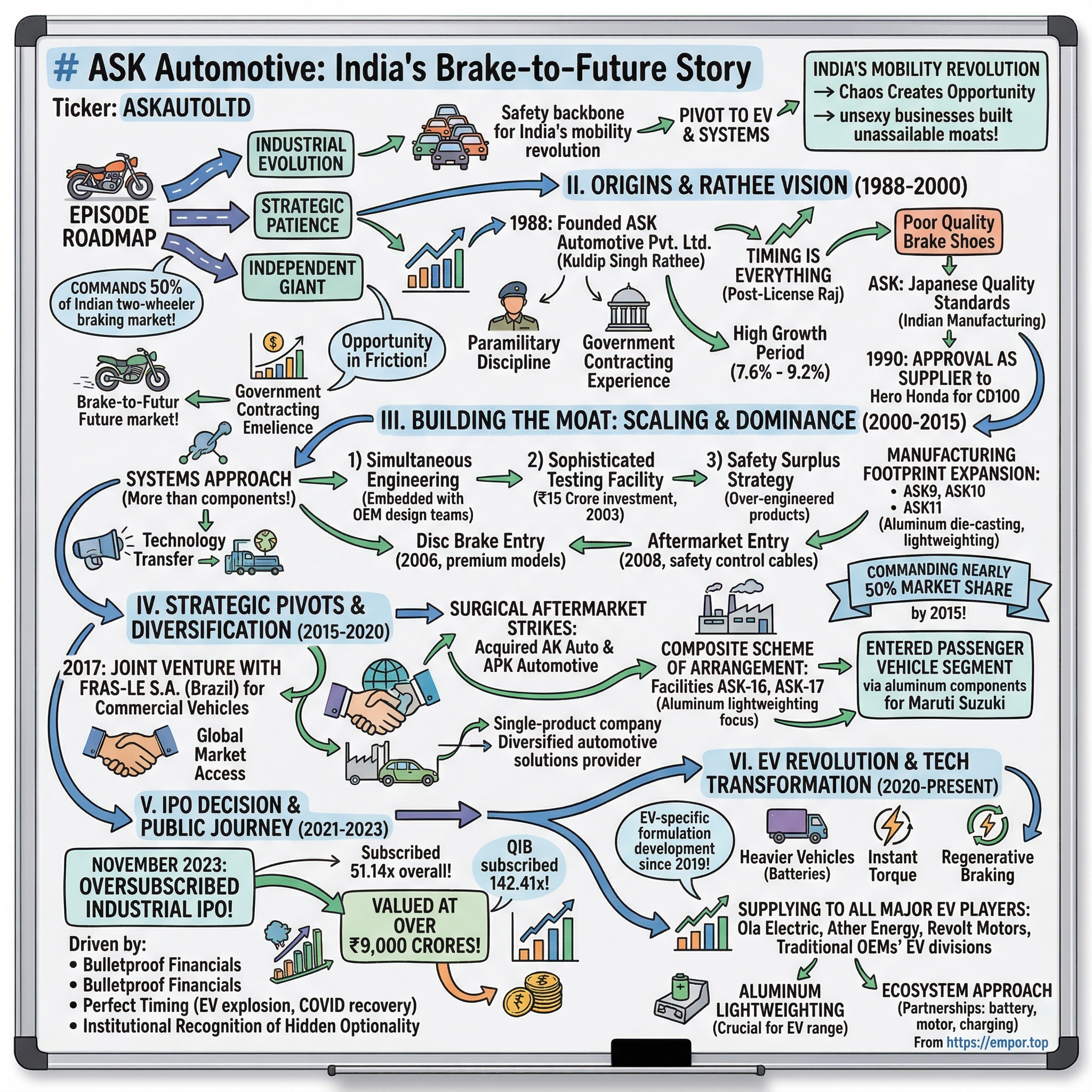
ASK Automotive: India's Brake-to-Future Story
I. Introduction & Episode Roadmap
Somewhere on the Delhi–Jaipur highway right now, a Hero Splendor is braking hard behind a truck. The rider squeezes the lever, a steel cable pulls a cam, two curved shoes press outward against the inside of a spinning drum, and a few grams of resin-bonded friction material convert kinetic energy into heat.
It works, or it doesn't. There is no software layer, no redundancy, no over-the-air patch. The entire safety case rests on a chemistry recipe and a stamping tolerance.
Roughly half the time in India, those shoes were made by a company most people have never heard of.
The scale of the anonymous incumbent
ASK Automotive Limited is the largest manufacturer of brake shoes and advanced braking systems for two-wheelers in India, holding an estimated 50% combined share of original-equipment and branded-aftermarket volumes — a position independently attributed to it by CRISIL in the company's IPO prospectus.1
It supplies virtually every major two-wheeler brand sold in the country: Hero MotoCorp, Honda Motorcycle & Scooter India, TVS, Suzuki, Yamaha, Bajaj, Royal Enfield, and electric entrants such as Ola Electric and Ather Energy.2
The financial numbers reflect that reach. In the fiscal year ended March 2026, ASK reported total income of ₹4,196 crore (up 16.2%), EBITDA of ₹551 crore, and profit after tax of ₹297 crore.3 Return on average capital employed stood at 26.9%, placing it near the top of the listed Indian auto-component sector.3
In the June 2026 quarter, it posted the highest revenue, EBITDA, and net profit in its history, prompting management to raise full-year growth guidance from mid-teens to high-teens.45
The fact that reframes the story
Here is the detail that reframes the company: in FY26, braking was no longer ASK's largest business.
Aluminium lightweighting precision solutions — die-cast crankcases, engine covers, motor housings, battery enclosures, and structural brackets — contributed 50.8% of revenue, compared to 36.9% for advanced braking systems.3 Five years earlier, braking represented 52.9% of revenue while aluminium accounted for 31.7%.1
The company that built its core franchise in friction has evolved, by revenue, into a high-pressure die-casting supplier that also owns the country's dominant brake-shoe business.
That inversion is the central tension of the story. The braking business provides the moat: proprietary formulations, lengthy OEM validation cycles, and decades of established vendor ratings. The aluminium business provides the growth — a segment where ASK held roughly a 9% share of the two-wheeler market at the time of listing, competing head-on against much larger suppliers.1
One business earns the right to exist. The other has to win it every year.
Myth versus reality
Three common consensus descriptions of ASK circulate in broker notes and business coverage. Each contains partial truth and benefits from context:
-
Myth: It is primarily a braking company. Reality: Braking is now the smaller half of revenue and the segment growing more slowly. The core investment debate centers on the die-casting business, making the die-casting competitive landscape the primary benchmark.
-
Myth: It is essentially debt-free and self-funds growth. Reality: While the company funded its plant build-out without primary equity, it carries meaningful debt. Leverage has risen since listing, and the FY27 capital expenditure programme exceeds annual net profit by a wide margin.36
-
Myth: The electric-vehicle transition is its main growth engine. Reality: Electric two-wheelers accounted for under 5% of FY26 revenue, and the customers driving EV volumes were the same legacy OEMs that dominate the internal combustion engine order book.37
What the evidence has to settle
The bullish narrative presents a cash-generative safety franchise funding a fast-growing lightweighting business, both powertrain-agnostic, riding an Indian two-wheeler market that produced 26.7 million units in FY26.3
The skeptical narrative presents counter-evidence. Braking grew 17% in FY26 against industry production growth of 11.8% — solid outperformance, but modest for a business framed as compounding market share.3 The aluminium segment's high headline growth is inflated by raw alloy price pass-through that management itself strips out when assessing performance.4 Exports, repeatedly described as a strategic priority, represented 3.4% of FY26 revenue and were lower in absolute terms in FY25 than in FY24.38
Additionally, effective January 1, 2026, the Indian government mandated anti-lock braking systems on every new two-wheeler — a regulatory change pushing front wheels from drum to disc brakes, precisely the segment of the braking market where ASK is weakest.910
The road ahead runs through the company's founding in a liberalising Delhi, the accumulation of formulation know-how and OEM lock-in through the 2000s, an M&A and joint-venture phase in the late 2010s that included acquiring two businesses from the founder's sons, an all-secondary IPO in 2023, the segment inversion, the AISIN partnership, and the regulatory shift now reshaping the supply chain.
Along the way, this analysis tests, rather than assumes, the claims underpinning the investment case — placing company disclosures and execution records directly alongside each management assertion.
Start with the workshop.
 Subscribe on LinkedIn
II. Origins & The Rathee Vision (1988–2000)
An improbable founder
In 1974, Kuldip Singh Rathee was directly recruited as a Deputy Superintendent of Police in the Central Reserve Police Force, India's largest paramilitary organisation, serving until 1978.3 He held an economics honours degree from Delhi University and subsequently worked as a Class I contractor with the Central Public Works Department alongside a spell in real estate.3
Nothing in that background suggested friction material chemistry. Instead, it provided operational discipline, familiarity with regulatory processes, and comfort with physical execution—a useful foundation for building an auto-component enterprise in pre-liberalisation India.
ASK Automotive was incorporated in January 1988. Manufacturing began the following year at a single facility in Gurugram, Haryana — the plant the company still calls ASK-1 — with an initial entry into original-equipment brake shoes.1
The company bypassed aftermarket sales and distribution to enter original-equipment manufacturing directly.
Why the boring product was the right product
In 1989, nearly every two-wheeler in India relied on drum brakes, which require friction lining attached to brake shoes. Producing that friction lining consistently remains technically demanding.
A brake lining is a composite material combining structural fibres, binding resins, thermal-management fillers, and friction modifiers to regulate grip across temperature ranges. Altering resin curing temperatures by a few degrees shifts lever feedback. An improper blend can cause lining glazing, brake fade, or structural delamination from the steel backing.
Consequently, the entry barrier relies less on capital equipment than on technical validation. Purchasing stamping presses is straightforward, but securing original-equipment manufacturer (OEM) approval requires proving that a friction compound performs reliably across extreme climate conditions and heavy payloads over tens of thousands of kilometres.
The main barrier to entry is validation rather than machinery.
The company's prospectus highlighted this technical moat: as of June 30, 2023, ASK held a portfolio of 52 proprietary formulations, of which only seven had been licensed in from partners — the remaining forty-five developed in-house and, by design, unpatented and unpublished.1
Riding a demand explosion without being consumed by it
Timing also shaped ASK's development. The company started manufacturing just as Indian two-wheeler production began a major expansion phase.
Hero Honda's four-stroke 100cc motorcycles shifted consumer demand toward fuel-efficient motorcycles, while economic liberalisation in 1991 enabled Japanese joint-venture partners to mandate higher local component content. Vehicle manufacturers required domestic suppliers that could maintain strict manufacturing tolerances and delivery schedules, moving away from the fragmented, unbranded workshops that then dominated the friction trade.
ASK capitalized on this period primarily through strategic positioning. It established itself as an organized manufacturer within a fragmented segment and targeted original-equipment supply contracts before pursuing the replacement market.
While original-equipment supply yielded lower initial margins and required stringent auditing, it established certified, long-term vendor relationships. Those OEM validation credentials later enabled ASK to cross-sell additional product categories, including panel assemblies, cables, and die castings.
Owning the recipe
ASK also prioritized internal control over its core processes. The prospectus describes in-house designing, developing and manufacturing capability as a founding characteristic rather than a later addition — the tool room, the dynamometers, the chemical batching all built internally.1
For a specialized chemical formulation business, outsourcing production processes risked compromising proprietary know-how.
By the end of the 1990s, ASK operated a small footprint focused on a single product family. The vendor awards that later filled the annual report — the first Honda Motorcycle & Scooter India recognitions arrive in 2004, 2005 and 2006 — had not started yet.1
At the close of the decade, the company operated from its base in Gurugram with a focused strategy: securing OEM certification rather than competing strictly on price.
The following fifteen years translated that early positioning into a broader market footprint.
III. Building the Moat: Systems Scaling & OEM Lock-in (2000–2015)
The metronome
The clearest way to see what happened between 2000 and 2015 is to read the company's own plant ledger, which reads like a metronome.
ASK-2 in Gurugram, 2001. ASK-3 in IMT Manesar, 2004. ASK-4 in 2009, ASK-5 in 2010, ASK-7 in 2012, ASK-8 in Bengaluru in 2013, ASK-9 and ASK-10 in Manesar in 2014, ASK-11 in Ahmedabad in 2015.1
Nine plants in fifteen years, almost all of them within a short drive of a customer's assembly line.
That geography is not incidental; it is the business model. Braking components and aluminium castings are heavy, low-value-density parts called off against a daily schedule. A supplier sitting forty kilometres from the customer's gate can run genuine just-in-time supply, absorb the customer's inventory risk, and respond to a schedule change in hours. A supplier six hundred kilometres away is running a logistics company with a factory attached.
When ASK put plants in Manesar for Hero and Honda, in Bengaluru for the southern cluster, and in Ahmedabad for Gujarat, it was buying a cost and responsiveness advantage no formulation could deliver.
From part to function
The more consequential shift was in what ASK sold. Two entries in the milestone table mark it. In 2004, the company entered the original-equipment market for aluminium lightweighting with the panel assembly for front brakes. In 2015, it entered the aftermarket for safety control cables — clutch, front brake, throttle and speedometer cables.1
Read those together and the strategy becomes obvious. ASK was climbing from component to sub-system.
A brake shoe is a part. A brake panel assembly — the die-cast aluminium hub plate with shoes, springs, cam and lever already fitted, delivered ready to bolt onto a wheel — is a module. The customer stops buying five things from four vendors and starts buying one thing from ASK. Content per vehicle rises, the customer's own assembly labour falls, and the supplier moves from being a price-per-piece vendor to being the owner of a function.
How a brake company became a die-caster
That move also explains how ASK ended up in aluminium at all.
The company did not wake up one morning and decide to become a die-caster. It became a die-caster because the brake panel it wanted to sell was a casting. Once the pressure die-casting machines were installed and the process discipline learned, the same equipment could make crankcases, engine covers, cylinder blocks and, eventually, electric motor housings and battery enclosures.3
The aluminium franchise that now generates more than half of revenue was, in origin, a by-product of vertical integration into a braking sub-assembly. That is a genuinely elegant piece of industrial logic, and worth naming plainly: capability begat adjacency, not the other way round.
What the moat is, and what it is not
The advantage that formed in this period is best understood as time, not technology.
When a two-wheeler manufacturer changes a brake supplier, it is not swapping a commodity; it is re-opening a homologated safety system. New tooling has to be cut, samples produced, dynamometer-tested, then run through vehicle-level endurance validation across temperature, load and wear cycles. The customer's own engineering resources are consumed by the exercise.
Nobody does this to save two percent on a part costing a few hundred rupees — which is why incumbency in friction, once earned, is unusually durable, and why the awards ASK began collecting from Honda Motorcycle & Scooter India in the mid-2000s for quality, delivery and development support mattered more than they look.1
Now the necessary caution, because "high switching costs" is exactly the kind of phrase that should be tested rather than repeated.
Durable incumbency is not the same as pricing power. ASK's own prospectus is blunt about the shape of these relationships: its customer agreements are open-ended, terminable on notice, and stipulate no firm volume or sales commitment at all. Business flows through purchase orders and delivery schedules the customer may cancel unilaterally, with or without cause.1
The company discloses that no top-three customer had cancelled an order in the three years to FY23 — a bounded statement about a specific period, and one that should not be inflated into a general assurance.1
The moat protects volume continuity. It does not protect price.
The bill that came with the strategy
By FY21, the concentration this strategy produced was visible: the top three customers accounted for 54.3% of revenue and the single largest for 31.9%.1
Winning deeply inside a handful of very large customers is what created the 50% share. It is also what created the dependency. Both arrived in the same package, and neither cancels the other.
By 2015 ASK had scale, share, and a customer list. What it did not have was a corporate structure a public-market investor could look at without flinching.
IV. Capital Deployment, M&A & Strategic Pivots (2015–2020)
The five years leading up to 2020 were, in effect, ASK preparing itself for a public listing. Three distinct moves defined the period, though only one was straightforwardly a growth investment.
Move one: renting a technology from Brazil
On December 6, 2017, ASK signed an agreement with Brazil’s Fras-Le S.A. — part of the Randon group and one of the world's larger friction-material manufacturers — to create a joint venture in India. The venture aimed to manufacture brake linings and pads for commercial vehicles across original-equipment and independent-aftermarket channels.
At the time, ASK's group turnover was reported at over $220 million compared to Fras-Le's $380 million-plus, with the partners planning to invest more than ₹100 crore over three years into a facility in Manesar.11 ASK Fras-Le Friction Private Limited was incorporated in 2017 and began operating in 2018, licensing commercial-vehicle formulations under a January 2018 agreement.111
Strategically, the logic was sound. Commercial-vehicle friction presents a vastly different technical challenge than two-wheelers — higher thermal loads, longer duty cycles, and stricter qualification standards. Licensing the recipes through a partner proved far more cost-effective than acquiring a foreign friction company at a control premium.
However, the structure could not accelerate customer adoption.
Evaluated against its performance, the venture's financial impact remains minimal nearly a decade after the initial agreement. ASK's share of joint-venture profit fell from ₹6.3 crore in FY25 to ₹2.3 crore in FY26 — a drop of nearly two-thirds — alongside a ₹0.8 crore loss in the March 2026 quarter alone, against full-year group net profit of ₹297 crore.3
Whatever capabilities the Fras-Le partnership added, it has not converted into a material commercial-vehicle profit stream after eight years, and recent results trend downward. This track record provides an important base rate when evaluating management claims about newer partnerships opening large addressable markets.
Move two: buying two businesses from the founder's sons
This set of transactions warrants close scrutiny and demonstrates why governance-minded investors inspect prospectus disclosures carefully.
On March 26, 2018, ASK executed two business purchase agreements on a slump-sale basis.
It acquired the independent-aftermarket brake products business for two- and three-wheelers from AK Auto Industries — including the ASK-14 facility, plant, machinery, inventory, staff, and technology — for ₹107.98 crore paid to proprietor Aman Rathee, a company director and member of the promoter group.
On the same day, ASK acquired the matching business of APK Automotive, including the ASK-15 facility, for ₹88.89 crore paid to proprietor Prashant Rathee, who was also a director and promoter-group member.1 Both acquisitions took effect on April 1, 2018.
In effect, the company directed roughly ₹197 crore of corporate capital to purchase personally owned businesses from two of the founder's sons.
The balance sheet reflects the accounting impact of these deals. The goodwill arising from the acquisitions carried a valuation of ₹181.91 crore, tested annually for impairment based on management's five-year cash-flow projections using a 16.2% weighted average cost of capital and a 4% terminal growth rate as of March 2023.1 Consequently, almost the entire purchase price covered intangible value rather than physical assets.
While consolidating family-owned aftermarket operations into the corporate entity ahead of an IPO eliminates potential conflicts between the listed company and the founder's family, the mechanics remain notable.
This related-party capital deployment materially exceeded the company's annual net profit at the time, occurred at valuations established between family members, and created a goodwill balance whose recovery depends on internal cash-flow forecasts.
Move three: collapsing the family structure
The third move finalized the corporate simplification. Through a composite scheme of amalgamation and demerger involving A.A. Autotech Private Limited and Vijaylaxmi Infra Projects Private Limited — effective retroactively from April 1, 2018, and finalized in 2019 — A.A. Autotech merged into ASK, transferring the ASK-16 and ASK-17 facilities in IMT Manesar directly onto the company's balance sheet.1
Prashant Rathee had served as a director of A.A. Autotech from 2008 and Aman Rathee from 2012 until the merger.3
Operating assets also moved out of the company: ASK sold its ASK-9 facility to Vijay Rathee under a sale deed dated March 27, 2018.1
The restructuring produced a cleaner corporate structure with fewer promoter-owned operating assets alongside the corporate vehicle. However, the path to structural simplicity relied extensively on transfers across family balance sheets.
The pivot that mattered most
Alongside the corporate restructuring, ASK executed an operational shift that redefined its product mix.
Stricter emission and fuel-efficiency standards required Indian automakers to reduce vehicle weight, creating strong demand for aluminium high-pressure die casting. In this process, liquid aluminium is injected under high pressure into steel dies to create thin-walled components with minimal need for subsequent machining.
ASK redirected its die-casting capacity — originally built for brake panels — toward engine crankcases, engine covers, cylinder blocks, throttle bodies, and filter housings.3 By FY21, aluminium lightweighting accounted for 31.7% of total revenue.1
While the operational transition was logical and well-executed, it introduced a structural strategic tradeoff. ASK expanded rapidly into a segment characterized by lower entry barriers and larger, better-capitalized competitors — exchanging superior moat strength in friction for a larger total market in lightweighting.
By 2020, ASK possessed a streamlined corporate structure, a fast-growing second product line, and a cash-generative friction business. It was now positioned to seek public market capital.
V. The Public Journey & Management Credibility (2021–2023)
The trajectory that made the offer possible
The three years leading up to the public listing established the company's financial profile. Revenue rose from ₹1,544 crore in FY21 to ₹2,013 crore in FY22 and reached ₹2,555 crore in FY23 — a compound annual growth rate of roughly 29%.6
Profitability followed a more volatile trajectory. Net profit stood at ₹106 crore in FY21, dropped to ₹83 crore in FY22, and recovered to ₹123 crore in FY23.6 Operating margin compressed from 12% to 8% before recovering slightly to 9%.6
That FY22 margin drawdown provides essential context for evaluating the business's structural cost resilience. Unit volumes did not contract; rather, commodity aluminium prices surged. A manufacturer that purchases raw metal, adds processing value, and supplies five dominant vehicle makers found that contractual cost pass-through arrangements operate with a time lag. During a sharp input-cost rally, that indexation lag absorbed a fifth of the profit pool.
Management contends that pass-through clauses function back-to-back to protect absolute EBITDA, arguing that rising raw-material prices distort only percentage margins by expanding the revenue base.5 Historical performance indicates this protection holds over a full cost cycle, even if short-term lags erode profitability across individual quarters.
A pure offer for sale
ASK converted to a public limited company in January 2023 and completed its initial public offering that November. Priced between ₹268 and ₹282 per share on a face value of ₹2, the issue comprised 2,95,71,390 equity shares aggregating approximately ₹834 crore.12 The shares listed on the National Stock Exchange on November 15, 2023.3
The entire ₹834 crore gross proceeds accrued to selling shareholders. Structured purely as an offer for sale, the transaction issued no new shares and raised no primary capital for the company.12
This structure clarifies the company's capitalization requirements. It indicates that internal cash generation and debt facilities were sufficient to finance major capital commitments — including the Karoli mega-facility in Rajasthan, additional Bengaluru plants, and die-casting expansions — without primary equity dilution. However, it does not mean the business operates without debt. As of March 2026, consolidated debt stood at ₹679 crore, with a debt-to-equity ratio of 0.50 and average debt-to-EBITDA of 0.95.63 While rating agency CRISIL maintains AA long-term and A1+ short-term credit ratings on the business, financial leverage has expanded since listing, up from a debt-to-equity ratio of 0.38 in FY25.38
The people running it
Kuldip Singh Rathee continues as Chairman and Managing Director. His executive communication style on earnings calls is notably direct for an Indian promoter, occasionally correcting analysts on past guidance details. During an October 2025 call, when questioned about a perceived 14% margin target, he noted: "It was 13.7% guidance and we have already explained that 30 basis point in percentages only will get affected."13 He also explicitly defined how management targets should be interpreted, concluding that call by stating: "I am an optimist and I always remain optimist. The numbers that we give you are our aspirational numbers."13
Co-founder Vijay Rathee, a science postgraduate and former Punjab & Sind Bank officer, serves as a Non-Executive Director and co-trustee of the group's corporate social responsibility trust.3 Operational leadership rests with the second generation: Joint Managing Directors Prashant Rathee, a Delhi University commerce graduate and former A.A. Autotech director, and Aman Rathee, an engineering graduate holding an MBA from Purdue and an M&A certification from Harvard Business School.3
The independent board offers substantial industry and financial experience. The bench includes Yogesh Kapur, a chartered accountant and former managing director of Enam Securities; Rajan Wadhera, former President of Mahindra & Mahindra's automotive and farm equipment sectors; Vinay Kumar Piparsania, a former executive at Ford India and Hero MotoCorp; and Kumaresh Chandra Misra, a retired Indian Administrative Service officer.3 Governance oversight remains crucial in a business where the promoter and promoter group held a 74.95% equity stake as of June 2026.6
Reading the promoter's own selling
Since listing, the promoter group has executed equity sales on three occasions. The IPO itself monetised roughly 15% of the company.12 In September 2024, Kuldip Singh Rathee sold an additional 6.05% through an offer for sale at a floor price of ₹433 per share, comprising a 5.5% base issue and a 0.55% greenshoe option.14 On November 25, 2025, another 78,85,704 shares — 4% of paid-up capital — were sold, reducing the promoter and promoter group stake from 78.95% to 74.95%. SBI Mutual Fund acquired 78,61,739 of those shares, representing 3.99% of company equity, at ₹473 apiece for ₹371.86 crore.15
The November 2025 transaction carried a regulatory mandate: Securities and Exchange Board of India (SEBI) rules require listed entities to maintain a minimum public float of 25%, and the sale brought total promoter ownership to precisely 74.95%.15 By contrast, the September 2024 sale — executed at a floor price above the IPO band — lacked a compliance requirement, representing a promoter choosing to convert equity holdings into cash roughly ten months post-listing.
While founders routinely diversify holdings and the promoter group retains a nearly 75% unencumbered stake, these repeated liquidity events qualify assumptions regarding insider equity alignment over the post-listing period.
What public investors ultimately underwrote, in November 2023 and since, was the performance of the underlying operating business.
VI. Deep Dive: Core Business, Industry Structure & Moat Analysis
What ASK actually sells, in the proportions it actually sells them
The single most important fact about ASK's business mix is that it has inverted, and the company's FY26 disclosures make that inversion unambiguous.
Aluminium lightweighting precision solutions generated ₹2,121 crore in FY26, a 30% increase that accounted for 50.8% of revenue. Advanced braking systems generated ₹1,542 crore, up 17%, representing 36.9%. Safety control cables contributed ₹157 crore, up 14%, or 3.8%. Wheel assembly — the legacy low-margin business being phased out — contributed ₹207 crore, down 46%, at 5.0%, before dropping to zero on April 1, 2026.3
The wheel-assembly exit illustrates both strategic capital allocation and the practical limits of vendor autonomy. Phasing out the segment expanded operating margins, with management quantifying the benefit at roughly 80 basis points of EBITDA margin against a revenue trade-off of about ₹300 crore.8 Blended EBITDA margin subsequently expanded from 10.3% in FY24 to 12.3% in FY25 and 13.1% in FY26.83
However, the exit was not a swift, unilateral decision. On the May 2025 earnings call, Kuldip Singh Rathee explained that the low margin of the wheel-assembly business had been flagged in the draft prospectus, and management spent two years asking the customer to transition the supply contract before the customer shifted 60% of the volume in the fourth quarter of FY25.8 The transition required two years of negotiations and customer approval, highlighting the allocation of power in major OEM relationships and qualifying descriptions of the portfolio change as a purely autonomous move.
The channels, and what they reveal
In FY26, the channel mix comprised internal combustion engine (ICE) two-wheelers at 68.6%, the independent aftermarket at 10.0%, wheel assembly at 5.0%, electric two-wheelers at 4.7%, exports at 3.4%, passenger vehicles at 3.2%, and other applications at 5.1%.3
Three key insights emerge from that breakdown. First, ASK remains overwhelmingly an Indian two-wheeler supplier, with combustion-engine and electric models together generating roughly three-quarters of total revenue. Second, the aftermarket's 10% share provides a modest profit buffer that should benefit structurally from the reduction in Goods and Services Tax (GST) from 28% to 18%, as ASK's branded products compete directly against lower-priced unbranded and counterfeit parts — a dynamic management explicitly noted.13 Third, the primary growth vectors emphasized in market commentary — exports and passenger vehicles — combined to generate less than 7% of revenue despite years of focused expansion.
Export performance illustrates the gap between strategic emphasis and financial contribution. Exports dropped from ₹174 crore in FY24 to ₹147 crore in FY25.8 In the first half of FY26, export revenue reached ₹63 crore compared to ₹74 crore in the prior-year period, which management attributed to tariff disruptions and supply constraints in rare-earth magnets while maintaining that full-year exports would surpass FY25 levels.13 In the June 2026 quarter, export revenue rebounded to ₹39 crore from ₹33 crore, and management targeted 20% export growth for FY27 alongside a Ford contract valued at ₹40 crore to ₹45 crore.45 While recent quarterly metrics show stabilization, export sales have not yet achieved material scale, making near-term growth reliant primarily on domestic demand.
The competitive map
The Indian two-wheeler advanced braking market that ASK leads remains modest in absolute size. CRISIL valued the segment at ₹2,822 crore in 2023, projecting an 8% compound annual growth rate to roughly ₹4,142 crore by 2028, with ASK, Allied Nippon, Endurance Technologies, and Brembo as the primary suppliers.1 Maintaining a 50% share in a ₹2,800 crore market provides a strong anchor, but offers limited absolute room for expansion — explaining why the company expanded into aluminium lightweighting.
In aluminium die casting, the addressable market is significantly larger, but ASK operates as a smaller player. The IPO prospectus identifies Endurance Technologies, Craftsman Automation, Sundaram Clayton, and Rico Auto Industries as primary competitors, estimating ASK's share of the two-wheeler lightweighting market at 9% in FY23.1
The scale difference is most evident when comparing ASK with Endurance Technologies. In FY26, Endurance reported consolidated total income of ₹14,720 crore — up 26.1% — and net profit of ₹952 crore, representing roughly three and a half times ASK's revenue and more than three times its net profit.16 Endurance operates across die-casting, suspension, braking, and transmission sub-systems across India and Europe for two-, three-, and four-wheeler manufacturers.
This comparison reflects distinct operational profiles. ASK delivers higher returns on capital, generating a 26.9% return on average capital employed compared to Endurance's standalone EBITDA margin of approximately 12.6% on a substantially larger asset base.316 ASK's narrower product scope offers operational focus, though it leaves the company more exposed to single-category cycles. Meanwhile, the segment leader operates at multi-fold scale, supplies a broader client base, and continues to expand.
In commercial-vehicle and passenger-car friction — the segments targeted by the ASK Fras-Le joint venture — the competitive landscape features established specialists including Brakes India, Rane Holdings, Bosch, Allied Nippon, Sundaram Brake Linings, Hindustan Composites, and Masu Brake Pads.1 This crowded market of established four-wheeler suppliers explains why the joint venture has generated limited earnings after eight years of operation.
Where the advantage is real
Beyond marketing narratives, ASK's structural advantages rest on three specific mechanisms.
The first is its library of 45 self-developed friction formulations held as trade secrets rather than patents, validated on internal dynamometers for Indian operating conditions.1 While trade-secret protection carries inherent risk — as noted in the prospectus warning that confidentiality cannot be guaranteed — the primary barrier for competitors is not discovering a chemical blend, but completing the lengthy re-homologation process required on active vehicle platforms.1
The second advantage is geographical co-location. ASK operates 18 manufacturing facilities located near major automotive hubs in Gurugram-Manesar, Bengaluru, Haridwar, Baddi, Ahmedabad, and Karoli, supported by a workforce that expanded from roughly 7,000 in early 2026 to over 9,000 by May 2026 as the Karoli plant scaled up.35
The third mechanism is vendor relationship longevity, reflected in a 33-year supply relationship with Hero MotoCorp and relationships spanning two decades or more with its next four largest two-wheeler customers.3 This track record demonstrates the practical impact of customer switching costs.
However, these advantages do not insulate the business from customer pricing leverage — and the most significant near-term shift facing ASK is driven not by market competition, but by regulatory mandate.
VII. The EV Revolution, Product Mix & Falsification Testing
The powertrain-agnostic claim, examined
The most frequent assertion in ASK's investor materials is that its products are powertrain-agnostic.3 While factually correct, this statement provides limited analytical insight into the company's growth trajectory.
Every vehicle requires a braking system regardless of its propulsion method. When Indian electric two-wheeler manufacturers expanded production, ASK was not displaced; instead, it secured new supply contracts. The company had onboarded nine electric-vehicle original-equipment manufacturers (OEMs) as customers between April 2021 and the publication of its initial public offering prospectus, and currently supplies Ola Electric and Ather Energy, among others.12
The key analytical question centers on content value per vehicle rather than supplier survival. Management asserts that content per vehicle on an electric two-wheeler runs roughly 40% to 50% higher than on an equivalent internal-combustion engine model.13 This value increase stems from aluminium lightweighting rather than friction components: electric scooters require die-cast motor housings, battery enclosures, controller housings, and structural brackets that are absent in petrol vehicles, whereas braking content remains broadly comparable.
Consequently, ASK's electric-vehicle upside represents primarily a lightweighting expansion opportunity. This dynamic places the company's growth in a segment where it holds a single-digit market share, rather than the braking segment where it maintains a dominant position.
The scale reality check
Examining the financial data shows that electric-vehicle volumes remain small relative to total revenue.
Electric two-wheeler components represented 4.7% of ASK's total revenue in FY26, compared to 4.2% in FY25 — representing a 50-basis-point expansion in product mix over the year.3
Macroeconomic retail data reflects this gradual transition. Electric two-wheeler retail sales in India reached 1.4 million units (1,401,818 units) in FY26, representing a 21.8% increase, while market penetration rose from 6.1% to 6.5% of total two-wheeler sales — exceeding 10% only in June 2026.7 Management acknowledged this modest contribution during an October 2025 conference call, noting that "EV is not performing much."13
Customer volume shifts within the segment provide further context. In FY26, TVS Motor Company led electric two-wheeler sales with 341,647 units, followed by Bajaj Auto at 289,325 units. Ather Energy grew sales 82% to 239,129 units, and Hero MotoCorp expanded 196% to 144,330 units. Conversely, former market leader Ola Electric saw retail volumes decline 52% to 164,294 units.7
For an auto-component supplier, this volatility demonstrates that emerging electric-vehicle startups delivered unpredictable manufacturing volumes. ASK's exposure to new EV entrants has functioned primarily as a strategic hedge, while actual segment volume growth was driven by the established OEMs that dominate its internal-combustion order book. The electric transition has altered ASK's per-vehicle component mix more than its underlying customer base.
The regulation that actually matters
While market focus centered on electrification, regulatory mandates reshaped the two-wheeler braking market directly.
On June 23, 2025, the Ministry of Road Transport and Highways issued a draft notification proposing mandatory anti-lock braking systems (ABS) across all L2-category two-wheelers, with the requirement taking effect for new vehicle models on January 1, 2026.9 Prior to this rule, ABS was compulsory only for motorcycles exceeding 125cc displacement, representing roughly 16% of total industry volume. The mandate extended coverage to the remaining 84% of the market — the 100cc commuter motorcycles, scooters, and mopeds that comprise ASK's primary volume base.10
This regulation presents significant engineering and supply-chain implications. Commuter two-wheelers predominantly utilize drum-brake systems on base models. Compliance requires replacing front drum assemblies with disc brakes and electronic ABS control modules. Industry estimates project unit cost increases of ₹2,000 to ₹3,000 on vehicles already equipped with front disc brakes, and ₹5,000 to ₹7,000 on models requiring a complete conversion from drum to disc assemblies.10 Industry executives, including Bajaj Auto Executive Director Rakesh Sharma, cautioned that full supply-chain readiness could require 12 to 24 months.10
The mandate effectively forces a large-scale transition from front-wheel drum brakes to disc-brake systems across India's commuter vehicle market.
Testing the 50% share claim against the disc transition
This structural shift directly tests ASK's long-term market share trajectory.
ASK's estimated 50% market share applies primarily to brake shoes, the core friction element of drum brakes. Its competitive position in disc brake pads is substantially smaller. Company prospectus disclosures indicate that against an installed disc-brake pad capacity of 17 million units, annual capacity utilization ranged between 54% and 57% across FY21, FY22, and FY23. Over the same period, brake-shoe capacity utilization operated between 74% and 80%.1
While ASK does not separately disclose its specific market share in two-wheeler disc brake pads, operational metrics confirm that the company holds a leading position in drum-brake shoes — the product being displaced — and a lower utilization rate in disc brake pads.
Furthermore, the competitive landscape in disc braking and ABS integration differs significantly from traditional drum systems. In advanced two-wheeler braking, the prospectus identifies Allied Nippon, Endurance Technologies, and Brembo as primary competitors.1 Endurance produced approximately 280,000 single-channel ABS units in FY26 and outlined plans to expand production capacity toward 1.2 million units annually, while trade estimates value the broader medium-term two-wheeler ABS market at approximately ₹80,400 crore, with Bosch and Continental holding dominant positions in electronic control modules.1610
ASK produces friction materials and structural castings rather than electronic ABS modules.
The calibrated conclusion
Evaluating historical performance against these regulatory changes narrows the core investment thesis.
The regulatory mandate does not invalidate ASK's established customer relationships or friction formulation capabilities, as disc-brake assemblies still require friction pads. However, the assumption that a 50% market share in drum brakes automatically guarantees equivalent share capture in ABS-equipped disc systems is unproven. ASK occupies a strong position in a shrinking product category, holds a weaker market share in the expanding disc segment, and does not manufacture high-value electronic ABS modules.
The company's capital allocation reflects a measured response. On January 28, 2026, the board approved two leased manufacturing facilities in Rajasthan for brake shoes and disc brake pads, adding 6 crore units annually to existing capacity of 26 crore units — a 23% capacity increase — for an investment of approximately ₹35 crore funded from internal accruals, with commissioning targeted for the first quarter of FY27.17 This ₹35 crore commitment represents roughly 5% of the company's ₹700 crore total capital expenditure budget for FY27.5
Management's public commentary on the mandate remained cautious during earnings calls. In October 2025, Chairman Kuldip Singh Rathee stated that the official implementation date was unconfirmed, noting that major OEMs lacked definitive timelines and adding: "There is a lot of uncertainty. Let the notification come, then only we can clarify."13 By August 2026, management continued to characterize the regulatory framework as draft proposals pending final notification.5
This stance reflects standard industry practice regarding OEM homologation timelines, though it also indicates a conservative approach to a major regulatory realignment.
The key metric for evaluating ASK's adaptation will be the growth rate of its advanced braking segment relative to overall two-wheeler production over upcoming quarters. In FY26, prior to full mandate enforcement, ASK's braking revenue grew 17% compared to industry vehicle production growth of 11.8%.3 If ASK successfully defends its market share during the disc-brake transition, this growth premium should persist as per-vehicle disc content increases. Conversely, if competitors capture disc-pad share on platforms where ASK previously supplied drum shoes, segment growth will converge toward or lag industry production.
While that plays out, management has been building an entirely different optionality — in a vehicle segment ASK has barely touched.
VIII. Strategic Expansion: AISIN Partnership & 4W Aftermarket (2024–2026)
The partner
Aisin ranks among the ten largest tier-one automotive suppliers globally, serving as the Toyota group's historical transmission and drivetrain arm while manufacturing clutches, water pumps, brake components, and body systems across the passenger-car industry.8
On April 24, 2024, ASK executed a joint-venture agreement with Aisin Asia (Thailand) Company Limited and AISIN Automotive Haryana Private Limited. The resulting entity, AISIN ASK India Private Limited, was incorporated on July 30, 2024, to market and sell independent-aftermarket passenger-car components across India, Nepal, Sri Lanka, and Bangladesh.18
The venture showcased its product lineup at the Bharat Mobility Global Expo in January 2025 before launching commercial distribution in April 2025.[^19]819
Why the structure is the interesting part
The strategic design of the venture rests on what it excludes: manufacturing.
Structured as a marketing and distribution alliance, the entity avoids capital commitments for four-wheeler original-equipment tooling or platform validations with major automakers like Maruti Suzuki or Hyundai. Instead, ASK routes Aisin's globally engineered components through its established distribution infrastructure — leveraging dealer networks, mechanic training programs, and the branded aftermarket presence expanded through its 2018 acquisitions.
This approach commercializes ASK's independent aftermarket channel, which represents 10% of total revenue.3 Unlike original-equipment supply contracts that depend on single-customer relationships, a distribution network functions as a reusable asset capable of absorbing new product lines with minimal incremental capital. If successful, the strategy monetizes existing distribution assets; if sales lag, financial exposure remains limited.
However, this arrangement yields trading economics rather than manufacturing margins — characterized by lower gross margins, reduced capital intensity, and no accumulation of proprietary technology for ASK.
What it has actually delivered
Two years after formation, financial contributions remain minimal, a timeline management openly acknowledges.
On the August 2026 earnings call, Chief Financial Officer Naresh Kumar noted that while the joint venture continues expanding its product range, profitability is not expected until the fourth quarter of FY27, adding that initial returns will be modest and trading-focused, with formal FY28 guidance deferred to second-quarter results.5
This trajectory aligns with historical precedent across ASK's technical partnerships. The commercial-vehicle friction venture with Fras-Le, established in 2017, remained financially immaterial through FY26.3 Similarly, a February 2024 technical collaboration with Taiwan's LIOHO Machine Works for two-wheeler alloy wheels remained in customer validation through August 2026, generating no commercial revenue two and a half years post-signing.8135
This extended timeline reflects the rigorous validation cycles required for safety-critical components. As Chairman Kuldip Singh Rathee noted, because automotive safety parts require thorough customer qualification, approval processes cannot be rushed.13
For investors, this operational reality underscores that technical collaborations at ASK face historical lead times ranging from two to eight years before producing meaningful earnings. Consequently, the AISIN joint venture is best evaluated against these conversion timelines rather than the headline addressable size of the passenger-car aftermarket.
The one that did convert
In contrast to those slower rollouts, one recent partnership achieved commercial execution relatively quickly.
In March 2025, ASK formed a strategic alliance with Japan's Kyushu Yanagawa Seiki to produce high-pressure die-cast alloy wheels for a primary Japanese automaker.8 On August 4, 2026, the company confirmed that manufacturing was operational at its Karoli plant and initial commercial shipments to the customer had commenced.4
Achieving commercial delivery within seventeen months — significantly faster than the LIOHO venture — was aided by entering the agreement with a committed original-equipment client. Management projected peak revenue potential of ₹250 crore against ₹125 crore in deployed capital, guiding for alloy-wheel revenue of ₹70 crore to ₹90 crore in FY27 before scaling toward ₹250 crore in FY28.135
Management estimates India's scooter alloy wheel market at approximately ₹2,000 crore, currently dominated by gravity die casting — a slower, thicker-walled manufacturing process.8 High-pressure die casting enables lighter weight and faster production cycles. If ASK secures broader OEM validation, the technology could allow the company to capture share in a category equal to roughly two-thirds of the entire Indian two-wheeler braking market.
That combination represents a promising, partially proven opportunity, with one customer currently supplied and further platform validations pending.
The German venture, and the capex it all implies
ASK pursued another international venture on June 25, 2025, when its board approved a joint venture with Germany's T.D. Holding GmbH to manufacture and sell passenger-vehicle sunroof control cables and helix cables. ASK holds a 49% stake alongside TDH's 51% controlling interest, committing an initial investment of ₹2.45 crore.20 Management targeted initial commercial deliveries for the second half of FY27.5
These expanding partnerships accompany a substantial capital expenditure cycle. After spending approximately ₹600 crore across FY24 and FY25 combined and ₹450 crore in FY26, management raised its FY27 capital budget to ₹700 crore — driven by a major customer order requiring a new facility in South India to be operational before March 31, 2027.135 Funding relies on a combination of internal cash flows and debt, with management targeting a debt-to-equity ratio below 0.5.5
The Karoli mega-plant in Rajasthan, which absorbed ₹490 crore by March 2025, serves as the primary operational test for this expansion.8 Plant utilization reached 75% in the June 2026 quarter, up from 60% to 65% previously, while monthly revenue increased from ₹60 crore to ₹110 crore. Management projects full-year revenue from the facility to reach approximately ₹1,500 crore across FY27 and FY28, which aligns with its targeted asset turnover ratio of 1.75 times.513
Committing a ₹700 crore capital budget against annual net profits of ₹297 crore demonstrates aggressive growth reinvestment funded partially through leverage. While supported by customer commitments, this expenditure marks a shift from a self-funded model to a leverage-assisted growth strategy, leaving returns sensitive to underlying two-wheeler volume cycles.
IX. Playbook: Business & Operating Lessons
Running ASK through Hamilton Helmer's 7 Powers
Helmer's framework asks a hard question: what stops a competitor from replicating your economics? Applied honestly to ASK, three of the seven powers are present in some form, and four are not.
Switching costs — present, and the strongest of the three. Not contractual switching costs; ASK's agreements carry no volume commitment and are terminable on notice.1 The lock-in is procedural. Re-homologating a friction system on a live platform consumes the customer's own engineering bandwidth for a validation cycle that management describes, without irony, as something they are "never in a hurry" about.13 Thirty-three years with Hero MotoCorp is the observable output of that mechanism.3
Cornered resource — present, but narrower than advertised. Forty-five self-developed friction formulations, held as trade secrets rather than patents, tuned to Indian heat, dust and load.1 The company's own prospectus concedes it cannot guarantee they stay confidential.1 Call this a real asset with a soft perimeter: valuable because re-validating a rival's version is slow, not because the chemistry is unknowable.
Scale economies — present in the pond ASK swims in, absent against the largest peer. Purchasing power in aluminium and resin, plant density around OEM clusters, and a fixed-cost base spread over 26 crore braking pieces a year matter enormously against regional friction suppliers.17 They matter much less against a competitor running three and a half times the revenue.16
Process power — claimed, not demonstrated. Management points to precision die casting and low scrap rates, but ASK has published no scrap, yield or first-pass-quality data that would let an outsider verify a process advantage over Endurance, Craftsman or Rico. The 26.9% return on average capital employed is consistent with an efficiency edge; it is also consistent with an asset-light aftermarket mix and a well-timed capacity cycle.3 Treat this as unproven rather than established.
Branding, network economies, counter-positioning and cornered distribution — absent. The "ASK" brand does carry real weight in the two-wheeler independent aftermarket, where CRISIL identified it as the leading brand by production volume for FY23, and that is worth something in a channel plagued by counterfeits.1 But brand power in a ₹300-per-part replacement category is a modest force, and there is no network effect, no counter-positioning, and no exclusive distribution to speak of.
The honest summary: ASK has one strong power, one moderate power with a soft edge, one power that works locally and fails against the segment leader, and one that is asserted rather than shown. That is a good industrial business. It is not an unassailable one.
Lesson one: how to manage a commodity you cannot control
Aluminium is roughly the largest input in ASK's cost of materials, and its price moves violently.
The company's mechanism is back-to-back pass-through with customers: raw material cost plus value addition, with the metal element repriced. Kuldip Singh Rathee's formulation is unusually clear — "in percentages it will keep on changing, but the absolute numbers will remain the same."13
The consequence is a set of financials that require translation. In the June 2026 quarter, reported revenue grew 52.1%, but 33.4 percentage points of that came purely from alloy price pass-through and minus 6.6 points from the wheel assembly wind-down, leaving underlying growth of 25.3%.4 EBITDA margin fell 176 basis points to 12.0% — not because profitability deteriorated but because the denominator inflated.4 Absolute EBITDA rose 32.7%.4
The operating lesson generalises beyond ASK: in a pass-through business, margin percentage is a contaminated metric and absolute gross profit per unit is the honest one. Investors who penalise the margin line in an aluminium rally, and reward it in a crash, will consistently misread this company.
But the FY22 record already established the limit of that mechanism. Pass-through with a lag is not a hedge. It is a delayed reimbursement, and in a sharp enough rally the delay is expensive.6
Lesson two: how to sell to customers far larger than you
ASK's five largest customers are among the largest two-wheeler manufacturers on earth. Its top three generated 60.8% of revenue in FY23, with the largest alone at 34.5%.1 The textbook outcome for a supplier in that position is annual price-down negotiations grinding margins toward the cost of capital.
That has not happened, and the mechanism is worth naming because it is transferable. ASK moved up the assembly: from shoe to panel assembly to co-designed sub-system, with in-house design, tooling and dynamometer testing so the customer's engineers are collaborating on a solution rather than tendering a part.1 A vendor that owns a function is negotiated with. A vendor that supplies a piece is squeezed.
The second half of the mechanism is the aftermarket. Roughly a tenth of revenue comes through a branded channel where ASK, not the OEM, owns the customer relationship, and where GST 2.0's reduction from 28% to 18% improves branded product's competitiveness against grey-market copies.133 That channel is the reason ASK's economics are not purely a function of OEM goodwill.
Lesson three: know which businesses to leave
The wheel assembly exit is the cleanest capital-allocation lesson in the company's record, and its most interesting feature is how long it took. The problem was disclosed in the draft prospectus. Management then spent two years asking the customer to move the business elsewhere before the customer shifted 60% of it in Q4 FY25, with the remainder gone by April 1, 2026.83
The lesson is not "exit low-margin businesses." Everyone knows that. The lesson is that in a captive-supply relationship you often cannot exit unilaterally, that the exit therefore has to be negotiated over years, and that the time to identify the low-value-add business is before you build capacity for it.
Lesson four: buy the recipe, rent the customer
ASK's approach to new technology has been consistent for two decades: license or partner rather than acquire. A Japanese non-asbestos brake shoe collaboration in 2001, NUCAP of Canada for mechanically bonded disc pad retention in 2016, HSH for control cables in 2016, Fras-Le in 2018, LIOHO and AISIN in 2024, Kyushu Yanagawa and T.D. Holding in 2025.3
Five technical collaborations and three joint ventures is a lot of partnership for a ₹4,200 crore company.3 The capital risk of each is small, which is the point.
The evidence also shows the limit. Partnerships that arrive with a customer attached convert quickly — Kyushu Yanagawa, seventeen months to first supply.4 Partnerships that arrive with only a technology can sit in validation for years, or never earn out at all. When the next collaboration is announced, the useful question is not what market it addresses. It is which specific customer asked for it.
That question — evidence versus announcement — is the right frame for the whole investment case.
X. Bear vs. Bull Case & Financial Stress Test
Porter's five forces, applied without flattery
Buyer power: high, and the defining feature of this business. Three customers, more than half the revenue, no volume commitments, cancellable purchase orders, and periodic platform re-tendering.1 The wheel assembly episode showed that even ASK's exit decisions require customer consent.8 This is the force that caps the business's terminal margin.
Supplier power: moderate, and largely neutralised. Aluminium and steel suppliers have pricing power, but the pass-through architecture transfers most of it to the customer, at a lag.134
Threat of new entrants: low in friction, moderate in castings. A new entrant in brake shoes must clear formulation development plus a multi-year OEM validation cycle. A new entrant in aluminium die casting must clear a purchase order and a capital raise. The two halves of ASK's business have structurally different entry barriers, and the half that is growing has the lower one.
Threat of substitutes: rising, and specific. Not a substitute for braking — a substitute within it. The January 2026 ABS mandate is converting front drums to discs across roughly 84% of industry volumes, moving value toward disc pads, calipers and electronic modules.109 ASK's utilisation history shows disc pads as its weakest product line.1 It makes no ABS modules.
Competitive rivalry: intense in aluminium, benign in two-wheeler friction. ASK holds roughly half of a ₹2,822 crore braking market growing at 8%; it holds single-digit share in a much larger lightweighting market where Endurance, Craftsman, Sundaram Clayton and Rico compete hard.1 Mix shift is therefore also a rivalry shift: every year, more of ASK's revenue comes from its more contested business.
The bull case, stated at its strongest
Start with what has actually been delivered, because it is substantial. Over the four years to FY26, revenue compounded at 20.0%, EBITDA at 31.9% and earnings per share at 38.4%.3 Margins expanded from 10.3% in FY24 to 13.1% in FY26 while the company simultaneously walked away from ₹300-odd crore of low-value revenue.83 Return on average capital employed was 26.9%, achieved with debt-to-equity at 0.50 and a CRISIL AA rating.3
The forward case has four legs.
The braking franchise is a genuine cash engine — roughly half of a category that grows with vehicle production, protected by validation cycles, throwing off cash to fund the rest.
The aluminium business is compounding at 30% and now supplies electric motor housings, battery enclosures and passenger-car components, with content per electric two-wheeler running 40-50% above ICE.313
The alloy wheel programme is the first partnership in years to reach supply, addressing a market management sizes at roughly ₹2,000 crore, with ₹250 crore of revenue potential already capitalised.48
And the operating leverage is visible and improving: Karoli at 75% utilisation and rising, monthly revenue nearly doubled in a year, plant-level margins already at blended levels, and management raising FY27 growth guidance to high teens.513
The bear case, stated at its strongest
Customer concentration is not improving in the way it needs to. The top three were 54.3% of revenue in FY21 and 60.8% in FY23.1 The diversification vectors — exports at 3.4%, passenger vehicles at 3.2%, EV at 4.7% — are collectively under 12% of FY26 revenue after years of stated focus.3 Concentration risk here is not theoretical: a single platform re-tender at the largest customer is a mid-single-digit revenue event.
The regulatory shift attacks the strong half of the portfolio. The ABS mandate is a demand event for the braking industry and a mix event for ASK specifically — moving content from the product where it leads to products where it does not, and creating a large electronics pool it does not address.101 Management's stated position as recently as August 2026 was to await final regulation before commenting.5
Margin percentage is hostage to aluminium, and the record shows the hedge is imperfect. FY22 profit fell 22% in a rising-metal year on flat-to-growing volumes.6 Q1 FY27 margin fell 176 basis points on the same mechanic.4
Capital intensity is rising faster than earnings. FY27 capex guidance of ₹700 crore against FY26 profit of ₹297 crore, funded partly by term loans, with debt already at ₹679 crore.563 Leverage has moved from 0.38x to 0.50x debt-to-equity in one year.83
The optionality has a poor conversion record. Fras-Le: eight years, ₹2.3 crore of profit share in FY26 and a loss in the March quarter.3 LIOHO: two and a half years, still in testing.5 AISIN: profitability not expected before end-FY27, and "not significant" even then.5
Regenerative braking is a slow, real drag on the aftermarket. Electric two-wheelers recover part of their deceleration through the motor, reducing friction wear. The effect is small today at 4.7% of revenue and rising penetration makes it larger over a decade, in the aftermarket channel that carries ASK's best economics.
The activist's file
A skeptical long/short investor would open with four items, in this order.
The 2018 related-party purchases. ₹196.9 crore paid to two promoter-group directors for their personally owned aftermarket businesses, generating ₹181.91 crore of goodwill that still sits on the balance sheet and is tested annually against management's own five-year cash-flow projections.1 The economic rationale is defensible. The process — family-to-company transactions priced without a public market — is exactly what a governance screen flags.
Promoter selling cadence. Three monetisation events in three years: a ₹834 crore all-secondary IPO, a 6.05% offer for sale in September 2024 at a ₹433 floor, and a 4% block in November 2025.121415 Only the last was compliance-driven.
Guidance discipline. In May 2025 management targeted a 14% EBITDA margin for FY26 and expected alloy wheel revenue of roughly ₹100 crore in the second half of FY26.8 FY26 delivered 13.1%, and first supply of high-pressure die-cast alloy wheels began on August 4, 2026 — in FY27.34 Management attributes the margin gap to the aluminium denominator and quantifies it at 40 basis points, which is a coherent and largely verifiable explanation.3 The alloy wheel slip is a genuine timing miss on a specific, publicly stated commercial target, and it was not flagged as a miss.
Disclosure gaps. ASK does not disclose segment-level EBITDA, customer names against revenue, disc pad market share, or content per vehicle. For a company whose central investment debate is a product-mix transition inside one segment, that is a material gap — and it means outside investors are calibrating a mix shift they cannot directly observe.
On the other side of the ledger, the file has some clean pages. The auditors have issued no material qualifications, the promoters have confirmed no encumbrance on their shares in FY26, and the pre-IPO restructuring did materially reduce the promoter-owned assets operating alongside the listed company.115
The verdict, weighed
The history does not reject the core claim. ASK genuinely leads Indian two-wheeler braking, genuinely earns high returns on capital, and has genuinely converted a brake-panel by-product into a business larger than the one that spawned it.
The history does narrow the claim in two specific places.
The moat is durable but segment-specific: it protects a business now contributing roughly 37% of revenue and facing a regulatory-driven product substitution, not the 51% aluminium business where competition is open and ASK is not the leader.
The optionality is real but slow: on this company's demonstrated record, a partnership announcement is worth very little until a named customer takes delivery.
What is left intact but unproven is the proposition that ASK can carry its two-wheeler friction economics into disc pads, alloy wheels, passenger-car castings and the four-wheeler aftermarket simultaneously. Nothing in the record refutes it. Nothing yet confirms it either.
XI. Epilogue: The Forward Risk Radar & Key KPIs
The risks that actually have a mechanism
Three core risks present clear operational mechanisms that could alter ASK Automotive's financial trajectory, distinct from broader macroeconomic conditions.
The first is the regulatory disc transition. It carries an established implementation date, clear regulatory rules, explicit per-vehicle cost increases, and an aggressive competitor set — all while shifting market value away from ASK's core drum-brake shoe franchise.1091
The second is a potential deceleration in domestic two-wheeler demand. ASK enters FY27 carrying a ₹700 crore capital expenditure program, a new facility in South India committed to an undisclosed OEM order, the Karoli mega-plant still scaling toward full capacity, and expanding balance-sheet leverage.53 Fixed-cost absorption heavily supports current operating margins. Yet FY26's 11.8% expansion in Indian two-wheeler production was buoyed by GST reductions, tax rationalisation, and interest rate cuts — a favorable alignment of tailwinds unlikely to repeat every year.313
The third risk is execution concentration. The aluminium lightweighting expansion, alloy wheel qualification, AISIN distribution rollout, sunroof cable venture, new southern plant, and Rajasthan braking expansion are all proceeding simultaneously. This multi-front ramp occurs at a company that added roughly 2,000 employees between February and May 2026 as headcount approached 10,000.5 Complex industrial enterprises rarely fail on a single operational front; they fail under the weight of simultaneous execution challenges.
Beyond these core risks sit secondary headwinds: input-cost volatility with its documented quarterly indexation lag, export exposure to tariffs and rare-earth magnet supply bottlenecks that disrupted revenue in FY26, and ongoing platform re-tendering by major customers.13
If we were running it
Three strategic priorities flow directly from the operational evidence.
First, management must address the disc brake pad gap decisively. The ₹35 crore capacity addition represents a sensible incremental step, but it accounts for just 5% of the FY27 capital program against a regulatory shift reshaping the company's core safety market.175 Either ASK can capture leading disc-pad share on platforms where it currently supplies drum shoes — requiring aligned capital allocation and clear disclosure — or friction becomes a legacy cash generator harvested while lightweighting compounds. Both represent viable strategies, but public investors currently lack visibility on which path management is pursuing.
Second, the company should disclose segment-level profitability. Until financial reporting breaks out EBITDA by business segment, the ongoing debate over the strategic shift from a high-moat friction franchise to a more competitive die-casting business relies largely on analytical inference.
Third, ASK must preserve the capital discipline that built its historical returns. A 26.9% return on average capital employed stands out as the company's most compelling financial metric, and a ₹700 crore capex commitment alongside rising leverage is precisely the environment where return on capital risks dilution.35
The three numbers to track
Advanced braking segment revenue growth versus SIAM two-wheeler production growth. This benchmark offers the cleanest quantitative test of whether the anti-lock braking mandate expands or erodes ASK's market position, requiring only two publicly reported data series. In FY26, ASK's braking revenue grew 17% against industry vehicle production growth of 11.8%.3 A widening growth spread indicates that per-vehicle content gains are outpacing any market share loss during the drum-to-disc transition. Conversely, a narrowing or negative spread serves as an early falsification signal.
Absolute EBITDA per quarter rather than EBITDA margin percentage. Because raw aluminium cost pass-through clauses mechanically expand or contract reported revenue, margin percentages fluctuate wildly across commodity cycles. Quarterly absolute EBITDA remains the true gauge of profitability. In the first quarter of FY27, absolute EBITDA reached ₹164 crore alongside a 12.0% margin — illustrating how percentage margins can compress even as the underlying profit pool expands by nearly a third.4
Karoli plant utilisation and revenue generation. Having absorbed roughly ₹700 crore in cumulative capital through March 2025, the Karoli mega-facility represents management's central operational bet, with guidance targeting ₹1,500 crore in full-year revenue across FY27 and FY28 as utilisation climbs beyond 75%.85 If plant throughput scales as projected, operating leverage will validate the expansion. If volume stalls, the heavy capex burden turns a growth strategy into an overhang.
Everything else — the AISIN partnership, sunroof cable joint venture, export pipeline, and disc pad expansion — remains strategic optionality. On ASK's historical record, optionality is proven only when a named OEM takes commercial delivery.
References
-
ASK Automotive Limited — Red Herring Prospectus, 2023 ↩↩↩↩↩↩↩↩↩↩↩↩↩↩↩↩↩↩↩↩↩↩↩↩↩↩↩↩↩↩↩↩↩↩↩↩↩↩↩↩↩
-
ASK Automotive Exiting Low-Value Segments to Drive Margin Growth — Autocar Professional, 2026 ↩↩
-
Investor Presentation, Q4 & FY26 Earnings Call, ASK Automotive Limited — BSE filing, 2026-05-19 ↩↩↩↩↩↩↩↩↩↩↩↩↩↩↩↩↩↩↩↩↩↩↩↩↩↩↩↩↩↩↩↩↩↩↩↩↩↩↩↩↩↩↩↩↩↩↩↩↩↩↩
-
Press Release — Unaudited Financial Results for the quarter ended June 30, 2026, ASK Automotive Limited — BSE filing, 2026-08-04 ↩↩↩↩↩↩↩↩↩↩↩↩↩
-
Earnings call transcript: ASK Automotive Q1 FY27 — Investing.com, 2026-08-05 ↩↩↩↩↩↩↩↩↩↩↩↩↩↩↩↩↩↩↩↩↩↩↩
-
ASK Automotive Ltd — Consolidated Financials, Ratios and Shareholding — Screener.in ↩↩↩↩↩↩↩↩↩
-
TVS leads electric two-wheeler sales with 44% jump in FY26; Ola Electric sees 52% decline — Business Today, 2026-04-01 ↩↩↩
-
ASK Automotive Limited Q4 & FY25 Earnings Conference Call Transcript — ASK Automotive, 2025-05-14 ↩↩↩↩↩↩↩↩↩↩↩↩↩↩↩↩↩↩↩
-
ABS likely to be mandatory on all new bikes and scooters from January 2026 — Autocar India, 2025 ↩↩↩↩
-
ABS mandate to skid entry-level two-wheeler sales and profitability, spur component makers — Moneycontrol via TradingView, 2025 ↩↩↩↩↩↩↩↩
-
ASK Automotive Ltd. signs joint venture with FRAS-LE, Brazil — ASK Fras-le Friction, 2017-12-06 ↩↩
-
ASK sets price band; Old Bridge Capital files papers for MF offering — Business Standard, 2023-11-02 ↩↩↩↩
-
ASK Automotive Limited Q2 & H1 FY26 Earnings Conference Call Transcript — ASK Automotive, 2025-10-31 ↩↩↩↩↩↩↩↩↩↩↩↩↩↩↩↩↩↩↩↩
-
ASK Automotive promoter to pare 6% stake via OFS — India Infoline, 2024-09-26 ↩↩
-
ASK Automotive jumps after SBI MF picks up 3.99% stake — Business Standard, 2025-11-26 ↩↩↩↩
-
Endurance Technologies FY26 Results: India & Europe Drive Record Growth — Carbike360, 2026 ↩↩↩↩
-
ASK Automotive Announces ₹35 Crore Capacity Expansion for Advanced Braking Systems — Autocar Professional, 2026-01-28 ↩↩↩
-
ASK Automotive forms joint venture with Japan-based AISIN Group — Autocar Professional, 2024 ↩
-
ASK Automotive introduces AISIN ASK products, marking its entry into the four-wheeler aftermarket across South Asia — Autocar Professional, 2025 ↩
-
ASK Automotive Board Approves Joint Venture with T.D. Holding GmbH for Sunroof Cable Manufacturing — Autocar Professional, 2025-06-26 ↩
 LinkedIn
 WhatsApp
 Reddit
 Hacker News
 Email
Email Kindle
 RSS Feed
 Spotify
 Apple Podcasts
 Amazon Music
 Audible
 YouTube