Asahi India Glass: The Invisible Giant Behind India's Glass Revolution
I. Introduction & Episode Thesis
Stand on any flyover in Gurugram at rush hour and look down. You are looking at an Asahi India Glass showroom. Roughly four out of every five passenger cars crawling below carry windshields, sidelites, and backlites made by a company almost none of their owners could name. The brand on the bonnet is Maruti Suzuki, Hyundai, or Tata. The brand etched, in a font small enough to require squinting, into the bottom corner of the windshield is AIS.
That anonymity is the point. Asahi India Glass Limited is a business-to-business industrial company that has spent four decades becoming structurally unavoidable in two of India's largest physical-capital markets — the cars Indians drive and the buildings they work in — without ever needing a consumer to choose it.
The numbers, as of late August 2026, describe a company at a pivotal moment. AIS carried a market capitalisation of roughly ₹24,300 crore, with the stock around ₹953 a share.1 For the financial year ended 31 March 2026, consolidated revenue from operations was ₹4,982.15 crore, up 8.44%, and total income crossed ₹5,031 crore.2 Consolidated EBITDA grew 20.16% to ₹959.04 crore. And yet consolidated profit after tax fell 7.16%, to ₹344.70 crore.2
That divergence lies at the heart of the business. A company whose operating earnings accelerated while its net profit declined is one that has just absorbed significant capital costs. Depreciation rose 48.6% and finance costs rose 58.9% in a single year, both consequences of the largest investment cycle in the company's history landing on the income statement at once.2 Return on average capital employed, on a standalone basis, slid from 22% in FY2021-22 to 12% in FY2025-26. Return on equity fell from 21% to 9.74% over the same five years.2
The central question is not merely how a 1984 three-way joint venture became an industry fixture, though that history explains much of what followed. The central question is sharper: does dominance in Indian automotive glass actually convert into durable returns on capital, or does the float glass furnace at the other end of the business eat the returns the windshield business earns?
That question reflects the dual architecture of AIS. The company is not a single unified operation; it is a high-share, high-switching-cost automotive components business bolted onto a capital-hungry, import-exposed commodity glass manufacturer. The two are welded together by a strategy management calls "Deep Localisation," which served as the theme of its FY2025-26 report.2 The bull case holds that this integration creates a moat: raw sand enters at one end, and an ADAS-calibrated panoramic sunroof emerges at the other, a capability unmatched in India. The bear case holds that the structure is a trap: the commodity segment consumes capital at a rate the branded automotive business cannot justify.
Evaluating both perspectives is aided by a 41-year public record and a SEBI-regulated placement document filed in September 2025, which required detailed disclosures beyond standard annual reports.
This operational phase comes at a critical juncture. AIS commissioned its third float glass plant, raised ₹1,000 crore of equity, reduced debt, received a credit rating upgrade, and then guided investors toward a further capital expenditure programme exceeding ₹2,000 crore across FY2027 and FY2028.3 The company is, in effect, exiting one major expansion cycle by embarking on the next. Whether that reinvestment compounds shareholder value or functions as a capital treadmill is the core thesis under evaluation.
Five themes frame this analysis: the mechanics of a tripartite joint venture that outlived most peers from its era; the reduction of single-customer dependency; the backward-integration strategy into float glass; the differing economics of the two primary business segments; and the technology inflection — including sunroofs, acoustic lamination, head-up displays, and ADAS — that is steadily increasing glass value per vehicle in India.
The story begins with a government effort to build a car.
 Subscribe on LinkedIn
II. The Tripartite Genesis: Labroo, AGC, and Maruti (1984–1987)
In the early 1980s, India did not have a car industry so much as it had a car permission system. The License Raj rationed capacity, capped imports, and treated foreign capital with suspicion. Into that environment, the Government of India injected something unusual: Maruti Udyog Limited, a state-backed venture with Suzuki Motor of Japan, charged with producing a small, affordable, reliable car. The Maruti 800 arrived and reshaped Indian roads.
A car maker cannot operate in isolation. Maruti needed an Indian supplier base capable of meeting Japanese quality standards, but in 1984 virtually none existed. Maruti helped build one joint venture at a time, with glass representing a critical gap.
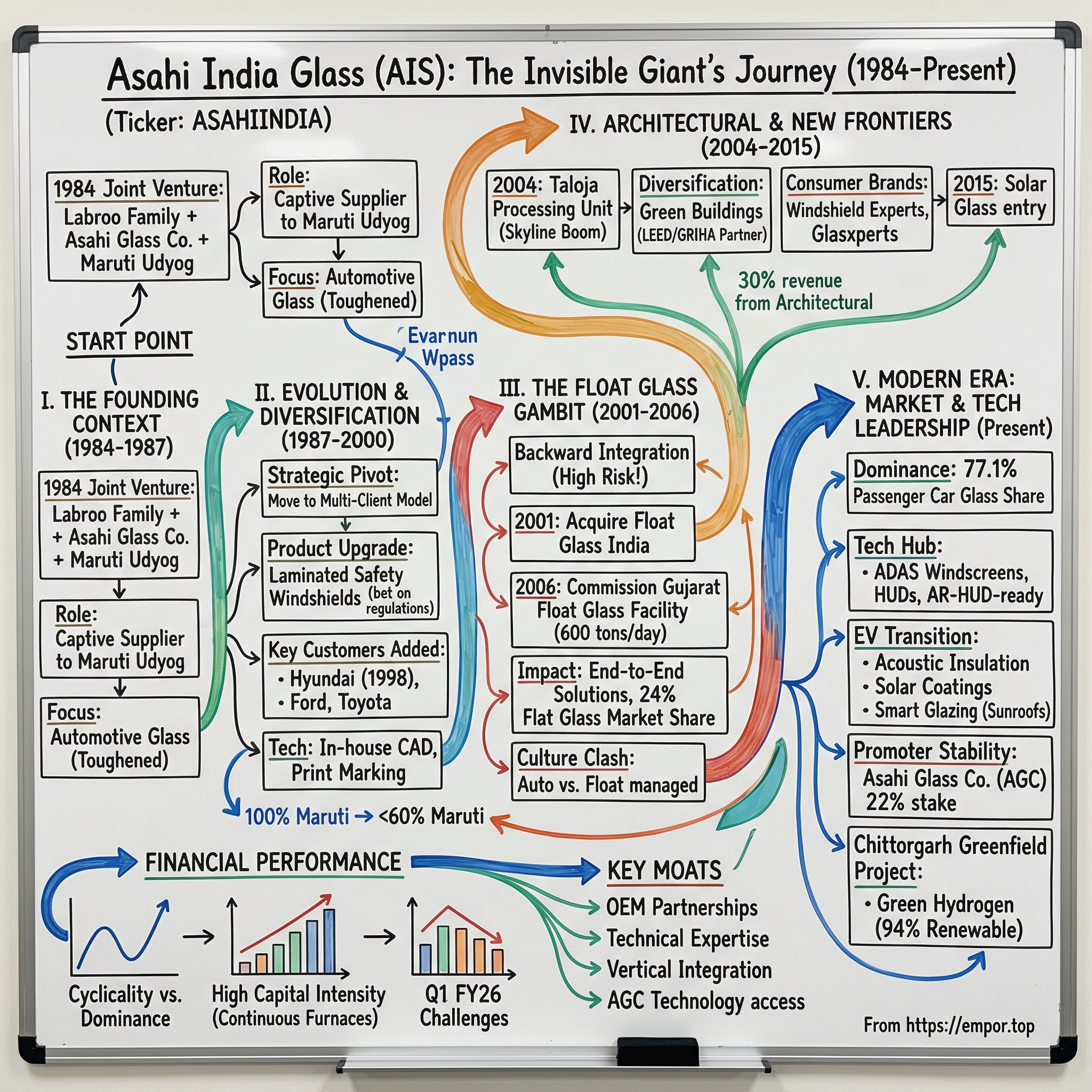
The enterprise that filled it was incorporated on 10 December 1984 as Indian Auto Safety Glass Private Limited, renamed Asahi India Safety Glass in 1985, and became Asahi India Glass Limited in September 2002 after expanding beyond automotive safety glass.4 It commenced commercial operations in March 1987 with a single manufacturing facility for toughened glass automotive windshields at Bawal, Haryana.3 One plant, one product, and one customer.
Three founding partners structured the venture, each bringing distinct assets:
Asahi Glass Co., Japan — today AGC Inc. — supplied the technology. As one of the few global industrial firms with deep flat glass expertise, AGC holds roughly 12–13% of the world float glass market and around 30% of the world automotive glass market.3 Crucially, AGC did not demand majority control. It took a minority-but-anchoring equity stake and provided technical support, leaving operational management to the local team.
The Labroo family managed Indian operations. B.M. Labroo served as founding promoter alongside his son Sanjay Labroo, who became Managing Director in 1990 and remains Chairman and Managing Director today. Sanjay Labroo holds a dual degree in finance and management from the Wharton School and later served as a Director on the Central Board of the Reserve Bank of India — an unusually financial background for an industrial manufacturer.3 That capital orientation became vital when debt pressures mounted in later expansion cycles.
Maruti Udyog brought the order book. In a licensed economy, a guaranteed anchor customer was far more valuable than upfront capital.
Why did this joint venture endure while many 1980s partnerships collapsed? Most early partnerships failed when foreign partners sought remote control while local partners wanted technology without operational accountability. AIS inverted that dynamic: technology came from Japan, execution and regulatory navigation from Delhi, and demand from a customer that was also an equity holder with a shared stake in the outcome.
Testing the "perfect alignment" story
While compelling, this founding narrative remains incomplete. Two structural constraints bound the young enterprise tightly.
The first was reliance on a single buyer. AIS's own historical account notes that it evolved "from a single-plant, single-product, single-customer business."2 For an early supplier, the anchor customer's assembly schedule dictated its cash flow. Any operational hiccup at Maruti — component import delays, licensing friction, or demand shifts — passed straight through to AIS's thin balance sheet.
The second constraint was initial scale. The company's starting capital was ₹1.87 crore, a figure Sanjay Labroo still cites in shareholder letters four decades later as the first of only three equity raises in AIS's history.2 Capitalised at under ₹2 crore while setting up capital-intensive industrial equipment, the company funded expansion through debt and supplier credit. This pattern — relying on debt and retained earnings rather than fresh equity — became standard practice, ultimately straining the balance sheet in subsequent cycles.
The complete picture of the genesis is not simple alignment, but a trade-off: the joint venture structure solved the technology and demand problems effectively, but left the long-term capital structure unaddressed. That balance sheet dynamic persisted across the company's expansion, remaining relevant as AIS entered FY2027 having just completed its third equity raise.2
Before tackling its capital structure, however, the company's immediate imperative was expanding its customer base.
III. Breaking the Single-Customer Handcuffs (1988–2000)
Liberalisation arrived in 1991 and, for an auto components supplier, it looked like a gift wrapped in a threat.
The gift: global carmakers began arriving in India, and every one of them needed a local glass supplier who understood Japanese-standard quality systems. The threat: those same open borders allowed global glass giants to enter the market as well.
AIS spent the 1990s executing two moves simultaneously — climbing the technology ladder and widening its customer base — and the sequencing proved critical.
From toughened to laminated: the technology climb
Start with the physics, which explain the structural barrier. A toughened (or tempered) glass panel is heated and then rapidly cooled so its surface enters compression. Hit it hard enough and it shatters into thousands of blunt granules rather than sharp shards. That is what side windows and rear windscreens are made of. It is a demanding manufacturing process, but it remains a predictable one.
A laminated windshield is a far more complex product. Two curved sheets of glass are bonded around an interlayer of polyvinyl butyral — a tough, clear plastic film. Upon impact, the glass cracks but remains adhered to the film, preserving structural integrity and preventing the roof from collapsing in a rollover. Manufacturing one requires bending two sheets of glass to identical compound curvature under high heat, adhering to sub-millimetre tolerances, and bonding them without creating optical distortion in the driver's line of sight.
That capability gap is why automotive glass functions as a technical component rather than a generic material. It also explains why AIS's technological progression through the 1990s mattered more than any single customer acquisition: laminated windshields were where industry value and competitive barriers would concentrate.
AIS expanded its automotive portfolio over subsequent decades to include laminated windshields, tempered side and backlites, defogger glass, and solar-control glass, eventually extending into commercial vehicles and off-highway segments including tractors, earthmoving equipment, and city trains.3 Each adjacency represented a modest market individually, but collectively they established AIS as the industry's default supplier.
Widening the customer base — and supplying your shareholder's enemies
This phase highlighted a persistent governance dynamic in AIS's corporate structure. Maruti Suzuki is simultaneously AIS's largest customer, a promoter shareholder, and represented on the AIS board.2 Yet AIS actively supplies Maruti's direct competitors.
Today AIS supplies automotive glass to virtually every major domestic original equipment manufacturer — including Maruti Suzuki, Hyundai Motor India, Kia, MG, Honda, Tata Motors, Mahindra & Mahindra, Toyota Kirloskar, Volkswagen, Ford, Škoda, and Fiat — and added Mercedes-Benz India as a premium client in FY2025-26, initially supplying side and rear glass with windshield development to follow.32
That this arrangement has endured for three decades reflects the economic design of the partnership. Maruti's financial interest in AIS's overall corporate profitability has consistently outweighed any incentive to restrict supplier access to rivals. However, investors should recognize that this equilibrium depends on ongoing commercial alignment rather than formal contractual exclusivity.
Testing "unshakable customer lock-in"
The conventional narrative presents AIS as an entrenched market leader facing little competitive risk. The historical record, however, reveals a more nuanced dynamic.
Saint-Gobain did not enter India in 1996 and immediately capture market share from AIS. Instead, Saint-Gobain built its Indian footprint around the Sriperumbudur complex in Tamil Nadu and established dominance in the float glass market over the following two decades. By the time industry ratings were formalized, Saint-Gobain possessed an installed float capacity of 3,850 tonnes per day compared to AIS's 1,250 TPD.8 In float glass, Saint-Gobain achieved clear market leadership. In automotive glass, it did not.
That divergence illustrates a fundamental difference in product economics. The same global competitor, entering the market during the same period with substantial capital, achieved leadership in commodity flat glass while failing to displace the incumbent in automotive glass.
Architectural float glass is sold by the square metre off a standardized price list. Automotive glass is engineered into a specific vehicle platform over a multi-year development cycle using dedicated tooling, making mid-lifecycle switching prohibitively expensive due to re-validation requirements. The 1990s demonstrated not customer sentiment, but high switching costs inherent to automotive manufacturing.
This dynamic has remained consistent. In June 2024, AIS management outlined a target to increase passenger-vehicle glass market share to "up to 75%" in FY2025, up from 72% at the end of FY2024.9 By FY2025-26, the company's annual report placed Auto Glass market share at approximately 80%, a figure independently corroborated by rating agency estimates at around 79%.23 Market share expanded even as Indian passenger vehicle production reached record volumes.
Calibrated verdict: the concept of customer lock-in applies specifically to vehicle platforms already in production. Each new vehicle model launch represents an open competition, which is why AIS tracks its internal "new business win ratio."2 The indicator of a weakening competitive position would not be an immediate drop in total market share, but a sequence of lost high-volume platform bids, which would only materialize in reported market share two to three years later.
Securing new vehicle platforms, however, required expanding underlying glass production. By 2001, AIS remained dependent on third-party suppliers for its raw float glass.
IV. The Float Glass Gambit: Backward Integration & M&A (2001–2006)
At the turn of the millennium, AIS faced a structural vulnerability. The company possessed strong OEM relationships, bending furnaces, lamination lines, and strict quality systems, but lacked control over its core raw material: clear float glass, the flat sheet from which every windshield and window originates. Relying on imports meant that cost of goods sold fluctuated alongside the rupee, ocean freight rates, and the production schedules of foreign suppliers.
Sand to solutions
Float glass manufacturing is a distinct industrial process whose mechanics shape the economics of half the company. Sand, soda ash, dolomite, and limestone melt at roughly 1,600°C before the molten glass is poured onto a bath of molten tin. Floating on the flat tin surface, the glass spreads under its own weight, yielding a sheet of uniform thickness with two smooth surfaces without requiring grinding or polishing.
The primary operational constraint is the furnace. Running continuously for 15 to 18 years, a float glass furnace cannot simply be turned off without destroying its refractory brick lining. AIS's placement document underscores this reality: its Roorkee furnace ran continuously for 18 years before undergoing a planned "cold repair" shutdown scheduled for restart in November 2025, following a comparable shutdown at Taloja in 2014.4 Between these overhauls, the furnace consumes fuel continuously regardless of prevailing market demand.
This engineering constraint creates high operating leverage in both directions. During demand upturns, incremental production yields high operating margins. During downturns, plants must maintain output regardless of price weakness.
The FGI transaction
In 2001, AIS entered float glass manufacturing by acquiring Floatglass India Limited (FGI) and its facility in Taloja, Maharashtra — an entity that functioned as AGC's struggling Indian float venture.3 A subsequent merger folded FGI into AIS, completing its transition from glass processor to primary manufacturer. Consequently, the company adopted the name Asahi India Glass Limited in September 2002 to reflect its expanded scope beyond automotive safety glass.4
Skeptics at the time argued that the listed entity was absorbing a loss-making asset from its foreign promoter. However, subsequent operational integration validated the strategic rationale. Two decades later, AIS maintains a total float glass capacity of 2,150 tonnes per day across plants in Taloja, Roorkee, and Soniyana, Rajasthan, the last of which was commissioned in March 2025.2 Domestic float production enabled net foreign-currency exposure to decrease from ₹629 crore as of 31 March 2025 to ₹519 crore by 31 March 2026.3 Furthermore, in FY2025-26, inter-segment sales from Float Glass to the automotive and architectural divisions expanded to ₹492 crore from ₹65.89 crore the prior year, illustrating the scale of internal sourcing.2
While the transaction achieved strategic integration, it did not insulate the company from cyclical volatility.
Testing "vertical integration eliminates margin risk"
Historical evidence directly challenges the assertion that backward integration eliminates margin risk.
Integrating upstream transformed variable cost risks into fixed cost commitments. Prior to 2001, rising float glass prices compressed margins. After 2001, falling float glass prices left AIS operating continuous furnaces, burning fuel to manufacture products that required price discounting.
The financial strain materialized in the early 2010s. AIS posted consolidated net losses of approximately ₹95 crore in FY2012 and ₹98 crore in FY2013, remaining unprofitable through FY2014 before achieving a modest turnaround in FY2015.1 Having expanded furnace capacity during the preceding decade, the company struggled to service the associated debt. Management addressed the liquidity shortfall through the second equity raise in its history, a ₹250 crore rights issue in 2013, which remains one of only three public capital raises alongside the initial ₹1.87 crore in 1987.2
External trade pressures resurfaced more than a decade later. In a sunset review concluded on 6 November 2025, India's Directorate General of Trade Remedies examined clear float glass imports from Malaysia. The regulator determined that dumping margins reached up to 60%, with Malaysian imports accounting for nearly 85% of total volume during the investigation period. The findings noted that domestic producers "suffered its lowest level of capacity utilisation during the period of investigation, along with a decline in market share resulting in reduced profitability, negative cash flows, lower return on capital employed, and rising inventories."6
This trade assessment documented ongoing structural pressures, confirming that domestic float glass operations faced negative cash flows and margin compression in late 2025.
Calibrated verdict: The premise that vertical integration eliminates margin risk is contradicted by AIS's operational history. Vertical integration delivered specific operational advantages: guaranteed supply, lower foreign exchange exposure, and tight quality control over specialized automotive glass inputs. However, it failed to confer pricing power and amplified earnings volatility across economic cycles. Validating the narrower benefits of integration would require the float segment to sustain profitability without protective tariffs — a condition that remains untested.
Evaluating these structural dynamics requires examining the company's two primary operating segments separately.
V. Segment Economics & Market Structure: Auto Glass vs. Architectural Float
If you want to understand Asahi India Glass as an investment, do one thing: stop looking at consolidated revenue and start looking at where the capital sits.
In the quarter ended 30 June 2026, AIS's Automotive Glass segment carried capital employed of ₹2,693.72 crore and delivered a segment result of ₹127.66 crore. Its Float Glass segment carried capital employed of ₹3,358.52 crore — more — and delivered ₹117.03 crore.5 The smaller business, by external revenue, absorbs the larger share of the balance sheet.
That is the structural tension of AIS in one line, and everything else is commentary.
The automotive engine
In FY2025-26 the Auto Glass strategic business unit posted sales of ₹3,369.31 crore, up 12.70%, with market share around 80% of the Indian passenger vehicle glass market.2 Segment result was ₹367.14 crore.2
The interesting part is what is happening inside that revenue. Indian passenger vehicle volumes rose 7.9% in FY2025-26 to a record 4.64 million units, with exports up 17.5%.2 AIS grew faster than that. The gap is content per vehicle.
Here is the mechanism in plain terms. A basic hatchback needs a windshield, four side windows and a backlite — a fixed quantity of fairly ordinary glass. An SUV with a panoramic roof needs all of that plus a large curved glass panel that is itself a complex laminated part. Add acoustic lamination — a specialised interlayer that damps road noise, essentially a sound-absorbing sandwich filling — and the interlayer costs more. Add solar-control coatings that reflect infrared to keep the cabin cool, which matters enormously in Indian summers and matters even more in electric vehicles where cabin cooling drains range. Add a windshield that must be optically perfect in a specific zone because an ADAS camera looks through it, and must be manufactured to a tighter tolerance so the camera's calibration holds. Add a head-up display, which requires a wedge-shaped interlayer so the driver sees one projected image rather than a ghosted double.
None of these change the number of cars. All of them change the rupees of glass per car. Management framed the opportunity in exactly these terms in the FY2025-26 report: growth comes from "premiumisation, localisation, technology, design and development, new products and higher value addition," so that AIS benefits from both more vehicles and more valuable glass in each one.2 In FY2025, the company expected to supply over 1.5 million sunroof units.9
This is a real mechanism, not a slogan. But it has a limit worth stating alongside it: more content per vehicle is not the same as more margin per vehicle. The Auto Glass segment's result margin actually fell in FY2025-26 — ₹367.14 crore on ₹3,369.31 crore of external revenue, versus ₹360.33 crore on ₹2,989.72 crore a year earlier.2 The company sold materially more glass, of a more sophisticated kind, and converted a slightly smaller fraction of it into segment profit. Premium content raised revenue faster than it raised earnings.
The architectural cyclical
The Architectural Glass business tells the opposite story with the opposite timing, and it is the more instructive one.
Float glass external revenue was ₹1,261.95 crore in FY2025-26, essentially flat against ₹1,266.55 crore.2 Flat sounds benign. Look further back and it isn't: architectural revenue was ₹1,749.39 crore in FY2023, ₹1,527.41 crore in FY2024 and ₹1,332.44 crore in FY2025 — a decline of roughly a quarter across two years, during a period when Indian construction activity was strong.4
That is not a demand problem. That is a price problem.
Its cause is named explicitly in Sanjay Labroo's FY2025-26 shareholder letter: "Additional domestic capacity and aggressively priced, cheaper imports from Chinese transplants in south-east Asian countries continued to exert pressure on the domestic float glass industry."2 The phrase "Chinese transplants" is doing a lot of work — it refers to Chinese-owned float capacity built in Malaysia, Indonesia and Vietnam, which exports into India from outside China's own tariff exposure.
Testing "oligopoly pricing power in float glass"
The four-player domestic structure is real: Saint-Gobain leads on installed float capacity, AIS ranks second, Gold Plus Glass Industry third, with Gujarat Guardian and others behind.8 Concentration exists. Pricing power does not follow from it.
The disconfirming evidence is unusually direct. The FY2025-26 chairman's letter contains this sentence: "I deeply thank the government of India for extending the much-needed temporary support to the domestic industry in the form of imposing a Minimum Import Price (MIP) on clear float glass from imports."2 Read that again as an investor rather than as a shareholder. The chief executive of the second-largest float producer in the country is publicly thanking the state for price protection. That is not the language of a business with structural pricing power.
The policy backdrop confirms it. On 18 August 2026 the Directorate General of Foreign Trade issued Notification No. 29/2026-27, shifting specified clear float glass under HS codes 70051090 and 70052990 from "Free" to "Restricted" unless imported at or above a Minimum Import Price of ₹34,000 per metric tonne, for one year.7 A separate countervailing duty investigation into imports from Malaysia and Indonesia, initiated in September 2025, remained under way.7 Anti-dumping duty on Malaysian clear float glass was recommended for continuation for five further years at a reference price of USD 374 per tonne.6
Three overlapping trade remedies, in force or under consideration, for one product. And AIS was among the domestic producers who petitioned for them.6
Calibrated verdict: the oligopoly pricing power claim is rejected. Float glass realisation in India is currently set by trade policy, not by market structure. This is a segment whose profitability is, to a meaningful degree, a political variable — and the MIP has a one-year clock on it. The observable event that would falsify the bearish read would be float segment margins sustaining after the MIP lapses in August 2027. Until then, any float margin improvement should be discounted for policy content.
There is a genuine counterweight, and it is the reason the picture is not simply grim. The Float Glass segment result improved to ₹246.55 crore in FY2025-26 from ₹200.82 crore, and in the June 2026 quarter it jumped to ₹117.03 crore from ₹36.70 crore a year earlier.25 Some of that is trade protection. Some of it is genuinely operational: F2 at Roorkee restarted after its cold repair, F3 at Soniyana reached stable operations, and mix shifted toward value-added coated products where AIS holds roughly 65% share of the value-added architectural glass segment against just ~13% of architectural glass overall.3
That last pair of numbers is the most useful thing in the segment. AIS is a minor player in commodity architectural glass and a dominant one in the specialised end. If the company's own strategy works, the commodity share stays small and the value-added share carries the segment. If it doesn't, AIS owns 2,150 tonnes per day of furnace competing on price against Southeast Asian imports.
Which brings us to the businesses management would rather talk about.
VI. Retail & Sized Optionality Bets: Windshield Experts & Solar Glass
Every industrial manufacturer eventually faces a strategic temptation: We make the product, so why allow an intermediary to own the customer relationship?
For AIS, that line of thinking produced a cluster of consumer-facing ventures — AIS Windows, AIS Glasxperts, AIS Windshield Experts, and Car Fit Experts — along with a set of energy-adjacent investments. While informal analysis often frames these initiatives as growth optionality, financial statements allow them to be sized precisely.
Sizing the consumer business honestly
First, consumer operations are not immaterial to overall top-line expansion. The Consumer Glass strategic business unit generated ₹765.66 crore in FY2025, accounting for 14.99% of revenue from operations — up from ₹232.21 crore and 5.56% in FY2023.4 That represented one of the fastest-growing divisions across the enterprise.
Second, top-line growth has not yet translated into sustainable capital returns. In FY2025-26, AIS completed a composite corporate restructuring — approved by the National Company Law Tribunal on 19 May 2025 and effective 1 July 2025 — that merged GX Glass Sales & Services, AIS Distribution Services, and AIS Adhesives into AIS Glass Solutions, which was subsequently renamed AIS Consumer Glass Solutions.2 That consolidated entity ended FY2026 with turnover of ₹640.94 crore and profit after tax of ₹24.43 crore, but carried accumulated losses that left reserves at negative ₹65.65 crore.2
Windshield Experts, the company's branded automotive glass repair and replacement network, operates under a separate subsidiary, Shield Autoglass Limited. In FY2026, Shield Autoglass recorded turnover of ₹65.65 crore, a net loss after tax of ₹0.86 crore, and accumulated losses leaving reserves at negative ₹16.25 crore.2 Across the consumer division, the network expanded to more than 79 cities and over 151 dealerships, complemented by AIS Windows experience centres in New Delhi and Bengaluru.2
Consequently, Windshield Experts generates roughly 1.3% of consolidated revenue and has yet to establish standalone profitability. The underlying thesis — that a branded, insurance-linked service network commands higher margins while insulating the aftermarket from sub-standard glass — remains structurally logical, but it is not yet borne out by financial results after years of operation.
Statutory auditors highlighted these balance sheet pressures. AIS's consolidated audit report for FY2026 included an Emphasis of Matter drawing attention to "Auditors Reports of three subsidiary companies regarding accumulated losses and resultant effect on their net worth and current liabilities exceeding current assets," while affirming that these deficits do not jeopardize group going concern status.2 In FY2025, the corresponding audit note encompassed four subsidiaries.4 While these liabilities are modest relative to AIS's ₹3,934 crore equity base, they mark the appropriate metric for evaluating downstream expansion claims.
Managing Director Sanjay Labroo offered a candid assessment in annual reporting, bounding the enterprise's progress: "We have remained small and slow in this business with the objective to understand consumer requirements and build our B2C processes. I am extremely optimistic about exponential growth of AIS-CG."2 Evaluating an eleven-year-old portfolio of consumer brands that leadership describes as intentionally slow, alongside projections of future expansion, leaves the investment hypothesis unproven by empirical returns.
The solar and energy bets
The factual record regarding solar manufacturing requires clarification. Contrary to market commentary suggesting a commercial solar glass line launched in the mid-2010s failed, company disclosures indicate no such manufacturing asset exists. Neither the FY2025-26 annual report nor the September 2025 placement document lists a solar glass production unit among AIS's strategic business units, subsidiaries, or associates.24 AIS operates three formal strategic business units: Auto Glass, Architectural Glass, and Consumer Glass.2 Any prior solar glass initiatives were never operationalized into a reporting manufacturing segment.
Disclosed investments confirm that energy-related commitments have served as targeted operational risk hedges rather than core business diversification. In May 2025, AIS invested up to ₹46.62 lakh for a 26% stake in Boond Solar SPV-A Private Limited.[^10] The company also holds a 33.39% stake in Fourvolt Solar Private Limited — diluted from 40.00% — which contributed ₹0.46 crore to consolidated profit in FY2026.2 Additionally, AIS executed a 20-year green hydrogen supply agreement for the Soniyana float facility, paired with a solar power arrangement for electrolysis.3 Sized in lakhs and low single-digit crores, these transactions represent captive power cost-management decisions rather than growth optionality.
The venture that says the most
The most informative capital allocation decision in recent years occurred outside the primary manufacturing divisions.
Through entities later merged into AIS Consumer Glass Solutions, AIS previously held a 34% equity stake in Under Par Sports Technologies Private Limited. On 24 March 2026, the board of the consumer subsidiary approved selling the entire stake to Under Par's promoter directors, with the transaction closing on 30 March 2026.[^12][^11] Related-party filings also cite AL Sports & Wellness LLP among enterprises subject to significant influence by key managerial personnel.2
Taking a one-third position in a sports technology enterprise and subsequently divesting reflects a distinct capital management pattern: non-core positions are periodically acquired, but leadership demonstrates a willingness to exit them. Separately, in January 2024, AIS acquired equity in AIS Adhesives and AIS Distribution Services from Map Auto Limited, framing the buyouts as part of its strategy to consolidate downstream operations ahead of the 2025 corporate restructuring.10
Calibrated verdict on optionality: None of these secondary ventures is currently large enough to alter the core investment case, and consumer segment profitability remains unverified. The optionality thesis holds only in a limited sense: these represent contained capital allocations that have not impaired balance sheet stability. Revising this assessment would require AIS Consumer Glass Solutions to eliminate its accumulated losses and deliver return on capital comparable to the automotive division — a milestone that has not occurred.
The broader governance questions rest higher up in the corporate structure.
VII. Management, Governance, and Promoter Alignment
Sanjay Labroo has led Asahi India Glass since 1990. That 36-year tenure spans India's economic liberalisation, the Floatglass India acquisition, two severe debt cycles, and the current capital expansion program. Few Indian industrial chief executives match that length of service, and none within the glass sector.
Management's tone in the FY2025-26 annual report stands apart from conventional corporate commentary. The chairman's letter opens with global geopolitics — touchpoints ranging from the Strait of Hormuz and the war in Ukraine to international trade friction — before highlighting artificial intelligence as "creating tectonic shifts in EVERYTHING."2 Beyond its unconventional style, the commentary is notable for acknowledging operational headwinds directly rather than obscuring them.
Labroo refrained from portraying the year as a financial success. Instead, the annual report explicitly cited input inflation, supply chain friction, increased depreciation, higher finance costs from newly commissioned assets, competitive pressures in architectural glass, and "the time required to fully optimise newly created capacity, affected our returns," observing that "given the capital-intensive nature of the glass business, there is usually a lag between capacity creation and financial returns."2 Identifying these margin pressures directly provided an upfront assessment of operational challenges before market analysts raised them.
The ownership structure
Promoter entities held a combined 51.58% stake as of 31 March 2026, where entity composition carries more analytical weight than total ownership.3 AGC Inc. held 21.18%, Managing Director Sanjay Labroo held 11.47% personally, and Maruti Suzuki India held 10.59%.2 All three principal shareholders experienced minor dilution during the September 2025 qualified institutional placement — AGC from 22.21%, Labroo from 12.02%, and Maruti Suzuki from 11.11% — as neither promoters nor board directors participated in the equity issue.24
The ten-member board of directors included five independent members as of 31 March 2026, two of whom were women.3 Board membership also experienced recent turnover: Masahiro Takeda resigned upon retiring from AGC, independent director Setsuya Yoshino stepped down upon returning permanently to Japan, Kazuo Ninomiya joined as a Non-Executive Director, and Takahiro Tokuda was appointed as a Non-Executive Independent Director via a postal ballot concluded on 9 May 2026.2[^14] While fully disclosed and compliant with regulatory standards, the routine rotation of Japanese nationals across both non-executive and independent board seats narrows the functional distance of the independent bench.
The related-party sandwich, quantified
While market commentary often frames the promoter structure as a shared-alignment advantage, disclosure filings quantify its operational extent: total related-party transactions reached 40.12% of revenue from operations in FY2025, compared with 39.43% in FY2024 and 32.75% in FY2023.4
These transactions concentrate on opposite ends of the operating statement.
On the supply side, AIS purchased ₹545.05 crore in goods and services from Singapore-based AGC Asia Pacific Pte. Limited in FY2025-26, crossing the regulatory threshold requiring material related-party shareholder approval.2 On the commercial side, AIS recorded ₹872.97 crore in sales of goods and services to Maruti Suzuki in FY2025-26 — also requiring shareholder approval — followed by ₹301.42 crore in the June 2026 quarter alone.2 Credit rating agency disclosures indicate Maruti Suzuki accounted for approximately 32% of AIS's automotive glass sales in FY2026.3
This structure establishes a dual relationship: AIS sources key inputs from one promoter shareholder while delivering a significant portion of output to another. Both sets of transactions are fully disclosed, certified at arm's length, and approved by the audit committee. Nevertheless, the architecture leaves the enterprise conducting material procurement and revenue negotiations with entities represented on its own board of directors.
One expenditure item shifted notably during the period. Technical and royalty fees paid to AGC group entities declined to ₹8.36 crore in FY2025-26 from ₹51.91 crore in FY2024-25.2 Although annual disclosures did not detail the specific cause of this reduction, the drop aligns with management's stated "Deep Localisation" strategy of building internal engineering capabilities.
Testing "promoter alignment protects margins"
Evaluating the alignment hypothesis requires examining customer concentration alongside long-term return metrics.
Company-wide sales remain moderately distributed: the largest single customer represented 14.29% of revenue in FY2025, the top five generated 40.38%, and the top ten accounted for 54.19% — proportions that remained stable across three consecutive fiscal years.4 However, within the Automotive Glass segment specifically, Maruti Suzuki's nearly one-third revenue share provides substantial buyer leverage.
Empirical performance shows that promoter alignment has not insulated capital returns during heavy investment periods. Standalone return on average capital employed dropped from 22% to 12% over five years, while return on equity fell from 21% to 9.74%.2 Consolidated return on equity declined 30% year-on-year to 10.48%, a reduction management attributed largely to equity dilution from the September placement.2 Concurrently, interest coverage decreased 30% to 3.31 times as rising finance costs outpaced earnings growth before interest and taxes.2
Calibrated verdict: The claim that promoter alignment protects profit margins is not supported. Alignment has historically provided solvency support — rating agency reports explicitly note past promoter backing during liquidity stresses — which represents a meaningful stabilizing factor for a capital-intensive manufacturer.3 However, that backing has not prevented return on capital metrics from halving during peak capital cycles.
The capital allocation record, without the varnish
Evaluating AIS's financial management requires connecting three sequential developments.
First, AIS raised ₹1,000 crore through a qualified institutional placement in September 2025, issuing 11,837,261 equity shares at a premium of ₹843.79 per share across 24 institutional investors. The issuance resulted in a 4.87% equity dilution and was oversubscribed roughly 3.9 times within five minutes of opening.2 Net proceeds were directed primarily toward debt repayment and general corporate purposes.4
Second, balance sheet leverage metrics improved immediately. Total debt decreased by ₹471.81 crore to ₹2,058.67 crore. The debt-to-equity ratio fell from 0.96 to 0.52, while debt-to-EBITDA declined from 3.17 to 2.15 times.2 Following these changes, CARE Ratings upgraded AIS's long-term credit rating from CARE A+ to CARE AA- in January 2026, reaffirming the rating in July 2026.[^15]3
Third, management subsequently outlined plans for capital expenditure exceeding ₹2,000 crore planned across FY2027 and FY2028. Key projects include a fourth float glass line, a second coater facility, an appliance glass manufacturing plant for white goods, and Patan Phase IV development, funded through a combination of debt and internal cash generation, with a fifth float line at planning stage.32
Rather than marking a permanent transition to deleveraged operations, the transaction history illustrates a recurring capital cycle: AIS utilized institutional equity to restore a balance sheet leveraged by prior expansions, then promptly committed the restored borrowing capacity to a new phase of capital expenditure. A similar pattern occurred in 2013, when a ₹250 crore rights issue followed three consecutive years of net losses linked to float glass expansion.
Which raises an obvious question: what does management say when analysts push back? The answer is unexpected.
VIII. Transcript & Conference Call Forensic Analysis: Guidance vs. Reality
There is no transcript to analyse.
That is not a research oversight; it is the central finding. A review of AIS's regulatory filings with the BSE covering 386 announcements between April 2023 and August 2026 reveals no earnings conference call transcripts, no investor meeting intimations, and no investor presentations.11 Public disclosures remain strictly confined to mandatory filings: quarterly financial results, board meeting outcomes, newspaper notices, compliance certificates, postal ballots, credit rating updates, and QIP documentation. AIS reports its quarterly financial results but does not hold analyst earnings calls.
This absence is more than a compliance detail. The standard mechanisms investors rely on to evaluate management — unscripted answers to direct questions, quarterly guidance tracking, or persistent analytical questioning — do not exist in the public record. There is no live, interactive dialogue available for review.
The company's corporate governance report states that its website is "regularly updated with the financial results, corporate information, official news releases, presentation to institutional investors, analysts and press releases."2 Yet across the period reviewed, no analyst presentations or call transcripts reached the stock exchanges. For an enterprise that raised ₹1,000 crore from 24 institutional investors in September 2025, this lack of interactive investor engagement represents a notable governance gap.
What can be tested instead
In the absence of earnings calls, management accountability must be evaluated through a promises-versus-outcomes audit, comparing public management commitments in the press against disclosed regulatory outcomes.
On market share, management under-promised. In June 2024, senior executives publicly targeted a passenger vehicle glass market share of "up to 75%" for FY2025, up from 72%, alongside double-digit top-line growth ambitions.9 The FY2025-26 annual report cited auto glass market share at approximately 80%, a figure independently corroborated at roughly 79% by rating agency estimates.23 Management delivered ahead of its target.
On float capacity, management delivered early. The ₹1,400 crore Soniyana float plant, slated in mid-2024 for commissioning by late calendar 2025, commenced commercial operations ahead of schedule in March 2025.92 Similarly, the Roorkee furnace cold repair, flagged in the September 2025 placement document for a November 2025 restart, was completed on schedule in November 2025.43
On automotive capacity, execution drifted. The June 2024 briefing outlined plans to commission Patan Phase 3 by September 2024.9 However, the FY2025-26 annual report published in August 2026 listed Patan Phase 3 as still "under implementation," with Phase 4 under consideration.2 This reflects a nearly two-year delay on a brownfield expansion, marking the primary execution slip in recent disclosures.
On capital returns, management offered qualitative priorities rather than numerical targets. Sanjay Labroo's shareholder letter noted that the priority "now is to harness growth with operational excellence and financial prudence," describing FY2025-26 as a transition "from undertaking capital expenditure to improving the returns generated by it," and adding that "the next phase must be about consolidation, optimisation, superior cash generation and higher returns."2 No specific return on capital employed (ROCE) threshold accompanied these statements.
The primary forward-looking projections in the public domain originate from credit rating agency disclosures, which benefit from direct management access. Rating agency reports projected annual revenue growth of 8% to 10% over the next two years, with operating margins averaging around 20%.3 While informative, these third-party projections lack the detailed accountability of direct quarterly management Q&A.
Narrative consistency
A recurring discrepancy appears in environmental disclosures. The FY2025-26 annual report notes that renewable energy adoption across automotive and architectural divisions "reached 45% in FY 2025-26" and progressed toward 65% during FY2026-27, targeting 70% by 2030.2 Concurrently, the report's capitals summary records total energy consumption of 1,349,878 MWh, with "12.5% from renewable sources."2 While the difference may reflect distinct baselines — such as total electricity versus overall energy consumption including furnace fuel — the disclosures leave the metrics unreconciled, presenting the higher figure in the narrative while recording the lower percentage in tabular data.
While minor in isolation, such reporting gaps highlight the type of analytical detail typically clarified during institutional earnings calls, reinforcing the impact of AIS's limited public dialogue.
IX. Strategic Frameworks: Porter's 5 Forces & Hamilton Helmer's 7 Powers
Evaluating AIS through Hamilton Helmer’s 7 Powers framework yields an unusual pattern: the enterprise scores strongly on powers that protect market position, but poorly on powers that generate pricing leverage.
Scale economies — real but bounded. AIS operates 15 manufacturing facilities and 11 sub-assembly units-cum-warehouses, deliberately clustered near automotive hubs at Bawal, Roorkee, Chennai, Taloja, Patan, and Kharkhoda.2 Glass is bulky, fragile, and expensive to transport, making a broken windshield in transit a total loss. Proximity is therefore both a cost and service advantage, and the on-site assembly unit inside Maruti's Kharkhoda Supplier Park represents proximity taken to its logical conclusion — just-in-time supply from inside the customer's fence.2 However, this advantage reflects scale in logistics rather than scale in purchasing power, offering little leverage against soda ash suppliers or gas utilities.
Switching costs — very high in automotive, near zero in float. This asymmetry represents the single most important strategic power in the company's portfolio. Once a vehicle model is designed around an AIS windshield—with dedicated tooling cut and ADAS calibration validated—switching suppliers mid-cycle is cost-prohibitive. Architectural float glass offers no equivalent lock-in, as buyers select primarily on price and delivery timelines.
Cornered resource — weakening, by design. While conventional analysis cites privileged access to AGC’s global technology as a core moat, disclosure filings complicate that narrative. Technical and royalty fees paid to AGC group entities fell by roughly 84% year-on-year, aligning with management's "Deep Localisation" strategy aimed at moving "beyond conventional import substitution toward building a genuinely indigenous technology base across design, engineering, and manufacturing."2 AIS is systematically reducing reliance on its primary external resource. While operationally prudent, this transition prevents treating AGC access as a durable cornered resource. Moreover, local R&D expenditure remains modest at ₹6.96 crore in FY2026, supporting glass development across 13 vehicle models and 14 architectural products.2 Consequently, this power rates as moderate and declining.
Process power — the strongest genuine claim. AIS anchors operations in Total Quality Management and Plan-Do-Check-Act discipline under its "Quality of Japan at the Cost of India" framework, supported by DOJO training centres first established at Bawal in partnership with Maruti Suzuki in 2017 and later expanded across all sites.2 Decades of accumulated operational know-how in compound-curvature bending and high-precision lamination represent embedded institutional capability rather than patentable intellectual property. This organizational learning represents process power in its purest form, forming a barrier that competitors cannot easily replicate.
Branding — modest and mostly B2B. Institutional recognition remains solid, with AIS receiving supplier awards from Maruti Suzuki, Honda, Nissan, Ashok Leyland, and UNO Minda in FY2026.2 However, consumer brand equity remains unestablished, as demonstrated by the financial performance of Windshield Experts.
Counter-positioning and network effects — absent. AIS operates as an established incumbent rather than a market insurgent, and industrial glass manufacturing inherently lacks network dynamics.
Porter, applied to the actual evidence
Buyer power: high in automotive, and rising. This leverage stems not from single-customer concentration—with top-ten clients representing a stable 54% of revenue—but from OEMs controlling vehicle design and platform selection.4 Maruti Suzuki's dual role as both key customer and promoter shareholder reinforces this buyer leverage.
Supplier power: high, and largely unhedgeable. Glass manufacturing requires substantial energy and raw material inputs, with the FY2026 annual report identifying cost volatility in these inputs as a principal risk.2 Rating agencies emphasize that cost pass-through in float glass "is market dependent" — succeeding during tight supply but failing during market downturns.3 Management's strategy of investing in captive renewable power and green hydrogen agreements reflects an operational attempt to manage input costs rather than exert supplier pricing power.
Threat of new entrants: low in automotive, moderate in float. Constructing a float glass plant represents a capital barrier; Saint-Gobain initiated a seventh Indian float line in 2025, while Gold Plus Glass expanded annual capacity beyond one million tonnes.8 Conversely, establishing an OEM-validated automotive glass operation requires multi-year platform validation cycles that capital alone cannot bypass.
Threat of substitutes: genuinely very low. No alternative material matches transparent, load-bearing, optically precise glazing in automotive or architectural applications. Polycarbonate options exist but have not achieved commercial displacement at scale.
Rivalry: intense in float, disciplined in automotive. The float segment faces price competition from imports selling up to 40% below domestic market levels, with dumping margins measured by trade authorities at up to 60%.6 In contrast, the automotive glass market operates effectively as a disciplined duopoly alongside Saint-Gobain Sekurit, where competitive bidding occurs during model selection rather than ongoing spot markets.
The synthesis: AIS's powers are concentrated in the segment that holds less of its capital. Automotive Glass benefits from high switching costs, process power, and logistics scale while holding ₹2,693.72 crore in capital employed. Conversely, Float Glass lacks these structural protections while carrying ₹3,358.52 crore.5 Every rupee of the ₹2,000 crore-plus forward capex program directed at float lines and coaters increases the relative weight of the lower-moat segment within consolidated capital employed.
This dynamic does not invalidate backward integration, which provides supply security and input quality control. However, it underscores that expanding float capacity risks diluting overall returns on capital unless value-added product mix improves substantially.
X. Risk Radar: Material Threats to the Economic Thesis
Energy and raw material shocks, with a policy-dependent pass-through. Glass melting is among the more energy-intensive industrial processes on earth, and the mechanism of harm is specific: gas costs rise immediately, while price increases to OEMs and builders arrive with a lag or not at all. AIS's rating agency flagged the West Asia conflict as a direct risk to fuel cost stability, noting that while the company passed through elevated costs and prices subsequently stabilised, renewed escalation "could exert pressure on operating profitability."3 The FY2026 accounts also record a net foreign currency loss of ₹44.22 crore, against ₹0.82 crore the prior year, on an import-linked cost base and foreign-currency borrowings.2 The mitigations — green hydrogen at Soniyana, rooftop solar, hybrid power purchase agreements — are real but partial, given renewables were 12.5% of total energy in FY2026.2
Automotive cyclicality, now the dominant exposure. Around 65–70% of AIS's FY2026 revenue came from the auto OEM segment.3 The company's own record shows how this transmits: the pandemic, the semiconductor shortage and general slowdowns each hit auto production and flowed straight through. There is no diversification defence here — the architectural business is cyclical too, just on a different cycle.
Import dumping and the expiry clock. This is the most immediate and most datable risk in the file. The Minimum Import Price runs for one year from 18 August 2026.7 Anti-dumping duty on Malaysian clear float glass was recommended for continuation, but recommendation and final implementation are separate steps.6 Trade remedies in India have historically been renewed, challenged, allowed to lapse and reimposed. An investor modelling AIS's architectural glass margins without a probability weighting on trade policy is not modelling the business.
Execution risk on more than ₹2,000 crore of committed capex. The rating agency named this as its primary constraint, stating that significant time or cost overruns "may adversely impact AIS' debt protection metrics and cash flow profile," and that total debt to operating profit is expected to stay below 2.5 times through the build.3 The Patan Phase 3 slippage is the relevant precedent.
Litigation and indirect tax overhang. This deserves more attention than it usually gets. AIS's statutory auditors designated litigation and contingent liabilities as the single Key Audit Matter for FY2026, citing "inherent risk of litigations and claims" in a complex regulatory environment.2 The standalone contingent liabilities for claims not acknowledged as debts totalled roughly ₹476 crore at 31 March 2026, of which ₹362.28 crore related to excise, customs duty and service tax — up from ₹319.92 crore a year earlier.2 The customs component includes multiple show-cause notices alleging mis-classification of imported items, which the company is contesting and expects to win based on prior outcomes.2 The placement document disclosed 85 tax proceedings and 29 statutory or regulatory proceedings against the company, aggregating ₹630.60 crore, plus 115 tax proceedings and one criminal proceeding against subsidiaries.4 These are disclosed, contested and unprovided-for. They are also large relative to a year's profit.
Disclosure and records hygiene. The placement document disclosed that AIS could not trace form filings for certain historical equity allotments, changes of registered office and change of name, and that some board and shareholder minutes relating to incorporation and early capital build-up are not traceable, despite internal searches and an independent company secretary's review.4 The company relied on a registrar search certificate instead. This is unlikely to be financially material. It is a legitimate data point about institutional record-keeping at a 41-year-old listed company.
A named-person disclosure. The placement document also discloses that Sanjay Labroo's name appears on the Credit Information Bureau list solely in connection with his former role as an independent director of Ballarpur Industries, from which he resigned effective 13 May 2019, with no present association.4 AIS disclosed it proactively in an offer document. Investors should register it and weigh it as what it is: an artefact of a lapsed outside directorship, not a finding about AIS.
The risk that is not on this list is refinancing. Liquidity was assessed as strong, with gross cash accruals of ₹690 crore in FY2026 expected to rise to ₹850–900 crore in FY2027 against scheduled repayments of about ₹374 crore, working capital limits utilised at only ~31%, cash of ₹241 crore, and over ₹1,000 crore of unutilised unsecured credit lines.3 Post-placement, AIS is not a balance sheet story in the way it was in 2013.
XI. The Investment Story Spine: Bull vs. Bear Case
Why AIS wins from here
The content-per-vehicle escalator is real and mechanically driven. This represents the strongest leg of the bull case because it does not require AIS to gain share or raise prices — only for Indian consumers to continue purchasing vehicles. Every panoramic sunroof, acoustic windshield, laminated sidelite, solar-control coating, and HUD-compatible screen raises the rupee content of a single vehicle. Indian passenger vehicle volumes reached a record 4.64 million units in FY2026, supporting management's "two-dimensional" strategy of expanding vehicle volumes alongside higher glass value per unit, as Automotive Glass revenue grew 12.70% against industry volume growth of 7.9%.2
The automotive position is more entrenched than commonly credited, and it has been tested. AIS holds approximately 80% market share, up from 72% two years earlier, achieved despite facing a global competitor that established dominance in the adjacent float glass market.298 This position is anchored by model-level switching costs, co-located manufacturing facilities, and early-stage design capabilities with OEMs. Securing Mercedes-Benz India as a client in FY2026 demonstrates that AIS can expand into premium segments alongside its core mass-market base.2
The balance sheet is genuinely repaired and the capex is genuinely productive. The credit rating upgrade to CARE AA- reflected operational improvements; the F3 plant at Soniyana delivered measurable cost savings, reduced import dependence, and supported the sequential recovery in operating profitability that analysts expect to sustain.[^15]3 Results for the quarter ended June 2026 — with revenue rising 15.03% to ₹1,413.39 crore and net profit increasing 172.09% to ₹149.08 crore across both operating segments — represent the initial clear quarter following higher depreciation and finance charges, indicating a functional capacity ramp-up.5
What could break the case
Returns on capital have halved, and the next capex cycle is already committed. This forms the central thesis of the bear case. Standalone return on average capital employed fell from 22% to 12% and return on equity declined from 21% to 9.74% over five years, even as automotive demand reached record levels and market share expanded.2 If AIS generates lower capital returns while holding an 80% market share in a growing industry, it raises questions about the structural return profile of the dual-segment model. While management attributes this compression to investment gestation lags, that rationale becomes harder to sustain if capital returns remain muted after Soniyana fully stabilizes and a fourth float line absorbs the next ₹2,000 crore-plus capex commitment.
The float business is a policy-supported asset in a company that keeps adding to it. The combination of minimum import prices, anti-dumping recommendations, and countervailing duty investigations reflects regulatory intervention to protect domestic producers from injury.67 AIS is committing forward capital toward a fourth float line and a second coater within this policy context.3 Proponents emphasize that value-added coated products operate in a distinct market where AIS holds a ~65% segment share compared to ~13% in basic architectural glass.3 Critics counter that coating facilities sit atop primary furnaces, which must continue running regardless of market conditions.
The margin sandwich is structural, not cyclical. AIS purchased ₹545 crore in goods from one promoter entity while selling ₹873 crore to another in FY2026, with related-party transactions historically accounting for roughly 40% of revenue.24 Even under standard arm's-length compliance, this structure positions AIS between major procurement and sales partners who maintain equity stakes and board representation. Financial results for FY2026 — featuring record vehicle production and higher premium product mix alongside a lower automotive segment margin — indicate that carmakers capture a significant portion of value additions.2
Disclosure quality lags the shareholder register. Following a ₹1,000 crore institutional placement, AIS continues to operate without holding quarterly earnings calls, filing analyst presentations, or providing numerical financial guidance.11 For institutional investors evaluating positions, this limited direct engagement represents a persistent reporting constraint.
The three KPIs that actually matter
Strip away secondary metrics and three key performance indicators determine the outcome of the investment thesis.
One: return on average capital employed. Beyond top-line expansion and market share gains, ROCE measures whether AIS can compound capital efficiently through major investment cycles. Management has identified capital return improvement as a operational priority, making this the primary metric of execution success.
Two: the Float Glass segment result relative to its capital employed. Both data points are disclosed in quarterly segment reports.5 This ratio isolates how trade policy interventions, import volumes, and new furnace capacity translate into standalone capital returns for the commodity division.
Three: automotive segment result margin, not automotive revenue growth. While revenue growth tracks vehicle volumes and content additions, segment result margin demonstrates how much value AIS retains against OEM purchasing leverage. In FY2026, segment result margin contracted year-on-year.2
Secondary factors — including sunroof volumes, ADAS adoption, green hydrogen arrangements, and retail store footprints — remain contextual variables around these three core indicators.
XII. Lessons & Playbook for Founders & Investors
One: A tripartite joint venture works when each party's contribution is non-substitutable. AIS survived four decades of a structure that dissolved most 1980s partnerships because AGC provided global technology it could not deploy alone in India, the Labroos supplied local operational execution, and Maruti delivered anchor demand. Crucially, the foreign partner accepted a minority equity stake. The core governance insight is that long-term alignment stems from structural asymmetry of contribution rather than legal contracts. The ongoing trade-off is permanent: AIS operates within a related-party architecture that generates roughly 40% of its revenue.4
Two: Backward integration buys supply security, not pricing power — price it accordingly. The Floatglass India acquisition delivered essential supply security, lower foreign-currency risk, and tight quality control.32 However, it also converted a variable input cost into a heavy fixed asset that must run continuously, leading to net losses a decade later and requiring a rescue rights issue.12 Founders evaluating upstream integration must stress-test downside scenarios with continuous facilities operating at a loss, as commodity cycles inevitably test capital resilience.
Three: Escape single-customer dependency by climbing the technology ladder, not by chasing logos. AIS diversified its revenue by progressing from basic toughened glass to laminated windshields, defoggers, and solar-control panels before expanding its OEM client base. Proprietary engineering made it essential for automakers to integrate AIS into new vehicle platforms, causing customer expansion to follow capability. Sequencing matters: broadening a client roster without deepening technical capabilities merely redistributes commodity risk across a wider surface area.
Four: Premiumizing a commodity raises revenue faster than returns, requiring precise measurement. The float segment's value-added market share of roughly 65% compared to its 13% overall architectural share demonstrates effective product positioning.3 Conversely, the automotive division's simultaneous revenue expansion and margin contraction highlights the structural limit of value addition.2 Both dynamics exist concurrently; investors and founders must evaluate return on capital rather than relying solely on top-line growth.
Five: Read what leadership publicly thanks regulators for. Managing Director Sanjay Labroo's public expression of gratitude for state-enforced Minimum Import Prices offers a clearer assessment of domestic float glass pricing power than corporate presentations.2 Annual report disclosures rarely contain explicit misstatements; management candidly reveals structural constraints in places standard financial indexes overlook.
XIII. Epilogue: The Future of Glass in Mobility & Green Architecture
The windshield is becoming a screen — literally. The trajectory of connected, autonomous, and electric vehicles is transforming the largest transparent surface in an automobile into sensing and display infrastructure. Cameras and radar look through it, requiring optical tolerances ordinary glass cannot deliver. Head-up displays project onto it, needing a wedge-shaped interlayer to prevent double imaging. Electrochromic tinting may eventually allow panels to darken electronically, replacing manual sunshades. Each progression shifts glass from a passive structural component toward an active system, increasing value per square metre.
AIS outlined this transition in its FY2026 disclosures, describing an industry moving "from products to systems; from mechanical to electronic; from standardisation to personalisation," with glass becoming "an active contributor to safety, thermal management, acoustics, aesthetics, connectivity and driving assistance."2 The company has also developed certified bullet-resistant glass for defense mobility and pursued secondary opportunities in white goods glazing, metro rail, and off-highway equipment.2 While not all of these adjacencies will achieve meaningful scale, several expand the addressable surface area per vehicle.
The second transition is harder and far more capital intensive. Decarbonizing float glass furnaces operating at 1,600°C represents one of heavy manufacturing's most stubborn operational challenges. AIS executed a 20-year green hydrogen supply agreement at its Soniyana facility — framing the deal as a first for India's glass sector — paired with a solar equity investment to power electrolysis.23 Management targets expanding renewable energy to 70% of total consumption by 2030, up from a disclosed 12.5% baseline in FY2026.2 That journey requires substantial capital, and the intermediate returns on green thermal infrastructure remain unproven.
This brings the analysis back to the Gurugram flyover where the story began.
Asahi India Glass remains vital industrial infrastructure for two of India's largest physical-capital markets. Its automotive franchise is defensible, protected by platform switching costs, and aligned with a structural content-escalation trend that does not require winning additional market share to expand top-line revenue. The empirical evidence supports that operational reality.
What the evidence does not yet demonstrate is the transition from structural indispensability to high financial returns. An enterprise holding roughly 80% of a growing domestic passenger vehicle market while earning a 12% standalone return on average capital employed reflects the economics of its dual-segment structure. Management attributes compressed returns to investment gestation lags across major capital cycles — a claim that remains directly verifiable through quarterly disclosures.
The coming years will test that thesis. Either newly commissioned capacity at Soniyana and Patan, alongside the planned fourth float line, yields the operational cash flows and return recovery leadership projects — or AIS will demonstrate over a full market cycle that dominance in Indian industrial glass does not guarantee superior returns on capital.
References
-
Asahi India Glass Ltd — Consolidated financials, shareholding and ratios — Screener.in, accessed 2026-08-28 ↩↩↩
-
Asahi India Glass Limited — 41st Integrated Annual Report FY 2025-26, filed with BSE 2026-08-27 ↩↩↩↩↩↩↩↩↩↩↩↩↩↩↩↩↩↩↩↩↩↩↩↩↩↩↩↩↩↩↩↩↩↩↩↩↩↩↩↩↩↩↩↩↩↩↩↩↩↩↩↩↩↩↩↩↩↩↩↩↩↩↩↩↩↩↩↩↩↩↩↩↩↩↩↩↩↩↩↩↩↩
-
Asahi India Glass Limited — Rating Rationale and Press Release — CARE Ratings, 2026-07-09 ↩↩↩↩↩↩↩↩↩↩↩↩↩↩↩↩↩↩↩↩↩↩↩↩↩↩↩↩↩↩↩
-
Asahi India Glass Limited — Placement Document, Qualified Institutions Placement — NSE, 2025-09-19 ↩↩↩↩↩↩↩↩↩↩↩↩↩↩↩↩↩↩
-
Asahi India Glass Limited — Financial Results for the Quarter Ended 30th June, 2026, filed with BSE 2026-08-05 ↩↩↩↩↩
-
DGTR Issues Final Findings in Sunset Review of Anti-Dumping Duty on Clear Float Glass from Malaysia — Department of Commerce, Trade Connect Newsroom, 2025-11-06 ↩↩↩↩↩↩
-
DGFT Revises Import Policy for Clear Float Glass Imports, Imposes MIP — Taxscan, 2026-08-18 ↩↩↩↩
-
Gold Plus Glass Industry Limited — Rating Rationale — ICRA, 2019-02-14 ↩↩↩↩
-
Asahi India bets big on premium cars, targets 75% PV glass market share in FY2025 — Autocar Professional, 2024-06-03 ↩↩↩↩↩↩
-
Asahi India Glass Limited — Disclosure under Regulation 30: purchase of shares in AIS Adhesives Limited and AIS Distribution Services Limited, filed with BSE 2024-01-25 ↩
-
BSE India — Asahi India Glass Ltd (Scrip Code: 515030) corporate announcements and filings, reviewed for the period April 2023 to August 2026 ↩↩
 LinkedIn
 WhatsApp
 Reddit
 Hacker News
 Email
Email Kindle
 RSS Feed
 Spotify
 Apple Podcasts
 Amazon Music
 Audible
 YouTube