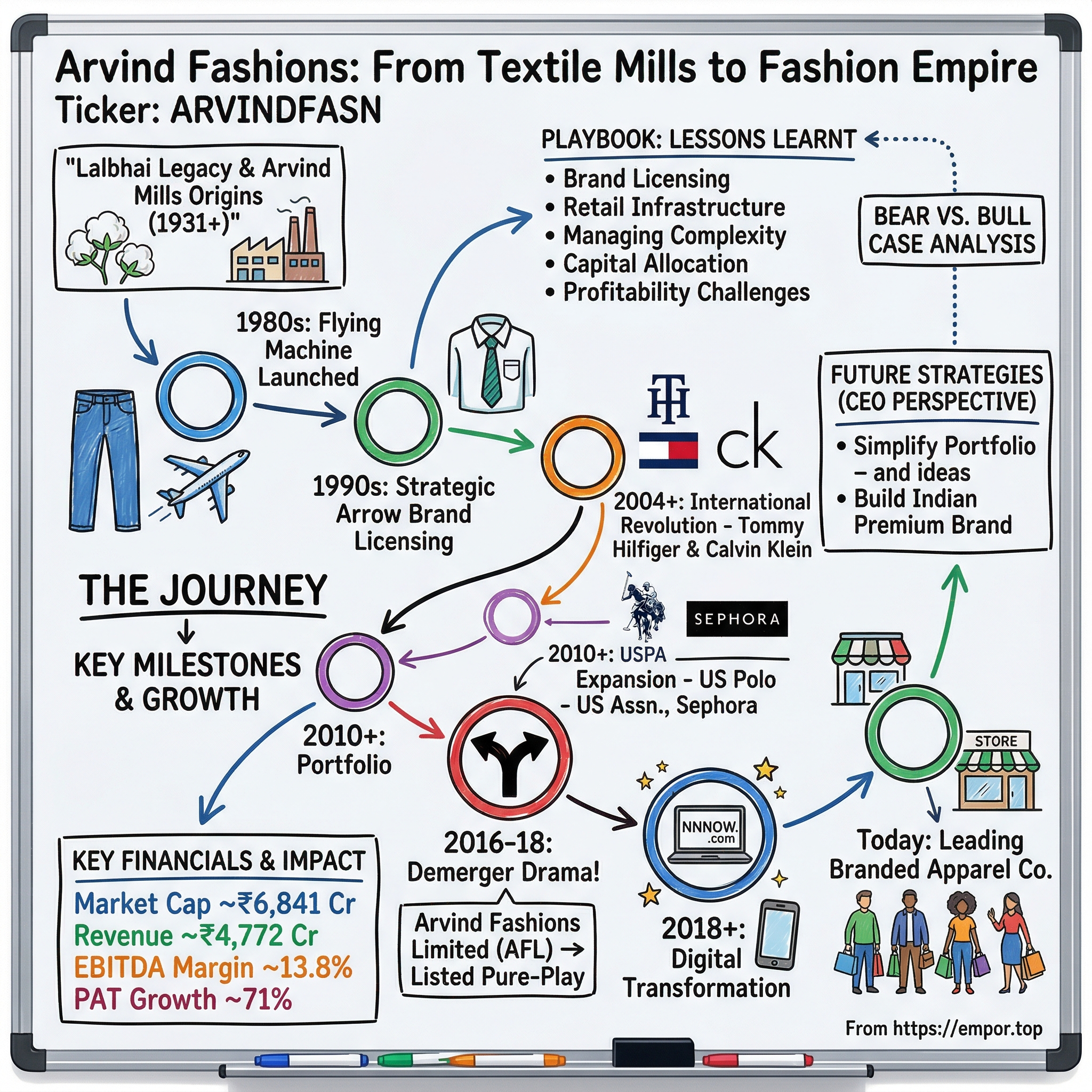
Arvind Fashions: From Textile Mills to Fashion Empire
I. Introduction & Episode Roadmap
On a Thursday afternoon in May 2026, three executives dialled into a conference bridge to discuss a company that, six years earlier, had been fighting for survival: Kulin Lalbhai, the fifth-generation scion of one of India's oldest industrial families; Amisha Jain, seven months into the chief executive's chair; and Girdhar Chitlangia, the chief financial officer who had spent much of the preceding half-decade removing debt from a balance sheet that had nearly buried the business.
The figures they reported were strong by the standards of Indian apparel retail. Revenue for the fiscal year ended March 2026 rose 14% to ₹5,266 crore, while operating profit before other income climbed 17% to ₹705 crore. Return on capital employed surpassed 23%, crossing what Lalbhai called the company's "North Star metric."12 The business turned around from a reported loss of ₹36 crore in FY25 to a net profit of ₹123 crore, prompting the board to recommend a dividend of ₹1.60 per share.13
Six years earlier, that same company posted a net loss of ₹399 crore as revenue collapsed 17%, putting it months away from seeking emergency capital from shareholders at a fraction of the valuation private equity paid in 2016.4 Between those two moments lies one of the most instructive corporate turnarounds in Indian consumer retail: a 95-year-old textile house that sought to own brands rather than merely weave fabric for them, accumulated twenty-eight of them, nearly collapsed under the operational complexity, pruned roughly two dozen, and rebuilt itself around five core labels.
Today, Arvind Fashions Limited (NSE: ARVINDFASN) centres on five key brands: U.S. Polo Assn., Tommy Hilfiger, Calvin Klein, Arrow, and Flying Machine. As of June 2026, its footprint spans roughly 1,030 exclusive brand outlets, complemented by a wholesale network of multi-brand outlets and department store counters that contributes 42% of sales.561 Direct channels—comprising company-owned retail and online business-to-consumer sales—reached 62% of total revenue in the June 2026 quarter.5 Yet its market capitalisation sits at roughly ₹6,000 crore, compared to the ₹8,000 crore enterprise valuation a private equity investor assigned to the business a decade ago, prior to its public listing.78
That valuation gap forms the analytical core of this story. Operational performance has improved substantially, yet long-term equity holders have seen little of that operational progress translate into investment returns.
The narrative unfolds in five acts. First come the mill roots: the Lalbhai family's founding during the Swadeshi era in 1931 and the denim pivot in the 1980s that rescued the business. Second is the licensing era, when Arvind concluded that profits in Indian apparel lay in branding and retail storefronts rather than weaving looms.
Third comes the crash: the 2018 demerger that left public shareholders with a leveraged, overextended, twenty-eight-brand portfolio right as Indian consumer demand slowed and ultimately stalled. Fourth is the restructuring: terminating the Gap license, selling Unlimited and Sephora, and allowing a long tail of smaller licenses to lapse. Fifth is the streamlined business that remains—and the central question of its true intrinsic value.
Throughout, the analysis tests management claims against historical execution rather than taking them at face value. Executive leadership asserts that the recent margin expansion is "structural."5 However, the record of this company under the Lalbhai family provides a detailed evidentiary trail against which to test that claim.
 Subscribe on LinkedIn
II. The Lalbhai Legacy & Arvind Mills Roots (1931–1980s)
Ahmedabad in 1931 was simultaneously the Manchester of India and the political center of the Swadeshi movement. As Mahatma Gandhi made the spinning wheel a national symbol, the city's mill-owning families were called upon to be both nationalists and industrialists.
The Lalbhai family answered by building a mill. Arvind Mills was established that year in response to Gandhi's call for economic self-reliance, and within four years the company was exporting fine fabric to Switzerland and the United Kingdom.9
Kasturbhai Lalbhai, who took charge of the family's affairs at seventeen following his father's death, was the figure who set the institutional tone. He was a textile magnate who also co-founded the Indian Institute of Management Ahmedabad alongside Vikram Sarabhai and endowed a series of educational institutions.9 That combination—commercial ambition wrapped in civic obligation—explains how the family has behaved in crisis ever since: it does not liquidate; it restructures. Over ninety-five years, that instinct has proven to be both the company's greatest strength and, at times, its most expensive habit.
For four decades after independence, Arvind operated as a classic License Raj industrial textile business: producing grey cloth, fine fabrics, and yarn sold to converters and traders, protected by import substitution and constrained by capacity licensing. It was a stable business precisely because it was shielded. When those protective barriers fell, the model broke.
By the late 1970s, decentralized powerlooms—cheaper, unregulated, and nimbler—were undercutting the composite mills that had long defined Ahmedabad and Bombay. As mills closed across the country, Sanjay Lalbhai joined the company in 1977 amid a decaying industry structure.9 His response became the strategic decision on which everything downstream would depend.
Rather than defend the traditional fabric business, he pivoted the company into denim—a fabric tied to global fashion trends, sold into a category culturally ascendant among young Indians and not yet served domestically at scale. Family lore dubbed the strategy "Reno-vision." His own framing was blunter: an entrepreneur has to reinvent the company many times.9
The bet paid off. Arvind became India's dominant denim fabric producer and one of the largest worldwide, supplying major global jeans brands. Yet denim fabric, regardless of market share, remains a commodity with a fashion overlay. A producer's revenue is bound to the cotton cycle, capacity expansions in China and Turkey, and the purchasing decisions of a handful of global buyers who can switch mills for a few cents a meter.
That structural realization—that apparel value accrues to whoever owns the consumer relationship, not the loom—became the foundation for the company's next era. The mistake Arvind eventually made was not in identifying where value sat, but in assuming that holding a brand license was equivalent to owning the brand, and that managing more licenses would automatically generate more value.
For an investor evaluating Arvind Fashions in 2026, the mill history provides critical context. The promoter family brings a ninety-five-year record of surviving structural disruption through reinvention rather than exit. That tendency cuts both ways: it explains why the company was not liquidated in 2020, but also why it accumulated twenty-eight brands in the first place. Reinvention and diversification are close cousins, and only one reliably creates value.
III. The Denim Spark & The Birth of Flying Machine & Arrow (1980s–2000s)
In 1980, Arvind took a step no Indian textile company had attempted: it placed its own brand name on a pair of jeans. Flying Machine was India's first home-grown denim label, introduced into a market where jeans were an imported luxury and domestic denim was widely regarded as inferior.10 The brand gained rapid market acceptance, becoming the country's leading branded jeans line by 1994.10
Commercially, the shift altered Arvind's profit model. The mill was now selling fabric to its own apparel division, converting it, branding it, and capturing retail margins. The gross margin on a finished pair of branded jeans was a multiple of the margin on the raw denim woven inside it. For a business long exposed to volatile cotton prices and global fabric capacity cycles, capturing downstream retail value proved highly attractive.
A second strategic move proved even more consequential and replicable. In 1993, Arvind introduced Arrow to India—the American dress-shirt brand then owned by Cluett, Peabody & Co., with a heritage dating to the nineteenth century.
Arrow's debut, anchored by a dedicated flagship store, marked the first time an international apparel brand was formally retailed in India.10 Arvind established what became the master-licensee model for the domestic market: secure exclusive Indian rights to a global brand, tailor the fit and pricing for local consumers, and build out the retail distribution network directly.
The timing aligned with India's economic liberalisation. Arrow expanded alongside the growth of IT services and private banking, which created millions of corporate jobs that required formal office wear. Arrow effectively sold the uniform for India's expanding white-collar workforce.
Building distribution, however, presented a harder operational challenge. Arvind had to transition from selling cloth to wholesale merchants—who took title, paid on credit terms, and absorbed inventory risk—to operating exclusive brand outlets. In retail, Arvind carried the inventory risk, funded working capital, and depended entirely on store sell-through rates.
The company also had to establish franchise economics in a market with no existing blueprint. These operational lessons were learned expensively and, as subsequent periods revealed, imperfectly. Almost every major financial stress at Arvind in the decades that followed would be a working-capital challenge under a different guise.
Testing the moat claim. The central narrative from this era suggests that Flying Machine established a durable domestic denim franchise, backed by first-mover advantage, mill integration, and local brand identity. Arvind's own financial record refutes the stronger version of that thesis. Through the 1990s and 2000s, as liberalisation opened the market to global denim majors, Flying Machine steadily lost share at the premium end.
The evidence appears clearly in public filings. Over the three fiscal years ending March 2025, Flying Machine's holding company reported revenue of ₹472.38 crore in FY23, which dropped to ₹458.24 crore in FY24, and fell further to ₹432.16 crore in FY25—reflecting a brand contracting in nominal terms within a growing retail market, four decades after its inception.11
That trajectory demonstrates how first-mover advantage in apparel decays without an enduring cost or distribution moat. Flying Machine's brand equity persisted—management's market research in FY26 confirmed that consumer awareness remained strong—but brand equity that fails to generate revenue growth is a memory rather than a competitive moat.2 The label has since returned to double-digit growth off a lower revenue base, and management repositioned it in FY26 as a unisex, denim-anchored youth brand with a direct-to-consumer online store planned for launch in the second half of FY27.25 Whether that effort achieves lasting traction remains an open question; at present, Flying Machine represents an early-stage turnaround backed by two quarters of improvement rather than a proven competitive asset.
What Arvind correctly deduced from this era was that licensed international brands could scale faster in India than domestic labels. What it incorrectly inferred was that managing multiple licenses simultaneously would be equally straightforward.
IV. The Licensing Craze & The 28-Brand Supermarket (2004–2016)
If you wanted to bottle the optimism of Indian consumer investing between 2004 and 2016, you could do worse than a photograph of Arvind's brand wall in that period. It looked less like a portfolio than a supermarket aisle.
The centrepiece was Tommy Hilfiger. Arvind entered the brand's India business in partnership with the Murjani Group and, after PVH Corp acquired Tommy Hilfiger globally, restructured into a joint venture with PVH; the company's own timeline dates Tommy Hilfiger's arrival under its wing to 2009, positioning it as India's first designer-premium brand.10 The formal licence with Tommy Hilfiger Europe BV was signed on 7 September 2011 for a consideration of ₹37.80 crore — about $7.5 million — capitalised as an intangible asset, with the trademark itself remaining the property of the licensor.12
That last clause is the single most important sentence in this entire section, and we will return to it repeatedly. Arvind bought the right to sell, not the thing being sold.
Into this joint venture, Arvind added Calvin Klein — the brand PVH had acquired in 2003 — with licence agreements dated 19 March 2014 and 1 December 2015, and an addendum in March 2018 adding product categories for a further $1.1 million.1213 Calvin Klein jeans, underwear and accessories gave Arvind a second premium engine, and the two brands together established a strong position in the aspirational tier of Indian apparel.
The man who ran it was Shailesh Chaturvedi, who had joined Arvind in 2006 specifically to build the Tommy Hilfiger business after a career at Madura Coats and United Colors of Benetton. Over roughly fifteen years he built Tommy into one of India's most admired premium brands, took over Calvin Klein in FY18, and added Arrow in FY19.14 Remember his name; the company's rescue was handed to him.
The other pillar was U.S. Polo Assn., licensed from the trademark arm of the United States Polo Association. Arvind's own timeline places USPA's addition to the portfolio in 2014, and the brand went on to become, by an enormous margin, the most valuable thing the company has ever built. USPA's global licensor now describes India as home to more than 400 brand stores and roughly 2,000 shop-in-shops across more than 200 cities, and openly targets a billion-dollar brand in India alone.1015
And then there was everything else. Gant, Nautica, Izod, Ed Hardy, Aeropostale, Elle, Hanes, The Children's Place, Newport, Ruf & Tuf. Megamart, launched in 2004 as a mass-market format. Unlimited, a chain of large-format value department stores in south and west India. The Gap India master franchise, signed in 2015. The Sephora India master franchise in beauty retail. NNNOW.com, launched in 2016 as an in-house e-commerce platform.10
The logic was seductive and, stated abstractly, not stupid: own a brand at every price point and every format, share the back end, and let scale in sourcing, logistics and retail relationships compound across the portfolio.
In practice, twenty-eight brands meant twenty-eight merchandising calendars, twenty-eight seasonal buys, twenty-eight sets of markdowns, and twenty-eight claims on the same senior management attention. Fashion inventory is a perishable asset masquerading as a durable one, and every additional brand adds a perishability clock.
In October 2016, the market validated the strategy in the most emphatic way available. Multiples, the private equity firm founded by Renuka Ramnath, agreed to invest ₹740 crore for roughly a tenth of Arvind's branded apparel business, at an enterprise valuation of about ₹8,000 crore.7 Three funds signed the share subscription agreement on 25 October 2016. It was, at the time, one of the largest private investments in Indian consumer retail.
The analytical lesson is not that Multiples was foolish. It is that a sophisticated, well-resourced institutional investor, with full diligence access, priced this portfolio at roughly ₹8,000 crore of enterprise value a decade ago — and that as of August 2026, after a full turnaround, record margins and a record ROCE, the entire listed equity was worth about ₹6,000 crore.8 Whatever else the intervening decade produced, it did not produce a return on that mark. Any thesis that leans on brand portfolio breadth as a source of value has to explain that gap first.
V. Demerger, PE Hype, and the Balance Sheet Crash (2016–2020)
Certain corporate transactions appear to create value on the day they occur, only to reveal two years later that they merely transferred risk. Arvind's demerger was one such event.
In late 2018, Arvind Limited separated its branded apparel business into Arvind Fashions Limited—alongside a standalone spin-off of its engineering division—and Arvind Fashions listed independently in March 2019.
The pitch to investors was straightforward: the textile manufacturing and fashion retail arms had distinct capital requirements, different growth trajectories, and separate investor bases, meaning a split would allow the market to value each business independently. Public shareholders received equity in the new fashion entity in proportion to their existing Arvind holdings, with the expectation that value creation would follow.
What actually landed on the newly independent balance sheet told a more troublesome story. Arvind Fashions entered the public market carrying heavy net debt, a stretched working capital cycle driven by an expansive inventory footprint across two dozen brands, and substantial capital expenditure commitments tied to two loss-making formats: Unlimited value retail and Gap. The ₹8,000 crore private equity valuation established in 2016 had reflected a high-growth pitch; the standalone listed company inherited the heavy cost structure that pitch demanded.
Then consumer demand faltered. The Indian discretionary retail slowdown took hold in the second half of 2018, well ahead of the pandemic, and by fiscal year 2020 the financial toll was severe. Revenue fell 17% to ₹3,866 crore, and the company posted a net loss of ₹399 crore, reversing a ₹21 crore profit from the prior year.4
Gap. The Gap India franchise offered a clear illustration of why master licensing can be treacherous. Gap was an American mall brand engineered around North American fits, pricing tiers, and retail property economics. Transplanted into Indian shopping centres with high occupancy costs and lower consumer purchasing power, and fed through a supply chain calibrated for Western replenishment cycles, the business model failed to gain traction.
In fiscal year 2020, the Gap business generated ₹182 crore in revenue while incurring a pre-tax loss of ₹34 crore.4 On 29 September 2020, Arvind Lifestyle Brands and Gap Inc. agreed to terminate their Indian franchise arrangement, with Arvind retaining an investment bank to find a buyer for the unit's local operations.4 Reliance Retail subsequently signed a long-term master franchise agreement with Gap Inc. on 6 July 2022 to retail the brand across all Indian channels.16
Unlimited. Value department stores are a volume game determined by shelf-space economics and inventory turnover. Arvind competed against Pantaloons, Max, Reliance Trends, and increasingly Zudio—rivals operating with far greater scale or lower cost structures. Unlimited depended on company-owned stores, self-funded inventory, and relentless price discounting, standing in direct conflict with the asset-light strategy Arvind later adopted.
COVID-19. The pandemic escalated an existing strategic flaw into a severe liquidity crisis, visible most clearly in the working capital numbers. In fiscal year 2021, Arvind Fashions carried 172 days of inventory and 119 days of receivables against 175 days of payables, resulting in a cash conversion cycle of 116 days on reported sales.17 In practical terms, the company was holding nearly six months of unsold garments ordered for seasons that never materialized, while waiting four months to collect payments from wholesale partners whose own stores were closed. Operating leases continued to accrue while storefronts remained shuttered, leaving return on capital employed in negative territory at minus 2% as late as fiscal year 2022.17
And then the shareholders paid. Retrospectives often gloss over dilution, but the historical sequence is straightforward. Arvind Fashions turned to its equity investors three times in eighteen months to shore up its balance sheet. The board approved a rights issue of 3,99,79,347 shares at ₹100 per share, allotted on 24 July 2020. That was followed by a second rights issue of 1,48,02,856 shares at ₹135 per share, allotted on 25 March 2021. Finally, the company issued 1,83,06,624 shares on a preferential basis at ₹218.50 per share, approved by shareholders in September 2021.12 Altogether, Arvind Fashions raised roughly ₹1,000 crore of fresh equity at valuations far below its demerger mark, diluting existing ownership by well over 50%.
The falsification, stated plainly. The argument that maintaining twenty-eight brands provided downside diversification and retail bargaining power was contradicted by the company's operational results. Rather than hedging risk, managing twenty-eight labels concentrated vulnerability because every brand drew from the same capital pool and shared credit facilities.
When retail demand dropped, Arvind could not contract twenty-eight inventory positions quickly enough, transmitting balance sheet stress directly to equity holders. The takeaway is not that portfolio diversification is inherently flawed, but rather that when inventory is perishable and operations are leveraged, brand breadth acts as a multiplier of financial risk rather than a buffer.
This context frames the central question facing the business in 2026. Executive leadership maintains that recent margin gains are structural. Yet those assurances come from the same management lineage that oversaw the expansion to twenty-eight brands. What, precisely, has changed?
VI. The Great Pruning: Fire Sales, Exits, and Debt Redemption (2020–2023)
In late 2020, with losses mounting and the balance sheet under severe stress, the board appointed Shailesh Chaturvedi as managing director and chief executive, succeeding J. Suresh in early 2021.14 The choice was strategic.
Chaturvedi was not an external turnaround specialist; he was the internal executive who had built the company's most profitable brands. His mandate was clear: stop the cash burn, divest non-core assets, repay debt, and prioritize profitability over revenue expansion.
Over the next three years, management systematically dismantled the brand supermarket.
The Gap exit had already been negotiated before Chaturvedi took charge, with inventory write-downs and store closure costs absorbed in fiscal year 2021. Flying Machine was partially monetized in a transaction announced on 9 July 2020, when Flipkart invested ₹260 crore into Arvind Youth Brands Private Limited for a 31.25% minority stake.1811 While framed as a strategic distribution partnership to lock the denim label into India's largest e-commerce platform, the deal's immediate function was providing essential liquidity.
Unlimited was divested next. In July 2021, Arvind Lifestyle Brands agreed to sell all 74 Unlimited stores, along with its warehouses, inventory, and brand rights, to V-Mart Retail for roughly ₹150 crore in cash plus contingent payments—a transaction completed on 2 September 2021.19 Management noted at the time that while Unlimited was "a scalable format with significant product capabilities in value retail, which has large potential," the company chose to exit to concentrate resources on six high-conviction brands.19
Yet that six-brand portfolio strategy proved temporary; the sixth brand on that list was Sephora.
Sephora was sold to Reliance Beauty & Personal Care on 3 November 2023. Reliance acquired Arvind's beauty retail subsidiary—spanning 26 stores across 13 cities—at an enterprise value of ₹216 crore, yielding an equity consideration of ₹99 crore. The division had generated ₹337 crore in revenue during fiscal year 2023, representing roughly 7.6% of Arvind's consolidated turnover.20
The long tail of smaller licenses was phased out. Aeropostale and Ed Hardy were formally discontinued during fiscal year 2024, while other sub-scale licensed labels—including Gant, Nautica, Izod, Elle, Hanes, and The Children's Place—were surrendered or allowed to expire.1217
The contraction of the retail footprint highlights the scale of the retrenchment. Between fiscal years 2019 and 2024, Arrow's exclusive outlet count dropped from 290 to 190, while Flying Machine's contracted from 263 to 154. Gap, Unlimited, and Sephora vanished from the network entirely.17 This was not routine portfolio pruning, but a corporate contraction driven by survival.
Even U.S. Polo Assn.—the company's strongest brand—underwent network rationalization. Its exclusive store count stood at 368 in fiscal year 2019, peaked at 405 in fiscal 2023, and was pared back to 351 by fiscal 2024 as lower-performing locations were closed.17 Management did not simply divest weak licenses while expanding core labels; it rationalized store footprint across the entire portfolio. That process explains why the subsequent store expansion cycle began from a significantly reduced base.
What the restructuring accomplished—and what it did not. The balance sheet improvement was substantial. By March 2025, gross and net debt had each fallen by approximately ₹75 crore over the year, net working capital stood at ₹817 crore on capital employed of ₹1,554 crore, and return on capital employed crossed 20% for the first time.13 By March 2026, ROCE reached 23%.1 The working capital cycle—which had previously threatened the company's solvency—shortened to 58 days in March 2025 and sat at 64 days in March 2026.1
However, the narrative of "disciplined capital allocation" requires three qualifications based on disclosed execution.
First, the asset sales were executed under balance sheet pressure rather than optimal market timing. Receiving a ₹99 crore equity cheque for Sephora India—a unit producing ₹337 crore in annual revenue within a fast-growing consumer category—reflects a seller with limited leverage. Management acknowledged that Arvind lacked the capital required to compete effectively against Reliance and Nykaa in multi-brand beauty retail, making debt reduction a more prudent risk-adjusted decision. That logic was sound, but it confirms that the company had expanded into a category it could not financially sustain.
Second, the commitment to "six high-conviction brands" contracted to five within twenty-six months. Selling a core designated brand shortly after publicly committing to it indicates that portfolio priorities remained fluid. While shifting market conditions justify strategic pivots, it underscores that long-term brand commitments should be evaluated cautiously.
Third, the Flipkart transaction yielded poor long-term investment results. On 29 December 2025, Arvind Fashions agreed to buy back Flipkart's 31.25% stake in Arvind Youth Brands for ₹135 crore, restoring full ownership of Flying Machine.11 Flipkart had invested ₹260 crore five and a half years earlier, effectively exiting at roughly half its initial capital in nominal terms, while Flying Machine's revenue contracted from ₹472 crore in fiscal 2023 to ₹432 crore in fiscal 2025.11 While Arvind reacquired the minority stake at a low valuation, the five-and-a-half-year partnership failed to deliver brand growth.
The restructuring period ultimately demonstrates necessary, disciplined crisis management that stabilized the balance sheet and stopped value destruction. However, whether current executive leadership can translate a streamlined five-brand portfolio into sustainable long-term value creation remains an open question, with an operational track record spanning only four years.
VII. The Core 5 Power Brands Engine & Unit Economics
Stripping away historical complexity leaves a simplified operational structure: five core brands, three ownership arrangements, and a shared backend infrastructure.
U.S. Polo Assn. and Arrow operate under long-term licenses managed by Arvind Lifestyle Brands, a wholly owned subsidiary. Tommy Hilfiger and Calvin Klein sit within PVH Arvind Fashion Private Limited, a 50-50 joint venture. Flying Machine resides in Arvind Youth Brands, which returned to 100% ownership in December 2025.
An important accounting detail shapes how these numbers appear to investors. Despite holding exactly half the equity, Arvind consolidates the PVH joint venture as a full subsidiary rather than using equity accounting.
The company states the basis is contractual: Arvind has the power to appoint the chairman, who holds a casting vote and directs relevant activities.12 Consequently, 100% of Tommy Hilfiger and Calvin Klein revenue flows into Arvind's top-line total, even though half of their net profits are subsequently deducted as minority interest—which amounted to ₹61 crore in FY26 and ₹69 crore in FY25.1 For investors evaluating revenue multiples, a substantial portion of top-line sales carries only half of the underlying earnings.
U.S. Polo Assn. serves as the portfolio's anchor franchise. The brand crossed ₹2,000 crore in net sales value in FY25, with management accepting an analyst's estimate on the May 2026 earnings call that sales reached ₹2,400 to ₹2,500 crore.132 That single licensed label generates roughly 45% to 47% of consolidated group revenue.
Its market positioning—affordable premium casualwear priced below global luxury labels but above domestic private brands—aligns directly with expanding middle-class discretionary income. It holds a dominant position in polo shirts while expanding into denim, footwear, innerwear, kidswear, and womenswear across the company's widest retail footprint.
These category extensions drive much of the recent top-line momentum. Non-men's apparel categories expanded by approximately 25% to represent 24% of group sales in FY26, with management confirming that U.S. Polo Assn. generated the majority of that adjacency revenue.2 This product expansion creates tangible operating leverage: cross-selling footwear or kidswear to an existing shirt customer utilizes the same retail footprint, staff, and fixed store rental costs.
However, a structural vulnerability remains: Arvind does not own the asset. The long-term brand equity accumulated through local execution ultimately accrues to a trademark owned in the United States.
Tommy Hilfiger and Calvin Klein capture the higher-margin premium segment, benefiting from rising affluent consumer spending while facing greater sensitivity to regulatory changes. When India's tax reform took effect on 22 September 2025, the Goods and Services Tax on apparel priced above ₹2,500 rose from 12% to 18%.21 On the May 2026 earnings call, Chief Executive Amisha Jain stated that the rate increase temporarily slowed fourth-quarter retail growth across the PVH brands before both returned to double-digit expansion.2 The disruption highlights how premium price points carry heightened policy exposure relative to mass-market categories.
Arrow represents an ongoing operational turnaround. Demand for formal office wear faced structural headwinds from post-pandemic hybrid work trends and broader workplace casualization. Brand sales remained subdued in the fourth quarter of FY26, which Jain attributed to a merchandise model transition and a muted wedding season, describing the soft performance as timing-related rather than structural.2 Historical execution across prior brand exits suggests such management explanations warrant cautious monitoring.
Efforts to reposition Arrow toward a broader "modern professional" identity, simplify inventory lines, update store layouts, and drive online sales—which grew over 80% through direct consumer channels in the June 2026 quarter—indicate initial strategic momentum, though long-term commercial recovery remains unproven.5
The channel architecture reflects a deliberate shift in how product reaches the consumer. In FY26, wholesale channels—comprising multi-brand outlets and department store counters—accounted for 42% of revenue, company-owned retail stores represented 29%, direct-to-consumer (D2C) online sales accounted for 14%, and business-to-business (B2B) online and secondary channels made up the remaining 15%.1
Management has actively transitioned distribution away from marketplace B2B wholesale—where platforms dictate discounting and retail pricing—toward D2C channels where Arvind acts as the seller of record. D2C online sales grew 45% in FY26, expanding its revenue share from 11% to 14%, while total direct channels—combining company retail and D2C online—reached 62% of sales by June 2026.15
Where the gross margin actually goes is worth examining, as a 56% gross margin alongside a 13% operating margin reflects substantial intermediary selling expenses. Two primary cost categories dominate that gap. Commission and brokerage fees paid to franchise partners and department store hosts totaled approximately ₹560 crore in FY24, equal to 13% of sales.17 Advertising and publicity expenditures totaled roughly ₹170 crore, or 4% of sales, after growing 38.5% that year as management increased brand promotion.17
Combined, these expense lines illustrate the economic model. Arvind relies primarily on third-party distribution, paying variable sales commissions rather than maintaining fixed retail real estate. This asset-light structure minimizes upfront capital expenditure but places a permanent ceiling on operating margins, effectively charging the company rent for distribution channel access alongside licensing royalties for brand rights.
The cost of that shift is the balance sheet counterweight. Under a wholesale model, inventory leaves the balance sheet upon delivery; under direct channels, it remains until the final consumer purchase. Inventory holding periods increased from 91 days in March 2025 to 102 days in March 2026 and 105 days by June 2026, while inventory turnover declined from a historical 4.0 times to 3.5 times.15 Net working capital requirements expanded from 58 days to 64 days and reached 65 days over the same period.16 Borrowings rose from ₹390 crore to ₹531 crore.1
Chief Financial Officer Girdhar Chitlangia attributed the working capital expansion to specific operational factors: the channel mix shift contributed roughly six days, early inventory intake for spring-summer 2026 served as a buffer against supply chain disruptions, and the acquisition of Flipkart's minority stake required debt financing, even as receivable days improved from 55 to 52.25 Management told analysts the company remains on track to eliminate net debt within nine to twelve months while restoring inventory turns to between 3.7 and 3.8 times within eighteen to twenty-four months.25
These management targets provide explicit parameters against which to track execution. The strategic tension lies between margin expansion and capital efficiency: the D2C transition that drives higher gross margins simultaneously absorbs working capital, creating downward pressure on return on capital employed.
The core operational thesis depends on gross margin improvements outpacing working capital friction. To date, margin gains have maintained that lead—gross margin expanded by 130 basis points in FY25, 90 basis points in FY26, and an additional 90 basis points in the first quarter of FY27.1315 This margin-versus-capital dynamic represents the central operational metric determining whether recent financial gains remain sustainable.
VIII. Competitive Landscape, Industry Economics & Helmer's 7 Powers
Comparing Arvind Fashions with its key Indian apparel peers for the fiscal year ended March 2026 offers immediate clarity—and a sobering reality check.
Aditya Birla Lifestyle Brands—the entity holding Louis Philippe, Van Heusen, Allen Solly, and Peter England following its 2025 separation from Aditya Birla Fashion and Retail—generated ₹8,396 crore in FY26 revenue, up 7%, with EBITDA of ₹1,429 crore at a 17.0% margin, reported net profit of ₹171 crore, 3,348 stores, and net debt of ₹726 crore.22 Its retail like-for-like growth stood at 6%.22
Trent generated ₹19,701 crore in revenue, up 18%, adding a net 198 Zudio stores to reach 963 and 52 Westside locations to reach 300.23
Page Industries, the Jockey licensee and benchmark for Indian innerwear economics, delivered ₹5,246.8 crore in revenue alongside ₹1,152.9 crore in EBITDA and ₹763.8 crore in profit after tax.24
Against these peers, Arvind's FY26 numbers show a business growing faster than its closest structural comparator (14% versus ABLBL's 7%) with superior store productivity (8.1% retail like-for-like versus 6%), but carrying a thinner operating margin (13.4% versus 17.0%) and generating less than a fifth of Page's absolute profit on nearly identical revenue.12224
Three analytical conclusions follow. First, execution improvements are visible in a peer-relative frame, indicating that Arvind is taking market share in its core categories. Second, the margin gap relative to ABLBL is primarily structural, reflecting Arvind's heavier wholesale channel mix and shared earnings on the PVH joint venture; closing that gap requires multi-year portfolio mix adjustments rather than cost reduction alone.
Third, the Page comparison provides a stark contrast in licensee economics. Page controls its own manufacturing base and holds a license so entrenched that it operates with the economics of brand ownership, converting top-line revenue into net profit at roughly four times Arvind's rate. Licensee profitability varies dramatically based on contract terms and category depth, and Arvind operates well below the top tier of that spectrum.
Porter's Five Forces analysis reveals demanding structural dynamics across the apparel industry. Supplier power remains low, as Indian apparel manufacturing is fragmented and Arvind sources predominantly from domestic vendors, which currently provides an operational advantage.2 Buyer power at the consumer level is absolute, with zero switching costs. Channel-level buyer power is rising sharply as department stores and online marketplaces consolidate into a small group of gatekeepers, several of which—including Reliance and Tata—own competing brand portfolios.
Threat of substitutes is continuous, as shifting seasonal fits, silhouettes, and pricing structures can rapidly render inventory obsolete. Threat of entry is moderate for standalone brands but low at the platform level, where national distribution and licensing rights create meaningful barriers to entry. Industry rivalry remains intense and price-focused. Competitors have increasingly advanced the timing of end-of-season discount sales—a trend an Equirus analyst raised directly with management in July 2026, which Chief Executive Amisha Jain declined to interpret.5
Helmer's 7 Powers model tests the durability of the business model:
Branding represents Arvind's primary competitive strength, though it remains a rented asset. Decades of global marketing investment by PVH and USPA's licensor generated aspirational brand equity that Arvind translates into domestic price realization it could not replicate with a proprietary label.
The evidence appears in gross margin expansion, rising from 53.5% in FY25 to 56.7% by the first quarter of FY27, with management targeting the high 50s over the next two to three years.1352 That trajectory demonstrates pricing power, but the economic returns on brand equity accrue to Arvind only for the duration of its licensing contracts.
Cornered Resource represents the central thesis of optimistic valuations and warrants rigorous scrutiny. Arvind holds exclusive Indian distribution rights for four of its five core brands. While exclusivity is genuine during the contract term, its long-term durability cannot be independently verified by outside investors. The Calvin Klein licence runs to 31 December 2028, with a five-year renewal option available without additional consideration subject to contractual compliance; management considers renewal "virtually certain" and amortises the intangible asset through December 2033 on that basis.12 Specific terms for the USPA and Arrow licenses remain undisclosed.
Under the Tommy Hilfiger agreement, Arvind must meet minimum sales targets and pay royalties based on the higher of actual or minimum sales value.12 This structure creates financial operating leverage, turning royalty obligations into a fixed cost during market downturns.
Consequently, exclusivity operates as a conditional, contractual arrangement subject to non-disclosure and accounting management judgment. Recent corporate history demonstrates this vulnerability. Gap was an international license Arvind held and terminated, which Reliance now operates. Sephora was a beauty franchise Arvind built and sold, which Reliance now operates. In both cases, prominent international brand rights migrated to a larger competitor within four years.
While this history does not imply a similar outcome for decades-old, highly profitable relationships like USPA or PVH, it requires framing "cornered resource" claims as contractual rights that have twice proven terminable.
Scale Economies remain moderate but are gradually expanding. Shared sourcing, warehousing, analytics, and retail organization across five brands provide baseline efficiency, while an FY26 reorganization into dedicated business units with centralized digital, marketing, data, and AI functions represents an explicit push to deepen scale economies.2 However, at ₹5,266 crore in revenue, Arvind operates at roughly one-quarter the scale of Trent and maintains no proprietary manufacturing base.
Counter-Positioning works against Arvind's business model. Value retail models such as Zudio—built on proprietary design, direct store ownership, rapid inventory turns, and price points below licensed brands—operate with a lower cost structure that Arvind cannot emulate without cannibalizing its existing price architecture.
Switching Costs are non-existent, representing a fundamental economic reality of consumer fashion retail.
Network Effects do not apply to this retail model.
Process Power remains an unverified operational capability. Management asserts that Arvind has established superior internal capabilities in inventory freshness, auto-replenishment, and full-price sell-through rates. The supporting evidence includes steady like-for-like sales growth, expanding gross margins, and management's repeated assertion that inventory freshness sits at an all-time high.25
The disconfirming evidence is equally clear: inventory holding periods expanded by roughly twenty days over two years, inventory turns slowed from 4.0 to 3.5 times, and management twice declined analyst requests in consecutive quarters to disclose the exact full-price sell-through percentage, offering gross margin as a proxy instead.25 An operational capability that cannot be evaluated through its underlying metric requires appropriate analytical discounting.
The net verdict: Arvind Fashions possesses one strong rented power (branding), one conditional power (contractual exclusivity), and an unverified process capability. That combination supports solid returns on capital in a expanding retail market, but provides limited insulation against licensors, commercial landlords, or low-cost competitors.
IX. Management Credibility, Governance & Capital Allocation Audit
The Lalbhai family holds its stake through Aura Securities and affiliated entities. At March 2025, the promoter group held 35.19% of Arvind Fashions, down from 36.78% a year earlier, with Aura Securities alone at 31.22% after a 4.59-percentage-point reduction during the year.13 Sanjay Lalbhai remains the patriarch of the group; Kulin Lalbhai, the fifth-generation son who has led the branded apparel side, serves as non-executive vice chairman and opens the earnings calls with the strategic framing.2
The professional leadership has now turned over once. Chaturvedi's five-year term was scheduled to run to 31 January 2026; the board announced his successor on 17 July 2025, well ahead of that. Amisha Jain joined on 13 August 2025 and took charge as managing director and chief executive on 1 October 2025, with Chaturvedi stepping down effective 30 September 2025.2526 The overlap was deliberate, and by any reasonable measure the handover was clean — the June 2026 quarter delivered 15.5% revenue growth and 19.6% EBITDA growth, with no visible operational disruption.5
Jain's background is worth understanding because it signals where the company is being pointed. She spent three years as Levi Strauss's managing director for South Asia, the Middle East, Africa and Eastern Europe, ran Zivame — the digitally native innerwear business — as chief executive, and previously held roles at Nike India, Motorola and McKinsey, with an INSEAD education and earlier time inside the Arvind group.25 A denim operator, a D2C operator and an innerwear operator, hired to run a company whose three stated priorities are denim repositioning, D2C expansion to 65% of sales, and adjacency growth in footwear and innerwear.2 The appointment is coherent with the strategy, which is more than can be said for many succession decisions.
Auditing management behaviour over time is where a neutral assessment has to be earned rather than asserted.
The record against them. The 2016–2020 regime — the same promoter group, a different professional layer — set out a portfolio strategy that inflated to twenty-eight brands, funded it with debt, promised value unlocking at demerger, and delivered instead two years of heavy losses, a collapse in the equity value implied by the 2016 private round, and roughly ₹1,000 crore of dilutive issuance at distressed prices.12 Executives who preside over that do not get to describe the subsequent clean-up as pure discipline; a large part of it was repair.
The record for them. Since FY22, the narrative across annual reports, presentations and calls has been consistent in a way that is genuinely uncommon. The same metrics appear every quarter: like-for-like growth, direct channel share, gross margin, net working capital days, ROCE. Guidance has been given in specific, falsifiable terms and, so far, met.
At the start of FY26 the company set out five objectives — 12–15% revenue growth, margin expansion through operating leverage, 100–200 basis points of direct-channel share gain, roughly 150 gross store openings largely through the franchise route, and higher net square footage than FY25.1 It delivered 14% growth, 40 basis points of margin expansion, a 300-basis-point direct-channel gain, 50 net stores from roughly 150 gross, and 1.43 lakh net square feet against 1.22 lakh.113 That is a management team hitting a self-set, publicly stated scorecard.
Where the disclosure gets thin. Three areas stand out. Full-price sell-through, discussed above, is repeatedly requested and never given. Brand-level revenue and profitability are not disclosed — analysts have to estimate USPA's size from the outside, and when one asked directly whether Arrow and Flying Machine profitability had improved, describing it as "one of the very frequent questions asked by the investor community," the answer described merchandising initiatives rather than numbers.2 And when an analyst asked how many company-owned stores had closed during FY26 to reconcile 150 gross openings against 50 net, the chief financial officer said he did not have the data to hand.2 None of these is scandalous. Together they mean an investor is asked to take the brand-level health of the portfolio substantially on trust.
The accounting judgments an investor should actually read. Two deserve attention.
First, the carrying value of Arvind Fashions' standalone investments in its own subsidiaries. At March 2025, the aggregate carrying amount of equity and perpetual debt in Arvind Lifestyle Brands and Arvind Youth Brands stood at ₹1,871.51 crore, and the annual report states plainly that those subsidiaries have suffered erosion in net worth relative to the investment made.
Management concluded no impairment was necessary, based on value-in-use models requiring significant judgment on revenue growth, profitability, terminal growth and discount rates, supported by a comparable-companies valuation from an external expert.
The statutory auditor flagged this as a key audit matter.12 This is not an allegation of impropriety — it is standard, properly disclosed, and the operating recovery supports the conclusion. It is simply the single largest judgment call in the accounts, and it depends on forecasts continuing to be met.
Second, the consolidation of a 50%-owned joint venture as a subsidiary on the basis of a chairman's casting vote, discussed earlier, is also a judgment. It is defensible and disclosed. It flatters the revenue line.
One further item that belongs in an activist's file. Arvind Fashions has pledged 4,63,51,265 shares of Arvind Lifestyle Brands and 4,05,75,090 shares of Arvind Youth Brands as security against working capital facilities.12 And on the May 2026 call, an analyst noted that a portion of the company's effective borrowing sits inside trade payables as supplier acceptances, historically around 5–6% of sales; the chief financial officer confirmed the practice, framed it as normal management of MSME payment cycles, and placed it second in priority behind term-loan reduction.2 Investors evaluating the "net-debt-zero" milestone should understand that it is measured against reported borrowings of ₹531 crore, not against the full financing embedded in a ₹1,387 crore payables balance.1
One structural feature an outsider should notice. Arvind Fashions is a large business run by a small permanent organisation. In FY24 the company employed 6,445 people, of whom only 1,244 were permanent and 5,201 were temporary or contracted, with contract labour charges of roughly ₹200 crore.17 Retail staffing in India is commonly structured this way, and it gives the company genuine cost flexibility — one reason the FY21 cost reduction was possible at all.
It also concentrates institutional knowledge in a small core team, which raises the stakes on senior retention during a leadership transition and makes store-level execution quality dependent on how well a largely contracted frontline is trained and supervised.
Incentives. Executive stock option schemes are in place, including a 2025 scheme approved by shareholders, and the annual report ties management performance discussion to EBITDA, ROCE and PAT rather than revenue alone.12 The alignment is directionally right. The specific vesting hurdles are not disclosed in a form that lets an outsider verify how demanding they are.
X. Earnings Call Forensics & Q&A Realities
Comparing two consecutive Arvind Fashions earnings calls back-to-back—May 2026 and July 2026—offers a clear view of corporate communication under analytical scrutiny, as identical prepared scripts met increasingly focused analyst questioning.
The prepared remarks followed a disciplined, repeatable template. Chief Executive Amisha Jain opened each call with three core takeaways: the direct-to-consumer channel was compounding, profitability gains were structural, and the company entered the period with operational confidence.25 Vice Chairman Kulin Lalbhai provided the overarching strategic framing and return-on-capital benchmarks, while Chief Financial Officer Girdhar Chitlangia detailed balance sheet progress.
The five strategic priorities introduced in May—category leadership across India's five largest apparel segments, scaling differentiated brands, building a direct-to-consumer organization, integrating data and artificial intelligence, and increasing supply chain agility—reappeared in July as the operational logic for a business-unit reorganization.25
The analyst question-and-answer sessions revealed where strategic friction remained.
On growth durability. Equirus analyst Deep Shah asked in May whether U.S. Polo Assn., with estimated annual revenues of ₹2,400 crore to ₹2,500 crore, could maintain a compound annual growth rate of 13% to 14% over the next three to four years. Jain responded that management expected portfolio brands to grow in the mid-double digits—offering a broad portfolio target rather than addressing the specific brand's trajectory.2 By July, ICICI Direct analyst Kaustubh Pawaskar questioned whether the first quarter's 11.6% like-for-like retail growth was sustainable against earlier guidance of 8% to 10%. Jain reiterated full-year revenue growth guidance of 12% to 15%, expecting same-store sales growth and store network expansion to contribute roughly equally.5 The pattern remained consistent: management issued targets at the consolidated portfolio level and defended them at the group level.
On discounting and demand. The sharpest exchange occurred in July when Shah asked whether competitors advancing their end-of-season sales signaled weakening consumer demand. Jain declined to comment on competitor motivations, redirecting attention to Arvind's same-store performance and market share gains.5 Read charitably, the response reflected standard corporate reticence regarding rivals; read critically, it bypassed an opportunity to characterize broader consumer demand across the retail sector.
On margins under input-cost pressure. In May, amidst rising cotton prices, Pawaskar asked whether management's guidance of 30 to 40 basis points in annual margin expansion could withstand commodity inflation. Jain cited domestic sourcing arrangements, overhead cost controls, and selective price increases.2 In July, Chitlangia provided greater operational detail, explaining that extended procurement lead times had initially insulated the business, but persistent input costs would require pricing adjustments on fresh inventory within 45 to 60 days—while Jain added that any price increases would remain "minimal."5 The subtle contrast between financial caution and commercial re-assurance highlighted how management balances margin preservation against volume growth.
On working capital. An analyst from Motilal Oswal raised the sharpest balance sheet challenge of the July call, observing that combined inventory and receivables had expanded by roughly ₹350 crore against just ₹170 crore in incremental revenue growth.5 Chitlangia attributed the expansion to specific operational factors: six days added by the channel mix shift toward direct-to-consumer sales, global sourcing realignments at PVH Corp, and temporary inventory buildup in footwear following the resolution of a regulatory compliance issue—an explanation that was specific, quantified, and checkable.5 In May, PhillipCapital analyst Ankit Kedia pressed on working capital efficiency, noting that inventory holding periods had expanded by roughly twenty days over two years while receivable collection shortened by only three days. Chitlangia acknowledged that a wholesale B2B transaction for Tommy Hilfiger near the end of March distorted the comparison.2 In both instances, management addressed working capital friction with explicit operational details rather than generalized assurances.
On the profit line. Emkay analyst Devanshu Bansal asked in July why profit after tax fell to ₹10 crore from ₹13 crore in the prior-year quarter despite operating EBITDA growing 19.6%. Chitlangia clarified that the prior-year period included one-time lease-accounting gains from store closures, and projected that non-operating income would normalize around ₹7 crore to ₹8 crore per quarter.5 The exchange highlighted a key accounting reality: Arvind's reported net profit remains small relative to EBITDA due to right-of-use asset depreciation under Ind AS 116, interest expenses, and the 50% minority profit share deducted for the Tommy Hilfiger and Calvin Klein joint venture. For investors, quarterly net earnings remain volatile, making underlying operating metrics the clearer indicator of performance.
On the strategy that got them here. The most revealing question of either call came from a Nuvama analyst in May, who asked whether management's previous commitment to focus exclusively on its five core brands remained intact. Jain affirmed that the five core brands offered significant growth runway, but added, "having said that, over a period of time, if something comes up, which strategically makes sense from a portfolio point of view, we will be open to looking at it."2 When pressed by another analyst on whether this implied the current portfolio was insufficient, Jain clarified that the 15% revenue growth target relied entirely on organic expansion and that any new category entry would likely be built internally rather than acquired.2
That open door represents a critical variable for long-term investors. Arvind Fashions suffered its primary balance sheet crisis through unconstrained portfolio expansion, and its recent turnaround credibility rests on operational focus. While an open stance on strategic opportunities is standard corporate positioning, adding brand licenses would directly test whether management's capital discipline remains a permanent operational shift or a temporary response to crisis.
XI. Playbook: Business & Investing Lessons
Stripping Arvind Fashions down to its transferable strategic insights yields four primary lessons, each visible across the broader Indian consumer retail landscape.
1. The tenant's trap. Building a retail business on licensed intellectual property is akin to renting a storefront on a city's premier commercial street. An operator pays royalties indefinitely, cannot build terminal equity in the trademark itself, and operates under a landlord monitoring top-line growth. The economics can appear attractive because an operator bypasses the decades and hundreds of crores required to build organic brand equity. The underlying trade-off is that operational success remains entirely transparent to the trademark owner, who retains the ultimate pricing power.
Arvind's operational disclosures demonstrate both sides of the model. The joint venture with PVH Corp—combining Tommy Hilfiger and Calvin Klein—expanded revenue from ₹675 crore in FY20 to ₹1,239 crore in FY24, with its EBITDA margin broadening from 11.1% to 19.1% and net profit reaching ₹136.5 crore.17 That performance illustrates the potential of a well-executed license: high profitability, steady top-line expansion, and manageable working capital at 61 days.17 However, ownership of the underlying trademarks remains with PVH, rights to Calvin Klein extend only through late 2028 with a compliance-dependent renewal option, and royalties are calculated on the higher of actual or minimum sales thresholds—ensuring the licensor participates in upside gains while remaining insulated from market downturns.
The tenant's trap carries a second structural vulnerability that Arvind has experienced repeatedly: the trademark holder can transfer local rights to a competitor upon contract expiration or exit. Both Gap and Sephora were established in India under Arvind's management and subsequently transitioned to Reliance Retail. The broader lesson is not that licensing is inherently flawed—companies like Page Industries have compounded value for decades under exclusive licenses—but that a licensee's long-term enterprise value depends entirely on contractual agreements that outside equity investors rarely inspect directly.
2. Complexity is a tax paid in working capital rather than administrative overhead. The visible cost of operating twenty-eight separate brands was redundant marketing and fragmented executive oversight. The far larger economic burden was that every individual label required its own seasonal purchasing commitments six to nine months ahead of store delivery, requiring precise size and color forecasting. Managing twenty-eight separate fashion bets funded by debt did not provide downside diversification; instead, it created twenty-eight correlated inventory positions vulnerable to the same consumer spending slowdown.
The counter-lesson is equally instructive: portfolio rationalization does not resolve brand-level operational challenges automatically. Even after trimming its portfolio to five core labels, Arvind Youth Brands—the subsidiary housing Flying Machine—generated an EBITDA margin of just 0.6% alongside a net loss of ₹37.5 crore in FY24 on ₹472 crore in revenue, while carrying a 169-day working capital cycle.17 Reducing portfolio breadth provides clarity, but concentration yields value only when the remaining core assets earn their cost of capital.
3. In fashion retail, inventory behaves like a melting ice cube. Industrial raw material inventory generally retains its baseline cost value. By contrast, a retailer's spring fashion collection is worth its full price tag in April, a fraction of that by July, and deeply discounted clearance value by September. Consequently, the working capital cycle—rather than the reported income statement—serves as the primary leading indicator of operational health in apparel retail.
Arvind's cash conversion cycle contracted from 116 days in FY21 to 58 days in FY22, releasing more operating liquidity through footprint rationalization and inventory clearing than years of store expansion would have generated.17 That historical dynamic underscores why the recent re-expansion of working capital toward 64 to 65 days warrants continued tracking, even as gross margins expand.
4. Asset-light operations exist on a spectrum rather than a binary choice. Arvind's stated operational strategy centers on franchise-owned, franchise-operated stores, which shifts store fit-out capital expenditure to third-party partners. However, executive disclosures on the May 2026 earnings call highlighted important operational nuances: out of approximately 150 gross store openings in FY26, roughly 50 were company-owned and company-operated, requiring landlord security deposits that absorbed a substantial share of the year's ₹110 crore in capital expenditures.2 Furthermore, Arvind operates on a consignment basis across much of its retail network—recognizing revenue only upon final consumer purchase—meaning Arvind, rather than the franchise partner, retains the inventory risk at the store counter.2
This arrangement differs significantly from a pure wholesale franchising framework, directly shaping balance sheet metrics. Arvind leverages partner capital for real estate fit-outs and frontline store labor, but retains underlying merchandising and inventory holding risks. The model is asset-light regarding fixed property assets, yet asset-heavy regarding current working capital. Financial models that treat the business as a pure low-capital franchisor risk underestimating its ongoing working capital intensity.
The synthesis: Arvind Fashions learned through balance sheet distress that in consumer apparel retail, capital efficiency defines long-term strategy. Management's current emphasis on inventory freshness, full-price sell-through rates, direct-to-consumer expansion, and return on capital employed represents a direct institutional response to those historical lessons.
XII. Analysis & Bear vs. Bull Case
Evaluating Arvind Fashions requires separating market perception from financial reality.
Myth: Arvind Fashions is a debt-free, high-return compounder that has permanently repaired its balance sheet and cleanly converts premiumisation into shareholder returns.
Reality: The company operates an improved operational engine, with return on capital employed rising from minus 2% in FY22 to 12% in FY23, 16% in FY24, over 20% in FY25, and above 23% in FY26. However, return on net worth stood at just 2.95% in FY25, down from 8.94% the prior year.17131
The divergence between operating returns and equity returns stems from specific structural line items: minority interest deductions on half the Tommy Hilfiger and Calvin Klein profits, ongoing interest expenses, and right-of-use lease asset depreciation under Ind AS 116. Meanwhile, borrowings rose to ₹531 crore as of March 2026, keeping management's net-debt-zero target a future projection rather than an accomplished milestone.12
An evaluation focused solely on return on capital employed overstates the net benefit to equity holders, while focusing exclusively on return on equity overlooks the genuine operational recovery. A balanced analysis requires weighing both dynamics.
The bull case, stated in mechanisms rather than adjectives.
U.S. Polo Assn. provides a strong core engine. The flagship label accounts for nearly half of group revenue, anchored by more than 400 exclusive brand outlets and roughly 2,000 shop-in-shop counters. Its category extensions into footwear, innerwear, kidswear, and womenswear generated 24% of group sales after growing approximately 25% in FY26.
This category expansion creates tangible operating leverage, as selling additional product lines through existing storefronts avoids incremental real estate costs.152 Sustained growth in these adjacent categories allows the company to pursue mid-teens top-line expansion without relying heavily on aggressive store openings.
Gross margin expansion reflects operating gains. Gross margins expanded across three consecutive reported periods, driven by disciplined discounting and higher full-price realizations, with management targeting the high 50s percentage range over the next two to three years.13152 Each 100-basis-point expansion in gross margin on ₹5,266 crore in revenue adds approximately ₹53 crore to pre-tax earnings—a substantial contribution relative to FY26 profit before tax of ₹262 crore.1
Favorable premium consumption trends. Discretionary spending growth in India remains concentrated in aspirational urban segments, directly benefiting core portfolio labels such as Tommy Hilfiger, Calvin Klein, and U.S. Polo Assn.
Consistent operational execution. Management has delivered on public guidance for four consecutive years, establishing a track record of meeting multi-year operational targets.
The bear case, stated with the same discipline.
Licensing dependency creates permanent structural risk. Four of the company's five core labels operate under third-party licenses. Only one renewal date is publicly disclosed, leaving contract terms for key brands unverified by outside investors. As India becomes a critical global growth market, brand owners possess strong incentives to extract higher financial terms upon renewal, while distribution infrastructure built by a licensee can ultimately be transitioned to larger capital partners upon contract expiration.
Growth relies heavily on capital expansion. Management projected FY27 revenue growth of 12% to 15%, with store expansion and same-store sales expected to contribute roughly equally.5 Requiring new retail square footage, store security deposits, and working capital for half of projected top-line growth indicates that expansion remains capital-intensive, rather than driven solely by high-margin same-store volume.
Intensifying competitive pressure. Trent's value retail platform—generating ₹19,701 crore in FY26 revenue—continues to reshape domestic price expectations, while consolidated conglomerates such as Reliance and Tata control major department store counters and digital marketplaces accounting for 42% of Arvind's sales.231 Channel consolidation among these major gatekeepers creates ongoing pressure on wholesale margins.
Working capital expansion threatens capital returns. Transitioning toward direct consumer channels expands gross margins but extends inventory holding periods. Unless inventory turnover recovers toward management's target of 3.7 to 3.8 times, working capital friction risks capping return on capital employed despite expanding gross margins.5
Sensitivity to commodity inflation and tax policy. Management cited cotton price inflation, currency weakness, and supply chain disruptions as cost pressures requiring potential retail price adjustments within 45 to 60 days.15 Additionally, the September 2025 tax reform—increasing Goods and Services Tax on apparel priced above ₹2,500 from 12% to 18%—highlighted the policy exposure associated with premium price points.21
Persistent equity valuation lag. A decade after a private equity round valued the branded apparel business at ₹8,000 crore, Arvind Fashions' market capitalization sat at roughly ₹6,000 crore in late August 2026, with shares trading between ₹366 and ₹579 over the prior twelve months.8 Operational improvement has not yet delivered long-term capital appreciation relative to pre-listing valuations, leaving the onus on ongoing execution to bridge the gap.
The activist's audit file. Skeptical investors focus on four critical areas. First, reporting disclosures withhold precise brand-level profitability and full-price sell-through percentages while management references them in qualitative terms. Second, reported borrowings of ₹531 crore understate total financial obligations because trade payables include supplier acceptances accounting for 5% to 6% of sales, alongside pledged subsidiary shares securing working capital facilities.212 Third, standalone carrying values for subsidiary investments exceed net worth and rely on management's value-in-use modeling, which statutory auditors designated as a key audit matter. Fourth, portfolio discipline remains tested as executive leadership has declined to rule out future brand acquisitions, despite past over-expansion causing the previous financial crisis.
Framework synthesis. Combining industry structure and competitive power frameworks indicates that Arvind Fashions operates in a challenging sector characterized by zero consumer switching costs, absence of network effects, consolidating retail gatekeepers, and continuous product substitution. The company achieves above-average operational returns by combining rented brand equity, contractual distribution exclusivity, and tight operational execution. This structure supports solid commercial returns during growth cycles, but does not construct a durable competitive moat. Arvind Fashions is best understood as a disciplined operator navigating a demanding industry rather than a protected economic franchise.
Three core tracking metrics. First, retail like-for-like sales growth serves as the primary indicator of organic consumer demand across the store network, evaluated quarterly through consumer sell-out figures.2 Second, inventory turnover indicates whether direct-to-consumer expansion generates net capital efficiency, with management's target to move from 3.5 times toward 3.7 to 3.8 times serving as the benchmark.
Third, return on capital employed—designated by management as the company's core financial metric—combines operating margins, asset efficiency, and working capital performance into a single measure. Maintaining high single-digit same-store sales growth, restoring inventory turns, and sustaining return on capital employed above 20% would validate management's structural recovery thesis. Conversely, decelerating same-store growth accompanied by expanding retail footprint and slowing inventory turns would signal a return to capital-intensive expansion.
XIII. Epilogue & "If We Were CEOs"
Amisha Jain inherited something rare: a company that has already absorbed its operational pain. The write-offs are done, non-core brands have been divested, equity dilution is complete, and the core operational engine works. Her primary challenge is the harder work that follows a successful turnaround: proving that the company can create long-term enterprise value rather than merely recover from past distress.
Four strategic priorities define that test.
Secure the ground you stand on. The single largest unaddressed risk in this business is contractual, and the most valuable action management could take for shareholders requires no capital: extend the core brand licenses and disclose enough contractual detail for the market to price their durability.
Investors currently know that the Calvin Klein license runs through late 2028 with a five-year extension option that management treats as virtually certain, but possess virtually no disclosed terms regarding U.S. Polo Assn.—the flagship label that generates nearly half of group revenue.12 A long-dated, publicly detailed renewal for that primary brand would do more to secure equity valuation than two years of store footprint expansion.
Make U.S. Polo Assn. wider without making it thinner. The category adjacency strategy is delivering top-line growth, with footwear illustrating both the commercial opportunity and the underlying operational fragility. Quality-certification restrictions held back the category during fiscal year 2025, and restocking inventory once regulatory issues resolved contributed directly to working capital expansion in mid-2026.135 Building U.S. Polo Assn. footwear and innerwear into genuine category contenders requires dedicated supply chain investment rather than additional shelf space alone. The Footwear Stride format stood at just 19 stores as of May 2026, representing an early-stage retail test rather than an established retail platform.2
Finish Flying Machine or stop paying for it. Having repurchased full ownership of Flying Machine, management no longer relies on a external partner to absorb repositioning costs. The brand delivered double-digit sales growth in fiscal 2026, supported by 70% growth in direct online sales off a base that contracted for three consecutive years, with a dedicated direct-to-consumer platform scheduled for launch in the second half of fiscal 2027.25 That progress represents an encouraging start against a weak historical baseline. The definitive commercial test is whether Flying Machine's annual revenue can surpass its fiscal 2023 level of ₹472 crore and expand its operating EBITDA margin out of low single digits—milestones that remain unproven.
Resist portfolio expansion. The most disciplined choice available to executive leadership is one that requires no press release: refraining from adding a sixth brand license. The company's corporate history offers a clear warning regarding the operational friction created when a focused apparel business with improving cash flows attempts to integrate additional brand licenses. If operational cash flow exceeds what the five core brands can absorb at high rates of return, capital allocation should prioritize cash dividends and debt redemption over acquiring new logos.
The overarching question facing the company is one the Lalbhai family has answered repeatedly over ninety-five years. Arvind survived the decline of composite textile mills by becoming a global denim supplier, survived commoditized fabric manufacturing by becoming a brand licensee, and survived brand over-expansion by restructuring into a streamlined five-brand retail operator. Each strategic pivot preserved the enterprise. However, none of those reinventions built an unassailable competitive moat that well-capitalized rivals could not challenge—which explains why the company periodically requires structural reinvention.
The present business model represents the most operationally efficient iteration in the company's listed history. Whether it proves permanently defensible will be determined by license renewal disclosures, inventory turnover metrics, and same-store sales performance over the next three years.
References
-
Q4 FY26 Results Presentation — Arvind Fashions Limited, 2026-05 ↩↩↩↩↩↩↩↩↩↩↩↩↩↩↩↩↩↩↩↩↩↩
-
Q4 FY26 Earnings Conference Call Transcript, held 2026-05-07 — Arvind Fashions Limited (filed with BSE), 2026-05-13 ↩↩↩↩↩↩↩↩↩↩↩↩↩↩↩↩↩↩↩↩↩↩↩↩↩↩↩↩↩↩↩↩↩↩↩
-
Arvind Fashions Swings to ₹66.34-Crore Profit in Q4, FY26 Net Surges, Dividend Announced — Outlook Business, 2026-05 ↩
-
Arvind Lifestyle Brands and Gap Terminate Franchise Business Agreement — Apparel Resources, 2020-10 ↩↩↩↩
-
Earnings Call Transcript: Arvind Fashions Q1 FY27 Results — Investing.com, 2026-07-22 ↩↩↩↩↩↩↩↩↩↩↩↩↩↩↩↩↩↩↩↩↩↩↩↩↩↩↩↩↩
-
Arvind Fashions Q1 FY27 Slides: Direct Channels Fuel 15.5% Growth — Investing.com, 2026-07-22 ↩↩
-
Multiples PE to Invest Rs 740 Crore in Arvind's Brand Business — VCCircle, 2016-10-25 ↩↩
-
Arvind Fashions Stock Price Quote and Financial Ratios — Moneycontrol ↩↩↩
-
From Khadi to Denim, Arvind Ltd Has Survived by Evolving — Forbes India, 2018 ↩↩↩↩
-
Arvind Fashions Takes Full Control of Youthwear Unit, Buys Flipkart's 31.25% Stake for Rs 135 Crore — Storyboard18, 2025-12-29 ↩↩↩↩
-
Integrated Annual Report 2024-25 — Financial Statements and Notes — Arvind Fashions Limited, 2025 ↩↩↩↩↩↩↩↩↩↩↩↩↩
-
Integrated Annual Report 2024-25 — Corporate Overview, Chairman's Statement and Management Discussion — Arvind Fashions Limited, 2025 ↩↩↩↩↩↩↩↩↩↩
-
Arvind Fashions MD & CEO Shailesh Chaturvedi Steps Down — Storyboard18, 2025-07 ↩↩
-
Retail and Leisure International: U.S. Polo Assn., India's Power Brand — U.S. Polo Assn. ↩↩
-
Reliance Retail Partners with Gap Inc. to Bring Gap to India — Reliance Retail Media Release, 2022-07-06 ↩
-
Arvind Fashions — FY24 Annual Report Analysis — Anand Rathi Research, 2024-08-28 ↩↩↩↩↩↩↩↩↩↩↩↩↩
-
Flipkart Invests Rs 260 Crore in Arvind Fashions Subsidiary — Business Standard, 2020-07-09 ↩
-
Arvind Lifestyle Brands to Sell Unlimited to V-Mart Retail Ltd. — Apparel Resources, 2021-07 ↩↩
-
Arvind Fashions Sells Sephora India Business to Reliance Retail for Rs 99 Crore — Business Today, 2023-11-03 ↩
-
Premium Apparel Above Rs 2,500 Will Get Costlier Under New GST — Apparel Views, 2025-09-04 ↩↩
-
Press Release — Q4 FY26 Results — Aditya Birla Lifestyle Brands Limited, 2026-05-07 ↩↩↩
-
Trent Posts Double-Digit FY26 Growth on Rapid Zudio Expansion — Storyboard18, 2026-04 ↩↩
-
Quarterly Release and FY26 Investor Update — Page Industries Limited, 2026 ↩↩
-
Arvind Fashions Names Amisha Jain as Next MD and CEO, Replacing Chaturvedi — People Matters, 2025-07-17 ↩↩
-
Press Release: Amisha Jain Takes Charge from Shailesh Chaturvedi as MD & CEO of Arvind Fashions Limited — Arvind Fashions Limited, 2025-10-01 ↩
 LinkedIn
 WhatsApp
 Reddit
 Hacker News
 Email
Email Kindle
 RSS Feed
 Spotify
 Apple Podcasts
 Amazon Music
 Audible
 YouTube