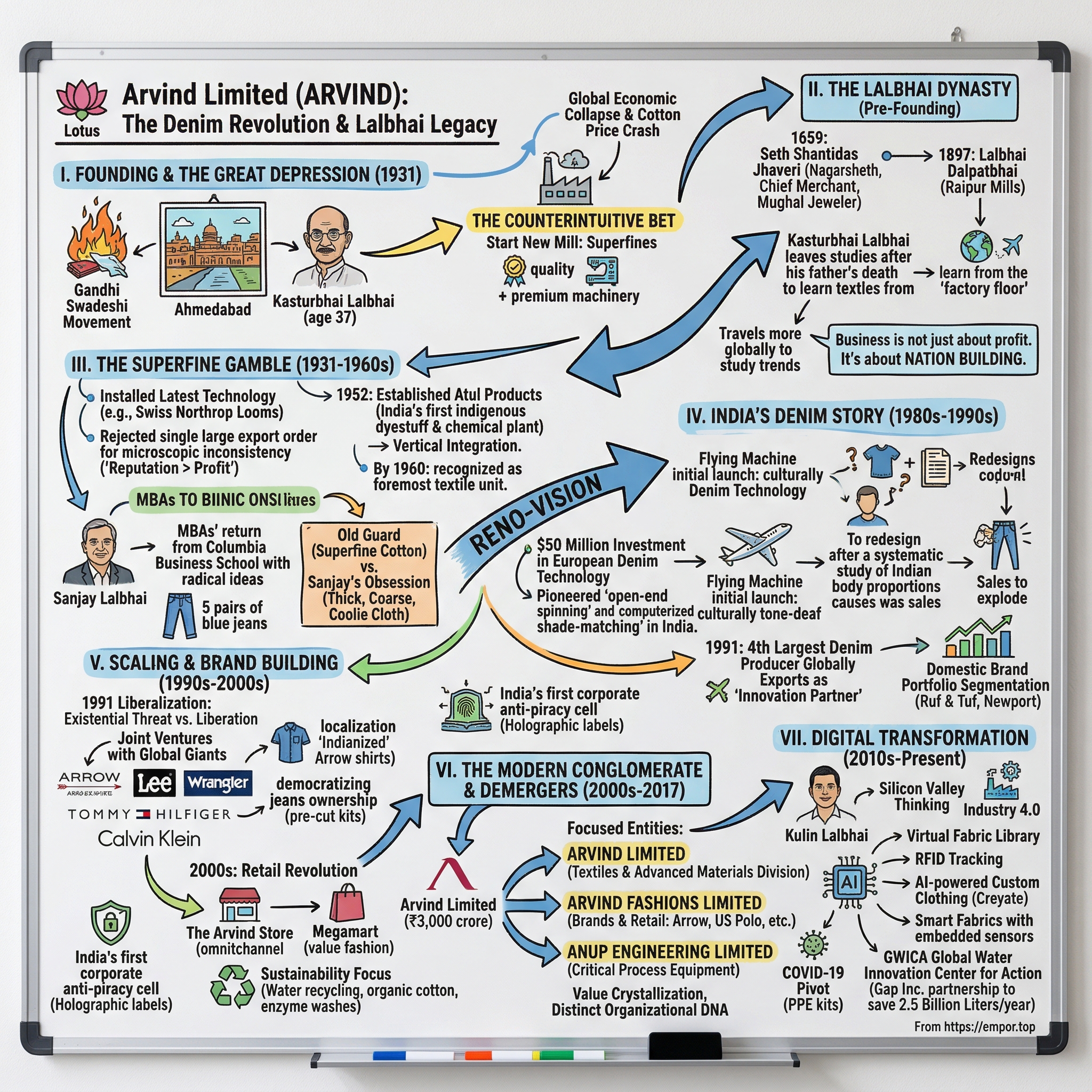
Arvind Limited: India's Denim Titan, The Lalbhai Dynasty, and the Technical Materials Pivot
I. Introduction & The Great Depression Bet
On 25 August 2026, CARE Ratings upgraded Arvind Limited's long-term credit rating from AA- to AA, citing improved margins, stronger returns on capital, and a more robust balance sheet.7 For a company that defaulted on roughly ₹2,700 crore of long-term debt and posted a net loss of about ₹316 crore in 2000, the upgrade is more than routine financial news—it marks a major corporate turnaround.21
Ninety-five years earlier, in the summer of 1931, three brothers from Ahmedabad—Kasturbhai, Narottambhai, and Chimanbhai Lalbhai—invested their capital into a new cotton mill at the precise moment the global economy was collapsing.12 Commodity prices were in free fall, British cloth from Lancashire still dominated Indian shelves, and Mahatma Gandhi's Swadeshi campaign urged Indians to burn foreign textiles without any guarantee domestic mills could match their quality. Into this market, the Lalbhais placed a bet that appeared reckless on paper: build a mill to produce finer cloth than the imports, rather than cheaper cloth.
That core decision—prioritising quality over cost and technical complexity over volume—serves as the main narrative thread of the company's history. It explains the superfine voiles exported to Switzerland and the United Kingdom by 1935.1 It explains why Arvind introduced indigo denim manufacturing to India in the late 1980s. It also explains why the company nearly ruined itself years later by mistaking a product advantage for a durable moat. And it explains Arvind's strategic position in 2026: the fastest-growing, highest-margin division of India's most prominent denim manufacturer now produces ballistic vests, industrial filter bags, wind-blade composites, and needle-punched nonwoven fabric for the underbodies of American cars.
In the financial year ended March 2026, Arvind reported consolidated revenue of ₹9,303 crore (up 12%), EBITDA of ₹1,061 crore (up 15%), and profit before exceptional items of ₹444 crore (up 21%).24 Net debt closed at ₹1,172 crore, down ₹112 crore from a year earlier.2 Return on capital employed reached roughly 13.8%—respectable for an Indian textile mill, though modest against a domestic cost of capital that rarely drops below 11%.3 Public markets have priced in this recovery: the stock traded around ₹541 in late August 2026, valuing the equity at roughly ₹14,700 crore, or about 33 times trailing earnings—a valuation multiple characteristic of a growth business rather than a traditional textile mill.3
That premium valuation rests on three key strategic pillars.
The first is scale in the core textile business. Arvind produced 59.5 million metres of denim and an all-time high of 135.8 million metres of woven fabric in FY26,2 maintaining its position among the world's largest fabric suppliers over the past three decades.
The second is vertical integration: moving further down the value chain from fabric into finished apparel. Garmenting volumes reached 41.6 million pieces in FY26, generating over ₹2,000 crore in revenue.2 Management contends that converting in-house denim into finished jeans yields higher margins and stickier customer relationships than selling raw fabric. While sound in theory, execution across previous apparel cycles provides critical context for evaluating this claim.
The third pillar is the Advanced Materials business—human protection fabrics, industrial filtration and belting, and fibre-reinforced composites. Revenue in this segment grew from ₹679 crore in FY21 to ₹1,544 crore in FY25, representing a 23% compound annual growth rate, with EBITDA margins ranging between 13% and 16% compared to 8% to 11% in textiles.5 Advanced Materials revenue reached ₹1,839 crore in FY26.2 In May 2026, this unit—housed within wholly owned subsidiary Arvind Advanced Materials Limited—acquired roughly 61% of US nonwovens manufacturer Dalco-GFT at an enterprise value of $136 million, marking its first manufacturing expansion outside India.5
All three strategic bets remain active, measurable, and partially in tension with the company's historical record. Arvind has previously promised mix shifts that failed to materialise, developed high-margin adjacencies that required later write-downs, and expanded through debt-fuelled acquisitions that brought the firm to financial distress. Evaluating the 2026 performance requires weighing current operating progress against a ninety-five-year history containing evidence for both optimism and caution.
The analysis ahead examines the Lalbhai family's merchant origins from the Mughal era, the Depression-era founding, the mid-1980s "Reno-vision" pivot that established Indian denim, the licensing expansion and debt restructurings of 2001, the 2018 corporate demerger, and the ongoing effort to transform a cyclical fabric maker into an industrial materials platform. It reflects a multi-generational business that has repeatedly demonstrated long-term strategic foresight alongside short-term operational missteps.
 Subscribe on LinkedIn
II. The Lalbhai Dynasty & Pre-Founding Legacy (1590s–1930)
Seventeenth-century Ahmedabad was not a provincial outpost but the commercial capital of Gujarat and one of the wealthiest trading hubs in the Mughal Empire. Its leading merchant princes held the title of Nagarseth, or city chief—a position carrying genuine civic authority. The family that later built Arvind traces its lineage to Shantidas Jhaveri, a Jain jeweller and bullion trader who supplied the Mughal court and was among the wealthiest merchants in seventeenth-century Ahmedabad.22
Evaluating this lineage requires separating romantic family narrative from analytical substance. Four centuries of continuous merchant standing in a single city does not constitute an economic moat. It does, however, establish a distinct operating temperament: an understanding that operating authority is granted by civic standing as much as market dynamics, and that reputational capital compounds more slowly and lasts longer than financial capital. That temperament surfaced in later corporate inflection points, including a major debt restructuring where the promoters chose not to walk away, and the development of an environmental engineering business created initially because the company's own dye houses required one.
The family's direct industrial lineage began in the late nineteenth century. Lalbhai Dalpatbhai founded the Saraspur Manufacturing Company in Ahmedabad in 1897, an event Arvind marks as the starting point of its corporate timeline.1 Following Lalbhai Dalpatbhai's death in 1912, his seventeen-year-old son Kasturbhai left his studies to join the business.22 Rather than entering management directly, Kasturbhai began on the mill floor as a timekeeper—learning operations before managing capital allocation, a sequence rare among dynastic heirs.
By the turn of the twentieth century, Ahmedabad was widely called the "Manchester of the East." Dozens of cotton mills operated along the Sabarmati River, financed largely by Jain and Vaishnav trading families shifting capital from bullion trading and moneylending into steam-powered manufacturing. This transition shaped the local business culture: mill owners were financiers who acquired machinery rather than engineers who raised capital. They understood balance sheets before looms, establishing an industrial tradition attentive to solvency—until strategic missteps compromised that discipline decades later.
Kasturbhai Lalbhai (1894–1980) defined the family's second era, operating as an institution builder alongside his textile interests.11 He participated in the Swadeshi movement through the 1930s and co-founded the Ahmedabad Education Society in 1936. He was a founding member of the Indian Institute of Management Ahmedabad (IIMA), chairing its Buildings Committee for seventeen years and selecting architect Louis Kahn to design the campus, while also serving as chairman of IIT Bombay for nearly a decade.11 Additionally, he supported the establishment of the Physical Research Laboratory, the National Institute of Design, and the Ahmedabad Textile Industry's Research Association (ATIRA), which was founded by Vikram Sarabhai in 1947; Kasturbhai chaired ATIRA during its inaugural management conference in 1955.11
Three aspects of that institutional record carry direct implications for evaluating the company's modern balance sheet.
First, ATIRA functioned as an industry-funded research commons for Indian textiles. Decades of involvement with a dedicated textile research institution gave the family deep access to process knowledge—accumulated expertise in dyeing, finishing, and fibre chemistry that cannot be rapidly purchased or reflected as an asset on a balance sheet. This provides context for the "process power" advantage evaluated in Section IX.
Second, in 1952 the family established India's first dye and chemical plant under Atul Products, explicitly to reduce reliance on imported dyestuffs.1 Viewed structurally, the textile business identified a critical imported chemical input and integrated backward to manufacture it. That pattern—resolving an upstream operational requirement internally before commercialising the capability for external customers—reappeared decades later in water treatment and technical fabrics. Whether this approach creates durable value or operational complexity remains a central analytical question.
Third, Kasturbhai's documented leadership style established long-standing corporate defaults. Contemporaries cited values of simplicity, frugality, functionality, and strict accountability, and he declined the formal chairmanship of IIMA to prevent the institution from being perceived as a family project.11 Institutional caution became a core trait—making the extreme leverage and financial distress of the 1990s a notable departure from historical practice.
This conservative orientation also shaped the group's social initiatives. The group established the SHARDA Trust in 1995 to work with urban communities surrounding Arvind's manufacturing facilities, later consolidating its community programmes under the Arvind Foundation in 2015.1 In financial terms, community investments operate primarily as risk mitigants: they support labour stability, municipal relationships, and environmental permitting in a state where industrial dye operations face regulatory scrutiny. They do not represent a competitive moat or generate margin expansion, and should be evaluated accordingly.
Multi-generational family control presents distinct structural trade-offs. Continuous family ownership enables long-term capital allocation without the pressure of quarterly market shifts—an asset when building an advanced materials platform. Conversely, family control shields management from market-driven changes of control when returns on capital underperform. Consequently, equity valuation depends entirely on execution quality rather than takeover potential.
By 1930, the essential elements were in place: an established merchant family with civic authority, a young leader trained in plant operations, an active manufacturing mill, and a national movement advocating domestic textile production. The strategy the Lalbhais adopted with these assets forms the next chapter of the company's history.
III. Founding & The Superfine Gamble (1931–1970s)
In 1931, the prevailing logic among Ahmedabad mill owners favoured volume over sophistication. Domestic demand was overwhelmingly concentrated in coarse cloth—cheap, low-count yarn woven into dhotis and basic workwear for a low-income, largely rural market. Competitors raced to capture that mass volume. Meanwhile, the high-margin segment—fine voiles, cambrics, and shirtings demanded by urban consumers and export markets—was dominated by British imports from Lancashire, as Indian mills lacked both the specialized machinery and the process discipline to spin and weave at higher yarn counts.
To enter this market, the Lalbhai brothers travelled to England, purchased modern spinning and weaving machinery, and directed the new venture toward the technical segment that domestic competitors avoided.2 Arvind Mills was formally incorporated on 1 June 1931 to manufacture superfine fabric.2
Commercially, targeting superfine fabrics during the Great Depression carried substantial risk. Higher yarn counts require finer threads, which increase yarn breakages, force looms to run at lower speeds, generate higher material wastage, and demand strict environmental and process control during bleaching and dyeing. Capital intensity per metre of output is elevated, while initial market volumes are modest. During an economic slump, buyers of premium cloth are often the first to curtail spending. By accepting weaker short-term operating leverage in exchange for structural differentiation, the Lalbhais gambled that technical barriers to entry would shield the mill from local competition longer than the downturn would last.
In textile manufacturing, yarn count measures fineness: a higher count indicates a thinner thread, yielding more threads per inch and producing lighter, softer, and higher-value fabric. Spinning higher counts is technically demanding, as pulling thread thinner increases tension, and a single break halts the spinning frame. Maintaining high-count production with minimal downtime depends less on capital expenditure than on precise operational variables—humidity control, raw fibre selection, meticulous machine maintenance, and operator skill. This operational know-how represented organizational capital rather than a fixed asset on a balance sheet—durable when maintained, but prone to decay if production standards slip.
The strategy produced swift results. By 1935, Arvind's fine fabrics, including its signature butta voiles, gained acceptance in Switzerland and the United Kingdom.12 Exporting fine cotton goods into the home market of Britain's textile industry provided both a commercial milestone and a tangible validation of Swadeshi industrial capability.
To secure consistent fabric quality, Arvind adopted end-to-end vertical integration under one roof, combining spinning, weaving, bleaching, and dyeing within a single facility. While modern supply chains often favor specialized outsourcing, 1930s Indian industrial infrastructure lacked third-party suppliers capable of meeting the strict tolerances required for superfine fabrics. Becoming an integrated producer resolved upstream quality constraints—an operational pattern Arvind would mirror decades later when expanding directly into garment manufacturing.
Between the 1950s and 1970s, India's regulatory environment shifted dramatically. The post-independence government implemented a strict licensing regime governing industrial capacity, product selection, and pricing, while subjecting raw cotton to quotas. Composite mills—large integrated operations like Arvind—faced mounting pressure between price-controlled domestic fabric mandates and a rapidly growing, decentralized powerloom sector that operated with lower overhead, cheaper non-unionized labor, and minimal regulatory oversight. Across India, integrated composite mills entered a prolonged structural decline, culminating in widespread mill closures in Bombay during the early 1980s.
This regulatory divide reconfigured Indian textile manufacturing. Registered composite mills paid excise duties, maintained unionized workforces, and were required under government control orders to produce fixed quotas of low-margin cloth at administered prices. Decentralized powerlooms escaped most of these financial and regulatory obligations. In effect, industrial policy taxed integration while subsidizing fragmentation. In response, mill owners could exit the industry, split operations into smaller unorganized units, or shift production further upmarket into complex fabrics beyond the technical capabilities of basic powerlooms. Arvind chose the upmarket path, driven as much by strategic necessity as by foresight.
While Arvind survived the license-raj era, the business that emerged in 1980 remained strategically constrained. Its primary competitive asset was deep process expertise in managing complex manufacturing workflows at scale. To institutionalize this technical discipline, the family established the Narottam Lalbhai Research Centre in 1977 to advance textile research and process development.1
Over its first five decades, Arvind built neither a consumer brand nor a direct retail distribution moat. Instead, it accumulated deep organizational competence in processing technically demanding materials—the foundation that decades later enabled its diversification into technical protection fabrics, industrial filtration, and advanced composites. As the 1980s approached, a new generation of leadership sought to turn this specialized manufacturing capability into a global growth platform.
IV. The "Reno-vision" Revolution & Denim Boom (1980s–1990s)
By the mid-1980s, Indian composite mills faced a crisis of survival. Decentralised powerlooms undercut integrated mills on production costs, while labor unrest disrupted operations across major textile hubs. As mills closed across Bombay and Ahmedabad, conventional cost-cutting—producing standard cloth slightly cheaper—amounted to a margin-destroying race to the bottom against competitors with far lower overheads.
Sanjay Lalbhai, representing the next generation of family leadership, rejected that path. In 1985, Arvind launched "Renovision," a strategy that reoriented the company away from the crowded domestic mass market toward international opportunities and higher-value products.1 The core objective was straightforward: exit commodity fabrics and focus on categories protected by technical barriers to entry.
Arvind selected denim as its primary growth engine—a non-obvious choice at the time. In the mid-1980s, denim was a Western fabric with virtually no Indian manufacturing base. It was also technically demanding: heavy, indigo rope-dyed cloth requires precise chemical and process controls so that the finished fabric fades predictably when washed.
That fading characteristic represents the central technical hurdle of denim manufacturing. Unlike conventional dyes that penetrate deep into cotton fibers, indigo coats the outer layers of yarn like paint on a rope, leaving the core white. In rope dyeing, thousands of yarn strands are twisted together, dipped repeatedly into indigo baths, and oxidized in air between dips to build up color layers. When a finished pair of jeans is washed and abraded, the outer coating wears away to reveal the white core underneath. Controlling bath concentration, dip count, oxidation time, and tension dictates how a garment ages over time—a complex process-control problem that matched Arvind's fifty years of dyeing discipline while remaining well beyond the reach of basic powerloom operators.
Arvind had already tested domestic consumer demand. In 1980, it launched Flying Machine, India's first domestic denim apparel brand, establishing that young Indian consumers wanted jeans even at premium prices.12 Manufacturing followed this demand signal: in 1987, India's first denim manufacturing plant commenced operations in Ahmedabad.1
Over the following decade, Arvind executed one of the largest capacity expansions in Indian manufacturing history. By the late 1990s, the company had built roughly 120 million metres of annual denim capacity, becoming the world's third-largest denim manufacturer.21 An Ahmedabad mill that a decade earlier fought powerlooms for basic cloth orders was now supplying indigo fabric to global brands such as Levi Strauss and Lee.15
Parallel to its denim build-out, Arvind commissioned a shirting facility at Santej in 1998 with 34 million metres of capacity.1 Woven shirting provided Arvind with a second major product line featuring a distinct customer base and demand cycle. That diversification proved valuable decades later: in FY26, woven fabric volumes reached an all-time high while denim ran well below nameplate capacity.2
To penetrate the domestic market, Arvind devised a distribution strategy tailored to 1990s India, where organized apparel retail was minimal and neighbourhood tailors dominated garment construction. Rather than competing directly against tailors with ready-made garments, Arvind launched Ruf & Tuf in 1995 as a ready-to-stitch kit containing cut fabric legs, buttons, rivets, a zipper, a leather label, and an instruction booklet for local tailors to assemble.15 This approach turned independent tailors into an uncapitalized assembly and distribution network. Arvind complemented this by launching Newport to target the economy segment.
While this expansion demonstrated Arvind's ability to identify underserved categories and scale technical manufacturing, it also exposed structural vulnerabilities. The company's competitive edge rested on factors that proved difficult to defend: indigo dyeing know-how was replicated within a decade by mills in China, Turkey, and India; fixed capacity turned into an operating drag when demand cycled down; and primary brand equity remained with B2B customers like Levi's and Lee rather than Arvind.
This dynamic illustrates a recurring challenge for tier-one industrial suppliers. When a manufacturer's primary customers are powerful global consumer brands, revenue may look prestigious, but operating terms mirror commodity contracts. The brand owns the retail shelf, the pricing power, and the customer relationship, while the fabric supplier carries the heavy machinery and inventory risk. Every additional metre Arvind sold to global jeans brands expanded its scale while highlighting that the highest economic returns accrued elsewhere in the value chain. Arvind would spend the next three decades—through brand licensing, retail, and vertical garmenting—attempting to redefine that structural position.
Moreover, the tailor-based distribution network failed to become a durable competitive asset. Arvind discontinued Ruf & Tuf in 2001 under the pressure of excise and tax economics, followed by an unsuccessful relaunch in 2004 and a digital revival attempt in 2019.15 By the time Arvind Fashions pruned its portfolio two decades later, Ruf & Tuf and Newport were both slated for exit.16 What began as an inventive distribution solution proved to be a product of its era rather than a compounding moat.
External macroeconomic tailwinds also accelerated growth. India's 1991 economic liberalization, combined with the arrival of satellite television, generated rapid consumer demand for Western apparel just as Arvind brought its denim capacity online. However, management interpreted this cyclical boom as a permanent secular trend, concluding that building more denim capacity was inherently self-sustaining. The financial consequences of that assumption would arrive with the downturn at the end of the decade.
V. Brand Licensing, Over-Expansion, & The Great Debt Crash (1990s–2000s)
If the late 1980s focused on manufacturing products competitors could not match, the 1990s centered on acquiring international brand names. Following India's economic liberalisation in 1991, global apparel brands sought domestic market entry, and Arvind possessed the two assets they required: manufacturing scale and distribution access. In 1993, Lee Jeans and Arrow Shirts entered the Indian market through Arvind partnerships.1 The portfolio expanded over subsequent years through licensing and joint-venture structures, bringing brands such as Calvin Klein and Tommy Hilfiger to India by 2011.1
The economics of these master licensing agreements and joint ventures differed significantly from a structural moat. The Indian partner provided capital, retail infrastructure, working capital, and inventory risk, while the brand owner contributed the trademark and collected royalties. During market expansions, both entities profited; during downturns, the licensee absorbed inventory markdowns while royalty obligations remained intact. Crucially, the licensee did not own the underlying brand assets. Arvind's Lee and Wrangler operations were structured as a joint venture with VF Corporation in which Arvind held a minority stake before eventually exiting; licensed brands that migrated to Arvind Fashions, including Newport and Ruf & Tuf, were later discontinued during post-demerger portfolio rationalisation.16 A licensing portfolio functions primarily as a distribution enterprise rather than a brand-equity builder, generating limited long-term compounding unless the business owns the customer relationship.
A secondary structural strain from licensed retail manifested directly in cash flow performance. Apparel retail places continuous demands on working capital: inventory is ordered a season in advance, carries fashion obsolescence risk, and depreciates rapidly if unsold. A manufacturer's balance sheet is structured for slow-turning fixed assets funded with long-term debt, whereas a retail balance sheet requires fast-turning inventory funded by short-term credit. Combining the two models meant the core manufacturing operation continuously funded retail seasonal working capital swings, obscuring the true return on capital across both businesses.
Alongside brand licensing, Arvind expanded into unrelated corporate ventures. The group's corporate disclosures continue to list telecommunications among historical business lines nearly four decades later.5 Concurrently, in 1997, the company committed to a major manufacturing complex costing approximately ₹1,000 crore, financed with domestic and foreign currency debt.14
Then the industry cycle turned sharply.
The falsification test. Management and financial markets had assumed that massive denim manufacturing scale combined with global brand licensing created a durable, high-margin business. Subsequent operational results disproved that thesis.
By the late 1990s, global denim manufacturing capacity outpaced demand, triggering a collapse in fabric prices. The Asian financial crisis depressed export demand, while a depreciating rupee inflated debt service on foreign currency loans raised for machinery purchases, driving project cost overruns. The new manufacturing complex experienced prolonged startup delays before reaching profitability, and regional flooding further disrupted plant operations.14 While individual setbacks were manageable, their combined weight overwhelmed a balance sheet structured for uninterrupted growth.
By 2000, Arvind Mills accumulated approximately ₹2,700 crore in long-term debt—comprising roughly ₹1,771 crore owed to domestic institutional lenders and ₹929 crore to overseas creditors, with ICICI Bank holding over ₹500 crore—and recorded a net loss of about ₹316 crore.21 The company defaulted on its debt obligations as accumulated losses crossed ₹500 crore, destroying equity value.14
The operational impact of default extended far beyond balance sheet metrics. Servicing that debt load consumed multiple times operating cash flow, diverting capital away from plant maintenance, working capital, and payroll. Capital starvation forced key managerial departures, while commercial buyers dual-sourced fabric supplies to mitigate counterparty risk. Financial distress transformed into operational disruption within four quarters. That Arvind preserved its client relationships and technical capabilities throughout this period remains a notable operational outcome.
The restructuring initiated in February 2001 represented one of the largest corporate debt realignments in Indian corporate history. Arvind allocated approximately ₹750 crore toward debt buyback programs; certain lenders accepted principal haircuts of up to 55%, while others converted debt into five- and ten-year instruments, with 43 of 54 lenders approving the plan to halve ongoing interest costs.21 To fund the restructuring, Arvind liquidated surplus real estate for ₹255 crore and spent subsequent years rationalising non-denim manufacturing lines across shirting, khakis, and knits.14
The debt buyback mechanism operated as a structured balance sheet discount. Rather than seeking simple maturity extensions, Arvind offered cash repurchases at a discount, offering creditors immediate liquidity over uncertain future recoveries. Lenders accepting haircuts of up to 55% formalised losses, whereas participating lenders rolling over obligations assumed duration risk for full principal recovery.21 Retiring debt below par generated an immediate restoration of equity value. This execution required cash from real estate sales and promoter commitment; the controlling family retained management oversight and navigated the restructuring without abandoning the enterprise.
Three analytical lessons emerge from this restructuring.
First, combining capital-intensive commodity manufacturing with high financial leverage creates severe downside risk during inventory destocking cycles, as fixed operating costs and debt service obligations remain constant while volumes and prices fall simultaneously.
Second, Arvind's financial crisis resulted not from its core denim product strategy, but from financing capital expenditure under the assumption of an uninterrupted growth cycle. The underlying product focus proved viable over the long term, with Arvind remaining a major global denim producer in 2026. Evaluating manufacturing enterprises requires distinguishing between operational product positioning and balance sheet capitalization.
Third, promoter behavior directly influenced the recovery trajectory. Management did not walk away from distressed assets; instead, promoters restructured liabilities, sold non-core assets, and maintained operational integrity. Between 2008 and FY12, the restructured entity expanded revenue at a 17% compound annual rate to ₹4,925 crore, generated ₹602 crore in EBITDA, and increased direct-to-consumer revenue from under 20% to approximately 40% of total sales.14 However, this operational recovery established the foundation for a subsequent challenge: expanding a consumer retail platform directly on top of a capital-intensive textile manufacturing balance sheet.
VI. The Demerger Crucible: Decluttering the Conglomerate (2008–2017)
In 2008, the company dropped "Mills" from its corporate name, rebranding Arvind Mills Ltd as Arvind Ltd while launching a dedicated technical textiles division.1 The name change was not mere cosmetic repositioning. It signaled an explicit management admission that traditional cotton milling would no longer define the enterprise, marking the start of a broader attempt to move beyond basic fabric manufacturing.
What followed was a decade of incubation across disparate sectors. In environmental engineering, the company built out Arvind Envisol, securing a 2014 patent for polymeric film evaporation technology in wastewater treatment.1 In real estate, it organized group-owned land assets into Arvind SmartSpaces before demerging the arm in 2015.1 In retail and distribution, it opened The Arvind Store network in 2010, launched a proprietary e-commerce platform in 2016, and introduced an in-house ready-to-wear brand in 2017.1 Meanwhile, textile innovation continued: Arvind produced India's first Better Cotton Initiative bale in 2011, launching Khadi Denim and a stretch-denim partnership with Invista in 2015.1
Several sustainability initiatives from this era functioned as commercial infrastructure rather than corporate philanthropy. In 2019, Arvind commissioned a wastewater treatment facility at Naroda in partnership with Gap Inc., which the company stated conserved 2.5 billion litres of freshwater annually.1 Subsequent environmental collaborations included a 2022 textile recycling alliance with PurFi Global, a 2024 water innovation centre at Santej, and the 2025 installation of what Arvind described as India's first commercial-scale supercritical carbon dioxide dyeing machine, developed with H&M Group and Deven Supercriticals.1 Structurally, these partnerships operate as customer-funded qualification programs. When global apparel brands co-develop proprietary processing technologies inside a supplier's facilities, they integrate the manufacturer directly into their global compliance architecture. This integration creates the textile division's most defensible switching-cost mechanism—though whether it yields pricing power rather than routine order retention remains an open operational question.
Examining this expansive portfolio reveals a deep structural conflict. By 2016, a single listed entity housed heavy capital-intensive textile mills alongside a rapidly growing retail business managing licenses for Gap, Sephora, Arrow, Flying Machine, Tommy Hilfiger, Calvin Klein, and the Unlimited value chain. It also contained a heavy process-equipment manufacturer, an environmental engineering firm, a real estate developer, an e-commerce platform, and legacy telecom operations. These divisions operated under fundamentally incompatible capital cycles, working capital requirements, and return profiles. Apparel retail requires heavy seasonal inventory and store capital expenditure, with public markets valuing it on same-store sales growth. Fabric manufacturing requires machinery investments and relies on plant capacity utilization. Combining them forced consolidated returns on capital into a blended average across misaligned operations.
While the resulting conglomerate discount is often attributed to market skepticism, it represents a structural information breakdown with direct capital allocation consequences. Sharing a single balance sheet prevents public markets from discerning which division generates cash and which absorbs it, leading investors to price the parent entity near its weakest component. Internally, the arrangement distorted capital allocation, forcing high-return projects to compete for corporate capital against low-return legacy units backed by historical sentiment. A corporate demerger offered a mechanism to expose and address both operational friction and capital misallocation simultaneously.
In 2018, Arvind executed a structural corporate split, receiving National Company Law Tribunal approval to divide into three distinct listed entities: Arvind Fashions Ltd for branded retail, Anup Engineering for heavy equipment manufacturing, and Arvind Ltd retaining core textiles and emerging materials.12 Following the 29 November 2018 record date, shareholders received one share of Arvind Fashions for every five Arvind shares held, and one share of Anup Engineering for every twenty-seven, with Arvind Fashions formally listing on 8 March 2019.
Management framed the transaction around value unlocking. The underlying rationale was structurally sound: isolate inventory-intensive consumer retail from asset-heavy manufacturing, enable each entity to raise capital against its own operating cash flows, and eliminate internal cross-subsidization.
The falsification test. Evaluating the proposition that demerging branded retail unlocks shareholder value yields a nuanced outcome.
On valuation, the thesis holds partial merit. By April 2026, the four listed entities of the Lalbhai group commanded a combined market capitalization of approximately ₹23,600 crore—with Arvind Ltd at roughly ₹10,300 crore, Arvind Fashions at ₹6,300 crore, Anup Engineering at ₹4,300 crore, and Arvind SmartSpaces at ₹2,700 crore.5 Operating data from FY25 demonstrated that the spun-off businesses delivered higher return profiles than the parent enterprise: Anup Engineering achieved a 22% EBITDA margin and a 25% return on capital employed, Arvind SmartSpaces recorded 28% and 20%, and Arvind Fashions generated 14% and 20%—compared to Arvind Ltd’s 11% margin and 13% return on capital.5 These figures illustrated the conglomerate discount directly, as higher-margin, higher-return businesses had previously been valued as secondary units of a lower-return core.
However, the post-demerger trajectory for retail shareholders exposed underlying operational weaknesses. Once operating independently, Arvind Fashions revealed that its retail network had over-expanded into lower-margin retail footprints. The entity exited licensing agreements for Gant, Izod, and Nautica in FY20, followed by exits from The Children's Place, Hanes, Newport, and Ruf & Tuf, alongside the mutual termination of its Gap franchise after the pandemic. In July 2021, it sold the 74-store Unlimited retail chain to V-Mart for approximately ₹150 crore in cash plus contingent payments at book value—a transaction reflecting asset rationalization rather than profitable monetization.16 To stabilize operations, Arvind Fashions reduced its FY21 cost base by roughly ₹540 crore (a 40% reduction), executed a rights equity issuance, and sold a minority stake in its youth-brands division to Flipkart.16
These operational realities clarify the impact of the demerger. The corporate split did not generate intrinsic value within the retail division; rather, it exposed that retail operations had been consuming corporate capital while housed within the parent balance sheet. Independent funding requirements accelerated operational discipline—reframing the 2018 corporate restructuring as necessary portfolio rationalization rather than instant value creation. This experience offers context for evaluating ongoing structural separations across technical materials: corporate demergers function as financial disclosure events prior to value creation, occasionally exposing operational headwinds alongside strategic focus.
Following their separation, Anup Engineering and Arvind SmartSpaces generated returns on capital consistently above those of the parent entity, indicating that their capital had been constrained by consolidated corporate architecture rather than operational execution.5
The post-split entity of Arvind Ltd retained a fundamental strategic question: stripping away retail brands and heavy engineering left a core fabric manufacturing business alongside a smaller, rapidly expanding advanced technical materials division, setting up the strategic choices of the subsequent decade.
VII. The Modern Play: Denim Scale, Garmenting Pivot, & Advanced Materials Optionality (2018–Present)
On 27 August 2025 — one year to the day before this article — the second tranche of a punitive US tariff landed on Indian textiles, taking the total duty to 50%.17 Half of it had arrived on 7 August; the rest was a reprisal for India's continued purchases of Russian oil. Overnight, Indian knitted clothing faced effective duties near 64% and woven garments above 60%, while Bangladesh and Vietnam faced roughly 20%.17 Walmart, Gap and Target reportedly asked Indian suppliers to pause shipments. The United States is India's single largest textile market — roughly $10.3 billion a year, about 28% of the country's textile and apparel exports.17
For a company like Arvind, with exports historically running at 45-50% of consolidated revenue, this was an existential-grade shock arriving without warning.13 It is the single most useful stress test of the modern Arvind, and worth watching how the company actually behaved rather than what it said.
What it said, on the Q3 FY26 call in late January 2026, was measured: tariff headwinds of ₹20-25 crore a quarter, roughly ₹90 crore annualised, described as manageable, with management pointing to UK and EU free trade agreements as offsetting market openings.10 What the numbers showed that quarter was a company absorbing the blow without breaking: revenue of ₹2,373 crore, up 14%, and an all-time-high EBITDA of ₹286 crore at a 12.0% margin — with the textile division up 9% at an 11.2% margin and Advanced Materials up 32% at a 15.5% margin.10 The tariff-exposed business held; the non-tariff-exposed business ran.
Then the macro turned again. On 6 February 2026 the United States and India issued a joint statement setting a reciprocal tariff of 18% on Indian goods, textiles and apparel explicitly included, down from 50%.1819 India's position went from worst-in-class to roughly at par with or better than most Asian competitors.
The results that followed are the cleanest evidence available on what Arvind's fabric business can do when the trade environment is not actively hostile. In the quarter ended June 2026, reported on 13 August, consolidated revenue rose 25% to ₹2,501 crore and EBITDA rose 39% to ₹258 crore.8 Denim fabric volumes hit 17.5 million metres, up 34% and the highest in sixteen quarters, with management describing denim capacity as running at 100% utilisation and being extended through leased rather than owned assets.8
That last detail is the most important operating disclosure of the year, and it cuts both ways. Choosing to expand denim through leased capacity rather than a greenfield plant is exactly the behaviour you would want from a company whose last debt-funded denim expansion nearly killed it. It is also an admission that management does not trust the demand signal enough to put permanent capital behind it.
The textile division: cash generator, price taker
The textile business generated ₹7,148 crore of FY26 revenue against total revenue of ₹9,303 crore.4 It is roughly three-quarters of the company and the source of most of its cash. It is also the part with essentially no pricing power, and Q1 FY27 proved it.
In that quarter, textile revenue grew 13% but textile EBITDA margin fell to 8.0% from 8.4%, because roughly ₹100 crore of input cost inflation driven by geopolitical tensions could not be passed through fast enough.8 Management framed this as a deliberate choice — trading margin for growth to protect market share — and as a timing issue that pricing would catch up with over coming quarters.8
Take that explanation seriously and then test it. A business that must choose between volume and margin when cotton moves is, by definition, a price taker. Arvind has now said versions of "pricing catches up with a lag" across multiple cycles; CARE's 2024 assessment named susceptibility to cotton price volatility as a standing rating constraint, alongside a heavy reliance on creditor financing for working capital.13 The claim that verticalisation smooths this volatility is testable, and the Q1 FY27 print is a data point against it: the garmenting business inside textiles did ₹497 crore of revenue on 11 million-plus pieces, up 13%, at roughly 7.5% EBITDA margin — below the division average, not above it.8
Garmenting: the pivot that keeps slipping
The strategic logic of "fabric to garment" is genuinely good. A metre of denim sold as fabric earns a fabric margin once. The same metre converted in-house into a stitched jean earns a fabric margin plus a conversion margin, deepens the relationship with the brand that buys finished goods, and makes the customer stickier because switching means requalifying a garment programme rather than reordering a roll of cloth.
The execution record is where it gets uncomfortable, and this is the falsification test that matters most for the current bull case.
In November 2018, at the time of the demerger, Arvind laid out explicit targets: consolidated revenue of ₹12,000 crore by 2023 from ₹6,798 crore; Advanced Materials revenue of ₹1,600 crore by 2023 from ₹505 crore; garmenting capacity from 31 million pieces to 125 million pieces by 2023; and fabric-to-garment conversion rising from 10% to 30-40%.12
Against those targets: FY23 consolidated revenue came in at ₹8,382 crore, not ₹12,000 crore.3 Advanced Materials reached ₹1,250 crore in FY23 against a ₹1,600 crore target, hitting that number roughly two years late.5 And garmenting volumes in FY26 — three years past the target date — were 41.6 million pieces, exactly one-third of the 125 million promised.2
COVID accounts for part of this. It does not account for all of it. On the Q4 FY26 call in May 2026, management described garmenting capacity moving "from high 40 million to mid-50 million garments," with margins currently in high single digits and a target of mid-teens "over time."9 Three months later, on the Q1 FY27 call, the language was "close to 15%" volume growth in FY27 with low double-digit margins achievable in "18 to 24 months."8 Management also flagged that supply constraints in Indian garmenting — read: skilled labour and trained sewing capacity — are the binding limit.9
The calibrated conclusion: the verticalisation thesis is not rejected, but it must be narrowed severely. Arvind can grow garmenting volumes at low-to-mid teens and is doing so. It cannot grow them at the rate it promised in 2018, and the constraint is operational — labour and training — not demand. Investors should therefore underwrite garmenting as a slow, grinding mix improvement worth perhaps a hundred-odd basis points of blended margin over several years, not as a step-change. The number that would confirm or falsify the revised claim is specific: garmenting EBITDA margin crossing 10% on a sustained basis by FY28. Management has now put that on the record twice with a defined window.89
The unit economics behind the garmenting argument are simple enough to state without a spreadsheet. Selling a metre of denim earns the mill a fabric margin, once, on a product the buyer can source from four other countries. Converting roughly one and a half metres of that same denim into a finished pair of jeans earns the fabric margin plus a conversion margin, and — more importantly — changes what the customer is buying. A brand switching fabric suppliers reorders a roll of cloth; a brand switching garment suppliers has to requalify a production line, a compliance audit and a delivery schedule. The prize is not the incremental margin, which is thin, but the stickiness. The catch, visible in Arvind's own numbers, is that garment conversion is labour-intensive work with no scale advantage, so the incremental margin stays thin for a long time before the stickiness shows up.
Advanced Materials: the real optionality, and the real question
Now the interesting part. Arvind Advanced Materials Limited operates three verticals: Human Protection (flame-retardant, arc-flash, high-visibility and special protection workwear), Composites (glass and carbon fibre fabrics and pultruded profiles, including a large FRP manufacturing position), and Industrial Applications (woven and nonwoven filtration bags and fabrics, reinforcement scrims, coated fabrics).5
In plain terms: Arvind makes the cloth that stops a spark from setting a refinery worker on fire, the bags that strip dust out of a cement plant's exhaust, and the resin-impregnated fabric that becomes a wind turbine blade or a railway panel. These are unglamorous products with a critical shared characteristic — they are specified in. An oil company does not switch flame-retardant fabric suppliers because a rival is 3% cheaper; the fabric is written into a safety standard, and requalification takes years. That is a genuinely different economic animal from selling denim to a jeans brand.
The financial record supports the framing. AMD revenue went ₹679 crore (FY21), ₹1,024 crore (FY22), ₹1,250 crore (FY23), ₹1,428 crore (FY24), ₹1,544 crore (FY25) — a 23% compound rate — with EBITDA margins of 14%, 13%, 13%, 16% and 15%.5 FY26 delivered ₹1,839 crore, up 19%.2 The Q1 FY27 quarter was a record ₹650 crore of revenue and ₹97 crore of EBITDA at a 15% margin, with the India business alone up 40%.8
In FY25 the business was moved into a wholly owned subsidiary, and on 6 May 2026 that subsidiary made its first acquisition: approximately 61% of Dalco-GFT, a US maker of needle-punched nonwoven specialty fabrics.5
The deal deserves a close look, because acquisitions are where Indian promoters most often destroy value, and this one is atypically well-constructed. Dalco-GFT was founded in 1988, runs two automated plants in North and South Carolina with about 75 million pounds of annual capacity and around 170 employees, and sells 300-plus products into mobility (~68% of revenue), geotextiles (~15%), industrial (~9%) and flooring and furniture (~8%).5 In calendar 2025 it did about $100 million of revenue at a 17%-plus EBITDA margin, roughly 40% ROCE, and 95%-plus cash conversion.5 It holds sole-source positions on about 88% of its programmes across 75-plus customers, with mobility contracts typically running 5-12 years.6 Arvind paid an enterprise value of $136 million — 7.75 times CY25 adjusted EBITDA — for a controlling stake, with the existing management team rolling over roughly 39% and a defined path to full ownership over four years.5
Three things are right about this deal. It is in an adjacency Arvind already understands rather than an unrelated diversification. The seller's management stayed and kept skin in the game. And the multiple paid is lower than the multiple Arvind's own equity trades at, which makes it arithmetically accretive on day one — the company said as much, and the first partial quarter delivered ₹157 crore of revenue and ₹24 crore of EBITDA at a 15.1% margin from about 1.8 months of ownership.8
One thing is not right, or at least not yet proven: how it was paid for. The $85.4 million consideration plus $25 million of working capital debt was funded entirely with $110 million of new borrowing — $60 million at the AAML level and $50 million at Dalco, part of it refinancing existing debt.6 CARE expected consolidated debt to rise to roughly ₹3,000 crore from ₹2,065 crore at March 2025.6 Net debt stood at about ₹2,100 crore before the QIP in the June 2026 quarter.8 A company whose defining trauma was debt-funded expansion just did a debt-funded expansion.
Management's mitigation was to raise equity. Arvind allotted 99,00,990 shares at ₹505 in August 2026, raising ₹500 crore against a floor price of ₹518.58 — a 2.62% discount.20 That is a sensible, well-timed placement into a strong stock, and it materially de-risks the acquisition. It is also dilution, and it moved promoter holding down: from about 41.2% in March 2023 to 39.53% in March 2026 and 38.09% by August 2026.3 There is no indication of promoter share pledging in the available disclosures.
There is a further, quieter tension here that deserves naming rather than burying. Punit Lalbhai's own framing of the acquisition — that it accelerates "growth ambitions of 18-20%" — was accompanied by an explicit statement that debt would be brought down "sharply over the next few years."5 Deleveraging and 18-20% growth in a capital-hungry materials business are not automatically compatible. Watch which one gives.
Environmental solutions: real technology, uneven commerce
Arvind Envisol is the group's water treatment arm, built on patented polymeric film evaporation technology for zero liquid discharge — a process that boils effluent down to a solid so a dye house discharges no liquid waste at all.1 Strategically it matters because European brands increasingly audit their suppliers' water footprint, and a mill that cannot demonstrate compliance loses orders. Arvind built the capability because it needed it, then sold it.
But the commercial record is a caution against treating in-house technology as automatic profit. In FY23 Arvind took a provision of roughly ₹57 crore against receivables and unbilled revenue in the water treatment business amid civil conflict and political instability in Ethiopia.13 Good technology sold to the wrong counterparty in the wrong country is still a write-off. That episode is a useful prior when evaluating how quickly any of Arvind's other technical capabilities will convert into durable earnings.
Beyond textiles and Advanced Materials sits a residual "others" bucket — environmental solutions, a legacy telecom unit and assorted holdings — which contributed roughly ₹200 crore of revenue and ₹16 crore of EBITDA in the December 2025 quarter.10 It is small enough not to move earnings and large enough to matter to the story, because it is the visible remnant of the conglomerate era. A company arguing that it deserves to be re-rated as a focused materials platform is carrying, on the same balance sheet, a telecom line of business that has outlived every strategic rationale it was founded with.5 Tidying that up would cost little and signal a good deal.
VIII. Management, Capital Allocation, & Governance Stress-Test
Corporate history produces a distinct category of Indian promoter family: one that survives financial distress and thereafter maintains a permanent aversion to risk. Across five years of earnings calls, Arvind's leadership reflects that cautious temperament—with the notable exception of the Dalco-GFT acquisition.
Sanjay Lalbhai has directed the enterprise for four decades. As the executive who launched Renovision in 1985, introduced denim manufacturing to India, assembled the international brand licensing portfolio, presided over the subsequent financial crash, negotiated the 2001 restructuring, and ultimately demerged the conglomerate, his record encompasses both the firm's most insightful and most flawed capital allocation choices.113 Any evaluation crediting him for the strategic denim pivot must equally account for the leverage that preceded the collapse.
Punit Lalbhai, Vice Chairman, oversees Advanced Materials, engineering, agribusiness, and the innovation and sustainability agenda.513 He developed the Advanced Materials division from inception into a business generating over ₹1,800 crore in revenue with higher margins and faster growth than the core textile operation, while also leading the group's first overseas acquisition. The investment thesis positioning Arvind as an industrial materials platform rests primarily on this unit.
Kulin Lalbhai serves as Vice Chairman overseeing retail concepts and digital initiatives.13 His domain—the consumer-facing branded apparel arm—was separated during the 2018 demerger and subsequently required extensive operational restructuring.
Jayesh Shah, whole-time director and group CFO, is a chartered accountant with three decades at the firm who helped structure both the 2001 debt realignment and the 2018 corporate split.13 Nigam Shah joined as CFO in September 2023 and serves on the board.
Recent analyst scrutiny highlights key operational tensions. On the August 2026 earnings call, questions focused on four main themes: input cost inflation pass-through, the timeline for garmenting margin recovery, the sustainability of denim volume growth at full plant utilization, and the integration and debt repayment schedule for the US acquisition.8 While executive responses offered specific metrics and windows for the first three areas, explanations regarding debt reduction remained generalized. Providing precise short-term operational targets alongside vague multi-year deleveraging goals reveals an asymmetric planning visibility.
The falsification test on capital discipline. The claim is: post-2017 management exhibits strict capital allocation discipline and transparent guidance. Testing this claim against actual execution across multi-year cycles yields measurable friction points.
Target-setting. The long-term targets outlined during the 2018 demerger showed wide gaps when measured against actual results. Management targeted consolidated revenue of ₹12,000 crore by 2023, but reported ₹8,382 crore. It projected garmenting capacity of 125 million pieces by 2023, yet output reached just 41.6 million pieces by FY26. Advanced Materials was expected to reach ₹1,600 crore by 2023, but hit ₹1,250 crore.32512 Meanwhile, the demerged retail entity aimed for ₹9,000 crore in revenue by 2022 against an actual FY25 print of ₹4,620 crore.512 Widespread target shortfalls of 30% to 70% point to structural over-optimism in strategic planning rather than unexpected market headwinds.
Return on capital. Returns on capital have lagged internal and agency forecasts. In April 2024, CARE noted that return on capital employed had risen to 12.02% in FY23 from 11.46%, and projected a gradual increase to 16% by FY25.13 Actual performance reached roughly 13% in FY25 and 13.8% in FY26.35 This shortfall stems from the working-capital intensity of cotton and fabric inventory, with CARE highlighting the company's above-average reliance on creditor financing to support working capital requirements.13
What has actually improved. Capital discipline has shown clear progress in balance sheet deleveraging. Total debt fell by approximately ₹770 crore between March 2019 and March 2022, and by an additional ₹350 crore in FY23, reducing gearing to 0.54 times and total outside liabilities to net worth from 1.54 to 1.01.13 Free cash flow reached roughly ₹381 crore in FY26.3 Citing margin expansion, improved returns, and lower leverage, CARE upgraded Arvind's credit rating to AA in August 2026, noting garmenting volume growth of 12% in FY26 and 13% in the first quarter of FY27.7 Balance sheet repair has succeeded; driving higher returns on retained capital remains a slower process.
Governance and second-layer items. Several governance and operational items warrant ongoing monitoring. Arvind holds approximately 525,000 square yards of freehold land near Ahmedabad, monetizing portions through residential development—a source of asset value that creates related-party transactions alongside the group's listed real estate arm.13 The corporate structure encompasses 16 subsidiaries, 3 joint ventures, and an associate, representing a complex consolidation footprint for a ₹9,300 crore business. A greenfield human-protection facility across Varanasi and Ahmedabad, budgeted at ₹154 crore and funded through ₹91 crore of debt alongside internal equity, qualifies for production-linked incentive support and serves as an active benchmark for project execution.13 In addition, reported earnings in FY23 included a ₹149 crore gain from selling the group's internet business, illustrating that net profits have occasionally benefited from non-recurring asset sales.13
The activist question. Institutional investors focus on three unresolved structural questions. First, with a return on capital of 13.8% and a price-to-book ratio exceeding 3.5 times, why did the company issue new equity to finance an acquisition instead of reallocating capital from its lower-return textile division?3 Second, what is the long-term plan for the non-core "others" segment—encompassing telecom, water treatment, and minor holdings—which lacks scale and generates limited market valuation? Third, if Advanced Materials represents a superior growth asset, what is the definitive timeline for a full corporate spin-off? While management transferred the division to a wholly owned subsidiary, disclosures contain no public commitment to an independent listing date.
Owner alignment presents a balanced picture. A promoter equity stake near 38% maintains substantial economic alignment, tying family wealth directly to equity performance.3 However, promoter ownership has trended downward over three years, declining further after the board elected to fund growth through an equity placement without pro-rata promoter participation.320 Domestic institutional investors have expanded their stakes in response.3 A growing institutional shareholding increases market accountability, raising the operational cost of missing forward targets.
The overall assessment of management reflects a clear dichotomy: demonstrated operational capability, technical ambition, and crisis resilience, balanced against a multi-cycle pattern of setting targets that outpace actual delivery. Underwrite the execution. Discount the targets.
IX. Industry Economics, Competitive Landscape, & Helmer's 7 Powers
Evaluating textile economics requires tracking an industry metric that rarely surfaces in standard corporate disclosures: the spread between Indian raw cotton prices and international benchmarks.
India sets a Minimum Support Price for raw cotton to protect domestic farmers. When global prices fall below that floor, domestic mills must purchase their primary raw material at a premium relative to Bangladeshi or Vietnamese competitors buying identical fibre on international markets. Manufacturers cannot easily pass on this cost differential, as global apparel brands compare supply quotes across multiple Asian production hubs. CARE Ratings cited this exact mechanism to explain the demand weakness in Indian textile exports during FY23: elevated domestic cotton prices and their premium over international benchmarks.13 Rather than a temporary cyclical inconvenience, this represents a structural cost handicap that fluctuates with agricultural policy and remains outside management control.
Trade policy introduces a second volatile variable. The 2025–2026 tariff adjustments demonstrated how rapidly trade terms shift operating economics. A 50% US tariff imposed in August 2025 rendered Indian garments 30% to 35% more expensive than Bangladeshi or Vietnamese alternatives, before a February 2026 interim agreement reset the rate to 18%, restoring parity with or advantages over regional rivals.1719 Historically, Bangladesh has leveraged duty-free market access and lower labor costs, while Vietnam has relied on supply-chain speed and logistics. India's structural advantage lies in domestic cotton cultivation and an integrated value chain spanning raw fibre to finished garments—a depth that underpins its role as a key beneficiary of "China Plus One" sourcing diversification, even as implementation proceeds gradually.13
Logistics represents the third critical variable. Ongoing Red Sea maritime disruptions extended shipping lead times and drove up container freight rates to European and North American ports. Arvind explicitly attributed approximately ₹100 crore of input cost inflation in the first quarter of FY27 to these geopolitical tensions.8
Combined, these three forces define the central operational reality of the core business: an efficient manufacturer operating in an environment where raw material costs, trade tariffs, and freight rates are dictated entirely by external market forces.
The wage dynamics governing garment manufacturing represent a fundamental constraint on strategy. Garment assembly remains 60% to 70% labor by cost, featuring minimal automation across international supply chains; a sewing machine operator in Dhaka operates comparable equipment at similar speeds to one in Ahmedabad. With production technology virtually identical across regions, competitiveness hinges on wage rates, labor productivity, tariff access, and logistics speed. India ranks behind lowest-cost nations on wages, remains competitive on productivity, and experiences volatility on trade terms. Consequently, garment assembly remains the most margin-compressed link in the apparel value chain, with returns gravitating toward lower-cost manufacturing destinations.
The competitive set divides along distinct product lines. In premium denim, Turkey's ISKO defines international standards in stretch and performance fabrics, while Cone Denim and legacy North American mills compete on geographical proximity to Western markets. Domestically, Arvind competes against Raymond's denim division, Vardhman Textiles, and KPR Mill in yarn and fabric, alongside Welspun Living in home textiles. In technical materials, the peer group shifts to global specialists: DuPont in flame-retardant aramid fibres (Nomex and Kevlar), Teijin, Hexcel, and Gurit in structural composites, and Freudenberg in nonwovens. This operational divergence illustrates Arvind's dual market positions: a global scale leader competing on cost and process efficiency in denim, versus a regional challenger competing against established multinationals with long-standing customer specifications in technical fabrics. That structural disparity explains why acquiring an established US platform carrying 88% sole-source positions proved strategically more effective than attempting to build identical OEM approvals organically from Ahmedabad.5
The high-margin segment of denim operates under fundamentally different economics. ISKO competes on engineered performance attributes—such as stretch recovery, durability, and fabric architecture—positioning its output as a specified ingredient brand that commands pricing power. Rather than establishing a branded fibre platform, Arvind has pursued circular denim programs and co-developed sustainable processing methods. While this sustainability focus provides a defensible position with European buyers navigating strict environmental mandates, it represents a regulatory compliance advantage rather than a proprietary performance differentiation—a distinction that risks eroding as environmental standards become baseline industry requirements.
Freight rates and container transit times operate as a direct levy on geographic distance, disproportionately impacting lower-margin fabric and apparel producers that lack pricing power to absorb cost spikes. Rerouting vessels around the Cape of Good Hope during Red Sea disruptions extends transit timelines by weeks, trapping inventory on water and lengthening the working capital cycle that suppliers must fund.
Porter's five forces framework highlights key structural dynamics across the portfolio:
Supplier power is high and non-market-driven, as agricultural support policy dictates domestic raw cotton pricing. Buyer power is elevated in standard fabric and apparel manufacturing—where retail clients such as Gap, Target, PVH, and Levi Strauss maintain multi-country sourcing networks—but lower in Advanced Materials, where components are specified directly into customer engineering designs. Threat of substitutes remains moderate in denim due to synthetic and blended alternative fabrics, but low in protective workwear and industrial filtration, where non-compliant materials violate regulatory safety standards. Threat of new entrants is moderate in capital requirements but high in market practice, as governments across Asia subsidize textile infrastructure to drive industrial employment. Rivalry remains intense, fragmented, and prone to structural overcapacity.
Hamilton Helmer's 7 Powers framework evaluates the business's strategic moats:
Scale economies — present in core manufacturing, but constrained by cyclical demand. Installed annual capacity of roughly 100 million metres of denim and 135.8 million metres of woven fabric provides meaningful fixed-cost absorption across spinning and indigo dyeing facilities.23 However, denim production reached only 59.5 million metres in FY26, with management reporting full capacity utilization only during the quarter ended June 2026.28 Unutilized capacity during cyclical troughs converts scale into negative operating leverage. Furthermore, garment assembly gains minimal benefit from scale, as sewing operations remain labor-intensive with flat marginal cost curves.
Process power — central to company positioning, yet restricted in financial impact. Decades of specialized dyeing expertise, process innovation at the Narottam Lalbhai Research Centre, Envisol's patented wastewater evaporation systems, and commercial waterless supercritical carbon dioxide dyeing represent genuine technical capabilities.1 However, process power must manifest through premium pricing or cost advantages; Arvind's traditional textile EBITDA margin of 8% to 11% reflects limited divergence from industry peers.810 Process advantages manifest primarily in Advanced Materials, where EBITDA margins consistently reach 15% to 16%.5
Switching costs — sharply divided across business units, forming the central element of the valuation thesis. Standard fabric manufacturing carries minimal switching costs for brand buyers. In contrast, Advanced Materials features substantial switching barriers, with multi-year qualification cycles required for defense, industrial safety, and automotive OEM applications. Dalco-GFT's 5- to 12-year mobility supply contracts and 88% sole-source product share quantify these customer switching barriers.56
Counter-positioning — limited. Arvind's expansion into technical materials does not rely on a business model that incumbents are structurally prevented from copying. Competitors such as Vardhman Textiles and Welspun Living maintain the financial capacity to expand into technical applications. Arvind's advantage rests on first-mover timing and its acquired US manufacturing footprint rather than an unmatchable business model.
Branding, cornered resources, and network economies — absent as economic moats at the parent level, following the transfer of retail brands to Arvind Fashions during the 2018 corporate separation.
The structural analysis demonstrates a clear strategic dichotomy: approximately 80% of consolidated revenue originates in a traditional fabric business lacking durable economic moats, while roughly 20% derives from an advanced materials segment protected by high switching costs. The long-term investment case for re-rating the enterprise depends entirely on shifting that revenue balance.
X. The Investment Spine: Bull vs. Bear Case & Historical Falsification
Stripped of ninety-five years of history, the central question facing investors in late August 2026 is straightforward: is Arvind fundamentally a cyclical textile mill with a promising technical materials division, or a technical materials platform anchored by a legacy fabric business? Trading at roughly 33 times trailing earnings and 3.5 times book value, the equity market has priced the business far closer to a high-growth materials enterprise than its current consolidated financials justify.3
Myth versus reality. Three common market perceptions clash directly with disclosed financial data.
Myth: Arvind remains a denim pure-play. Denim production reached 59.5 million metres in FY26, less than half the company's 135.8 million metres of woven fabric volume, while its fastest-growing and highest-margin division produces no denim fabric.25 Denim remains the firm's most recognized product line, but it has ceased to be its primary financial driver.
Myth: The 2018 demerger single-handedly repaired the balance sheet. Balance sheet deleveraging resulted from sustained operating cash flow generation and nearly a decade of disciplined debt reduction.13 Furthermore, that financial flexibility is being actively deployed: gross consolidated debt was projected to rise toward ₹3,000 crore following the Dalco-GFT acquisition in the United States, prior to the subsequent equity placement.6
Myth: Advanced Materials is primarily a defence supplier. While military-adjacent protective fabrics form a component of the portfolio, the majority of segment revenue generates from industrial workwear, filtration systems, and belting, while the acquired US manufacturing platform derives approximately two-thirds of its revenue from automotive applications.5 The appropriate analytical framework for the division is an industrial consumables platform selling on strict engineering specifications rather than a defence contractor.
The bull case. The growth thesis centers on the Advanced Materials segment, which expanded at a 23% compound annual rate over five years with operating margins between 13% and 16%, reaching ₹1,839 crore in revenue in FY26 within wholly owned subsidiary Arvind Advanced Materials Limited.52 The acquisition of Dalco-GFT adds approximately $100 million in annual revenue at a 7.75 times EBITDA multiple, introduces needle-punched nonwoven technology, provides access to a $2.5 billion US market, and establishes a North American manufacturing footprint that insulates the unit from Indian export tariff adjustments.5 Management projects segment annual growth between 18% and 20%.8 Maintaining that expansion rate over four years would scale the division into a ₹4,000 crore enterprise with superior margins and return metrics relative to the parent textile business, strengthening the rationale for a future corporate spin-off.
The firm's balance sheet provides structural support for this strategy. Net debt closed at ₹1,172 crore in March 2026 against consolidated EBITDA of ₹1,061 crore, representing a net debt-to-EBITDA ratio of roughly 1.1 times—a fraction of the leverage recorded during the 2000 financial crisis.24 CARE Ratings upgraded Arvind's long-term credit rating to AA during the acquisition process.7 Subsequently, a ₹500 crore institutional equity placement was completed at a 2.6% discount to floor price, de-risking acquisition funding.20 Additionally, environmental investments in zero liquid discharge, recycled denim programs, and waterless dyeing serve as commercial assets as Western retail clients face stricter compliance mandates.1
The bear case. Skepticism surrounding the investment thesis derives primarily from the firm's historical operating record. The legacy textile business operates as a price taker in a globally oversupplied industry, burdened by domestic raw cotton support pricing. Results from the first quarter of FY27 highlighted this structural constraint: consolidated revenue grew 13%, yet textile operating margins contracted because ₹100 crore in input cost inflation could not be passed through to customers.8
Consolidated capital efficiency has shown limited structural improvement. Return on capital employed stood at 12.02% in FY23, reached roughly 13% in FY25, and reached 13.8% in FY26—falling short of credit rating agency projections of 16% while remaining modest relative to a domestic cost of capital around 11%.1335 Years after separating its retail division, the parent enterprise continues to generate returns close to its hurdle rate.
The vertical garmenting pivot—intended to enhance textile profitability—operates at one-third of the target capacity originally projected for 2023 while generating operating margins below the textile division average.2812 Executive commentary confirms that garment expansion faces ongoing labor supply constraints in an industry where Indian manufacturing competes on wages against regional exporters in Bangladesh, Vietnam, and Cambodia.9
Furthermore, technical capability does not guarantee consistent commercial returns. Despite holding proprietary water treatment patents, the environmental engineering division required a ₹57 crore provision against Ethiopian receivables in FY23 due to regional conflict.13 Within Advanced Materials, high-margin structural carbon composites represent a minor share of volume, with the majority of revenue generated from conventional industrial protective wear and industrial applications.5
Evaluating the core claims. Evaluating management's three strategic assertions reveals distinct levels of execution.
First, the assertion that Advanced Materials represents a superior business model is supported by operational data. Delivering five consecutive years of 13% to 16% operating margins through pandemic disruptions, cotton price volatility, and tariff adjustments demonstrates business resilience, while Dalco-GFT's 40% return on capital employed and 88% sole-source contract positions provide empirical evidence of customer switching costs.5
Second, the claim that vertical integration into garmenting structurally expands textile margins remains unproven at scale. Garment expansion is proceeding at approximately one-third of the speed outlined in 2018, requiring substantial margin expansion before delivering a measurable impact on consolidated profitability.
Third, the assessment of capital allocation discipline presents a mixed record. Debt reduction discipline has been demonstrated across multiple operating cycles. Conversely, long-term forward guidance has consistently overshot actual delivery. Acquisition discipline reflects a single, logically structured US transaction funded through debt, making long-term return on invested capital the critical evaluation metric.
The primary downside risk to the valuation does not stem from short-term cotton price movements or tariff fluctuations, which the firm has shown capacity to absorb. Rather, the thesis would be falsified if Advanced Materials revenue growth decelerates toward the legacy textile rate while consolidated leverage remains elevated. That outcome would indicate that segment margins reflected cyclical demand rather than durable switching costs, leaving the enterprise with increased debt without structural growth. Two consecutive years of sub-12% growth in Advanced Materials alongside flat operating margins would provide clear evidence of such deceleration.
Key performance indicators. Three specific metrics will determine the trajectory of the investment thesis:
- Advanced Materials revenue contribution and operating margin. Advanced Materials represented roughly 20% of FY26 revenue with EBITDA margins near 15%.25 Expanding segment contribution toward 25% or 30% of consolidated revenue while maintaining mid-teens margins serves as the essential requirement for sustaining the stock's valuation multiple.
- Garmenting operating margin. Management committed to achieving low double-digit EBITDA margins within 18 to 24 months of August 2026, compared to approximately 7.5% in the first quarter of FY27.8 Progress on this metric provides the primary test of whether vertical garment integration generates structural margin expansion.
- Net debt to EBITDA ratio. Net debt stood at 1.1 times EBITDA in March 2026 before gross debt expanded toward ₹3,000 crore following the Dalco-GFT transaction.26 Deleveraging over the subsequent eight quarters alongside Advanced Materials growth will indicate whether capital discipline is being maintained following foreign acquisition.
Broader macroeconomic variables—including cotton pricing, ocean freight rates, and quarterly fabric export volumes—represent operational noise relative to these three core metrics.
XI. Playbook: Business & Investing Lessons
Stewardship is not the same as performance, and both matter. Ninety-five years of continuous family control produced a company that survived a colonial economy, the License Raj, a global denim downturn, and a debt default without ever being broken up or liquidated. That degree of longevity is rare and warrants recognition when assessing risk. It has not, however, generated superior returns on capital: a ten-year revenue compound annual growth rate of roughly 2% and a return on capital employed that has hovered near the cost of capital show that survival and compounding require different skills.3 Investors evaluating family-controlled enterprises should price durability appropriately while refusing to pay a premium for growth that has not materialized.
Product focus is a double-edged tool. The Renovision strategy saved Arvind by concentrating capital on a single, technically demanding product category. Yet concentrating on that same fabric line, funded heavily through debt, nearly destroyed the firm a decade later. The takeaway is not an indictment of product focus; rather, a concentrated product strategy requires a conservative, low-leverage balance sheet. When a single product line enters a cyclical downturn, an over-leveraged enterprise lacks alternative cash flows to cover debt service.
Demergers serve as diagnostic instruments. The 2018 corporate split did not magically create value out of a conglomerate footprint; instead, it forced each business unit to operate on its own cash flows and exposed how the branded retail arm had over-expanded into lower-margin retail space. The spun-off units subsequently generated higher returns on capital than the parent enterprise—demonstrating that conglomerate corporate structure, rather than underlying asset quality, had dragged down overall performance.5 Applying that same analytical lens to the structural separation of Advanced Materials suggests prioritizing improved operational disclosure ahead of value creation.
Value-chain migration is a decade-scale transition, not a quick strategic pivot. Moving from commodity spinning to specialty weaving, finished garment assembly, and engineered technical materials represents a logical strategic progression. Arvind has pursued this transition since 2008, yet Advanced Materials still accounts for only roughly one-fifth of consolidated revenue.2 When management teams project rapid revenue mix shifts within heavy manufacturing, analysts should look past strategic intent and scrutinize specific plant capacities, capital expenditure schedules, and commercialization timelines.
When an enterprise acquires overseas capacity, examine the funding structure before evaluating the strategic narrative. The industrial logic behind acquiring Dalco-GFT is sound and its valuation multiple reasonable. However, the transaction relied on $110 million in new debt raised by an enterprise whose primary historical crisis stemmed from debt-fueled expansion, followed within three months by a ₹500 crore institutional equity placement.620 That sequence reveals far more about balance-sheet discipline and management priorities than any executive announcement.
Critical operational variables often lie outside corporate control. Within a single twelve-month window, Arvind's primary export market shifted from a 50% tariff rate down to 18%—a regulatory swing that impacted reported earnings more significantly than internal cost-reduction programs could achieve over the same timeframe.1719 For trade-exposed manufacturers, analytical rigor requires evaluating whether a firm can endure adverse policy environments while retaining capacity to capitalize on favorable reversals. Absorbing an annualized tariff burden of roughly ₹90 crore while generating record quarterly EBITDA, followed by acquiring a manufacturing footprint within the target tariff zone, provides an effective operational template for managing external trade volatility.105
Manufacturing scale does not equal operational utilization. Arvind has cited nameplate denim capacity in nine-figure meter terms for three decades, yet annual profitability has consistently depended on plant utilization rates rather than installed capacity. Nameplate capacity functions as a headline metric; plant utilization drives unit economics, though usually only the former is highlighted by default in public announcements.
Examine disclosures provided to credit rating agencies alongside shareholder communications. Credit rating reports incorporate forward operating projections supplied directly by management during private reviews, offering measurable benchmarks for retrospective evaluation. A 2024 credit assessment outlined an expected return on capital employed of 16% by FY25; actual execution fell several percentage points short, while the same document explicitly detailed the key structural constraints—raw cotton price volatility and heavy reliance on creditor-funded working capital—that made achieving that target difficult.135 Credit rating agency disclosures represent one of the most accessible sources of empirical guidance available to analysts, yet they remain systematically under-utilized.
XII. Epilogue & Future Horizons
Ninety-five years after three brothers imported British machinery to weave cloth finer than the empire's own, the enterprise they founded is larger, more diversified, and growing faster than the broader textile sector for the first time since the 1990s. In April 2026, the group's four listed companies commanded a combined market value of roughly ₹23,600 crore, with total revenue across eight business lines approaching ₹20,000 crore.52 Whether Arvind evolves beyond a traditional textile manufacturer into an industrial materials platform remains an open operational question, but the metrics governing that transition are clear.
Two critical structural questions remain unaddressed in public disclosures. Although Arvind transferred its Advanced Materials business into a separate subsidiary, management has not committed to a public listing date, execution timeline, or long-term equity ownership structure for the division. Furthermore, while the acquisition of Dalco-GFT includes a four-year path to acquire the remaining 39% minority stake alongside an intention to reduce debt, the specific funding mechanism for that buyback remains undisclosed.56 While these gaps do not signal immediate distress, they represent key execution variables for long-term investors.
Evaluating management's progress depends on three core operational benchmarks: expanding Advanced Materials beyond one-fifth of consolidated revenue while sustaining EBITDA margins above 15%; lifting in-house fabric-to-garment conversion toward the 30% to 40% range targeted in 2018; and reducing net leverage below 1.0 times EBITDA while driving return on capital employed into the mid-teens.122 Meeting these benchmarks requires no shift in corporate strategy, but demands a level of sustained execution over a multi-year planning cycle that the enterprise has historically struggled to achieve.
In the near term, operating fundamentals appear stronger than at any point in recent years: denim manufacturing is operating at full capacity, woven fabric output has hit record levels, export tariff pressures have eased, garmenting volumes are expanding at low-to-mid-teen rates, Advanced Materials has recorded its highest quarterly performance, and equity placements have recapitalized the balance sheet following the North American acquisition.8220 These improving operating metrics and lower financial leverage prompted CARE Ratings to upgrade Arvind's credit rating to AA in August 2026.7
The strategic test facing leadership—specifically Vice Chairmen Punit and Kulin Lalbhai—is whether a century-old textile manufacturer can successfully transition into an advanced materials enterprise. Management frequently cites global technical fabric leaders such as Teijin and Freudenberg as peers. However, the scale disparity remains vast: those competitors operate multi-billion-dollar materials platforms protected by decades of customer qualification lock-in, whereas Arvind's Advanced Materials business—including the Dalco acquisition—generates under $300 million in annual revenue. The strategic direction is established; closing the scale gap defines the primary long-term challenge.
Dynastic succession presents a parallel test. Chairman Sanjay Lalbhai has guided the group for four decades, while his sons now direct its core growth divisions as vice chairmen.513 While the operational transition appears orderly, corporate history suggests the primary risk facing a new generation is not operational capability, but balance-sheet overconfidence. Inheriting a repaired balance sheet without having managed the 2001 default risks underestimating the danger of debt-funded growth. Retiring the borrowing incurred for the US acquisition over the next three years will provide the first clear test of whether historical capital discipline has been institutionalized across generations.
Ultimately, assessing Arvind's long-term transformation requires measuring forward targets against historical delivery. In 2018, management projected consolidated revenue of ₹12,000 crore and garmenting capacity of 125 million pieces by 2023, ultimately falling far short of both figures.12 Demonstrating that Arvind has evolved from a cyclical fabric producer into a disciplined materials platform will require setting realistic operational targets and meeting them consistently—establishing a track record built on execution rather than cyclical recoveries in denim.
References
-
Our Story — Arvind Limited corporate timeline ↩↩↩↩↩↩↩↩↩↩↩↩↩↩↩↩↩↩↩↩↩↩↩↩
-
Arvind at 95: A Story Worth Preserving, A Future Still Being Woven — The Textile Magazine, 2026 ↩↩↩↩↩↩↩↩↩↩↩↩↩↩↩↩↩↩↩↩↩↩↩↩↩↩
-
Arvind Ltd consolidated financial dashboard — Screener.in ↩↩↩↩↩↩↩↩↩↩↩↩↩↩↩
-
Arvind Limited Reports Double-Digit Revenue Growth in Q4 FY26, Profit Rises 6% — Apparel Resources, 2026-05-16 ↩↩↩
-
Arvind Advanced Materials enters USA through Acquisition of Dalco-GFT — press release and investor presentation, Arvind Limited, 2026-05-06 ↩↩↩↩↩↩↩↩↩↩↩↩↩↩↩↩↩↩↩↩↩↩↩↩↩↩↩↩↩↩↩↩↩↩↩↩
-
Arvind Limited — Credit update on Dalco-GFT acquisition, CARE Ratings, 2026-05-15 ↩↩↩↩↩↩↩↩
-
CARE upgrades Arvind Limited's long-term credit rating to AA (Stable) — TipRanks, 2026-08-25 ↩↩↩↩
-
Arvind Ltd (BOM:500101) Q1 FY2027 Earnings Call Highlights — GuruFocus via Investing.com, 2026-08-13 ↩↩↩↩↩↩↩↩↩↩↩↩↩↩↩↩↩↩↩
-
Arvind Ltd (BOM:500101) Q4 FY2026 Earnings Call Highlights — Yahoo Finance, 2026 ↩↩↩↩
-
Arvind Limited Weaves a Resilient Q3 FY26 Amidst Global Headwinds — Multibagg, 2026-01-31 ↩↩↩↩↩
-
Kasturbhai Lalbhai and IIMA — IIM Ahmedabad Archives, 2023 ↩↩↩↩
-
Arvind's strategy linked with growth in Textile, Advanced Materials — The Textile Magazine, 2018-11-29 ↩↩↩↩↩↩↩
-
Arvind Limited rating rationale — CARE Ratings, 2024-04-17 ↩↩↩↩↩↩↩↩↩↩↩↩↩↩↩↩↩↩↩↩
-
The turnaround story of Arvind Mills — Business Today, 2012-07-17 ↩↩↩↩↩
-
Ruf & Tuf — the 'fitted' denims your tailor stitched, and made 1990s cool — ThePrint ↩↩↩
-
Arvind Lifestyle Brands to sell Unlimited to V-Mart Retail Ltd. — Apparel Resources, 2021-07-23 ↩↩↩↩
-
US Imposes 50% Tariff on Indian Textiles and Apparel — Global Textile Times, 2025 ↩↩↩↩↩
-
United States-India Joint Statement — The White House, 2026-02-06 ↩
-
US-India Strike Interim Trade Deal, Cut Tariffs to 18% — India Briefing, 2026 ↩↩↩
-
Arvind Limited: QIP allocation finalized at ₹505 per share — InvestyWise, 2026-08 ↩↩↩↩↩
-
Corporate Restructuring at Arvind Mills — MBA Knowledge Base case study ↩↩↩↩↩
 LinkedIn
 WhatsApp
 Reddit
 Hacker News
 Email
Email Kindle
 RSS Feed
 Spotify
 Apple Podcasts
 Amazon Music
 Audible
 YouTube