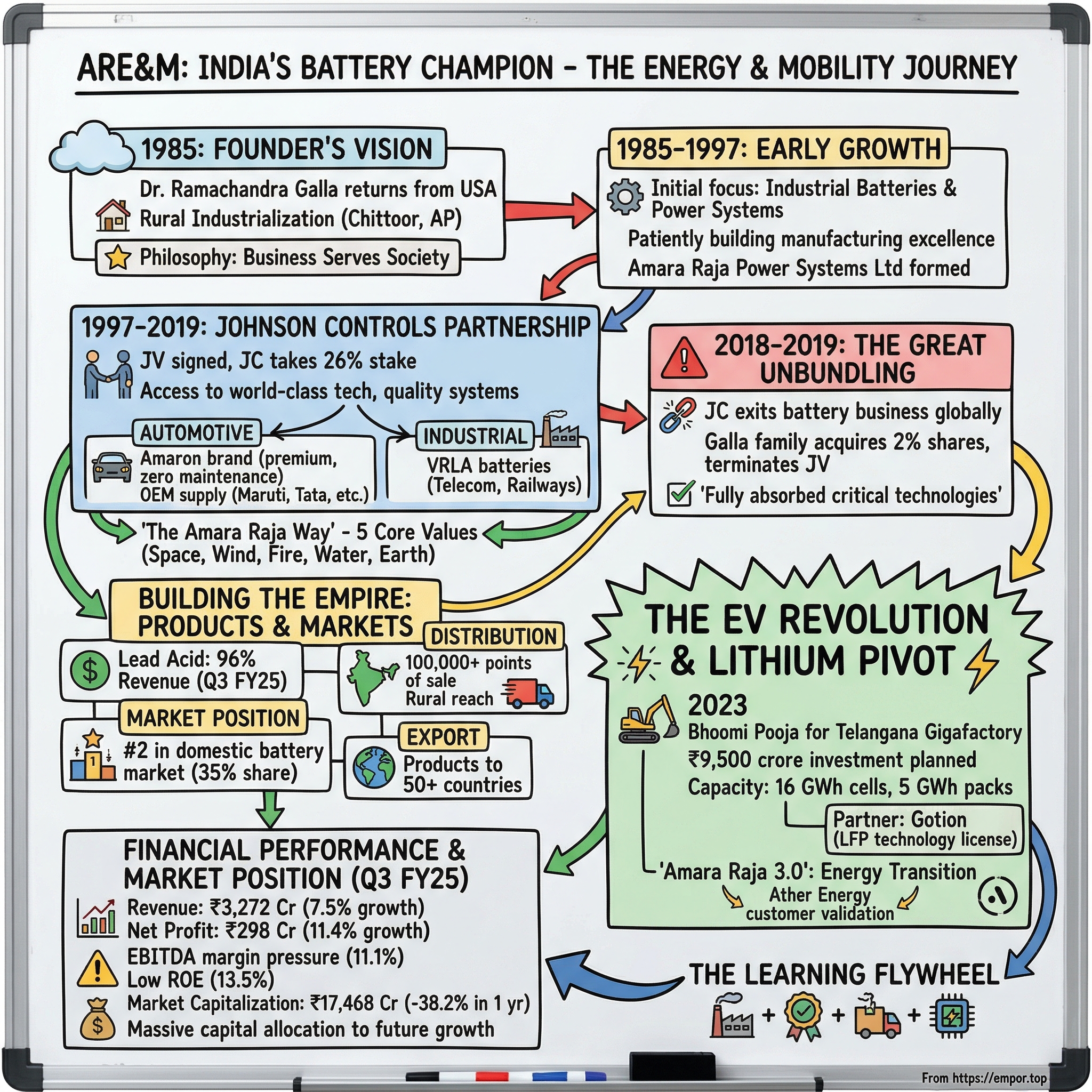
Amara Raja Energy & Mobility: India's Battery Champion Takes on the Future
I. Introduction & Episode Roadmap
Somewhere on the Chennai–Bengaluru corridor, a truck driver's alternator dies at two in the morning. He coasts to a roadside shack, and the mechanic who wanders out does not ask what brand of battery is under the hood. He asks a simpler question: Amaron or Exide? Two colors, two names, two companies. For roughly a quarter of a century, that choice has defined the consumer-facing landscape of India's organized automotive battery market—a duopoly so stable it functions as a national default setting.
The company behind the black-and-neon-green battery is Amara Raja Energy & Mobility (NSE: ARE&M). It did not originate in Mumbai, Delhi, or a typical corporate hub. Instead, it was founded in Karakambadi, a village roughly 12 kilometers from the temple town of Tirupati in Andhra Pradesh, where a returning engineer decided in 1985 to build a factory so local workers would not have to migrate.[^1] Forty-one years later, that origin still shapes the company's operating culture—and, uncomfortably, its single largest historical vulnerability.
The scale today is substantial. For the financial year ended March 2026, ARE&M reported consolidated revenue from operations of ₹13,814 crore (up 7.5% year-over-year) on net sales of ₹13,549 crore.1 However, profit after tax declined 5.2% to ₹1,206.89 crore, reflecting top-line growth paired with margin pressure.1 By late August 2026, market capitalization stood near ₹16,890 crore, with the stock trading at ₹920.85—about 13% below its 52-week high and 37% above its 52-week low, reflecting a year of range-bound trading rather than compounding.2 Distribution spans 23 sales branches, 32 warehouses, over 400 Amaron franchisees, more than 40,000 dealers, and over 2,000 service hubs, anchored by two core brands: Amaron for premium urban consumers and PowerZone for rural and semi-urban markets.3
Yet ARE&M's central story in 2026 is less about its legacy lead-acid footprint and more about a strategic capital allocation dilemma.
In the June 2026 quarter (Q1 FY27), lead-acid batteries generated ₹4,005 crore of the company's ₹4,214 crore consolidated revenue—roughly 95% of the total.4 The New Energy division, housing its lithium initiatives, contributed ₹209 crore or about 5%, though its 50% year-over-year growth rate reflects a small starting base.4 Concurrently, ARE&M has committed ₹9,500 crore (approximately $1.1 billion) toward a lithium-ion "Giga Corridor" in Telangana scheduled through 2031.5 This capital outlay represents roughly two-thirds of the company's current market value, financed primarily by cash flows from legacy lead-acid chemistry to build capabilities in lithium-ion cells where ARE&M lacks a commercial track record.
This tension underscores the current debate. Bull cases emphasize that India's large internal-combustion vehicle fleet provides a durable, cash-generative replacement market to fund the new energy transition, backed by four decades of industrial manufacturing experience. Bear cases highlight that ARE&M missed out on direct government production-linked incentives, faced disruptions in technology licensing, and must build cell manufacturing scale against global cost leaders such as CATL and BYD, as well as domestic competitors further along in execution.
This analysis evaluates both perspectives against empirical disclosures. The section ahead traces the company's rural industrial origin; the 22-year joint venture with Johnson Controls that built the Amaron brand; the 2019 exit that restored full family control; lead-acid economics and aftermarket dynamics; corporate governance structures and capital allocation records; the 2021 regulatory confrontation over environmental compliance; and recent lithium-ion licensing agreements. It then applies strategy frameworks—including Helmer's 7 Powers and Porter's Five Forces—and earnings analysis to identify the core metrics determining ARE&M's long-term trajectory.
The story begins with an engineer returning home.
 Subscribe on LinkedIn
II. Rural Industrialization & Founding Context (1985–1996)
Petamitta is not a place that typically features in corporate histories. Located in the dry southern reaches of Andhra Pradesh's Chittoor district, it is where Galla Ramachandra Naidu was born in June 1938 to a farming family.[^1] His subsequent career followed a classic trajectory of post-independence engineering achievement: an electrical engineering degree from Sri Venkateswara University in Tirupati, a master's degree in applied electronics from Roorkee, a second master's in systems science from Michigan State University, and engineering positions at US Steel in Pittsburgh and Sargent & Lundy in Chicago.[^1] By the early 1980s, Naidu had built the successful American career that India's technical education apparatus was largely oriented to produce.
In 1985, Dr. Galla returned to Chittoor district with an unconventional plan: build advanced manufacturing facilities in rural villages rather than metropolitan industrial hubs, enabling local youth to find industrial employment without migrating.[^1] The company established its initial factory and corporate office in Karakambadi. Within the group, this approach was formalized as "non-migratory job creation." The enterprise's name also reflected ties to family and region: Amara Raja was derived from the names of Jayadev Galla's maternal grandparents, Amaravati and Rajagopal Naidu.
Beyond the social narrative lay distinct commercial realities. Establishing a battery manufacturing plant in rural Andhra Pradesh during the mid-1980s required navigating India's pre-1991 license-permit regime. Prime industrial buyers—including state electricity boards, the Department of Telecommunications, and state-owned enterprises—procured exclusively from an established network of suppliers and had little incentive to trial an unproven regional manufacturer. Furthermore, local electrical grid reliability was low, skilled labor had to be trained internally from scratch, and transport links to major commercial hubs spanned hundreds of kilometers.
Amara Raja's market entry relied on a technological wedge rather than commercial scale. The company introduced valve-regulated lead-acid (VRLA) batteries to India. Unlike conventional flooded lead-acid batteries—open vessels of liquid sulfuric acid that vent gas during charging and require regular maintenance with distilled water—VRLA batteries seal the electrolyte in an absorbent glass mat or gel. The sealed cell internally recombines generated gases, eliminating routine maintenance. In an operating environment constrained by maintenance reliability, a maintenance-free battery offered a clear functional advantage.
This design enabled Amara Raja to secure orders across industrial power backup segments—such as telephone exchanges, electrical utilities, and uninterruptible power supply systems—just as India expanded its telecommunications infrastructure. Although customer procurement cycles were long and incumbent suppliers entrenched, sealed battery performance allowed the company to win commercial contracts without an established brand name.
The decision to build in a rural setting created a dual long-term operational structure. Industrially, rural siting secured low-cost land, reduced labor attrition compared to urban hubs, and built strong local community support. Strategically, however, it concentrated the company's entire manufacturing infrastructure within a single district in Andhra Pradesh. For over three decades, this geographical density maximized operational efficiency; yet as detailed in Section VII, it also exposed the enterprise to concentrated regional regulatory and political risks.
By the mid-1990s, Amara Raja had established a profitable industrial battery business and an operational manufacturing base. However, it lacked automotive technology, consumer brand equity, and mass-market scale—gaps it sought to close in 1997 through a strategic partnership with a major global battery manufacturer.
III. The Johnson Controls Era & Building Amaron (1997–2019)
The 1990s cross-border technology joint venture followed a familiar playbook in Indian industry: a global corporation provided intellectual property, a domestic partner supplied local market access, and the alliance persisted until strategic priorities diverged. Amara Raja adopted this model in 1997, when Milwaukee-based Johnson Controls—then the world's largest manufacturer of automotive batteries—became its technology partner and ultimately acquired a 26% equity stake.6
Through that equity partnership, Amara Raja gained access to decades of metallurgical research. Automotive lead-acid battery performance depends heavily on grid design—the lead lattice inside the cell that holds active material and conducts electric current. Inferior grid casting corrodes, warps, and sheds material, leading to premature battery failure in high heat. Johnson Controls brought a stamped-grid technology, marketed as PowerFrame, which produced a more uniform, corrosion-resistant lattice than traditional cast-and-punch manufacturing. Combined with silver-bearing alloys and maintenance-free VRLA construction, the design yielded a battery capable of enduring India's extreme ambient temperatures, severe road vibration, extended idle periods, and inconsistent charging systems.
That technical capability provided a foundation, but commercial success required disrupting an established duopoly. Exide Industries had dominated Indian automotive batteries for decades, supported by low consumer engagement with battery selection prior to failure. Amara Raja recognized that the retail replacement market presented an opportunity to build brand equity directly with end users rather than relying solely on institutional procurement.
The Brand That Broke a Monopoly
In 2000, Amara Raja introduced the Amaron brand, using visual and marketing differentiation to challenge the incumbent. While the category standard relied on red packaging, Amaron featured black casing with a neon-green accent, allowing consumers and mechanics to identify the brand immediately in retail settings. The slogan "Lasts Long, Really Long" framed technical durability in simple consumer terms. Crucially, the company targeted the automotive replacement market first rather than competing immediately for original-equipment manufacturer (OEM) contracts. The aftermarket allowed a challenger brand to win customer trust directly at the point of purchase.
This focus on brand equity addressed a key structural feature of the auto-component market. For a commoditized industrial product purchased every three to five years without simple pre-purchase quality verification, brand recall allows a manufacturer to establish pricing power and customer retention that specifications alone cannot deliver. Amaron converted an unbranded replacement part into a deliberate consumer choice.
The Distribution Machine
Maintaining brand promise required an extensive physical distribution network. Batteries are heavy, hazardous, perishable in inventory, and required immediately when a vehicle fails. Market leadership required delivering fresh, fully charged units rapidly across a wide geographic footprint. Amara Raja established this reach through franchised pit stops, master distributors, and a dealer network that exceeds 40,000 outlets, supported by regional branch and warehouse infrastructure.3 To capture price-sensitive segments without diluting Amaron's premium positioning, the company launched PowerZone as a secondary brand for rural and semi-urban markets, competing against unorganized local assemblers.3
In parallel with aftermarket expansion, Amara Raja secured OEM supply agreements across India's automotive sector and expanded industrial deliveries for telecommunications, railways, and uninterruptible power supply (UPS) systems, while building an export network reaching more than 50 countries.7 Although OEM supply contracts carried thinner margins, they established an initial install base that drove subsequent replacement demand when batteries reached the end of their service life.
By the late 2010s, Amara Raja had established strong brand recognition, a technological alliance supplying ongoing design updates, and the second-largest position in India's organized battery market. The joint venture operated effectively until Johnson Controls decided to exit the automotive battery business globally.
IV. The Great Unbundling: Johnson Controls Exit (2019)
Corporate breakups rarely announce themselves in the country where they land hardest. In November 2018, Johnson Controls International announced plans to sell its Power Solutions division—the unit housing its Tirupati-linked battery operations—to focus on building technologies.6 The division was subsequently acquired by Brookfield Business Partners and renamed Clarios. For a portfolio manager in Milwaukee, the transaction was a routine reallocation of capital; for Amara Raja, it meant the technology parent that had underwritten 22 years of product development was passing to a private equity owner without a long-term strategic commitment to an Indian affiliate.
The Galla family moved quickly to resolve the ambiguity. In early 2019, the family bought out equity held by Johnson Controls, terminating the shareholders' agreement and accompanying technology licensing arrangements effective April 1, 2019.6 Investors responded immediately, driving the stock down approximately 5% on the announcement.6 Later in 2019, reports that Brookfield was re-evaluating its investment in the residual stake knocked the shares down again.8
That market anxiety reflected a rational concern: a manufacturer whose primary technical edge stemmed from licensing arrangements with the world's largest automotive battery maker now had to rely entirely on the capabilities it had internalized over the preceding two decades.
Management maintained in filings and investor communications that the transition was seamless. The company stated that it had built robust internal engineering capabilities, retained operational rights to designs developed under the 1997 agreement and subsequent updates, and no longer required an external licensor to manufacture competitive lead-acid batteries. Empirical execution in the years following supported that assessment. Lead-acid chemistry is mature and evolutionary; ARE&M continued to secure OEM approvals, expand volumes, and preserve product quality without its former partner. In the core lead-acid market, operating independently proved manageable.
The more far-reaching consequence was strategic. Between 2019 and 2026, the automotive industry's center of gravity in energy storage shifted decisively toward lithium-ion, with cell technology and supply chains concentrating in China, South Korea, and Japan. By becoming independent in 2019, ARE&M parted ways with a foreign technology partner just as the global battery sector faced an unprecedented technological transition. While Clarios itself remained focused on lead-acid chemistry, independence meant ARE&M could no longer leverage an established parent to navigate next-generation chemistries. Instead, from April 1, 2019 onward, the company had to negotiate technology access on the open market from foreign suppliers subject to evolving trade policies and geopolitical constraints.
The 2019 unbundling gave the Galla family full strategic control over a highly cash-generative enterprise, but it also placed sole responsibility for technological adaptation on internal leadership. Before addressing the lithium-ion transition, however, management had to maximize cash flow from its legacy lead-acid operations.
V. Core Business Deep Dive: Lead-Acid Economics & Market Duopoly
Fundamentally, ARE&M operates less like a conventional manufacturer and more like a converter. The company purchases lead—a commodity whose price is determined on the London Metal Exchange—converts it into branded batteries, and distributes them across two distinct channels operating at sharply different margin profiles. Consequently, core operational performance hinges on the spread between raw material costs and realized pricing.
Raw materials, primarily lead and lead alloys, account for roughly 70% of the total cost base, while plastics contribute an additional 10%.9 This high cost exposure causes a consumer-facing brand business to behave quarter to quarter much like a commodity processor, where fluctuations in global lead prices directly dictate operating margins.
Two Channels, Two Businesses
Within the core automotive segment, the aftermarket and original equipment manufacturer (OEM) channels display starkly different financial characteristics.
The replacement aftermarket generates the bulk of profitability. A driver stranded by a dead battery prioritizes immediate availability and brand trust over price comparison. This channel operates largely on a cash-and-carry basis with disciplined working capital, high customer retention, and demonstrable pricing power, allowing the Amaron brand equity to translate directly into higher margins.
Conversely, the OEM channel provides high unit volume and low profit margins, serving auto manufacturers with rigorous procurement teams and a preference for dual-sourcing. Its primary strategic value is creating an installed base, as every factory-installed unit represents a prospective aftermarket replacement customer in three to five years. In the March 2026 quarter, ARE&M reported over 30% growth in both four-wheeler and two-wheeler OEM volumes, while the replacement aftermarket grew 5–6%.9 This volume divergence highlights an underlying margin challenge: rapid expansion in lower-margin OEM sales dilutes overall profitability, given that the higher-margin aftermarket is expanding only at the broader growth rate of the vehicle fleet.
Meanwhile, the industrial segment—encompassing telecom towers, UPS systems, solar backup, railways, and motive power—presents a more fragile profile. This business is tender-driven, price-sensitive, and vulnerable to technological substitution. On the FY26 fourth-quarter earnings call, management reported that telecom battery volumes fell as infrastructure clients migrated to lithium-ion solutions, though the company maintained an estimated 50% market share in that contracting category, with overall industrial volumes growing just 3–4%.9 Maintaining a dominant position in a shrinking legacy segment offers limited long-term protection against technology shift.
The Duopoly and What It Actually Buys
Exide Industries and ARE&M together control the vast majority of India's organized lead-acid market, with Exide maintaining the leading share. This duopoly structure fosters price discipline, as two rational leaders competing against a fragmented tail of unorganized assemblers benefit more from passing on raw material cost increases than from engaging in destructive price wars.
However, the fourth quarter of FY26 illustrated both the strength and the limitations of this pricing power. Facing sharp cost inflation in lead alloys and sulfuric acid, the company instituted a 5–6% price hike during the quarter and indicated that an additional 2–3% increase might be required depending on commodity trends and currency movement.9 While unbranded manufacturers lack the standing to enforce such price adjustments, timing lags create operational friction. OEM supply contracts contain formal indexation clauses that adjust prices periodically, but aftermarket price adjustments are executed with a lag to avoid driving cost-conscious consumers toward competitors or informal battery rebuilders. Consequently, input cost spikes temporarily squeeze operating margins before retail prices catch up.
The June 2026 quarter (Q1 FY27) clearly demonstrated this dynamic. Consolidated revenue expanded 23.9% year-over-year to ₹4,214 crore on strong volume growth, but the operating EBITDA margin fell to 9.6% from 10.7% in the prior-year period, while profit after tax (PAT) margin narrowed to 4.5%.4 Management attributed this margin compression to higher expenditures for lead alloys, sulfuric acid, polypropylene, and freight, alongside brand investments such as an Amaron Assist service pilot.4 By comparison, the company maintained EBITDA margins around 12.6% during FY25.4 Generating robust top-line growth alongside a three-percentage-point margin decline over two years underscores that pricing power, while genuine, remains constrained by retail demand elasticity.
Vertical Integration as Margin Defence
To insulate operations from commodity volatility, ARE&M has progressively integrated its supply chain. Because lead is highly recyclable, secondary lead recovered from used batteries is less expensive and less volatile than primary metal, making backward integration into lead recycling a key cost-mitigation lever. Similarly, on the plastics front, ARE&M brought in-house the manufacturing of battery containers, covers, handles, and jars—a structural reorganization explored further in Section VI—capturing manufacturing margin previously retained by a related-party supplier.
In summary, ARE&M's legacy lead-acid business remains cash-generative, backed by a strong aftermarket brand and high entry barriers. However, its overall profitability remains heavily tied to external variables like London Metal Exchange prices and currency fluctuations. Furthermore, its fastest-growing volume segment generates the lowest margins, while its industrial division faces long-term technological disruption. This leaves the core business operating as a dependable source of cash flow facing a contracting long-term horizon—setting up the broader governance and capital allocation choices that follow.
VI. Current Management, Governance & Capital Allocation
On January 29, 2024, Jayadev Galla, then a sitting Member of Parliament for Guntur, announced he would not contest the upcoming general election. "It is with a heavy heart that I announce my decision to not contest in the upcoming 2024 general elections," Galla said, adding that he would step back from politics "to focus on diversifying the business which is at a crucial stage of leading the world in the transition to a more sustainable future."10 Galla had won the Guntur seat twice, in 2014 and 2019, while leading the Telugu Desam Party's parliamentary group.10 For a company whose manufacturing units had faced closure notices from state environmental regulators three years prior under an opposing regional administration, the promoter's exit from active politics marked a notable shift in governance focus.
Galla serves as Chairman and Managing Director, having presided over the Amaron brand expansion and the post-Johnson Controls separation. Beneath him, the executive leadership structure directly mirrors the company's dual operational focus. Executive Director Harshavardhana Gourineni oversees the legacy automotive and industrial divisions—the lead-acid core generating ongoing operational cash flow—while Executive Director Vikramadithya Gourineni leads the New Energy division, encompassing the lithium gigafactory buildout, cell research and development, pack assembly, and electric vehicle charging infrastructure.
The Trust Restructuring
In early 2025, the founding family formalized its succession architecture. Founder Dr. Ramachandra Naidu Galla settled 2,14,44,157 equity shares—representing 99.53% of the equity share capital of RNGalla Family Private Limited, the holding company for the promoter group—into four family trusts: RNG Jayadev Trust (35.50%), Jayadev Trust (28.94%), Ramadevi Trust (20.68%), and RNG Ramadevi Trust (14.40%).11 The Securities and Exchange Board of India (SEBI) granted an exemption from open-offer requirements under Regulation 11(5) of the Substantial Acquisition of Shares and Takeovers (SAST) Regulations by order on January 24, 2025, with disclosures confirming no change in overall promoter equity, which remained at 32.86% of the listed company.11
This restructuring stabilizes control across family branches and mitigates succession risk for the operating enterprise. However, it does not alter the promoter group's financial commitment. At 32.86%, ARE&M's promoter stake sits below the 50%-plus equity ownership typical among Indian family-led manufacturing conglomerates. Consequently, the family guides a ₹9,500 crore capital expenditure program while holding approximately one-third of the underlying equity, creating a structural asymmetry in how execution risks and capital commitments are shared with public shareholders.
The Related-Party Question
On September 26, 2022, ARE&M's board approved a scheme of arrangement to demerge the plastic battery components division of Mangal Industries Limited into the listed entity, executing an implementation agreement with the target company and its shareholder.12 The acquired division—comprising roughly 150 injection molding machines producing containers, covers, handles, jars, and auxiliary components alongside associated real estate—supplied its output exclusively to ARE&M.13 At the time of the transaction, Mangal Industries was wholly owned by RN Galla Family Private Limited, the promoter entity controlling ARE&M.13
From an operational perspective, absorbing a sole-source supplier responsible for roughly 10% of the battery cost base eliminated intermediary margins, secured key component supply, and streamlined corporate structure. However, because the listed enterprise issued consideration to acquire assets from its own controlling entity, the transaction placed the promoter group on both sides of the valuation process. The transaction received full statutory and regulatory clearances—including approvals from shareholders, creditors, stock exchanges, SEBI, and the National Company Law Tribunal—providing procedural validation.12 Nevertheless, the transaction established a precedent of absorbing promoter-held assets into the listed entity, highlighting the importance of ongoing governance oversight for future related-party proposals.
The Returns Record
A central metric evaluating management's capital allocation is return on equity (ROE). ARE&M has historically maintained superior capital efficiency relative to Exide Industries, keeping return on capital employed ahead of its primary peer. However, profitability metrics have trended downward, with ROE falling from roughly 14.6% in FY24 to approximately 11.6% in FY26.14 The financial performance in FY26—where consolidated revenue rose 7.5% while net profit declined 5.2%—underscores this return compression.1
This margin pressure stems from two distinct drivers. The first is cyclical cost inflation in key raw materials like lead, alloys, and sulfuric acid, which directly compresses short-term operating margins. The second is structural: substantial capital deployed toward the Telangana Giga Corridor remains tied up in capital work-in-progress, generating no immediate revenue while initial pre-operating expenses, research spending, and depreciation begin impacting the income statement ahead of commercial cell production. Consequently, capital efficiency metrics naturally soften during the multi-year construction phase of an industrial megaproject.
As a result, ARE&M's long-term capital allocation record remains in a transitional phase. Historically, the enterprise maintained conservative leverage and steady shareholder returns—declaring a final dividend of ₹5.20 per share for FY25, for example—while funding early gigafactory expenditures through internal cash generation.7 Ultimately, whether this capital deployment represents prudent balance-sheet utilization or heightened operational exposure will depend on the timing and commercial yield of the Telangana facilities. That strategic shift raises a pivotal geographic question: why the company chose Telangana for its primary lithium investment.
VII. The Environmental & Political Crisis: Relocation to Telangana (2021–2023)
In April 2021, during the crest of India's COVID-19 Delta wave when healthcare facilities relied heavily on backup power, the Andhra Pradesh Pollution Control Board issued closure orders against Amara Raja's primary manufacturing facilities at Karakambadi and Nunegundlapalli in Chittoor district.15 The regulator cited environmental compliance violations, specifically raising concerns regarding lead exposure and local contamination. These were not peripheral operational sites; together, they housed the company's entire lead-acid production capacity—built across thirty-six years in the very district where the founder had established his rural industrial model.
Management launched an immediate two-track response. The company petitioned the Andhra Pradesh High Court while arguing publicly that shutting its facilities would disrupt critical backup power supplies for hospitals and essential services nationwide during a public health emergency.15 The High Court granted an interim stay suspending the closure orders. That judicial relief was extended through a series of hearings across 2021 and 2022, including a continuation in January 2022 and another on June 29, 2022, which deferred the matter by twelve weeks.1615 Throughout the proceedings, the company stated that it continued to "place the highest priority on the environment, health and safety" of its workforce and nearby communities.15
A critical distinction separates public perception from the judicial record. While market commentary sometimes suggests the closure notices were formally quashed, regulatory disclosures indicate the orders were merely suspended by court mandate, allowing operations to continue under ongoing compliance monitoring while the substantive legal challenge remains pending. Interim judicial stays provide operational continuity rather than regulatory resolution. Consequently, the proceedings represent an ongoing regulatory and legal overhang on ARE&M's primary manufacturing hub, held in abeyance by court order rather than closed out by environmental authorities.
The political environment added further complexity. The enforcement action coincided with Jayadev Galla serving as a prominent Member of Parliament for the opposition Telugu Desam Party while Andhra Pradesh was administered by the rival YSR Congress Party. While regulatory oversight of lead processing facilities is standard industrial practice, geographic hyper-concentration creates structural vulnerability. Concentrating total production footprint within a single political jurisdiction exposes an enterprise to regional administrative shifts—an asset-location risk that conventional compliance expenditures cannot entirely eliminate.
The Telangana Answer
To mitigate this geographical exposure, ARE&M directed its next phase of major capital expansion across the state border into Telangana. The company committed ₹9,500 crore (approximately $1.1 billion) through 2031 to establish a New Energy "Giga Corridor" at Divitipalli in Mahbubnagar district, encompassing an advanced lithium-ion cell manufacturing gigafactory, a battery pack assembly plant, and the ePositive Energy Labs research center in Hyderabad.5 This strategic pivot ensured that virtually all incremental growth capital would be deployed outside its historical base in Andhra Pradesh.
From a capital allocation perspective, selecting Telangana offered dual benefits: securing a large greenfield site required for cell fabrication while capturing state-level industrial incentives and diversifying political exposure. Strategically, the decision signaled a deliberate pivot by leadership to limit further capital concentration in Chittoor district.
For investors, the episode highlights structural tail risks inherent in geographically concentrated manufacturing assets. While the Telangana project diversifies future capital deployment, it does not remove near-term operational risk from the core business. The Chittoor district facilities continue to generate roughly 95% of total revenue,4 leaving the company's primary cash engine operating under an ongoing legal stay.
VIII. The EV Revolution & The Lithium Pivot (2023–Present)
In the summer of 2024, ARE&M's share price surged roughly 20% in a single trading session.17 The catalyst was a strategic partnership: wholly owned subsidiary Amara Raja Advanced Cell Technologies (ARACT) executed a technical licensing agreement with GIB EnergyX Slovakia—a joint venture of Gotion-InoBat-Batteries, whose controlling parent is Chinese battery manufacturer Gotion High-Tech—to acquire lithium iron phosphate cell technology.1819 Investors interpreted the deal as a direct solution to the company's most glaring capability gap. For nearly two years, that optimistic assessment held.
What the Gigafactory Is Meant to Be
Management envisioned a phased operational expansion. At Divitipalli in Telangana, ARACT planned a buildout targeting 16 gigawatt-hours (GWh) of annual lithium-ion cell capacity by the end of the decade, alongside battery pack assembly and a dedicated 10 GWh battery energy storage system facility.4 The initial commercial phase comprises a 4 GWh line of cylindrical cells spanning both nickel manganese cobalt (NMC) and lithium iron phosphate (LFP) chemistries.20 To support early integration, the company inaugurated a 1.5 GWh battery pack plant in 2024 and broke ground on a customer qualification plant—a pilot facility designed to produce sample cells for prospective client testing and validation—within the Giga Corridor.5
This dual-chemistry strategy reflects distinct market trade-offs. LFP cells rely on iron and phosphate cathodes, offering lower manufacturing costs, superior thermal stability, and longer cycle life at the expense of energy density, yielding heavier battery packs for equivalent vehicle range. NMC cells pack greater energy into less weight but carry higher material costs and depend on scarcer metals. Management projects that LFP chemistry will capture 75% to 80% of Indian demand, with NMC serving the remainder, and capacity allocation is planned to match that distribution.20 However, the company's initial commercial output prioritizes NMC cylindrical cells aimed at electric two-wheelers—the segment where weight efficiency is critical and India's electric vehicle transition is most advanced.21
In the interim, pack assembly and charging infrastructure provide initial commercial revenue. In the fourth quarter of FY26, battery packs and chargers generated ₹280 crore, contributing to roughly 60% year-over-year revenue expansion in the New Energy division.91 The company also finalized commercial arrangements, including a cell supply agreement with electric two-wheeler maker Ather Energy.21 Nevertheless, assembling imported or third-party cells into battery packs carries lower margins and lower technological barriers than domestic cell fabrication. Today, pack assembly drives the New Energy segment's top-line growth, while cell manufacturing remains under construction.4
The Deal That Stopped Working
That construction timeline encountered geopolitical headwinds when Chinese regulatory policy shifted. On the FY26 fourth-quarter earnings call in June 2026, management disclosed that the Gotion technology transfer had stalled. Executive Director Vikramadithya Gourineni acknowledged the constraint directly, noting that "since 2024, sharing and licensing of technology is something largely discouraged by the Chinese government."22 Consequently, cell development would now be "largely driven by teams in India" across LFP, NMC, and prospective next-generation chemistries.22
Operational complications extended beyond software and patent rights. Management confirmed that manufacturing equipment for the cell line had been ordered, but commissioning depended on securing visas for Chinese technical engineers to oversee on-site installation in India.9 This operational bottleneck highlighted a multi-layered dependency: a facility facing licensing restrictions, reliant on foreign-sourced machinery, and requiring foreign engineers on the factory floor to achieve operational status. Management also noted that Chinese technology restrictions would likely inflate production costs for Indian-manufactured lithium cells.23
Project schedules shifted accordingly. Having previously targeted commercial cell production during FY26, management pushed the operational timeline into FY27, characterizing the revision as "barring plus or minus a few quarters, largely in line with what we have been sharing up until now."20 By mid-2026, revised guidance targeted commissioning a 100-megawatt-hour (MWh) qualification plant, opening the first 2 GWh of gigafactory capacity by June 2027, and introducing proprietary Indian technology for electric vehicle applications by 2028 or later.2122 To build internal R&D capabilities, the company deployed approximately $100 million into research infrastructure and talent acquisition, with Gourineni highlighting that "a large part of our team is Indian nationals who have worked in large battery companies around the world."21 Cumulative equity investment in ARACT reached approximately ₹850 crore as of FY25 disclosures, with an additional ₹1,000 crore slated for FY26.20
The Incentive That Never Came
Compounding these execution challenges was the outcome of federal industrial policy. When the Ministry of Heavy Industries conducted its ₹18,100 crore Production-Linked Incentive (PLI) scheme for Advanced Chemistry Cell manufacturing, ARACT submitted a bid. It was not selected. Reliance Industries secured the full 10 GWh allocation as the top-ranked bidder, placing ARACT second on the waitlist.2425 Significantly, despite Exide and Amara Raja being the only established battery manufacturers among the applicants, neither won an award because the scoring model heavily weighted domestic value addition, proposed plant capacity, and subsidy discount benchmarks that favored capital-intensive conglomerates.
As a result, ARE&M must fund cell fabrication without government subsidies, competing against incentivized domestic players and established Chinese producers operating at vast economies of scale. While the federal PLI framework itself experienced implementation delays—with only about 2.8% of the targeted 50 GWh capacity operational by early 202626—the absence of subsidy support removes a financial buffer built into initial project economics.
In summary, ARE&M's lithium transformation presents a stark strategic trade-off: genuine market necessity, substantial capital commitment, and expanding pack revenue, balanced against an unproven cell business slated for 2027, relying on internal R&D after external licensing friction, operating without federal subsidies, and trailing its primary domestic rival in execution. This capital deployment offers strategic optionality, but at a high cost and with significant execution risk.
IX. Mandatory Historical Falsification Layer
Every investment case is a set of claims, and claims are only worth what survives contact with the record. This section takes the three load-bearing propositions in the ARE&M story and pushes each against the strongest disconfirming evidence in the company's own history, over the longest span that bears on it.
1. Testing the "Amaron Brand & Distribution Moat" Claim
The claim: Amaron's brand equity and physical distribution network confer pricing power and insulate margins from input-cost volatility.
The disconfirming evidence: Start with the margin record, because pricing power is ultimately a margin claim. Between FY25 and the June 2026 quarter, consolidated EBITDA margin fell from about 12.6% to 9.6% while revenue grew 23.9% year on year.4 The compression was driven by alloy, sulphuric acid, polypropylene and freight costs.4 The company did raise prices — 5–6% in the March 2026 quarter, with a further 2–3% flagged as possible — but the increases followed the cost shock rather than pre-empting it, and the aftermarket, where the brand supposedly binds, grew only 5–6% while the low-margin OEM channel grew over 30%.9 A brand with unconstrained pricing power does not lose three points of EBITDA margin over two years to input costs it can see coming.
Second, and more damaging to the distribution and brand framing specifically: on 3 June 2026, the Supreme Court upheld interim orders of the Calcutta High Court in Exide's trade dress suit, directing ARE&M to stop fresh manufacturing and sale of its red-coloured Elito batteries, cease promoting the product, sell existing red stock only through third parties, repackage remaining inventory in non-red materials, and destroy cartons resembling Exide's packaging.27 The affected inventory was disclosed at roughly ₹25 crore of distributor and franchise stock, ₹15.6 crore at retailers, and 20,789 units valued at about ₹2.6 crore requiring repackaging; the company had halted red battery production after the Division Bench order of 2 April 2026.27 The financial magnitude is immaterial. The strategic content is not. A company whose entire brand story is that it built distinctive equity from scratch was found, on an interim basis, to have launched a product trading on a competitor's visual identity — and lost. That is a data point about how the company competes at the margins of its own brand claim.
Third, the industrial half. Telecom VRLA volumes have declined as customers switch to lithium, with the company retaining roughly 50% share of a contracting segment.9 Substitution in industrial B2B has run faster than a lead-acid incumbent would like, and the moat has no purchase there at all: a tower operator buying on total cost of ownership does not care what colour the battery is.
Falsification verdict: The claim survives in narrowed form. In the automotive replacement market, the brand and distribution advantage is real and demonstrated — the company can push through mid-single-digit price increases in a commoditised category without losing the channel, which a no-name assembler cannot. But it is a lag-and-recover franchise, not a margin-insulating one, and it does not extend to industrial B2B, where substitution is winning. The stronger version of the claim — that the moat protects margins through the cycle — is rejected by the FY25-to-FY27 record.
Forward falsification KPI: Consolidated EBITDA margin failing to recover above roughly 12% within four quarters of lead, alloy and acid input costs stabilising would indicate the pricing power is eroding rather than merely lagging.
2. Testing the "Management & Governance Discipline" Claim
The claim: Management runs a conservatively financed business with disciplined capital allocation and clean governance.
The disconfirming evidence: Three items belong here. The first is the target-setting record. In January 2018, management publicly set out a plan to double revenue in three years and overtake Exide.28 Revenue in FY18 was well below half the FY26 figure, and eight years later ARE&M remains the second-largest player in organised lead-acid. Ambitious public targets that are not met, and are subsequently neither restated nor explained, are a legitimate mark against guidance credibility — and the pattern recurred in the lithium programme, where first cell production slid from FY26 to FY27 and was then framed as "largely in line with what we have been sharing."20 That framing is worth pausing on: a full-year slip described as within a few quarters of plan is the kind of language that erodes trust in later timelines.
The second is the related-party structure. The Mangal Industries demerger consolidated a promoter-owned supplier into the listed company, cleared by shareholders, creditors, the exchanges, SEBI and the NCLT, but nonetheless a transaction in which the promoter stood on both sides.1213 The third is the concentration risk that the promoters themselves ultimately repudiated by moving their growth capital to another state — an implicit acknowledgement that thirty-six years of single-district concentration had become an unpriced liability.515
And then the returns: ROE down from roughly 14.6% in FY24 to about 11.6% in FY26, with FY26 profit falling 5.2% on 7.5% revenue growth.141
Falsification verdict: Partially rejected, with an important qualification. The claim of conservative financing holds up — the company has funded the early gigafactory tranches from internal accruals and continued paying dividends through the build.720 The claim of superior capital allocation does not currently hold: the returns record is deteriorating, the guidance record is uneven, and the related-party history means the group's structural choices warrant scrutiny rather than trust. Crucially, the deterioration is largely explained by a deliberate strategy, which means the verdict is properly "unproven and trending negative" rather than "management is poor."
Forward falsification KPI: Failure to restore consolidated ROE above roughly 15% within two years of the first gigafactory phase reaching commercial production would convert the current unproven verdict into a rejected one.
3. Testing the "Lithium Technology Optionality" Claim
The claim: The Gotion licensing arrangement gave ARE&M a low-risk bridge to state-of-the-art LFP cell manufacturing, making the Telangana gigafactory an attractive call option on India's EV transition.
The disconfirming evidence: This is the claim the record treats most harshly, because the company's own management has bounded it. The licensing route, signed in June 2024 and worth a 20% one-day share price move, is no longer functioning as designed: technology sharing is "largely discouraged by the Chinese government," development is now "largely driven by teams in India," and homegrown EV-application technology is expected "probably sometime 2028 and later."1822 The residual dependency is physical as well as legal — the cell line equipment is ordered from China and commissioning is gated on visas for Chinese engineers.9
Then there is the conversion record, which is the right way to test optionality. The relevant question is not whether ARE&M can build a plant; it is the historical rate at which the company has converted technical milestones into revenue in a chemistry it did not license. The honest answer is that there is no such record to point to. ARE&M's entire commercial history in advanced chemistry is licensed: VRLA and PowerFrame from Johnson Controls, LFP from Gotion. It has never taken an internally developed cell chemistry to commercial qualification with a major OEM. That is not a prediction of failure; it is an absence of affirmative evidence, and the correct treatment of an absence is lower confidence, not a negative verdict.
Add the competitive clock. Exide's Bengaluru lithium plant, built with 蜂巢能源 SVOLT technology, had reached full equipment installation, dispatched first customer samples in the June 2026 quarter, and was guided toward commercial revenue from the December 2026 quarter, with a ₹1,400 crore capital plan for FY27.29 ARE&M's first commercial cells are guided to FY27 with 2 GWh operational by June 2027.2120 The domestic rival is roughly a year ahead, on licensed technology that appears to have transferred.
Falsification verdict: The specific claim — that licensing provided a low-risk bridge — is rejected outright by the company's own disclosures. What remains is a materially riskier proposition: an internally developed cell programme, without PLI support, roughly a year behind the domestic peer, dependent on Chinese equipment and commissioning labour, targeting a market where imported cells set the price. The optionality still exists, and the strategic necessity of pursuing it is genuine, but it should be valued as a high-risk R&D-led venture rather than as a technology-transfer execution project.
Forward falsification KPI: Failure to achieve commercial qualification of locally manufactured cells with at least two significant Indian EV or ESS customers by the end of FY28 — with disclosed volumes, not sample dispatches — would falsify the remaining version of the claim.
What the Three Verdicts Add Up To
Taken together, the pattern is consistent rather than random. ARE&M's demonstrated strength is commercial and industrial execution inside a chemistry it has already mastered: brand, distribution, plant efficiency, and cost recovery over time. Its demonstrated weakness is timeline credibility and technology self-sufficiency. The current strategy asks the company to do more of the second thing using the proceeds of the first. That is the investment question in one sentence, and no framework resolves it — though frameworks do clarify where the pressure lands.
X. Strategic Frameworks: Helmer's 7 Powers & Porter's 5 Forces
Frameworks are useful precisely when a business is in transition, because they force a distinction between the advantages a company has and the advantages it needs. Applied to ARE&M, the exercise produces an unusually stark result: the powers it holds belong to the business it is trying to move beyond, and the business it is moving toward has almost none of them yet.
Hamilton Helmer's 7 Powers
Branding — powerful, in one segment. Amaron is one of very few genuine consumer brands in Indian auto components. A customer asking for a battery by name in a roadside shop is the definition of brand power, and it converts into the ability to price above unorganized alternatives. The boundary is important: the power operates in automotive replacement and does essentially nothing in industrial tenders or OEM procurement, and—as the Elito litigation demonstrated—brand advantage in this category is partly a matter of visual identity that courts, not customers, ultimately adjudicate.27
Scale economies — strong in the core, absent in the new. In lead-acid, ARE&M's purchasing volume, automated assembly, and recycling integration deliver a unit-cost position that a subscale entrant cannot approach. In lithium, the relevant comparison is not domestic; it is CATL and BYD, whose annual output is measured in hundreds of gigawatt-hours against a first Indian line of two to four gigawatt-hours. On cost, a four-gigawatt-hour line is not a scale player; it is a pilot facility with a factory built around it. Management's own acknowledgement that Chinese technology curbs will raise the cost of Indian-made cells is a concession on exactly this point.23
Process power — moderate and real. Four decades of lead-acid manufacturing, smelting, and assembly optimization represent accumulated know-how that cannot be easily bought. Whether it transfers to lithium cell production is genuinely uncertain: cell manufacturing is closer to semiconductor fabrication than to battery assembly, dominated by coating uniformity, moisture control, and yield management. The company is not starting from zero, but it is starting from a different discipline.
Switching costs — moderate, and concentrated in the wrong places. High where a telecom operator or a railway has specified a battery into a system design; low in retail replacement, where the switching cost is the customer's willingness to ask a mechanic for a different brand. The segment with the higher switching costs is precisely the segment being substituted away by lithium.
Counter-positioning — weak, and structurally so. ARE&M cannot attack its own lead-acid economics, because lead-acid cash flows fund the lithium build. This is the classic incumbent's bind. The company must defend the cash cow and build its replacement simultaneously, which is why the capital programme is stretched through 2031 rather than compressed.
Network effects — absent. Battery manufacturing has none. The closest analogue is the service network's density advantage, which is better characterized as distribution scale than as a network effect.
Cornered resource — weak. No captive lithium, no proprietary commercialized cell chemistry, no exclusive access to critical cathode materials, and no functioning technology licence. The one asset that comes closest to a cornered resource is the physical dealer and service network, which took twenty-five years to build and cannot be replicated with capital alone.
Porter's Five Forces
Threat of substitutes — high and rising. This is the dominant force in the analysis. Lithium-ion is already displacing lead-acid in telecom backup and is progressively doing so in two- and three-wheeler propulsion and residential storage; sodium-ion sits further out as an additional threat to the same applications. The company is responding by becoming a substitute producer itself, which is a strategic necessity, but it does not change the direction of the underlying force.
Bargaining power of buyers — mixed and asymmetric. Automotive OEMs are sophisticated, dual-source by policy, and exert real price pressure—which is why that channel earns single-digit margins even while growing at over 30%.9 Retail aftermarket buyers have almost no leverage individually. Telecom and infrastructure buyers, running competitive tenders on total cost of ownership, hold substantial leverage.
Bargaining power of suppliers — high on both sides of the transition. Lead is priced on the London Metal Exchange with no negotiating leverage available, and metal plus alloys accounts for roughly 70% of total cost.9 On the lithium side, the supplier power problem is broader and more novel: cathode and anode materials, cell-line equipment, and—as the visa episode demonstrated—even commissioning engineers are concentrated in a jurisdiction that has begun treating battery technology as a strategic export.922
Competitive rivalry — high, and about to change character. In lead-acid, the duopoly with Exide is disciplined and mutually profitable. In lithium, the field is crowded and well-capitalized: Exide backed by SVOLT technology, Reliance holding the federal Production-Linked Incentive allocation, Ola Electric, and a range of domestic and international entrants, all competing against imported Chinese cells that set the price floor.2529
Threat of new entrants — asymmetric. Almost nil in lead-acid, where environmental permitting, recycling infrastructure, and distribution networks create formidable barriers—the 2021 pollution enforcement episode illustrates how difficult it is to operate a compliant lead facility. High in lithium, where the main barriers are capital and technology access rather than accumulated craft, and where conglomerates with deeper balance sheets than ARE&M's have already entered.
The synthesis is uncomfortable but clear. ARE&M holds a strong hand in a game whose rules are changing, and it is using the proceeds from that hand to buy a seat at a table where it currently holds no structural advantage. The strategic case rests entirely on whether operational competence and India-specific distribution can substitute for scale and technology in the new paradigm. That is precisely the question market analysts have repeatedly raised with management.
XI. Earnings Call Transcript Playbook & Analyst Q&A Audit
Reading ARE&M's recent earnings calls in sequence is a useful exercise, because the prepared remarks and the question-and-answer sessions have been telling noticeably different stories.
The prepared-remarks version is one of momentum. On the FY26 results, management highlighted 15% consolidated revenue growth in the March quarter, New Energy revenue growth of roughly 60% for the year, battery packs and chargers reaching ₹280 crore, over 30% growth in both four-wheeler and two-wheeler OEM volumes, sustained investment in the customer qualification plant and BESS facilities, and sustainability milestones including twelve-times water positivity and zero-waste-to-landfill status.91 The FY25 commentary had a similar cadence, with Harshavardhana Gourineni describing "strong volume growth across automotive categories and continued momentum in UPS applications," while acknowledging headwinds from alloy prices and regulatory changes affecting solar energy settlements.7
The Q&A version is where the pressure shows, and analysts have converged on three questions that recur across calls.
First: what has actually been transferred? The Gotion question has been asked in some form on every call since the licensing announcement, and the answers have migrated. The June 2026 answer was the most candid to date — technology sharing discouraged by the Chinese government, development now largely driven by Indian teams, homegrown EV technology "probably sometime 2028 and later."22 The follow-on detail management volunteered on the same call is the more revealing one: equipment ordered, some Chinese engineers already on site, and visas the main remaining obstacle to commissioning.9 An investor should note the structure of that answer. It reframes a technology-access problem as a logistics problem, which is a more tractable-sounding version of the same dependency.
Second: how durable is the lead-acid cash flow? The interrogation here focuses on volume trajectory past FY27 as two- and three-wheeler electrification accelerates, and on the telecom decline that is already visible. Management's answer has been that the internal-combustion vehicle parc keeps replacement demand growing for years, and that the company retains around half the telecom segment.9 That is true and also incomplete: it addresses share, not the size of the pool.
Third: what happens to returns during the build? Analysts have pressed on margins and on the returns drag from capital sitting idle in Telangana. Management's disclosed answer on the BESS plant is unusually specific and worth taking at face value: initial operating margins of "6% to 7%," improving with scale.9 Set that against a lead-acid business that has historically run around 12–13% at the consolidated EBITDA line, and the arithmetic is plain — in its early years, success in New Energy will dilute consolidated margins, not lift them. That is an honest disclosure, and it is also a warning about how the next three years of reported numbers will look even if execution goes well.
There is a fourth theme running underneath, less a question than a texture: exports. Management has repeatedly attributed muted export volume growth to geopolitical issues, and has flagged rupee depreciation as a reason further domestic price increases may be needed.9 For a company that sells into more than fifty countries and buys an LME-priced commodity in dollars, currency is not a footnote.7
On credibility, the fair assessment is mixed rather than damning. Management does disclose bad news — the Gotion difficulty, the telecom decline, the margin compression, the specific low starting margin on BESS — and does so with enough specificity to be useful. Where it is weaker is in reconciling current statements with prior ones: a full-year slip in first cell production described as "barring plus or minus a few quarters, largely in line" is not a reconciliation, and the 2018 ambition to double revenue in three years and overtake Exide was never formally revisited.2028 The pattern is a management team that is candid about the present and loose about the past.
XII. Bear vs. Bull Case Analysis
The bear case does not require anything to go catastrophically wrong. It requires only that the current trajectory continue.
The Bear Case
Lithium execution risk is now the base case, not the tail. The licensing bridge has failed in its intended form, leaving ARE&M to commercialize cell technology largely on internal R&D, in a chemistry where it has never taken an internally developed product to OEM qualification, roughly a year behind Exide's SVOLT-enabled plant, without the ACC incentive that Reliance won.222925 The dependency on Chinese equipment and commissioning engineers means the timeline is exposed to a geopolitical variable the company cannot influence.9
Returns compress before they expand. ROE has already fallen from about 14.6% in FY24 to roughly 11.6% in FY26, and the New Energy business will start at 6–7% operating margins against a core that has run roughly double that.149 A multi-year period of large capital deployment into non-yielding assets, combined with a dilutive new segment, is the textbook setup for a valuation derating regardless of whether the strategy is ultimately correct.
The cash cow has a clock. Telecom VRLA is already contracting.9 Two- and three-wheeler electrification directly reduces the addressable lead-acid starter-battery pool over time, and while the existing internal-combustion parc supports replacement demand for years, the growth in that pool slows first and then reverses. Terminal-value assumptions that extrapolate the current lead-acid business are the most fragile part of any bull model.
Input costs and currency remain in charge of the margin. With raw materials at roughly 70% of cost and price increases arriving with a lag, a sustained rise in lead, alloy and acid prices, or further rupee weakness, compresses margins faster than the aftermarket can absorb increases.94
The activist's list. A skeptical investor would add: an unresolved pollution-board matter over the core manufacturing base that has been suspended rather than closed;15 a promoter group holding about a third of the equity while directing a capital program worth over half the market value;115 a precedent of acquiring promoter-owned assets into the listed company;1213 a trade dress injunction from the Supreme Court that speaks to competitive conduct;27 and a public target-setting record that has not been reconciled.28
The Bull Case
The replacement annuity is genuinely large and genuinely durable. India's on-road vehicle fleet is overwhelmingly internal-combustion and will remain so for many years, and every one of those vehicles needs a new starter battery every three to five years regardless of what new vehicles are being sold. Aftermarket demand is a function of the installed base, not of new-vehicle mix—which means the cash cow declines far more slowly than EV penetration headlines imply. Meanwhile, the OEM channel grew over 30% in the March 2026 quarter, feeding the future replacement pool.9
Distribution is the asset that survives the chemistry change. Whatever is inside the box, someone has to get it to 40,000 dealers and 2,000 service hubs across India and stand behind it.3 A lithium pack or a home energy system sold through an existing Amaron channel carries a customer-acquisition cost close to zero. This is the strongest argument that ARE&M's lead-acid franchise is an asset in the new world rather than merely a legacy.
The pack, charger and BESS business is real revenue today. New Energy grew about 60% in FY26 and over 50% in the June 2026 quarter, reaching ₹209 crore in that quarter alone, driven by packs, chargers, home energy and lithium telecom solutions.14 Stationary storage for renewable integration is a large and growing Indian market with less brutal technology competition than automotive cells, and the company is building a dedicated 10 GWh BESS facility for it.4
Financial conservatism gives the option time to mature. The company has funded the early gigafactory phases from internal accruals and continued to pay dividends through the build, and the capital program is staged to 2031 rather than front-loaded.2075 That staging is what converts a bet-the-company decision into a series of smaller, revisable decisions.
Import substitution is a policy tailwind even without PLI. If Chinese export controls raise the landed cost of imported cells—which management expects—the economics of domestic manufacturing improve for everyone building in India, including the company that did not win the subsidy.23
How to Weigh Them
The honest synthesis is that the bull and bear cases operate on different clocks. The bull case is about the next three to five years, where the aftermarket annuity, the distribution asset, and the pack business are all demonstrably working. The bear case is about years five to ten, where the lead-acid pool starts shrinking and the question of whether ARE&M has a real cell business gets answered definitively. An investor is not choosing between the two so much as deciding how much to pay today for an outcome that will not be visible for several years, in a company whose reported returns will look worse in the interim even if the strategy is succeeding.
XIII. Critical Forward KPIs for Investors
Most disclosed operating metrics offer little insight compared to three core questions. For investors evaluating ARE&M's long-term trajectory, performance hinges on three primary indicators.
1. Consolidated EBITDA margin, tracked against the lead and alloy cycle. This serves as the clearest test of whether the Amaron franchise retains genuine pricing power. The critical metric is not the absolute margin level during a downturn, but the recovery lag: how many quarters after raw material costs stabilize does the margin return toward the low-teens level recorded in FY25.4 A persistent failure to recover would signal an eroding aftermarket moat rather than routine cyclical absorption. This metric should be monitored alongside the split between aftermarket and OEM volume growth, given that a mix shift toward lower-margin OEM sales compresses profitability independently of input-cost dynamics.9
2. Commercial cell qualification with named customers—volumes, not samples. The decisive gigafactory milestone is neither facility commissioning nor sample dispatches. Instead, it requires a disclosed, repeat, volume supply relationship with a major Indian electric vehicle or energy-storage customer for cells fabricated at Divitipalli. Pilot supply and regulatory certifications do not equal commercialization, particularly given ARE&M's lack of a commercial track record in converting cell technical arrangements into revenue. Management's guided execution sequence moves from a 100-megawatt-hour qualification plant to two gigawatt-hours of operational capacity by June 2027 before scaling further.21 The timing pattern across these checkpoints will offer a far stronger signal of execution capability than any single announcement.
3. New Energy revenue and segment margins, disclosed separately. The New Energy division generated approximately 5% of consolidated revenue in the June 2026 quarter.4 Expanding this share represents the foundation of the company's long-term growth thesis. However, revenue scale must be evaluated alongside segment profitability. With management guiding initial operating margins for battery energy storage systems at 6% to 7%, top-line expansion without margin improvement would indicate that the company is purchasing market share rather than establishing a profitable enterprise.9
Return on equity remains a useful summary metric, but it functions primarily as an output of these three operational variables rather than an independent indicator—reflecting capital tied up in long-term construction during a major expansion phase.14
XIV. Epilogue & Summary Lessons
There is a symmetry to this story that is hard to miss. In 1985, a founder returned from America to a village near Tirupati and built a factory so local workers could stay. Forty-one years later, his successors are building a gigafactory 400 kilometers away in Telangana because remaining solely in Andhra Pradesh had become the primary operational risk. The founding logic has been turned inside out by the very forces—political, regulatory, and technological—it was designed to escape.
Three lessons extend beyond this single enterprise.
The first is that in a commoditized industrial category, distribution scale and brand recall can substitute for technological leadership for decades. Amaron did not dominate by manufacturing a fundamentally superior battery in a disclosable technical sense. It won by turning an invisible purchase decision into a visible consumer choice, establishing a distinct brand identity, and placing product within immediate reach of stranded drivers across India. Investors frequently undervalue that distribution advantage in unglamorous categories—and, as recent margin compression demonstrates, overvalue its ability to insulate profitability when raw material costs rise rapidly.
The second is that political risk in emerging-market manufacturing is not an abstraction to haircut in a spreadsheet. It arrives as a regulatory closure notice targeting facilities that generate virtually the entire corporate revenue base, requiring years of interim judicial stays rather than a swift administrative resolution. Geographic density that delivers operational efficiency for three decades can become a single-point vulnerability in a changing political environment.
The third is the most demanding: a generational technology transition cannot be guaranteed through a licensing agreement when a foreign government deems the underlying technology strategic. ARE&M pursued what appeared to be a capital-efficient path into lithium-ion cell manufacturing—paying for established technology to bypass internal development timelines—only to find technology transfer restricted by foreign policy. What remains is the far more challenging route: build internal engineering capabilities, recruit global talent, accept extended schedules, and rely on legacy cash flows to fund the multi-year transition.
Whether that strategy succeeds remains an open question. What can be tracked are empirical indicators. Lead-acid operating margins will reveal whether the Amaron franchise retains the pricing power necessary to cushion input inflation. Commercial cell qualifications at the Telangana gigafactory will demonstrate whether four decades of lead-acid manufacturing experience can translate into advanced cell fabrication without active foreign licensing. Finally, the alignment between management guidance and operational delivery will determine how much confidence the broader growth narrative merits.
References
-
Amara Raja FY26 Revenue Up 7.5%; PAT Falls 5.2%, Q4 Revenue Rises 14.6% YoY — Saur Energy International, 2026-05 ↩↩↩↩↩↩↩
-
Amara Raja Energy & Mobility Ltd — Share Price and Key Insights, Screener.in ↩
-
Amara Raja Energy & Mobility — Aftermarket Business and Distribution Network ↩↩↩↩
-
Amara Raja Q1 FY27 slides: revenue surges 24% as margins compress — Investing.com, 2026 ↩↩↩↩↩↩↩↩↩↩↩↩↩↩↩
-
Amara Raja breaks ground for customer qualification plant at Gigacorridor in India — S&P Global AutoTechInsight ↩↩↩↩↩↩
-
Amara Raja Batteries falls 5% on termination of agreement with Johnson Controls — Business Standard, 2019-04-03 ↩↩↩↩
-
Amara Raja Energy & Mobility Reports 10.2% Annual Revenue Growth in FY25, Declares Final Dividend of ₹5.20 — Autocar Professional, 2025-05 ↩↩↩↩↩↩
-
Amara Raja dips 5% on reports of Brookfield re-evaluating investment — Business Standard, 2019-08-29 ↩
-
Amara Raja Energy & Mobility Ltd (BOM:500008) Q4 FY26 Earnings Call Highlights — GuruFocus via Investing.com, 2026-06 ↩↩↩↩↩↩↩↩↩↩↩↩↩↩↩↩↩↩↩↩↩↩↩↩
-
Galla Jayadev, TDP MP and industrialist, announces a break from politics — The South First, 2024-01-29 ↩↩
-
Disclosure to stock exchanges on settlement of RNGalla Family Private Limited shares into family trusts — NSE archives, 2025-03 ↩↩↩
-
Outcome of Board Meeting — Scheme of Arrangement with Mangal Industries Limited, Amara Raja Batteries Limited filing, NSE archives, 2022-09-26 ↩↩↩↩
-
Amara Raja moves to acquire Mangal components unit — Batteries International, 2022-10-06 ↩↩↩↩
-
Amara Raja Energy & Mobility — company analysis and returns metrics, Tradejini ↩↩↩↩
-
Amara Raja granted fresh suspension of closure orders — Batteries International ↩↩↩↩↩↩
-
Amara Raja Batteries: AP Court extends stay on closure notices of plants in Andhra Pradesh — India Infoline, 2022-01-07 ↩
-
Amara Raja signs technical licensing pact with GIB EnergyX; stock zooms 20% — Business Standard, 2024-06-25 ↩
-
Amara Raja signs licensing agreement with GIB EnergyX for Li-ion cells tech — Business Standard, 2024-06-24 ↩↩
-
Amara Raja Announces Strategic Technology Collaboration with Gotion-InoBat-Batteries (GIB) — Amara Raja Group press release, 2024-06 ↩
-
Amara Raja Delays Start of Operations at Li-ion Cell Plant to FY27 — Autocar Professional ↩↩↩↩↩↩↩↩↩
-
China curbs no bar: Amara Raja goes solo to unlock homegrown battery tech for India — Business Today, 2026-06-22 ↩↩↩↩↩↩
-
Amara Raja 'going it alone' on battery cells as China frowns on tech support — Batteries International, 2026 ↩↩↩↩↩↩↩
-
Amara Raja Expects China Tech Curbs To Push Up Lithium Cells Prices In India — Saur Energy International, 2026 ↩↩↩
-
MHI awards 10 GWh capacity to one bidder under PLI ACC scheme — Press Information Bureau, Government of India, 2024-09 ↩
-
Centre awards RIL full quota of Advanced Chemistry Cell under PLI-II — Business Standard, 2024-09-04 ↩↩↩
-
Only 2.8% of target capacity delivered yet under India's battery manufacturing incentive scheme — IEEFA, 2026-01 ↩
-
SC Upholds Exide's Red Battery Trade Dress, Restrains Amara Raja from Fresh Manufacturing — Outlook Business, 2026-06-03 ↩↩↩↩
-
Amara Raja plans to double revenue in 3 years, overtake Exide — Business Standard, 2018-01-02 ↩↩↩
-
Exide Targets ₹20,000-Cr Core Business Revenue by FY28, Eyes Q3 Rollout of Bengaluru Lithium-Ion Plant — Outlook Business, 2026 ↩↩↩
 LinkedIn
 WhatsApp
 Reddit
 Hacker News
 Email
Email Kindle
 RSS Feed
 Spotify
 Apple Podcasts
 Amazon Music
 Audible
 YouTube