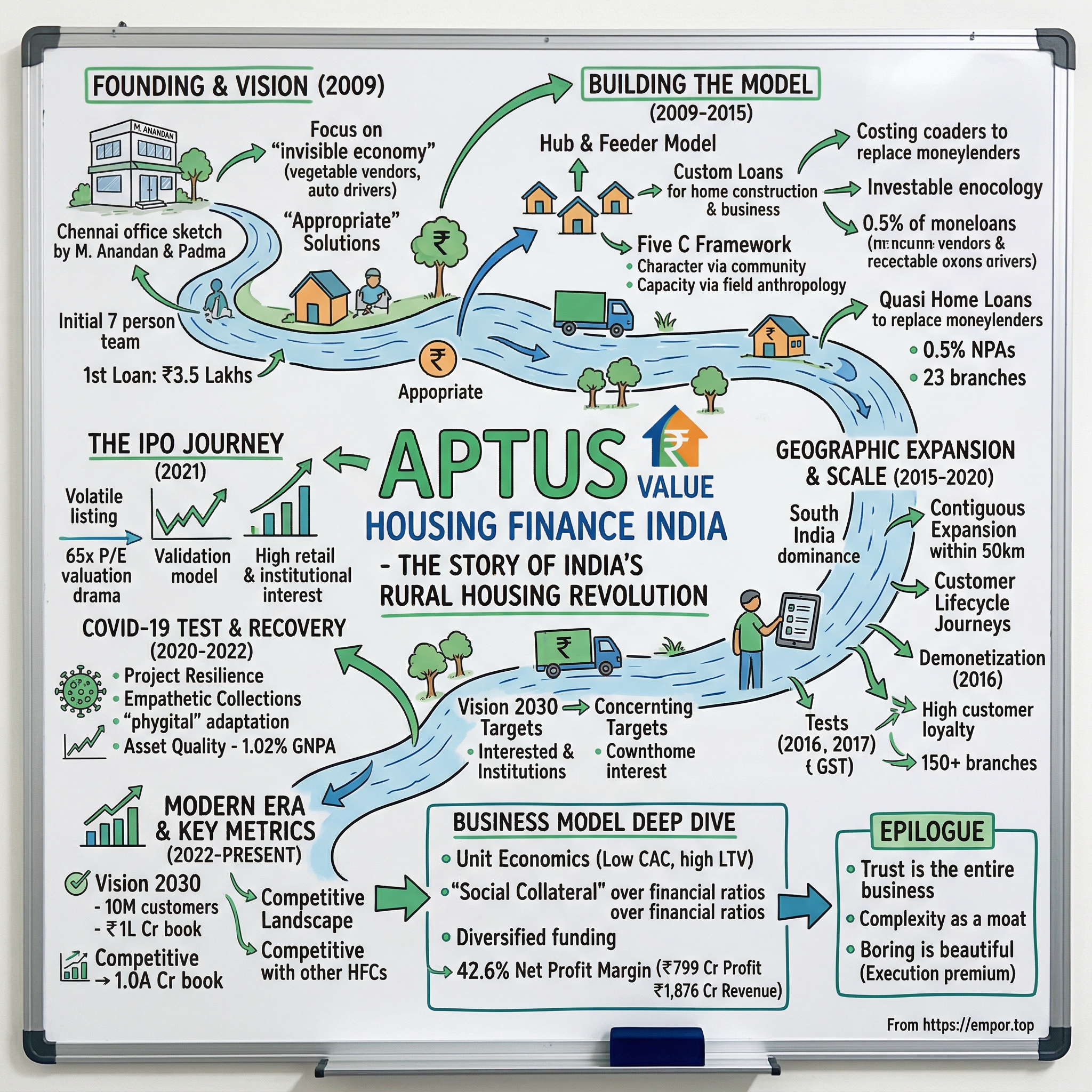
Aptus Value Housing Finance: The Machine of Indian Rural Housing
I. Introduction & Episode Roadmap
Somewhere in a district town in coastal Andhra Pradesh — call it a place with one main road, three temples, a bus stand, and a weekly market — a woman who runs a tailoring unit out of her front room wants to add a first floor to her house. She has no salary slip. She has never filed an income tax return. Her income arrives in cash, in irregular bursts, from neighbours who pay when the harvest money comes in. Every large bank in India has a beautifully engineered process for turning documents into credit decisions, and she has no documents. On paper, she does not exist.
A man on a motorcycle turns up at her door. He is not a broker. He is on the payroll of a housing finance company headquartered in Chennai, he lives about forty minutes away, and he speaks her language. He will count the sewing machines. He will ask how many blouses she stitches in a festival week and what she charges. He will pull her bank statement through an account aggregator and look at whether small deposits arrive with rhythm. A civil engineer employed by the same company will come to measure the plot and photograph the roof line. A lawyer employed by the same company will read the title deed. If the file clears, she will get roughly ₹9 lakh at an interest rate somewhere in the mid-teens — expensive by the standards of a metro home loan, and a fraction of what the local moneylender charges. The loan will be secured against the house she is standing in, at a loan-to-value ratio of about 40%.1
Multiply that scene by roughly 193,000 customers and 372 branches, and you have Aptus Value Housing Finance India Limited.2
Here is the number that makes this company genuinely unusual, not just locally interesting. For the quarter ended June 2026, Aptus reported a return on assets of about 7.8% and a return on equity above 20%.3 For context, the affordable housing finance sector as a whole — the twenty-odd specialist lenders that ICRA tracks — earns a return on managed assets in the range of 2.5% to 2.7%.4 Aptus's two closest listed comparables earn 3.3% and 3.9%.56 In global financial services, a durable 7%-plus return on assets in a secured mortgage book is close to a contradiction in terms. Secured lending is supposed to be a thin-margin, high-volume business. Aptus runs it like a high-margin, low-volume one.
The full financial picture as of the most recent reported quarter: assets under management of ₹13,648 crore, up 21% year on year; full-year FY26 profit after tax of ₹943 crore, up 26%; a net worth of ₹5,060 crore; and a capital adequacy ratio of about 70%.27 The market capitalisation sits near ₹13,000 crore at a share price around ₹258 — which works out to roughly 13 times trailing earnings and about 2.6 times book value.8
That last sentence is where the story turns from a profitability puzzle into an investing puzzle. Aptus listed in August 2021 at ₹353 a share.9 Five years later, profits are three and a half times higher and the stock is roughly 27% below the issue price.89 Nothing broke. The company did approximately what a bull would have wanted it to do operationally, and shareholders from day one still lost money. Understanding why is more instructive than any single operating metric in this business.
There is a second tension worth flagging up front, because the rest of this piece keeps circling back to it. Aptus's investor presentations market the company on four pillars: 100% in-house sourcing with zero dependence on direct sales agents; conservative loan-to-value ratios; rock-bottom credit costs; and a contiguous, disciplined expansion map. Over the past eighteen months, management has itself begun softening three of those four. A "connector" channel now contributes 8% of disbursements.3 Sanctions below ₹7 lakh have been discontinued in favour of larger, more bankable tickets.10 Gross non-performing assets have roughly doubled from 0.70% at March 2021 to 1.70% at June 2026.12 And in the same window, shareholders voted down two management proposals — one on governance rights, one on employee stock options.1112
None of that means the machine is broken. It might mean the machine is maturing, which is a different and more ordinary thing. But it does mean the marketing deck and the operating reality have started to drift apart, and the interesting analytical work is in the gap.
Here is the roadmap.
- The 2009 genesis. M. Anandan's four decades inside the Murugappa Group, and the credit vacuum that opened beneath India's formal banking system after the global financial crisis.
- Building the machine (2010–2019). Why refusing to pay brokers a commission turned out to be an underwriting decision rather than a cost decision, and how you construct a profit-and-loss statement for a customer who has never seen one.
- The capital scaling era and the 2021 IPO. WestBridge Capital's decade-long bet, and an offering priced at roughly 66 times earnings that never traded above its issue price again.
- Post-IPO evolution and the management handover. From founder-CEO to P. Balaji, the finance chief who had been in the building since 2010 — and what the ownership register looks like now that the private-equity anchor has gone.
- The economics. Where the extraordinary return on assets actually comes from, how much of it is skill and how much of it is an under-levered balance sheet, and what Porter and Helmer say about whether it lasts.
- The stress test. Concentration, seasoning, strategy drift, two shareholder rebellions, and the questions a short seller would ask on the next call.
- Bull, bear, and the two or three numbers that actually matter.
Let's begin in Chennai, in the wreckage of 2008.
 Subscribe on LinkedIn
II. Genesis & Founding Thesis (2009–2012)
In 2008, M. Anandan was a man with an unusually complete education in South Indian retail credit and no obvious reason to start a company. He had spent decades inside the Murugappa Group, one of the oldest and most conservative business houses in Chennai — a conglomerate whose culture prizes patience over flash. He was executive director of Cholamandalam Investment and Finance Company from 1997 to 2000, then its managing director from 2000 to 2006, then managing director of Cholamandalam MS General Insurance from 2006 to 2008.13 That arc is worth pausing on. Chola is a vehicle and small-business lender that survives by understanding borrowers who do not fit templates: truck operators, small contractors, traders. Anandan spent the productive middle of his career learning how such loans go bad, at the level of the individual file, in exactly the four states Aptus would later colonise.
Then he left, and at an age when most executives in Indian financial services take board seats, he incorporated a housing finance company. Aptus Value Housing Finance India Limited was incorporated on December 11, 2009 and received its certificate to commence business in June 2010.13 Anandan served as its managing director from inception until 2023 — thirteen years — before moving up to executive chairman.13
The timing was not accidental. The global financial crisis had done something specific to Indian lending. It made every large, well-capitalised institution simultaneously more risk-averse and more document-dependent. The mortgage majors of the era — the pre-merger HDFC, ICICI, State Bank of India, LIC Housing — competed ferociously for the same customer: a salaried professional in a Tier 1 or Tier 2 city with a payslip, a Form 16, and a builder-constructed apartment with clean approvals. That customer is genuinely attractive. Loss rates are low, ticket sizes are large, and the entire process can be industrialised.
The problem is that this customer is a minority of India. The overwhelming majority of Indian households derive income from self-employment or informal work: shopkeepers, small manufacturers, farmers with side businesses, drivers, milk vendors, tailors, mechanics. These households own land, build houses incrementally over years, and finance construction through savings, family loans, gold, and — when nothing else works — local moneylenders charging rates that begin around 36% annually and go up from there.
So the market vacuum was not "housing finance." It was underwriting technology. Formal lenders had built a machine that converts documents into credit. If you had no documents, the machine could not see you — not because the risk was unacceptable, but because the assessment cost per rupee lent was uneconomic at the ticket sizes involved.
That last point is the whole opening. Nobody wanted to send an underwriter on a motorcycle to inspect a ₹6 lakh loan, because the hour of skilled labour cost more than the loan earned. Any lender willing to make that hour cheap enough — through local hiring, standardised templates and volume — would inherit an entire market by default.
Anandan's founding thesis inverted the standard assumption about this segment. The conventional view treated informal-income borrowers as subprime by definition — high-risk, high-loss, tolerable only at usurious pricing. His bet was that the risk lived in the documentation, not the borrower, and that if you replaced paperwork with physical verification and anchored every loan to a self-occupied residential property at a conservative loan-to-value ratio, you would end up with something closer to prime credit that happened to be priced like subprime.
Two structural choices carried the thesis. The first was the collateral. Aptus's core product is secured against the house the borrower lives in, with loan-to-value capped at 50% and running around 40% on average across the book.110 The behavioural logic is not subtle: a family will sacrifice a great deal before risking the roof it sleeps under, and if it does default, half the property value provides genuine room to recover. This is a materially different proposition from lending against a rental property or an under-construction unit. As of March 2025, roughly 81% of the portfolio sat below a 50% loan-to-value threshold.13
The second was the recovery mechanism. Because Aptus is a registered housing finance company with mortgage security, it has access to the SARFAESI Act, which permits secured creditors to enforce against property without a full court process.13 In a country where civil litigation can consume a decade, that legal shortcut is the difference between a secured loan and a theoretically secured loan. Every credit assumption in this business ultimately rests on it.
Capital came slowly and from investors comfortable with the unglamorous. Caspian and Granite Hill Capital Partners provided early equity, joined by the India Financial Inclusion Fund. WestBridge Capital arrived in the middle of the decade and became the anchor, and in September 2016 WestBridge and the India Financial Inclusion Fund closed a ₹270 crore round, with WestBridge putting in roughly ₹245 crore of it.14 Peak XV Partners and Malabar Investments also became holders over time.15
The composition of that investor base is itself informative. These were not growth funds underwriting a land grab; they were financial-inclusion and long-duration investors comfortable with a business that would take a decade to matter. That patience shaped what got built next.
The geography was equally deliberate. Aptus began in rural and semi-urban Tamil Nadu — the founder's home ground, where he knew the districts, the property markets, and the failure modes — and made a rule of expanding only into adjacent districts. The company's own AUM history shows how patient that was: ₹29 crore in FY11, ₹86 crore in FY12, ₹159 crore in FY13, ₹252 crore in FY14.1 Four years to reach a loan book smaller than a single branch of a large bank. Aptus reached profitability around FY12 and its hundredth branch only around FY17.1
That slowness is the most underrated fact in the company's history. Aptus spent its first six or seven years building a credit process against a very small book, which meant its early mistakes were cheap. By the time the balance sheet was large enough for errors to matter, the process had already been debugged in the field. It is the opposite of the venture-funded playbook, and in secured lending it is almost certainly the correct one.
The question was what happened when the same organisation had to scale that process across four states without diluting it.
III. Building the Underwriting & Distribution Machine (2012–2019)
Every lender in India that has ever blown up has done so in roughly the same way, and it usually starts with a commission.
The standard Indian mortgage distribution model runs through direct sales agents — independent brokers who source customers, assemble files, and get paid a percentage of the disbursed amount. The economics are seductive: variable cost, no branch investment, instant reach. The problem is that the agent's incentive terminates at disbursement. The agent is paid for the loan being made, not for it being repaid. So the agent learns, rationally, to present every borrower in the best possible light: to coach the customer on what to say, to shop the same file to four lenders simultaneously, to fill gaps in the paperwork with optimism. Adverse selection is not a bug in the DSA model; it is the model working as designed.
Aptus's answer was to refuse to participate. The company built an in-house field force and, in its own words, sources 0% from DSAs and builders.110 As of the June 2025 quarter, roughly 79% of leads came from in-house sales executives, about 12% through the "Bandhu" referral app aimed at the local construction ecosystem, about 6% from existing-customer referrals through the customer app, and about 3% from digital marketing.1
This is more than a cost decision, though the cost effect is real. Consider what owning the customer relationship end-to-end actually buys. First, the person who originated the loan is on the payroll and is measurable — his portfolio can be tracked, and a sales officer whose files go delinquent has a career problem. Second, there is no third party incentivised to obscure information. Third, and most importantly for the economics, the borrower has no price-shopping intermediary standing next to her. She is not comparing four term sheets; she is comparing one offer against not getting a loan at all.
That last point explains the single most striking line in Aptus's financials: pricing stability. The company's portfolio yield has sat between roughly 16.9% and 17.4% every year from FY21 through FY26, and the spread over cost of borrowings has held in a band of roughly 8.6% to 9.0% across the same period — through a rate-hiking cycle and a rate-cutting one.12 Lenders do not normally get to hold a spread flat through both halves of an interest rate cycle. Aptus does, because its customer's alternative is not a cheaper bank.
The second pillar was vertical integration of assessment, not just sourcing. Aptus employs its own legal officers and its own civil engineers, organised in a hub-and-spoke arrangement where each hub serves the branches beneath it.13 As of the December 2025 quarter, the in-house team included about 2,258 people in business origination, 333 in credit, 299 in legal and technical, and 743 in collections.10 The reasoning is straightforward once you have seen how the alternative fails. Outsourced valuers and panel advocates in small Indian towns are paid per report and depend on the lender for volume. They have every incentive to say yes. When the same valuer serves four lenders in one district, the local property market's true condition becomes invisible to all of them at once. By employing the engineer, Aptus converts the valuation from a purchased opinion into an internal control — and, incidentally, gains a real-time read on construction activity across hundreds of micro-markets.
The third pillar is the underwriting method itself, and it deserves plain explanation because it is the actual product.
When a bank underwrites a salaried borrower, it reads a payslip and applies a ratio. When Aptus underwrites a self-employed borrower, it reconstructs the payslip. A field officer visits the business and builds a synthetic income statement from observable physical evidence: how much inventory sits in the kirana store and how fast it turns; how many litres a milk vendor delivers and at what margin; how many machines a small workshop runs and how many shifts; how many customers pass through in an hour. Cross-checks come from bank statement velocity — the rhythm and consistency of small deposits — pulled increasingly through India's account aggregator framework, plus credit bureau records where they exist. Aptus says it collects more than fifty key data points for customer profile analysis, layers on machine-learning-assisted scoring, and then routes the file to a centralised credit team rather than letting the branch decide.1 Roughly 78% of borrowers are self-employed and about 78% fall in the low-income group.1
That last design choice — centralised credit approval with decentralised sourcing and collection — is the quiet structural genius of the model. The branch does what only a local can do: find the customer, look at the business, chase the payment. The centre does what only a centre can do: apply consistent standards, compare across geographies, and resist local enthusiasm. Aptus reports that more than 90% of loans are approved within 72 hours, which matters enormously to a borrower whose contractor is waiting.1
Then there is collections, which in this segment is where the money is actually made or lost. Aptus's stated protocol is intensive monitoring of the first 15 to 24 months of every loan — the window in which early-default signals appear — escalating to legal action and SARFAESI enforcement past 90 days past due.1 Around 94% of collections are now routed digitally, with e-NACH mandates on 100% of loans, over 90% of agreements executed digitally, and around 90% of customers on the mobile app.1 The digital layer is not a moat by itself — everyone is doing it — but it does something specific here: it converts a cash-collection business, with all its leakage and fraud risk, into a data business where a missed auto-debit generates a same-day signal.
The product architecture that sits on top of this machine is three-legged, and understanding it is essential to understanding the returns. The home loan business — first-time buyers on the periphery of Tier 2, 3 and 4 towns — carries an average ticket of about ₹9.6 lakh, an average tenure just over ten years, and a yield around 15.6%. Quasi home loans, for construction or purchase against a self-occupied property but not fully meeting National Housing Bank definitions, average about ₹9.1 lakh at roughly 17.5%. And small business loans, housed in the wholly owned non-banking subsidiary Aptus Finance India Private Limited, average about ₹9.0 lakh at roughly 20.1%.110 Consolidated, housing loans were about 60% of the book at March 2025 with non-housing at 40%, of which quasi home loans were about 14%.13
Note what that structure really is: a regulated housing finance company with a high-yield non-bank bolted to its side, sharing the same customers, the same branches, the same management, and the same collateral type. It is the single largest reason Aptus's blended returns beat pure housing lenders. It is also, as later sections show, where the credit stress has shown up first.
The final pillar was the expansion rule. Branches open only in districts adjacent to existing operations, after screening regional demographics, urbanisation, competitive intensity, and — tellingly — local delinquency trends drawn from bureau data.1 The results compound in a way that is visible in the branch cohort data. By the December 2025 quarter, branches more than three years old carried an average loan book of roughly ₹50.9 crore each; branches one to three years old averaged about ₹20.0 crore; branches under a year old averaged about ₹2.2 crore.10 Back in FY22, the mature cohort averaged ₹33 crore.16
Read that as a mechanism, not a statistic. Each vintage keeps growing for years after the fixed cost of the branch has been paid. That is the engine behind an operating expense ratio of about 2.6–2.7% of assets against a sector average nearer 3.3%.14 It also means reported opex is structurally understated in a fast-expansion year and overstated in a slow one — a subtlety worth remembering when management explains a quarter.
By 2019 the machine worked, the book was compounding, and the only thing missing was the event that would test whether it worked when someone was watching every ninety days.
IV. The Capital Scaling Era & The 2021 IPO Valuation Drama
Between FY19 and FY21 the loan book roughly doubled, from ₹2,247 crore to ₹4,068 crore, and it did so straight through the three worst shocks the Indian informal economy had faced in a generation.1
Demonetisation in November 2016 removed most of the country's cash overnight — in a customer base that transacted almost entirely in cash. The Goods and Services Tax rollout in 2017 forced small traders into a formal filing regime many were unequipped for. Then in 2018 the collapse of IL&FS froze wholesale funding for every non-bank lender in India simultaneously, and the market stopped distinguishing between good books and bad ones. Aptus's gross non-performing assets came through at 0.70% at both March 2020 and March 2021.1
Two honest caveats belong next to that record. First, those figures were computed under the pre-2021 recognition norms, as the company's own presentation footnotes.1 Second, a book growing at 30% a year mechanically flatters any ratio whose numerator takes time to age — the denominator arrives faster than the defaults. Both caveats are real. Neither erases the underlying point: through three exogenous shocks, a portfolio of informal-income borrowers in South India did not visibly crack.
WestBridge Capital watched this and pressed its bet, building toward a stake that would reach roughly 29% of the company by the time of the public offering and after.13 That is an unusual position for a growth investor — closer to a controlling anchor than a minority holder — and it came with board seats and institutional governance expectations. It also meant that when the exit came, it would be a large one.
The initial public offering opened on August 10, 2021 and closed on August 12, in a price band of ₹346 to ₹353, and was subscribed 17.2 times.9 The structure was a small fresh issue of ₹500 crore for growth capital alongside a much larger offer for sale by existing holders, and the company listed on August 24, 2021.13[^20]
Then came the debate that has defined the stock ever since. At ₹353, Aptus was priced at roughly 66 times FY21 earnings and something in the region of six and a half times book value. For a lender. In a country where large private banks have historically traded at three to four times book in good times.
The bull argument was internally coherent. A company earning 7–8% on assets, growing its book at nearly 30%, with credit costs of 20 basis points and a total addressable market measured in tens of millions of households, is not really a bank — it is a compounding machine that happens to be regulated as one. On that framing, paying up was justified.
The skeptical argument was equally simple and turned out to be the operative one. Six and a half times book does not merely require the company to perform; it requires the market's willingness to pay six and a half times book to persist. Those are separate bets, and only one of them is about the business.
The market's reaction on day one was a shrug and a step back. The stock listed at a discount of roughly 5.6% and spent the session below the issue price.17 Not a collapse — a pricing correction, and a signal that the marginal buyer was unwilling to underwrite six-and-a-half-times book for perfection sustained indefinitely.
The marginal buyer was right, and this is the single most useful investing lesson in the Aptus story. Over the five years to August 2026, the company delivered almost exactly what the bull case required: profit after tax compounded from ₹267 crore in FY21 to ₹943 crore in FY26, roughly 3.5 times, or about 29% annually.17 Earnings per share rose from around ₹5.4 to ₹18.83.8 And the share price fell from ₹353 to about ₹258.8
The arithmetic is worth spelling out because it is so clean. Earnings per share grew about 3.5 times. The price-to-earnings multiple fell from roughly 66 times to roughly 14 times — a compression of about 79%. Multiply 3.5 by 0.21 and you get 0.74; multiply ₹353 by 0.74 and you get about ₹261. That is essentially where the stock trades.8 Five years of genuinely excellent operating execution were fully consumed by the de-rating of the entry multiple, with a little left over for the dividend.
For long-term investors this is the whole game in one company. Business quality and investment outcome are different variables. A great operating record purchased at a great price produces wealth; the same record purchased at 6.5 times book produces a five-year round trip. Nothing about Aptus's execution needed to disappoint for the shareholder to lose. Only the multiple had to normalise — and multiples in Indian financials always eventually normalise, because the entire sector re-rates and de-rates together as a function of liquidity and credit sentiment rather than any single company's merits.
Which raises the question the next section addresses: while the multiple was collapsing, what was actually happening inside the company?
V. Post-IPO Evolution, COVID Resilience, & Management Transition (2021–Present)
The pandemic hit Aptus's customer base in the most direct way imaginable. When a state locks down, a tailor stops earning that week. There is no work-from-home for a milk vendor.
The company's response was to lend into the crisis sparingly and to restructure almost nothing. Aptus offered minimal moratorium relief during the first COVID wave and did not restructure loans; during the more disruptive second wave, when the Reserve Bank of India offered restructuring but no blanket moratorium, Aptus stayed selective. By the March 2022 quarter, the restructured book stood at a nominal 1.2% of total loans, and Anandan told analysts that recovery on those restructured accounts had been good — the deliberate consequence of keeping restructuring minimal was that soft-bucket delinquency ran a little higher for a couple of quarters instead.16
That is a real, testable management choice, and it deserves credit as behaviour rather than rhetoric. Restructuring is the accounting equivalent of sweeping dust under a rug: it converts a delinquent loan into a performing one by contract rather than by cash. Many Indian lenders used the 2021 window generously and paid for it in FY23 and FY24. Aptus chose to carry visible pain in the soft buckets rather than invisible pain in the restructured book, and collection efficiency for the March 2022 quarter came in at 103%.16
The RBI's November 12, 2021 circular then forced a second adjustment. It harmonised non-performing asset recognition across lenders — most consequentially by requiring daily due-date-based classification and by making upgrades from NPA conditional on clearing all arrears rather than partial payment. For a lender whose informal-income customers habitually pay a few days late and catch up within the month, this was a mechanical hit. Aptus's gross NPA rose to 1.19% at March 2022, and management was explicit that the increase was driven by the regulatory change.16 Reported asset quality got worse; the underlying book did not.
Then came the succession, which in a founder-driven Indian financial company is usually the moment of maximum risk. Anandan had run Aptus as managing director since inception. In the first quarter of FY24, P. Balaji — who had joined as chief financial officer in 2010 and had been executive director and CFO — was elevated to managing director, with Anandan continuing as executive chairman.13
The design here is conservative in a way that cuts both ways. Balaji is not an outside hire with a new theory of the business; he is the man who built its financial architecture from year one, over fifteen years of continuity. The credit culture almost certainly transfers intact. On the other hand, this is succession without fresh eyes, and it leaves the founder in an executive chair above the chief executive — an arrangement that concentrates authority rather than distributing it. Proxy advisers have said so directly: Stakeholders Empowerment Services has observed that combining the board chairmanship with an executive position blurs the line between board and management and concentrates power in one person.18 CARE Ratings, for its part, flagged that as scale and geographic reach grow, broadening the depth of management across key functions is critical, and noted the company's response — new assistant vice presidents in collections, legal and technical, plus state heads in sales and credit.13
The wider leadership bench, as disclosed, comprises C.T. Manoharan as executive director and chief business officer, Sanjay Mittal as chief financial officer, John Vijayan as chief risk officer, V. Krishnaswami as chief technology officer, and V. Sundara Kumar heading legal, technical and receivables — a group with three decades of average experience, most of it in South Indian retail credit.1 Five of nine directors are independent.1
The ownership register, meanwhile, was rewritten completely. On September 4, 2025, WestBridge sold a 12.2% stake — about 6.09 crore shares at ₹328.85 each, roughly ₹2,006 crore — to a group of twenty-four institutions including Kotak Mahindra Mutual Fund, ICICI Prudential, Tata Mutual Fund and Goldman Sachs.19 Combined with sales by affiliated entities, WestBridge and its associates exited about 16.46% and went to zero.20 On October 23, 2025, WestBridge formally sought reclassification from the promoter group to public shareholder status under SEBI Regulation 31A, and both BSE and NSE subsequently approved it.2018
The effect on the shareholding structure was dramatic. Promoter holding — which was 62% in 2022 and 52.98% at March 2025, of which 29.07% was WestBridge and 23.91% the founder family — stood at 23.86% by June 2026, consisting essentially of M. Anandan at about 19.2%, Padma Anandan at about 2.7%, and a small family holding.13818 Foreign institutions hold roughly 30% and domestic institutions roughly 30%.8 By December 2025, public institutional shareholders represented about 79% of the free float, up from 67% a year earlier.18
Aptus is now, in practical terms, an institution-controlled company with a founder holding under a quarter of the equity.
That single structural fact explains most of what followed. A register dominated by mutual funds and foreign institutions behaves differently from one anchored by a private-equity partner with board representation: it is more liquid, more valuation-sensitive, and far more willing to vote against management on governance questions. The two shareholder defeats examined in the stress-test section are the direct consequence.
Operationally, the post-IPO record has been strong and is decelerating. FY25 delivered AUM of ₹10,865 crore, up 25%, and profit after tax of ₹751 crore.13 FY26 delivered AUM of ₹13,107 crore, up 21%, profit after tax of ₹943 crore, up 26%, and disbursements of ₹4,009 crore, up only 11%.7 Branch count went from 300 to 339 to 372 by June 2026.1372 The FY26 dividend was ₹4.60 per share, against a payout history averaging around 30%.218 CARE Ratings upgraded the long-term rating to AA with a stable outlook from AA- positive during FY26, with ICRA at AA-.1
Return metrics have stayed remarkable and roughly flat: return on assets of 7.7% in FY25, 8.2% in Q4 FY26, and about 7.8% in Q1 FY27, with return on equity climbing from 18.8% in FY25 to above 20% as the balance sheet levered up slightly.1213 CARE's independently computed return on total assets — a stricter denominator than the company's average-AUM basis — was 7.44% in FY25, 7.59% in FY24 and 7.85% in FY23.13 The profitability is real under either convention. It is also, quietly, trending down.
Asset quality is the line that has moved. Gross NPA went from 1.07% at March 2024 to 1.19% at March 2025 to 1.52% at March 2026 to 1.70% at June 2026; net NPA from 0.80% to 1.29% over the same span; and 30-plus days past due from 5.91% at March 2025 to 6.87% at June 2026.13221 Credit cost rose from 0.28% of assets in FY25 to about 0.50% in FY26 and 0.60% consolidated in the June 2026 quarter.13103
The honest interpretation is neither alarm nor dismissal. Portfolio seasoning is the dominant explanation and CARE named it explicitly as a rating constraint: the majority of the book was originated in the five to six years before March 2025, against loan tenures of five to fifteen years, so the portfolio has simply not yet lived through the part of its life when mortgages default.13 A book compounding above 20% is perpetually young, and a young book always reports better asset quality than it will eventually deliver. Some normalisation from 0.70% was inevitable and arguably healthy. Whether 1.70% is the new plateau or a way station is the central open question in the equity, and no one — including management — knows yet.
VI. Deep Dive: Core Business Economics & Market Dynamics
Strip away the branch photographs and the ESG slides, and Aptus is an arbitrage on a single asymmetry: it charges 17% for money it borrows at 8%, on collateral worth two and a half times the loan, to customers no one else will serve.2 Everything else in the business exists to keep that asymmetry from being competed away or defaulted away. This section examines the industry it lives in, the peers chasing the same asymmetry, and whether the defences are structural or merely current.
The industry. Affordable housing finance companies are the specialist tier of Indian mortgage lending. ICRA's tracked set — around twenty entities including Aadhar, Aavas, Aptus, Home First, India Shelter, Vastu, Shubham and Truhome — had an on-book portfolio that crossed ₹1,27,000 crore by December 31, 2024, growing 14% over nine months, with ICRA expecting 20–22% growth for FY25 and FY26.4 Their share of the overall housing finance company loan book, excluding the merged HDFC entity and a couple of stressed names, was a meaningful 16%.4 This is no longer a cottage industry.
The structural tailwind is real but slower-acting than promotional material suggests. India's housing deficit is concentrated exactly where these lenders operate, and the government's policy support is substantial: Pradhan Mantri Awas Yojana-Urban 2.0, approved with effect from September 1, 2024, targets assistance to one crore urban poor and middle-class families over five years, with a total investment of ₹10 lakh crore including ₹2.30 lakh crore of subsidy, and includes an interest subsidy scheme for economically weaker, low-income and middle-income beneficiaries.22 Rising rural incomes and the gradual digitisation of land records also expand the addressable set, since a clean title is the precondition for a mortgage.
But the same subsidy that expands the market also draws in competition, and the sector's own numbers show the squeeze already arriving: ICRA reported AHFC net interest margins of 6.3% in nine months of FY25 with margins expected to remain under pressure, operating expenses at 3.3%, credit costs at 0.5%, and return on managed assets of 2.5–2.7%.4 Bank borrowings and NHB refinance together made up 76% of the sector's funding, meaning the whole cohort's cost of funds is hostage to the same handful of counterparties.4
The peer set, honestly compared. Against those sector averages, Aptus is an outlier — but the reasons matter more than the ranking.
Aavas Financiers, the largest listed comparable, closed FY26 with AUM of ₹23,450 crore, up 15%, profit of ₹656 crore, up 14%, net interest margin of 7.93%, spread of 5.20%, return on assets of 3.29% and return on equity of 13.93%.5 Aavas operates across Western and Central India, lends at lower yields, and is now controlled by CVC Capital after a change of ownership.5 Home First Finance closed FY26 with AUM of ₹15,878 crore, up 24.9%, profit of ₹540 crore, up 41.4%, a spread of 5.3% and return on assets of 3.9% — a technology-forward lender with a higher share of salaried customers on the urban fringe, which means faster growth, thinner margins, and more direct collision with banks.6 India Shelter Finance reported FY26 AUM of ₹11,044 crore, up 29%, profit of ₹503 crore, up 33%, with fourth-quarter return on assets of 5.9%, return on equity of 17.6% and spread of 6.60% — the closest structural analogue to Aptus, with a similar tilt toward loan against property and self-employed borrowers.23
Then there is Five-Star Business Finance, which is instructive precisely because it is not a housing lender. Five-Star does pure small-business lending against property in the same South Indian towns, at a net interest margin of 19.86%, producing a return on average AUM of 8.68% — higher than Aptus — but with FY26 AUM growth of only 11%, profit growth of 2% to ₹1,099 crore, and return on equity of 16.06%.24 Five-Star is the mirror that reveals what Aptus's structure is actually worth: you can earn more on assets by dropping the housing wrapper, and you will pay for it in growth durability, funding access and cyclicality.
Aptus's position in that field is specific. Its return on assets of roughly 7.8% is roughly double Aavas and Home First and about a third above India Shelter.35623 Three things drive the gap, and only two of them are competitive advantages.
The first is genuine: product mix. Roughly 40% of the consolidated book is non-housing, sitting in the NBFC subsidiary at yields up to 22%, sharing branches, staff and collateral with the housing business.13 Aptus gets small-business-lender yields on a mortgage-lender cost base. That is a structural design advantage, not an execution one, and it is available to any competitor willing to build the same two-entity structure.
The second is genuine: cost. An opex ratio of 2.6–2.7% against a sector 3.3% is roughly 60–70 basis points of pure return on assets, generated by branch vintage compounding and by not paying sourcing commissions.14
The third is not an advantage, and it is the most commonly misread number in this story. Aptus's capital adequacy ratio is about 70%, against a regulatory minimum for housing finance companies of 15%, with gearing of 1.59 times at March 2025.113 Peers run three to four times levered. Because Aptus funds nearly a third of its assets with equity rather than debt, its interest expense is structurally lower, which mechanically inflates return on assets. A lender with no debt would report a spectacular return on assets and a terrible return on equity.
This is why the headline pairing of 7.8% return on assets with 20% return on equity is less impressive than it first appears — and why it is the sharpest capital-allocation question at the company. Aavas converts 3.29% on assets into 13.93% on equity through leverage. Aptus converts 7.8% into 20.4%. If Aptus levered to peer norms, the same operating performance would produce a return on equity well north of 30%. Instead, roughly half its balance sheet capacity sits unused while the company pays out about 30% of earnings and retains the rest into an already over-capitalised base.8 CARE observes that current net worth and retained profits will let Aptus grow for three to five years with no further equity — which is another way of saying the equity base is far larger than the business needs.13
Management's implicit defence is that a lender to informal borrowers in concentrated geographies should carry a fortress balance sheet, and after IL&FS that argument has real force. But it is a choice with a cost, and it deserves to be discussed as one rather than presented as an unambiguous strength.
Helmer's 7 Powers, tested rather than asserted.
Process Power is the strongest claim and it holds up. Aptus's advantage is not a product or a brand; it is an accumulated, tacit organisational capability for pricing informal cash flows in specific micro-markets, distributed across thousands of local employees and encoded in centralised rules. Process Power in Helmer's framework requires that the capability be hard to copy even when fully described — and this one is, because it consists of hiring, training and retaining thousands of locally rooted staff over a decade. Evidence: fifteen years of credit costs between 0.1% and 0.8% of assets across three macro shocks.1 Counter-evidence: field-level attrition of 40–45%, improved from 50–60%, as competitors poach trained officers.3 A capability held in people leaks when the labour market tightens.
Cornered Resource is the weakest claim. A branch network is not a cornered resource; it is a capital expenditure any competitor with funding can replicate, and several are doing exactly that. What is closer to cornered is the customer data — bureau-invisible borrowers with a proven repayment history inside Aptus's system, whom Aptus can re-lend to at low marginal cost. Management is explicitly monetising this: Anandan told analysts the company sees the opportunity to offer add-on products to its existing base of over 200,000 customers, and plans new products in the NBFC arm.25
Counter-Positioning is real but eroding. A large bank cannot run a ₹9 lakh average-ticket, physically-inspected loan book without destroying its cost-to-income ratio — the assessment cost per rupee lent is simply too high. That asymmetry is structural. What is not protected is the upper end of Aptus's range. As Aptus moves toward larger tickets — having discontinued sanctions below ₹7 lakh and targeting the ₹8–20 lakh band — it walks toward the segment where banks and prime housing finance companies can compete on price.10 Counter-positioning only works while you stay in the position.
Scale Economies are present and improving. The CARE upgrade to AA and cost of borrowings falling from 8.6% to 8.0% year on year are worth real basis points on a ₹13,600 crore book, and central technology and governance costs spread over a growing base.12 But this is also the power most available to competitors: Aavas, Home First and Aadhar are all climbing the same ratings ladder.
Aptus has no meaningful Network Economies, no Switching Costs beyond prepayment friction, and no Branding Power that lets it charge more than a rival in the same town. Two of seven powers are strong, two are conditional, three are absent — which is a good score for a lender and a long way from unassailable.
Porter's five forces. New entrants: moderate, not low. Capital is abundant, private equity has funded a dozen challengers, and the barrier is organisational rather than financial — which slows entry without preventing it. Buyer power: low today, because the borrower values speed, title assistance and availability over 100 basis points, and rising tomorrow as digital comparison spreads even in Tier 3 towns. Supplier power: moderate and underappreciated. Aptus funds itself from banks (about 52%), NCDs (about 21%), securitisation (about 14%) and NHB refinance (about 14%), across 25-plus lender relationships with no commercial paper exposure.1 Management's own complaint on the June 2026 quarter call is telling: NHB refinance was priced at 8.2–8.3% against market rates of 7.8–7.9%, making the government refinance channel uncompetitive.25 When your cheapest structural funding source becomes your most expensive, supplier power is not theoretical. Substitutes: low — the alternative remains informal lending at punitive rates. Rivalry: moderate to high and intensifying, visible in attrition rates and in management's own admission that competitive pressure in Tamil Nadu is affecting employee retention.21
The composite picture is a business with genuine, durable advantages in the low-ticket informal niche and thinning advantages everywhere it is now growing. That tension is exactly what the last two years of earnings calls have been about.
VII. Earnings Calls, Skeptical Stress Test, & Strategic Friction Points
On May 7, 2025, management sat down with analysts to close out FY25 and set expectations for the year ahead. The guidance was specific: disbursement growth of 24–25%, loan book growth of 28–30%, credit cost of 40–45 basis points, and operating expenses of 2.63–2.7% of assets.26 Five growth levers were named — new branches in Odisha and Maharashtra, officer productivity rising from three loans a month to four, average ticket size moving from ₹8–8.5 lakh to ₹9–9.5 lakh, digital marketing leads rising from 21% to 25%, and the full-year effect of the 28 branches opened in FY25.26
FY26 delivered AUM growth of 21% and disbursement growth of 11%.7 Against a guide of 28–30% and 24–25%.
How management handled that gap is the most useful window into its credibility, and the answer is mixed in an interesting way. By the December 2025 quarter, Balaji was no longer defending the original number. He told the market plainly that the company had discontinued sanctions below ₹7 lakh in a deliberate move toward a higher-ticket, higher-quality customer cohort, that this had caused moderation in disbursements, and that FY26 would close at 20–21% AUM growth rather than the promised 28–30%.10
That is a real explanation with a real mechanism, and it is more than many managements offer. It is also a significant, quietly executed strategy change. Deliberately refusing loans below ₹7 lakh means walking away from the smallest, least-banked borrowers — the exact cohort the founding thesis was built to serve, and the cohort where competition is thinnest and pricing power greatest. It is a rational response to attrition, competition and credit signals in the small-ticket segment. It is also, unmistakably, a step upmarket toward the territory where banks live. Investors are entitled to ask why a company whose entire moat rests on serving the unserved is choosing to serve them less.
Two other narrative shifts deserve the same scrutiny.
The first is sourcing. Aptus's Q3 FY26 investor presentation, published in early 2026, still carried the claim "100% In-House Sourcing" and "0% - Sourcing from DSA / Builders" on its underwriting slide — while, three slides earlier, listing "pursue alternate channels via digital marketing and connectors" as a growth strategy.10 By the June 2026 quarter call, Balaji was citing "growing traction of the connector channel, which contributed 8% of disbursements in Q1."3 A connector is not a full direct sales agent, and the distinction may well be meaningful in practice. But the company is now sourcing a rising share of business through third parties while marketing itself on the absence of third parties. Either the moat slide needs updating or the channel needs explaining. Both cannot stay as they are.
The second is product expansion. Anandan framed it directly on the June 2026 call: as the company scales from ₹15,000 crore toward ₹25,000 crore and beyond, there is a need to diversify the product range, and the opportunity is particularly in the NBFC business.253 New products in the higher-yield, non-housing subsidiary, sold to an existing customer base — that is the textbook path to sustaining returns as core growth matures, and also the textbook path to credit surprises. It is worth noting where the stress already sits: in the June 2026 quarter, credit cost in the NBFC arm ran at 1.4% against 0.2% in the housing company.3 Management is proposing to expand precisely the entity with seven times the credit cost.
Which brings us to the June 2026 quarter itself — the most contentious call in the company's public life. The headline numbers were strong: AUM up 21% to ₹13,648 crore, disbursements up 36% to ₹1,053 crore, profit up 19% to ₹261 crore, return on equity of 20.4%, spread stable at 9.0% with cost of funds down to 8.0%, and 33 new branches taking the network to 372.227 The stock fell about 5.8% on the day.25
It fell because of two lines. Gross NPA rose to 1.70% from 1.52%, 30-plus days past due rose to 6.87% from 6.21%, and collection efficiency slipped to 98.52% — split as 99.5% in the housing company and 97.5% in the NBFC.25 Management's characterisation was that this reflected a temporary collection issue in the NBFC portfolio at quarter-end, describing it as a "small hitch" in June collections rather than portfolio deterioration, with Balaji stating that there was no problem with the quality of the customers funded in the NBFC, and offering July data showing 30-plus DPD down roughly 15–20 basis points.25
That answer is specific, falsifiable and accompanied by post-quarter evidence, which is more than evasion. It is also the third consecutive quarter in which asset quality moved the wrong way and was attributed to something temporary — seasonality in June 2025, festive-period volatility in December 2025, an operational hitch in June 2026.11025 Each explanation is individually plausible. Collectively they describe a trend. The disciplined position for an investor is to treat management's seasonality framing as a hypothesis that the September and December 2026 quarters will test, not as an answer.
Now the activist stress test — the four questions a skeptical long-short investor would put to this board.
One: the geography is not diversifying, it is rotating. Aptus's presentations describe expansion into seven states. The AUM tells a narrower story. At the December 2025 quarter, Andhra Pradesh accounted for ₹5,359 crore, Tamil Nadu ₹3,817 crore, Telangana ₹2,099 crore and Karnataka ₹946 crore, against a combined ₹109 crore in Odisha and Maharashtra.10 Top-three-state concentration was 92% of AUM at both March 2024 and March 2025 — unchanged.13 More striking, the largest single exposure has shifted: in FY25 Andhra Pradesh became the biggest state at 42.31% of AUM, overtaking Tamil Nadu at 33.35%.13 Aptus did not reduce concentration; it moved its concentration from one state to another. And by the June 2026 quarter, Maharashtra and Odisha combined stood at roughly ₹160 crore, about 1.2% of the book.25 After three years in Maharashtra, that is a rounding error. Management's counter — that Odisha and Maharashtra face less intense competition and that under-penetrated pockets remain in Telangana and Karnataka — may prove correct.25 The data so far shows an expansion plan that has not yet begun to change the risk profile.
Two: is growth being bought with underwriting? The bear case writes itself: AUM up 21%, disbursements up 36% in a single quarter, GNPA up 18 basis points, 30-plus DPD up 66 basis points, and credit cost guided to 0.5% having actually printed 0.6%.23 The counter-evidence is genuine and should be weighed: average loan-to-value remains around 40%, the minimum ticket size was raised rather than lowered, and the company is moving toward better cohorts rather than worse ones.10 A lender chasing growth by loosening standards does not discontinue its smallest loans. On the evidence, Aptus is trading growth for quality, not the reverse — which is the right trade and also the reason the growth guidance was missed.
Three: governance, which is where the real news is. Twice in six months, Aptus's shareholders voted management down.
In February 2026, the company put to postal ballot a special resolution amending its Articles of Association. Following WestBridge's exit and reclassification, the amendment removed the former investor-promoter's rights and — this is the contested part — vested in M. Anandan and Padma Anandan the right to nominate a majority of the board excluding independent directors, the right to appoint the board chairperson, and affirmative voting rights allowing them to approve or reject board decisions, all without any minimum shareholding threshold.18 Stakeholders Empowerment Services recommended voting against, noting that as drafted a promoter holding as little as 0.1% would retain nomination rights, that shareholders would be reduced to approving decisions pre-decided by promoters, and that directors' fiduciary duties would be substantially diluted.18 On February 18, 2026, the resolution failed: 50.93% against, 49.07% for, on 81.17% participation, with public institutional shareholders voting 74% against while the promoter group voted 100% in favour.12
Then at the 17th annual general meeting on August 4, 2026, the special resolutions approving the "Aptus ESOP 2026" plan and the grant of options to subsidiary employees failed, securing only 73.11% support against the 75% special-resolution threshold, with public institutional investors voting 38.92% against.1128 Shareholders approved the FY26 accounts, borrowing limits and NCD authorisations at the same meeting.11
Set aside the merits of either proposal and look at the pattern. A founder holding under 24% attempted to entrench control rights untethered to ownership, was rejected, and then failed to carry a routine incentive plan. That is what a governance overhang looks like in real time. It matters commercially for three reasons. First, employee retention in a business whose moat is people now has a live problem — the company had explicitly cited ESOPs as a retention tool while running 40–45% field attrition.13 Second, any future proposal requiring a special resolution faces an institutional base that has demonstrated it will organise. Third, the mismatch between the founder's roughly 19% economic stake and the executive authority he exercises as chairman is now a subject of active contest rather than quiet acceptance.
Four: yield compression and the funding squeeze. Aptus held its spread at 9.0% through the June 2026 quarter, and management notes that 66% of debt is variable-rate — 35% repo-linked, 31% MCLR-linked — with a repo increase calculated to cost only about 6 basis points.25 That is genuine pricing power, demonstrated rather than claimed. But management has already begun implementing calibrated rate cuts on selected ticket sizes, and the NHB refinance channel has become uncompetitively priced.25 The compression scenario does not require a bank to enter a village. It requires Aptus's own move upmarket to place a growing share of its book in competitive territory — which is management's stated plan.
VIII. Current Risk Radar
Risk in this business does not arrive as a market event. It arrives as a monsoon, a state cabinet decision, or a branch manager in a new state who does not know which land titles in his district are worthless.
This is worth internalising before running through the list, because it changes what an investor should actually monitor. A software company's risks are largely visible in its financial statements. A lender to informal borrowers in three adjacent Indian states carries risks that are physical, political and organisational, and that show up in the numbers only after they have already happened. The useful questions are therefore mechanical rather than statistical: through what specific channel would this harm the business, and what would the early warning look like?
Geographic concentration. With roughly 92% of AUM in three adjacent states, Aptus is not a diversified Indian lender; it is a leveraged bet on the household economies of Andhra Pradesh, Tamil Nadu and Telangana.13 The specific mechanisms deserve naming rather than gesturing at.
Physically, coastal Andhra and Tamil Nadu sit in a cyclone corridor, and a severe event damages both the collateral and the borrower's cash flow at the same moment — the single worst correlation a secured lender can carry. Politically, South Indian state politics is competitive and redistributive, and farm or micro-loan waiver rhetoric can change repayment behaviour even when a specific lender is legally untouched. That is the subtle version of the risk: the moral hazard travels faster than the legislation, because a borrower who hears that loans may be forgiven starts behaving accordingly months before any law exists.
The regulatory version is already on the statute book. The Tamil Nadu Money Lending Entities (Prevention of Coercive Actions) Act, enacted in 2025, criminalises coercive recovery practices with jail terms and routes disputes through district-level committees.29 Management's assessment on the FY25 call was that the measure targets unregistered lenders and moneylenders rather than a registered housing finance company with ₹8–9 lakh average tickets, and that reading is probably correct.26 But the direction of travel across Indian states — Karnataka passed a comparable ordinance — is toward constraining field collection practices. Field collections are the load-bearing wall of this business model. Any legislation that makes a monthly doorstep visit legally hazardous attacks the mechanism, not the margin.
Refinancing and cost of capital. Aptus borrows roughly 52% from banks, 21% through non-convertible debentures, 14% via securitisation and 14% from NHB refinance, with average borrowing tenure around 80 months and no commercial paper exposure at all.1 The asset-liability profile showed no negative cumulative mismatch in any bucket up to one year, and liquidity stood at ₹2,057 crore at March 2026.1321 That is a genuinely conservative liability book, and the absence of short-term paper is the specific lesson of 2018 applied.
So the residual risk here is not a liquidity crisis; it is a margin one. Debentures issued through 2024 and 2025 carry 8.75% coupons, and with bank funding at roughly half the book and mostly floating, a rate cycle transmits to Aptus's cost of funds with a lag in both directions.13 The awkward detail is that NHB refinance — the channel designed to be the cheap, policy-supported option for exactly this kind of lender — has become uncompetitively priced relative to the market.25 Meanwhile the rating agencies have set explicit tripwires: CARE would consider a downgrade on return on total assets sustained below 3% or gearing above 3 times.13 Neither is remotely close, which is itself informative about how much cushion the over-capitalised balance sheet buys — and about how much room exists to lever up before any rating consequence appears.
Asset quality in the informal segment. This is the risk that cannot be engineered away, only priced. A carpenter, a small trader and a milk vendor have no salary continuity and no employer absorbing shocks on their behalf. Input-cost inflation, a regional demand slowdown, a bad agricultural season, or the closure of a single local industry hits them immediately and simultaneously — which is precisely the correlation that geographic concentration amplifies.
The mitigants are structural and meaningful: roughly 40% loan-to-value, self-occupied collateral, SARFAESI enforcement, and fifteen-to-twenty-four-month intensive monitoring on every new loan.113 The distinction worth holding onto is that these keep loss-given-default low; they do not keep probability-of-default low. A lender can be simultaneously very safe and very delinquent, and the 30-plus DPD trend from 5.91% to 6.87% across five quarters is the honest live indicator of the second thing.133 The NBFC subsidiary, at 1.4% credit cost against the housing company's 0.2%, is where it surfaces first.3
Execution risk outside the South. This is the most underrated item on the list, because it is the one place the moat does not travel. Aptus's advantage is accumulated local knowledge: which titles are clean, which builders cut corners, which borrower profiles pay through a bad year. In Maharashtra and Odisha, none of that exists yet. Land title conventions differ, borrower credit culture differs, and there is no reservoir of trained officers to draw on — the company must hire and season them from scratch, in a labour market where its trained staff are already being poached.
The cohort data quantifies the drag precisely. Branches under a year old averaged just ₹2.2 crore of AUM at December 2025, against ₹50.9 crore for branches over three years old.10 With 33 branches opened in a single quarter and 60–70 planned for FY27, a meaningful share of the network will be sub-scale for years, carrying full cost against minimal revenue.25 Aptus is targeting ₹25,000 crore of AUM by FY28-29, and the arithmetic effectively requires the new geographies to work.1 So far they have contributed about 1.2% of the book.25
Regulatory and compliance. Housing finance companies sit under RBI supervision with the National Housing Bank as sector development institution, and the perimeter has been tightening steadily — the 2021 NPA harmonisation, liquidity coverage requirements, digital lending guidelines, and the principal business criteria that require an HFC to keep housing loans above prescribed thresholds.
That last one is not abstract for Aptus. Management executed its first direct assignment of non-housing loans, ₹75 crore, explicitly to improve the principal business criteria to 64.3%, and indicated ongoing selective transactions of ₹100–150 crore per quarter driven by regulatory requirements and asset-liability management.26 Read that carefully, because it is the most important accounting judgment in the company. The high-yield non-housing book that drives Aptus's superior returns is bounded by regulation, and the company is now managing that ratio through balance-sheet transactions rather than through mix alone.
The economics of doing so are attractive — direct assignment yields of about 18.5% against roughly 9% funding cost — but structuring around a regulatory limit is a workaround, and workarounds attract supervisory attention.26 It also has a reporting consequence worth flagging: gains on derecognition of financial instruments were ₹32 crore in the June 2025 quarter alone, contributing 1.1 percentage points of that quarter's return on assets.1 That is an upfront, transaction-dependent gain rather than recurring spread income. When a company's headline return metric depends partly on how much book it sold, the quality of the earnings deserves separate examination from the quantity.
Cybersecurity and data privacy. This belongs on the list precisely because Aptus's digitisation has been so successful. Over 90% of agreements are executed digitally, roughly 90% of customers are on the mobile app, account aggregator penetration runs near 78%, and every loan carries an e-NACH mandate.1 Each of those is an efficiency gain and an attack surface. The company holds bank-account credentials, income data and property documents for nearly 200,000 households who have no realistic ability to detect or remediate a breach themselves. Governance is disclosed — a board IT strategy committee oversees the cyber security and data privacy policy, alongside IT steering and IT security committees.113 No material incident has been disclosed. The mechanism to watch is not headline reputational damage but operational: a collections and origination stack this integrated means a sustained outage or compromise interrupts disbursement and auto-debit simultaneously, in a customer base where a missed collection cycle is genuinely hard to recover.
IX. Bull vs. Bear Case Analysis
The bull case.
The core argument is that Aptus has built something genuinely rare: a lending organisation whose competitive advantage lives in process and people rather than in price or capital, operating in a segment large enough to absorb decades of growth. The supporting evidence is not rhetorical. Fifteen years of credit costs between 0.1% and 0.8% of assets, spanning demonetisation, GST, the IL&FS freeze and a pandemic.1 An operating cost ratio roughly 70 basis points better than the sector.14 A portfolio yield that has not moved more than 50 basis points in six years and a spread held within 40 basis points of 8.8% through both halves of a rate cycle — demonstrated pricing power, not asserted pricing power.12
The financial productivity that results is the highest in its listed peer group by a wide margin, and it is confirmed by an independent computation on a stricter denominator.13356 Aptus generates the returns of a small-business lender with the collateral quality and funding access of a mortgage lender — the product of a deliberate structure in which a wholly owned NBFC shares branches, staff, customers and collateral with a regulated HFC.
The market opportunity is durable in a way that most Indian growth stories are not, because it is a supply-side problem rather than a demand-side one. Tens of millions of households can afford a ₹9 lakh mortgage at 15% and cannot access one, and the constraint is the cost of assessment. Policy support is substantial and multi-year.22 Rising rural incomes and digitising land records expand the eligible pool.
Capital discipline has been real, and the fortress balance sheet is optionality. Gearing of 1.59 times and capital adequacy near 70% mean Aptus can fund three to five years of growth from retained earnings alone, without a rights issue, without dilution, and — critically — without depending on wholesale markets that periodically shut.13 For a lender to informal borrowers, surviving the funding winter is a competitive weapon: the 2018 freeze is precisely how several competitors lost a decade.
And on valuation mechanics, the bull can point out that the de-rating which destroyed the 2021 shareholder is the 2026 shareholder's starting condition. At roughly 2.6 times book and 14 times earnings for a business earning 20% on equity with 20%-plus growth, the multiple is no longer pricing perfection.8
The bear case.
The bear does not argue that Aptus is a bad company. The bear argues that every pillar of the thesis is quietly softening at once.
Start with asset quality, because it is measurable and moving in one direction. Gross NPA has more than doubled from 0.70% to 1.70% in five years; net NPA from 0.49% to 1.29%; 30-plus DPD from 5.91% to 6.87% in five quarters; credit cost from 0.28% of assets to 0.60%.11323 CARE names moderate portfolio seasoning as a rating constraint and notes most of the book was written in the preceding five or six years against tenures of five to fifteen years.13 The bear's point is not that management is hiding anything — it is that the reported asset quality of the past decade was flattered by a young, fast-growing book, and the true through-cycle loss rate has not been observed yet. If it settles at 2% rather than 1%, the excess return on assets narrows materially.
Concentration has not improved. Twelve years of contiguous expansion has produced 92% of AUM in three states and a new largest-state exposure of 42% in Andhra Pradesh.13 Non-southern geographies are 1.2% of the book after three years of effort.25
The moat narrative is being amended by management itself. The connector channel is at 8% of disbursements while the deck still claims zero third-party sourcing.103 Sanctions below ₹7 lakh have been discontinued, moving the company toward larger tickets and closer to bank competition.10 New products are planned in the subsidiary whose credit cost is seven times the parent's.253 Field attrition of 40–45% attacks the people-based moat directly.3
Guidance discipline has slipped. FY26 loan-book growth was guided at 28–30% and delivered 21%; disbursement growth guided at 24–25% and delivered 11%; credit cost guided at 40–45 basis points, then re-described as a 45–50 basis point range, then printed 50 for the year and 60 in the following quarter.26173 Each individual reset came with a reason. The pattern is a management team that guides ambitiously and then explains.
Competition is arriving from multiple directions simultaneously: Home First growing AUM at 25% with 41% profit growth, India Shelter at 29% AUM growth, Five-Star pressing from the pure small-business side, Aavas recapitalised under CVC ownership and targeting 20%-plus growth.562324 Sector net interest margins are already under pressure by ICRA's assessment.4
And governance is now an active, quantified risk rather than a footnote: two defeated resolutions in six months, an attempt to hard-wire board control rights with no shareholding floor, a proxy adviser recommending against, institutional shareholders at roughly 79% of the free float, and a rejected ESOP plan in a business that depends on retaining field staff.111218
Where the war-game lands. The two cases are not symmetrical in kind. The bull case rests on a demonstrated, fifteen-year operating record and a structurally underserved market. The bear case rests on the observation that the record was set in a specific, favourable configuration — small tickets, dense home geography, a young book, an under-levered balance sheet, a founder-controlled register — and that management is now voluntarily changing four of those five variables while the fifth ages.
Both can be true. The most likely outcome is neither a break nor a continuation of past excellence, but convergence: an excellent lender whose returns drift from extraordinary toward merely very good as the book seasons, the mix moves upmarket, and competition arrives. The investable question is what price already reflects that convergence — and how fast it happens.
X. Strategic Playbook & Durable Business Lessons
Strip Aptus of its geography and its rupee amounts and what remains is a set of design choices that generalise well beyond Indian mortgages. Six of them are worth carrying away.
Own the origination, because you are really buying the information. The decision to refuse direct sales agents is usually framed as a margin choice: pay no commission, keep the spread. The deeper insight is that in credit, the sourcing channel is the underwriting channel. Whoever meets the customer first controls what the lender learns about them, and an intermediary paid on disbursement has every incentive to control that information unhelpfully.
Aptus's fifteen-year credit cost record is the return on that decision. The cost is equally visible, and honest accounting requires stating it: an in-house field force of thousands, running 40–45% attrition, with a permanent recruitment and training obligation that never amortises.3 The lesson transfers to any business where the salesperson's incentive and the firm's long-term outcome diverge — insurance, enterprise software sold on multi-year contracts, anything with a renewal that someone else booked.
Expand contiguously, because credit culture is geographic. The adjacent-district rule looks like caution and is actually an information strategy. A district manager can only supervise what he understands, and understanding a property market is local, tacit, and slow to acquire — the kind of knowledge that cannot be written into a policy document and shipped to a new state.
The branch vintage data shows the payoff clearly: mature branches at roughly ₹51 crore of AUM each versus ₹2.2 crore for the newest cohort, meaning most of a branch's value is created in years three through ten.10 The corollary is the constraint Aptus now lives with. A company that grows by deepening cannot diversify quickly, and after three years its two newest states remain about 1.2% of the book.25 Contiguous expansion buys asset quality and sells optionality. That is a real trade-off, not a free lunch, and the bill arrives exactly when the home market matures.
Match the collateral to the behaviour, not just the value. Lending against the self-occupied home at roughly 40% loan-to-value, rather than against income streams or investment property, is the single most important risk decision in the business, and it works on two levels simultaneously. Financially, the equity cushion provides recovery room. Behaviourally, a family will exhaust every other option before risking the roof it sleeps under — which lowers the probability of default, not merely the loss when one occurs.
Layer SARFAESI enforcement on top and the structure becomes self-reinforcing: the legal remedy is credible enough to change borrower behaviour long before anyone has to use it.13 The transferable principle is that the best collateral is not the most valuable asset, it is the one the borrower will fight hardest to keep.
Know which of your advantages is skill and which is a balance-sheet choice. Aptus's return on assets near 7.8% is not one thing. Part of it is product mix, part is a genuinely superior operating cost position, and part is simply the arithmetic of funding roughly a third of assets with equity rather than debt.113 Conflating those three is how investors systematically overpay for financial companies.
The discipline is to decompose returns into the parts that survive competition, the parts that survive a credit cycle, and the parts that are a reversible capital-structure decision — then to notice that a management team enjoying the safety of an under-levered balance sheet is also, simultaneously, declining to deploy a large share of its shareholders' capital. Neither the fortress reading nor the lazy-capital reading is automatically correct. Both should be argued explicitly rather than assumed away by whichever is more flattering.
When a moat claim and an operating decision conflict, believe the decision. Aptus's investor materials continue to lead with 100% in-house sourcing and low-ticket financial inclusion. Its actual choices over the past eighteen months have been to add a connector channel that reached 8% of disbursements, discontinue its smallest loans, and plan new products inside the subsidiary carrying seven times the parent's credit cost.10325 Investor presentations are lagging indicators of strategy; capital allocation and product decisions are leading ones. Reading the second and discounting the first is most of the analytical work in any company with a good story.
Growth targets set in the best year become credibility liabilities in the worst. The FY26 guidance episode is a small, clean case study in how managements damage themselves without doing anything dishonest. A 28–30% loan-growth target was set in May 2025, a deliberate and defensible decision to raise minimum ticket size was taken during the year, and the outcome was 21%.26107 Every step was reasonable; the sequence still reads as a miss. The durable lesson is that a management team compensated on operating metrics should guide to what its strategy implies rather than to what its momentum implies — because the alternative is spending the following year explaining a good decision as though it were a bad quarter.
XI. Epilogue & Key Investment Metrics to Watch
Aptus in August 2026 is a more interesting company than it was at listing, and for uncomfortable reasons. In 2021 it was a story: pristine asset quality, extraordinary returns, an enormous underserved market, priced as if all three would persist indefinitely. In 2026 it is a business with a fifteen-year operating record, a seasoning loan book, a founder holding under a quarter of the equity, an institutional shareholder base that has twice voted management down, and a strategy in visible transition — trading at roughly a third of the price-to-book multiple it commanded at issue.81211
The share price has traced that transition faithfully: a 52-week range of roughly ₹193 to ₹364, with the stock down about 15% over the year to August 2026 and roughly 27% below its 2021 issue price, even as FY26 profit reached ₹943 crore.3087 Anyone looking for evidence that operating performance and shareholder return are separate variables has it here, in one name, over five years.
Three numbers, and only three, carry most of the information about what happens next. Everything else in the quarterly release is either downstream of these or noise.
First, the delinquency stack — 30-plus days past due, watched alongside gross NPA and split by entity. The headline NPA figure is a lagging, regulation-shaped number that tells you where the book was two quarters ago. The 30-plus DPD bucket is where informal-income stress surfaces first, because a borrower under pressure misses one instalment long before she misses three.
The entity split matters just as much as the level. The gap between the housing company's roughly 99.5% collection efficiency and the NBFC's 97.5% is precisely where the mix risk lives, and it is the NBFC that management proposes to expand with new products.253 The specific hypothesis to test is management's seasonality claim: if 30-plus DPD, having climbed from 5.91% to 6.87% across five quarters, resumes its old seasonal pattern and falls back through the second half of FY27, the "small hitch" framing is vindicated and the model is intact. If it ratchets up again, the book is telling investors that its through-cycle loss rate is structurally higher than the past decade implied — and the excess return on assets compresses toward the peer group.
Second, the spread — not the yield, not the reported net interest margin, but the gap between portfolio yield and cost of borrowings. This is the load-bearing beam of the entire investment case, because it is the only number that directly measures whether the pricing power is real or merely historical. It has held between roughly 8.6% and 9.0% for six years, through both directions of an interest rate cycle.12
Management now guides to a net interest margin of 12.5–13% for FY27 while simultaneously implementing calibrated rate cuts on selected ticket sizes and steering the book toward larger loans.25 Those two things are in tension, and the spread is where the tension resolves. Watch whether it holds as the average ticket rises. A spread that compresses while ticket size grows is the clearest available signal that the move upmarket has carried Aptus into territory where it is a price-taker rather than a price-setter — and that would undo the single most distinctive feature of its economics.
Third, AUM outside the four southern states, measured in rupees rather than in growth percentages. Odisha and Maharashtra at roughly ₹160 crore represent about 1.2% of the book, and percentage growth off a base that small will look spectacular for years while meaning almost nothing.25 Triple-digit growth rates on a rounding error are a reporting artefact, not evidence.
The honest measures are the absolute rupee number and the AUM per branch in those states relative to the roughly ₹51 crore mature-branch benchmark in the South.10 Together they answer the only question that matters about geographic expansion: does the model travel, or does it merely relocate cost? This is also the swing factor in management's stated ambition of ₹25,000 crore of AUM by FY28-29, because if the four southern states must deliver nearly all of it, then either concentration deepens or growth slows.1 There is no third path.
Beyond those three, one qualitative item belongs on the same watch list: what management does after two shareholder defeats. Whether it returns with a revised employee stock option plan on terms institutions can support, whether the Articles of Association question reappears in another form, and whether the board addresses the concentration of chairman and executive authority that proxy advisers have flagged.18 For a company whose stated moat is thousands of trained local employees in a market where rivals are actively poaching them, an unresolved incentive structure is not a governance abstraction. It is an operating risk with a measurable consequence in the attrition line.
The larger reason Aptus repays study has little to do with whether the stock happens to be cheap. It is one of the cleanest demonstrations available anywhere that financial inclusion, executed with the right collateral and the right assessment technology, can be a genuinely high-return commercial business rather than a subsidised social programme. A woman with a sewing machine and no tax return got a mortgage because an organisation figured out how to underwrite her at a cost that worked, and both parties came out ahead. That is a real achievement and it deserves to be stated plainly, separately from any view on the shares.
What remains unresolved is whether the machine that achieved it can do five hard things at once: nearly double in size, move upmarket without losing its pricing power, cross into states where its local knowledge does not yet exist, absorb the seasoning of a book that has never seen a full cycle, and complete the transition from founder authority to institutional governance. Each of those is individually survivable. Attempting all five in the same three years is what makes the next several quarters genuinely informative rather than merely incremental.
References
-
Aptus Value Housing Finance India Limited — Investor Presentation, Q1 FY26 ↩↩↩↩↩↩↩↩↩↩↩↩↩↩↩↩↩↩↩↩↩↩↩↩↩↩↩↩↩↩↩↩↩↩↩↩↩↩↩↩↩↩↩↩↩
-
Aptus Value Q1 FY27 slides: profit jumps 19% but NPAs rise — Investing.com, 2026 ↩↩↩↩↩↩↩↩↩↩↩↩↩
-
Aptus Value Housing Finance India Ltd (BOM:543335) Q1 2027 Earnings Call Highlights — Yahoo Finance, 2026 ↩↩↩↩↩↩↩↩↩↩↩↩↩↩↩↩↩↩↩↩↩↩
-
Affordable Housing Finance Companies: Steady performance; impact of seasoning on asset quality remains monitorable — ICRA, March 2025 ↩↩↩↩↩↩↩↩↩
-
Aavas Financiers Q4FY26 Earnings Call: Net Profit Up 18%, AUM Crosses Rs. 234.5 Billion, NIMs Expand to 8.45% — ScanX, 2026 ↩↩↩↩↩↩
-
Home First Finance FY26 Profit Jumps 41.4% to ₹540.4 Cr, AUM Grows 24.9% — Whalesbook, 2026 ↩↩↩↩↩
-
Aptus Value Housing Finance FY26 Profit Surges 26% to ₹943 Crore — Whalesbook, 2026 ↩↩↩↩↩↩↩↩
-
Aptus Value Housing Finance India Ltd — Financials, Shareholding and Key Ratios — Screener.in ↩↩↩↩↩↩↩↩↩↩↩↩
-
Aptus Value Housing Finance IPO ends with strong subscription — ICICI Direct, 2021-08 ↩↩↩
-
Aptus Value Housing Finance India Limited — Investor Presentation, Q3/9M FY26 ↩↩↩↩↩↩↩↩↩↩↩↩↩↩↩↩↩↩↩↩
-
Aptus Value Housing Finance shareholders reject ESOP plan at AGM — ScanX, 2026-08 ↩↩↩↩↩
-
Aptus Value Housing Finance Postal Ballot Resolution Rejected by Shareholders — ScanX, 2026-02 ↩↩↩↩
-
Aptus Value Housing Finance India Limited (Revised) — Rating Rationale, CARE Ratings, 2025-05-20 ↩↩↩↩↩↩↩↩↩↩↩↩↩↩↩↩↩↩↩↩↩↩↩↩↩↩↩↩↩↩↩↩↩↩↩↩↩
-
Aptus Value Housing Finance raises Rs 270 cr funds — Business Standard, 2016-09-21 ↩
-
Peak XV Partners sells 1.5% stake in Aptus Value Housing for Rs 213 cr — Business Standard, 2023-11-10 ↩
-
Aptus Value Housing Finance India Limited — Q4 FY22 Earnings Conference Call Transcript, May 2022 ↩↩↩↩
-
Aptus Value Housing Finance IPO Listing: Stock gains over 5% from listing price — Zee Business, 2021-08-24 ↩
-
Aptus Value Housing Finance India Ltd — Proxy Advisory Report, Postal Ballot 18 February 2026, Stakeholders Empowerment Services ↩↩↩↩↩↩↩↩
-
WestBridge Capital sells 12.2% stake in Aptus Value Housing for Rs 2,006 crore — Moneycontrol, 2025-09 ↩
-
WestBridge Crossover Fund Seeks Reclassification to Public Category in Aptus Value Housing Finance — ScanX, 2025-10 ↩↩
-
Aptus Value Housing Finance India Ltd (BOM:543335) Q4 2026 Earnings Call Highlights — Yahoo Finance, 2026-05 ↩↩↩↩↩
-
Pradhan Mantri Awas Yojana – Urban 2.0 — Ministry of Housing and Urban Affairs, Government of India ↩↩
-
India Shelter Finance FY26 Profit ₹503 Cr, AUM ₹11,044 Cr — Whalesbook, 2026 ↩↩↩
-
Five-Star Business Finance Posts ₹1,099 Cr Profit, Targets 20% FY27 AUM Growth — Whalesbook, 2026 ↩↩
-
Earnings call transcript: Aptus Value Housing Finance falls on Q1 2027 asset-quality concerns — Investing.com, 2026 ↩↩↩↩↩↩↩↩↩↩↩↩↩↩↩↩↩↩↩↩↩
-
Aptus Value Housing Finance India (NSE:APTUS) Q4 FY25 Earnings Call Transcript — StockAnalysis, 2025-05-07 ↩↩↩↩↩↩↩
-
Aptus Value Housing Finance Q1 results: net profit up to ₹2.6B, GNPA rises — ScanX, 2026-07 ↩
-
Aptus Value Housing Finance India Ltd — Notice of the 17th Annual General Meeting — NSE, 2026-07-13 ↩
-
The Tamil Nadu Money Lending Entities (Prevention of Coercive Actions) Act, No. 40 of 2025 — PRS Legislative Research ↩
-
Aptus Value Housing Finance India Ltd Share Price — 52-week range and returns — INDmoney, 2026-08 ↩
 LinkedIn
 WhatsApp
 Reddit
 Hacker News
 Email
Email Kindle
 RSS Feed
 Spotify
 Apple Podcasts
 Amazon Music
 Audible
 YouTube