Central Japan Railway: The Monopoly That Is Spending Itself Into a Hole in the Alps
The 6:00 AM Nozomi
At six o'clock on a weekday morning, Tokyo Station's Platform 14 is already crowded. A white-and-blue N700S trainset slides in, stops, and aligns its doors with markings on the platform to within a fraction of an inch. Cleaning crews board, turn every seat, bag every scrap of trash, and step off. Twelve minutes later, the train departs for Shin-Osaka. Behind it, another is already queued. During peak hours, Central Japan Railway Company—known in Japan as JR Central—runs up to 13 Nozomi express services per hour in each direction on a single pair of tracks.1
The operation functions less like a conventional railway and more like a high-capacity conveyor belt, standing among the most profitable pieces of physical infrastructure in the world.
The financial results are exceptional for a transportation business. In the fiscal year ended March 31, 2026, JR Central reported consolidated operating revenues of ¥2,006.2 billion and operating income of ¥830.1 billion.2 That represents an operating margin above 41 percent for a business whose primary activity is moving passengers between three metropolitan areas in a nation with a shrinking population. Net income attributable to owners of the parent reached ¥552.8 billion.2 Almost all of this earning power stems from a single corridor: the Tokaido Shinkansen. On a non-consolidated basis, the high-speed line generated ¥1,585.3 billion in transportation revenue, with Shinkansen growth accounting for ¥148.1 billion of the company's ¥152.8 billion total revenue increase for the year.1
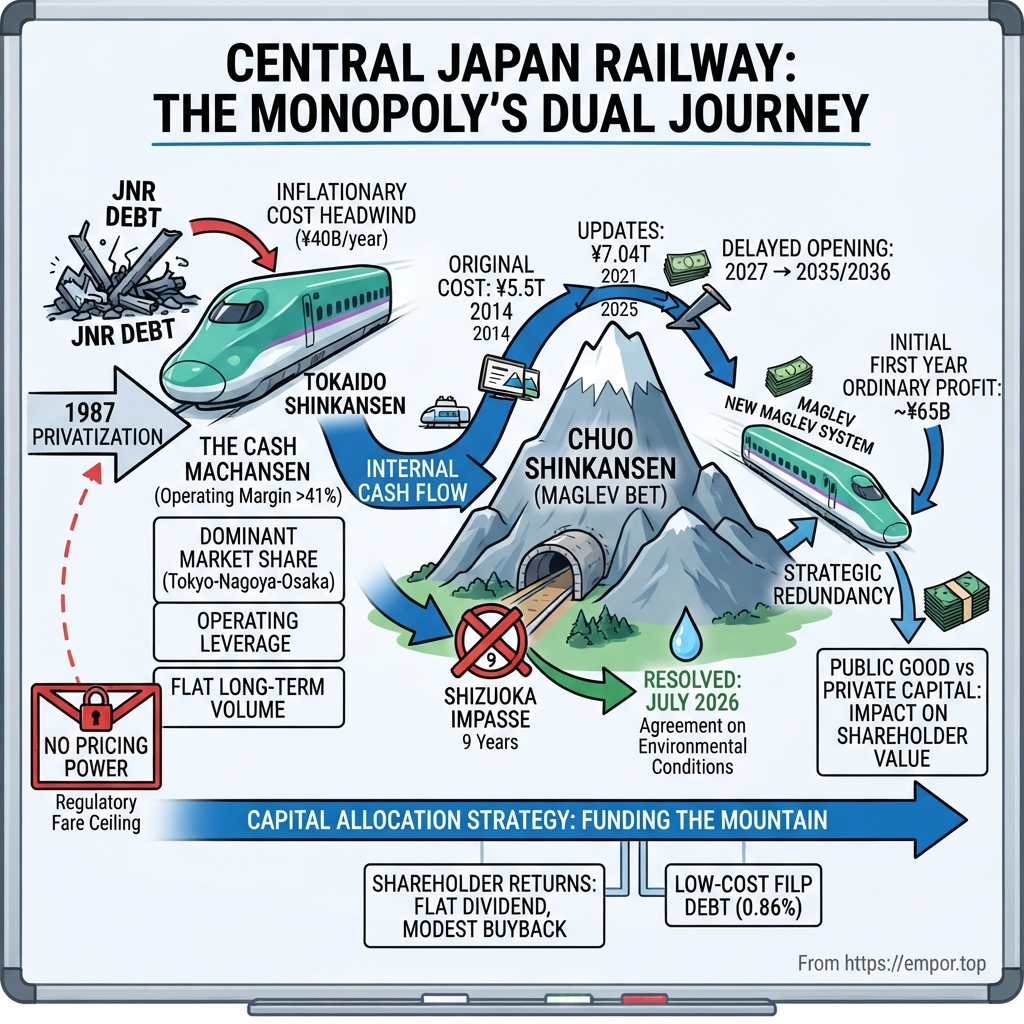
Yet JR Central is deploying this cash flow in an unusual way. While Western investors might expect share buybacks, dividend increases, adjacent acquisitions, or a leveraged recapitalization, JR Central has instead committed to constructing a 286-kilometer, tunnel-heavy railway through the spine of the Japanese Alps. Estimated to cost ¥11 trillion, the project relies on magnetic levitation technology that has never been operated commercially on a full network scale. JR Central is funding the project entirely on its own balance sheet, without government subsidies or fare-box guarantees.3
On July 7, 2026, the final political hurdle to the project fell away when Shizuoka Governor Yasutomo Suzuki formally approved construction of the 8.9-kilometer Shizuoka section of the Southern Alps tunnel, ending an impasse that had frozen the project since 2017.45
For current and prospective shareholders, the central question is not whether the Tokaido Shinkansen is a premier asset; it clearly is. The question is whether even a premier asset can serve as collateral for a generational engineering bet whose own sponsor projects first-year ordinary profit of roughly ¥65 billion.3
That figure warrants close scrutiny later in this analysis.
To understand why management would undertake such a commitment, one must look to the company's origins. JR Central was not created solely to maximize commercial return; it was established to clean up the largest corporate failure in modern Japanese history.
 Subscribe on LinkedIn
Born From the Wreckage: JNR, 1987, and the Debt That Defined a Culture
On March 31, 1987, Japanese National Railways (JNR) ceased to exist. The state-owned carrier had become a fiscal disaster, burdened by decades of political featherbedding, labor conflicts, loss-making rural branch lines built for regional politicians, and debt that could no longer be serviced from operations. The government split the enterprise into six regional passenger companies and one freight operator, which began operating on April 1, 1987.6
The division was far from equal. JR East received the Tokyo commuter network along with the Tohoku and Joetsu Shinkansen lines. JR West inherited the Kansai region and the Sanyo Shinkansen. JR Central received a narrower but far more lucrative asset: the Tokaido Shinkansen, a 515-kilometer line between Tokyo and Shin-Osaka that opened in 1964 and carried the densest high-speed passenger traffic in the world. JR Central also inherited unprofitable conventional lines across the Chubu region, which continue to operate at a loss typical of Japanese regional rail.
The primary architect of this restructuring—and the figure whose philosophy guided JR Central for the next 35 years—was Yoshiyuki Kasai. Kasai was one of the JNR executives who advocated from within for dismantling the state railway, arguing that only privatization and regional division could break union influence and impose commercial discipline. He became president of JR Central in 1995 and chairman in 2004, remaining the company's dominant strategist until his death on May 25, 2022, at age 81.7
Kasai was not a traditional corporate executive. He was an influential figure who published extensively, cultivated deep ties within the ruling Liberal Democratic Party, and viewed the Tokaido Shinkansen as vital national infrastructure rather than merely a commercial business. His core takeaway from JNR's collapse was not that railways are inherently unprofitable, but that reliance on government support is fatal. That conviction came to shape JR Central's capital allocation strategy for decades.
That independence came at a heavy cost. The newly privatized companies did not receive the Shinkansen infrastructure outright; title was initially held by a state entity and later sold back to the operators, with JR Central assuming obligations that far exceeded its equity. Nearly four decades later, the company's balance sheet as of March 31, 2026, still carried ¥489.5 billion in long-term accounts payable for railway facilities—a lingering legacy of that original buyout structure.8
Although JR Central listed on the Tokyo Stock Exchange in 1997, full privatization took another decade. In July 2005, the Japan Railway Construction, Transport and Technology Agency (JRTT) sold 600,000 shares, followed by its remaining 286,071 shares on April 5, 2006, fully exiting its equity stake.8
Why does a 1987 restructuring remain relevant to investors in 2026? Because it established a distinct and enduring corporate culture. For three generations, JR Central's management has been drawn from career railway operators holding two core beliefs: that excessive debt is dangerous, and that government dependence is worse. The company's approach to capital spending, the maglev project, shareholder pressure, and regulatory relations stems directly from this ethos—a management philosophy willing to accept a lower return on equity to maintain absolute strategic autonomy.
Whether that autonomy represents financial discipline or a value trap lies at the heart of JR Central's investment thesis. First, however, comes an examination of the cash-generating machine funding the entire enterprise.
The Machine: Why the Tokaido Shinkansen Prints Money
The Tokaido Shinkansen effectively operates as the sole high-capacity transit corridor connecting metropolitan regions that together generate roughly a third of Japan's economic output. Building a competing high-speed railway along the same alignment is virtually impossible due to physical land constraints, prohibitive capital requirements, and existing rights of way. Air travel, its primary alternative, remains slower door-to-door, more susceptible to weather disruptions, and tied to airports located well outside city centers. Moreover, regulatory fare ceilings reflect cost structures established decades ago when operating expenses were higher.
This dominant competitive position is reflected in market share statistics. On the Tokyo–Nagoya route, rail commands virtually the entire passenger market; on the Tokyo–Osaka corridor, rail retains a market share in the mid-80 percent range, leaving All Nippon Airways and Japan Airlines to compete for the remainder.9 While commercial aircraft fly faster in raw transit time, high-speed rail dominates on door-to-door efficiency and schedule density. Traveling from Haneda to Itami requires two transit legs to outer airports, security checks, and adherence to rigid departure times. By contrast, traveling between Tokyo Station and Shin-Osaka allows passengers to walk directly onto one of up to 13 departures per hour in central business districts—a decisive advantage for high-frequency business travelers.
This structural advantage generates operating leverage rarely seen in transportation. Because the core costs of operating the Tokaido Shinkansen—including track maintenance, signaling, maintenance depots, and approximately ¥190 billion in annual non-consolidated depreciation—are essentially fixed, passenger volume directly drives profitability.1 Once fixed expenses are covered, additional ticket sales convert almost entirely into operating profit.
The fiscal year ended March 31, 2026—designated by the company as fiscal 2025—illustrated this leverage clearly. Tokaido Shinkansen passenger volume measured at Tokyo Station reached 109 percent of the prior fiscal year's baseline, peaking at 116 percent during the second quarter.1 According to management disclosures, roughly three percentage points of the transportation revenue gain stemmed from visitor travel for the Osaka-Kansai Expo, two percentage points came from foreign tourism, and the remainder reflected recovering domestic demand alongside fewer typhoon disruptions compared to the prior year.1 Concurrently, transportation revenues exceeded company forecasts by ¥23.3 billion.1
This revenue surge flowed straight to the bottom line: non-consolidated operating income rose 17.9 percent to ¥774.4 billion on a 10.1 percent increase in total revenue, demonstrating that roughly two-thirds of each incremental yen of revenue converted into operating profit.1
However, JR Central's conventional network represents an ongoing financial drag that broader top-line numbers obscure. The company operates regional lines across Chubu—including the Chuo, Takayama, Kansai, Taketoyo, and Iida lines—serving commuter routes around Nagoya alongside low-density rural routes. In the fiscal year ended March 31, 2026, conventional lines accounted for just ¥4.7 billion of the ¥152.8 billion non-consolidated transportation revenue increase, while the Shinkansen generated ¥148.1 billion.1 Conventional lines delivered barely three percent of revenue growth while absorbing a disproportionate share of headcount, track mileage, and maintenance overhead.
This imbalance reflects the structural terms of the 1987 privatization rather than operational mismanagement. Privatized JR entities inherited public service obligations alongside their core trunk routes, requiring JR Central to maintain subsidized local transit across Chubu. Consequently, while the company's consolidated operating margin exceeds 41 percent, that figure masks a stark divergence: it understates the standalone profitability of the Tokaido Shinkansen while obscuring the low returns of regional lines. Fundamentally, JR Central operates as a single high-margin express corridor burdened by regional transit obligations, rather than a diversified transport group.
Non-railway operations remain modest by comparison. Merchandise and secondary business revenue grew 6.9 percent to ¥174.4 billion in the fiscal year ended March 31, 2026, supported by station retail and rolling-stock manufacturing, while real estate revenue rose 7.2 percent to ¥55.5 billion on higher commercial rents.2 While these adjacent businesses monetize station passenger traffic effectively, they account for less than 12 percent of consolidated revenue combined. Unlike East Japan Railway Company (JR East), which has developed extensive commercial real estate across Tokyo's major urban hubs, JR Central's non-rail footprint remains constrained by a network serving fewer dense commercial nodes.
Looking ahead, two diverging structural trends frame the corridor's long-term demand. The first is foreign tourism. Inbound traveler spending reached an estimated ¥156 billion in the fiscal year ended March 31, 2026—several times higher than pre-pandemic fiscal 2018 levels.1 This high-yield traffic served as the principal growth driver during a year of national population decline. However, tourism revenue remains inherently vulnerable to currency fluctuations, foreign trade policy, and geopolitical shifts.
The second trend centers on business travel, the corridor's historical core. While remote work has not eliminated corporate travel—JR Central data shows Express Reservation usage among its 200 largest corporate clients well above 2023 levels and rising—this trajectory represents a post-pandemic volume recovery rather than a long-term expansion driver.1 With Japan's working-age population steadily contracting, domestic business travel cannot sustain long-term volume growth over coming decades.
Ultimately, the operational data underscores a fundamental reality: JR Central commands a defensible monopoly over a market with essentially flat long-term volume potential. Future revenue growth depends heavily on pricing and passenger mix rather than expanding passenger numbers.
This dynamic highlights a central strategic constraint that is often mistaken for pure financial strength.
The Regulated Monopoly's Dirty Secret: It Cannot Raise Prices
In its April 2026 investor presentation, JR Central made a disclosure that cuts to the heart of its commercial limits: "Under the ceiling approval system based on the total cost method, it is not possible to revise the maximum amount of railway fares and fees."1
Japanese railway fares operate under a total-cost framework (sōgenka hōshiki), under which regulators set fare ceilings based on allowable operating costs plus a fair return. Decades of efficiency gains and dense passenger volume on the Tokaido Shinkansen have pushed JR Central's operating costs well below its approved ceiling. The resulting paradox is severe: because the company is highly profitable relative to its statutory cost base, it has no legal mechanism to pass inflationary cost increases along to passengers. A regulatory framework designed to prevent monopoly overcharging now prevents the operator from raising prices when its input costs escalate.
Those input costs are escalating rapidly. For the fiscal year ending March 31, 2027, JR Central projected a non-consolidated cost increase of approximately ¥40 billion from inflation and labor expenses. This includes roughly ¥26 billion in higher maintenance labor costs—¥20 billion of which stems directly from compliance with Japan's revised Construction Business Act—alongside ¥7 billion in internal wage hikes, ¥5 billion in contractor labor costs, and ¥2 billion for materials.1
While a ¥40 billion hit represents roughly 5 percent of JR Central's ¥774.4 billion non-consolidated operating income, these cost increases compound annually without a corresponding fare indexation mechanism. This cost inflation explains the lower guidance that caught investors off guard: for the fiscal year ending March 31, 2027, JR Central forecast consolidated operating revenue of ¥1,993.0 billion (down 0.7 percent), operating income of ¥702.0 billion (down 15.4 percent), and net income attributable to owners of the parent of ¥447.0 billion (down 19.1 percent).10 While part of the revenue contraction reflects the end of Osaka-Kansai Expo traffic, the underlying margin pressure stems from rising operational expenses against a fixed fare structure.
First-quarter results for the period ending June 30, 2026, confirmed this margin compression. Reported on July 31, 2026, quarterly operating revenue rose 3.0 percent year-over-year to ¥492.7 billion, but operating income fell 0.9 percent to ¥219.1 billion as operating expenses climbed 6.2 percent, driven principally by personnel costs. Net income slipped 1.8 percent to ¥142.6 billion.11 Top-line growth paired with declining profitability highlights the core vulnerability of a fixed-fare operator facing inflationary pressures.
Management has outlined two strategies to counter this squeeze, though they carry vastly different execution risks.
The first response relies on internal cost reductions, where track record offers some reassurance. JR Central aims to achieve ¥80 billion in recurring annual savings over a 10-to-15-year period. Through the fiscal year ended March 31, 2026, the company reported cumulative savings of approximately ¥30 billion, targeting ¥45 billion in cumulative reductions by March 2027.1 Operational initiatives behind these numbers include driver-only operation on Series 315 four-car conventional trains using AI image recognition—introduced on the Taketoyo and Kansai lines in March 2026—automated visual inspection of Shinkansen trains scheduled for full rollout by fiscal 2029, and rolling-stock life-extension programs designed to trim annual depreciation.1 Investors should note, however, that management altered its accounting baseline in 2026 to incorporate capital expenditure and head-office savings, making year-over-year cumulative progress figures harder to compare directly.
The second response is regulatory reform, which remains a prospective goal rather than a finished result. JR Central stated it will "work with the relevant parties" to create a flexible mechanism for passing inflation through to fares and shift non-reserved Shinkansen express surcharges from a regulatory approval system to a simple notification regime.1 Transitioning express surcharges to a notification system would give JR Central commercial pricing autonomy for the first time in its history. Without such regulatory relief, however, the carrier faces persistent margin erosion that internal cost savings alone cannot fully counter.
Lacking direct pricing power, management is attempting to optimize revenue mix and stimulate high-margin demand. Premium Class private compartments are scheduled to launch on October 1, 2026, with semi-private seating and upgraded Green Car accommodations planned for deployment throughout the fiscal year ending March 31, 2027.1 Simultaneously, the carrier launched targeted marketing campaigns, including chartered train packages, entertainment partnerships with Yoshimoto Kogyo Holdings, an "Oshi Travel" promotional tie-up with the Ultraman franchise for its 60th anniversary, and expanded "Golden Route" offerings for foreign tourists.1 According to company disclosures, these demand-generation initiatives generated over ¥10 billion in revenue during the fiscal year ended March 31, 2025, and expanded to over ¥20 billion in the fiscal year ended March 31, 2026.1
While doubling revenue from these initiatives shows marketing momentum, a ¥20 billion gain offsets only half of the carrier's ¥40 billion annual cost headwind. Product mix enhancements offer temporary relief, but long-term margin stability requires either regulatory fare reform, accelerated cost reductions, or management's ultimate strategic hedged bet: building a second high-speed trunk line.
Before evaluating that maglev project, a prior question warrants examination: how successfully has JR Central deployed capital outside its core rail corridor in the past?
Buying the Factory: Nippon Sharyo and the Lesson From Rochelle, Illinois
In 2008, JR Central took a step rare for Japanese railway operators and virtually unheard of in Western transport: it acquired its primary train manufacturer.
Nippon Sharyo, based in Nagoya, is one of Japan's oldest rolling-stock manufacturers, producing Shinkansen trainsets, limited-express cars, and commuter railcars. By 2008, however, the supplier was struggling financially. JR Central established an equity and business partnership in August 2008, acquiring a 50.1 percent majority stake and consolidating Nippon Sharyo as a subsidiary.12
The strategic logic was defensive and sound on its own terms. JR Central was embarking on a multi-decade capital program that required two guarantees from its supplier: absolute reliability on Shinkansen trainset delivery schedules, and complete control over superconducting maglev intellectual property. Leaving either requirement to an independent vendor—especially one vulnerable to acquisition or financial distress—introduced strategic risks JR Central was unwilling to accept. Nippon Sharyo's ongoing dependence on JR Central as its controlling shareholder remains a disclosed feature of its corporate governance today.12
This acquisition was not a return-on-equity trade; it was operational insurance. For the domestic Shinkansen network, that insurance has largely delivered value. JR Central has experienced no supply disruptions for Shinkansen trainsets, and its manufacturing subsidiary contributed to revenue growth in the merchandise and secondary business segment during the fiscal year ended March 31, 2026.2
However, a subsequent overseas expansion offers critical perspective on management's capital allocation track record and engineering execution.
In September 2012, Nippon Sharyo secured a contract valued at approximately $371 million to build 130 bi-level passenger cars for Amtrak corridor services in California and Illinois under the Next Generation Bi-Level program.13 To fulfill the contract, the company constructed a manufacturing facility in Rochelle, Illinois. In September 2015, the initial prototype shell failed a required 800,000-pound compression safety test when the structure buckled.13 Redesign efforts and production delays followed. In 2016, Nippon Sharyo closed the Rochelle plant, acknowledging in a company statement that the venture "brought significant losses, which severely impaired our financial conditions to the extent that we can no longer build rail cars at the Rochelle factory."14 The contract was terminated and reassigned to Siemens in 2017.14
This setback provides three key insights into JR Central's broader corporate strategy.
First, it offers direct evidence under the current management regime that JR Central's domestic engineering precision does not automatically translate to foreign markets. The Tokaido Shinkansen's safety and punctuality record relies on a closed, vertically integrated network operating under a single regulator, uniform signaling, fixed loading gauges, and standardized crash norms. Placed in a U.S. regulatory environment with different structural mandates, the same organization produced a prototype that failed fundamental compression testing, resulting in a plant closure.
Second, it reflects the outcome of JR Central's international expansion strategy. The company spent years marketing superconducting maglev technology and N700-based high-speed rail abroad, most notably through the Texas Central high-speed rail proposal between Dallas and Houston. That effort ultimately faltered. Amtrak ended its participation in April 2025 after the U.S. federal government withdrew a $63.9 million grant, returning the initiative to private hands as Japanese investors quietly exited the venture.15 After more than a decade of international business development, JR Central's overseas high-speed rail strategy has yielded no operating revenue-generating asset.
Third, the episode illustrates that technical demonstrations and speed records do not equate to commercial deployment. While JR Central holds the world speed record for a crewed train on its Yamanashi test line and possesses decades of maglev operational data, it also possessed a fully engineered bi-level railcar design and a signed contract in 2012—an initiative that ultimately ended in a facility write-off.
For the Chuo Shinkansen, the underlying maglev technology has been repeatedly demonstrated. The primary execution risks are geology, capital costs, political alignment, and schedule timelines—the very real-world constraints that the Rochelle experience showed the company is not immune to managing.
These historical constraints provide essential context as JR Central embarks on its most daunting engineering task: tunneling through the Japanese Alps.
The ¥11 Trillion Bet: Superconducting Maglev and the Chuo Shinkansen
Understanding the project requires starting with the physics, as superconducting maglev technology differs fundamentally from conventional high-speed rail.
A traditional train rests on steel wheels running along steel tracks and relies on onboard electric motors to turn those wheels. Beyond roughly 350 kilometers per hour, that system hits physical limits: the contact area between wheel and rail is tiny, traction diminishes, and overhead pantographs collecting current face severe aerodynamic drag and extreme vibration.
JR Central's superconducting maglev—the Chuo Shinkansen—eliminates physical wheel-to-rail contact altogether. Superconducting coils installed on the train are chilled to cryogenic temperatures, allowing them to carry electric current with virtually zero electrical resistance and generate powerful magnetic fields with minimal energy input. As the train travels through a U-shaped concrete guideway embedded with its own coils, moving magnetic fields induce opposing currents in the guideway walls. Above roughly 150 kilometers per hour, this magnetic force levitates the vehicle about ten centimeters clear of the guideway. Propulsion is supplied directly by energizing the guideway coils in sequence—effectively unrolling an electric motor along the track bed, with the train serving as the moving rotor.
The practical comparison is less a conventional locomotive and more a magnetically suspended bullet moving down a rifled barrel, propelled by the barrel itself. Designed for a service speed of 500 kilometers per hour, the line is built to shrink transit time between Shinagawa Station in Tokyo and Nagoya to roughly 40 minutes.
Achieving that velocity requires an almost perfectly straight alignment, as a vehicle traveling at 500 kilometers per hour cannot safely navigate the curves of the existing 285-kilometer-per-hour Tokaido Shinkansen. In mountainous Japan, a straight path means going underground. The 286-kilometer alignment between Shinagawa and Nagoya runs overwhelmingly through tunnels, including deep urban sub-surface sections beneath Tokyo and a 25-kilometer bore through the Southern Japanese Alps.
That structural precision imposes extraordinary capital costs. Superconducting maglev demands continuous onboard cryogenic cooling to keep magnet coils below their transition temperature, while the entire concrete guideway must be manufactured to engineering tolerances more typical of precision machinery than heavy civil construction. Whereas conventional track can be laid on ballast and adjusted over time, a maglev guideway functions as a 286-kilometer machine component. Consequently, cost revisions have been driven less by novel technology risks than by traditional construction pressures: labor expenses, raw material costs, technical tunneling challenges, and spoil disposal.
The technology also leaves the finished asset inflexible. The Chuo Shinkansen shares no interoperability with the existing Shinkansen network—maglev trains cannot run on steel rails, and standard high-speed trains cannot enter the guideway. The line will operate as a standalone system requiring dedicated maintenance depots, specialized flight-style crews, distinct servicing protocols, and custom spare parts. While management frames this as a "dual system" strategy, running two completely separate high-speed railways along the same general transit corridor duplicates fixed operating costs for as long as both networks remain active.
The counterweight to those higher costs is structural redundancy. Operating two independent railways along separate geographical routes ensures that a major earthquake, landslide, or extended infrastructure overhaul on one line will not sever Japan's primary transit artery. For an economy whose core commercial centers lie along a coastal corridor exposed to the Nankai Trough subduction zone, that resilience carries immense public value—even if it does not generate direct revenue on an income statement.
The financial scale of the bet is immense.
The original construction budget for the Shinagawa–Nagoya segment was estimated at approximately ¥5.5 trillion. In April 2021, management raised the estimate to ¥7.04 trillion, reflecting an updated construction implementation plan approved in December 2023. On October 29, 2025, JR Central disclosed that total estimated costs had expanded to approximately ¥11 trillion.3 That update represented a doubling of the original cost baseline, following a series of upward revisions every few years.
Capital deployment is already far advanced. Cumulative capital expenditure on the Chuo Shinkansen from fiscal 2014 through the fiscal year ended March 31, 2026, totaled ¥2,336.1 billion, as annual spending expanded from ¥5.0 billion in fiscal 2014 to ¥306.7 billion in fiscal 2025, with ¥367.0 billion planned for fiscal 2026.1 As of March 31, 2026, JR Central had executed 82 main construction contracts covering roughly 90 percent of the Shinagawa–Nagoya route, acquired approximately 85 percent of the required land, and secured disposal sites for roughly 85 percent of the excavated soil.1
Spoil disposal is no minor detail. Excavating a 286-kilometer, mostly underground railway generates tens of millions of cubic meters of crushed rock. In a densely populated, seismically active nation with strict environmental oversight, securing legally approved disposal sites represents a critical operational bottleneck. Management's decision to report spoil site acquisition as a headline milestone highlights how tightly that constraint binds project progress.
The project timeline has suffered parallel delays. Initially scheduled to open in 2027, the target slipped in 2024 when President Shunsuke Niwa acknowledged that construction bottlenecks made 2027 unachievable, pushing the expected opening to at least 2034.16 Following the July 2026 regulatory approval in Shizuoka, current projections place the Tokyo–Nagoya opening no earlier than 2036—a nine-year delay from original plans—while the October 2025 financial disclosures relied on a 2035 operational model.53 For a decade, every schedule revision has pushed completion further into the future.
The project's second phase—a 152-kilometer extension from Nagoya to Shin-Osaka—remains further out. Management's policy is to initiate second-phase construction only after paying down debt accrued from the first phase, under a self-imposed guideline to keep consolidated long-term debt within roughly ¥5 trillion until the full line is operational.16
The key hurdle for equity investors, however, lies in management's own financial model for the completed line.
In the long-range forecast accompanying its October 2025 disclosure, JR Central projected that during the first full fiscal year of Shinagawa–Nagoya operations, consolidated operating revenue would reach approximately ¥1.64 trillion, with ordinary profit projected at roughly ¥65 billion. Incremental revenue generated directly by the maglev opening was estimated at around ¥70 billion, while outstanding long-term debt was projected to reach ¥7.1 trillion.3 The model assumed passenger fares set at the existing Nozomi reserved-seat rate plus a ¥700 premium.3
Comparing those projections to current earnings puts the maglev's financial profile into sharp focus. For the fiscal year ended March 31, 2026, JR Central reported non-consolidated ordinary income of ¥720.8 billion.1 Management's own model shows that after investing ¥11 trillion and expanding long-term debt past ¥7 trillion, group ordinary profit in the maglev's initial year will equal roughly one-eleventh of what the core rail business generated in 2026.
These metrics demonstrate that the Chuo Shinkansen cannot be justified as a high-return commercial growth initiative over any standard investment horizon. Instead, the project functions as a strategic redundancy asset—a secondary inland trunk line insulating the Tokyo–Nagoya–Osaka corridor against a catastrophic Nankai Trough earthquake and providing operational flexibility should the aging Tokaido Shinkansen infrastructure eventually require multi-month closures for structural overhaul.
Management defends the investment on those national-resilience grounds, pointing out that Japan's primary economic corridor relies on a single 1964-era coastal alignment vulnerable to natural disasters. Establishing a secondary inland route strengthens national infrastructure. However, major public infrastructure assets of this scale are typically funded by governments rather than corporate balance sheets. At JR Central, public-good infrastructure is being financed directly by public shareholders, at an initial return profile that management itself acknowledges will remain depressed for years following launch.
Investors can evaluate that trade-off on its merits, but treating the Chuo Shinkansen as a near-term growth catalyst contradicts management's own financial disclosures. On the numbers, the project is an expensive insurance policy.
Whether that policy can be sustained without crippling the balance sheet depends heavily on how the enterprise finances its debt load.
The Balance Sheet as Strategy: The Cheapest ¥3 Trillion in Japan
In November 2016, JR Central applied to the Japan Railway Construction, Transport and Technology Agency (JRTT) for a ¥3 trillion long-term loan under Japan's Fiscal Investment and Loan Program (FILP), the state's policy finance mechanism. The company drew down the funds in sequential tranches, securing the full ¥3 trillion by July 2017.17
Management was explicit regarding its objectives. The FILP loan addressed three structural financial risks: interest rate risk, by fixing long-dated debt at low borrowing costs; financing risk, by pre-funding the entire external capital requirement of the original ¥5.5 trillion plan so changing market conditions could not stall construction; and redemption risk, by structuring maturities to follow the construction phase, allowing cash to accumulate first.17 Crucially, JR Central framed the facility as preserving rather than compromising its independence, asserting that the Chuo Shinkansen remained premised on funding full construction costs as a private enterprise while maintaining operational autonomy and stable dividends—a premise the company stated the FILP loan did not alter.17 The primary strategic objective was timeline acceleration: securing long-term capital enabled JR Central to prepare for Nagoya–Osaka construction immediately after the Shinagawa–Nagoya section opened, aiming to advance full-line operations by up to eight years.17
With a decade of hindsight, that borrowing stands out as an exceptionally advantageous capital maneuver. The five FILP tranches carry a weighted average interest rate of just 0.86 percent and mature in the mid-2050s.16
As the Bank of Japan exited negative interest rates and long-dated government bond yields climbed, the market value of that fixed-rate debt dropped sharply. JR Central's financial disclosures illustrate the effect clearly: the ¥3 trillion carrying value of the FILP debt had an estimated fair value of ¥1,633,755 million as of March 31, 2026, down from ¥2,060,045 million a year earlier.8 The market value of that obligation fell to nearly half its face value, shrinking by more than ¥400 billion in a single fiscal year.
For a corporate borrower, a steep fall in the market value of long-term liabilities represents a significant economic benefit. JR Central locked in nearly ¥3 trillion in sub-1 percent financing for three decades just as domestic capital markets began repricing long-dated risk higher. While this unrecorded valuation gain does not flow through reported net income or appear in conventional price-to-earnings metrics, it provides a substantial economic cushion for the balance sheet.
The broader balance sheet as of March 31, 2026, remains structurally robust. Total assets reached ¥10,876.2 billion against total equity of ¥5,136.6 billion, yielding an equity ratio of approximately 47 percent—an unusually conservative capital structure for an infrastructure operator in the middle of an ¥11 trillion megaproject.8 Non-FILP long-term debt, excluding current portions, stood at ¥1,135.3 billion, down from ¥1,196.8 billion a year earlier.8 The FILP proceeds remain segregated in dedicated accounts, with ¥1,904.8 billion held in trust—up from ¥1,489.4 billion—ring-fenced from general corporate cash and drawn down as construction progresses.8
Strong internal cash generation supports this capital structure. Operating cash flow for the fiscal year ended March 31, 2026, reached ¥748.1 billion, up from ¥624.5 billion the prior year, while consolidated capital expenditure rose to ¥609.0 billion from ¥514.2 billion.1 While the enterprise remains comfortably self-funding for now, the margin between operating cash flow and total capital spending is narrowing. Furthermore, management's updated ¥11 trillion cost estimate assumes additional borrowing beyond the ¥3 trillion already secured, modeled at an interest rate of 3 percent.3 That rate assumption represents a critical pivot: while initial funds cost 0.86 percent, incremental debt will carry an interest rate more than three times higher at a time when Japanese yields are rising.
One accounting detail warrants careful interpretation. The FILP funds sit in a segregated trust disclosed as money held in trust for Chuo Shinkansen construction, paired directly against the corresponding long-term debt liability.8 While transparent and standard, this structure means headline cash and debt figures overstate both operational liquidity and net leverage. The ¥1,904.8 billion held in trust cannot be deployed for dividends, share repurchases, or general corporate expenses; it is legally restricted to project construction.8 Unrestricted cash and cash equivalents ended the fiscal year at ¥370.5 billion, down from ¥394.7 billion.1 That represents a modest liquidity buffer for a corporation of JR Central's scale—a direct consequence of ring-fencing megaproject funds.
A second accounting nuance involves depreciation. Non-consolidated depreciation and amortization totaled ¥190.6 billion for the fiscal year ended March 31, 2026, slightly below the prior year's level, as management's cost-reduction program explicitly incorporated extending the operational service life of Shinkansen rolling stock to trim annual capital expenditures and depreciation.1 While extending asset lifespans reflects sound maintenance capabilities, it also reduces near-term depreciation expense and boosts reported net income. JR Central transparently discloses the initiative as a formal efficiency project, but investors should note that a portion of the targeted ¥80 billion cost savings reflects deferred accounting depreciation rather than direct cash savings.
Shareholder returns remain secondary to capital preservation. JR Central's formal policy prioritizes stable dividend payouts while accumulating internal reserves to fund maglev construction and essential safety investments.1 For the fiscal year ended March 31, 2026, the annual dividend was ¥32 per share, split evenly between interim and year-end payouts of ¥16, with identical ¥16 interim and year-end dividends forecast for the following year despite a projected 19 percent net income decline.1 The board also authorized the repurchase of up to 6.5 million shares for up to ¥20 billion, executed between May and July 2026 and retired on August 31, 2026.10 Historical disclosures show prior share buybacks of ¥696.2 billion alongside a ¥524.4 billion retirement, establishing that larger capital returns have occurred in past fiscal years.8
Nevertheless, a ¥20 billion buyback against ¥552.8 billion in net income represents a modest distribution rather than a comprehensive capital return program. That allocation reflects a clear corporate philosophy: management believes surplus cash yields a higher strategic return invested in alpine tunneling than returned to equity holders. Whether public investors endorse that priority was largely an academic debate while construction remained stalled—a dynamic that shifted once political impasses began to clear.
Nine Years in Shizuoka: The Water War
The Southern Japanese Alps are sparsely populated. The segment of the Chuo Shinkansen crossing Shizuoka Prefecture spans just 8.9 kilometers, runs entirely underground beneath the mountains of Shizuoka City, and includes no station.[^20] Shizuoka receives no direct transit benefit from the high-speed line. What it does possess is the Oi River.
The Oi originates in those mountains and supplies water to eight cities and two towns downstream for drinking, agriculture, and the region's signature tea industry. The argument advanced by then-Governor Heita Kawakatsu from 2017 onward was straightforward: tunneling beneath the watershed would intercept groundwater, reduce flow in the Oi, and damage the Southern Alps ecosystem.[^20]
Kawakatsu withheld consent for tunnel construction, and because prefectural cooperation served as an indispensable prerequisite, the project stalled for nine years.
What makes this episode instructive is not merely that a governor delayed a railway, but what it revealed about the underlying structure of project risk. JR Central's business plan had accounted for technical and financial challenges, but the timetable was brought to a halt by a single sub-national politician with no formal statutory veto in national law who nevertheless wielded effective local control while representing a constituency facing all the environmental risks and none of the transit benefits. Neither engineering expertise nor balance-sheet strength could bypass that political reality.
The resolution unfolded through a gradual, procedural process. Kawakatsu stepped down, and Yasutomo Suzuki took office as governor in 2024. A prefectural expert panel worked through 28 environmental protection conditions demanded of JR Central. On February 13, 2026, JR Central signed a natural environment conservation agreement with Shizuoka Prefecture covering preliminary works, allowing tree-clearing for the construction site to begin on February 16.1 At an expert committee meeting on March 26, 2026, discussions concluded on all 28 environmental conditions.1[^20] Beginning May 26, public briefing sessions took place across Shizuoka City and the ten municipalities within the Oi River basin to build local support.1
By late June, media reports indicated Suzuki had decided to grant approval.[^21] On July 7, 2026, he formally issued approval, bringing the nine-year standoff to an end.4[^20] A formal environmental conservation agreement covering primary construction was slated for signature on July 18, with JR Central planning to launch main construction on the Shizuoka section before the end of 2026.[^20]18
The 28 conditions represent permanent operational commitments rather than one-off concessions. Focused on preserving the Oi River's water table and protecting the Southern Alps ecosystem—the core issues behind Kawakatsu's opposition[^20]—the agreement mandates continuous water monitoring, flow-restoration protocols, and ongoing oversight by a prefectural panel throughout construction and subsequent operations. JR Central demonstrated this operational constraint in miniature when the February 13, 2026 preliminary agreement was required before basic tree-clearing could begin three days later.1
Strategically, JR Central secured consent by accepting ongoing regulatory oversight. The company did not defeat the environmental objections; it agreed to submit to external supervision. For an enterprise whose corporate identity was forged on absolute operational self-reliance, accepting third-party monitoring underscores how urgently management sought to unblock the line.
This arrangement also creates an unquantified operational risk that management has not addressed publicly: the consequences if environmental monitoring detects groundwater disruption after tunneling is advanced. A legally binding agreement with enforcement mechanisms introduces a contingent liability attached to the critical path of an ¥11 trillion project. Because JR Central has disclosed no specific financial provision or scenario sensitivity for potential mitigation costs or construction suspensions, this unhedged variable belongs firmly in the investment risk column.
Governor Suzuki's approval was not an unconditional surrender; it was a transactional exchange. JR Central accepted binding, monitored environmental obligations in return for construction clearance. This ongoing regulatory framework alters the pre-2017 status quo and imposes long-term compliance mandates on the carrier.
For investors, three distinct conclusions emerge from the Shizuoka settlement.
First, the removal of the political barrier is tangible and material. The Southern Alps tunnel represented the primary binary obstacle to project completion, and its resolution eliminates the main legal threat to the route.
Second, resolving the political impasse converts a schedule delay into an active capital drain. For nine years, Shizuoka's resistance inadvertently capped annual capital outlays. With clearance granted, JR Central's fiscal 2026 plan increases Chuo Shinkansen capital expenditure to ¥367.0 billion, entering the most capital-intensive phase of construction.1 The political friction that temporarily shielded shareholders from rapid cash burn no longer exists.
Third, the protracted dispute serves as a warning regarding the remaining 10 percent of construction contracts and 15 percent of land acquisitions. Regulatory clearance in Shizuoka does not guarantee that future friction—whether over soil disposal, deep-underground land rights in urban segments, or local environmental challenges—will resolve smoothly. On a multi-decade megaproject, additional localized resistance remains the statistical baseline.
The executives who navigated this nine-year political impasse—and who now oversee the deployment of capital for the remaining construction phase—require close examination.
The People: Career Railwaymen, and What Their Record Actually Shows
JR Central is run by railway operators, not financiers. Shunsuke Niwa became President and Representative Director in April 2020, arriving in the job roughly as the pandemic collapsed passenger volumes to a fraction of normal. Executive Vice President and Representative Director Kentaro Takeda presents the financial results; Senior Corporate Executive Officer Ataru Kimura, Director General of Corporate Planning, presents sustainability and the Chuo Shinkansen project status.1 The division of labour on the investor deck is itself revealing: the president takes strategy and shareholder returns, the EVP takes the numbers, and the planning chief owns the maglev.
This is a company where the CEO is expected to be an expert on the railway rather than on the capital structure. That has consequences in both directions.
On the positive side, the operating record is genuinely exceptional and is not a matter of management assertion. The Tokaido Shinkansen's safety and punctuality performance is the reference standard for high-speed rail globally, and the cost-reduction programme described above is being executed against published cumulative targets with specific named projects rather than vague efficiency language. When JR Central said it would deliver approximately ¥30 billion of cumulative savings by the year ended March 2026, it delivered approximately ¥30 billion.1 When it forecast transportation revenues for that year, it beat the forecast by ¥23.3 billion.1 Near-term guidance discipline is good.
On the negative side, the long-horizon promises have a poor record, and an investor should weigh them by the same standard.
The 2027 opening date for the Chuo Shinkansen was maintained for years and then abandoned; Niwa himself conceded in 2024 that it was impossible and pointed to 2034 at the earliest.16 Current reporting suggests no earlier than 2036.5 The cost estimate has gone from ¥5.5 trillion to ¥7.04 trillion to ¥11 trillion — a doubling, disclosed in steps.3 The overseas high-speed rail strategy, pursued with considerable senior management attention across two administrations, has produced no operating asset, and Japanese investors exited Texas Central following Amtrak's April 2025 withdrawal.15 The vertical integration into rolling stock, sound in domestic logic, produced a US factory closure and a terminated contract when it was extended beyond its home market.14
Put those together and a calibrated view emerges. This is a management team that is highly credible on the twelve-month operating horizon and on anything within its own closed system, and that has repeatedly missed on multi-decade, externally dependent commitments. That is not unusual for infrastructure — megaproject cost and schedule overruns are close to a law of nature — but it is the relevant base rate, and it argues for treating the current 2035–2036 opening guidance and the ¥11 trillion figure as central estimates rather than ceilings.
There is a further point about incentives that is harder to evidence but worth stating carefully. JR Central's executives are career railway operators promoted from within an organisation whose founding trauma was state dependence and whose founding hero, Kasai, framed the Tokaido Shinkansen as a national organ. That culture produces genuine strengths: an obsessive safety orientation, a refusal to lever up the balance sheet, a willingness to invest through cycles. It also produces a systematic bias toward building rather than returning capital, and it makes the company relatively insensitive to the cost of equity. A management team optimising for the hundred-year integrity of Japan's transport spine and a management team optimising for per-share value will make different decisions, and where they diverge, JR Central has consistently chosen the former.
That is a defensible institutional choice. It is also precisely the thing a shareholder is buying into, whether or not they realise it.
Governance is otherwise unremarkable in the Japanese large-cap context. The company has, following a board resolution, identified seven materiality items — safety, service, local communities, global environment, human capital, innovation, and governance — for sustainability disclosure aligned with the Sustainability Standards Board of Japan standards.1 This is compliance-driven rather than strategically revealing, and the framing that the JR Central Group's mission is "contributing to the development of Japan's main transportation artery and social infrastructure" is a fair summary of how the company sees itself.1 Note what is absent from the materiality list: capital efficiency.
With the people and the project understood, it is worth clearing away several things that are widely believed about this company and are not quite true.
Myth vs Reality
Myth: JR Central is a monopoly, so it has pricing power.
Reality: The company holds dominant market power but lacks pricing power, an unusual and uncomfortable combination for an infrastructure operator. Under Japan's total-cost ceiling approval system, the maximum fare cannot be revised upward, a constraint JR Central explicitly acknowledged in its April 2026 investor disclosures.1 As a result, the carrier is currently absorbing roughly ¥40 billion in annual cost inflation with no statutory mechanism to pass those expenses on to passengers.1 Any realistic assessment of the business must begin with this reality. The only pricing levers available to management involve product mix—such as premium seating, reserved-seat upgrades, and new travel packages—rather than base fare increases.
Myth: The maglev is JR Central's growth engine.
Reality: According to management's own published forecast, opening the Shinagawa–Nagoya segment will generate roughly ¥70 billion in direct incremental revenue while leaving first-year group ordinary profit at approximately ¥65 billion, set against long-term debt of ¥7.1 trillion.3 Whatever role the Chuo Shinkansen serves strategically, it is not a near- or medium-term earnings expansion story. Treating it as a growth catalyst requires ignoring the company's own financial disclosures.
Myth: JR Central is a pure play on Japanese inbound tourism.
Reality: Inbound travel contributes to growth, but far less than headline narrative suggests. While foreign tourism generated approximately ¥156 billion in revenue during the fiscal year ended March 31, 2026, that figure represents less than 10 percent of the carrier's ¥1,663.2 billion in non-consolidated operating revenue.1 Inbound travelers provided a valuable boost at the margin, but they do not form the foundation of the enterprise. The core business remains domestic business and leisure travel along a corridor facing flat long-term volume demand.
Myth: The Shizuoka approval fully de-risks the project.
Reality: Regulatory approval in Shizuoka removes the single largest political obstacle, but it also accelerates capital expenditure. As of March 31, 2026, roughly 10 percent of main construction contracts for the Shinagawa–Nagoya route remained unsigned, about 15 percent of required land was unacquired, and disposal sites for approximately 15 percent of excavated soil were unsecured.1 While these remaining percentages appear modest, they carry disproportionate operational risk because the uncompleted items are, by definition, the most difficult to resolve.
Myth: A 41 percent operating margin makes the business invulnerable.
Reality: That exceptional margin stems from extreme operating leverage on a fixed cost base, and operating leverage works equally in both directions. Results for the first quarter ended June 30, 2026, demonstrated this dynamic: quarterly revenue rose 3.0 percent, yet operating income fell 0.9 percent as operating costs expanded.11 A major demand shock—whether from a severe earthquake interrupting service, a sharp downturn in foreign tourism, or a broader economic contraction along the main transit corridor—would filter through the income statement with the same force that drove the earnings recovery.
Myth: Management relies entirely on internal cash generation to fund the maglev.
Reality: JR Central maintains that it bears the full economic cost as a private enterprise with management autonomy, a description that accurately reflects who carries the financial liability.17 However, the ¥3 trillion drawn from the JRTT under the state's Fiscal Investment and Loan Program represents government-channeled policy finance, locked in at a weighted average interest rate of 0.86 percent with maturities extending into the mid-2050s—terms unavailable to any commercial borrower in the open market.16 Describing the project as self-funded is accurate in that the company receives no direct subsidies or revenue guarantees, but inaccurate if it implies financing on arm's-length commercial terms.
With these misconceptions cleared away, the underlying investment thesis comes into focus.
The Bull Case, the Bear Case, and Where the Evidence Lands
Porter, applied honestly
Threat of new entrants: near zero, and this is the strongest part of the case. Nobody is building a second high-speed line between Tokyo and Osaka. The right of way does not exist, the land acquisition would be impossible, and the only entity with the capability and rights to build a competing alignment is JR Central itself — which is, in fact, exactly what it is doing. The barrier is not a patent or a brand; it is three hundred kilometres of the most expensive real estate in Asia.
Threat of substitutes: real but bounded. Air has lost this corridor and the loss looks structural: rail holds effectively all of Tokyo–Nagoya and the mid-80s percent of Tokyo–Osaka.9 The more interesting substitute is the one that requires no vehicle at all — the trip not taken. Remote work is the live threat, and the honest read on JR Central's own corporate Express Reservation data is that it has not materialised as a volume decline; usage by the top 200 corporate accounts has trended above the 2023 base.1 That is evidence, not assertion, and it should update a sceptic. But it is evidence about recovery from a trough, not about the shape of 2040.
Bargaining power of buyers: low individually, high collectively through the regulator. No passenger negotiates. But the Japanese state, acting through the fare ceiling, exercises buyer power more effectively than any customer could — capping the monopolist's ability to price. This is the corporate-governance equivalent of a customer with a permanent most-favoured-nation clause. It is the reason a 41% operating margin coexists with a company that cannot offset a 5% cost increase.
Bargaining power of suppliers: deliberately neutralised, at a cost. Owning 50.1% of Nippon Sharyo removed rolling-stock supplier power.12 But labour and construction inputs are where supplier power actually bites now, and JR Central has no control there: the ¥26 billion maintenance labour increase, including roughly ¥20 billion tied to the Construction Business Act revision, is supplier power expressing itself directly in the P&L.1 Japan's construction labour shortage is structural and worsening, and JR Central is about to become one of the largest buyers of tunnelling labour in the country.
Rivalry: minimal in the core, and that is precisely the problem. A business with no rivals and no pricing freedom cannot compete its way to higher returns. It can only cut costs. That is a finite game.
Seven Powers, applied honestly
Of Hamilton Helmer's seven, JR Central plausibly holds three and arguably a fourth.
Cornered resource is the strongest. The Tokaido right of way, the station slots at Tokyo and Shin-Osaka, and the operating licence over Japan's densest corridor are genuinely irreplaceable. This is the closest thing in global transport to an unrepeatable asset.
Scale economies are real and mechanical. Spreading a largely fixed infrastructure and depreciation base across roughly 170 million annual Tokaido Shinkansen journeys produces a unit cost no competitor could approach.
Process power is the third, and it is underrated. Thirteen trains an hour on one track pair, twelve-minute turnarounds, and a punctuality record measured in seconds are not the result of a single invention; they are the accumulated product of six decades of organisational learning that cannot be bought or copied quickly. This is where the export failures are instructive, though: process power proved to be embedded in the system, not portable in the organisation.
Switching costs are weak. A passenger can fly tomorrow. What holds them is the product, not lock-in — though the EX corporate reservation platform, with its corporate account integration, creates a mild workflow stickiness for business travel that is worth watching as a slowly accumulating asset.
What JR Central does not have is branding power in the pricing sense (the brand is beloved and cannot be monetised through fares), network economies in the Metcalfe sense (one more passenger does not make the service better for others; at the margin it makes it worse), or counter-positioning (there is no incumbent it is disrupting).
Three-and-a-half powers out of seven is a strong score. But note the pattern: every power JR Central holds is a cost and supply power. None of them is a power over price. In Helmer's framework, a power that cannot be converted into differential margin expansion is an asset that protects existing returns rather than compounding them.
The bull case, stated fairly
The strongest version is this. JR Central owns an irreplaceable asset in a market where demand has proven more durable than the pandemic-era consensus expected, with inbound tourism providing a genuinely new demand layer. It has locked in ¥3 trillion of thirty-year money at 0.86% in a country now repricing long rates violently upward — a financing coup whose value has already shown up as a ¥1.37 trillion gap between the carrying and fair value of that debt.8 It carries a 47% equity ratio mid-project.8 It generates ¥748 billion of operating cash flow.1 It has a specific, delivering cost programme.1 And it has just cleared the political obstacle that blocked its strategic project for nine years.4 If the regulatory framework shifts toward notification-based pricing, the earnings power of the existing railway re-rates materially without a single new passenger.
The bear case, stated fairly
The strongest version is this. This is a company whose profit peaked, on its own guidance, in the year ended March 2026, and which forecasts a 15.4% operating profit decline and 19.1% net profit decline in the following year.10 It cannot raise prices by regulatory design.1 Its costs are inflating at roughly ¥40 billion a year with no automatic pass-through.1 It is now accelerating into the heaviest spending phase of a project that has already doubled in cost, slipped nine years, and which by the company's own plan will leave it with ¥7.1 trillion of debt earning ¥65 billion of ordinary profit in its first full year of operation.3 Its marginal funding cost is assumed at 3% against the 0.86% it locked in, in a rising-rate environment.316 Its capital return to shareholders — a flat ¥32 dividend and a ¥20 billion buyback against ¥552.8 billion of net income — is a rounding error relative to cash generation, by explicit policy, and that policy will not change while the tunnel is being dug.110 And its track record on non-core capital deployment includes a factory closure in Illinois and an abandoned Texas project.1415
Weighing it
Where does the evidence actually land on each claim?
The moat claim survives intact. Nothing in the record undermines the proposition that the Tokaido Shinkansen is an irreplaceable, defensible asset. The air-share data, the absence of any credible new entrant, and the corporate travel recovery all support it. This is the rare case where the consensus view is simply correct.
The pricing power claim is rejected. Not narrowed — rejected. Management's own disclosure states the fare ceiling cannot be revised, and the Q1 FY2027 result of rising revenue and falling profit is the mechanism operating in real time.111 Any model that assumes JR Central can inflation-adjust its fares is wrong until the regulatory regime changes.
The management quality claim is narrowed. Operating execution and near-term guidance: credible, evidenced. Megaproject cost and schedule forecasting, and capital deployment outside the home system: not credible on the record, across Rochelle, Texas Central, and three successive maglev cost revisions.14153 The narrowed claim is: trust them to run the railway, discount their long-dated project forecasts.
The capital allocation claim is left unproven and should be treated as the central risk. The FILP financing was excellent and is now demonstrably valuable.817 But the decision that dominates shareholder outcomes over the next fifteen years — whether to spend ¥11 trillion on the Chuo Shinkansen — cannot be validated by any evidence available today, and the sponsor's own return projection for the first full year is poor.3 The historical analogue that bears most directly on it, the vertical integration into rolling stock, worked domestically and failed abroad. The maglev is a domestic project, which favours the bulls; it is also unprecedented in scale, which does not.
The optionality claim on maglev technology export should be heavily discounted. JR Central has held world-leading superconducting maglev capability for decades and has converted it into zero overseas revenue. The record on turning technical milestones into commercial outcomes outside Japan is, so far, a record of non-conversion.15
The activist stress test
What would a hostile shareholder actually say at the AGM?
They would say the company is running a ¥5.1 trillion equity base at a return that is structurally capped by its own investment programme, and that the ¥11 trillion maglev is a transfer of value from current shareholders to future Japanese travellers and to the state's resilience objectives — a public good financed with private equity. They would point out that the Nagoya–Osaka phase remains discretionary, and demand that JR Central commit not to start it until the first phase is operating and debt is demonstrably falling, rather than relying on a soft internal guideline. They would question why a company forecasting a 19% profit decline is holding its dividend flat rather than raising it. They would ask why a ¥20 billion buyback is the right number when operating cash flow is ¥748 billion. And they would ask, pointedly, what the company's plan is if the ¥11 trillion becomes ¥14 trillion — because the base rate on this project says it might.
Management's answers to all of these would be some version of the artery must be secured. That answer is sincere, it is culturally coherent, and it is not a financial answer.
The counter-argument the activist would struggle with is the FILP position and the Nankai Trough. Locking in ¥3 trillion at 0.86% before the rate regime turned was a genuine act of foresight that saved shareholders an enormous amount of money, and it was made by the same management philosophy the activist wants to overthrow. And a single-alignment national artery on a tsunami-exposed coast is an authentic tail risk that a purely financial owner would systematically underweight.
The risk radar, restricted to what is material
Three risks matter and the rest are noise.
Seismic. A major Nankai Trough event is the defining tail risk and the defining strategic rationale simultaneously. It would be catastrophic for the existing line and is the reason the redundant one is being built. There is no hedge available to a shareholder.
Rate and refinancing. Beyond the ¥3 trillion FILP tranche, the remaining maglev funding is assumed at 3%.3 Japanese long yields moving another 100 basis points against the company would add materially to the cost of a project measured in trillions, and the existing bond stack already shows coupons ranging from the 1.3% area on recent shorter paper up through the 2.5–2.6% range on longer 2038–2039 maturities.8 Refinancing risk is manageable; marginal cost-of-capital risk is not trivial.
Construction labour and inflation. The ¥20 billion Construction Business Act-related cost increase is an early signal, not a one-off.1 Japan's construction workforce is shrinking and aging while JR Central is about to bid for tunnelling capacity at unprecedented scale. This is the most likely proximate source of the next cost revision.
Technology disruption, by contrast, is largely irrelevant here — no plausible AI or software development substitutes for physically moving 170 million people a year between Tokyo and Osaka, and the company's own automation programme is a beneficiary of the technology rather than a victim of it. Cybersecurity is a genuine operational concern for a signalling-dependent railway and JR Central lists it under its safety materiality, but it has not been a material financial event.1
What to Actually Watch
Three metrics carry nearly all the information about whether this story is going well or badly. They are not the ones most commonly quoted.
One: Tokaido Shinkansen transportation revenue versus the cost base—specifically, whether revenue growth exceeds operating expense growth. Passenger volume alone is misleading, because volume can rise while profit falls, which is exactly what happened in the quarter ended June 30, 2026.11 The single question that determines the earnings trajectory of the existing business is whether demand-generation initiatives, premium product mix, and internal cost reductions can collectively outrun roughly ¥40 billion of annual input inflation without fare increases. Watch the spread between those two growth rates, quarter by quarter. If it turns durably positive without a regulatory change, management has solved a hard operational problem. If it stays negative, the profit peak in the fiscal year ended March 31, 2026, was a real peak.
Two: the Chuo Shinkansen cost estimate and target opening date—as a pair, not individually. These are the two numbers that have moved consistently in one direction for a decade, from ¥5.5 trillion and 2027 to ¥11 trillion and 2035–2036.3165 Each revision transfers value away from equity. The supporting indicators to track alongside them are the three completion percentages the company now publishes: contracts signed, land acquired, and excavated soil disposal sites secured, all standing between 85 and 90 percent as of March 31, 2026.1 Because the remaining items are the most difficult to resolve, the pace at which those percentages approach 100 percent is a far better leading indicator of schedule than any stated target date.
Three: any change to the fare-setting regime. This is binary, currently unpriced, and the largest single swing factor for the existing business. JR Central has stated it is working with relevant parties to allow inflation to be reflected in fares flexibly and to bring non-reserved-seat Shinkansen limited-express fees under a notification regime.1 If regulators grant that flexibility, the cost-inflation pressure substantially disappears and the core railway's earnings power steps up. If years pass with no regulatory movement, the bear case on margin compression is confirmed by default.
Everything else—the dividend, the buyback, inbound visitor numbers, the corporate sustainability framework—is policy-fixed, cyclical, or secondary.
The Shape of the Bet
Western capital markets often struggle to evaluate a specific category of enterprise: one that is operationally dominant, highly profitable, and indifferent to short-term share price maximization.
JR Central fits that profile. It operates an exceptionally lucrative transport corridor with operating margins above 41 percent. Its balance sheet benefits from low-cost, long-term financing secured before domestic interest rates began rising, its cost-reduction initiatives are on track, and Shizuoka Prefecture has cleared the final major political hurdle blocking its main project.
It is also a company that has disclosed in its own long-range plan that after spending ¥11 trillion, it projects roughly ¥65 billion in ordinary profit during the maglev's first full year of operation,3 while maintaining a flat dividend payout1 through a forecast 19 percent net income decline to continue funding construction.10
These two realities exist side by side. The Tokaido Shinkansen remains a premier cash-generating asset, but the Chuo Shinkansen represents a claim on that line's free cash flow for two decades—exchanging short- and medium-term equity returns for national infrastructure resilience.
Investors in JR Central are not simply buying a high-margin railway monopoly; they are buying a monopoly that has already committed its cash flow to an alpine tunnel. Whether that commitment proves to be an act of long-term institutional foresight or a costly engineering overreach will not be clear until the 2040s.
What is clear today is the structure of the investment, the key metrics that will test the thesis, and management's transparency regarding the financial trade-offs. By publishing the ¥65 billion ordinary profit figure itself, JR Central provided shareholders with an explicit look at the return profile of its ¥11 trillion undertaking.
References
-
Year-End Investor Meeting FY2026.3 presentation — Central Japan Railway Company, 2026-04-30 ↩↩↩↩↩↩↩↩↩↩↩↩↩↩↩↩↩↩↩↩↩↩↩↩↩↩↩↩↩↩↩↩↩↩↩↩↩↩↩↩↩↩↩↩↩↩↩↩↩↩↩↩↩
-
Central Japan Railway: Fiscal Year Ending March 2026 Financial Results, Net Sales ¥2.006 Trillion — Japan IR, 2026-04-28 ↩↩↩↩
-
JR Central: Shinagawa–Nagoya Chuo Shinkansen maglev to cost 11 trillion yen — TRAICY Global, 2025-10-29 ↩↩↩↩↩↩↩↩↩↩↩↩↩↩↩↩
-
Long-stalled maglev line finally gets green light from Shizuoka Prefecture — The Japan Times, 2026-07-07 ↩↩↩
-
Shizuoka Governor Approves Chuo Shinkansen Alpine Tunnel — Railway News, 2026 ↩↩↩↩
-
Obituary: Yoshiyuki Kasai — International Railway Journal, 2022 ↩
-
JR Central Chairman Emeritus Kasai dies aged 81 — Railway Gazette International, 2022-06-25 ↩
-
Consolidated Balance Sheet as of March 31, 2026 and related financial statements — Central Japan Railway Company ↩↩↩↩↩↩↩↩↩↩↩↩↩
-
Share of Passenger Market — Shinkansen versus Airlines, Fact Sheets 2025 — West Japan Railway Company ↩↩
-
JR Central Posts Strong FY2026 Results and Launches Share Buyback Amid Softer FY2027 Outlook — TipRanks, 2026 ↩↩↩↩↩
-
JR Central Posts Mixed Q1 Results but Keeps Dividend as Profits Face Pressure — TipRanks, 2026-07-31 ↩↩↩↩
-
Nippon Sharyo Details Reliance on Central Japan Railway as Controlling Shareholder — The Globe and Mail ↩↩↩
-
Nippon Sharyo prototype fails test, workers laid off — Trains Magazine ↩↩
-
Nippon Sharyo closing northern Illinois railcar plant — Trains Magazine ↩↩↩↩↩
-
Texas High-Speed Rail Project Future Uncertain After Latest Setback — Newsweek, 2025 ↩↩↩↩↩
-
JR Central's Shinkansen 'dual system' to create Japanese megaregion — International Railway Journal ↩↩↩↩↩↩↩
-
Long-Term Loan Using the Fiscal Investment and Loan Program (FILP) — Central Japan Railway Company ↩↩↩↩↩↩
-
Shizuoka gov. OKs start of construction for stalled maglev train project — Japan Today, 2026-07 ↩
 LinkedIn
 WhatsApp
 Reddit
 Hacker News
 Email
 Kindle
 RSS Feed
 Spotify
 Apple Podcasts
 Amazon Music
 Audible
 YouTube