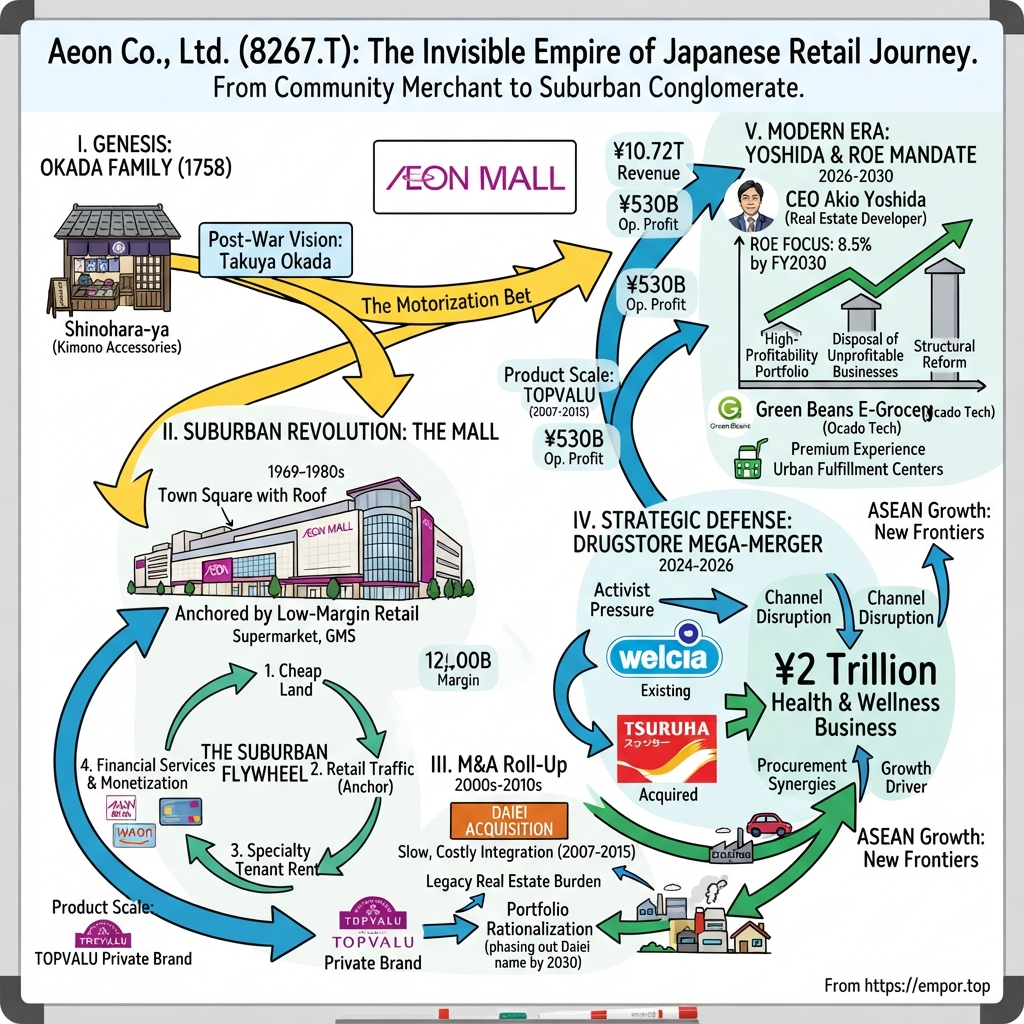
Aeon Co., Ltd.: The Invisible Empire of Japanese Retail
I. Introduction & Episode Roadmap
There is a particular kind of building that has quietly become the center of civic life in provincial Japan. It sits on the edge of a mid-sized city, surrounded by an ocean of free parking. Inside, past the automatic doors, the air smells faintly of fried chicken and floor wax. On the ground floor, a supermarket sells ¥98 bean sprouts. On the second floor, a Uniqlo sits alongside a cram school, a dental clinic, and a municipal service counter where residents can renew residence certificates. On the third floor, a cinema and a food court serve high school students studying until closing and, in the morning, elderly residents walking laps of the air-conditioned concourse before shops open.
This building is not a shopping mall in the traditional American sense. It functions closer to a town square with a roof, replacing the traditional train-station shopping arcades across hundreds of Japanese communities. Almost all of them are owned, anchored, financed, and operated by one company: イオン株式会社 Aeon Co., Ltd., listed in Tokyo under ticker 8267.
By scale, Aeon is Japan's largest retailer and among the largest in Asia. In the fiscal year ended February 28, 2026—the company's fiscal 2025—consolidated operating revenue reached ¥10.72 trillion, up 5.7% for its fifth consecutive record year, while operating profit rose 13.8% to ¥270.4 billion.1 Those two figures summarize the central puzzle of the company: ¥10.72 trillion in revenue produced a consolidated operating margin of roughly 2.5%. Aeon moves an enormous volume of goods while retaining very little of the top line.
That low margin highlights a core structural paradox. Aeon's largest divisions by revenue—general merchandise stores and supermarkets—are among the least profitable retail formats in the developed world. Yet the same corporate entity controls one of Asia's most valuable portfolios of suburban commercial real estate alongside a consumer finance operation encompassing a bank, a credit card issuer, and an e-money network. These two sides of the business co-exist by design, with retail foot traffic intended to drive profitability in real estate and financial services.
The strategic choice is clearest when contrasted with its primary rival. 株式会社セブン&アイ・ホールディングス Seven & i Holdings spent the first half of the 2020s in an activist-driven battle over corporate structure, ultimately choosing to narrow its focus: shedding its legacy general merchandise store chain イトーヨーカ堂 Ito-Yokado and concentrating capital on its high-return global convenience store network to raise returns on capital.
Aeon took the opposite path. It retained its low-margin retail anchors, expanded its retail footprint, and argued that the anchor stores generate the traffic that makes its high-margin divisions profitable. This analysis tests whether that strategy represents a genuine structural synergy or a rationale for capital that has under-earned for two decades.
The roadmap: a merchant family in Mie Prefecture whose business dates to 1758; a post-war patriarch who bet the company on Japanese car ownership before suburban motoring took off; the 1969 three-way merger that created JUSCO and established a federated operating model; the suburban mall-plus-credit-card flywheel that turned store traffic into real estate and interest income; decades of acquisitive roll-ups culminating in the long, costly integration of 株式会社ダイエー Daiei; the 2024–2026 drugstore consolidation that created a two-trillion-yen health and wellness business from ウエルシアホールディングス Welcia Holdings and ツルハホールディングス Tsuruha Holdings; and the current era under chief executive 吉田 昭夫 Akio Yoshida, who has committed the group to a return-on-equity target it has struggled to reach historically.
The story begins with a shop that sold almost nothing.
 Subscribe on LinkedIn
II. The Okada Dynasty & The Genesis of JUSCO
In 1758, in the port town of Yokkaichi in Mie Prefecture, a merchant family opened a business called Shinohara-ya selling kimono accessories—the small, unglamorous trade of obi cords, sashes, and fittings. This was the mid-Edo period, and the shop served a local clientele under a merchant-class social order that had existed for centuries.
The relevant detail for a modern investor is not the antiquity, but the nature of the trade. Kimono accessories were a business of small ticket sizes, repeat customers, and relationships spanning generations within a single town. The family that would eventually take the name Okada learned commerce in an environment where the customer was a neighbor. That framing—retail as a community obligation rather than a pure transaction—persists inside Aeon today. It remains both its greatest asset for customer loyalty and one of its most expensive operational habits.
The business survived the Meiji Restoration, rapid industrialization, and the destruction of the Pacific War, which flattened much of Yokkaichi in air raids. Re-emerging as Okadaya, a regional dry goods retailer, the company eventually passed to a young leader who would reshape post-war Japanese commerce: 岡田 卓也 Takuya Okada.
The patriarch who read the map before the roads were built
Takuya Okada took over a family enterprise that was stable by mid-century standards. But in Japan's 1950s and 1960s, small family retailers were vulnerable to structural shifts. Okada recognized that the fragmented landscape of mom-and-pop shops—protected by habit, proximity, and local regulations—would eventually face pressure from three simultaneous forces: the scale economics of modern chain retailing, the opening of Japanese distribution to foreign capital, and the physical redistribution of the population.
His core philosophy, repeated within the company for decades, held that the store belongs to the customer. While such statements are common in corporate histories, at Aeon it established operational consequences that remain visible on the balance sheet. In particular, a persistent reluctance to close underperforming stores in dependent communities has historically depressed capital efficiency and weighed on shareholder returns.
1969: the merger that shouldn't have happened
The foundation of modern Aeon was established through an unconventional alliance for its era. In 1969, Takuya Okada persuaded two rival regional retailers, Futagi and Shiro, to combine purchasing power with Okadaya. The resulting entity was named JUSCO—short for Japan United Stores Company—before being renamed Aeon in 2001.
At the time, combining family-controlled regional businesses presented significant cultural hurdles, as merchant identity was tied closely to family heritage. Okada proposed a federated model rather than an outright buyout: centralize functions where scale dictates economics—procurement, logistics, capital allocation, and real estate acquisition—while retaining local operational control. Regional management preserved autonomy, local store banners, and existing supplier relationships.
This federated structure created both a major acquisition advantage and a persistent operational challenge. As a sourcing model, it made Aeon the preferred acquirer for struggling regional chains over subsequent decades. When regional operators faced distress, Aeon offered a path that preserved local employment and brand legacy, allowing it to win transactions on non-price terms.
Conversely, managing a federation of semi-autonomous operating companies—each with distinct IT systems, store formats, labor practices, and local political ties—proved difficult to rationalize. As acquisitions accumulated, Aeon grew into a complex group of hundreds of consolidated entities and multiple listed subsidiaries. Consequently, operational integrations that a centralized acquirer might complete in months often required years or stalled entirely.
The motorization bet
The pivotal strategic decision of this period was geographic. In 1960s Japan, retail was centered around major railway hubs. Department stores such as 三越 Mitsukoshi and 高島屋 Takashimaya built flagships at train terminals to capture foot traffic from commuting workers.
Okada anticipated that consumer mobility would shift toward automobiles. Household vehicle ownership was accelerating from a low base, alongside national investment in highway infrastructure. If families adopted cars, convenience would no longer depend on proximity to train stations, but on parking availability. Furthermore, suburban land was dramatically cheaper than urban station-front parcels.
JUSCO moved to city outskirts, constructing large-format stores backed by expansive parking lots. The economic structure differed sharply from downtown department stores: lower land costs permitted larger store footprints and broader merchandise assortments under one roof. Lower site acquisition costs allowed JUSCO to position stores around broader regional catchment areas rather than existing pedestrian streams.
This geographic expansion established the foundation for Aeon's contemporary business model. The company's primary profit drivers today—real estate development and consumer finance—grew out of suburban retail sites acquired during this early period of motorization.
Myth versus reality: the "250-year-old company"
Aeon's corporate narrative emphasizes its 1758 origin date, making it useful to distinguish between operational heritage and economic reality.
While corporate materials trace a 268-year history, the enterprise operating today was largely built in the 57 years following the 1969 merger. Its core value-generating assets—the mall portfolio, financial services, private-label supply chains, and Southeast Asian operations—were developed after 1980. The Edo-period dry goods business does not constitute a modern competitive moat.
What the heritage does provide is institutional continuity and an established reputation. Generations of continuous family management helped build long-term relationships with regional vendors, municipalities, and local retailers seeking acquirers. However, these same cultural ties have also reinforced organizational inertia, making the company slower to exit unprofitable ventures or execute necessary store closures.
For investors, this long-standing continuity represents a double-edged sword that provides relational stability while slowing operational restructuring.
III. The "Suburban Flywheel": Real Estate & Finance in Disguise
Understanding a retail conglomerate often requires looking past top-line revenue to segment disclosures. At Aeon, those disclosures reveal a sharp internal divergence.
In fiscal 2024—the year ended February 28, 2025, providing a clean snapshot prior to major drugstore acquisitions—the general merchandise store segment generated approximately ¥2.616 trillion in revenue but only ¥16.3 billion in operating profit, representing an operating margin of roughly 0.6%. The supermarket segment turned about ¥2.244 trillion in revenue into ¥32.9 billion in operating profit, or roughly 1.4%. Together, these core retail businesses accounted for nearly half of group revenue but generated less than one-fifth of group operating profit.2
The profit engines lie elsewhere. Shopping center development—dominated by イオンモール Aeon Mall—generated about ¥368 billion in revenue and ¥53.0 billion in operating profit, yielding a margin above 14%. Financial services, comprising the イオンカード Aeon Card and イオン銀行 Aeon Bank ecosystem, produced about ¥387 billion in revenue and ¥61.1 billion in operating profit, achieving a margin approaching 16%.2
Stripping away top-line revenue highlights the asymmetry: two business lines generating roughly 7% of group revenue produced more operating profit than the two retail divisions generating roughly 48%. Low-margin grocery and merchandise sales are not the primary profit center; they exist to generate customer traffic.
How the flywheel actually turns
This business model operates through a four-stage mechanism:
One: buy the land cheap. Aeon acquires sites on the outskirts of mid-sized cities—often agricultural or industrial land purchased at a fraction of urban commercial prices. Large-scale retail development in Japan requires navigating local zoning regulations and prefectural approvals under the large-store siting regime—a slow, politically mediated process dependent on municipal relationships built over decades.
Two: anchor it yourself. The mall opens anchored by an Aeon general merchandise store offering groceries, household goods, children's clothing, and everyday consumables. While this retail operation operates near break-even, it secures weekly visits from local families. Food retail represents the highest-frequency category in consumer commerce, drawing households into the facility multiple times per week rather than seasonally.
Three: rent the traffic to somebody else. With recurring foot traffic established, specialty tenants lease surrounding storefronts. Japanese mall leases frequently feature variable rent structures tied to tenant revenues, allowing Aeon Mall to participate directly in tenant sales growth with minimal incremental expenditure. That structure underpins the segment's 14% margin and high operating leverage: in fiscal 2025, shopping center development operating profit rose 33.8% to ¥70.9 billion from ¥53.0 billion, driven by renovated locations where specialty tenant sales grew 9.1% year on year.13
Four: monetize the wallet. Inside the facility, consumers are integrated into the financial ecosystem through Aeon Card credit accounts, WAON e-money cards, and Aeon Bank deposits, incentivized by unified store discounts. The group captures merchant interchange fees, interest on revolving balances and consumer loans, fee income, and net interest margins on retail deposits gathered at negligible funding costs.
This structure streamlines customer acquisition. Rather than incurring high marketing costs to acquire cardholders, Aeon signs up consumers at its checkout counters, funding acquisition discounts partly through retail operations. A portion of the unearned grocery margin is thus effectively converted into financial services customer equity.
The part of the flywheel nobody photographs
The financial services division serves as the secondary profit driver, operating with low visibility but high efficiency.
Aeon Bank operates primarily within the retail footprint, embedding counters and ATMs directly inside supermarkets. For suburban consumers, conducting banking transactions late into the evening in a grocery location provides clear utility. Operationally, this model provides a deposit-gathering network with virtually no incremental real estate footprint.
Similarly, the group's prepaid e-money platform, WAON, generates an interest-free cash float redeemable predominantly within Aeon's own store network. This creates a functional loyalty mechanism that directs repeat consumer spending back to group banners. Combined with designated discount days for Aeon Card holders, the financial structure systematically channels household expenditures toward Aeon properties.
However, this advantage does not constitute a strict switching barrier. Japanese consumers routinely hold multiple payment options, and no contractual barriers prevent shoppers from patronizing competing chains. Aeon's financial system relies on habit reinforced by recurring discounts—a durable distribution advantage, but not an absolute lock on consumer behavior.
Testing the moat, not admiring it
Evaluating Aeon's position through competitive strategy frameworks highlights two primary structural factors:
Cornered resource. Advocates contend that Aeon's suburban land bank and regulatory approvals form an unassailable asset. In regional cities of 150,000 residents, local catchments typically support only one destination mall of Aeon's scale. The first mover captures primary site locations and tenant demand, leaving prospective competitors with unviable economics. Furthermore, municipal authorities rarely approve second large-scale developments after witnessing the impact on traditional shopping districts.
Yet this geographic protection is bounded. While a cornered resource deters rival mall developments, it does not insulate properties from regional population decline or shift consumer traffic away from suburban malls toward alternative channels like drugstores. Aeon's decision to deploy over ¥100 billion into acquiring drugstore operators reflects an implicit recognition that physical real estate alone cannot shield group volumes.
Scale economies. The private-label brand トップバリュ Topvalu provides a clearer operational leverage tool. Topvalu sales reached ¥1.2 trillion in fiscal 2025, up 10% year on year, with management targeting ¥1.4 trillion for fiscal 2026 while aiming to double the number of "mega items"—products generating over ¥1 billion in annual sales—to secure manufacturing efficiencies.3 Private-label margin expansion stems from volume concentration per stock-keeping unit rather than total product count; high unit volumes per item yield substantial procurement leverage over suppliers.
This volume concentration offers a tangible advantage during inflationary periods when price sensitivity rises. However, the durability of this margin shift remains to be tested if input inflation moderates: it remains uncertain whether Topvalu retains basket share or if consumers revert to national brands once price differentials narrow.
The uncomfortable arithmetic
Despite the profitability of the real estate and financial divisions, the model requires substantial capital deployment. Shopping mall development remains highly capital-intensive, leaving Aeon with a significant interest-bearing debt load against real estate assets that deliver mid-teens operating margins on a modest revenue base. Consequently, consolidated return on equity has remained chronically depressed.
The economic model thus exhibits a clear dual character: while low-margin retail successfully drives high-margin real estate and financial earnings, building and maintaining the infrastructure required to generate those revenues has historically failed to yield strong consolidated returns on capital.
This structural capital drag leads directly to the company's historical challenges in operational integration.
IV. The M&A Roll-Up & The "Indigestion" of Daiei
To understand Daiei's historical weight in Japanese retail, consider a business that was simultaneously a local equivalent to Walmart, a symbol of post-war economic recovery, and a personal empire. Founded after World War II under the premise that discount retail represented a public good, Daiei rose to become Japan's largest retailer. At its peak, the company owned a professional baseball team, constructed a hotel and stadium complex in Fukuoka, and borrowed heavily against real estate values during the asset bubble of the late 1980s.
When land values collapsed after 1990, Daiei's real estate leverage crippled its balance sheet. Through the 1990s and early 2000s, the chain underwent repeated restructurings, debt forgiveness from creditor banks, and eventual intervention by the state-backed Industrial Revitalization Corporation of Japan. By the mid-2000s, Daiei could no longer survive independently, turning the company into a prime acquisition target.
The slowest acquisition in modern retail
Aeon pursued a characteristically patient approach, executing the buyout over eight years.
In March 2007, Daiei entered a capital and business tie-up with Aeon and trading house Marubeni, with Aeon acquiring Daiei shares and becoming a leading shareholder.4 Rather than taking immediate control, Aeon secured a strategic stake, board representation, and time. In 2013, Aeon purchased the majority of Marubeni's holding, raising its stake to roughly 44% and consolidating Daiei onto its financial statements starting in August of that year.4 The final transaction unfolded across late 2014: a share exchange announced in September led to Daiei's delisting from the Tokyo Stock Exchange in December, making it a wholly owned subsidiary on January 1, 2015—concluding a public listing that began in 1971.4
Why this is the textbook case against Aeon's M&A discipline
The staged entry offered an initial defense: Aeon avoided paying a control premium in 2007 for an asset with uncertain restructuring costs, acquiring optionality at a modest upfront expense. However, that entry pricing advantage was undermined by subsequent operational execution.
Daiei's core vulnerability lay in its real estate portfolio—large, aging, urban and near-urban stores designed for legacy shopping habits in locations that were costly to operate and difficult to reconfigure. Resolving those structural issues required either heavy capital expenditure to renovate the stores or aggressive closures to eliminate operating losses. Aeon favored store repositioning over rapid closures, pursuing restructuring at a deliberate, drawn-out pace.
This deliberate pace reflects Aeon's broader operational philosophy. In Japan, store closures extend beyond standard real estate decisions. Shutting a store often removes the primary grocery provider from neighborhoods with aging, non-driving populations, eliminates positions for part-time workers where local employment options are limited, and severs ties with regional suppliers dependent on the chain's distribution network. Aeon's corporate ethos—rooted in its history as a regional merchant—treats these local social impacts as direct responsibilities rather than external considerations.
While that approach maintains community goodwill, it has proven financially costly for equity investors. Throughout the 2010s, the consolidated general merchandise segment absorbed substantial capital expenditure while producing minimal operating profit, holding group return on equity in the low-to-mid single digits. The brand's gradual retreat has extended into the current decade: management indicated that the Daiei name will be phased out of the Tokyo metropolitan area entirely by 2030 as locations transition to other Aeon formats.5
The other roll-up: China and ASEAN
While Daiei was Aeon's most prominent domestic transaction, the group also deployed significant capital overseas during the same era.
Aeon expanded across Southeast Asia—including Malaysia, Thailand, Vietnam, Indonesia, and Cambodia—as well as China, exporting both its shopping mall format and, via Aeon Financial Service, its consumer credit ecosystem. The initial thesis matched demographic realities: export a retail and finance platform honed in a mature, shrinking domestic market into younger, rapidly urbanizing Asian economies. Shopping centers in Hanoi or Kuala Lumpur benefited from demographic tailwinds absent in regional Japanese prefectures.
However, international execution has produced divergent regional outcomes. The ASEAN operations, anchored by Vietnam, have emerged as key performance drivers, contributing to record group operating results in the first quarter of fiscal 2026 and prompting management to commit additional capital to Vietnamese expansion.123 Conversely, operations in China faced severe headwinds. Aeon Mall expanded aggressively during a domestic property and consumer boom that subsequently slowed, leaving assets exposed to a challenging commercial real estate environment.
The international financial division encountered its own operational hurdles. Aeon Financial Service's Thai subsidiary suspended new loan disbursements starting in February 2024 following asset quality and operational issues—highlighting the risks of deploying consumer credit models across unfamiliar regulatory and underwriting environments.16
Taken together, Aeon's overseas track record presents a mixed picture. The company correctly identified regional growth trends and built a profitable footprint in ASEAN, but faced structural difficulties in China and credit execution challenges in Thailand. This performance mirrors the typical experience of Japanese retailers expanding abroad, offering evidence of international growth potential without justifying a valuation premium for global execution.
What this history says about the present
This historical context directly informs how investors should evaluate Aeon's recent drugstore consolidation. In pursuing that transaction, management implicitly asserts that the group can integrate a large-scale acquisition and capture synergies on a predictable schedule. Yet Aeon's longest domestic precedent—the integration of an underperforming, legacy retail chain with deeply entrenched local stakeholders—required nearly a decade and yielded asset stabilization rather than substantial value creation.
Historical evidence suggests a distinct pattern in Aeon's M&A capability: the group excels at acquiring businesses whose primary constraints stem from procurement and scale, but struggles when targets require drastic real estate rationalization and workforce reductions. Daiei presented the latter challenge. Whether the integration of Tsuruha Holdings aligns with the former model remains the critical test—a question where early evidence, examined in the following section, offers more encouraging indicators due to the structural economics of the drugstore format.
V. The ¥2 Trillion Drugstore Mega-Merger: The Tsuruha & Welcia Saga
Walk into a Japanese drugstore and the first surprise is how little of it is drugs. There is a dispensing pharmacy at the back, often with a pharmacist who knows the regular customers by name. But the floor is mostly cosmetics, detergent, snacks, bottled tea, rice, frozen food, and diapers — sold at prices that frequently undercut the supermarket across the street.
This is not an accident of merchandising. It is the most disruptive business model in Japanese retail over the past fifteen years. The dispensing pharmacy, reimbursed under national health insurance, carries a margin structure that subsidizes everything around it. That lets the drugstore price groceries and consumables aggressively — not as a loss leader in the usual sense, but as a traffic instrument funded by a regulated, demographically expanding revenue stream. In an aging society, prescription volume grows structurally.
The result is that drugstores have spent a decade eating the edges of the general merchandise store and the supermarket. They are smaller, cheaper to build, need no mall, and are closer to where elderly customers actually live. If you were designing the format most likely to erode Aeon's core retail footprint, you would design a Japanese drugstore.
Aeon's response was to own the category.
The engine that was already running
Welcia Holdings was the quiet success story. Built from a regional pharmacy base, developed under Aeon's umbrella, it became the group's fastest-growing profit center — a business where the health and wellness segment's operating margin of roughly 3.6% in fiscal 2024 looked unimpressive against the mall business but was multiples of what the general merchandise stores managed on similar revenue.2 By fiscal 2025 the segment's operating profit had reached ¥52.3 billion, up 16.7%.1
But Welcia alone was not the largest player, and Japanese drugstore retailing was consolidating fast. Being second in a consolidating category with thin margins and heavy procurement leverage is a poor place to stand.
The activist who forced the hand
The catalyst arrived from outside the Japanese retail system entirely. オアシス・マネジメント Oasis Management, the Hong Kong-based activist fund led by Seth Fischer, built a substantial position in Tsuruha Holdings — the largest independent drugstore chain — and ran a campaign pressing for governance reform and, implicitly, for consolidation.
This is where the story becomes a case study in a specific kind of strategic threat. Aeon did not primarily fear that Oasis would run Tsuruha badly. It feared what a motivated activist with a large stake in the sector's leading independent could catalyze: a combination with a rival, a sale to a competitor, or a restructuring that left Aeon's Welcia permanently subscale against a consolidated leader. An activist in a fragmented sector is not just a governance problem for one company; it is a solvent applied to the entire industry structure.
In February 2024, Aeon acted. It agreed to acquire Oasis Management's entire 13.6% stake in Tsuruha for approximately ¥102.3 billion, simultaneously announcing an intention to combine Welcia and Tsuruha.6[^7]
Read the transaction plainly: Aeon paid over a hundred billion yen to remove an activist from the board of a company it did not control, in order to protect the strategic position of a company it did. Management would describe this as securing the future of the health and wellness business. A skeptical investor would note that it is also the single clearest data point available on how Aeon's board weighs defending its ecosystem against the cost of capital. Both readings are legitimate, and which one is right depends entirely on whether the resulting entity earns its keep.
The mechanics, step by step
The structure took another two years to execute, and it was executed in public under considerable scrutiny.
On April 11, 2025, the definitive agreements were signed: a share exchange combining Welcia and Tsuruha, alongside a capital and business alliance framework.7 The terms drew immediate objection. Orbis Investments, a shareholder in Welcia, publicly criticized the proposed exchange ratio and Aeon's planned tender offer, arguing that the structure disadvantaged Welcia's minority shareholders relative to Aeon.[^9] This is worth recording precisely because it is the recurring complaint against Aeon's group architecture: when a parent with multiple listed subsidiaries reorganizes them, minority holders at the subsidiary level have every reason to ask whose interests set the ratio.
Shareholders of both companies approved the transaction at meetings on May 26 and 27, 2025.[^9] Welcia was delisted from the Tokyo Stock Exchange in late November 2025, and the share exchange became effective on December 1, 2025, making Welcia a wholly owned subsidiary of Tsuruha.[^9]
Aeon then launched a tender offer on December 3, 2025, for a further tranche of the merged Tsuruha entity at ¥11,400 per share — a premium of roughly 4.6% to the pre-announcement closing price, which is a thin premium by any standard and reflects the reality that Aeon was already the controlling influence.[^9] The offer closed successfully in early January 2026, taking Aeon to approximately 50.9% of the merged company and consolidating Tsuruha as an Aeon subsidiary from mid-January 2026.8
Does the industrial logic hold?
The combined entity controls annual turnover exceeding ¥2 trillion, making it decisively Japan's largest drugstore group. Management has framed the opportunity around Tsuruha's network of more than 5,600 stores and roughly 50,000 health professionals, targeting approximately ¥15 billion of synergies in fiscal 2026 against a three-year goal of ¥50 billion.3
Here is the case for taking this more seriously than the Daiei precedent would suggest. Drugstore synergies are overwhelmingly procurement synergies — the same manufacturers, the same categories, the same private label opportunity. That is the kind of integration Aeon has demonstrably been good at for fifty years, going back to the original JUSCO purchasing federation. It does not require closing stores in politically sensitive communities, and it does not require repositioning obsolete real estate. The two chains have limited geographic overlap in their core regions. This is the "scale and procurement" problem, not the "real estate and headcount" problem.
The case for caution is equally concrete. Aeon set a specific, dated, quantified synergy target — ¥15 billion in year one, ¥50 billion over three. That is unusually falsifiable by Japanese disclosure standards, and it should be treated as a commitment to be marked against outcomes, not as evidence of anything yet. Aeon's consolidation also brought accounting effects that flatter the headline: fiscal 2025 profit attributable to owners of the parent surged 167.5% to ¥72.6 billion, but that figure absorbed one-off restructuring charges against extraordinary gains from the step acquisition of Tsuruha.1 A step-acquisition remeasurement gain is an accounting consequence of consolidating a stake you already held. It is not cash, and it will not repeat.
The strategic reading, then: Aeon identified the format that was cannibalizing its core, and rather than compete with it, bought it. That is a defensible response to a real threat, executed at a real price, with an integration profile that plays to the group's demonstrated strengths. Whether the price was right depends on synergy delivery that has barely begun.
VI. Current Management: Akio Yoshida & The Professional Salaryman Era
For twenty-three years, Aeon was led by founding family member 岡田 元也 Motoya Okada, nephew of Takuya Okada. Motoya Okada presided over the company's international expansion into ASEAN and China, its domestic acquisition spree, the absorption of Daiei, and the construction of its modern shopping mall portfolio. He is also the brother of Katsuya Okada, a prominent Japanese politician—reflecting a family whose influence extends well beyond commerce. In 2020, he stepped back from the presidency to become Chairman, handing operational leadership to Akio Yoshida as President and Representative Executive Officer. As of 2026, Motoya Okada continues to serve as Executive Chairman.9
The developer in the retailer's chair
Yoshida is not a member of the founding family. He is a career Aeon executive whose reputation was established in shopping center development—the group's primary profit generator—including the aggressive build-out of Aeon Mall in China.
This background represents a distinct shift in executive perspective. While a leader raised in food retail might instinctively defend existing store networks, an executive trained in real estate development focuses on site economics, yield on cost, tenant mix, and multi-decade project return profiles. That mental model is reflected in Aeon's priorities under Yoshida: explicit cash-flow framing, portfolio-level capital allocation language, and a willingness to state public return targets.
The China experience cuts two ways. It gave Yoshida direct operating exposure to a market where Aeon Mall expanded aggressively into a real estate cycle that later deteriorated sharply. Navigating a development program during a market downturn provides lessons absent from a purely domestic career, though whether that experience produces lasting capital discipline in future cycles remains unproven.
The alignment problem, stated honestly
Yoshida's direct equity stake in Aeon is negligible, representing approximately 0.004% of shares outstanding.9 This low level of insider ownership is typical for long-established Japanese listed companies and reflects a distinct executive incentive architecture rather than a lack of commitment.
While Western governance models rely on equity ownership to align executives with share-price performance, the traditional Japanese salaryman model motivates leadership through institutional advancement, peer consensus, organizational reputation, and stewardship for future leadership. This framework encourages long-term planning, continuous operation, and a low tolerance for value-destroying financial engineering. However, it can also foster a key structural weakness seen across Japanese corporate history: prioritizing organizational scale, employment stability, and market presence over return on equity, as personal executive outcomes are rarely tied to shareholder returns.
A central structural question centers on the Chairman. Motoya Okada oversaw the expansion strategy that Yoshida is now tasked with refining. A professional chief executive seeking to exit underperforming formats or streamline group complexity must navigate decisions enacted under current board leadership. Corporate filings do not disclose the degree of operational latitude Yoshida holds. That authority will ultimately be demonstrated by actions: executing disposals of low-margin assets and simplifying listed subsidiary structures would indicate genuine independence, while prioritizing top-line expansion without business exits would signal continuity with past practices.
The ROE mandate
The Tokyo Stock Exchange's 2023 initiative pressing companies trading below book value to publish capital efficiency plans shifted disclosure standards across corporate Japan. Aeon responded in 2026 by announcing a five-year Group Medium-term Management Plan spanning fiscal 2026 through fiscal 2030.10
The plan sets explicit financial targets for fiscal 2030: operating revenue of ¥15 trillion, operating profit of ¥530 billion, EBITDA of ¥1.1 trillion, and a return on equity of 8.5% or higher.11 Management's stated policy focuses on allocating resources to growth areas while executing structural reforms across four pillars: building a high-profitability portfolio, reforming food retail profit structures, disposing of unprofitable businesses, and restructuring finances around cash flow.11
Investors should evaluate these targets through three key observations.
First, reaching an 8.5% return on equity requires nearly doubling Aeon's historic performance, as the group's ROE has hovered in the low-to-mid single digits for most of the past decade. While an 8.5% return remains modest relative to standard international equity hurdles, it represents a substantial shift from the company's historical record.
Second, the plan's underlying math highlights its operational scope. Generating ¥530 billion in operating profit on ¥15 trillion in revenue implies a consolidated operating margin of approximately 3.5%, compared to roughly 2.5% today. The strategy does not transform Aeon into a high-margin enterprise, but rather a slightly higher-margin retailer operating at greater scale. Consequently, most ROE expansion must be driven by incremental group-level margin gains and balance sheet efficiency—such as improved asset turnover and optimized leverage—rather than a fundamental overhaul of the underlying business model.
Third, the plan explicitly identifies the disposal of unprofitable businesses as a core pillar. This commitment warrants close monitoring, as executing exits directly challenges five decades of institutional emphasis on footprint preservation.
Initial results reflect near-term progress. For fiscal 2026, management guidance projects operating revenue of ¥12 trillion and operating profit of ¥340 billion, up 25.8%.1 In the first quarter of fiscal 2026, Aeon reported record results: operating revenue rose 14.6% to ¥2,941.9 billion, operating profit expanded 33.6% to ¥75.2 billion, and profit attributable to owners reached ¥13.8 billion compared to a ¥6.5 billion loss in the prior-year period, with growth driven by health and wellness, real estate development, entertainment, and ASEAN operations.12 However, much of this near-term gain reflects the accounting consolidation of Tsuruha rather than organic gains in legacy retail, reinforcing that long-term progress depends on executing asset disposals rather than top-line additions.
VII. The Activist Stress Test & Capital Allocation Review
An activist pitch against Aeon requires little elaboration:
Aeon generates more than ¥10 trillion in revenue and roughly ¥270 billion in operating profit, yet carries a heavy debt load on a property-intensive balance sheet. It consolidates over 300 companies, several of which remain separately listed, placing public minority shareholders between the parent and its core assets. Its largest revenue-generating retail divisions operate at margins under 2%, and its return on equity has hovered below its cost of capital for nearly two decades. Even management's five-year target offers a modest return by global retail standards. What, then, is the shareholder's true claim on the value being created?
Each element of that critique warrants careful examination.
The asset turnover problem
Aeon's primary capital allocation challenge lies in its tendency to convert revenue into fixed assets rather than cash. Malls require long-term capital commitments, while store buildouts, distribution centers, and automated fulfillment hubs continuously expand the balance sheet. Because return on invested capital depends on operating margin multiplied by asset turnover, Aeon faces structural pressure on both measures.
Skeptics argue that the legacy general merchandise store chain acts not as a strategic engine, but as a low-margin public utility—funding community services, employment, and supplier networks at the expense of equity returns.
Management counters with its ecosystem flywheel: low-margin retail anchors generate the recurring foot traffic that enables real estate leasing and financial services income. While logically consistent and supported by segment profit figures, this thesis is not self-evident. It would be undermined if reconfigured malls—where anchor space is scaled back or replaced by third-party tenants—maintained specialty rent and financial product adoption. Recent mall renovations, which saw fiscal 2025 specialty tenant sales rise 9.1%, demonstrate that reconfigured facilities remain viable, offering a partial counterargument to the necessity of full-sized anchor stores.3 Until management provides disaggregated performance data, the flywheel hypothesis remains plausible but unproven.
A more defensible view is that while grocery foot traffic drives ecosystem value, the traditional general merchandise format—with its dedicated apparel and household goods departments—is not uniquely required to deliver it. Management has implicitly acknowledged this distinction, emphasizing structural operational changes over incremental store-level fixes in fiscal 2025: shifting toward centralized food processing centers and transitioning apparel toward vertical specialty models. As one executive noted during an earnings call, improvements to store-level operations alone have clear limits.3
The e-grocery question
Aeon's most capital-intensive discretionary investment is Green Beans, a premium online grocery service launched through an exclusive 2019 partnership with UK robotics specialist Ocado Group.13
The underlying technology shapes the unit economics. Conventional online grocers fulfill orders manually from store aisles—a low-capital approach that fails to scale because pickers overcrowd retail floors while labor costs per order remain flat. Ocado replaces store picking with centralized customer fulfillment centers (CFCs), where automated bots navigate high-density grid structures to retrieve inventory crates for picking stations. This model requires heavy upfront capital investment, but significantly lowers variable fulfillment costs at scale.
Aeon's first CFC in Chiba opened in July 2023 as Ocado's debut facility in Asia, offering approximately 50,000 items with one-hour delivery windows.1314 A second facility in Hachioji, Tokyo, opened in June 2026, while a third location in Kuki-Miyashiro is scheduled for 2027.1415
Early operating metrics highlight distinct consumer behavior: membership has reached roughly 660,000, with average basket sizes exceeding ¥10,000 compared to the Japanese online grocery benchmark of roughly ¥7,000.15 A 40% basket size premium improves drop-off economics, as delivery margins depend heavily on revenue generated per vehicle stop against fixed route costs.
However, structural headwinds remain. Japan faces a tightening shortage of delivery drivers, exacerbated by 2024 regulations capping commercial driver overtime. Furthermore, Japan's dense convenience store network and widespread same-day store pickup options narrow the convenience advantage online grocers enjoy in Western markets. The CFC model also demands high volume utilization to offset substantial fixed facility costs. Management acknowledged wider initial losses in the first half of fiscal 2026 as the Hachioji facility ramped up, noting that it established a preparatory satellite hub in Hachioji fed by the Chiba CFC to build membership before the new facility went live.15 While logical operational planning, this pre-launch strategy does not yet prove long-term unit profitability.
Given Aeon's historical difficulty converting capital-intensive technology projects into sustained earnings, and without disclosed CFC-level contribution margins, Green Beans should be evaluated on disclosed metrics such as membership growth and order values—treating it as an unproven growth option with clear capital costs.
The listed subsidiary problem
Aeon Mall, Aeon Financial Service, and Tsuruha Holdings operate as separately listed public companies controlled by Aeon Co., Ltd. This parent-subsidiary structure increasingly conflicts with international governance standards and Japanese regulatory guidance aimed at protecting minority shareholders.
The governance conflict is operational rather than theoretical. Intercompany transactions—including property leases, shared service agreements, management fees, and merger swap ratios—involve transferring value between distinct shareholder bases controlled by the same parent entity. The public objection raised by Orbis Investments regarding the Welcia-Tsuruha exchange ratio and tender offer illustrates institutional friction inherent in this setup.[^9]
Parent-subsidiary structures can also obscure operational risks across business lines. For instance, Aeon Financial Service experienced asset quality issues in its international portfolio, resulting in the suspension of new loan disbursements at its Thai subsidiary in February 2024.16 Managing consumer finance operations across domestic and Southeast Asian markets introduces credit, regulatory, and operational risks that sit within separately listed corporate entities.
Management's traditional defense—that listed subsidiaries preserve capital market discipline and offer independent funding access—has grown less persuasive. In an environment where the Tokyo Stock Exchange actively discourages dual listings, the structure appears less like a strategic choice and more like institutional inertia.
VIII. Current Risk Radar
Three primary risks have the potential to alter the investment thesis, while other exposures remain secondary factors.
The demography that cannot be managed around
Aeon's suburban model carries a specific demographic vulnerability that extends beyond overall national population decline. The format depends on vehicle-owning households residing within a defined driving radius, with sufficient disposable income and recurring weekly shopping needs to justify physical store visits.
Japan's population is aging and contracting most rapidly in the regional and semi-rural prefectures where Aeon's mall network is most dominant and least contested. The primary risk is not an abrupt collapse, but a gradual erosion of the customer catchment area: fewer households, older residents, smaller basket sizes, and a growing share of elderly consumers who have surrendered their driver's licenses and can no longer reach suburban locations.
Because this structural trend is non-cyclical and uninfluenced by corporate strategy, management cannot easily neutralize it. Mitigating actions provide only partial relief: reallocating mall floor space toward medical clinics, municipal service centers, dispensing pharmacies, and elder-focused services increases site utility for an aging population, while expanding into Southeast Asia targets younger demographic profiles. The ASEAN business represents a genuine growth vector and was cited as a key driver of first-quarter fiscal 2026 results.12 However, operating as a small component of a group generating over ¥10 trillion in annual revenue, international expansion cannot offset the domestic core for years to come.
Labor
Japan's acute labor shortage directly affects Aeon's primary operational areas: store staffing, retail pharmacy, food processing, and distribution logistics. Rising minimum wages and intensified competition for part-time workers continue to elevate overall labor expenses.
For a business operating on thin retail margins, rising wage bills carry substantial financial risk. A general merchandise segment generating ¥16 billion in operating profit on ¥2.6 trillion in revenue—an operating margin of just 0.6%—has almost no capacity to absorb cost inflation. A modest percentage increase in part-time wages across a large workforce can eliminate the segment's operating profit entirely.
This structural vulnerability explains why centralizing food preparation into dedicated processing centers represents a major operational shift. Moving food preparation from individual store backrooms into automated regional facilities acts as a labor arbitrage, converting an inflating variable cost into a fixed, scalable capital expenditure. While this strategy addresses wage pressure, it requires significant capital investment, further compounding the group's ongoing asset turnover challenge.
Rates
Aeon carries a substantial interest-bearing debt load, largely secured by long-duration real estate, after operating for decades in a near-zero interest rate environment. The Bank of Japan's exit from negative policy rates and subsequent monetary normalization alters the financial dynamics of the real estate development model in two distinct ways.
On the expenditure side, debt refinancing occurs at higher interest rates, raising the hurdle rate for incremental development projects. Shopping malls operating with mid-teens margins on rental income over thirty-year asset lifespans are highly sensitive to rising discount rates; projects that generated marginal returns under zero interest rates become unviable as borrowing costs rise. Concurrently, higher interest rates compress commercial property valuations across the broader portfolio.
Conversely, the shift provides a structural offset through Aeon Bank's retail deposit base. In a zero-rate environment, retail deposits yield minimal spread value. Under positive policy rates, a large, stable retail deposit base provides cost-effective funding. The financial services segment thus functions as a partial hedge against rising real estate borrowing costs. The degree to which this hedge offsets group debt depends on deposit scale relative to overall leverage and Aeon Bank's ability to maintain deposit margins amid market competition.
The risks that are real but second order
Two additional exposures represent secondary risks to the group's outlook.
First, cybersecurity and data governance carry significant operational risk given Aeon's integrated financial ecosystem. Holding consumer banking accounts, credit histories, and transaction credentials across a broad customer base exposes the group to regulatory penalties and reputational loss in the event of a severe data breach at Aeon Financial Service. While no material incidents have been disclosed, data security remains an ongoing prospective vulnerability.
Second, execution risk across the strategic transformation plan remains substantial. The fiscal 2026–2030 management plan requires the group to concurrently integrate the ¥2 trillion Tsuruha-Welcia drugstore merger, restructure food processing and apparel sourcing, scale the automated Green Beans e-grocery platform, expand ASEAN operations, and execute underperforming asset sales—all while coordinating across hundreds of federated subsidiaries and multiple listed entities. Managing these complex initiatives simultaneously creates operational risk, where execution delays could lead to deferrals of stated financial targets.
IX. Bull vs. Bear Investment Case
The bull case
The mall became infrastructure. The strongest bull argument is not that Aeon Malls are attractive retail properties, but that across many Japanese communities they have become essential civic infrastructure—housing medical clinics, post offices, municipal counters, bank branches, and essential services alongside retail stores. Civic infrastructure follows a different demand curve than traditional retail: consumers visit a shopping center when they want to shop, but visit civic infrastructure when they have daily necessities to handle. Renovation data confirms that these locations respond to reinvestment, with specialty tenant sales up 9.1% at renovated properties.3
Drugstore consolidation creates real procurement power. A ¥2 trillion drugstore business is not merely large; it commands scale in a category characterized by fragmented suppliers, expanding private-label opportunities, and a demographically growing prescription base. The ¥50 billion three-year synergy target provides a specific, verifiable metric for tracking operational progress.3
Topvalu is working. Generating ¥1.2 trillion in private-label sales while growing 10% annually, backed by a strategy that concentrates purchasing volume into fewer, high-volume items to extract manufacturing efficiencies, offers the clearest evidence that Aeon can convert scale into operational savings rather than top-line volume alone.3
The bear case
The conglomerate discount is earned, not imposed. Aeon remains structurally complex, capital-heavy, and historically under-earning. Management's strategic plan targets a return on equity of 8.5% by fiscal 2030, a goal that would represent a major improvement over historical averages while still leaving the group behind international retail benchmarks.11 The bear thesis does not require operational failure; it simply assumes the historical status quo persists.
The exit that never comes. Unlike Seven & i Holdings, which narrowed its corporate focus, Aeon operates under the structural belief that its low-margin retail anchors remain essential to generating traffic for its high-margin financial and real estate divisions. That institutional conviction makes a clean separation of the mall and financial assets from the core retail operations difficult to execute. Investors expecting a value-unlocking spinoff are relying on a structural break that management has strong incentives to avoid.
Green Beans represents a cash drain with unproven returns, and the group's mixed history of executing capital-intensive technology initiatives offers little basis for early optimism.
Monetary policy normalization erodes the underlying financial model just as regional demographic decline contracts the customer base.
Porter, applied
Rivalry is intense and structurally depresses margins. Japanese food retailers compete aggressively on price against supermarkets, drugstores, discount chains, and dense convenience store networks, leaving no single participant with pricing power.
Supplier power represents Aeon's primary structural strength. With ¥10 trillion in total purchasing scale and ¥1.2 trillion in private-label volume, Aeon represents an indispensable buyer for Japanese consumer goods manufacturers, establishing its most durable commercial advantage.
Buyer power is held by Japanese consumers, whose habits were shaped by decades of deflation into exceptional price discipline. Aeon's Topvalu strategy reflects an implicit recognition that margin improvement depends on capturing vendor economics rather than raising shelf prices.
Substitutes pose an ongoing threat. Drugstores have encroached on traditional supermarkets; e-commerce channels captured market share in general merchandise apparel and home goods; and convenience stores serve quick-trip grocery needs. Aeon's primary response to the most acute threat—drugstore competition—was direct consolidation.
Barriers to entry remain asymmetric: high in suburban real estate development and low in store operations. Competing regional mall networks face formidable regulatory and site acquisition hurdles, whereas store-level retail formats remain easy to deploy.
Seven Powers, honestly scored
Cornered resource: present but narrowing. Prime suburban retail locations remain difficult to replicate, but shrinking catchment populations diminish their underlying asset value.
Scale economies: present and expanding, primarily concentrated in purchasing and private-label manufacturing.
Switching costs: modest. The Aeon Card and WAON payment ecosystem fosters customer habits and offers discount incentives, but consumers retain alternative payment options and face low barriers to shopping at competing chains.
Counter-positioning: absent. Aeon operates as the legacy incumbent vulnerable to counter-positioning by drugstores and digital channels, rather than the disrupter.
Branding, network economies, process power: absent as primary competitive drivers. While Aeon's brand conveys consumer trust and operational reliability, it does not generate premium pricing power or self-reinforcing network effects.
The composite assessment: Aeon holds genuine procurement scale and locational advantages across shrinking regional markets, operating over a retail footprint with limited pricing power and high capital requirements. That structure can generate acceptable equity returns only if capital intensity moderates or profits shift decisively toward higher-margin segments.
The KPIs that actually matter
Three core metrics provide the clearest view of operational execution:
One: consolidated return on equity relative to the 8.5% fiscal 2030 target. This figure represents the central benchmark for management's restructuring strategy. Because low retail margins limit top-line expansion as an ROE driver, progress requires structural margin gains or improved balance sheet efficiency.
Two: health and wellness operating profit and Tsuruha synergy realization. The quantified targets of ¥15 billion in fiscal 2026 and ¥50 billion over three years serve as a direct test of whether Aeon can execute large-scale M&A integration more efficiently than in past retail roll-ups.
Three: shopping center development operating profit alongside specialty tenant sales growth at existing malls. This metric reflects the health of the ecosystem flywheel. Sustained tenant sales growth during store reconfigurations validates the underlying real estate asset, whereas stagnating sales would indicate that demographic contraction is eroding the core property portfolio.
X. Playbook & Key Investing Lessons
The ecosystem subsidy, and its limits
The most transferable lesson from Aeon is the deliberate, structural use of a low-margin business as a customer acquisition engine for high-margin adjacencies. Aeon's grocery operation is, in economic substance, a customer acquisition line item disguised as a business segment—and an efficient one, given that customers arrive weekly, at no direct marketing cost, already transacting.
The limit of this playbook is the nuance most retellings omit: an ecosystem subsidy functions only if the loss-leader operates near break-even and the adjacent businesses generate sufficient return on the total capital required to support them. Aeon meets the first condition but has struggled for two decades with the second. A self-sustaining subsidy is a genuine strategy; a subsidy that consumes capital expenditure every year merely to maintain status quo becomes an operational tax on the enterprise that happens to generate foot traffic.
The diagnostic test for any company pursuing this model is straightforward: if the loss-leader had to be funded with external capital at market rates, would the adjacent profit pools still justify the investment? For Aeon, the answer over the past decade has hovered uncomfortably close to no—which is precisely the structural return deficit the fiscal 2026–2030 medium-term plan aims to resolve.
M&A as ecosystem defense
The Tsuruha transaction offers a distinct lesson for mature, consolidating markets. In an expanding market, competitive advantage is built; in a consolidating market, it is often defended—and defending that position can require writing substantial checks for assets on a timetable driven by external catalysts.
Aeon spent over ¥100 billion acquiring an activist fund's stake not because the activist was actively destroying value, but because an activist in a fragmented sector acts as an industry catalyst capable of consolidating rivals into a structure that leaves the incumbent at a scale disadvantage. The broader principle is clear: when a business relies on a regional ecosystem, the entry of a sophisticated capital allocator into the sector represents a major strategic event rather than a routine governance matter.
The counter-lesson—and the more critical one—is that defensive acquisitions must be evaluated against the same capital allocation standards as any discretionary investment. Capital deployed under strategic duress remains capital deployed. The core test is not whether the strategic threat was genuine, but whether the acquired asset ultimately earns its cost of capital—a question that will be answered by synergy realization over the coming three years rather than the strategic rationale presented at deal announcement.
The double-edged sword
Aeon's federated, multi-format, multi-listed structure represents both the foundation of its historical acquisition advantage and the primary cause of its chronic return deficiency. These are not separate operational realities, but two sides of a single structural model.
A commitment to preserving acquired brand identities, protecting local employment, and maintaining vendor relationships established Aeon as the preferred acquirer in a market where selling a family enterprise was long viewed with skepticism. Yet that same philosophy slowed operational rationalization, leaving the group carrying legacy formats, redundant systems, and underperforming store locations long past their economic utility.
This brings the narrative back to its origin in Yokkaichi, where a merchant family served local neighbors. Two hundred and sixty-eight years later, an enterprise built on that community ethos is being pressed by the Tokyo Stock Exchange, activist investors, and its own five-year management plan to prove that serving the community and creating shareholder value can be achieved on the same balance sheet.
Management has committed to achieving an 8.5% return on equity by fiscal 2030. The company's historical record indicates that expanding top-line revenue targets will be far simpler than executing structural exits from underperforming operations. Ultimately, the empirical test of whether this management era diverges from past cycles will not be top-line expansion, but whether Aeon closes, divests, or exits legacy assets it historically protected—and whether a sustained improvement in return on equity follows.
References
-
Aeon FY2025 slides: profit surges 168% despite revenue concerns — Investing.com, 2026-04 ↩↩↩↩↩
-
FY2024 AEON CO., LTD. Presentation Materials — Aeon Co., Ltd., 2025-04-11 ↩↩↩
-
Earnings call transcript: Aeon Co. sees record profits despite revenue miss in Q4 2025 — Investing.com, 2026-04 ↩↩↩↩↩↩↩↩↩
-
Iconic 'Daiei' Brand to Vanish from Tokyo Area by 2030 in Aeon Restructure — IBTimes JP ↩
-
Japan's Aeon, Oasis agree on sale of Tsuruha drugstore stake — Reuters, 2024-02-28 ↩
-
Final Agreement on Capital and Business Alliance (PDF) — Aeon Co., Ltd., 2025-04-11 ↩
-
Aeon's Tender Offer for Tsuruha Holdings Succeeds, Making It a Consolidated Subsidiary — BigGo Finance, 2026-01 ↩
-
Motoya Okada: Positions, Relations and Network — MarketScreener ↩↩
-
イオンnews|2030年、営業収益15兆円、営業利益5300億円目指す — 流通スーパーニュース, 2026-05 ↩↩↩
-
Aeon: Record-high revenue and profit, with FY2026 targeting double-digit growth and major investments — TradingView News, 2026-07 ↩↩↩
-
Ocado launches first CFC in Asia with AEON — Ocado Group, 2023-07 ↩↩
-
AEON THANA SINSAP (THAILAND) PLC Financial Statements — AEON Financial Service Co., Ltd. ↩↩
 LinkedIn
 WhatsApp
 Reddit
 Hacker News
 Email
 Kindle
 RSS Feed
 Spotify
 Apple Podcasts
 Amazon Music
 Audible
 YouTube