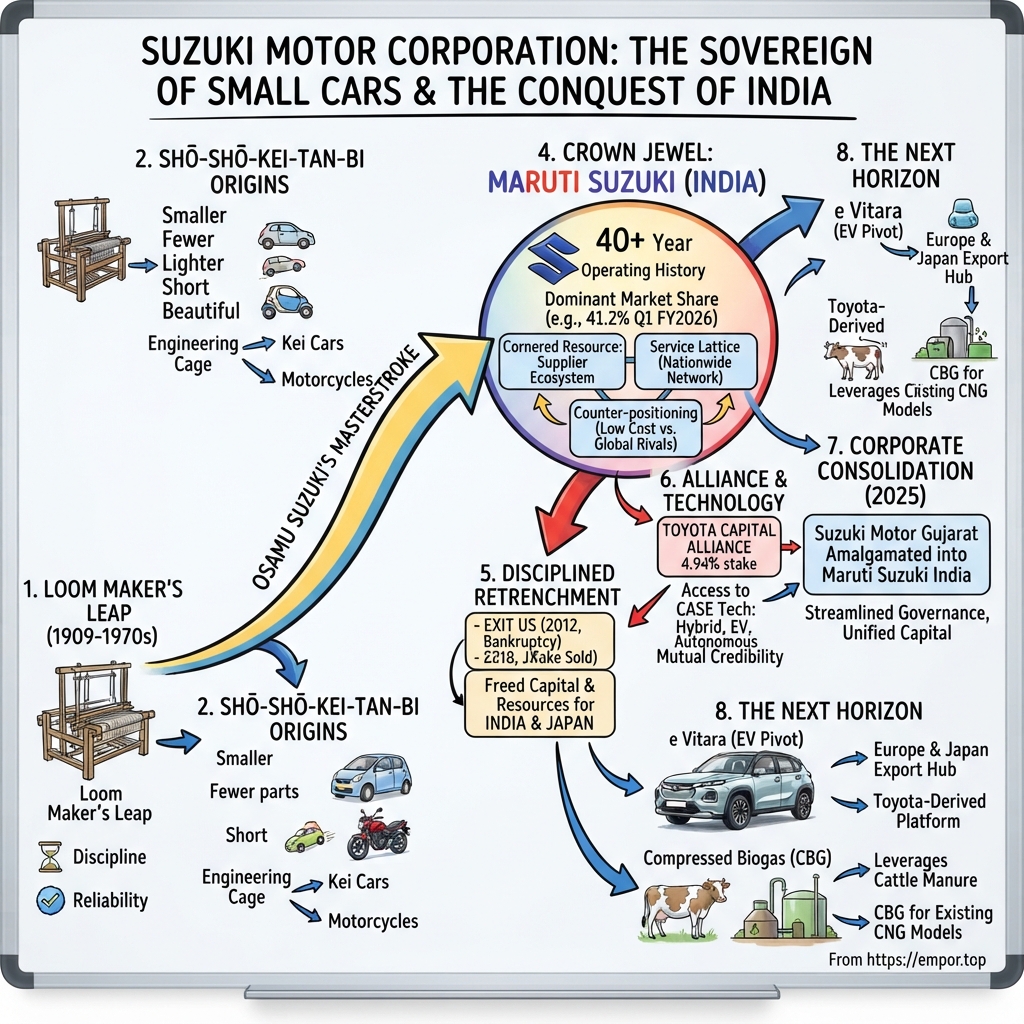
Suzuki Motor Corporation: The Sovereign of Small Cars and the Conquest of India
I. Introduction: The Fortress of Frugality & the Crown Jewel of India
Stand on a flyover in Gurugram at seven in the morning and watch the traffic knot itself together below. The heavy trucks are built by Tata and Ashok Leyland, while two-wheelers from Hero, Honda, and Bajaj fill the lanes. But the passenger cars — the small, boxy, practical vehicles carrying India's middle class to work — overwhelmingly bear a stylized, slanted S. It is neither a Toyota nor a Volkswagen emblem. It is the Suzuki badge of Maruti, named for the Hindu wind god, assembled in Haryana and Gujarat, and directed from a mid-sized industrial city on Japan's Pacific coast that few Western investors could locate on a map.
That market position is unusual. In most large emerging economies, the dominant automotive brand is either a state-protected domestic champion or a global giant deploying massive capital. India's market leader is neither.
This is the core paradox of Suzuki Motor Corporation (スズキ株式会社 Suzuki Motor Corporation). It is a Japanese automaker that sells almost no cars in the United States and none in China, having abandoned the world's two largest vehicle markets over the past three decades. Its vehicles remain exceptionally compact by modern industry standards: engine displacements below one liter, curb weights under a metric ton, and entry prices in India below the cost of an optional infotainment package on an American pickup truck. Yet for the fiscal year ended March 2026, Suzuki reported consolidated revenue of approximately ¥6.29 trillion, up 8.0% year on year, alongside total assets of ¥6.64 trillion and a shareholders' equity ratio above 50%.1 In the quarter ended June 2026, the company posted an operating profit of ¥158.0 billion at a 9.3% operating margin — a level of profitability that outpaces several larger global competitors.2
Suzuki's global vehicle volume places it outside the automotive industry's top tier, but its profitability tells a different story.
The explanation lies primarily in one nation.
Suzuki owns 58.53% of Maruti Suzuki India Limited, the publicly listed automaker that has led the Indian passenger vehicle market in market share for virtually its entire history. In the April–June quarter of fiscal 2026–27, Maruti Suzuki held a 41.2% domestic market share, up 2.3 percentage points year on year, driven by sales growth of 29.3%.3 India has become the world's third-largest automotive market by volume and the fastest-growing among major economies. Suzuki is not merely a participant in this expansion; it defines the market.
Viewed structurally, Suzuki is less a Japanese automaker with an Indian subsidiary than an Indian automotive franchise supported by a Japanese engineering parent, a domestic Japanese cash-generating business, and a global motorcycle division.
This concentration forms the core investment debate. A business deriving the majority of its profits from a single emerging market through a non-wholly-owned listed subsidiary — in vehicle segments widely viewed as facing structural headwinds — represents either a mispriced compounder or a value trap. Investors present compelling evidence for both arguments.
Resolving these contrasting views requires examining the historical record rather than projecting future outcomes. Suzuki possesses a 40-year operating history in India alongside a 20-year trend of market-share erosion within that same region. Its record also includes two failed market entries, one near-loss of corporate independence, and a functional strategic alliance.
This narrative traces how a rural Japanese weaving-loom factory transformed into the primary provider of Indian mobility. The company's trajectory moves from a founder who designed textile machinery to a son-in-law who bet the firm on a market competitors ignored; a four-year legal dispute with Volkswagen that threatened Suzuki's independence; two market exits that demonstrated disciplined capital allocation; a defensive technology alliance with Toyota (トヨタ自動車 Toyota); a corporate restructuring that consolidated Suzuki's Indian manufacturing under one entity; and an unconventional initiative to convert biomethane from cattle manure into automotive fuel.
This analysis tests each claim in the Suzuki thesis against the company's past operational failures, examining where its competitive moats have previously proven vulnerable.
 Subscribe on LinkedIn
II. The Loom Maker's Leap: Shō-Shō-Kei-Tan-Bi Origins
Like many Japanese industrial leaders, Suzuki began with textiles.
The Enshu plain on the coast of Shizuoka Prefecture was historically defined by cotton weaving. Its primary industrial center, Hamamatsu (浜松), provided the setting in 1909 when a 22-year-old carpenter's apprentice named Michio Suzuki (鈴木道雄 Michio Suzuki) established a workshop to manufacture looms for local weavers.4
The company's early development mirrored that of Toyota, which originated 60 kilometers to the west as Toyoda Automatic Loom Works. Both firms inherited mechanical principles from textile machinery: strict tolerance control, continuous mechanical optimization, and an insistence that every component justify its inclusion. Because industrial looms were required to operate reliably for decades in humid environments under non-technical operators, building them cultivated an exceptionally disciplined engineering culture.
Michio Suzuki attempted to diversify into automobiles in the late 1930s, developing a prototype passenger vehicle before military priorities redirected factory capacity. The core loom business sustained the company for four decades until post-war economic disruption and cheap foreign imports devastated Japan's textile industry, forcing Suzuki Loom Works to seek new markets.
The resulting corporate pivot was born of immediate economic necessity. In post-war Japan, consumers lacked the capital for automobiles or conventional motorcycles. In 1952, Suzuki introduced the "Power Free" — a clip-on 36cc motor for bicycles featuring a double-sprocket system that allowed riders to pedal with engine assistance, pedal independently, or run entirely on engine power.4 The inexpensive product solved a practical transportation problem for workers seeking affordable commuting options.
Commercial success from the Power Free funded Suzuki's expansion into motorcycles and microcars.
In 1955, the company introduced the Suzulight, Japan's first commercially successful front-wheel-drive car featuring independent suspension — designed as a kei car (軽自動車 kei cars) under government regulations that capped vehicle length, width, and engine displacement.4 The kei framework served as a rigid design cage. Building functional family transportation within strict dimensional boundaries fostered a distinct organizational capability: stripping mass, cost, and complexity out of a vehicle without sacrificing basic utility or structural integrity.
The loom business also provided a second enduring commercial advantage. Rather than selling to affluent urban buyers, loom manufacturers supplied small rural workshops and maintained those machines over long lifespans. This commercial model prioritized multi-decade customer relationships, minimal downtime, and low operating costs over high-margin single transactions. Suzuki applied the same distribution strategy to its motorcycle division during the 1950s, establishing a retail network across rural Japan and Southeast Asia long before expanding into global passenger cars. When Suzuki later entered India, it drew on seventy years of experience selling to price-sensitive rural customers.
Suzuki eventually formalized this manufacturing philosophy as Shō-Shō-Kei-Tan-Bi (小・少・軽・短・美), translating to "smaller, fewer, lighter, shorter, and more beautiful." The principle emphasizes fewer parts, lighter components, shorter assembly lines, and faster development cycles. In practice, the philosophy operates as an engineering control, requiring every proposed modification to justify its added weight and unit cost.
While conventional automakers design a vehicle and subsequently negotiate component prices with suppliers, Suzuki establishes a target cost ceiling that dictates vehicle architecture. Weight reduction serves as the primary cost lever. A lighter body structure permits a smaller engine, which allows for a lighter transmission, scaled-down brakes, thinner tires, and reduced fuel capacity. Each reduction compounds across assembly, lowering total production costs.
This cost-focused culture carries distinct strategic limitations. Suzuki's history includes models that failed in overseas markets due to excessive frugality and lack of refinement — a pattern that culminated decades later in an American bankruptcy filing. An engineering philosophy optimized for low-income buyers becomes a liability when customer purchasing power advances.
By the late 1970s, Suzuki faced clear structural constraints. Domestically, it maintained a solid position within a regulated niche. Internationally, it operated primarily as a motorcycle brand with a modest small-car sideline, trailing far behind Toyota, Nissan, and Honda in engineering budgets, dealer networks, capital access, and political weight. Japan's domestic vehicle market was reaching saturation, trade friction was restricting exports to the United States, and European incumbents dominated their home small-car markets.
Faced with mature or protected developed markets, Suzuki began searching in the early 1980s for an emerging economy with vast population scale, limited vehicle ownership, and minimal competitive presence.
III. The Son-In-Law's Masterstroke: Entering India (1982)
Osamu Suzuki (鈴木修 Osamu Suzuki) was not born a Suzuki. Born Osamu Matsuda in 1930 in Gifu Prefecture, he trained in law rather than engineering, worked at a regional bank, and married Shoko Suzuki — a granddaughter of the founder — taking her family's surname under the Japanese custom of adopting a son-in-law heir (婿養子 mukoyoshi). He joined the company in 1958 and led it, across various executive titles, until 2021. He died on December 25, 2024, at age 94.5
That background shaped his executive style. A lawyer-banker leading an engineering firm was unusual in post-war Japan, producing a chief executive driven by capital efficiency, risk allocation, and hard negotiations rather than product elegance. Suzuki's defining strategic choices under his leadership were financial and commercial rather than purely technical.
He was an eccentric executive among cautious corporate peers. He referred to himself as "the old man of a small company" long after Suzuki passed a trillion yen in annual revenue. He personally patrolled factory floors to eliminate wasted electricity, negotiated with suppliers over single-yen component costs, and kept authority tightly centralized — a governance structure that raised governance concerns among Western investors in later decades.
In 1981, the Indian government established Maruti Udyog, a state-owned enterprise tasked with manufacturing an affordable "people's car," and sought a foreign technology partner. Global automakers largely declined. At the time, India had low per-capita income, strict local-content mandates, an undeveloped supplier base, an illiquid currency, and a majority state owner that controlled production quotas. Major international manufacturers viewed the market, which then measured total annual passenger car sales in tens of thousands of units, as commercially unviable.
Osamu Suzuki flew to New Delhi and signed the agreement.
Industry accounts often frame global rivals as blind to India's potential. A more rigorous assessment suggests competitors calculated that the entry terms were incompatible with their larger cost structures and capital demands. For Toyota in 1981, India offered negligible volume, mandatory technology transfer, minority control, and political risk, compared to lucrative expansion opportunities in North America. That rationale suited Toyota's position, but proved wrong for Suzuki, whose strategic alternatives were far more constrained.
While looking obvious in hindsight, Suzuki's bet appeared reckless in 1981. The company was a minor player even in Japan, committing capital and top engineers to a minority stake in a foreign government venture where it lacked brand recognition, dealers, and suppliers. The underlying strategy was pragmatic: Suzuki could not beat Toyota, Nissan (日産自動車 Nissan), or Honda (本田技研工業 Honda) in developed markets, but it could dominate an emerging economy where low-cost engineering was the decisive advantage.
The joint-venture terms reflected Suzuki's initial lack of leverage and high strategic conviction. Taking a minority equity stake in a state enterprise, Suzuki agreed to transfer technology, meet escalating domestic content targets, and operate under a strict licensing regime. Where Western boards saw uninsurable political risk, Osamu Suzuki recognized an essential opportunity: as a smaller player, Suzuki could not afford to pass up a market of hundreds of millions of potential motorists simply because the initial operating conditions were challenging.
When the Maruti 800 debuted in December 1983, it transformed Indian personal mobility. Yet the vehicle itself was only the visible surface of Suzuki's deeper operational buildout.
The primary hurdle was localizing the supply chain. India's domestic-content rules prevented Suzuki from assembling imported kits from Hamamatsu. The company had to build vehicles using parts produced domestically, often by suppliers that did not yet exist. Suzuki brought Japanese component makers into local joint ventures, introduced monozukuri (ものづくり) manufacturing standards to a new workforce, and established statistical quality controls among vendors accustomed to loose tolerances.
This localization process reshaped the local industrial landscape. Because a passenger car comprises thousands of individual parts, Suzuki had to create its own domestic supplier ecosystem. The company established joint ventures, embedded engineers inside supplier plants, standardized measurement practices, and designed vehicle architectures around local supplier capabilities. This generated a dedicated vendor network whose tooling, cost structures, and engineering practices were aligned directly with Suzuki's standards, creating a formidable barrier to late entrants.
Simultaneously, Suzuki developed a nationwide sales and service footprint. Convincing first-time car buyers required deep institutional trust, particularly in rural regions far from major urban centers. Suzuki expanded its dealership and service point density into smaller towns, pairing sales outlets with standardized spare-parts logistics and certified mechanics. This network reassured buyers that a Maruti vehicle could be maintained reliably and affordably anywhere in the country.
Entering India fifteen years before global peers gained access enabled Suzuki to construct foundational infrastructure — a custom supplier ecosystem and a dense service network — that competitors could not easily duplicate. While brand marketing can be matched through advertising budgets, a nationwide grid of district workshops requires vehicle volume to justify its operating economics.
This distribution footprint remains central to the Suzuki investment thesis, but its protection has limits. Suzuki's Indian market share peaked above 50% in the mid-2000s before trending downward over two decades to its recent level of 41.2%, despite a year-on-year rebound.3 The erosion occurred not because the dealer network failed, but because competitors such as Hyundai, Tata Motors, Mahindra & Mahindra, and Kia captured growth in compact and mid-size sport utility vehicles — a segment Suzuki was slow to embrace due to its historical focus on ultralight minicars. The distribution network defended traditional compact sales, but could not offset shifting consumer preferences toward larger vehicles.
Consequently, Suzuki's distribution advantage protects vehicle volume more effectively than product mix. It has not fully insulated the company from market-share loss driven by delayed segment entries. Evaluating Suzuki's market position therefore requires monitoring its share within the expanding SUV and utility vehicle categories, where industry profitability has increasingly concentrated.
This fundamental tension — between a manufacturing culture built on frugality and a market migrating toward larger, premium vehicles — defined Suzuki's strategic choices over the subsequent three decades, ultimately driving its temporary alliance with Volkswagen.
IV. The Corporate Battle of the Decade: The Volkswagen Arbitration
By the late 2000s, executive discussions across the global automotive industry shared a common theme: individual automakers could no longer afford to navigate the next decade alone.
For Osamu Suzuki, the challenge could not be solved through cost engineering. Stricter emissions standards, emerging electrification mandates, and safety regulations were transforming the automobile from a mechanical product into a capital-intensive software and technology platform. Fixed research and development costs were rising beyond levels an automaker of Suzuki's scale could bear independently. Crucially, Suzuki's primary profit engine — small, budget-conscious vehicles — offered little room to absorb those mounting development expenses.
In December 2009, Suzuki and Volkswagen announced a "comprehensive partnership." Volkswagen acquired a 19.9% equity stake in Suzuki for roughly €1.7 billion, or about $2.5 billion at the time, while Suzuki reinvested approximately half of those proceeds into Volkswagen shares.6 On paper, the agreement offered a complementary exchange: Volkswagen would provide advanced technology and global scale, while Suzuki would contribute low-cost small-car engineering and access to an Indian franchise Volkswagen had struggled for years to build on its own.
The partnership produced virtually no operational results. No joint vehicle reached commercial production, no platform was shared at scale, and the primary output of the alliance became prolonged litigation.
The alliance collapsed almost immediately over cultural alignment rather than economic rationale.
In its annual disclosures, Volkswagen categorized Suzuki as an associate company over which it exercised significant influence. To Suzuki management, that classification was not a mere accounting detail; it signaled an assertion of corporate dominance. Volkswagen pressed to integrate Suzuki into its global procurement network and modular platform architecture. While logical for a scale-focused global conglomerate, that integration directly threatened an automaker whose competitive advantage rested on an ultra-lean cost base. Suzuki's cost discipline was not the product of standard purchasing terms, but the result of decades of adhering to its Shō-Shō-Kei-Tan-Bi engineering philosophy — principles that Volkswagen's standardized systems would have largely dismantled.
Beneath the tactical disputes lay a fundamental mismatch of strategic priorities. Volkswagen sought an emerging-market small-car division, whereas Suzuki sought an independent technology supplier. Contract terms could not reconcile these conflicting objectives once both parties recognized each other's true expectations.
The operational rift widened over engine sourcing. When Suzuki contracted to purchase diesel engines from Fiat for its European and Indian vehicle lineups, Volkswagen alleged a breach of the partnership agreement, asserting that Suzuki was required to adopt Volkswagen powertrain technology. Suzuki responded by demanding the return of its shares.
Volkswagen refused. In November 2011, Suzuki initiated formal arbitration proceedings with the London Court of International Arbitration. Following nearly four years of confidential proceedings, the tribunal ruled on August 30, 2015, that the partnership agreement was terminated and ordered Volkswagen to divest its stake back to Suzuki.7 Suzuki repurchased its 19.9% equity stake for approximately ¥460 billion — equivalent to roughly $3.8 billion at prevailing exchange rates — paying a substantial premium to reclaim its corporate independence relative to Volkswagen's original purchase price six years earlier.
Evaluated strictly as a financial transaction, the alliance proved value-destructive: Suzuki paid a significant financial premium to unwind a voluntary agreement, absorbing capital without gaining technology, manufacturing capacity, or market access. Strategically, however, the outcome preserved the firm's core enterprise value. Had Volkswagen expanded its stake or asserted operational control, Suzuki's low-cost small-car operations would likely have been absorbed into Volkswagen's broader platform architecture, reducing its Indian operations to a regional distribution channel. The distinct combination driving Suzuki's valuation — an independent low-cost engineering organization tied to a dominant Indian market position — would have been compromised.
At the same time, the episode highlighted Suzuki's initial strategic misjudgment in granting a far larger rival a near-blocking equity position without securing clear operational safeguards. While the legal exit was successfully executed, the original deal structure reflected significant strategic risk.
The Volkswagen arbitration left two enduring structural effects on Suzuki's corporate strategy.
First, it instilled an institutional aversion to equity-based reliance. Suzuki emerged from the dispute persuaded that shared equity creates operational leverage for larger partners, prompting the company to structure all subsequent strategic relationships without granting controlling governance rights.
Second, it reshaped Suzuki's balance-sheet management. The company became a disciplined accumulator of liquid capital, maintaining a conservative capital structure. In recent financial reporting, Suzuki maintained a shareholders' equity ratio of around 51% alongside a substantial net cash position.1 Management frames this liquidity as an essential operational buffer against market volatility. Conversely, institutional investors have historically viewed the strategy as inefficient capital management that depresses return on equity, or as a defensive measure against external control. The Volkswagen conflict provides the historical context for Suzuki's cash reserves, even as debate persists over the appropriate scale of that capital cushion.
The arbitration outcome also explains Suzuki's subsequent strategic moves. Within four years of regaining independence, Suzuki sought a new global partner — this time establishing terms designed to preserve its operational autonomy, while making key capital decisions that redefined its long-term corporate direction.
V. Retrenchment and Strategic Clarity: Exiting the US and China
Failure often offers clearer strategic lessons than success, and Suzuki's market retreats in North America and East Asia illustrate the operational limits of its low-cost model.
In November 2012, American Suzuki Motor Corporation filed for Chapter 11 bankruptcy protection and announced it would stop selling passenger cars in the United States, retaining only its motorcycle, all-terrain vehicle, and marine engine divisions.8 For a Japanese automaker, exiting North America marked a stark departure from industry norms. While Toyota, Honda, and Nissan spent three decades establishing deep manufacturing and commercial footprints in the United States, Suzuki withdrew entirely.
Suzuki had operated in the U.S. market since the 1980s, achieving early commercial success with the Samurai compact SUV. However, a safety controversy over rollover stability led to sustained reputational damage and a prolonged decline in sales volume. By the time of the bankruptcy filing, Suzuki's annual U.S. vehicle sales had shrunk to a negligible fraction of its Indian operations.
The underlying causes stemmed from structural strategy rather than pure execution. Suzuki's low U.S. sales volume could not amortize the fixed overhead of maintaining a national dealer network, meeting U.S.-specific regulatory certifications, supporting local marketing, and funding warranty infrastructure. Lacking domestic manufacturing facilities, the company bore full foreign-exchange risk on vehicles imported from Japan during a period of historically strong yen valuation. Furthermore, Suzuki's product lineup — engineered for narrow roadways, high fuel prices, and budget-conscious consumers — collided with American market preferences for larger vehicle dimensions, powerful engines, and low fuel costs.
Six years later, Suzuki executed a second major withdrawal with broader strategic implications. In September 2018, Suzuki agreed to sell its equity stake in its joint venture with Chongqing Changan Automobile, fully exiting passenger car manufacturing in China.9 Suzuki had entered China early, securing initial market share during the 1990s and 2000s with small hatchback models.
However, rapid economic growth transformed Chinese consumer demand. The market pivoted rapidly toward larger SUVs, premium interior features, and battery electric vehicles supported by national industrial policy and domestic competitors. Suzuki's brand identity, anchored in budget-friendly compact vehicles, lost traction as consumer preferences moved upmarket. Rather than committing extensive capital over a multi-year period to reposition itself as a mid-sized SUV manufacturer, Suzuki chose to exit.
While some observers characterized these exits as strategic foresight, a more grounded assessment indicates that competitive constraints forced Suzuki from both markets. Suzuki's management demonstrated corporate discipline by halting capital allocation to unprofitable regions rather than subsidizing non-competitive operations for brand prestige.
Had Suzuki continued funding loss-making operations in the United States and China throughout the 2010s, that capital expenditure would have reduced investment in expanding Indian production capacity — the primary engine of its subsequent earnings growth.
The double exit allowed Suzuki to concentrate its resources. Freed from persistent loss-making divisions, the company redirected capital, engineering capacity, and management attention toward India and Japan, while maintaining targeted positions in Southeast Asia, Pakistan, Hungary, and its global motorcycle business. The financial impact of this discipline is reflected in corporate margins: for an automaker of Suzuki's mid-tier global volume, sustaining a 9.3% operating margin in the quarter ended June 2026 relies less on premium pricing power than on eliminating structurally unprofitable market overhead.2
However, exiting China created a distinct strategic vulnerability. By leaving the world's largest vehicle market, Suzuki distanced itself from the primary center of global electric vehicle development, battery supply-chain scaling, and automotive software architecture. In saving capital, the company surrendered direct operational experience in advanced EV technologies. The long-term validity of that trade-off depends on whether expanding Chinese EV manufacturers enter India and Southeast Asia with cost and technology advantages that Suzuki cannot counter.
Rather than developing proprietary electric vehicle architecture independently, Suzuki addressed this capability gap through a partnership with Japan's largest automaker.
VI. The Shield of Aichi: The Toyota Capital Alliance
Toshihiro Suzuki (鈴木俊宏 Toshihiro Suzuki), Osamu's son, became president in 2015 — the same year the Volkswagen arbitration concluded. He brought an engineering background, a more collaborative managerial style than his father, and a daunting industry challenge. Global automakers were converging on the CASE framework — Connected, Autonomous, Shared, and Electric technologies. Each category demanded multi-billion-dollar investments in software and advanced hardware with long payback horizons, even as core vehicle manufacturing and warranty obligations continued.
For a mid-sized manufacturer like Suzuki, financing an independent development strategy across all four domains was mathematically unviable. The company faced three alternatives: forge a strategic partnership, accept an acquisition, or risk gradual regulatory obsolescence.
Mindful of its previous experience with Volkswagen, Suzuki approached new equity commitments with extreme caution. The initial dialogue with Toyota proceeded through years of preliminary agreements before any equity changed hands.
Suzuki chose a partner with the scale to supply advanced technology and the security to respect Suzuki's operational independence. Following a 2016 memorandum and a 2017 operational partnership, Toyota and Suzuki signed a capital alliance agreement on August 28, 2019. Under the arrangement, Toyota purchased roughly ¥96 billion of Suzuki stock for a 4.94% stake, while Suzuki acquired about ¥48 billion of Toyota shares, representing a 0.2% holding.[^10]
The cap table reflected the lessons of the Volkswagen dispute. While Volkswagen had acquired a 19.9% stake — creating accounting influence and governance friction — Toyota took under 5%. That structure aligned strategic incentives without granting controlling oversight or signaling an impending takeover.
The alliance functions as a balanced exchange.
The economics of CASE technology explain why cooperation was necessary. Developing a modern battery electric platform — spanning battery cells, thermal management, power electronics, and integration software — requires billions of dollars in upfront capital before generating initial revenue. Advanced driver assistance systems add further costs for sensors, computing hardware, road validation, and liability insurance, while connected services require dedicated software engineering teams. While Toyota can amortize these fixed development costs across roughly ten million vehicles annually, Suzuki cannot distribute them effectively across its lower-priced vehicle lineup, where unit margins are significantly narrower.
Through the partnership, Suzuki converts fixed technology costs into variable licensing fees. It gains access to Toyota's hybrid powertrains, electric vehicle architectures, hydrogen research, autonomous driving technology, and supply chain scale.
In return, Toyota gains expanded access to the Indian mass market, where its own operations had historically struggled to achieve high-volume scale. Under the cross-badging agreement, Toyota sells Suzuki-developed models — such as the Baleno hatchback rebranded as the Glanza — produced on Suzuki's cost-efficient manufacturing footprint. Toyota also gains an engineering partner with specialized expertise in ultra-lightweight vehicle design as affordable electrified vehicles become critical for emerging markets.
The arrangement offers Suzuki an additional advantage: regulatory and market credibility. Independent technology roadmaps from mid-sized automakers often face skepticism from regulators, capital markets, and component vendors. Leveraging Toyota-derived technology provides immediate engineering validation, easing compliance with European type-approval standards and Indian emissions mandates while securing battery supply commitments.
The principal vulnerability of the alliance remains long-term dependency. Suzuki relies on a direct market competitor for hybrid systems and future electric vehicle platforms, even as Toyota sells competing models in India and holds an equity stake in Suzuki. Suzuki's negotiating leverage rests on its dominant Indian distribution network and lean manufacturing cost structure; should either advantage weaken, the commercial terms of technology access could tighten. Furthermore, Suzuki management has not publicly disclosed the licensing fee structures, leaving an analytical gap for investors assessing structural operating margins.
Seven years after the initial capital agreement, the partnership has delivered operational vehicles rather than symbolic press releases, while Suzuki has maintained complete operational autonomy. Whether this arrangement remains a balanced technology lease or develops into strategic dependence remains a key monitoring item — particularly in India, where Suzuki turned its attention in the early 2020s to streamline a complex corporate structure.
VII. The Crown Jewel Consolidated: The Suzuki Motor Gujarat Transaction
Evaluating Suzuki's corporate restructuring in India requires understanding the revenue concentration of the broader enterprise.
The group operates across three principal segments, dominated heavily by automotive manufacturing. Automobiles generate roughly ¥5.6 trillion in revenue — representing approximately 89% of total group sales and a comparable proportion of operating profit. Motorcycles contribute around ¥469 billion, or 7.5% of revenue, while generating a slightly higher share of operating income. The marine division — primarily outboard motors — adds roughly ¥109 billion, accounting for under 2% of revenue but about 3.4% of operating profit.[^11]
Suzuki maintains operational footprints in Pakistan, Hungary, Indonesia, Thailand, and the Philippines, along with a strong motorcycle presence across South and Southeast Asia. While these regional operations provide geographic diversification and local cash flow, none generates sufficient volume to alter the parent company's overall financial trajectory.
Consequently, Suzuki's motorcycle and marine units provide steady niche earnings, but remain secondary to group valuation; even a doubling of marine profits would shift total operating income by only low single-digit percentages. For investors and analysts, Suzuki's enterprise performance remains almost entirely tied to its automotive operations, which are overwhelmingly concentrated in India.
This earnings concentration underlines the significance of the corporate structure that governed Suzuki's Indian operations until recently. Maruti Suzuki India Limited (MSIL) is a publicly listed Indian entity with a substantial public float. However, a major portion of Suzuki's Indian manufacturing capacity sat outside the listed company. Suzuki Motor Corporation held 100% of Suzuki Motor Gujarat Private Limited (SMG), a parent-owned subsidiary that manufactured vehicles and sold them to MSIL on a contract basis, essentially at cost.
Suzuki justified this arrangement on capital deployment grounds: the additional production capacity in Gujarat was needed rapidly, and the parent chose to fund construction directly from its balance sheet to avoid straining MSIL's capital resources. While plausible during the initial expansion phase, maintaining this arrangement over time effectively shifted crucial capital assets and future capacity growth directly to the parent entity.
Minority shareholders routinely criticized the structure. The core concern was not accounting misconduct, but structural governance. Manufacturing facilities critical to MSIL's long-term volume expansion sat on the Japanese parent's balance sheet, governed by internal supply agreements outside the direct control of MSIL's public investors, with transfer pricing set by corporate formula rather than market-rate negotiation. Consequently, equity analysts modeling MSIL were forced to evaluate related-party transactions with limited visibility. In the Indian equity market — where controlling promoter interests relative to minority rights are closely scrutinized — the dual-entity structure created a persistent valuation discount.
Management addressed this governance friction in July 2023, when MSIL's board approved acquiring 100% of Suzuki Motor Gujarat from the parent company.10 Rather than executing a cash purchase, MSIL revised its approach and issued new shares to Suzuki Motor Corporation through a preferential allotment valued at approximately ₹12,800 crore. The share issuance increased SMC's ownership stake in MSIL to 58.53% while absorbing the Gujarat manufacturing plants directly into the listed company.11 The amalgamation took effect in India with an appointed date of April 1, 2025, and MSIL has presented subsequent financial disclosures on a retrospectively adjusted basis.3
The share-swap structure presents distinct trade-offs for both minority and controlling shareholders.
From a bullish perspective, MSIL preserved billions of dollars in liquid capital that would otherwise have been remitted to the parent. This liquidity supports MSIL's long-term plan to expand annual production capacity to approximately four million units by the early 2030s, including funding the Kharkhoda plant development in Haryana — the largest single capacity expansion project in company history. The commissioning of the second Kharkhoda facility was explicitly cited as a primary growth driver for higher sales volumes in the June 2026 quarter.3 Unifying all Indian manufacturing under a single corporate entity also permanently eliminated transfer-pricing opacity and clarified MSIL's true unit economics.
From a bearish perspective, the transaction diluted public shareholders in favor of the controlling parent — a structure that naturally invites governance scrutiny. The valuation of SMG was negotiated internally; although backed by independent valuations and minority shareholder approval, Suzuki Motor Corporation effectively increased its percentage ownership of MSIL by contributing assets it had previously controlled at an internally negotiated valuation. While management countered that MSIL was already absorbing SMG's operational economics because vehicles were transferred at cost, that rationale represents an interpretation of historical arrangements rather than definitive proof of fair value.
On balance, the consolidation resolved a major governance overhang and improved operating capital efficiency, while simultaneously tightening parent control over the Indian subsidiary. For investors evaluating Suzuki Motor Corporation rather than MSIL, the transaction shifted net enterprise value toward the parent company, whose 58.53% stake in MSIL now accounts for the vast majority of Suzuki's intrinsic corporate value. This relationship also creates a practical disclosure advantage: MSIL's quarterly reporting in India is more detailed and frequently released earlier than Suzuki's consolidated parent disclosures, offering investors a more precise real-time indicator of group performance.
With manufacturing assets consolidated and production capacity expanding, Suzuki's primary operational focus turned to product execution — specifically, deciding which powertrains to manufacture in those facilities, ranging from standard electric vehicles to unconventional alternative fuel initiatives.
VIII. The Next Horizon: Cow Dung Biogas and the "e Vitara" EV Pivot
In September 2025, a cargo vessel departed Pipavav Port in Gujarat carrying roughly 2,900 electric SUVs bound for twelve European countries. Designed by a Japanese automaker, manufactured in India by a majority-owned subsidiary, and built on a platform co-developed with a domestic rival, the vehicles targeted consumers in one of the world's most stringently regulated automotive markets. The shipment marked the first time an India-built battery electric vehicle (BEV) had been exported to Europe at that commercial scale.12
The vehicle, designated the e Vitara, represents Suzuki's first global mass-production BEV. Built on the HEARTECT-e platform co-developed with Toyota, it is manufactured at the Gujarat facility now fully integrated into Maruti Suzuki India Limited (MSIL).13 Roughly half of total production is allocated for export, while a derivative model is supplied to Toyota under its own nameplate.
Suzuki entered the electric vehicle segment significantly behind competitors. Tata Motors had established a domestic passenger EV presence years before the e Vitara reached assembly lines, and global competitors had been distributing mass-market BEVs for over a decade.
Rather than attempting to reposition itself as a technology-first EV developer, Suzuki applied its core structural advantage: a low-cost manufacturing base operating in tandem with Toyota's electrified platform technology. The strategy targets markets where regulatory mandates, rather than organic consumer preference, drive electric vehicle adoption, creating demand for cost-efficient assembly that Suzuki's Indian supply chain is engineered to deliver.
Initial operational metrics reflect early export execution. In fiscal year 2025–26, MSIL exported a record 447,774 vehicles, retaining its position as India's largest passenger-vehicle exporter for a fifth consecutive year with approximately 49% of total national exports, while expanding e Vitara shipments across 44 countries.14 For a manufacturer with no prior electric vehicle lineage, these initial figures demonstrate tangible manufacturing throughput.
However, export volume alone does not validate the broader commercial thesis. Initial factory shipments reflect channel filling rather than sustained European retail demand, which requires multiple quarters of registration data to evaluate. At the lower price tiers of the European EV market, competition is escalating as Chinese manufacturers deploy vertically integrated battery supply chains that Suzuki does not possess. Furthermore, Suzuki remains a follower in India's domestic EV market behind established players like Tata Motors. Key performance indicators for this transition center on European retail registrations, realized vehicle pricing over consecutive quarters, and the timely execution of subsequent model variants.
The export initiative also alters how capital deployment in India should be evaluated. Historically, Indian assembly capacity was tied exclusively to domestic demand cycles, exposing capital investments to local economic fluctuations. Allocating a significant share of Gujarat's output to foreign markets transforms those facilities into global assets, smoothing plant utilization across non-correlated demand cycles while generating foreign currency revenue against a rupee-denominated cost structure. MSIL's sustained leadership as India's top passenger-vehicle exporter, accounting for roughly half of the country's total automotive exports, underscores this structural export capability.14 Nevertheless, this strategy introduces trade policy vulnerabilities, exposing the company to shifting international tariffs and foreign regulatory shifts that did not affect its historically domestic focus.
The cow dung option
Parallel to its EV rollout, Suzuki is pursuing an alternative powertrain strategy rooted in India's energy and infrastructure realities.
MSIL holds a dominant market share in India's compressed natural gas (CNG) passenger-vehicle segment. CNG vehicles occupy a distinct niche in emerging markets: they offer lower operating costs than gasoline models, carry a significantly lower purchase price than battery electric vehicles, refuel quickly, and require no home charging infrastructure — a critical feature in a market where private garage access is rare. For budget-conscious buyers in tier-three Indian cities, CNG represents a pragmatic transport solution.
For Suzuki, establishing market leadership in CNG was a natural extension of its core engineering capabilities. Adapting existing small gasoline engines for CNG required modest design modifications, aligning with the company's focus on incremental, cost-disciplined product development.
The primary limitation of CNG is fuel supply. Because India imports a significant portion of its natural gas, fuel prices remain vulnerable to international market volatility — a vulnerability highlighted in 2026 when energy market disruptions linked to conflict in the Middle East inflated input costs and prompted Suzuki to trim its full-year profit guidance.2
To mitigate supply exposure, Suzuki has invested in compressed biomethane gas (CBG) produced from cattle manure. The operational process involves purchasing raw manure from dairy farmers, digesting it anaerobically to produce methane, compressing the gas into vehicle fuel compatible with existing CNG models, and redistributing the residual organic matter as agricultural fertilizer. Suzuki has developed this initiative in partnership with the National Dairy Development Board and Banas Dairy in Gujarat.15 In July 2026, MSIL's board approved an initial phase of four CBG production facilities with a budget of ₹5,610 million, explicitly linking future capital expansion to the performance of these inaugural projects.3
Beyond its environmental rationale, the biomethane initiative addresses structural bottlenecks facing India's mass-market EV adoption. While electric vehicles depend on power grid expansion, charging infrastructure, and imported battery components, biomethane leverages India's extensive cattle population to produce fuel locally. The process operates as a largely carbon-neutral supply chain, generates supplemental income for rural dairy farmers within Suzuki's customer base, and utilizes the company's existing CNG vehicle lineup and dealership service network.
Nonetheless, the initiative remains an unproven long-term growth driver. The initial allocation of ₹5,610 million represents a modest capital commitment, and management has explicitly conditioned further investment on preliminary operating results. Operational scaling presents distinct challenges, including manure collection logistics across fragmented smallholder farms, digester uptime, gas purification standards, and retail distribution. Given Suzuki's mixed track record in commercializing non-core adjacent ventures, the biomethane project is best evaluated as a structured option with defined capital boundaries, where future progress depends on the approval and scale of phase-two capital commitments.
The speculative fringe
On the speculative edge of Suzuki's technology roadmap is its electric vertical takeoff and landing (eVTOL) initiative. Suzuki partnered with SkyDrive Inc. to manufacture eVTOL aircraft at its Iwata City plant in Shizuoka, establishing a target capacity of approximately 100 units annually.16
While manufacturing has commenced, the initiative carries negligible near-term enterprise value. Aircraft assembly without regulatory type certification and established commercial air traffic frameworks represents a contract manufacturing arrangement and brand exercise rather than a core revenue driver. Conservative financial modeling requires treating the venture as a non-material operation, viewing any future commercial returns as unpriced upside.
IX. The Playbook: Hamilton's 7 Powers & Porter's 5 Forces of Suzuki
Frameworks are only useful if they are allowed to return uncomfortable answers.
Strip away the narrative and ask the analytical question directly: what, mechanically, prevents a competitor from taking Suzuki's profits? Hamilton Helmer's 7 Powers framework forces specificity — a "power" must be both a benefit and a barrier, and most claimed moats fail the second test.
Start with the powers Suzuki plainly lacks. Suzuki has no branding power in the sense Helmer defines — the ability to charge a premium for an identical product because of what the badge signifies. In India, the Maruti badge denotes reliability and high resale value, which supports sales volume and residual values but not premium pricing; in Europe and Japan, Suzuki is explicitly a value brand. Nor does Suzuki possess process power comparable to Toyota's production system. Suzuki's manufacturing is exceptionally efficient, but it is efficient in ways Toyota fully understands — precisely why Toyota chose to partner rather than compete.
Scale economies — real, but local rather than global. Suzuki is not a global scale player; Toyota and Volkswagen each manufacture several times its volume. But scale economies operate within specific markets, and in Suzuki's primary domain — Japanese kei cars and Indian compact vehicles — Suzuki leads in volume by a wide margin. That scale yields genuine unit-cost advantages in components designed for sub-one-liter, sub-one-ton vehicles, amortizing tooling across volumes no niche competitor can match. The limitation is that this advantage is non-transferable. Suzuki holds no scale advantage in batteries, software, or mid-sized SUVs, forcing it to license technology from Toyota and leaving its margins exposed to shifts in segment mix.
Cornered resource — the Indian service lattice. MSIL's Arena and Nexa dealer networks span thousands of sales outlets backed by a far larger service footprint extending deep into rural India. The primary barrier to entry is not the capital cost of constructing dealerships, which a well-funded rival could duplicate over time, but the underlying economics. Service outlet viability requires throughput, throughput demands a large installed base, and that installed vehicle base took four decades to establish. This network is Suzuki's most durable asset, though it protects the incumbency of its existing fleet far more effectively than it secures market share in newly emerging vehicle segments.
Counter-positioning — a strong yet vulnerable defense. Premium and volume global automakers are structurally constrained from attacking Suzuki's entry-level price points without undermining their own margin architecture. Their vehicle platforms, supplier contracts, dealer expectations, and fixed overhead are all structured for higher-priced models — classic counter-positioning. However, counter-positioning only deters incumbents trapped by legacy economics. It offers no protection against new entrants operating at or below Suzuki's cost structure. Chinese automakers are not bound by Volkswagen's legacy cost constraints, nor are domestic Indian competitors like Tata Motors or Mahindra & Mahindra. Counter-positioning protects Suzuki's pricing flank against traditional global giants, but leaves it vulnerable to low-cost innovators.
Beyond scale economies, its service lattice, and counter-positioning, Suzuki lacks the remaining Helmer powers. It has no network economies, no meaningful switching costs beyond routine dealer relationships, and no proprietary process power. Without switching costs or network lock-in, every vehicle purchase remains contestable, requiring Suzuki to win customers repeatedly every five to eight years on price, utility, and execution.
Applying Michael Porter's Five Forces framework reveals that the competitive structure of Suzuki's core market is far more volatile than its market-share figures imply.
Threat of new entrants: low in the mass segment, moderate overall. Replicating Suzuki's Indian cost structure, supplier ecosystem, and service density from scratch is economically prohibitive. Yet entry need not be head-on. Entrants attacking specific high-margin segments with targeted models can bypass Suzuki's distribution moat entirely, as Kia demonstrated by establishing a profitable Indian footprint within a few years.
Bargaining power of buyers: high and structural. Indian mass-market car buyers are among the most price-sensitive globally, with purchasing decisions dictated by monthly installment costs and rigorous comparison shopping. Suzuki possesses cost leadership rather than pricing power. This dynamic was evident in the quarter ended June 2026: MSIL expanded net sales by 36% and sales volume by 29.3% year on year, yet net profit declined as raw material inflation compressed operating margins.3 A business with true pricing power does not absorb cost inflation at the expense of bottom-line profit.
Supplier power: moderate and rising. Traditional component vendors exercise minimal leverage against Suzuki's massive purchasing volume. However, suppliers of battery cells, semiconductors, and specialized electronics hold substantial power. As vehicle electrification accelerates, value shifts toward these component makers, presenting a structural margin risk: the larger the battery's share of total vehicle cost, the less Suzuki's low-cost manufacturing discipline can offset component pricing.
Threat of substitutes: high at entry level. Suzuki's traditional first-time buyers face viable alternatives, including two-wheelers — which remain far less expensive — and expanding ride-hailing services. While rising Indian incomes encourage two-wheeler owners to upgrade to entry-level cars, higher purchasing power also prompts existing Suzuki owners to transition to mid-sized SUVs, a segment where Suzuki historically lacked strong offerings.
Rivalry among existing competitors: intense and escalating. Tata Motors and Mahindra & Mahindra hold strong positions in mid-sized SUVs, while Tata has built an early lead in domestic passenger electric vehicles. Hyundai and Kia compete directly across core product lines. Mid-2026 data illustrates this competitive pressure: although Maruti's sales volume grew over 20% between January and July 2026, its market share remained flat year on year as rivals grew at comparable rates.
Government policy as a distinct force. Government regulations exert a decisive influence on Suzuki's operating economics. Indian state policies dictate emissions mandates, small-car taxation brackets, CNG infrastructure funding, electric vehicle subsidies, and import tariffs. Tax structures favoring compact vehicles directly support Suzuki's core lineup, whereas accelerated EV adoption timelines would favor competitors with more advanced electric platforms. Policy dependence represents an unhedgeable strategic variable.
Synthesizing these analytical frameworks shows Suzuki's competitive moat to be a formidable defensive fortress in a market where growth is robust, but profit pools are migrating into segments where Suzuki's historical advantages are less decisive. Suzuki cannot easily raise prices to expand margins; instead, its fundamental advantage lies in surviving price wars and margin compression better than its peers — a disciplined, resilient, yet demanding strategic edge.
X. The Analyst's Stress Test: Financials, TSE Reform, & The Bull vs. Bear Case
Before evaluating strategic frameworks or long-term forecasts, one fundamental metric defines Suzuki's financial model: the company earns a high-single-digit to low-double-digit operating margin on vehicles that rank among the most affordable in the global market. While much of the global automotive sector generates narrow margins on high-priced vehicles, Suzuki generates consistent profitability on budget-conscious models. Its net profit per unit remains modest, but its profit per unit of invested capital is substantial. That profile forms the core financial signature of the firm, underpinning both the bullish and bearish investment arguments regarding its long-term durability.
Management credibility, tested against behaviour
The central governance development at Suzuki over the past decade is that the era of centralized, single-leader governance concluded before external pressures forced a change. Osamu Suzuki's management approach was exceptionally concentrated. The transition to Toshihiro Suzuki introduced a more institutionalized, delegated structure. While this represents a structural governance improvement, the founding family maintains significant influence, meaning alignment between the family, the parent corporation, and minority shareholders of listed subsidiaries requires ongoing evaluation.
Executive compensation structures align closely with modern corporate governance standards in Japan. The disclosed framework allocates approximately 30% to base salary, 35% to short-term performance bonuses tied to operating profit and a low-teens return-on-equity target, and 35% to restricted stock linked to total shareholder return relative to the TOPIX index.[^11] The relative total shareholder return metric helps prevent executive payouts driven purely by broad market inflation, while the explicit return-on-equity hurdle directly addresses historical balance-sheet capitalization.
Management's guidance discipline offers a clear indicator of corporate reporting behavior. On August 5, 2026, despite reporting an 11% increase in quarterly operating profit and a 9.3% operating margin, management lowered its full-year operating profit guidance from ¥570 billion to ¥540 billion. The adjustment accounted for an estimated ¥110 billion in input-cost inflation resulting from geopolitical disruptions in the Middle East, while outlining three operational offsets: expanded sales volumes in India, selective price adjustments, and fixed-cost reductions.2 Adjusting annual forecasts downward following a profitable quarter demonstrates a conservative reporting posture. Furthermore, disclosing specific operational data — such as an order backlog of approximately 160,000 units in July 2026 and dealer inventory levels running at roughly two weeks against a one-month benchmark — provides investors with verifiable metrics rather than qualitative assertions.2
Narrative consistency across strategic cycles presents a more nuanced record. Suzuki has maintained a consistent core strategy for over a decade focused on prioritizing the Indian market, pursuing multiple powertrain options, preserving cost leadership, and maintaining operational independence. However, its messaging regarding vehicle electrification timing has shifted over time, moving from a cautious posture to a substantial capital commitment without fully detailing the evolving market assumptions behind that change.
Additionally, Suzuki's disclosure practices fall short of global best practices in several key areas. The commercial terms governing its technology partnership with Toyota remain undisclosed, geographic segment profitability is reported with broad granularity, and the parent company's reporting cadence provides less detailed operational visibility into Indian performance than the disclosures published independently by Maruti Suzuki India Limited.
The cash-hoarding fight and the TSE reform
Throughout the 2010s, foreign institutional investors frequently raised concerns regarding Suzuki's capital structure, arguing that an over-capitalized balance sheet structurally depressed return on equity and that excess cash reserves functioned primarily as a management cushion rather than productive capital. In response, management historically pointed to the liquidity requirements demonstrated during the Volkswagen partnership unwinding as justification for maintaining substantial cash buffers.
The catalyst for broader capital allocation changes came from market regulators. On March 31, 2023, the Tokyo Stock Exchange formally requested that listed companies — particularly those trading below book value — evaluate their cost of capital and disclose specific plans to enhance capital efficiency.[^19] This regulatory directive reshaped capital management expectations across Japanese industrial firms.
Suzuki responded with measured adjustments to its shareholder return framework. The company adopted a dividend-on-equity (DOE) target of 3.0%. Unlike a standard payout ratio tied to fluctuating annual net income, a DOE target anchors dividend distributions to net equity, providing dividend stability while creating an explicit carrying cost for unallocated equity reserves. Suzuki supplemented this policy with targeted share buybacks, including a ¥50 billion repurchase program, and raised its annual dividend to ¥46 per share, with guidance indicating potential further increases.1[^11] Concurrently, management outlined a capital deployment plan totaling approximately ¥4.5 trillion in capital expenditures and research and development through fiscal year 2030, earmarking roughly ¥2 trillion for electrification and ¥500 billion specifically for battery technology.[^11]
In comparison to Japanese corporate peers that responded to the Tokyo Stock Exchange initiative with immediate cross-shareholding divestments and large-scale share repurchases, Suzuki prioritized long-term capital deployment. The efficacy of this strategy depends entirely on whether those investments achieve their target return on capital over time.
Evaluating this capital allocation plan requires separating its distinct components. A ¥4.5 trillion investment program addresses capital efficiency concerns by reallocating balance-sheet cash toward operational growth. The capital allocation dedicated to expanding Indian manufacturing capacity is directly observable in ongoing plant construction at Kharkhoda, where new volume capacity is already impacting financial performance. Conversely, the capital designated for electrification and battery development carries higher execution risk, as Suzuki enters the segment later than established competitors and remains reliant on external platform architectures. Consequently, while Suzuki's capital return commitments are immediately verifiable, its multi-year capital deployment plans remain subject to ongoing operational execution.
This capital strategy reflects Suzuki's broader corporate history. Over the past fifteen years, the firm's most significant capital decisions included repurchasing its equity stake from Volkswagen at a premium, liquidating non-competitive operations in the United States and China, and issuing subsidiary equity to consolidate Indian manufacturing assets. While certain transactions resulted in short-term accounting write-downs, they preserved long-term strategic control. Evaluating the current ¥4.5 trillion capital program requires tracking delivered operational output against initial commitments.
The bull case, stated precisely
The primary bullish thesis for Suzuki relies on demographic trends and market penetration metrics rather than rapid adoption of electric vehicles or alternative fuels. Passenger vehicle ownership in India remains low relative to population size and growing household income levels. As broader segments of the population reach first-car affordability each year, Suzuki's expansive distribution network, low-cost manufacturing structure, and established service footprint position the company to capture initial vehicle purchases. Having consolidated its Indian manufacturing footprint under Maruti Suzuki India Limited and expanded production capacity, Suzuki stands to benefit from sustained volume growth as vehicle adoption expands.
The second supporting pillar is Suzuki's multi-powertrain strategy. The company's product portfolio spans gasoline, compressed natural gas, compressed biomethane gas, Toyota-derived hybrid systems, and battery electric vehicles. In emerging markets where public charging infrastructure remains sparse and consumer purchasing power is constrained, maintaining a diversified powertrain lineup mitigates the risk of over-committing capital to a single technology ahead of market readiness.
The third pillar is the strategic capital alliance with Toyota. This relationship grants Suzuki access to advanced powertrain, hybrid, and electronic architectures without requiring full equity consolidation, preserving Suzuki's operational autonomy while reducing internal research and development overhead.
The bear case, stated precisely
The bearish thesis for Suzuki does not require a contraction in Indian vehicle demand or a loss of overall market leadership; rather, it highlights potential margin compression even within a growing market.
The primary mechanism driving this risk is limited pricing power. In the quarter ended June 2026, Maruti Suzuki India Limited achieved a 29.3% year-on-year increase in sales volume and expanded its market share by 2.3 percentage points, yet net profit declined due to raw material cost inflation.3 Because Suzuki operates as a cost leader in price-sensitive segments, increases in input costs cannot be easily passed on to consumers through price hikes, leading directly to margin compression. Operational mitigations — such as volume expansion and fixed-cost reductions — are subject to competitive pressures from rivals pursuing similar strategies.
Second, product segment shifts present ongoing structural challenges. Suzuki's Indian market share declined from historic levels above 50% to the low-40% range over two decades, largely because consumer demand migrated toward sport utility vehicles faster than Suzuki introduced competitive offerings in those categories. Domestic and international competitors maintain established positions in higher-margin utility vehicle segments, constraining Suzuki's margin expansion.
Third, vehicle electrification timing introduces competitive risk. Competitors such as Tata Motors established early leads in domestic Indian electric vehicles, while Chinese automakers with integrated battery supply chains are expanding into Southeast Asia and Europe — key export destinations for Suzuki's e Vitara. Because Suzuki relies on external suppliers for battery cell manufacturing, its long-term unit-cost position in electric vehicles remains less vertically integrated than that of specialized EV manufacturers.
Fourth, Suzuki's domestic Japanese business faces structural demographic headwinds. The kei car category represents a mature market operating within a shrinking and aging population. While the division generates consistent cash flow, it offers limited top-line volume growth.
Finally, geographic concentration represents a central enterprise risk. The majority of Suzuki's consolidated valuation depends on a single market, a single listed subsidiary, and a single primary regulatory framework. Revisions to Indian trade tariffs, small-car taxation tiers, emissions regulations, or electric vehicle subsidies exert a disproportionate impact on Suzuki's overall corporate earnings.
The activist's angle
Institutional investors analyzing Suzuki's equity structure typically focus on four specific areas:
- Holding-Company Valuation Gap: Suzuki Motor Corporation's market capitalization reflects a structural discount relative to the combined value of its 58.53% equity stake in Maruti Suzuki India Limited and its wholly owned Japanese automotive and global motorcycle divisions.
- Capital Efficiency: Despite the adoption of a 3.0% dividend-on-equity target and active share buybacks, Suzuki's equity base remains large relative to its mid-teens return-on-equity target, resulting in a gradual pace of capital return.
- Corporate Governance and Related-Party Transactions: The equity transaction that consolidated Suzuki Motor Gujarat increased the parent entity's controlling stake in Maruti Suzuki India Limited, highlighting the ongoing influence of the founding family across both corporate entities.
- Information Disclosure: Limited public visibility into the financial terms of the Toyota technology partnership and broad geographic segment reporting constrain independent analysis of long-term operating margins.
These structural factors explain why Suzuki has historically traded at a conservative valuation multiple relative to its market position. Consequently, future equity performance depends as much on the continued evolution of its corporate governance and capital allocation policies as it does on vehicle volume growth.
XI. Epilogue & Watchlist: The 3 KPIs That Matter Most
Endings in this business are rarely tidy.
In December 2024, Osamu Suzuki died in Hamamatsu, the city where the company had built textile looms a century earlier. His defining strategic decision—traveling to New Delhi in the early 1980s when global rivals ignored the Indian market—generated more enterprise value than any single vehicle platform Suzuki ever engineered. It serves as an enduring lesson in the automotive industry: the highest-returning capital allocation decisions often depend more on geography than technology.
By late 2026, Suzuki has completed its market retrenchment, simplified its corporate structure, licensed essential electrification technology, and concentrated its capital on India alongside a select group of adjacent markets. This geographic concentration forms both the foundation of its profitability and its primary strategic vulnerability.
Three operational metrics define the company's forward trajectory.
First, Maruti Suzuki's Indian market share, specifically within utility vehicles. While total market share provides a headline figure, segment composition reveals structural health. The decisive test of Suzuki's distribution network is whether it can protect market position as Indian consumers trade up to larger vehicles. Maintaining overall volume while losing ground in utility vehicles indicates gradual profit erosion; expanding SUV share demonstrates that Suzuki's network advantage translates into higher-margin segments.
While the first metric evaluates Suzuki's competitive moat, the second measures operational efficiency.
Second, consolidated operating margin. Suzuki has maintained operating margins in the 9% to 10% range—an exceptional level of profitability for a mid-sized automaker focused on budget vehicles. However, that margin faces concurrent pressures from raw material inflation, aggressive pricing by Indian rivals, and a multi-trillion-yen capital program for electrification that yields minimal immediate profit. Whether management achieves its revised full-year operating profit target of ¥540 billion will demonstrate whether its low-cost manufacturing model can withstand systemic margin compression.
Because Maruti Suzuki India Limited and Suzuki Motor Corporation publish these first two metrics quarterly, investors can evaluate operational performance directly through reported financial results rather than executive commentary.
Third, retail sell-through of the e Vitara in Europe and Japan, rather than factory shipments. This metric tests the premise that India can serve as a competitive export hub for global electric vehicles—Suzuki's principal growth channel outside Indian domestic sales. Gross export figures and geographic distribution demonstrate functional logistics, but sustained retail registrations at viable price points over consecutive quarters are required to validate unit economics against rising Chinese competition. Delivery volumes confirm manufacturing throughput, but consumer registrations dictate long-term return on capital.
A final consideration involves interpreting Suzuki's corporate disclosures. The company's investor communications are direct, yet limited in detail compared to global peers. Consequently, the primary source of detailed financial visibility into the group's dominant earnings driver comes from a subsidiary listed in New Delhi under Indian regulatory oversight. Assessing Suzuki Motor Corporation requires examining Maruti Suzuki India Limited.
Secondary initiatives—including electric vertical takeoff aircraft, biomethane production facilities, and marine engines—represent speculative optionality rather than core value drivers. A century after designing low-cost transportation for post-war Japanese commuters, Suzuki's market valuation continues to depend on its ability to build affordable, reliable vehicles at scale.
References
-
Suzuki lifts revenue and dividends but flags profit decline for FY2026 — TipRanks, 2026 ↩↩↩
-
Suzuki cuts full-year profit outlook despite strong Q1 results — Investing.com, 2026-08-05 ↩↩↩↩↩
-
Maruti Suzuki announces Financial Results for Quarter 1 (April-June), FY 2026-27 and approves 4 CBG manufacturing projects — Maruti Suzuki India, 2026-07-31 ↩↩↩↩↩↩↩
-
Suzuki Integrated Reports Archive (company history and origins) — Suzuki Motor Corporation ↩↩↩
-
Notice regarding Passing of Senior Corporate Advisor Osamu Suzuki — Suzuki Motor Corporation, 2024-12-27 ↩
-
Volkswagen and Suzuki Agree on Strategic Partnership — Volkswagen AG, 2009-12-09 ↩
-
Arbitration Tribunal Orders Volkswagen to Sell Suzuki Shares Back — Reuters, 2015-08-30 ↩
-
American Suzuki Motor Corporation Files for Chapter 11 Bankruptcy Protection — Bloomberg, 2012-11-06 ↩
-
Suzuki Exits the Chinese Passenger Car Market as Sales Dwindle — Financial Times, 2018-09-04 ↩
-
Maruti Suzuki Board Approves Acquisition of Suzuki Motor Gujarat from SMC — Maruti Suzuki India, 2023-07-31 ↩
-
Maruti Suzuki India Limited Investor Relations — Maruti Suzuki India ↩
-
Maruti Suzuki starts the shipment of e VITARA to Europe — Maruti Suzuki India, 2025-09 ↩
-
Suzuki Launches its First Global Mass-Production EV: the e Vitara — Suzuki Global News, 2024-11-04 ↩
-
Maruti Suzuki announces Financial Results for FY2025-26 — Maruti Suzuki India, 2026-04 ↩↩
-
Suzuki and Banas Dairy Partner to Construct Biogas Plants in India — India Bioenergy Times, 2024-03-12 ↩
-
SkyDrive Launches eVTOL Production at Shizuoka Factory with Suzuki — SkyDrive Corporate, 2024-03-07 ↩
 LinkedIn
 WhatsApp
 Reddit
 Hacker News
 Email
 Kindle
 RSS Feed
 Spotify
 Apple Podcasts
 Amazon Music
 Audible
 YouTube