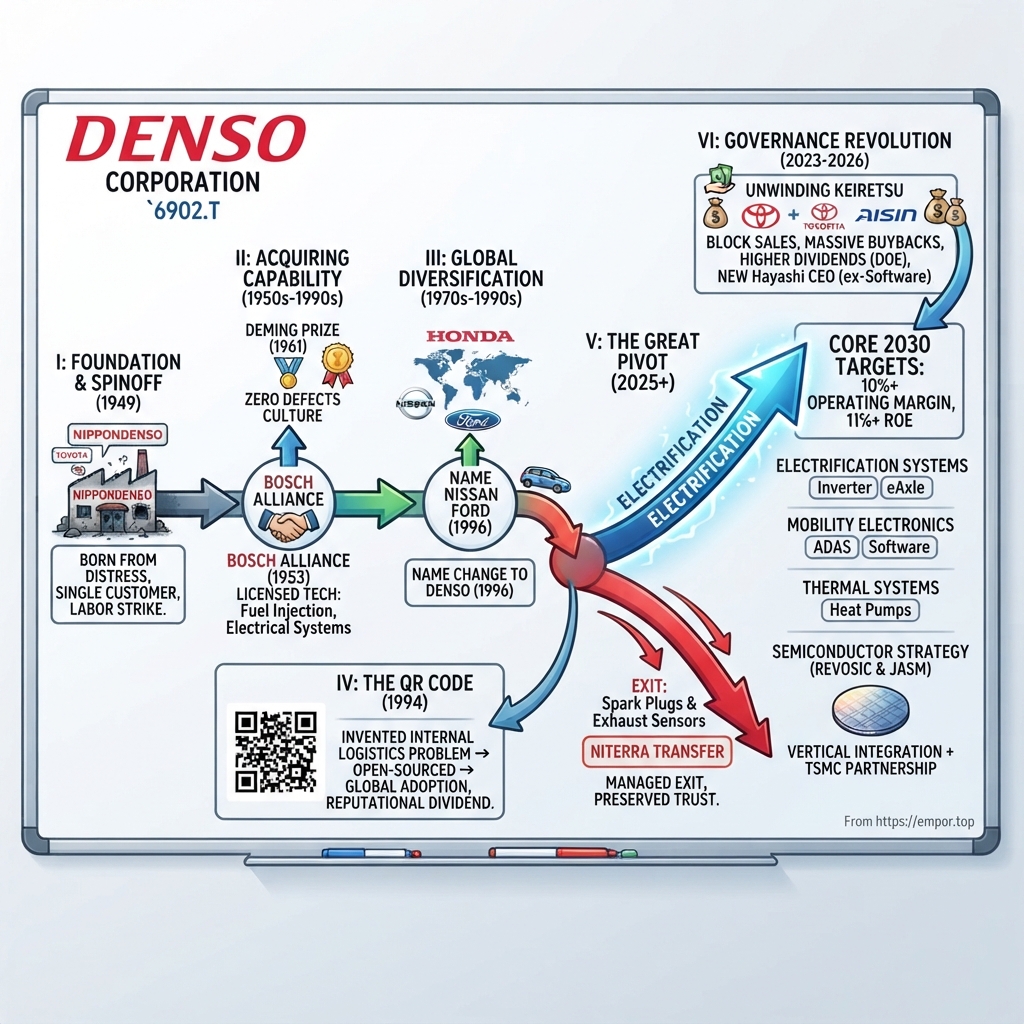
DENSO: The Silent Operating System of Global Mobility
I. Introduction & Episode Roadmap
There is a strong chance you interacted with a DENSO invention this morning. Not a spark plug or an alternator, but a black-and-white square. You pointed a smartphone at a restaurant menu, a boarding gate, or a payment terminal, and a sensor read a pattern of dots in milliseconds. That pattern was designed in 1994 by an engineer in Aichi Prefecture aiming to solve a routine industrial problem: standard barcodes on car-part cartons lacked sufficient data capacity, forcing assembly-line workers to scan the same box ten times to capture ten different fields.1
The company that owned the invention chose not to monetize it directly. DENSO filed the patent, published the technical specification, and declared the technology royalty-free.1 Three decades later, the QRコード QR Code is among the most widely deployed pieces of Japanese industrial design in history, even though few outside the automotive sector know who created it.
That obscurity illustrates the defining characteristic of 株式会社デンソー DENSO Corporation (6902.T, listed on the 東京証券取引所 Tokyo Stock Exchange). As one of the world's largest automotive suppliers, the company generated consolidated revenue of ¥7,540.0 billion (roughly $47 billion) and an operating profit of ¥552.5 billion in the fiscal year ended March 31, 2026, yet it remains almost invisible to the consumers who rely on it.2 When air conditioning runs in a Toyota, Honda, Ford, or Chinese electric vehicle, a DENSO compressor is frequently performing the work. When a hybrid vehicle calculates how to blend engine and motor torque, DENSO semiconductors often execute the decision. The company functions as essential connective tissue for global mobility.
The core paradox. DENSO originated in 1949 from corporate distress: the electrical-parts division that a financially strained トヨタ自動車株式会社 Toyota Motor Corporation spun off to satisfy its bankers.3 It began as a distressed entity with limited proprietary technology, a single customer, and an immediate labor strike. From that baseline, DENSO built a global manufacturing footprint, acquired key technology through licensing, earned top quality honors in Japan, and diversified its revenue base beyond its parent company. In recent years, DENSO has emerged as a major test case in Japanese corporate governance reform. The keiretsu structure that created DENSO has been reducing its ownership stake, while DENSO has pursued share buybacks at an unprecedented scale for a Japanese industrial firm.
What this story is not. This analysis is not a celebratory overview. DENSO's largest customer remains its primary shareholder-in-retreat, its most profitable legacy product lines are undergoing a planned phase-out, and its 2030 plan asks investors to believe that a hardware manufacturer historically averaging a 7% operating margin can reach double digits while concurrently funding semiconductor capacity, software platforms, factory automation, and an agriculture business.4 Management outlined these targets on March 31, 2026, at an investor briefing titled DENSO DIALOG DAY 2026.5 Whether the company can execute on these commitments remains an open question supported by only partial evidence to date.
The roadmap. The narrative begins with the company's origins in 1949 and its critical 1953 technology licensing agreement with Robert Bosch GmbH. It moves through the Deming Prize era, when zero-defect manufacturing was institutionalized, and the release of the QR Code, where open-sourcing a key innovation yielded long-term strategic benefits. The analysis then shifts to current investor priorities: segment economics, the planned transition away from internal-combustion components, silicon-carbide and foundry investments, and a capital-allocation overhaul directed by a CEO whose background is in engine control software rather than corporate finance.
 Subscribe on LinkedIn
II. Postwar Crisis & The Accidental Spinoff (1945–1949)
Picture Kariya, Aichi Prefecture, in the winter of 1949. Japan was four years out of the war. The Supreme Command for the Allied Powers had been breaking up the country's great industrial combines, while the ドッジ・ライン Dodge Line austerity program slammed the brakes on credit and inflation simultaneously. For a capital-hungry, demand-starved automaker, the economic shock was severe.
Toyota, at that moment, was far from the industrial powerhouse it would become. It was a struggling regional truck manufacturer with unsold inventory piling up in its yards, unable to meet payroll, and negotiating for survival with a syndicate of banks led by the Bank of Japan's Nagoya branch. The lenders imposed strict terms: cut headcount, separate sales from manufacturing, and shed non-core operations that were consuming cash without earning their keep.
Among the departments on the list was electrical equipment and radiators — the coils, generators, starters, and cooling units Toyota had been making in-house because no local supplier could build them to specification. It was low-yield work with aging tooling and inconsistent quality. Yet critically, it was a division that could theoretically sell to customers other than Toyota, giving it a viable path to survive independently.
On December 16, 1949, 日本電装株式会社 Nippondenso Co., Ltd. was established with ¥15 million in capital and 1,445 employees.3 In practice, those workers received no financial cushion, established customer roster, or proprietary technology portfolio. Instead, they inherited legacy machinery, a physical plant, and an informal commitment that Toyota would keep purchasing parts — a promise Toyota struggled to honor as it rationed cash and throttled vehicle production.
Operational trauma arrived immediately. Nippondenso faced labor unrest and layoffs during its first months of independence, mirroring the strikes convulsing its former parent. For a company born in a credit freeze, staffed by workers who had just seen colleagues let go, and reliant on a single customer that could not pay on time, survival dictated an unyielding focus on cash discipline and operational efficiency.
That lesson endured. At the end of FY2026, DENSO carried ¥1.19 trillion in cash against ¥8.73 trillion in total assets and ¥5.72 trillion in equity — a balance sheet unusually conservative by Western standards, forming the core of the activist critique explored later in this analysis.2 The company has long operated with the cautious posture of an organization shaped by early vulnerability.
What the origin story actually explains. This initial crisis established two foundational traits. First, it drove DENSO's commitment to component self-reliance: a supplier spun off as a cash-draining division chose to master its own capabilities rather than depend on outside vendors — a posture that directly informs the semiconductor strategy discussed in Section VI. Second, it forged a complex relationship with Toyota. DENSO was neither fully captive nor entirely independent. Created by Toyota's financial distress, sustained by its orders, and constrained by its product roadmap, DENSO entered a structural dynamic that has simultaneously anchored its stability and capped its growth ceiling.
In 1950, however, strategic positioning was secondary to product quality. The immediate challenge was that the new company's components were, by international standards, substandard — and its leadership was fully aware of the deficit.
III. The Bosch Alliance & The Deming Prize (1950s–1990s)
In the early 1950s, Nippondenso engineers disassembled Western-made electrical components — including generators, regulators, and fuel-injection parts — to assess competing technologies. Rather than discovering easily replicable design tricks, they identified a structural capability gap in materials science, machining tolerances, and the accumulated process knowledge required to maintain consistency across mass production runs.
Institutional knowledge of that depth could not be acquired through reverse engineering alone; it required direct licensing or instruction.
The 1953 pact: swallowing pride as strategy
In 1953, Nippondenso signed a technical cooperation agreement with Robert Bosch GmbH of West Germany.3 The partnership involved considerable asymmetry. Bosch, founded in 1886, had served as the global benchmark in automotive electrical systems for half a century. Nippondenso was four years old and operating in a nation then perceived primarily as a low-cost manufacturer.
Under the agreement, Nippondenso paid royalties in exchange for access to Bosch's designs and manufacturing expertise in spark plugs, fuel-injection equipment, and electrical components. The contract effectively allowed the Japanese firm to license technology it lacked the internal capacity to develop independently.
The agreement served three long-term strategic functions. First, it transferred vehicle system architecture — how electrical components interface across an entire vehicle platform — rather than isolated component blueprints. This system-level capability laid the foundation for DENSO's modern integration of complex thermal loops and electronic architectures.
Second, the deal established a repeatable playbook: license core capabilities initially, then optimize manufacturing efficiency to compete directly with the licensor. Today, Bosch remains DENSO's primary global competitor, with both companies competing across overlapping markets for over seven decades.
Third, the transaction reflected a pragmatic acknowledgment of technological deficits. Rather than masking internal limitations, Nippondenso paid to acquire foreign capabilities, establishing a pragmatic corporate strategy that prioritized long-term competitiveness over operational self-sufficiency.
The Deming Prize and the manufacturing religion
The company's next evolution centered on manufacturing quality. During the 1950s, Japanese manufacturers broadly adopted the statistical quality control methods of W. Edwards Deming to address widespread international quality perceptions.
Nippondenso implemented Total Quality Control company-wide and won the デミング賞 Deming Prize in 1961.3 The operational infrastructure established to secure the award proved more consequential than the honor itself. Nippondenso's implementation of Total Quality Control routed customer assembly-line defect data directly to specific factory machines and line operators, decentralized quality oversight to shop-floor workers, and measured defect targets in parts per million rather than percentages.
Supplier economics depend heavily on manufacturing yield. Operating at a defect rate measured in low parts-per-million reduces warranty reserves and recall exposure while enhancing pricing leverage with automakers, who prioritize assembly-line continuity over minor component price discounts. Zero-defect manufacturing provided DENSO with pricing resilience in an otherwise commoditized sector.
Maintainable quality standards, however, require constant execution. DENSO experienced recall-adjacent exposure during the global Takata airbag crisis in the 2010s, and in 2024 faced fuel-pump recalls affecting multiple automakers. At global production scale, component defects occasionally occur; the key distinction lies in whether defect patterns remain episodic rather than systemic. DENSO's long-term operational record indicates the former.
Escaping the orbit
During the 1970s and 1980s, Nippondenso pursued customer diversification by expanding sales to Toyota's competitors, including Honda, Nissan, General Motors, and Ford. Serving external automakers provided independent price discovery, established global competitive benchmarks, and protected the company against potential insourcing decisions by its main shareholder.
Diversification also insulated Nippondenso from concentration risk associated with Toyota's specific vehicle programs and market choices — a vulnerability that remains relevant to DENSO's strategic outlook.
In 1996 the company rebranded from Nippondenso to DENSO Corporation — dropping "Nippon" from the name of a company that, by then, earned a large and growing share of revenue outside Japan.3 The change reflected a fundamental transition from a domestic supplier to a global automotive enterprise.
The QR Code: giving it away on purpose
In 1994, DENSO addressed an internal logistics bottleneck that led to a widely adopted technological innovation. Standard linear barcodes used in company plants stored approximately twenty alphanumeric characters, requiring workers to scan multiple barcodes per shipping carton to record part numbers, lot details, destinations, and engineering revisions.
原昌宏 Masahiro Hara, leading a team at the subsidiary that became 株式会社デンソーウェーブ Denso Wave Incorporated, developed a two-dimensional matrix code designed for high-speed industrial scanning. The design incorporated three distinct corner position patterns to establish scanner orientation instantly and built-in error correction capable of decoding data even if up to roughly 30% of the symbol was damaged or obscured. The result held thousands of characters instead of twenty, and it was named for what it did: Quick Response.1
Then came the decision that made it famous. DENSO Wave patented the QR Code and then committed to not exercising its patent rights for standardized QR codes — making the specification free to use.1
By waiving patent royalties for standardized uses, DENSO Wave enabled global adoption. Proprietary data formats carry limited value without widespread standardization; royalty fees would have restricted adoption primarily to DENSO's immediate supply chain. Opening the technology established a universal format, while DENSO Wave commercialized specialized industrial scanners and verification hardware designed to read the codes.
This open-standard strategy had economic limitations. DENSO Wave's hardware business remained small relative to DENSO Corporation's overall corporate revenue, and downstream financial gains from consumer applications — such as digital payments, ticketing, and mobile media — accrued to software and platform companies. Nevertheless, open-sourcing the QR Code enhanced DENSO's global reputation for system design and long-term engineering vision as the company prepared to navigate major structural shifts in its core automotive markets.
IV. Inside the Core Engine: Segment Economics & Competitive Moats
If you want to understand what DENSO actually sells, stop thinking about "car parts" and start thinking about four industrial franchises that happen to share a customer list.
The consolidated picture for FY2026 was ¥7,540.0 billion of revenue and ¥552.5 billion of operating profit — about a 7.3% operating margin.2 Net profit attributable to owners was ¥443.8 billion.2 That margin number is the single most important fact about the business, and it needs interpretation rather than applause. Seven percent is respectable for a Tier-1 automotive supplier and unremarkable for an industrial company of comparable technical sophistication. It reflects a structural reality: DENSO's customers are a small number of very large, very sophisticated buyers who know exactly what a component should cost, and who contractually extract annual price reductions.
The four franchises
Thermal Systems is the oldest and steadiest — compressors, condensers, radiators, heat exchangers, the full cabin and powertrain cooling architecture. It has historically been roughly a quarter of revenue.6 This is a volume and manufacturing-footprint business: DENSO's leadership position in vehicle air conditioning rests on decades of compressor design plus plants close to customer assembly lines. It is also, counterintuitively, the segment with the most interesting growth story, for reasons we get to in Section V.
Mobility Electronics is the electronic control units, sensors, displays, ADAS cameras and radars, and the software that runs on them — also historically around a quarter of revenue.6 This is where semiconductor content, software complexity, and the highest technical risk live. It is the segment most exposed to the structural question of whether automakers will keep buying computers from suppliers or build their own.
Electrification Systems — inverters, motor generators, battery monitoring, DC-DC converters — is the designated growth engine. Management set a target of ¥1.1 trillion in electrification revenue as part of the 2030 plan, alongside ¥590 billion in ADAS.4 Those are the two numbers the plan lives or dies on.
Powertrain Systems — fuel injection, engine management, and the mechanical and ceramic content of internal combustion — was historically around a fifth to a quarter of revenue and among the highest-margin work the company did, because decades of accumulated calibration knowledge in diesel common-rail and gasoline injection are genuinely hard to replicate.6 It is now being deliberately reduced.
That last sentence contains the central tension of the whole investment case, and it is worth stating bluntly rather than burying it: the segment DENSO is exiting is the one where its pricing power was most established, and the segments it is growing are the ones where competition is most intense and customers are most capable of doing the work themselves. Every bull argument about mix shift has to survive that objection.
The Tier-1 arena
The competitive set is small and formidable. Robert Bosch GmbH remains the global scale leader across mobility, with a larger absolute R&D budget and the advantage of being privately held by a foundation — which means it can absorb multi-year losses in a transition without an activist calling. Continental AG has genuine strength in software, braking, and sensing but has spent years restructuring under financial strain, which constrains its ability to outspend. Valeo is a credible thermal and electrification challenger with a lower cost base and a more European customer mix. Aptiv and ZF compete in electrical architecture. And increasingly, the Chinese supplier base — led by firms attached to 比亚迪 BYD and the CATL ecosystem — competes on price and speed in electrification components in ways the Western and Japanese Tier-1s have not previously faced.
The classic Tier-1 squeeze operates like this: an automaker awards a program for a vehicle that will be produced for six or seven years, at a price that declines by a contractually specified percentage each year. The supplier must therefore reduce its own cost faster than the price declines just to hold margin flat. DENSO's answer has always been manufacturing engineering — automation, yield, and scale — rather than commercial negotiation. That works until an entrant with structurally lower labor and capital costs enters the same program.
Seven Powers, honestly applied
Using Hamilton Helmer's framework, three of the seven plausibly apply to DENSO's core, and it is worth being strict about which ones actually hold.
Scale economies — yes, clearly. DENSO spends at a level that only a handful of suppliers can match; the 2030 plan commits ¥3.7 trillion of R&D over five years alongside ¥2.2 trillion of capital expenditure and ¥700 billion in IT, intellectual property, and human capital.4 Spreading that across the volumes DENSO ships produces a per-unit R&D burden a smaller rival cannot match. This is real, and it is the most durable power the company has.
Switching costs — yes, but narrower than the sell-side version. The mechanism is genuine: DENSO engineers embed inside an automaker's product development teams years before start of production, co-designing the component against the vehicle's packaging, thermal, and electrical architecture. By the time the vehicle launches, replacing the part means redesigning things around it. For an integrated thermal loop or a powertrain ECU, that is a multi-year, multi-million-dollar switch, and automakers do not do it mid-cycle. But — and this is where the honest version diverges — those switching costs reset at every new vehicle program. They protect the current model's revenue, not the next award. An automaker that decides its next-generation platform will use a different architecture can re-source with zero switching cost, because there is nothing to switch from yet. DENSO's moat is therefore better described as program-level stickiness with recurring competitive re-entry than as a permanent lock.
Cornered resource — partially, and it is eroding in the place it mattered most. The strongest claim is thermodynamic and power-electronics know-how: decades of compressor design, refrigerant-loop control, and now power-semiconductor process knowledge that cannot be hired in a year. The weaker claim is the legacy one. DENSO's deepest cornered resource for forty years was diesel and gasoline injection calibration — and that resource is being retired by regulation and technology substitution, not by a competitor. A cornered resource whose end market disappears was never a moat; it was a rent on a market position.
What does not apply: network economies (there is no user network), counter-positioning (DENSO is the incumbent, not the insurgent — arguably the Chinese electrification suppliers are counter-positioning against it), and branding power in any consumer sense.
So what. DENSO's competitive position is real but conditional. It rests on out-manufacturing rivals at scale and being designed into vehicle architectures early — both of which have to be re-won on every program. The evidence that it is being re-won is the FY2026 revenue growth of 5.3% against a flattish global light vehicle market, and North American operating profit rising 34.9% year over year.27 The evidence that it is getting harder is the FY2027 guidance: management projected revenue up just 1.7% to ¥7.67 trillion with operating profit down 9.5% to ¥500.0 billion and net profit down 13.9%.7 Guiding to lower profit on higher revenue is what a cost squeeze looks like on paper.
That guidance is also the clearest statement management has made that this transition is not free. Which brings us to the most expensive part of it.
V. The Great Pivot: Dismantling the ICE Empire
There is a genre of corporate announcement that reads like an obituary written by the deceased. DENSO's board issued one on September 1, 2025.
On that date, the board resolved to transfer its spark plug business and its exhaust gas sensor business — oxygen sensors and air-fuel ratio sensors — to 日本特殊陶業株式会社 Niterra Co., Ltd., formerly NGK Spark Plug.8 The agreement had a long fuse: DENSO and Niterra had signed a memorandum of understanding on the transfer back on July 10, 2023, and spent more than two years negotiating the actual terms.9 The transfer remained conditional on competition-law clearances across every relevant jurisdiction.8
Why the slow version was the right version
A spark plug is not a glamorous product, but it is a revealing one. It is a ceramic-and-metal component manufactured to tight tolerances at enormous volume, sold into vehicles that will remain on the road for fifteen to twenty years. The aftermarket tail is long, predictable, and profitable. Moreover, an automaker buying the component cannot tolerate a gap in supply, because a discontinued plug means a vehicle line that cannot be serviced.
DENSO thus faced the standard incumbent's dilemma in an unusually sharp form: keep the business and tie engineers, factories, and capital to a market in secular decline; shut it down and abandon customers depending on service parts, damaging relationships in target growth segments; or sell it in haste and accept a distressed valuation.
The chosen path was slower and, on the evidence, more prudent: consolidate the assets into a specialist seeking to be the last profitable operator in a shrinking market. Niterra's strategic identity centers on ceramics and combustion sensing. For Niterra, acquiring DENSO's market share represents consolidation into strength — a classic endgame strategy where the surviving operator earns attractive returns because the market is contracting and competitors cease investing. For DENSO, the deal offers a clean release of engineering talent and factory capacity while keeping customer supply commitments intact. Both companies framed the rationale as strengthening internal-combustion product capability while powertrain diversification continues across regions.8
The investor lesson, stated carefully: this transaction is a competent managed exit, not a strategic masterstroke. The consideration was not disclosed in a way that allows an external analysis of valuation, and a business sold after a two-year negotiation into a declining market does not command a premium multiple. DENSO effectively acquired optionality on its engineering talent and preserved customer trust — both real assets, but both unquantifiable. The test of this strategy is straightforward: if DENSO's powertrain-related revenue declines faster than its electrification and ADAS revenue grows, the exit was correctly timed but insufficiently offset. That trajectory remains the key metric to monitor.
The thermodynamic nightmare that became an opportunity
Now consider the second half of the pivot, where DENSO's position is more structurally differentiated.
An internal combustion engine converts roughly 30% to 40% of fuel energy into motion, leaving the remaining 60% to 70% as waste heat — heat that conveniently provides cabin warming in winter. An electric vehicle powertrain, by contrast, operates at 85% to 90% efficiency, leaving virtually no waste heat. As a result, every joule required to warm the cabin must be drawn directly from the battery.
The operational impact is significant: operating a cabin heater in an electric vehicle during cold conditions can reduce driving range by 30% to 40% in independent winter testing, depending on ambient temperature and driving cycle. Meanwhile, the battery pack requires a narrow operating temperature band: if it is too cold, fast-charging capacity and power delivery fall; if it is too hot, cell degradation accelerates. Simultaneously, the inverter and electric motor generate heat that must be continuously managed.
Electric vehicle thermal management is therefore not a single cooling task, but four interconnected thermal challenges — cabin, battery, power electronics, and motor — that vary with ambient temperature and driving conditions, requiring real-time fluid routing through a complex network of valves and heat exchangers.
The technical solution is a heat pump system. Functioning essentially as a reverse air conditioner, a heat pump transfers heat rather than generating it through resistive heating, delivering two to three units of thermal energy for every unit of electrical energy consumed. Integrated systems can further harvest thermal waste from the inverter and battery pack and direct it to the cabin, turning an efficiency penalty into usable heat.
DENSO has pursued this market aggressively, developing carbon dioxide refrigerant heat pump systems that maintain operating efficiency at lower ambient temperatures than conventional refrigerants, alongside integrated thermal modules that consolidate valves, pumps, and heat exchangers into a single controlled loop.
Why this is a better business than selling air conditioners. Three factors compound this advantage. First, content value per vehicle rises materially when supplying an integrated system rather than an individual compressor. Second, integration is architectural: because the thermal loop routes physically through the battery pack, power electronics, and cabin, it must be co-engineered with the vehicle platform from inception — representing an intense form of supplier switching costs. Third, performance benefits are directly measurable: automakers can quantify the winter range preserved by an efficient thermal system, making it a key feature in cold-weather vehicle sales.
The counter-case, which deserves equal space. Thermal management is not an exclusive domain. Competitors including Valeo, Hanon Systems, Mahle, and emerging Chinese suppliers offer heat pumps and integrated thermal modules, with several securing major electric vehicle platform contracts. Furthermore, Tesla's integrated thermal architecture demonstrated that automakers can successfully design complex thermal loops in-house. Additionally, the thermal growth thesis depends on electric vehicle and plug-in hybrid adoption rates, which have expanded more gradually than early-decade projections anticipated, particularly in North America following regulatory changes. While DENSO retains a partial hedge — since hybrid vehicles feature both internal combustion and battery thermal loops, increasing system complexity — a market hedge does not guarantee sector dominance.
The calibrated conclusion: thermal management represents DENSO's strongest structural position in electrified mobility. The growth thesis remains valid, provided thermal segment revenue per vehicle expands faster than overall unit production — a metric that directly measures whether the company is capturing an integration premium.
Thermal management addresses the challenge of moving energy. The complementary challenge in electrified mobility is controlling that energy — a task that requires semiconductors.
VI. The Chip Kingmaker: "REVOSIC" & The Semiconductor Supply Chain
In the spring of 2021, automotive executives around the world learned a costly lesson: multi-billion-dollar assembly plants could be idled by a component costing less than a dollar. The global semiconductor shortage halted production lines from Detroit to Wolfsburg to Toyota City, exposing an industry that had spent two decades treating chips as an operational purchasing task delegated three tiers down the supply chain.
DENSO had approached chip strategy differently for years, and the crisis validated that long-standing posture — while simultaneously highlighting how much further the company had to evolve.
Why power semiconductors decide EV range
Understanding the underlying physics reveals why semiconductors dictate electric vehicle performance. A battery stores direct current, whereas an electric motor requires alternating current at frequencies that change constantly as the vehicle accelerates and decelerates. The inverter bridges this gap, relying on power semiconductors that switch on and off thousands of times per second.
Each switching cycle dissipates a small fraction of energy as waste heat. Accumulated across thousands of switches per second over a full drive cycle, these micro-losses consume a material portion of battery capacity.
Silicon carbide alters this trade-off. As a wide-bandgap material, silicon carbide (SiC) withstands higher voltages, switches faster with lower energy loss, and operates at higher temperatures without thermal failure. DENSO commercializes its SiC technology under the brand REVOSIC and integrated its initial SiC inverter into the eAxle for the Lexus RZ — Toyota's first dedicated battery electric model, announced in March 2023.10 In DENSO's standardized cruising tests, the SiC inverter reduced power losses to less than half those of a conventional silicon unit.10
Halving inverter loss does not double vehicle range, as the inverter represents only one component of total system loss. However, in an industry where engineering teams compete for incremental single-digit efficiency gains, a reduction of this scale in a primary subsystem provides compounding benefits. Lower waste heat reduces thermal cooling requirements, allowing for lighter heat-exchange assemblies, which in turn reduces overall vehicle mass and extends driving range.
Vertical integration as insurance
DENSO's semiconductor operations extend unusually deep into the supply chain. Rather than purchasing finished power modules from external suppliers, the company manages SiC technology vertically — from raw wafers through semiconductor devices to completed power card modules.1011 Few automotive Tier-1 suppliers maintain this breadth; most choose either chip fabrication or module assembly.
The strategic rationale is clear: power semiconductors represent the single largest factor in inverter performance, and controlling chip design allows co-optimization of the chip and module architecture. The accompanying risk is equally distinct. Semiconductor manufacturing is a capital-intensive, highly cyclical business that demands massive scale. In attempting internal fabrication, DENSO competes directly with specialized power semiconductor manufacturers — including STMicroelectronics, Infineon Technologies, onsemi, ローム Rohm, and 三菱電機 Mitsubishi Electric — all of which command larger chip volumes and supply a broader customer base. Because DENSO's SiC output remains heavily tied to Toyota Group electric vehicle production, its internal volume base for amortizing foundry fixed costs remains narrow.
Management's response, outlined in its 2030 plan, is to expand sales into industrial equipment and consumer electronics.4 While strategically logical, this expansion remains unproven. Entering industrial markets requires competing against established chipmakers with deep distribution networks, without the captive-customer backing that anchors DENSO's automotive business.
MIRISE and the joint-venture layer
In December 2019, DENSO and Toyota established MIRISE Technologies Corporation, a joint venture created to research and develop next-generation automotive semiconductors by consolidating advanced semiconductor R&D across both companies.[^12] The entity's name abbreviates "Mobility Innovative Research Institute for SEmiconductor."
The structure illustrates the Toyota Group's approach to technology development: rather than DENSO acquiring full ownership or Toyota building parallel capabilities, the partners pooled R&D into a shared entity to share engineering talent and capital burden. For outside investors, however, the arrangement creates analytical opacity. Joint ventures of this nature do not publish standalone financial statements, leaving the conversion rate from research expenditures to commercial revenue difficult to evaluate independently.
The JASM stake: buying supply, not building a fab
DENSO's most consequential semiconductor decision involved choosing where not to deploy capital.
Japan Advanced Semiconductor Manufacturing (JASM) serves as 台灣積體電路製造 TSMC's manufacturing subsidiary in Kumamoto, Japan. DENSO acquired a minority equity stake in JASM alongside Sony Semiconductor Solutions and, subsequently, Toyota. TSMC announced in February 2024 that it would construct a second Kumamoto fab with Toyota joining as an equity partner, leaving TSMC with an ownership stake exceeding 86% while Sony, DENSO, and Toyota held the remaining equity — with DENSO's position slightly above 5%.1213 The initial facility targeted mature and specialty process nodes for automotive, industrial, consumer, and computing applications, while the second facility expands into more advanced process nodes.13
This equity structure offers a disciplined capital strategy. Constructing a leading-edge semiconductor fab requires tens of billions of dollars in capital expenditure alongside specialized process capabilities outside a Tier-1 supplier's core competency. A minority investment in a TSMC-operated facility secures supply access to domestically manufactured microcontrollers and image sensors at a fraction of the cost, mitigating cross-Pacific supply chain disruptions and regional geopolitical risks.
Conversely, a minority equity stake in a foundry does not guarantee supply priority during an acute global deficit without explicit, binding allocation contracts, the terms of which remain confidential. Furthermore, non-controlling equity positions add non-core assets to a balance sheet that institutional investors are urging management to streamline. While management maintains that the investment de-risks its ADAS product roadmap, the true test will be whether DENSO's electronics production demonstrates greater resilience than its peers during the next global supply shock.
So what. DENSO's semiconductor strategy reflects its foundational principle — internalizing critical capabilities to prevent supply dependence — updated for a capital-intensive era through strategic equity partnerships rather than sole fab ownership. The principal vulnerability remains customer concentration: a vertically integrated semiconductor strategy tied primarily to one automaker's electric vehicle trajectory inherits that customer's market adoption rates.
That commercial concentration mirrors the financial dependency that DENSO's shareholders have spent the past three years attempting to unwind.
VII. Corporate Governance Revolution: Unwinding the Keiretsu
To understand what happened to DENSO's share register between 2023 and 2026, you first have to understand what 持ち合い株 cross-shareholding was for.
In the postwar 系列 keiretsu system, a manufacturer and its suppliers held each other's shares. The stated purposes were relationship stability and takeover defense; a supplier whose shares sat in friendly hands could invest in a decade-long co-development program without worrying about a hostile bidder. The unstated consequence was that enormous quantities of capital sat parked in equity stakes earning a dividend yield and nothing else, while boards faced no meaningful shareholder pressure because the largest shareholders were commercial partners who would never vote against management.
For decades, this was simply how Japan worked. Then the Tokyo Stock Exchange decided it should stop.
The regulator that changed the weather
On March 31, 2023, the TSE issued a request to listed companies on the Prime and Standard markets to implement management conscious of cost of capital and share price — with particular attention to companies trading below book value.[^15] It was not a rule. It had no penalty. It was, in effect, a polite institutional demand that Japanese boards stop treating the balance sheet as a storage locker.
Its effect was disproportionate to its legal force, because it gave global institutional investors a domestic regulatory reference point. Suddenly the argument "your ROE is too low and your cross-shareholdings are dead capital" was not a foreign-activist complaint; it was the exchange's stated expectation. Activist campaigns escalated across the market — including Silchester's public push for Toyota Industries to return capital to shareholders in May 2023, an early signal that even the innermost Toyota Group companies were no longer immune.14
The block sale
In late November 2023, Toyota Motor, Toyota Industries, and Aisin announced plans to sell roughly 10% of DENSO's shares, a block valued at approximately $4.7 billion.15 For a company whose identity was built on being the Toyota Group's electronics arm, this was seismic — not because the commercial relationship changed (it did not) but because the ownership premise of seventy-four years was being explicitly retired.
Then came the second wave, and it was larger. On June 3, 2025, the Toyota Group announced the privatization of Toyota Industries, a transaction that simultaneously dissolved the cross-shareholdings between Toyota Industries and Toyota Motor, Aisin, DENSO, and Toyota Tsusho.16 DENSO said it would tender all 14,823,500 Toyota Industries shares it held — a 4.93% stake — into the offer, and would repurchase its own shares held by Toyota Industries, announcing at the same time its intention to commence a tender offer for its own shares around mid-January 2026.17
Read that sequence carefully, because it is the whole modern story compressed into one transaction: DENSO sold a non-core equity stake it had held for relationship reasons, and used the proceeds and more to buy back its own stock from a shareholder who no longer wanted to own it. Dead capital on both sides of the ledger converted into a smaller, more efficiently owned equity base.
Enter Shinnosuke Hayashi
林新之助 Shinnosuke Hayashi became President and CEO in 2024, and his background is unusual enough to be analytically relevant.
Hayashi joined the company in 1986 and built his career in engineering rather than administration. His signature technical achievement was in electronically controlled common-rail diesel fuel injection — the technology that let a diesel engine's fuel delivery be governed by software rather than mechanics, and which was one of the great engineering franchises of DENSO's powertrain era. He later served as Chief Software Officer before taking the top job.
Two observations follow, one favorable and one cautionary.
The favorable one: a CEO who personally wrote engine control code has an unusually concrete understanding of what "software-defined vehicle" means, and — more importantly — credibility with the engineers who have to execute it. When DENSO's leadership says the company must become a software organization, it is not a consultant's slogan being relayed by a finance executive. Hayashi lived the transition from mechanical to electronic control once already, in diesel injection, and that transition is a genuinely useful analogy for the one he is now running.
The cautionary one: the man who made his name on diesel common-rail is presiding over the deliberate wind-down of the combustion franchise that technology anchored. That is either evidence of admirable objectivity or a source of institutional attachment that an outsider cannot assess from filings. There is also the plain governance fact that Hayashi's personal shareholding is immaterial — his alignment with shareholders runs through compensation design and reputation, not ownership. That is normal for a Japanese industrial CEO and worth noting rather than criticizing; it simply means his credibility must be judged on execution against stated targets, which is the standard we apply below.
The capital allocation record — and what it proves
Here is where the story becomes financially concrete.
DENSO's response to the overhang was one of the largest buyback programs in Japanese industrial history. For fiscal 2025 the company laid out repurchases totaling approximately ¥610 billion, combining the ¥250 billion remaining from a previously announced market buyback with up to ¥358 billion through a self-tender offer.17 The program continued: a further tender offer for its own shares, approved by the board on April 28, 2026 and conducted from April 30 to June 1, 2026, completed with a total acquisition value of ¥313.6 billion.[^20]
Alongside this, DENSO shifted its dividend policy to a Dividend on Equity basis with a target of 3.5% or higher — a structural change worth explaining, because it is more meaningful than it sounds.4 A conventional payout ratio (say, 30% of net profit) means the dividend falls when profit falls. For a cyclical auto supplier, that produces exactly the wrong behavior: dividends collapse in the years when shareholders most want stability. A DOE target instead ties the dividend to the equity base, which is far less volatile than earnings. It converts the dividend from a residual into a commitment. The annual dividend for FY2026 was ¥67 per share, raised ¥3 from the prior announcement.2
The 2030 plan — CORE 2030, unveiled at DENSO DIALOG DAY 2026 on March 31, 2026, with Hayashi presenting alongside Executive Vice Presidents Yasushi Matsui and Yasuhiko Yamazaki — set the targets against which all of this should be judged: revenue above ¥8 trillion, an operating margin above 10%, and ROE above 11% by 2030.54 Against an FY2026 base of roughly 7.2-7.3% operating margin and 8.1% ROE, that is a substantial gap.42
The activist stress test
What would a skeptical investor challenge? Four things, in rough order of force.
First, the gap between buyback activity and operating improvement. Buying back a large fraction of your own equity mechanically raises ROE without improving the business. Roughly three percentage points of the ROE journey from 8.1% toward 11% could plausibly come from share count and equity base reduction alone. The honest test of management is the operating margin target, which no amount of financial engineering delivers. Moving from about 7% to above 10% in an industry facing annual price-downs, tariff costs, and material inflation requires a genuine mix shift — and management's own FY2027 guidance projects margin going down first.7 That is not a contradiction; front-loaded investment does that. But it means the first two years of the plan will show the cost without the benefit, and investors should expect the narrative to be tested before it is validated.
Second, portfolio complexity. The 2030 plan does not merely defend the core. It commits to new domains: factory automation, targeted at roughly ¥300 billion of revenue by 2030 with productivity contribution equivalent to a 19,000-person workforce, and agriculture, targeted at roughly ¥100 billion with a 75% productivity improvement.4 A skeptic's word for this is diworsification. DENSO's defense is that both are extensions of existing capability — FA leverages the automation expertise it built for its own plants, agriculture leverages environmental control and sensing. That defense is coherent. It is also the defense every conglomerating industrial has offered. The relevant precedent is that DENSO's historical record of converting adjacent technical capability into third-party revenue is mixed: it invented the QR Code and captured a narrow slice of the value; it has run non-automotive ventures for years without them becoming material. The claim "we can build a ¥400 billion non-automotive business by 2030" should be held at low confidence until third-party revenue in those lines is separately disclosed and growing.
Third, the investment burden. ¥3.7 trillion of R&D and ¥2.2 trillion of capex over five years is roughly ¥1.2 trillion per year of combined spend against a company generating around ¥550 billion of operating profit.42 That is fundable from cash flow and the existing balance sheet, but it leaves limited room for error. If the electrification revenue ramp disappoints, the spending commitment does not automatically shrink with it.
Fourth, disclosure. DENSO reports segment revenue and profit, but the economics that matter most to the thesis — thermal content per electrified vehicle, semiconductor business profitability, software revenue — are not broken out in a way that lets an outsider verify progress independently. That is a legitimate ask, and the absence of it means investors are substantially trusting management's characterization of its own mix shift.
So what. The governance change is real and evidenced by actual transactions rather than intentions: cross-shareholdings sold, shares repurchased at scale, dividend policy structurally changed. That is more than most of corporate Japan has done. What is not yet evidenced is that the capital freed up produces returns above the cost of capital in the businesses it is being redeployed into. The first is a fact; the second is a forecast.
VIII. The Playbook: Durable Business & Investing Lessons
Strip away the specifics and three transferable lessons remain — each with a limit attached, because lessons without limits are merely slogans.
Lesson 1: Open standards maximize ecosystem value, but an innovator captures only the slice it occupies. The QR Code decision was sound: charging royalties would have confined a general-purpose technology to one company's supply chain and destroyed most of its potential value. Free adoption created a universal standard. But an honest accounting shows that DENSO captured industrial scanner sales and a reputational dividend, while the largest economic value — mobile payments, ticketing, and digital commerce — accrued to platform companies unrelated to the invention. The generalizable rule is not to surrender intellectual property indiscriminately. Rather, before opening a standard, an organization must identify precisely which adjacent asset it can monetize and realistically assess the size of that addressable market. DENSO's adjacent market was small. The decision was still correct, because the proprietary alternative was worth even less.
Lesson 2: The parent-subsidiary tightrope is navigated through commercial customers, not legal contracts. DENSO's operational independence from Toyota was never established by governance structure — Toyota Group entities held major equity stakes for more than seven decades. It was forged commercially by securing business from Honda, Nissan, General Motors, and Ford, which provided DENSO with independent price discovery and required Toyota to treat it as a supplier rather than a captive division. The limitation of this lesson is critical: customer diversification reduces dependence, but does not eliminate it. The Toyota Group remains DENSO's dominant customer, creating strategic constraints addressed in the next section. Co-development builds technical capability; customer diversification builds bargaining power; neither alone is sufficient.
Lesson 3: Wind down a declining franchise collaboratively, and absorb the time cost. The Niterra transfer took more than two years from the initial memorandum of understanding to the signed agreement, and will require further time to clear regulatory approvals.89 A rapid exit was available but would have been inferior, exposing automakers to component supply gaps and forcing DENSO to accept a distressed-seller discount. For investors evaluating an industrial firm in transition, the quality of a portfolio exit is measured not by the immediate headline price, but by the operational relationships preserved. DENSO retained customer trust across the segments it is keeping — the asset it could least afford to compromise. The counterweight remains equally clear: a well-managed exit from a declining business is still an exit from a profitable business. High process quality does not substitute for deploying the released capital into higher-return opportunities.
Those three lessons describe how DENSO reached its current position. What they do not settle is whether the position it now occupies remains structurally sound.
IX. Bull vs. Bear Case & Investor Stress Test
Evaluating DENSO requires stress-testing both sides of the investment thesis.
Why DENSO may lose
The Toyota dependence is a strategic ceiling, not just a concentration risk. The Toyota Group remains DENSO's dominant customer relationship — a commercial tie that survived intact even as cross-equity ownership was dismantled. Framing this relationship purely as customer concentration understates the strategic dynamic. A concentrated customer that leads in a growth market is an asset; a concentrated customer that moves more deliberately into pure battery electric vehicles transmits that conservatism directly into a supplier's electrification ramp.
Toyota's multi-pathway strategy — balancing hybrids, plug-in hybrids, hydrogen, and battery electric vehicles — proved commercially effective between 2024 and 2026, as global battery electric demand growth slowed while hybrid demand surged. That shift supported DENSO's near-term earnings while simultaneously dampening its long-term electrification narrative. Revenue from DENSO's inverters, motor generators, and battery management systems scales far more with pure electric vehicles than with hybrids. If Toyota's electric vehicle ramp remains measured, DENSO's ¥1.1 trillion electrification revenue target relies increasingly on winning non-Toyota platform contracts — forcing it to compete on price against lower-cost suppliers, particularly in China.4
The software-defined vehicle squeeze is the genuine existential question. Vehicle electronic architecture is consolidating. The traditional model relied on dozens of distributed electronic control units, each supplied by a Tier-1 vendor with embedded software — a structure that suited DENSO's hardware-centric portfolio. The emerging model relies on a small number of centralized domain computers running unified software platforms, reducing edge components to simple actuators and sensors.
If this transition accelerates, value migrates from peripheral hardware boxes to central compute modules and software stacks — layers that automakers strongly prefer to develop in-house. Tesla demonstrated the model, Chinese automakers adopted it aggressively, and Toyota established its software subsidiary, Woven by Toyota, specifically to develop the Arene software platform in-house. DENSO's long-term position in this consolidated architecture remains uncertain: it could supply high-value central computing modules and software layers, or it could be relegated to assembling lower-margin peripheral hardware beneath third-party operating systems.
The evidence remains mixed. DENSO possesses deep software engineering talent, a chief executive with a background in engine-control code, and close co-development ties with major automakers. However, the company has not yet demonstrated software-like operating margins, nor does it disclose software revenue separately — a notable reporting gap for an entity positioning itself as a software-defined mobility leader.
Cyclical and macro pressure is already visible in the numbers. For fiscal 2026, operating profit rose 6.5%, but the underlying composition revealed regional divergence: operating profit in Japan fell 15.7% despite a 4.5% revenue increase, leaving North American performance to carry the growth.7 US tariffs and rising material costs served as explicit headwinds.7 Furthermore, management's fiscal 2027 guidance projecting lower profit on higher revenue indicates that margin pressure will intensify before easing.7 First-quarter results for fiscal 2027, released July 31, 2026, confirmed this squeeze: revenue grew 9.1% to ¥1,913.9 billion, while operating profit fell 21.5% to ¥84.2 billion, driven by higher material costs and expanded growth investments.18 Management subsequently raised the full-year revenue forecast to ¥7,750.0 billion while maintaining its operating profit forecast at ¥500.0 billion.18
Raising revenue guidance while holding profit targets flat reflects a clear dynamic: demand remains resilient, but unit profitability is compressing. For a company targeting double-digit operating margins by 2030, this near-term margin compression represents the most significant counter-evidence currently available.
Why DENSO may win
Thermal is powertrain-agnostic, which is a genuinely rare property. Most automotive supply bets require predicting the exact pace of powertrain electrification. DENSO's thermal franchise is largely insulated from that risk. Battery electric vehicles require heat pumps and thermal battery conditioning; plug-in hybrids require those systems alongside engine cooling; conventional hybrids require thermal management for power electronics; and internal combustion vehicles require cabin air conditioning. Content per vehicle increases with powertrain electrification across every category, positioning DENSO to benefit from its leading global footprint in climate control systems.
Vertical integration in power semiconductors is a real cost and supply advantage — if volumes arrive. Managing silicon carbide from raw wafer production through final module assembly allows DENSO to co-optimize performance in ways standalone module assemblers cannot, while its equity stake in JASM secures domestic access to logic and imaging chips.1012 Against Bosch, which also maintains internal semiconductor fabrication, the competitive gap is narrower than against non-integrated peers like Continental or Valeo. The key condition remains volume: semiconductor fabs require high throughput to absorb fixed costs, and DENSO's internal volume base remains closely tied to Toyota Group electric vehicle production.
Capital efficiency has a mechanical tailwind that is already banked. Unlike operational turnaround stories, part of DENSO's return-on-equity trajectory does not depend on future manufacturing gains. The unwinding of cross-shareholdings and execution of major share repurchases have already occurred, with their impact on the equity base flowing through arithmetically.17[^20]
Porter's Five Forces, applied to the Tier-1 position
Buyer power: very high, and structurally so. A small group of global automakers accounts for most procurement, maintains precise cost models for components, and enforces annual contract price reductions. This structural dynamic explains why Tier-1 supplier operating margins historically average single digits rather than software-level returns.
Supplier power: moderate and rising. Raw materials, rare earth metals, and specialty microchips retain pricing leverage over component suppliers. Higher parts and material costs were explicitly cited as the primary driver of DENSO's first-quarter fiscal 2027 profit drop.18 Vertical integration in silicon carbide represents a direct effort to mitigate supplier leverage.
Threat of substitution: high, and actively reshaping the sector. The primary substitution threat is product-level: legacy internal combustion components like spark plugs and fuel injectors are being displaced by electric inverters and traction motors. The agreement to transfer the spark plug business to Niterra reflects a structured response to this transition.
Threat of new entry: rising sharply in electrification, low in thermal and legacy. Establishing a global thermal manufacturing footprint with qualified plants requires extensive capital and multi-year automaker certifications. Conversely, entry barriers in power electronics are lower, enabling fast-growing entrants — particularly Chinese suppliers — to capture market share rapidly.
Rivalry: intense but disciplined. The Tier-1 market has historically operated as an oligopoly competing on engineering quality and program awards rather than price wars. However, the expansion of lower-cost international suppliers presents an ongoing test to that pricing discipline.
Synthesizing this position through Hamilton Helmer's Seven Powers framework: DENSO maintains clear scale economies, program-level switching costs, and specialized engineering know-how. It does not possess network effects, consumer branding power, or counter-positioning advantages — setting a realistic boundary on its structural margin potential.
The historical falsification test
Evaluating management's core claims against historical performance reveals three key findings:
Claim: DENSO can convert technical leadership into premium economics. The primary counter-example is the QR Code — an invention that achieved universal global adoption while generating minimal direct revenue for its creator. Furthermore, despite decades of technical leadership in diesel common-rail injection, DENSO's consolidated operating margin consistently averaged in the single digits. Verdict: modified. DENSO converts technical leadership into long-term volume commitments and customer retention rather than premium pricing. Reaching a 10% operating margin requires a structural product mix shift that historically pricing power alone could not deliver.
Claim: management allocates capital with discipline. Supporting evidence includes recent execution: large-scale share buybacks, adoption of a dividend-on-equity policy, divestment of non-core shareholdings, and taking a minority foundry stake instead of constructing a proprietary chip fab.17[^20]12 However, this governance track record remains relatively short, established primarily since 2023 under leadership appointed in 2024. Verdict: intact, but unproven across a full economic cycle. The definitive test will occur during an industry downturn: maintaining dividend floors and share repurchases during a vehicle volume contraction would confirm permanent capital discipline.
Claim: DENSO can build material non-automotive businesses. Counter-evidence is clear: despite decades of internal expertise in factory automation, environmental controls, and identification systems, DENSO has not scaled a non-automotive division into a primary earnings driver. Verdict: unproven. Growth targets in factory automation and agriculture represent long-term strategic options rather than baseline financial projections.
The KPIs that actually matter
Investors monitoring DENSO's strategic transition should focus on three primary metrics:
1. Consolidated operating margin. This metric serves as the primary gauge of execution in the 2030 plan. While content growth per vehicle supports top-line expansion, expanding operating margins against contractual price reductions, tariffs, and elevated investment remains the central operational challenge. Management's guidance for a margin trough in fiscal 2027 establishes a baseline to measure recovery toward double-digit targets.
2. Electrification and ADAS revenue against stated targets. Progress toward management's targets of ¥1.1 trillion in electrification revenue and ¥590 billion in ADAS revenue provides a clear measure of portfolio transition.4 These targets also indicate whether DENSO is successfully expanding its customer base beyond the Toyota Group.
3. Non-Toyota revenue share. Although not reported with full segment granularity, non-Toyota revenue can be tracked through program win announcements and regional sales trends. This proportion indicates whether DENSO is building independent growth momentum across global platforms.
Other initiatives — including buyback execution, dividend adjustments, and adjacent ventures in agriculture and automation — remain secondary to these core operational metrics.
X. Epilogue & Outro
Seventy-seven years ago, 1,445 employees inherited legacy machinery, an aging physical plant, and a cash-strapped customer that could barely meet payroll. The company built from that crisis became an essential component supplier across the global automotive industry while remaining largely invisible to end consumers.
What makes DENSO compelling today is not its history, but its concurrent execution of two structural transformations. The first is industrial: phasing out a historically profitable internal-combustion business on a negotiated timeline with Niterra while scaling thermal management, electrification components, and power semiconductors. The second is financial: unwinding the keiretsu cross-shareholding structure that anchored its corporate governance for decades, funding large-scale equity repurchases, and adopting a dividend-on-equity policy.
Neither transformation is complete, and near-term financial metrics highlight the immediate execution risk: management's fiscal 2027 guidance projects lower operating profit despite higher consolidated revenue. Such margin compression can reflect front-loaded investment ahead of multi-year earnings benefits, or it can signal structural pricing pressure from automakers and lower-cost competitors. A single year of financial results cannot resolve that distinction; the trajectory of operating margins through 2030 will provide the definitive test.
The closing image is CEO Shinnosuke Hayashi outlining the company's 2030 targets in Kariya in March 2026, committing to an operating margin exceeding 10% — a level DENSO has not sustained in its modern history. Hayashi built his engineering career developing software for common-rail diesel injection systems, applying digital control to mechanical hardware. As the combustion technology he helped refine is phased out, his strategic objective for the broader enterprise remains fundamentally similar: transition a traditional hardware manufacturer into an intelligent mobility provider, and demonstrate that automakers will pay a premium for that capability.
Whether global markets reward that transition is the central question for the four years ahead.
References
-
The History and Evolution of the QR Code — Denso Wave Incorporated ↩↩↩↩
-
DENSO Announces Year-End Financial Results — DENSO Corporation, 2026-04-28 ↩↩↩↩↩↩↩↩
-
Corporate History and Founding Era — DENSO Corporation ↩↩↩↩↩
-
2030 DENSO Group Mid-Term Management Plan "CORE 2030" Overview — DENSO Corporation, 2026 ↩↩↩↩↩↩↩↩↩↩↩
-
DENSO Hosted "DENSO DIALOG DAY 2026", Delivers Mid-Term Management Plan "CORE 2030" — DENSO Corporation, 2026-04-01 ↩↩
-
DENSO: Fiscal Year March 2026 Financial Results — Japan IR, 2026-04-28 ↩↩↩↩↩↩
-
DENSO Signs Agreement to Transfer Part of Its Ceramic Product Business — DENSO Corporation, 2025-09-01 ↩↩↩↩
-
Toyota Supplier Denso in Talks to Sell Spark Plug, Sensor Business to NGK Spark Plug — Reuters, 2023-07-10 ↩↩
-
DENSO Develops Its First Inverter Using SiC Power Semiconductors — DENSO Corporation, 2023-03-31 ↩↩↩↩
-
Supporting the Electric Vehicle Revolution: Next-Generation SiC Semiconductor Chip Development — DENSO Corporation ↩
-
TSMC to Build Second Japanese Chip Fab in Kumamoto with Toyota, Denso Investment — Reuters, 2024-02-06 ↩↩↩
-
TSMC Announces JASM Expansion in Kumamoto with Toyota and Denso — TSMC, 2024-02-06 ↩↩
-
Activist Investor Silchester Urges Toyota Industries to Buy Back $1 Billion in Shares — Reuters, 2023-05-10 ↩
-
Toyota and Affiliates to Sell $4.7 Billion Stake in Supplier Denso — Reuters, 2023-11-28 ↩
-
Toyota Group to Accelerate Collaboration Towards Transforming into a Mobility Company Through Privatization of Toyota Industries Corporation — Toyota Motor Corporation, 2025-06-03 ↩
-
Implementation of Measures to Enhance Our Corporate Value in Connection with Toyota Industries Corporation Share Privatization — DENSO Corporation, 2025-06-03 ↩↩↩↩
-
DENSO Announces First Quarter Financial Results — DENSO Corporation, 2026-07-31 ↩↩↩
 LinkedIn
 WhatsApp
 Reddit
 Hacker News
 Email
 Kindle
 RSS Feed
 Spotify
 Apple Podcasts
 Amazon Music
 Audible
 YouTube