Agricultural Bank of China: The Rural Engine of a Global Financial Colossus
I. Introduction & Episode Roadmap (10 mins)
A Sunday-night filing that shouldn't make sense
On the evening of Sunday, September 6, 2026, a filing landed on the Shanghai Stock Exchange that would have seemed impossible to reconcile with the headlines of five months earlier. 中国农业银行 Agricultural Bank of China Limited — ABC, listed as 1288.HK in Hong Kong and 601288.SS in Shanghai — announced that it planned to sell up to RMB 160 billion of new A-shares. The buyers were not institutional investors doing price discovery. They were the 财政部 Ministry of Finance, subscribing for RMB 130 billion, alongside 中国烟草总公司 China National Tobacco Corporation, four of its provincial subsidiaries, and an investment vehicle called China Shuangwei, together taking the remaining RMB 30 billion.20 The stated purpose was blunt: replenish core tier-1 capital.
Five months earlier, the same bank had reported the strongest annual profit growth among China's five largest lenders.3 It was the world's third-largest bank measured by tier-1 capital, and had been designated a global systemically important bank for twelve consecutive years.1 Its total assets at the end of 2025 stood at RMB 48.78 trillion — roughly $6.8 trillion — having grown 12.8% in a single year.1 It paid out RMB 87.3 billion in dividends for 2025, three-quarters of which flowed back to state shareholders.1
So here is the opening puzzle. A bank that is enormously profitable in absolute terms, that reports one of the lowest bad-loan ratios in its peer group, and that has just raised its dividend payout ratio, is simultaneously asking the state to write it a cheque for RMB 160 billion. Both things are true. Holding both in your head at once is, more or less, the entire skill of analysing Agricultural Bank of China.
The dual-engine machine
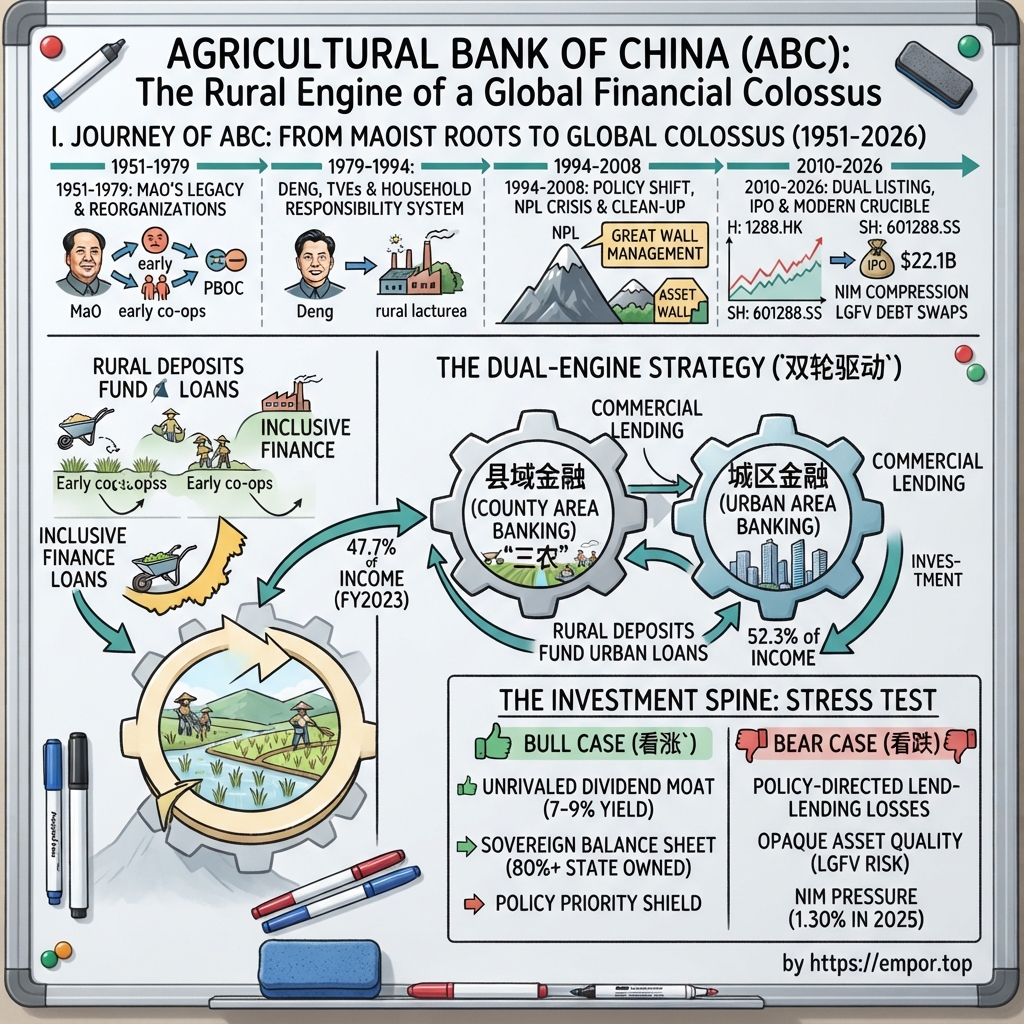
ABC is really two banks stapled together, and it reports them that way. There is 城区金融 urban area banking — corporate lending, mortgages, trade finance, treasury operations, the ordinary business of a very large commercial bank. And there is 县域金融 county area banking, the business ABC conducts through its 三农金融事业部 Sannong Finance Division across China's counties and county-level cities. 三农 Sannong is shorthand for agriculture, rural areas, and farmers — 农业、农村、农民 — and it is both a business segment and a political assignment. In 2025 the county segment generated RMB 359.7 billion of operating income, or 49.6% of the group total.1 Half of this bank, by revenue, operates in places where the other members of the Big Six either cannot or will not build a full-service branch.
The paradox to test
The consensus story about ABC among global income investors runs roughly like this: it is a sovereign-backed utility with an unassailable rural funding advantage, throwing off a high single-digit dividend yield, protected by state ownership from both competition and consequences. Much of that story is defensible. Parts of it are out of date — the H-share dividend yield, for instance, is no longer 8%; after a two-year re-rating it sits around 4.4%.31 And parts of it were never quite right: the rural network is not uncontested, the "self-funding fortress" has now returned to shareholders for capital twice in eight years, and the fastest-deteriorating part of the loan book in 2025 was not property or local government debt but the inclusive rural lending business that sits at the heart of the bull case.
The roadmap. Here is where this story goes.
First, the origin: a bank founded, abolished, refounded and abolished again as Beijing's ideology swung, which tells you something durable about what ABC actually is. Then the commercial conversion — the 1994 amputation of policy lending, the bad-debt reckoning of the late 1990s, and the state-engineered clean-up that made a listing possible.
Then the record-breaking 2010 dual IPO, and the strange afterlives of the men who ran it. Then the machine itself: how county deposits are gathered, priced, and redeployed, and where that advantage is genuinely widening versus where it is quietly narrowing.
Then the modern crucible of margin compression, property defaults, and the multi-trillion-renminbi local government debt swap. Then governance, the dividend, and the capital call. And finally, the war-game: what would actually have to break for the investment case to break with it.
 Subscribe on LinkedIn
II. Mao's Legacy and the Splits: The Origin of China’s Rural Banking (1951–1979) (15 mins)
Four foundings, three burials
Most great banks tell an origin story of continuity — a founding family, a first branch, an unbroken ledger. Agricultural Bank of China cannot. Its founding story is one of repeated institutional death.
The lineage begins in 1951, when the 农业合作银行 Agricultural Cooperative Bank was established as a specialised institution under the 中国人民银行 People's Bank of China to channel credit into a countryside that was being collectivised at speed.4 It lasted barely a year. In 1952 it was folded back into the central bank, its functions absorbed.4 In 1955 it was reconstituted, this time under the name Agricultural Bank of China, to finance the agricultural cooperatives then sweeping rural China. In 1957 it was merged into the PBOC again. In 1963 it was raised a third time, now reporting directly to the State Council. In 1965, it was merged into the central bank for the third time.4
Read those dates against the political calendar and the pattern is unmistakable. The bank appeared whenever Beijing wanted a dedicated instrument to push credit into the countryside, and disappeared whenever the leadership decided that credit allocation belonged inside a single monolithic central bank. It was not a company being restructured. It was a policy tool being picked up and put down.
The founding that stuck. The fourth attempt was the one that lasted. In 1979, as 邓小平 Deng Xiaoping's reform programme began, the State Council issued the notice re-establishing Agricultural Bank of China as a state specialised bank.4 The timing was not coincidental. The reform that defined the era was the 家庭联产承包责任制 household responsibility system, which broke the collective farm into household plots and let farmers keep and sell surplus output above their quota. Overnight, hundreds of millions of rural households became economic agents with their own income, their own savings, and — critically — their own need for seasonal working capital. Somebody had to bank them.
The TVE decade
What followed was one of the strangest and most productive credit expansions in modern economic history. The 乡镇企业 township and village enterprises — collectively owned factories and workshops sponsored by local governments — became the growth engine of the 1980s, absorbing surplus rural labour and producing everything from bricks to textiles to machine parts. They were not state-owned enterprises and they were not private firms; they occupied an ambiguous middle ground that made them hard to finance through any conventional channel. ABC, with branches in the counties where these enterprises actually operated, became a principal credit supplier to them.
This is where ABC's institutional DNA was set, and it matters for reading the bank today. Its branch network was not built to a commercial plan. It was built to an administrative map — one presence per county, following the geography of Chinese local government rather than the geography of profit pools. That is why ABC ended up with a physical footprint no competitor would rationally construct from scratch, and also why its cost structure has always been heavier than a purely urban bank's.
It matters in a second way too. Lending decisions in that era were not primarily credit decisions. A county branch manager extending working capital to a locally sponsored enterprise was executing policy, maintaining a relationship with the county government, and — somewhere down the list — assessing repayment capacity. Loan losses were not a failure of the system; they were an externality the system did not price. When the state later demanded that the bank become commercial, the accumulated cost of thirty years of that logic had to be recognised somewhere.
For investors, the takeaway from this period is not nostalgia. It is that ABC's franchise has always been granted rather than earned, and grants can be modified. The bank exists in its current form because the state decided in 1979 that it needed a rural credit conduit — the same logic under which it had been dissolved three times before. Every subsequent chapter, including the capital call of September 2026, is a variation on that theme. The bill for the TVE era came due in the 1990s.
III. The Break-up, the Bad Debts, and the Great Asset Management Clean-up (1979–2008) (20 mins)
Two contradictory instructions
Picture a bank being asked, in the space of five years, to do two contradictory things: stop lending on instruction, and start earning a return on a book that was almost entirely built on instruction.
The 1994 amputation
The first move was structural. In 1994 China created a set of policy banks to take over government-directed lending from the state commercial banks, and in April of that year ABC transferred most of its policy-related banking business to the newly founded 中国农业发展银行 Agricultural Development Bank of China (ADBC).45 Grain procurement financing, state reserve purchases, the genuinely non-commercial obligations of feeding a continent — those went to ADBC. ABC was left to become a commercial bank.
The logic was sound and the sequencing was brutal. The policy obligations left the balance sheet going forward; the loans made under those obligations in prior years stayed. ABC entered its commercial era carrying the credit consequences of a system it had not designed and could not have refused.
The reckoning
By the late 1990s the asset quality of China's state banks had become the central question of the country's financial reform, sharpened by the Asian financial crisis and by Beijing's determination to enter the World Trade Organization. The precise scale of ABC's non-performing book at its worst is not consistently disclosed in the bank's own historical filings, and figures that circulate in secondary literature vary widely — a caution worth carrying, because it is the same disclosure problem that recurs in the modern chapters of this story.
What is documented is the remedy. In 1999 the Ministry of Finance established four asset management corporations to absorb roughly RMB 1.4 trillion of bad loans from the major state banks.7 One of them, 中国长城资产管理公司 China Great Wall Asset Management, was created on November 2, 1999, specifically to take on Agricultural Bank's non-performing assets.8 ABC's own corporate history records the transfer plainly: in 1999, the bank "transferred its non-performing assets to China Great Wall Asset Management Corporation."4
There is a coda here that deserves a moment, because it is the kind of detail that recontextualises everything downstream. Great Wall AMC — the vehicle built to absorb ABC's bad debt — did not go on to a quiet and profitable life. In July 2025 it wrote off billions in accumulated losses and was consolidated under a larger state financial group.8 The bad loans did not evaporate when they left ABC's balance sheet. They moved to another state entity, sat there for a quarter-century, and eventually required their own resolution. When a modern investor reads that ABC's non-performing loan ratio is 1.27%, the honest question is not whether the number is accurate as reported. It is where, in a system with this many state balance sheets, the losses ultimately settle.
The 2008 recapitalisation
The last of the Big Four to be fixed was the hardest. In 2008 中央汇金投资有限责任公司 Central Huijin Investment injected assets equivalent to RMB 130 billion — roughly $19 billion — into ABC, and the State Council approved the joint-stock reform plan in October of that year.64 On January 15, 2009, Agricultural Bank of China Limited was formally established as a joint-stock company, assuming the assets, liabilities and business of its predecessor.4
Note the ownership architecture that emerged, because it has barely changed since. The Ministry of Finance and Central Huijin — itself a wholly state-owned company that holds equity stakes in China's key financial institutions on behalf of the State Council — became the two controlling shareholders. Huijin's mandate is explicitly passive on paper: it invests in state financial enterprises to preserve and increase state capital value, conducts no other commercial business, and states that it does not interfere in day-to-day operations.1 Whether a 40% shareholder that is also an arm of the State Council is meaningfully passive is a question minority investors have been answering for themselves ever since.
The analytical point for anyone underwriting ABC today: this bank has been recapitalised by the state twice — once via bad-debt transfer, once via direct injection — before it ever sold a share to the public. That history does not condemn the modern institution, which is far better run and vastly better capitalised. But it does establish a base rate. The claim "ABC generates enough capital internally to fund its own growth and dividend" is a claim about a bank whose entire pre-listing history consists of the state making up capital shortfalls. It needs to be tested against evidence, not assumed. By 2009, the clean-up was finished and the bank was, at last, sellable.
IV. The Last of the Big Four: The World-Record 2010 IPO (2008–2010) (20 mins)
The bake-off
In early April 2010, investment banks were summoned to pitch for the mandate of the decade. The bake-off ran across April 7 and 8; winners were announced on April 14; the kick-off meeting followed on April 16.12 Nine external bookrunners were eventually appointed — an unusually crowded syndicate, and a tell about how much distribution the issuer thought it would need.12
They needed it. ABC came to market as, in Euromoney's contemporaneous characterisation, China's weakest big bank.12 中国工商银行 ICBC had listed in 2006 with what was then the world's largest IPO; 中国建设银行 CCB and 中国银行 Bank of China had gone before that. ABC was last for reasons that were structural rather than incidental. Its network was enormous, geographically dispersed, and administratively fragmented — thousands of county-level outlets whose loan files, collateral records and internal controls had to be brought to a standard a Hong Kong prospectus could survive. The prospectus that resulted carried a substantial risk-factors section that visibly unsettled investors.12
And the market was hostile. The offering ran through the European sovereign debt crisis of mid-2010, when appetite for bank equity anywhere was thin.
The trade
ABC priced the H-share tranche at HK$3.20, above the midpoint of an HK$2.88–3.48 range, selling 25.4 billion shares for about $10.4 billion.109 The A-share tranche priced at RMB 2.68, at the top of a RMB 2.52–2.68 range, with 22.2 billion shares raising roughly $8.8 billion.9 The combined base deal was $19.2 billion, and the shares began trading in Shanghai and Hong Kong in mid-July 2010.9 When the over-allotment options were exercised, the total reached $22.1 billion — surpassing ICBC's 2006 offering to become the largest initial public offering in history at that time.11
Read the pricing carefully and it tells you what actually happened. The A-share book, sold to a domestic investor base with limited alternatives and a strong sense of what state policy wanted, priced at the very top of its range. The H-share book, sold to international institutions who could simply decline, priced above the midpoint but well short of the top. That gap is the single most durable fact about ABC as a listed security: two pools of capital, two views of the same asset, and a persistent valuation differential that has followed the shares for sixteen years. Even now, the Shanghai line trades at a premium to the Hong Kong line.
The men in the room
The IPO was chaired by 项俊波 Xiang Junbo, who had become ABC's chairman in January 2009. Day-to-day execution was run by 潘功胜 Pan Gongsheng, then an ABC vice president and a veteran of the ICBC listing.12
Their subsequent trajectories are worth sitting with, because they illustrate the incentive system inside a Chinese state bank more vividly than any governance chart. Xiang Junbo left ABC to chair the insurance regulator, and in 2017 was placed under investigation and expelled from the Communist Party; in June 2018 he pleaded guilty to taking bribes worth more than RMB 19.4 million.13 Pan Gongsheng went the other way entirely: to the PBOC as deputy governor in 2012, and in July 2023 to the governorship of China's central bank — which is to say, the institution that sets the loan prime rate whose successive cuts have been compressing ABC's margin ever since.
The executive who took ABC public now runs the monetary authority that determines its profitability. Nobody at the bank would describe that as a conflict; in the Chinese system it is simply how the career ladder works. For an outside investor, it is a precise illustration of why ABC's returns are set in Beijing rather than in a branch pricing committee.
Who actually owns this bank
The ownership structure that emerged from the listing has proved remarkably stable. As of December 31, 2025, Central Huijin held 40.14% of ABC's shares and the Ministry of Finance held 35.29%; the National Council for Social Security Fund held a further 6.72%, and Hong Kong Securities Clearing (Nominees) — the custodian through which most H-share holders sit — held 8.73%.1 State entities therefore control over 80% of the equity, and the free float that trades in Hong Kong is a minority sliver of a sovereign balance sheet.
That structure delivers something real: a funding cost and a depositor confidence that no privately owned bank in China can match. It also means that on any question where the interests of the state and the interests of minority shareholders diverge — the price of a policy loan, the timing of a capital raise, the size of a dividend — minorities do not have the votes. The 2010 prospectus said as much. Sixteen years of operating history have not contradicted it.
V. The Sannong Dual-Engine Strategy: Running the Rural Empire (25 mins)
What a county seat actually looks like
Go to a county seat in 甘肃 Gansu or 贵州 Guizhou and look for a bank branch. You will find an ABC outlet, almost certainly. You may also find a 邮储银行 Postal Savings Bank counter inside the post office, and a local 农村商业银行 rural commercial bank. What you will generally not find is a branch of a joint-stock commercial bank from Shenzhen. The unit economics do not work, and they never have.
That asymmetry is the foundation of ABC's franchise, and it deserves to be understood mechanically rather than romantically.
The deposit factory
Start with what the county network actually produces. At the end of 2025, the county segment held RMB 14.38 trillion of customer deposits against RMB 10.94 trillion of gross loans — a loan-to-deposit ratio of 76.04%.1 The segment gathers substantially more funding than it can lend locally, and the surplus is transferred internally to the rest of the bank. The accounting makes this visible: RMB 4.22 trillion of the county segment's assets sit as "placements within the system," and the segment earned RMB 189.5 billion of internal interest income during 2025 for supplying that funding to other divisions at internally set transfer prices.1
That is the dual-engine strategy in one sentence. The countryside is not primarily where ABC makes loans. It is where ABC manufactures cheap money, which the urban bank then deploys.
How cheap? The county segment's average deposit cost in 2025 was 1.28%.1 For a bank of ABC's size that is a formidable structural position, and it is the single most defensible element of the bull case. Rural depositors in China hold savings for precautionary reasons, have limited access to competing products, and rarely move accounts. Management leans on this heavily and can point to a hard metric: ABC's deposit deviation ratio — a regulatory measure of how much a bank's deposit balances spike around period-end, and therefore a proxy for how much of the base is genuinely stable versus rented for a reporting date — was 0.58% at the end of 2025, which the bank stated was the best among comparable peers and the only one below 3% for seven consecutive quarters.1 By the August 2026 interim call, management extended that record to nine consecutive quarters.15
The stickiness test, run for real
The best evidence for a funding moat is not that deposits are cheap. It is that a bank can make them cheaper without losing them. Through 2025 and 2026, ABC repriced maturing time deposits downward aggressively — by up to 135 basis points on some maturing tranches, according to management on the August 2026 call — and average daily core deposits still grew by RMB 3.67 trillion to RMB 29.59 trillion.15 Depositors were offered materially less and stayed.
That is a genuine, evidence-backed advantage. It is also, importantly, a shared advantage rather than a unique one, which is where the popular version of this story overreaches.
The network claim, tested
ABC ended 2025 with 23,128 domestic branches and institutions, including 19,313 basic-level outlets, and 457,835 employees.1 It has been the only major state bank expanding its branch count while peers shrink theirs — ABC added 34 outlets in 2024 while ICBC cut 130, Postal Savings cut 140, CCB cut 89 and Bank of China cut 20.32 In 2025 it relocated 179 outlets into townships and built 1,742 rural service stations.1 Management describes ABC as the only bank achieving full county coverage.28
But "largest branch network in rural China" is not the same claim, and it is not ABC's. Postal Savings Bank operated 39,224 outlets at the end of 2024 — over 70% more than ABC — through its self-operated plus postal-agency model, with the overwhelming majority in county areas and below.32 Add the thousands of rural commercial banks and rural credit cooperatives that dominate lending in many individual counties, and the picture changes: ABC's county position is strong, contested, and structurally different from a monopoly. What ABC uniquely combines is county-wide physical coverage plus the balance sheet, product range and technology budget of a global systemically important bank. Postal Savings has the outlets but a materially smaller asset base; the rural commercial banks have local knowledge but no scale. That narrower claim survives scrutiny. The monopoly claim does not.
The digital rural credit engine
The most interesting operational development of the past five years is 惠农e贷 Huinong e-Loan, ABC's digital lending platform for farming households. The mechanics are worth explaining plainly, because they are the difference between inclusive finance as charity and inclusive finance as a business. Traditionally, lending RMB 100,000 to a farmer required a loan officer to visit the household, assess the crop, verify the land contract, and manually build a file — a cost structure that made small rural loans unprofitable at any tolerable interest rate. Huinong e-Loan replaces that with bulk pre-scoring: ABC works with village committees and local government data to build household credit files for an entire village at once — the "whole-village advancement" approach — then lets qualified farmers draw pre-approved credit through mobile banking. The marginal cost of the loan collapses.
The scale is now substantial. The Huinong e-Loan balance reached RMB 1.84 trillion at the end of 2025, up 22.9% in a year and quadrupled over the course of the 14th Five-Year Plan.1 The county mobile banking business had 130 million monthly active users.1 Total inclusive loans reached RMB 4.35 trillion, with the micro and small enterprise portion at RMB 3.93 trillion across 5.24 million borrowers.1 By mid-2026 county loans had grown to RMB 11.92 trillion and Huinong e-Loan to RMB 2.1 trillion.15
Where the advantage is narrowing
Now the disconfirming evidence, which belongs right here rather than in a distant risk section. The county segment's average loan yield fell 54 basis points in 2025, to 3.00%, while its deposit cost fell only 26 basis points.1 The asset side is repricing down roughly twice as fast as the liability side. The segment's cost-to-income ratio rose from 33.54% to 34.19%.1 And county segment pre-tax profit grew just 1.2% on revenue growth of 3.0%.1
So the rural engine is still growing its balance sheet at a double-digit rate and still funding the rest of the bank at an enviable cost — but its own profitability is being squeezed from both directions, and the squeeze is arriving faster on the lending side than the relief is arriving on the funding side. The correct version of the moat claim is therefore narrower than the consensus one: ABC's county franchise is a durable low-cost funding advantage of contested but real value, currently generating declining marginal profitability. The metric that would confirm or falsify a stabilisation is the gap between the county loan yield and the county deposit cost, disclosed twice a year in the segment tables. In 2024 that gap was 200 basis points. In 2025 it was 172.1 That is the number to watch, and it leads directly into the margin story.
VI. The Regulatory Squeeze: Net Interest Margin Compression & The Policy Mandate (2020–2026) (25 mins)
The spread, explained simply
A bank's net interest margin is the simplest idea in finance dressed in the dullest language. It is the spread between what the bank earns on everything it owns and what it pays on everything it owes, expressed against its earning assets. For most of the modern era, China's large banks operated on a spread of well over two percentage points. That era has ended.
ABC's margin fell from 1.60% in 2023 to 1.42% in 2024 and 1.28% in 2025 — 32 basis points of compression in two years.1 On a RMB 48 trillion balance sheet, each basis point is real money.
The mechanism, in plain terms
Three forces are pushing in the same direction. First, the PBOC has repeatedly cut the loan prime rate, the benchmark to which most corporate and mortgage lending is linked. Existing floating-rate loans reprice downward, typically at the turn of the year, so a cut delivered in one year keeps depressing income in the next. Second, banks were directed to lower interest rates on outstanding mortgages to relieve household debt burdens and support a weak property market — an income transfer from bank shareholders to homeowners, executed by administrative guidance rather than by market pricing. Third, the composition of new lending shifted toward the categories policy favours — agriculture, small enterprises, green projects, technology — which carry lower rates and, in many cases, higher servicing costs.
ABC quantified the split for 2025 with unusual clarity: balance-sheet growth added RMB 44.0 billion to net interest income, while rate movements subtracted RMB 55.1 billion.1 Growing the balance sheet by 12.8% was not enough to offset the price decline. Net interest income fell 1.9% to RMB 569.6 billion, and still accounted for 78.5% of revenue.1
How the profit actually got made
This is where an independent reading diverges from the standard summary. ABC's 2025 operating income rose 2.1% to RMB 725.3 billion and net profit rose 3.3% to RMB 292.0 billion.12 The natural assumption is that costs were cut. They were not. Operating and administrative expenses rose 4.4% to RMB 255.1 billion, faster than revenue, pushing the cost-to-income ratio up from 34.40% to 35.18%.1 Return on average assets fell from 0.68% to 0.63%, and weighted average return on equity from 10.46% to 10.16%.1
The profit growth came from three other places. Fee and commission income rose 16.6% to RMB 88.1 billion, driven by wealth management, where personal financial assets under management reached RMB 24.7 trillion.12 Other non-interest income rose 24.6% to RMB 67.6 billion. Credit impairment charges fell 2.8% to RMB 127.2 billion.1 And — the least-discussed item — the income tax charge fell 13.3% to RMB 31.7 billion, taking the effective tax rate from roughly 11.4% to 9.8%.1 That decline is a mechanical consequence of the balance sheet's composition shifting toward tax-exempt government bonds: financial investments grew 17.9% in 2025 versus 9.2% for net loans, and holdings of treasury and special treasury bonds rose to 32.73% of the investment portfolio from 21.84% a year earlier.1
Put the pieces together and the honest description of 2025 is this: pre-tax profit grew 1.4%; net profit grew 3.3% because the tax rate fell; and the balance sheet grew 12.8% substantially by buying government bonds rather than by making loans.1 None of that is improper — buying sovereign bonds when credit demand is weak is what prudent banks do. But it is a materially different story from "profit growth driven by cost control," and an investor should know which engine is turning.
The stabilisation claim, and its early test
On the results call for 2025, management asserted that net interest income had turned positive year-on-year in early 2026 and framed this as an inflection point.16 That is a falsifiable claim, and 2026 has so far partly supported it. First-quarter revenue rose 10.49% to RMB 206.3 billion with net profit attributable to shareholders up 4.52% to RMB 75.2 billion, though the quarterly margin still slipped to 1.26%.18 By the first half, revenue was RMB 411.1 billion, up 11.2%, net profit RMB 148.1 billion, up 5.8%, and the margin had recovered two basis points from the first quarter to 1.28%.1715
Two things should temper enthusiasm. Double-digit revenue growth against low-single-digit profit growth means the incremental revenue is arriving with heavy associated costs or provisions attached; net interest income remained 75.9% of first-half revenue, so the outsized growth came disproportionately from non-interest lines that are inherently more volatile.17 And a two-basis-point sequential improvement is a data point, not a trend.
What management says, and what analysts push on
Chairman Gu Shu used the annual shareholders' meeting on June 26, 2026 to lay out what he called three pillars of sustainable profitability: finding genuine credit demand, growing financial investment income, and a strengthened risk foundation.28 He argued that ABC's county coverage lets it deploy roughly RMB 400 billion more in incremental annual lending to the real economy than the peer average, and expressed confidence in overall margin stability through 2026.28
The analyst questions on the August 2026 call went straight at the mechanics rather than the rhetoric. 中信证券 CITIC Securities pressed on the deposit repricing runway — how much more funding cost relief remains. JPMorgan asked about the retail franchise and, separately, about the concrete application of AI, which management answered by describing credit-process automation, an internal risk assistant, mobile banking with more than 280 million users, and the integration of DeepSeek and Qianwen models into staff workflows.15 Those are specific answers, which is a point in management's favour; they are also, so far, cost-efficiency answers rather than revenue answers, and ABC's rising cost-to-income ratio suggests the efficiency gains have not yet outrun the expense growth.
The credible conclusion: ABC's margin decline has decelerated and may be bottoming, but the evidence for a genuine inflection is two quarters old and partly flattered by a lower tax rate and by volatile investment income. That leads to the question of what the loan book itself is actually worth.
VII. The Balance Sheet Under Fire: Real Estate and LGFV Stress Tests (25 mins)
The trade that was only half right
When 中国恒大集团 China Evergrande Group defaulted and 碧桂园 Country Garden followed it into distress, the reflexive global trade was to short Chinese bank equity. The reasoning seemed airtight: property was the collateral underneath the entire credit system, so property's collapse had to detonate the banks.
Six years on, that trade has been at best partially right, and understanding why is essential to sizing what remains.
The property exposure, sized honestly
ABC's corporate loans to the real estate industry stood at RMB 874.3 billion at the end of 2025, which was 5.6% of its corporate loan book, down from 6.1% a year earlier.1 The non-performing ratio on those loans was 5.40% — unchanged from 2024, and roughly four times the group average.1 The developer book is genuinely bad. It is also small: those loans generated RMB 47.2 billion of non-performing balances, or 22.3% of all corporate NPLs from 5.6% of corporate loans.1
The analytical conclusion is that the bears were right about the asset and wrong about the arithmetic. A concentrated, high-severity loss in a portfolio that represents roughly one-thirtieth of the balance sheet does not sink a bank earning RMB 292 billion a year. Note also what did not happen in 2025: the developer NPL ratio did not improve. The property problem at ABC has stopped growing without healing.
The LGFV question and the great swap
The exposure that always worried sophisticated analysts more was 地方政府融资平台 local government financing vehicles — the off-balance-sheet companies through which Chinese local governments borrowed to build infrastructure, historically serviced out of land sales. When land sales in lower-tier cities collapsed, the debt service assumption collapsed with them. ABC, as the leading financier of county-level infrastructure in exactly the poorer interior provinces where land markets fell hardest, sat close to the centre of that risk.
Beijing's answer was not a bailout but a refinancing. In November 2024 the National People's Congress approved a package worth RMB 10 trillion to let local governments swap hidden debt into formal government bonds — RMB 6 trillion in raised debt ceilings over three years, plus RMB 800 billion a year of special-purpose bonds for five years.25 Mechanically, an opaque, high-rate LGFV bank loan is replaced by a transparent, low-rate local government bond.
The trade-off for a bank is precise and worth stating plainly. Interest income falls, because the bond pays far less than the loan did — bonds issued under the programme carried interest rates more than 2.5 percentage points below the debt they replaced. In exchange, the bank receives an instrument with a 20% regulatory risk weight instead of the 75%–100% applied to corporate loans, which frees capital, and it faces a far lower probability of default, which reduces future provisions.26 ABC's own disclosure describes the process in policy language: implementing debt-resolution policy, resolving stock debt risk on market-based and law-based principles, and advancing the orderly exit of financing platforms.1 The bank does not disclose a specific LGFV exposure figure — a material gap for anyone trying to size the residual risk independently, and one that should be named as such.
Some of the margin compression traced in the previous section is therefore not weakness at all; it is the price of de-risking, paid in yield. That is a genuinely favourable trade for a long-term holder, and it partly explains how the group NPL ratio kept falling — 1.33% in 2023, 1.30% in 2024, 1.27% in 2025, and 1.25% by June 2026, a fifth consecutive quarterly decline, with provision coverage of 292.55% at year-end 2025 easing to 290.10% at mid-2026.115
The threat nobody was watching
And now the part of the 2025 accounts that deserves far more attention than property or LGFVs.
While the corporate NPL ratio fell from 1.58% to 1.37%, ABC's personal loan NPL ratio rose from 1.03% to 1.34%.1 In absolute terms, retail non-performing loans grew from RMB 91.2 billion to RMB 124.3 billion, and personal loans went from 28.4% of the bank's total NPLs to 36.2%.1 Within retail, the deterioration was concentrated exactly where the growth story lives: 个人经营类贷款 personal business loans — the operating loans extended to farmers, individual proprietors and micro-business owners, which is what the inclusive finance and Huinong e-Loan machinery mostly produces — saw their NPL ratio jump from 1.39% to 1.85%, with the non-performing balance rising from RMB 34.7 billion to RMB 55.2 billion, an increase of nearly 60% in one year.1 Mortgage NPLs rose from 0.73% to 0.92% and credit card delinquencies from 1.46% to 1.88%.1
Two supporting disclosures sharpen the picture. Stage-three personal loan balances — the accounting bucket for credit-impaired exposures — increased roughly 36% during 2025.1 And within the five-category loan classification, the worst bucket, loss-category loans, rose from RMB 55.8 billion to RMB 141.5 billion while the doubtful category fell, with RMB 92.8 billion written off during the year.1 ABC was moving impaired exposures rapidly into the terminal bucket and charging them off — which is conservative classification behaviour, and simultaneously evidence that real losses were being realised rather than deferred.
Place this directly against the claim made in the previous section. The digital rural lending platform grew 22.9% in 2025 and the inclusive book grew 20.9%, while the NPL ratio on precisely that category of borrower rose 46 basis points. The two facts are not necessarily contradictory — a fast-growing book mechanically has a young loan cohort whose losses emerge later, which can flatter the ratio early and then catch up. But that is exactly the pattern that ought to make an analyst cautious rather than reassured. The bank's own commentary acknowledges the issue obliquely, referencing the construction of a new management system for inclusive retail credit; on the August 2026 call, management addressed inclusive retail risk controls in response to a direct question about asset quality.115
So the calibrated conclusion on asset quality is this. The headline NPL ratio is falling for real, helped by corporate de-risking and by an enormous debt swap that traded yield for safety. Property is contained but not cured. LGFV exposure is being converted into sovereign-linked paper at a cost that shows up in the margin. And the actual frontier of credit risk has migrated to the household and micro-business book that the growth narrative depends on. Whether ABC's inclusive-finance engine is a durable profit centre or a delayed credit problem is, at this point, genuinely unresolved — and it is the question that determines whether the dividend machine described next is as sturdy as it looks.
VIII. Management, Governance, and the Dividend Machine (20 mins)
The balance-sheet engineer
谷澍 Gu Shu did not arrive at Agricultural Bank as a rural banker. He arrived as ICBC's most senior financial technician. Holding a doctorate in economics from 上海财经大学 Shanghai University of Finance and Economics and qualified as a senior accountant, he built his career inside ICBC as general manager of financial accounting, then board secretary, then vice president and president, before taking ABC's executive directorship in January 2021 and the chairmanship in February 2021.29 He also serves as president of the China Banking Association and chairs the dealers' association of the China Foreign Exchange Trade System — the kind of concurrent industry roles that mark a banker as part of the policy apparatus rather than merely subject to it.29
That background shows in how he talks. Gu's framing at the 2026 shareholders' meeting — three pillars, a claim about the "core competency" of unearthing genuine credit demand, a specific quantification of ABC's incremental lending advantage — is the language of a balance-sheet engineer, not a salesman.28
His president, 王志恒 Wang Zhiheng, brings a different lineage: a master's in economics from 南开大学 Nankai University and a career spanning senior human resources and regional roles at Bank of China before serving as president and executive director of 中国光大银行 China Everbright Bank. He became ABC's president in June 2024, vice chairman and executive director in September 2024, and additionally took the role of chief compliance officer in February 2026.30
That last appointment deserves a flag rather than a verdict. Chinese regulation requires large banks to designate a chief compliance officer; vesting the role in the chief executive rather than an independent officer is permissible and common, but it concentrates responsibility for compliance oversight in the person whose business decisions compliance is meant to check. It is a governance judgement an investor should note, alongside a second structural change: following the revised Company Law, ABC eliminated its 监事会 board of supervisors entirely, transferring its statutory powers to the board's audit committee and abolishing the supervisors' office.1 Streamlining or a reduction in independent oversight, depending on your priors — but a real change in the machinery.
The incentive structure
Neither man is a founder-operator with meaningful equity. Both are senior state cadres running a state financial institution, with compensation constrained by state pay rules and career outcomes determined by the Party's organisation apparatus rather than by total shareholder return. The practical consequences are predictable and mostly stabilising: strategy does not lurch, empire-building acquisitions are rare, and risk appetite runs conservative.
The governance record is not spotless, and the failures are recent enough to matter. Beyond Xiang Junbo's conviction, 娄文龙 Lou Wenlong, a vice president of ABC from December 2012 to April 2017, was placed under investigation in May 2024 and expelled from the Party for corruption that November.14 Two former ABC senior executives disciplined for corruption within a decade is a real data point about internal controls at the very top of an institution with nearly half a million employees, even in the context of a system-wide financial anti-corruption campaign.
The dividend, and what it is now worth
ABC has paid out 30.0% of profit attributable to shareholders in each of 2023, 2024 and 2025 — a genuinely consistent record, not merely a stated policy.1 For 2025 that meant RMB 2.495 per ten shares in total, split between an interim distribution of RMB 1.195 paid in December 2025 and a final of RMB 1.300 approved at the April 2026 shareholders' meeting, for RMB 87.3 billion in aggregate.1 With the 2026 interim results, the board proposed lifting the payout ratio by a percentage point to 31%, declaring RMB 0.1297 per share.1915
Now the correction the consensus needs. The familiar description of ABC as a 7%–9% yield instrument is a description of the past. The H-shares have re-rated substantially; at HK$6.28 in early September 2026, the trailing dividend yield was approximately 4.4%.31 The dividend has grown steadily. The price has grown faster. Investors who bought the yield in 2023 have been rewarded through capital appreciation, but the security available today is a materially different one — a mid-single-digit yield rather than a high-single-digit one, on a stock trading closer to its book value than at the deep discount that defined the trade.
The capital call, and what it says about the fortress
Which brings us back to September 2026, and to the claim that most needs testing: that ABC's dividend is funded from a self-sustaining capital base.
The record says otherwise. ABC's core tier-1 capital ratio fell during 2025, from 11.42% to 11.08%, even as the total capital ratio slipped from 18.19% to 17.93%.1 Growing assets 12.8% while earning a 0.63% return on them and distributing 30% of profit is arithmetically self-defeating: the balance sheet compounds faster than retained earnings can support it. Something had to give.
What gave was the share count — for the second time in eight years. In 2018 ABC raised RMB 100 billion through what was then the largest A-share private placement by a Chinese commercial bank, issuing about 25.19 billion new A-shares to a group including the Ministry of Finance, Central Huijin and China National Tobacco, with regulatory approval granted that year.12434 The September 2026 placement is the same play at greater scale and with the same cast.20 It follows the March 2025 round in which the Ministry of Finance deployed RMB 500 billion of special treasury bond proceeds into Bank of China, China Construction Bank, 交通银行 Bank of Communications and Postal Savings Bank — a round from which ABC was excluded.22 The 2026 round, announced on September 7, covers RMB 300 billion of special treasury bonds across eight state financial institutions including ABC and ICBC, supplemented by roughly RMB 60 billion from China National Tobacco entities.21
Two nuances keep this from being straightforwardly value-destructive. First, in the 2025 round the four recapitalised banks priced their placements at premiums to market of between 8.8% and 21.5%, because state financial enterprises are generally required to issue at or above net asset value per share.23 ABC's stated net assets per share were RMB 7.91 at the end of 2025 while its A-shares traded around RMB 6.74 in early September 2026 — so state subscribers would likely again pay well above the market price, which is accretive to book value per share for existing holders even as it dilutes earnings per share. Second, the disclosed dilution to 2026 earnings per share is small, at roughly 0.54%, largely because the issue is expected to complete late in the year.20 The full-year effect in 2027 will be larger.
But the structural point stands, and an activist would press it hard: ABC distributed RMB 87.3 billion of dividends for 2025, roughly three-quarters of which went to state shareholders, and is now receiving RMB 130 billion of new equity from the Ministry of Finance. Money is going out the front door to the state and coming back in the side door from the state, with minority holders' claim on the enterprise diluted along the way and the payout ratio raised in the same year. Whether that is prudent capital management or circular accounting depends entirely on whether ABC's asset growth is genuinely value-creating at a 0.63% return on assets — a question the bank's own falling returns on assets and equity leave open.
The honest verdict on the dividend fortress: the payout is highly likely to be maintained, because the controlling shareholder is also the principal recipient and has every reason to keep the distribution flowing. But it is not self-funded from internally generated capital, and describing it as a fortress overstates a structure that has now required external equity twice. The confirming or falsifying metric is simple and public: whether the core tier-1 ratio stops declining after the placement lands.
IX. The Playbook: Porter's 5 Forces & Hamilton Helmer's 7 Powers (20 mins)
Running the frameworks, honestly
Strip away the state ownership and run ABC through the standard strategy frameworks, and something interesting happens: the frameworks mostly work, but several of them invert.
Threat of new entrants: genuinely low. Nobody is starting a new nationwide bank in China. Licensing is controlled, capital requirements are enormous, and the internet-finance experiment of 2015–2020 ended with regulators sharply constraining online microlending and forcing the fintech platforms into bank-like capital rules. This force is as close to nil as any industry offers.
Bargaining power of buyers: the inversion. The conventional reading says ABC's borrowers — a farmer in 河南 Henan, a small proprietor in 云南 Yunnan — have no leverage. Individually, true. But that framing misidentifies the buyer. ABC's most important customer is the state, which purchases policy outcomes: credit to agriculture, to small enterprises, to green projects, to strategic technology. And that buyer sets the price. The mandated reduction in outstanding mortgage rates, the successive loan prime rate cuts, and the LGFV debt swap are all instances of the dominant customer unilaterally repricing the product downward. On this reading, buyer power at ABC is not low — it is close to absolute, exercised by a single counterparty that is also the controlling shareholder.
Bargaining power of suppliers: low, and empirically so. Depositors are the suppliers of ABC's raw material, and the repricing evidence discussed earlier — up to 135 basis points cut from maturing time deposits while core deposits grew by RMB 3.67 trillion — is about as clean a demonstration of low supplier power as a bank can produce.15 This is the strongest force in ABC's favour and it is documented rather than asserted.
Threat of substitutes: rising, and under-appreciated. 支付宝 Alipay and 微信支付 WeChat Pay took payments, not deposits, and regulation subsequently curbed their credit ambitions. The live substitution risk today is different: as deposit rates fall toward 1%, Chinese savers migrate toward bond funds, insurance products and wealth management. ABC has partly internalised this — fee income from wealth management was the strongest revenue line in 2025 — but the migration converts high-margin deposit funding into lower-margin fee revenue. Substitution here does not destroy the customer relationship; it degrades its economics.
Competitive rivalry: high, and increasingly fought on ABC's home turf. The Big Six compete for the same policy-favoured lending categories with the same regulatory constraints, which compresses pricing toward a floor. In county markets specifically, Postal Savings Bank's larger outlet count and the rural commercial bank system make ABC's home market crowded rather than protected. The differentiator is not presence; it is the combination of presence with national-scale balance sheet and technology.
Turning to Hamilton Helmer's framework, and being disciplined about which powers actually hold:
Cornered resource — narrowed, not rejected. ABC's county network cannot be replicated by a Shenzhen joint-stock bank at any sensible cost. But it has been replicated, in outlet terms and then some, by Postal Savings Bank operating a different model. The defensible version: ABC holds the only full-county physical network attached to a balance sheet large enough to serve county governments, agribusiness and infrastructure at scale. That is narrower than a cornered resource and closer to a strong, contested position.
Scale economies — contradicted by the data. The theory says RMB 48.78 trillion of assets should spread fixed costs and drive down unit cost. The evidence says the opposite is happening: cost-to-income rose in both the group and the county segment in 2025.1 The likeliest explanation is that ABC is simultaneously investing in digital capability and maintaining the most expensive physical distribution network among the Big Four, while revenue growth is suppressed by policy pricing. Until cost-to-income turns down, scale economies at ABC should be treated as a hypothesis rather than a power.
Switching costs — real, and measurable. The deposit deviation ratio and the demonstrated tolerance of repricing constitute genuine evidence of customer inertia. Additionally, ABC reported 905 million personal customers by mid-2026 and 280 million individual social security card users, with wealth assets under management around RMB 25 trillion.15 Payroll relationships, pension distribution and government subsidy disbursement create the kind of administrative entanglement that is far stickier than brand preference.
Government-enforced privilege — double-edged, and the crux of the whole case. ABC enjoys advantages no private bank can obtain: an implicit sovereign guarantee on its liabilities, ratings of A/A-1 from S&P, A1/P-1 from Moody's and A/F1+ from Fitch that sit far above what its standalone financials would earn, targeted policy support for rural lending, and privileged access to state recapitalisation.1 The same privilege obliges it to lend at administered prices, to absorb policy costs, and to issue equity on the state's timetable. Helmer's frameworks assume a firm captures the surplus its power creates. ABC's most powerful advantage comes with a standing claim on that surplus by the entity that granted it.
The war-game conclusion: ABC's competitive position is strong on the liability side and structurally constrained on the asset side. It wins the funding contest and does not control the pricing of what it does with the funding. Any thesis for the stock has to be a thesis about that trade.
X. The Investment Spine: Bull Case, Bear Case, and Critical KPIs (20 mins)
The argument across the table
Set the frameworks aside and reduce this to the arguments a serious investor would actually have across a table.
Why ABC wins from here
The bull case has three legs, and each carries different evidentiary weight.
The strongest is the funding position. This is not a narrative claim — it is demonstrated by the deposit repricing experiment run at scale over two years, and it is worth more in an environment of falling rates than in a rising one, because ABC's ability to cut what it pays is the primary mechanism by which margin stabilises. Management's assertion that liability cost relief has further to run through 2026 is the single most consequential forward statement the company has made, and it is directly testable each quarter.15
The second is the policy alignment. ABC is not fighting the direction of Chinese economic policy; it is the instrument through which parts of it are executed. Under 乡村振兴 rural revitalization and 共同富裕 common prosperity, the lending categories ABC dominates are the categories the state most wants funded. That does not guarantee profitability — the last three sections have shown it often costs profitability — but it does substantially reduce the probability of the kind of tail event that destroys a bank, and it explains why credit ratings sit where they do.
The third is the de-risking trade, which is real and under-appreciated. Swapping opaque local government loans for sovereign-linked bonds lowers yield and lowers risk simultaneously. An investor whose horizon is a decade should prefer that trade to the alternative.
What breaks the case
The bear arguments that survive scrutiny are narrower than the popular ones, and correspondingly more serious.
Policy-directed pricing has no floor that shareholders control. If the loan prime rate continues down and deposit repricing runs out of room, the margin resumes falling. ABC has no pricing autonomy to defend itself. The mechanism is not speculative — it has already delivered 32 basis points of compression across two years.
The inclusive-finance book is a genuine unknown. The sharp rise in personal business loan delinquency, alongside the near-tripling of loss-category loans and RMB 92.8 billion of write-offs, is the most concrete negative datapoint in the 2025 accounts.1 The bull case treats the digital rural lending platform as a high-margin growth engine. Its first real credit cycle is running now.
Disclosure gaps are structural, not accidental. ABC does not quantify LGFV exposure. The five-category classification is a supervisory framework, not an audited market valuation. And the state's willingness to move losses between its own balance sheets — as it did with Great Wall AMC — means reported credit metrics carry an irreducible measurement uncertainty that no amount of ratio analysis resolves.
Dilution is not a risk; it is a pattern. The 2018 placement and the 2026 placement bracket eight years and RMB 260 billion of externally supplied common equity, with core tier-1 still declining in the interim. An investor should model periodic state recapitalisation as a feature of owning this security rather than as a tail event — while noting that the state's obligation to price at or above book value materially softens the economic damage relative to an ordinary dilutive raise.
And the valuation cushion has thinned. The re-rating that carried the H-shares to roughly HK$6.28 and compressed the yield to around 4.4% consumed a large part of the margin of safety that made this an obvious income trade three years ago.31 The business has improved less than the multiple has.
The activist's list
A skeptical investor with a seat at the table would push on four things: the absence of quantified LGFV disclosure; the simultaneity of a raised dividend payout and a RMB 160 billion equity call from the controlling shareholder; the combination of the president and chief compliance officer roles alongside the abolition of the board of supervisors; and the absence of any disclosed return-on-capital hurdle governing 12.8% annual balance sheet growth at a 0.63% return on assets. None of these is likely to be changed by minority pressure. All of them are legitimate.
One ownership footnote worth noticing
During 2025, Central Huijin's shareholding did not change — the October 2023 episode in which Huijin bought 37.3 million ABC A-shares as part of a market-stabilisation exercise across the Big Four was an event, not an ongoing bid.271 The marginal buyer of ABC's A-shares in 2025 was 中国平安人寿保险 Ping An Life, which added roughly 5.79 billion shares to reach a 1.67% stake.1 That is a commercial insurer allocating long-duration liabilities into a high-yielding, capital-light equity — a more informative signal about the security's appeal to real money than a state stabilisation purchase, and one that has a rational limit if the yield keeps compressing.
The three KPIs that matter
Three metrics, published on a regular schedule, will settle most of the arguments above:
First, the net interest margin — and specifically the county segment's loan yield versus deposit cost gap. The group margin is the headline; the county spread is where the moat either holds or erodes, and it is disclosed in the segment tables of every annual report.
Second, the personal business loan NPL ratio. This single line in the loan quality table is the cleanest read on whether inclusive rural lending is a durable profit engine or a maturing credit problem. It is the number that would falsify the growth story fastest.
Third, the core tier-1 capital ratio, read alongside the payout ratio. Together they answer whether ABC can fund its own growth and its own dividend. If core tier-1 resumes declining after the 2026 placement is absorbed, the recapitalisation cycle is structural rather than one-off.
Provision coverage near 290% and the group NPL ratio are worth monitoring, but both are heavily influenced by classification and write-off timing, and neither has been the leading indicator in this cycle. The three above have been.
XI. Epilogue & Outro (10 mins)
A shell, not a strategy
There is a small, quiet fact in the public record that captures something about where Agricultural Bank of China has arrived. On September 20, 2025, Agricultural Bank of China (UK) Limited — incorporated in London on September 24, 2010, two months after the record-breaking listing, and authorised by the Financial Conduct Authority — was formally dissolved.33
It is tempting to read this as a decisive strategic retreat from global ambition, and some commentary has. The record does not support that reading. The UK subsidiary's last filed accounts were made up to December 31, 2018, and its last confirmation statement dated September 2019 — meaning the entity had been effectively dormant for years before the paperwork caught up.33 Nor has ABC withdrawn from international banking: it still operated 13 overseas branches and four overseas representative offices at the end of 2025, and management reported RMB 3.82 trillion of cross-border renminbi settlement volume for the year.116 What was dissolved was a shell, not a strategy. The accurate statement is narrower and duller: ABC's international footprint is modest relative to its size and is not where management is spending its attention.
Where management is spending attention is visible in the operating plan. On the August 2026 call, executives committed to adding 2,000 township and county service points during the year, described a "one county, one product" localisation approach, and outlined an AI programme spanning credit decisioning, risk identification and staff support.15 Those are the priorities of an institution doubling down on the thing it already does rather than searching for a second act.
What it is, and what it isn't
The arc, then, runs from an administrative organ that Beijing created and dissolved four times, through the TVE credit boom whose losses the state absorbed twice, through the largest IPO the world had seen, to a bank of RMB 51 trillion in assets by mid-2026 that generates half its revenue in China's counties, holds 905 million personal customers, and has just asked its controlling shareholder for RMB 160 billion of fresh equity.171520
For an investor, the useful way to hold Agricultural Bank of China is not as a growth compounder and not quite as a bond proxy either. It is a leveraged claim on China's rural and county economy, run by capable state technicians, funded by the most durable deposit base in the country, priced by policy rather than by markets, and periodically recapitalised by its majority owner. The funding advantage is real and evidenced. The margin pressure is real and only tentatively stabilising. The credit risk has migrated from the headlines to the household book, where it is still being discovered. And the yield that once made the case obvious has been substantially arbitraged away by the market's own re-rating.
The bank has survived four foundings, two state clean-ups and one property collapse. What it has never yet done is generate enough capital internally to grow at the rate the state expects while paying the dividend the state receives. Whether it can start doing so — or whether periodic capital calls are simply the cost of owning a piece of sovereign infrastructure — is the question that the next several annual reports will answer.
References
-
Agricultural Bank of China Limited 2025 Annual Report (A-share code 601288) — Agricultural Bank of China, 2026-03-30 ↩↩↩↩↩↩↩↩↩↩↩↩↩↩↩↩↩↩↩↩↩↩↩↩↩↩↩↩↩↩↩↩↩↩↩↩↩↩↩↩↩↩↩↩↩↩↩↩↩↩↩↩↩
-
AgBank leads China's big five lenders in annual profit rise — The Standard, 2026 ↩
-
China Injects RMB130 Billion in State-Owned Bank — China Briefing, 2008 ↩
-
Resolution of Non-Performing Loans in China — Min Xu, NYU Stern ↩
-
China's Great Wall AMC Wipes Out Billions in Losses, Consolidates Under State Giant — Caixin Global, 2025-07-04 ↩↩
-
Agricultural Bank of China prices record-breaking $19.2 billion IPO — Renaissance Capital, 2010 ↩↩↩
-
ABC sets H-share IPO price at HK$3.2 — China Daily, 2010-07-09 ↩
-
Agricultural Bank of China Sets IPO Record with $22.1 Billion Boosted Sale — Bloomberg, 2010-08-15 ↩
-
How Agricultural Bank of China pulled the strings on its record-breaking IPO — Euromoney ↩↩↩↩↩
-
China's Former Top Insurance Regulator Pleads Guilty to Bribery — The Diplomat, 2018-06 ↩
-
Ex-Vice President of Agricultural Bank Under Graft Probe — Caixin Global, 2024-05-17 ↩
-
Earnings call transcript: Agricultural Bank of China posts stronger H1 2026 growth — Investing.com, 2026-08-28 ↩↩↩↩↩↩↩↩↩↩↩↩↩
-
Earnings call transcript: Agricultural Bank of China's robust H2 2025 results — Investing.com, 2026 ↩↩
-
农业银行(01288.HK)中期净利1480.62亿元,同比增长5.8% — Sina Finance, 2026-08-28 ↩↩↩
-
农业银行(601288.SH):2026年一季报净利润为751.85亿元、同比上涨4.52% — Sina Finance, 2026-04-30 ↩
-
2600亿元增资!工行、农行,刚刚官宣 — 21st Century Business Herald, 2026-09-06 ↩↩↩↩
-
Economic Watch: China to issue 300 bln yuan in special treasury bonds to boost capital of financial firms — Xinhua, 2026-09-07 ↩
-
China to issue 500-billion-yuan special treasury bonds to support state-owned banks — State Council Information Office, 2025-03-31 ↩
-
溢价率最高超20%,四家大行详解5200亿元定增定价逻辑 — 21st Century Business Herald, 2025-03-31 ↩
-
Agricultural Bank to Raise $15.8 Billion in Private Placement — Caixin Global, 2018-03-13 ↩
-
Beijing approves $1.4 trillion debt package in latest measure to boost flagging growth — CNN Business, 2024-11-08 ↩
-
China's 12 trillion yuan debt swap to ease local debt pressure, bank margins — S&P Global Market Intelligence, 2024-11 ↩
-
Central Huijin Investment increases stake in four China commercial banks — China Daily, 2023-10-12 ↩
-
Agricultural Bank of China (HKG:1288) Dividend History, Dates & Yield — StockAnalysis, 2026-09-08 ↩↩↩
-
AGRICULTURAL BANK OF CHINA (UK) LIMITED company overview — UK Companies House ↩↩
-
AgBank gets regulator's green light for US$15.6b private placement — South China Morning Post, 2018 ↩
 LinkedIn
 WhatsApp
 Reddit
 Hacker News
 Email
 Kindle
 RSS Feed
 Spotify
 Apple Podcasts
 Amazon Music
 Audible
 YouTube