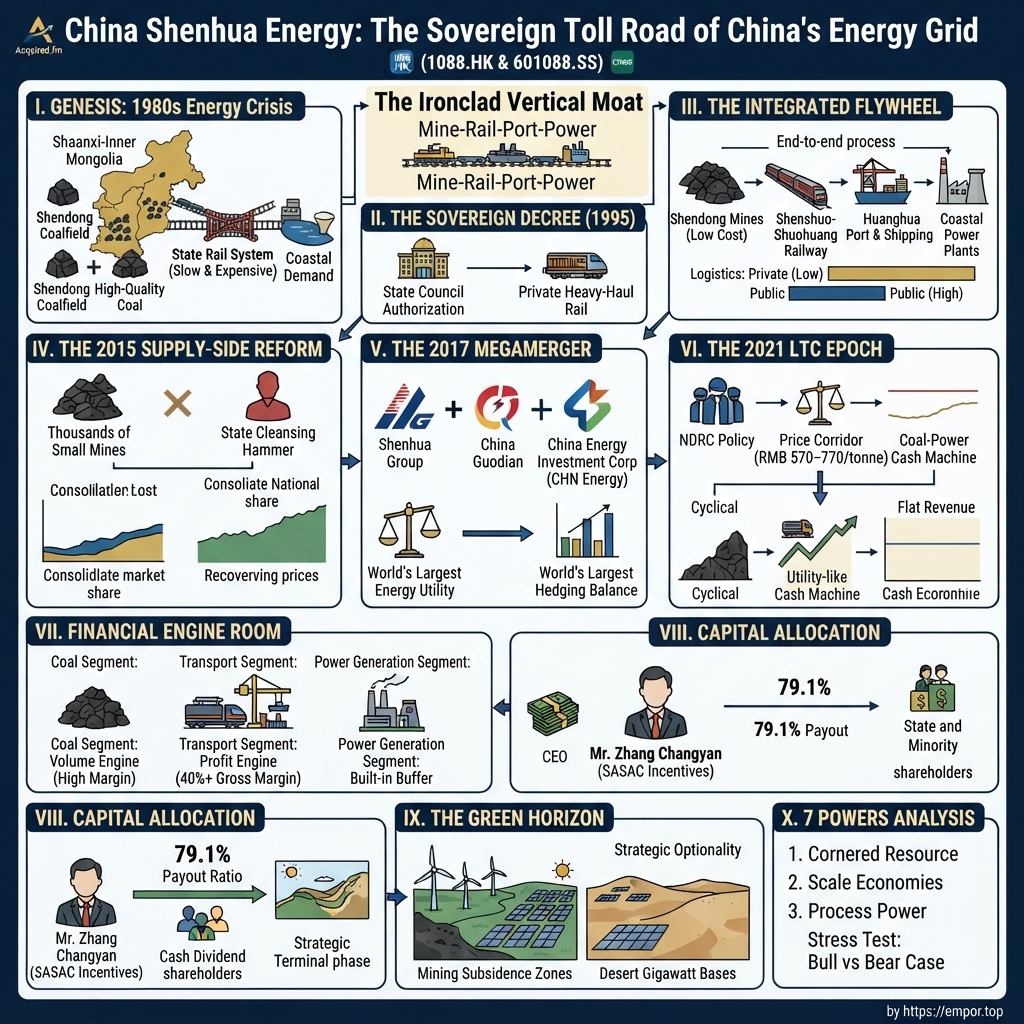
China Shenhua Energy: The Sovereign Toll Road of China's Energy Grid
I. Introduction & Episode Roadmap
On March 16, 2026, a share registrar in Shanghai completed a transfer that went largely unnoticed by Western investors. A little over 1.36 billion new A-shares were issued at RMB29.40 each to a single counterparty, transferring twelve assets — coal mines in Xinjiang and Inner Mongolia, pithead power plants, a chemicals business, a shipping company, and a port operator — from the balance sheet of a state holding company onto the balance sheet of its listed subsidiary.5 The listed subsidiary was 中国神华能源股份有限公司 China Shenhua Energy Company Limited, executing the largest share-settled asset purchase in the history of China's A-share market.5
The total transaction price was RMB133.598 billion, with roughly 70% — about RMB93.5 billion — paid in cash.4 That cash component was more than double the company's entire annual dividend payout and went directly to its controlling shareholder. Notably, the acquisition was announced just three months after a fiscal year in which China Shenhua's revenue had dropped by more than 13%.
This capital allocation decision highlights the central tension within China Shenhua. The conventional market narrative presents a simple framework: thermal coal is a declining industry as China decarbonises, yet this operator generates substantial cash flows and distributes most of them to shareholders. While that framing contains truth, it omits critical operational and policy realities.
The entity. China Shenhua trades as 1088.HK in Hong Kong and 601088.SS in Shanghai. In early September 2026, its H-shares traded near HK$45.74 while its A-shares traded around RMB47.61, giving the Shanghai listing a market capitalisation of roughly RMB1.03 trillion — a threshold management noted crossing during the first half of the year. Its combined market value stood at RMB832.6 billion at June 30, 2026, up 5.9% from the end of 2025.2 Measured by coal tonnage, power generation, or freight volume, it remains one of the largest energy producers in the world.
China Shenhua's operations differ significantly from standard coal mining enterprises. The company extracts coal in China's western interior, moves it over 2,408 kilometres of company-owned railway to its deepwater port on the Bohai Gulf, transports it on company-owned vessels, and consumes a substantial portion in its own power stations.3 It also sells logistics capacity to regional miners lacking rail infrastructure. In 2025, this logistics network — railways, ports, and shipping — generated roughly one-fifth of group segment profit before consolidation eliminations, achieving gross margins well above traditional extraction rates.1
The core paradox. While commodity producers typically operate as price-takers with earnings tied to supply cycles, China Shenhua occupies a hybrid position. It does not behave like a pure mining stock, nor is it a fully sheltered utility. In 2025, revenue fell 13.2% to RMB294.9 billion and net profit attributable to shareholders dropped 5.3% to RMB52.8 billion — though profit excluding non-recurring items fell 19.2%, and operating cash flow fell 17.6%.113 The company missed its full-year revenue target by roughly 8%.1 These fluctuations illustrate that earnings remain exposed to underlying market cycles.
Consequently, the core analytical question is not whether coal demand will taper, but how much of China Shenhua's stability derives from structural assets — dedicated infrastructure, low extraction costs, and captive power demand — versus state policy settings that can be adjusted over time.
Who owns it. Ownership structure is central to evaluating this dynamic. China Energy Investment Corporation held a 69.97% direct stake at the end of June 2026, reaching 70.02% when including holdings through a wholly owned subsidiary.2 The Hong Kong clearing nominee holding the H-share float represented another 15.54%.2 Institutional funds, state stabilization vehicles, and approximately 231,730 individual A-share accounts hold the remaining equity.2
This structure limits the capacity of outside shareholders to alter corporate strategy, eliminating conventional activist campaigns or takeover dynamics. Alignment for minority investors relies instead on cash flow mechanics: the state parent relies on regular cash extractions from its primary listed vehicle, distributed pro rata via dividends. While this structure has maintained dividend flows for nineteen years, changes in parental capital requirements remain a primary variable for minority returns.
A note on the scoreboard. Chinese corporate reporting standards require listed state enterprises to publish explicit annual operating targets and disclose performance against them semi-annually. For 2026, China Shenhua's adjusted plan targeted RMB360 billion in revenue, 513.4 million tonnes of commercial coal production, 618.1 million tonnes of coal sales, and 288.1 billion kilowatt-hours of power generation.2 This disclosure framework offers a clear benchmark for evaluating operational execution against management targets.
The roadmap. The analysis unfolds across six main sections. First, the company's origins: how a 1990s mining enterprise obtained regulatory approval to build private rail infrastructure, securing its core cost advantage. Second, the development of its integrated logistics model and the dual equity listings that funded it. Third, the 2012–2015 commodity downturn and the subsequent state consolidation around low-cost producers. Fourth, the 2017 merger that formed the world's largest power generator and established a captive customer base for Shenhua's coal. Fifth, the 2021 power supply shortages and the long-term contracting framework that reshaped domestic coal pricing. Finally, an evaluation of segment performance, the financial structure of the RMB133.6 billion asset injection, and the core drivers behind long-term valuation scenarios.
It begins with the infrastructure bottleneck that shaped early Chinese coal logistics.
 Subscribe on LinkedIn
II. The "Mine-to-Port" Genesis: Developing the Shendong Coalfield
In the late 1980s, the loess plateau of northern Shaanxi was a landscape of dust and ravines — thinly populated and agriculturally marginal. Geologists, however, were discovering that it sat atop one of the richest concentrations of thermal coal on earth.
The 神东煤田 Shendong Coalfield straddles the border between northern Shaanxi and southern Inner Mongolia. What made the deposit extraordinary was not merely its size, but its geometry and chemistry. The coal seams were thick, shallow, and laterally continuous, allowing longwall mining equipment to operate for kilometres without encountering major faults. The coal was also low in sulphur and ash, meaning it burned clean enough for coastal urban centers while generating less waste to transport. In mining, geology dictates the cost curve long before engineering begins, and Shendong sat near the bottom of that curve.
The bottleneck that defined everything. In the 1980s and early 1990s, China's economic expansion outpaced its national transport network. Thermal coal provided the vast majority of the country's primary energy. Mining was concentrated in the north and west, whereas energy demand centered on the industrializing eastern and southern coasts. Moving energy from pithead to consumer required traversing a thousand kilometres of heavily congested rail lines.
The Ministry of Railways operated that national network as a rationed public service, where freight allocations were determined politically and coal producers faced perpetual wagon shortages. Western pitheads frequently accumulated coal that had high coastal value but little local worth, even as coastal power stations depleted their stockpiles and regional grids rationed power. The primary constraint in China's coal market was logistics rather than production.
Under basic economic principles, the owner of a supply-chain bottleneck captures most of its value. In China's coal chain, that bottleneck belonged to the state railway, an entity structured to serve policy objectives rather than maximize commercial profits.
The sovereign exception. China Shenhua's structural advantage originated from an administrative decision to permit one state producer to operate outside the central railway monopoly. 神华集团 Shenhua Group was established with authorization to build, own, and operate a dedicated heavy-haul railway and port network designed specifically to transport Shendong coal to coastal markets.
This authorization represented a significant transfer of administrative privilege. In most markets, a private railway built by a mining firm represents conventional capital investment. In 1990s China, bypassing the Ministry of Railways converted a regulatory monopoly into a corporate balance-sheet asset. Granted to a single national champion under specific historical conditions, this privilege was not replicated, creating an entry barrier that remains intact decades later.
That physical infrastructure remains central to the enterprise. The 神朔铁路 Shenshuo Railway runs east from the coalfield to connect with the 朔黄铁路 Shuohuang Railway, extending to the Bohai Gulf where Shenhua constructed 黄骅港 Huanghua Port as its dedicated shipping terminal. In 2025, that rail network moved 313.0 billion tonne-kilometres of freight and Huanghua Port loaded 261.6 million tonnes.3 The rail infrastructure alone spans 2,408 kilometres of operating track, functioning as a private heavy-haul trunk corridor across northern China.3
What this means for the investment case. This structural configuration presents two distinct analytical perspectives for investors.
From a constructive view, Shenhua's primary asset is not coal reserves, which remain abundant across China, but its proprietary transport rights. Controlling dedicated infrastructure transforms a raw commodity extractor into a high-margin toll operator, a dynamic reflected in the elevated margins of its transport segment.
From a critical view, this administrative foundation leaves Shenhua tied to state policy objectives. Privileges granted by government decisions remain subject to regulatory adjustment, including tariff caps, capacity mandates, or broader national service obligations. Investors gain exposure to a protected infrastructure moat alongside sovereign governance risks.
Why heavy-haul rail is a different business from rail. The operational economics of heavy-haul rail differ substantially from standard rail transport. General freight networks are built for mixed cargo and moderate axle loads across interconnected routes serving multiple shippers. By contrast, a heavy-haul coal line operates between fixed endpoints, utilizing track, bridges, and rolling stock engineered specifically for high axle loads.
This structure yields capital and operating dynamics similar to a pipeline. The initial capital expenditure is substantial and fixed, but the marginal cost per additional tonne moved is minimal. High capacity utilization is critical, and that volume is secured when the line operator owns both the upstream mines and the downstream port terminals. Once operational, unit costs per tonne-kilometre fall well below those achievable on shared public networks that must accommodate passenger traffic and varied cargo schedules.
The regulatory permission to construct this network proved more valuable than the physical assets. Shenhua secured authorization for a optimized heavy-haul rail configuration along a corridor with sufficient volume to maintain full utilization. The company has continued to develop its transport technologies, reporting in 2026 that a 35,000-tonne heavy-haul group train completed China's first automated formation-driving trial on its rail network.2
This dual dynamic — high operational efficiency paired with policy dependency — forms the foundation for how the company subsequently converted its physical infrastructure into a public equity vehicle.
III. Creating the Vertical Monolith & Going Public
By the early 2000s, Shenhua possessed an asset structure unique among global coal producers: an integrated, end-to-end physical chain from the underground coal face to the power plant boiler, fully owned and dispatched by a single organization.
Understanding why that structure matters requires tracing the path of a single tonne of coal. A longwall shearer extracts coal underground, and continuous conveyor belts move it to a preparation plant. In standard mining operations worldwide, the commodity is sold at the mine gate, transferring logistics responsibility to third parties. At Shenhua, the coal is loaded directly onto company-owned railcars, hauled along proprietary tracks, discharged into corporate port stockyards, and loaded via company ship-loaders onto company-owned vessels. A substantial portion is then delivered into company-operated power stations, generating electricity sold directly to the regional grid.
Why owning the whole chain changes the economics. The primary advantage is margin capture. Every handoff in a traditional commodity supply chain allows an intermediary to extract a margin; Shenhua eliminated most of those touchpoints. A secondary, critical advantage is scheduling efficiency. A bulk commodity chain operates as a continuous queueing system, where operational bottlenecks typically occur at transfer points. When mine operators, railway authorities, port facilities, and end-buyers act as separate corporate entities with conflicting incentives, railcars sit idle, vessels wait at anchor, stockpiles accumulate, and working capital remains locked up in inventory. Centralized control across all four segments enables unified dispatch and optimized asset utilization.
That operational alignment provides a tangible cost advantage, though it reflects disciplined asset management rather than proprietary technology. Maintaining that advantage requires sustained capital expenditure. Shenhua has continued to expand its asset base, advancing the fifth construction phase at Huanghua Port and developing new production capacity at the Xinjie No.1 and No.2 mine shafts.2 Research spending reached RMB4.89 billion in 2025—up 17.0% year-on-year and accounting for roughly 1.7% of total revenue—supported by 4,233 research personnel, 89.3% of whom held a bachelor's degree or higher.13 While substantial for an extractive industrial enterprise, this commitment remains modest relative to the capital tied up in the underlying physical asset base.
The business hiding inside the business. A structural consequence of owning dedicated logistics capacity is Shenhua's merchant coal operation. In 2025, the company produced 332.1 million tonnes of commercial coal but reported total coal sales of 430.9 million tonnes.1 The gap of nearly 100 million tonnes represents coal extracted by third-party miners. Shenhua purchases this tonnage at the pithead, transports it across its proprietary rail and port network, and resells it at coastal delivery points.
This trading volume operates under distinct economics compared to direct mining. Functioning as a merchant logistics business, it captures the transport spread between inland pitheads and coastal markets with minimal geological risk or incremental fixed capital overhead, leveraging rail and port infrastructure already amortized by captive production. This business model allows Shenhua to monetize excess transport capacity, explaining why annual sales volumes consistently exceed internal production by nearly a third.
However, this trading operation carries greater volume sensitivity during market downturns. In 2025, total coal sales volume fell 6.4% while commercial production declined just 1.7%, indicating that purchased third-party tonnage absorbed a disproportionate share of the market contraction.1 When delivered spreads compress, management curtails external purchasing. This operational flexibility shields core mining margins while simultaneously amplifying top-line revenue volatility.
The capital harvest. Constructing this integrated network required capital beyond state budgetary allocations. To fund expansion, the state equity holder packaged core operating assets into China Shenhua Energy Company Limited. The entity listed H-shares on the Hong Kong Stock Exchange in June 2005, raising approximately HK$23 billion.[^20] In October 2007, the company executed an A-share initial public offering in Shanghai, pricing the issue at RMB36.99 per share and closing its first trading day up 87%.20
The timing of the Shanghai listing coincided with the peak of the 2007 Chinese equity market expansion and the apex of the global commodity supercycle, allowing the company to issue domestic equity at historic valuation highs.
Nineteen years later, those A-shares trade near RMB47.61. That price represents cumulative capital appreciation of roughly 29% over nearly two decades—an annualized capital return in the low single digits that lags Chinese nominal GDP expansion, bank deposit yields, and major global equity benchmarks over the same period. For equity investors evaluating the enterprise, this performance underscores that historical total returns have been driven almost entirely by dividend distributions rather than structural multiple expansion.
Two listings, one company, two prices. The dual-listing architecture created a persistent valuation spread characteristic of dual-listed Chinese state enterprises, where identical economic claims trade at different prices across separate currency regimes. In early September 2026, the Shanghai listing traded around RMB47.61 while the Hong Kong line traded near HK$45.74. This offshore discount reflects segmented investor bases, capital controls, and differing domestic versus international costs of capital.
For investors, this structural discount directly impacts cash yields. Cash dividends are declared in renminbi and converted to Hong Kong dollars for H-share distributions at prevailing exchange rates. Consequently, H-share investors receive the same per-share cash flow as A-share holders while deploying less purchase capital, generating a higher dividend yield on the Hong Kong listing.
The road not taken. Shenhua's capital allocation strategy during the 2000s commodity supercycle diverged significantly from international peers. While global mining majors utilized debt to acquire international reserves and expand seaborne market exposure, Shenhua directed capital into domestic heavy-haul rail, port facilities, shipping fleets, and pithead power plants—renminbi-denominated infrastructure assets producing stable logistics fees.
Although guided primarily by state mandates for domestic energy security rather than speculative strategy, this domestic infrastructure focus insulated the balance sheet. When international thermal coal prices declined post-2011, Shenhua entered the downturn backed by defensive, low-cost logistics infrastructure rather than leveraged offshore mining assets.
IV. Surviving the Supercycle Collapse & The Great Supply-Side Reform
The Chinese coal industry's near-death experience did not arrive as a single shock. It unfolded as a slow suffocation between 2012 and 2015, making it the most instructive period for assessing how much of Shenhua's current stability is truly structural.
Demand rolled over first. China's economic model shifted away from the fixed-asset investment boom that followed the 2008 stimulus, as coal-intensive heavy industries — including steel, cement, and aluminium — stopped expanding capacity at previous rates. Meanwhile, supply continued to expand: capacity approved during peak boom years kept entering the market, while thousands of small, poorly regulated private mines operating with low capital overhead kept producing because their marginal cost per additional tonne was negligible.
The result was a classic commodity trap. Prices fell sharply. Producers burdened with high fixed costs maintained high output simply to cover cash expenses, further deepening market oversupply. The sector slipped into aggregate losses, turning unprofitable mines into a broader economic and social challenge.
The state's answer. On February 5, 2016, China's State Council issued policy guidance on resolving overcapacity in the coal industry, establishing the framework for what became known as 供给侧结构性改革 supply-side structural reform.7 The policy relied on direct administrative mandates rather than market-driven mechanisms. Beijing froze approvals for new coal mines for three years and slowed projects designed to expand existing capacity. Underperforming operations — spanning thirteen specified categories alongside mines in environmentally sensitive zones — were scheduled for closure within one to three years.7 Regulators capped mine operations at a maximum of 276 working days per year, tightened safety supervision, and suspended non-compliant facilities. To consolidate the industry, the government encouraged large state operators to absorb smaller rivals, targeting a minimum single-enterprise production scale of three million tonnes per year within three years.
The 276-day operating cap highlights how administrative intervention alters market dynamics. In a traditional market economy, overcapacity resolves as falling prices force high-cost producers into bankruptcy — a prolonged and economically disruptive process. Instead, regulators set binding operational caps across all domestic mines. Supply contracted through administrative mandate, spurring a rapid price recovery.
The policy also incorporated a substantial social component. State Council directives paired capacity reduction targets with funded employee resettlement and reemployment assistance programs.7 In China, closing industrial capacity is managed as a labor and public-stability issue rather than a purely commercial decision. State fiscal support for displaced workers made large-scale capacity elimination politically feasible. This combination of administrative supply controls and fiscal transition funding provided domestic coal prices with a floor that seaborne markets lacked.
Who won. Structurally, China Shenhua was positioned as the primary beneficiary. Its operations were large-scale, highly mechanized, compliant with safety standards, and situated at the low end of the cost curve — precisely the asset profile state policy sought to preserve. Conversely, small, unintegrated mines faced systematic elimination, transferring market share and pricing leverage to major state-controlled incumbents.
However, operational data tests whether this regulatory shift permanently stabilized company earnings. If supply-side reform had eliminated commodity volatility, Shenhua's bottom line would have flattened after 2016. Instead, reported net profit attributable to shareholders fluctuated considerably: RMB43.9 billion in 2018, RMB43.3 billion in 2019, and RMB39.2 billion in 2020, before surging to RMB50.1 billion in 2021 and peaking at RMB69.6 billion in 2022. Profits subsequently moderated to RMB59.7 billion in 2023, RMB58.7 billion in 2024, and RMB52.8 billion in 2025.1 The jump from RMB39.2 billion in 2020 to RMB69.6 billion in 2022 represents an earnings expansion of nearly 80 percent over two years — a level of volatility far exceeding that of a traditional utility.
This evidence leads to a more precise analytical conclusion: supply-side reform did not eliminate cyclicality for China Shenhua, but rather established a higher earnings floor while reducing the frequency of severe downturns. That floor is sustained primarily by the company's low extraction and transport costs rather than regulatory policy alone — an important distinction for investors, as administrative policies can evolve while structural cost positions remain durable.
Why Chinese coal decoupled from the world. The 2016 policy intervention also decoupled Chinese domestic coal dynamics from global markets. By managing domestic supply through administrative targets and setting price guidance bands for long-term coal contracts, Beijing insulated the domestic market from seaborne pricing volatility.
Consequently, global coal benchmarks offer limited predictive value for China Shenhua's performance. Seaborne coal prices have experienced major rallies while domestic contract rates remained within official guidance, and vice versa. Because Shenhua sells predominantly to domestic counterparties, imports minimal coal, and reports entirely in renminbi, its operations are exposed to domestic demand patterns and domestic policy settings rather than global trade flows. This structure shields the business from international demand shocks while constraining its participation in global price spikes.
For financial modeling, this framework alters how supply projections are constructed. In international markets, analysts estimate future supply by aggregating industry capital expenditure and announced project timelines. In China's coal sector, policy directives regarding operating days or annual production quotas serve as the primary supply determinant and can be implemented or adjusted rapidly. The 2016 reforms restricted output, whereas responses to the 2021 power shortages quickly expanded supply. Evaluating China Shenhua requires assessing regulatory policy responses alongside traditional supply-and-demand fundamentals.
Ultimately, the supply-side reforms demonstrated the central government's willingness to intervene directly when structural imbalances threatened national energy stability. Eighteen months after launching coal sector reforms, Beijing applied a similar policy approach to resolve ongoing margin conflicts between coal producers and power generators.
V. The Megamerger: Shenhua + Guodian = China Energy Investment
For most of the two decades following China's separation of power generation from grid distribution, the country's electricity sector operated under a structural conflict.
Coal miners sold output at market-influenced prices, whereas coal-fired generators sold power at rigid administrative tariffs with limited ability to pass through fluctuating fuel costs. This mismatch created cyclical volatility between the two halves of the energy supply chain. When coal prices surged, mining profits expanded while power generators—including the state-owned "Big Five" utility groups—faced severe losses, with some plants operating at negative cash margins to maintain grid stability. When coal prices declined, profitability shifted back to generation. Because the state ultimately owned both segments, these price swings produced financial instability without net aggregate gains for the public balance sheet.
August 2017. To resolve this persistent imbalance, the State Council engineered a vertical merger across the supply chain. On August 28, 2017, regulators approved the restructuring of 中国国电集团公司 China Guodian Corporation—one of the Big Five power generators—and 神华集团 Shenhua Group, the nation's largest coal producer, creating 国家能源投资集团有限责任公司 China Energy Investment Corporation.619
The scale of the transaction was unprecedented in the sector. Combined assets exceeded RMB1.8 trillion, with Shenhua providing more than RMB1 trillion and Guodian contributing over RMB800 billion, including more than 143 gigawatts of installed generating capacity.6 The deal formed part of a broader state initiative to consolidate state-owned enterprises, which reduced the number of centrally administered enterprises from 196 in 2003 to 98 following the transaction.6
The logic, stated plainly. Integrating coal extraction with power generation does not eliminate fuel-margin friction; it internalizes it. When mining and power assets belong to the same enterprise, internal transfer pricing becomes an intra-company accounting detail rather than a commercial conflict. For policymakers, this alignment removed the risk of one state segment undermining another while establishing an enterprise large enough to advance national energy coordination.
For minority shareholders in the listed entity, the implications were more complex.
The primary advantage was an internal financial hedge. China Shenhua operates both coal mines and thermal power plants. During periods of elevated coal prices, higher mining margins help cushion generation losses; conversely, when coal prices fall, lower fuel expenses support expanded power generation margins. This dynamic was evident in the company's 2025 financial results: as the average coal selling price fell 12.1% to RMB495 per tonne, the coal segment's gross margin remained relatively stable, though gross profit per tonne of self-produced coal dropped 17.3% to RMB189. Meanwhile, the power segment's gross margin expanded by 1.9 percentage points to 18.0%, as average operating costs fell 6.1% against a modest 4.0% decline in realized power tariffs.3
However, this operational hedge remains partial rather than complete. In 2025, power generation generated roughly 17% of segment profit before consolidation eliminations, compared to 62% from coal mining.1 Because generation accounts for less than a fifth of profits while mining represents nearly two-thirds, power margins cannot fully offset broader earnings declines when coal prices weaken. The generation segment dampens earnings volatility rather than neutralizing it entirely.
The distinction that trips up most analysis. Evaluating the corporate structure requires distinguishing between two separate legal entities. The 2017 merger formed China Energy Investment Corporation—the unlisted parent company holding extensive state energy assets. China Shenhua Energy Company Limited is the publicly traded subsidiary in which the parent maintains a controlling stake of approximately 70%.2
Industry references to "the world's largest coal producer" or "largest power company" typically describe the parent group rather than the listed entity. The public company did not immediately inherit all group mining and power assets, as Guodian's operations were initially consolidated at the parent level. This structural division set the stage for a multi-year effort to inject parent assets into the listed subsidiary, culminating in the major 2026 transaction. Assessing scale claims regarding China Shenhua requires clarifying which entity's balance sheet is under review.
The overhang the merger created. The transaction also introduced a governance challenge that took nearly nine years to address. Because certain coal assets remained with the parent group and Guodian brought existing mining and power businesses, the parent retained assets that directly competed with its listed subsidiary. This horizontal competition between a state parent and a public subsidiary represented a long-standing governance concern for market participants.
Management subsequently noted that the 2026 asset acquisition "basically resolved" these historical competition overlaps.2 This statement acknowledges the duration of the structural overhang, while highlighting that addressing the conflict required significant cash outlays from the listed entity's balance sheet.
Before evaluating the financial structure of that transaction, an earlier policy development warrants examination: the regulatory shifts that altered domestic coal pricing and changed how investors evaluate China Shenhua's cyclical exposure.
VI. The 2021 Crisis and the Long-Term Contract (LTC) Epoch
In the autumn of 2021, China faced a severe power crisis.
The proximate causes were a post-pandemic industrial export surge that pushed power demand well beyond forecasts, earlier administrative restrictions on domestic mine output, and a domestic pricing framework that prevented power generators from passing rising fuel costs on to customers. The result was a physical coal shortage. Provincial governments rationed electricity, industrial plants operated on curtailed schedules, and several residential grids experienced blackouts. For state authorities prioritizing economic and social stability, the situation required immediate policy intervention.
The resulting price movements were unprecedented. Spot thermal coal at 秦皇岛 Qinhuangdao surged past RMB1,000 per tonne, yet China Shenhua delivered the bulk of its output under long-term contracts at approximately RMB677 per tonne.10 During the most lucrative pricing environment in the history of the domestic coal sector, the country's largest producer was selling coal at roughly two-thirds of prevailing spot rates.
This trade-off illustrates the core mechanics of the business. Investors viewing the long-term contract framework purely as downside protection must account for this historical constraint: the structure capped realization rates during an unprecedented supply deficit, as intended by regulators.
The policy reset. Concluding that unconstrained coal price volatility posed a direct threat to macroeconomic stability, the National Development and Reform Commission (NDRC) restructured market mechanisms rather than relying on temporary interventions. Policy makers deployed two primary regulatory levers.
The first lever was volume. The NDRC mandated that medium- and long-term contracts — 中长期合同 — cover the vast majority of coal consumed by power generators. This requirement escalated through 2021 from a 75% baseline toward comprehensive coverage of annual fuel needs at power and heating utilities.10 Regulators have maintained this framework through annual policy updates. For 2026, power plants were required to secure at least 80% of estimated annual demand through long-term contracts, while coal producers were directed to commit at least 75% of their production capacity, backed by mandatory monthly performance reporting.
The second lever was price. In early 2022, the NDRC established a formal price guidance range of RMB570 to RMB770 per tonne for medium- and long-term contracts of benchmark 5,500 kilocalorie thermal coal at Qinhuangdao, alongside corresponding ex-mine price caps across major producing provinces.98 Official guidance framed the initiative as an effort to anchor market expectations, reduce speculative trading, and provide predictable input costs for industrial energy consumers.9 Regulators explicitly defined the framework as a "range regulation mechanism on the basis of market-formed prices" rather than direct administrative price control.8
Myth versus reality. A common narrative among market observers holds that this regulatory corridor established an absolute floor and ceiling for China Shenhua's realized prices, effectively transforming the enterprise into a rate-regulated utility. However, corporate disclosures present a more nuanced operational reality.
The revenue mix demonstrates why realized prices fluctuate. In 2024, China Shenhua sold coal through four distinct channels at varying price points: annual long-term contracts averaged RMB491 per tonne (representing 53.6% of sales volume); monthly long-term contracts averaged RMB705 per tonne (33.7% of volume); spot transactions averaged RMB627 per tonne (7.9% of volume); and direct pithead sales averaged RMB285 per tonne (4.8% of volume).
Only the annual contract book — accounting for just over half of total volume — directly follows the formal price corridor. Monthly contracts, representing one-third of sales, adjust dynamically with market conditions, clearing at a premium of more than RMB200 per tonne above annual contract rates in 2024. Spot sales move freely with market forces. Consequently, the company's net realized price reflects a shifting weighted blend across all four sales channels.
This dynamic was evident in 2025. China Shenhua's average selling price across all coal channels declined 12.1% to RMB495 per tonne, while total sales volume contracted 6.4% to 430.9 million tonnes, contributing to a 13.2% drop in total group revenue.13 Spot markets also moved outside the guided band: benchmark 5,500 kilocalorie coal at Qinhuangdao opened 2025 near RMB770 per tonne, fell toward RMB617 by mid-year, and rebounded to roughly RMB830 by November. Spot prices crossed both the bottom and top bounds of the theoretical corridor within a twelve-month period.
The long-term contract framework narrows price dispersion rather than eliminating cyclicality. It dampens tail risk on both ends — preventing realization rates from reaching spot spikes of RMB1,000 per tonne while insulating the company against severe pricing collapses. Within this compressed range, earnings remain tied to broader energy cycles, as shown in 2025 when net profit excluding non-recurring items declined 19.2%.13
A precise framing of the business model indicates that the contract framework converts China Shenhua from a high-beta commodity producer into a moderate-beta operator with a high operational cash floor, in exchange for relinquishing windfall profits during energy deficits. Evaluating this trade-off depends on entry valuation and the stability of regulatory policy settings.
What would falsify the framework. Evaluating the durability of this regulatory model requires tracking specific operational indicators.
To the downside, a structural breakdown would be signaled by an administrative reduction in the official price corridor or policy mandates requiring a higher proportion of output to be committed to lower-priced annual contracts. Enforcement tools continue to tighten: for the 2026 contract year, regulators implemented mandatory monthly reconciliation reporting for suppliers and consumers to prevent contract under-delivery.
To the upside, a breakdown would be triggered by renewed physical supply deficits. If domestic coal demand outstrips output, policy priorities consistently favor volume security and price stabilization over producer margin expansion. Historical execution indicates that China Shenhua would again deliver coal below market spot rates to support grid stability.10
However, the primary floor supporting long-term valuation is anchored less by administrative mandates than by physical extraction and transport costs across the company's integrated segments.
VII. The Engine Room: Segment-Level Economics & The Transportation Moat
Beyond its macro narrative, China Shenhua functions as four distinct operations with differing underlying economics combined on a single balance sheet. Evaluating segment earnings power — and the structural drivers behind each unit — forms the core of its financial analysis.
The coal segment: a cost position, not a price call. In 2025, the coal business contributed roughly 62% of segment profit before consolidation eliminations.1 The company produced 332.1 million tonnes of commercial coal and sold 430.9 million tonnes including purchased volumes, against internal targets of 334.8 million and 465.9 million tonnes respectively — representing a minor production shortfall and a clearer miss on total sales.1
The decisive metric, however, is unit margin spread rather than gross volume. The unit production cost of Shenhua's self-produced coal was RMB171.6 per tonne in 2025, down 4.8% year-on-year.3 Set against an average self-produced selling price of RMB472 per tonne, gross profit stood at RMB189 per tonne.3
A production cost near RMB172 per tonne provides substantial structural insulation when compared against annual contract benchmark prices near RMB490 and spot market rates that fluctuated between RMB617 and RMB830 in 2025. Shenhua's cash extraction cost sits at roughly one-third of the lower bound of the regulated pricing corridor. For mining operations to incur cash losses, realized prices would need to fall by nearly two-thirds — a scenario absent from current regulatory policy and one that would place high-cost domestic competitors deep in negative margins.
This cost structure establishes the primary earnings floor for China Shenhua, rooted in geology and mine logistics rather than administrative price support. Cost control execution has also outpaced guidance: management budgeted for unit costs to rise roughly 6% in 2025 but delivered a 4.8% decline, and in the first half of 2026 again beat a budgeted 4% increase by recording a 4.1% decline.12 Two consecutive years of unit costs tracking below budget reflect operating efficiency and disciplined cost management.
The transportation segment: high-margin infrastructure. Railways, ports, and shipping together generated approximately 21% of segment profit before eliminations in 2025 — a earnings contribution that well exceeds the segment's revenue weight.1 That outperformance reflects high operating margins: in 2025, the railway business achieved a gross margin of 37.9% while the port business reached 46.7%.3 Shipping, operating in a open maritime market, recorded an 11.5% gross margin.3
These returns reflect infrastructure economics linked to volume rather than commodity pricing. Railway turnover volume remained essentially flat in 2025 at 313.0 billion tonne-kilometres, up 0.3%, while Huanghua Port throughput rose 2.6% to 261.6 million tonnes — even as group coal segment revenue contracted by more than 20%.3 Through the first nine months of 2025, railway segment revenue rose 0.3% and port revenue grew 3.1%, while coal segment revenue dropped 21.1% and power segment revenue declined 9.0%.1415
This divergence demonstrates the toll-road mechanics of the integrated network. The captive logistics assets generate fees based on freight movement rather than underlying commodity value, capturing stable cash flows from both internal production and third-party regional miners.
Two operational qualifications apply to this infrastructure thesis. First, logistics earnings remain vulnerable in non-monopoly segments: shipping volume fell 14.3% in 2025, driving a 28.7% decline in shipping revenue over the first nine months of the year.314 Coastal shipping remains competitive, whereas heavy-haul rail access represents a scarce asset. Second, domestic rail and port tariffs remain subject to state administrative oversight, meaning logistics margins operate within a regulated regulatory framework.
The power segment: earnings stabilizer. Installed generating capacity reached 52,676 megawatts at year-end 2025, with 220.2 billion kilowatt-hours generated and 207.0 billion kilowatt-hours sold.1 Output declined in 2025 — power generation fell 3.8% against a full-year target of 227.1 billion kilowatt-hours — as realized tariffs slipped 4.0% to RMB368 per megawatt-hour.13 The power business functions primarily as an internal hedge, converting lower internal fuel costs into generation margin expansion during periods of falling coal prices.
The coal chemical segment: specialized options. The chemical segment converts coal into polyolefins — specifically polyethylene and polypropylene for industrial use. The business reported a 7.2% gross margin in 2025 and contributed negligible net profit to group results.31 While providing alternative monetization channels for coal reserves, its scale relative to group earnings remains modest. The 2026 asset acquisition expanded corporate polyolefin capacity by more than 213%, increasing physical scale without altering short-term group profit drivers.3
Quarterly profile and non-recurring items. Intra-year revenue trends illustrate the sector's operational trajectory. Group revenue expanded progressively through 2025 — reporting RMB69.6 billion in the first quarter, RMB68.5 billion in the second, RMB75.0 billion in the third, and RMB81.8 billion in the fourth — tracking the mid-year recovery in spot coal prices.1 Net profit followed a matching trajectory, rising from RMB11.9 billion in the first quarter to RMB14.4 billion by the third quarter.
Financial results in the fourth quarter warrant closer inspection. Headline net profit reached RMB13.8 billion, but net profit excluding non-recurring items stood at RMB9.9 billion.1 Non-recurring items contributed roughly RMB3.9 billion to the fourth-quarter result. For the full year, non-recurring items generated a net gain of about RMB4.26 billion, compared to a net loss of RMB4.32 billion in 2024 — creating an RMB8.58 billion swing between the two reporting periods.13 This non-operating swing explains why full-year reported net profit fell 5.3% while profit excluding non-recurring items dropped 19.2%.
Capacity expansion pipeline. Project development remains focused on expanding capacity across existing links in the integrated chain. The company continues to advance shaft development at Xinjie No. 1 and No. 2, commission new thermal generating units at Qingyuan Phase II, Dingzhou Phase III, and Cangdong Phase III, and progress the fifth construction phase at Huanghua Port.2
Segment synthesis. China Shenhua combines low-cost mining operations operating under long-term pricing contracts, a captive power segment that buffers fuel price swings, and a dedicated transport network that earns infrastructure-style returns on freight volume. This structural integration mitigates downside earnings volatility during commodity downcycles.
The primary strategic question centers on corporate capital allocation — a dynamic that shifted significantly in late 2025.
VIII. Current Management, SOE Incentives, & Capital Allocation
The people. China Shenhua is run by Chief Executive Officer 张长岩 Zhang Changyan, who was appointed on November 29, 2024, for a three-year term and subsequently named an executive director.17 Born in August 1970, Zhang earned a degree in electrical engineering from Xi'an Jiaotong University in 1993, completed an MBA at Tsinghua University in 2001, and holds the professional title of senior economist.
His prior position is notable: from February 2022 to November 2024, he served as chairman and Party secretary of China Energy's group media center. This was a Party-track assignment rather than an operational one, illustrating how executive talent is developed across state-owned enterprise (SOE) groups — through cross-functional rotations rather than promotions up a single operating line. Investors accustomed to evaluating chief executives on direct profit-and-loss ownership will find limited historical signal in this background, as the selection process does not optimize for traditional operating track records.
Governance at the board level has seen frequent changes. 吕志韧 Lü Zhiren was elected chairman on September 30, 2024, for a three-year term but resigned on March 24, 2025, upon reaching retirement age — less than six months after taking office.18 His predecessor had resigned in 2022, leaving the chairmanship vacant for an extended period. When the board approved the 2026 interim report, only five of its seven directors attended in person, with two non-executive directors submitting proxies to Zhang.2 In July 2026, the board refreshed its independent non-executive seats, nominating two new candidates to replace retiring incumbents.
While leadership rotation across state enterprises is common and reflects external appointment decisions, the pattern remains relevant: the top governance post has repeatedly changed hands or sat vacant. Consequently, investors cannot rely heavily on traditional assumptions regarding management continuity.
The incentive structure. Executive compensation at China Shenhua differs markedly from Western corporate norms, as executives hold no material equity stakes. Instead, state-appointed managers are evaluated against a broader scorecard encompassing production safety, energy security, cost discipline, and shareholder returns. In 2026, the company disclosed that it had drafted formal remuneration measures for senior management, enforced term-and-contract frameworks, and moved to link executive pay directly to performance appraisal results.2
This arrangement presents a distinct dynamic for minority shareholders. The absence of equity-linked pay eliminates incentives for speculative acquisitions or financial engineering aimed solely at boosting short-term share prices. However, it also removes direct incentives to maximize long-term per-share value. Management focuses primarily on satisfying state mandates. When state policy aligns with minority interests — as demonstrated by consistent dividend payouts — the structure functions effectively. The key variable remains how management navigates scenarios where those priorities diverge.
December 2025: the test case. On December 20, 2025, China Shenhua announced an agreement to acquire equity in twelve companies held by its controlling shareholder and a wholly owned subsidiary for RMB133.598 billion. The target assets spanned coal mining, pithead thermal power generation, coal chemicals, and transport logistics — encompassing power plants, Xinjiang energy assets, chemical facilities, mining operations, shipping, coal marketing, and port operations. As of July 31, 2025, these assets represented RMB233.4 billion in total assets and RMB87.4 billion in net assets attributable to owners. Twelve companies across four provinces were acquired from a single counterparty: the state parent.
The consideration comprised 30% equity and 70% cash, setting the cash portion at RMB93.519 billion alongside up to RMB20 billion in supporting fundraising. The China Securities Regulatory Commission (CSRC) granted registration approval on February 12, 2026, and 1,363,248,446 A-shares issued at RMB29.40 per share were transferred on March 16, 2026.5 The transaction marked the largest share-settled asset purchase in the history of China's A-share market and became the first to utilize a newly established simplified review procedure.5
Operationally, the rationale was clear. The transaction resolved historical horizontal competition with the parent group, expanded China Shenhua's coal reserves by roughly 64.7%, raised annual coal production capacity to approximately 512 million tonnes, and increased polyolefin capacity by more than 213%.3 Management reported that the injection significantly enhanced the group's resource base, power generation capacity, chemical production scale, and shipping assets in a single transaction.2 Market analysts noted that the move aligned with national initiatives to reduce excess competition among state-owned enterprises operating under compressed margins and industrial deflationary pressures.4
This industrial context clarifies the timing. The transaction was not an opportunistic asset buy driven by low market valuations, but a state-directed consolidation executed under a streamlined regulatory framework to eliminate overlapping capacity across state-owned assets.54 The listed entity functioned as the consolidation vehicle rather than the primary strategic initiator.
What it cost, and why that matters. Evaluating the acquisition requires separating the operational gains from its balance-sheet impact.
First, the cash outlay. The RMB93.5 billion cash component exceeded twice the RMB41.811 billion China Shenhua paid in total 2025 dividends.1 The impact on the balance sheet was immediate: as of June 30, 2026, net assets attributable to shareholders fell 11.9% from the restated end-2025 figure to RMB450.9 billion, while total liabilities increased 23.5% to RMB370.9 billion.2 Under common-control accounting rules, cash paid in excess of the carrying value of acquired net assets is deducted directly from equity rather than recognized through the income statement. As a result, a substantial portion of book equity was absorbed in a single transaction with the parent shareholder.
Second, transaction governance. The deal constituted a related-party transaction negotiated between a controlling parent holding roughly 70% of the equity and its listed subsidiary. While the process met standard regulatory requirements — including independent valuations, CSRC registration, and shareholder approval — minority investors had limited commercial leverage in negotiating terms. Following the issue, the parent's total stake rose to 69.97% directly, or 70.02% when accounting for holdings through a wholly owned subsidiary.2
Third, equity dilution. Total share capital expanded by 9.2% to 21,689,434,304 shares.2 In the first half of 2026, earnings per share reached RMB1.339 — representing a modest 2.8% increase over the restated prior-year period figure of RMB1.302, even as net profit grew 4.1%.2 The difference reflects the expanded share count.
The accounting judgement investors must understand. Under PRC accounting standards for business combinations under common control, China Shenhua was required to restate historical comparative statements as if it had owned eleven of the twelve acquired assets in prior periods.2 This accounting treatment altered headline performance metrics significantly. First-half 2025 revenue was restated upward from the originally reported RMB138.109 billion to RMB175.423 billion, while net profit attributable to shareholders was restated from RMB24.641 billion to RMB27.583 billion.2
Consequently, the first-half 2026 financial results — revenue of RMB189.338 billion and net profit of RMB28.715 billion — reflect year-on-year growth of 7.9% and 4.1% against the restated baseline. However, compared to the unadjusted figures originally reported for the first half of 2025, growth would appear as roughly 37% for revenue and 17% for net profit.216 While both comparisons are technically valid under their respective frameworks, evaluating underlying operating momentum requires adjusting for this accounting restatement.
A second accounting wrinkle worth knowing. China Shenhua reports under both PRC accounting standards and International Financial Reporting Standards (IFRS), which produce differing profitability figures. Under PRC standards, the company charges mine maintenance and safety production fees directly to current expenses and holds them in a special equity reserve. Under IFRS, these expenditures are recognized as incurred, with qualified capital outlays capitalized as property, plant, and equipment and depreciated over time.2
This methodological distinction creates a meaningful reporting gap. For 2025, net profit attributable to shareholders stood at RMB52.849 billion under PRC standards compared to RMB54.218 billion under IFRS; for the first half of 2026, reported profits were RMB28.715 billion and RMB31.054 billion, respectively.12
This divergence explains why the company's 2025 dividend payout ratio can be cited as 79.1% under PRC standards or 77.1% under IFRS, despite identical absolute cash payouts.1 In addition, statutory financial statements for 2025 received an unqualified audit opinion from KPMG Huazhen, whereas the 2026 interim statements underwent a review — providing a lower level of assurance than a full audit — by Ernst & Young Hua Ming.12
The cash pile and what it earns. Treasury operations reflect a conservative capital preservation mandate. During the first half of 2026, the company placed RMB13.9 billion into short-term structured deposits, generating an expected return of approximately RMB11 million.2 This low-yield allocation underscores a treasury focus on liquidity rather than yield optimization. Similarly, investing cash outflows in 2025 fell nearly 75% to RMB21.8 billion, primarily due to the return of maturing structured deposits.13 With RMB197.0 billion in distributable profits on the books at year-end 2025, treasury balances serve as an intermediate holding buffer between operating cash flows and dividend distributions.1
Capital returns: the record, honestly stated. China Shenhua maintains a strong track record of cash distribution, returning more than RMB530 billion in cumulative dividends since listing.2 For 2025, the company declared a first-ever interim dividend of RMB0.98 per share (totalling RMB19.471 billion) alongside a proposed final dividend of RMB1.03 per share (approximately RMB22.34 billion). Total distributions reached RMB41.811 billion — representing 79.1% of net profit under PRC standards and 77.1% under IFRS, an increase of 2.6 percentage points over the 2024 payout ratio.11319 Under its 2025–2027 shareholder return plan, the company has committed to distributing at least 65% of annual net profit.19 For the first half of 2026, the board proposed an interim dividend of RMB0.98 per share, amounting to RMB21.256 billion.2
However, the expansion in the 2025 payout percentage occurred alongside a decline in total cash distributed. In 2023 and 2024, the company paid RMB2.26 per share annually, distributing RMB44.903 billion each year. Because net profit fell in 2025, total dividend cash paid decreased by roughly RMB3.1 billion even as the payout ratio expanded.1 Concurrently, financing cash outflows rose to RMB96.2 billion in 2025 — nearly double the prior year — driven by dividend payments and higher debt repayments.13 While absolute dividend flows remain substantial, distributions were drawn from a reduced profit base during a period of heavy capital deployment for asset acquisitions.
One point in management's favour. Management has demonstrated strong cost control relative to operational targets. In 2025, unit production costs for self-produced coal fell 4.8% against a budgeted 6% increase; in the first half of 2026, unit costs declined 4.1% against a planned 4% increase.12 Commercial coal production also landed within 1% of target in 2025.1 Conversely, target misses occurred primarily in total revenue and coal sales volumes — factors driven by market prices and demand conditions outside management's direct control.1
This operational performance indicates effective internal cost management, even as top-line results remain exposed to market pricing. Consequently, management's cost projections serve as a more reliable indicator of performance than revenue targets.
External institutional demand for supporting financing provides further market context. The RMB20 billion equity raise drawn from insurance funds and national industrial funds marked the largest equity refinancing in the history of China's coal sector and a record for inquiry-based restructuring finance in the A-share market.2 Participation by institutional investors indicates commercial backing for the transaction terms.
The ultimate impact of the asset injection depends on future cash returns per share. While the addition of low-cost coal reserves expands long-term earnings potential, the key benchmark for investors remains whether per-share dividend distributions on the expanded 21.7 billion share count can exceed the RMB2.01 per share paid on the pre-transaction share base.
IX. The Green Horizon: Real Optionality vs. Speculative Hype
Every analysis of a Chinese coal enterprise eventually confronts the same underlying question: how will the company fare when the energy transition accelerates?
The policy framework is 双碳 — China's dual-carbon goals committing the nation to peak carbon dioxide emissions before 2030 and achieve carbon neutrality before 2060. This mandate represents a binding policy directive backed by substantial physical deployment. In 2025, China added more than 430 gigawatts of new wind and solar capacity, lifting total renewable capacity above 1,800 gigawatts, generating roughly four trillion kilowatt-hours from renewable sources, and pushing renewables past 60% of national installed generating capacity.11
To put that scale in perspective, China's single-year solar and wind additions in 2025 exceeded the total installed power capacity of most G20 economies. This expansion marks the primary mechanism eroding domestic coal demand — not through sudden mine closures, but through thermal power plants operating fewer annual hours as zero-marginal-cost renewable power takes priority on the grid.
What Shenhua has actually built. Against that rapid national expansion, China Shenhua's renewable power footprint remains modest. At year-end 2024, the company held 1.2 gigawatts of combined wind and solar capacity — up 74% year-on-year — with green power generating 1.6% of group revenue.12 Set against total installed capacity of 52,676 megawatts, renewable facilities represented roughly 2% of the generating fleet.1 Through the first nine months of 2025, the company added 264 megawatts of commercial solar capacity, primarily across Guangdong and Fujian provinces, bringing its total pipeline of operating, under-construction, and planned new-energy projects to approximately 3.46 gigawatts.
A 74% growth rate appears dramatic primarily because it builds from a small baseline. Doubling 1.2 gigawatts yields 2.4 gigawatts — a minor fraction relative to China's annual national addition of 430 gigawatts. China Shenhua's renewable business currently functions as a minor operational segment growing from a low base, making it unlikely to serve as a primary earnings driver over the near-to-medium term.
Where the optionality is genuinely located. The more substantive case for the company's green transition centers on two structural assets that are difficult for competitors to replicate rather than headline wind capacity.
The first asset comprises land rights and grid connections. China Shenhua controls extensive tracts of mining subsidence land across Inner Mongolia and western provinces — industrially zoned acreage equipped with heavy-duty transmission infrastructure originally constructed for thermal power plants. Because grid interconnection capacity represents a key bottleneck for Chinese renewable development, existing high-voltage grid access holds significant strategic value. The company has begun utilizing this infrastructure, converting a former coal ash storage site at Shuangliao into a power facility, planning a one-gigawatt solar base in Inner Mongolia, and advancing integrated wind-solar-thermal projects in Jilin.12
The second asset is dispatchable power capacity. As variable renewable penetration expands, grid operators place higher value on generation that can be dispatched on demand. Thermal plants running fewer annual hours while receiving capacity and flexibility payments operate under a distinct earnings model compared to traditional volume-based generation. China Shenhua's technology development reflects this positioning; management disclosed that an ammonia co-firing trial on a 600-megawatt coal boiler was evaluated as internationally leading, targeting reduced carbon intensity for existing thermal units.2
The falsification test. The thesis that China Shenhua can convert legacy thermal infrastructure into renewable assets to preserve long-term terminal value relies on future execution. On historical evidence, that conversion rate remains low: despite years of strategic focus, renewables account for roughly 2% of generation capacity and less than 2% of group revenue. Technical milestones and industry recognitions — including a second-class National Science and Technology Progress Award in 2025 — demonstrate engineering capability but do not yet contribute meaningful revenue.2
The uncomfortable arithmetic. The primary long-term fundamental risk to the business does not depend on immediate administrative mine shutdowns, but on declining plant utilization. Thermal power stations face margin compression primarily when operating hours fall. Because solar and wind generation operate with zero fuel costs, dispatch rules prioritize renewable output. With domestic renewables generating roughly four trillion kilowatt-hours annually and national capacity expanding by over 400 gigawatts per year, thermal plant utilization faces continuous structural pressure.11
This structural shift affects China Shenhua across three interconnected segments: reduced national coal consumption lowers mining sales, fewer operating hours at captive power plants compress generation revenue, and declining total freight volumes eventually reduce rail and port turnover. Corporate performance in 2025 demonstrated the initial two pressures, as total coal sales volume fell 6.4% and power generation declined 3.8%.1 Transport volumes remained stable in 2025 while thermal fleet capacity remained large, but freight throughput faces long-term risk if thermal coal demand enters sustained contraction.
China Shenhua's green transition represents long-term optionality rather than a fully developed operational asset. While land holdings, grid interconnections, and balance-sheet capacity provide real foundations for development, the business model remains unproven at scale. The primary metric for tracking this transition is green power's share of total group revenue. Until that contribution moves from under 2% into high single digits, the renewable strategy warrants limited weight in near-term valuation models.
X. Strategic Analysis: 7 Powers & Bull vs. Bear Case
Hamilton Helmer's frame, applied honestly.
Cornered resource. Shenhua's claim here rests on the Shendong deposit and, following the 2026 asset injection, a reserve base roughly two-thirds larger than before.3 The cost evidence supports it: a unit production cost of RMB171.6 per tonne reflects a structural cost position rather than a temporary cyclical advantage.3 But that power is bounded. China possesses abundant coal reserves, and northern provinces like Shaanxi and Inner Mongolia host other large low-cost producers. Shenhua holds a position near the bottom of a domestic cost curve rather than exclusive access to a scarce resource. Rated genuine, but narrower than the label implies.
Scale economies. The strongest of the three strategic claims. Building a 2,408-kilometre private heavy-haul railway and a dedicated deepwater coal port in China today would require land assembly, environmental approvals, and administrative support that no longer exist. This is less a textbook scale economy than a physical and regulatory barrier to entry denominated in scale. The evidence shows in operational margins: 37.9% in the railway division and 46.7% at Huanghua Port, sustained even as coal segment revenue contracted.3
Process power. The weakest claim. Coordinated dispatch across mine, rail, port, and power plant is valuable and difficult to replicate quickly, but it reflects disciplined operational management rather than an accumulated proprietary capability. It also failed to protect the shipping segment, where freight volumes fell 14.3% in 2025.3 Rated modest.
Porter's five forces.
Rivalry is high but structurally managed: state regulators actively suppress destructive price wars and capacity oversupply, as demonstrated by the 2016 capacity reforms and the 2026 anti-overlap consolidation.74 Buyer power is concentrated and asymmetric — the buyers are state-owned power utilities, and the terms on which they buy are set by the National Development and Reform Commission (NDRC) rather than negotiated in open markets.10 That represents the single most important force in this industry, operating entirely outside the company's control. Supplier power is low; Shenhua's principal inputs are its own coal, internal power, equipment suppliers, and labour. Barriers to entry are moderate in mining and close to absolute in dedicated heavy-haul coal logistics. Substitution is the defining force over a decade: renewables at more than 1,800 gigawatts of installed capacity and climbing act as a zero-marginal-cost substitute arriving at unprecedented speed.11
Net: Shenhua occupies a strong position within an industry whose long-run demand curve is bending down and whose pricing is administered by its customers' regulator.
The bull case. The company sits near the bottom of the cost curve in a market where the marginal producer's costs are far higher, allowing it to generate positive cash flow in price environments that push competitors into losses. It owns logistics assets that yield infrastructure-grade margins on volume and are virtually impossible to replicate. It maintains a captive power business that converts lower internal fuel costs into generation margin expansion when coal prices fall. It distributes 77% to 79% of net profit as dividends and has committed to a payout floor of at least 65% through 2027.119 The 2026 asset injection extended the operational life of the resource base at a moment when new mine approvals remain strictly constrained. And in the first half of 2026, most operating segments moved in a positive direction: revenue rose, unit production costs fell, transportation turnover and chemical volumes grew, and operating cash flow reached RMB54.7 billion.221
The bear case. First, realized coal prices are constrained by NDRC policy guidance. The 2021 episode — long-term contract coal delivered at RMB677 per tonne while spot rates exceeded RMB1,000 — demonstrates what happens when state stability goals and shareholder returns diverge.10 An administrative decision to shift the pricing corridor lower to subsidize industrial power users would flow directly to Shenhua's bottom line without operational offsets.
Second, volume contraction. Coal sales volume fell 6.4% in 2025 and the company missed its internal sales target by 7.5%.1 Power generation fell 3.8% against target. Renewable additions of 430 gigawatts per year represent a compounding structural headwind rather than a temporary cyclical decline.11
Third, earnings quality. The 19.2% decline in 2025 net profit excluding non-recurring items against a 5.3% headline drop means roughly RMB4.3 billion of the reported result came from non-operating items that will not recur, whereas 2024 carried non-recurring losses.13 The swing between those two years flatters 2025's headline comparison.
Fourth, capital allocation and governance. The related-party asset acquisition consumed RMB93.5 billion in cash, reduced book equity by nearly 12%, raised total liabilities by almost a quarter, and expanded the share count by 9.2% in a transaction with a 70% shareholder.2 Outside investors can fairly question whether those funds would have generated higher returns if distributed directly to shareholders.
Fifth, safety and regulatory risk. Chinese coal mining operates under a strict supervision regime that suspends non-compliant operations, and a serious accident at a major mine can halt output across a basin.7 This represents a low-probability, high-impact risk that cost advantages cannot mitigate.
The three KPIs that actually matter.
First, the cash margin per tonne on self-produced coal — calculated as realized selling price less unit production cost. This single spread drives the segment that produces most of the company's profit, capturing both policy guidance and operating cost discipline in a single metric.
Second, transportation volumes and margins — tracked through railway turnover in tonne-kilometres, Huanghua Port throughput in loaded tonnage, and segment gross margins. This represents the toll-road thesis in testable form: if coal revenue falls while transport volumes and margins hold firm, the infrastructure moat is confirmed; if they decline together, it is not.
Third, dividends per share on the enlarged share count. Focusing on absolute cash received per share rather than the headline payout ratio — which rises mechanically when earnings fall — is essential for evaluating whether the RMB133.6 billion acquisition created net per-share value for minority shareholders.
Where the evidence leaves the case. The economic moat claim survives in narrowed form: it is a logistics and cost-position moat operating within a regulated market rather than an unconstrained resource monopoly. The earnings stabilization claim survives only in a weaker form — as volatility compression rather than complete insulation, as demonstrated by profit drops in 2025. The capital allocation claim remains under active test: nineteen years of reliable, high-volume dividend distributions are now counterbalanced by a massive related-party transaction whose long-term per-share returns are not yet observable.
XI. Epilogue & Outro
A comfortable narrative circulates among yield investors regarding China Shenhua: that public markets have mispriced a declining industry, leaving a fortress balance sheet with an irreplaceable moat generating large dividends backed by state support. Under this view, investors should simply buy the cash flows and ignore sector headwinds.
Many elements of that narrative hold up under scrutiny. The company's low extraction costs are verifiable, its transport network earns durable infrastructure-style margins when coal revenues weaken, and state owners rely on steady cash distributions. In aggregate, cumulative dividends have exceeded RMB530 billion since listing.2
However, this framing ignores the primary driver of actual investor returns. Issued in Shanghai in October 2007 at RMB36.99 per share, China Shenhua's A-shares trade near RMB47.61 in September 2026—representing approximately 29% capital appreciation over nearly two decades.20 Dividends accounted for virtually the entire return. The stock experienced no valuation re-rating, no multiple expansion, and no market premium for its infrastructure moat. Investors are effectively holding a cash coupon from a business public markets decline to value at a premium, with little in recent performance suggesting a structural shift.
This outcome reflects the fundamental nature of the enterprise. China Shenhua operates less like a conventional corporation focused strictly on maximizing equity value and more as an instrument of state energy policy. Its senior executives advance through state-owned enterprise leadership tracks, evaluated against scorecards where shareholder returns represent one metric among several. For most of two decades, this alignment favored minority shareholders because the state parent sought regular cash extractions. That alignment became less straightforward when the parent sold RMB93.5 billion in assets into the listed entity's balance sheet.
These dynamics do not render the enterprise unappealing. A low-cost producer with extraction costs near a third of official price guidance, backed by extensive reserves and a proprietary heavy-haul rail corridor to the coast, remains a formidable operational asset. Yet the appropriate analytical lens is that of a regulated infrastructure concession rather than a compounding growth enterprise: returns derive primarily from cash distributions, distributions rely on policy corridors, and those corridors remain subject to administrative adjustment.
The broader assumption—that unloved capital-intensive businesses consistently compound wealth for patient shareholders—warrants skepticism when applied to China Shenhua. The company demonstrates a narrower, albeit valuable, reality: an operator with a genuine cost advantage and irreplaceable physical assets can navigate industry consolidation, generate steady cash through a demand plateau, and return most of those cash flows to owners. Capital preservation paired with high payout yields is a meaningful investment result, but it differs fundamentally from multi-decade equity compounding.
This tension underscores a central operational paradox. China Shenhua's primary strength and its main vulnerability share the same origin. The administrative authority to construct a private railway, designation as a protected national champion, long-term contract protections, and parent-level asset injections all flow from state policy. The company cannot preserve its structural privileges while discarding its sovereign obligations; holding the toll road requires accepting the toll-setter.
This dependency is not inherently a reason to avoid the equity, as regulated concessions can offer attractive income streams. However, it requires clarity regarding what is being underwritten. Investors are not backing entrepreneurial agility, proprietary technological breakthroughs, or management teams reinvesting capital at elevated rates of return. They are holding a physical asset position within an administered energy system whose rules are set elsewhere and whose cash flows have historically been shared with public shareholders.
Upcoming performance disclosures will provide key empirical tests for this investment thesis: whether the expanded asset base generates higher per-share dividends than pre-transaction levels, whether logistics throughput and margins hold firm as domestic coal demand plateaus, and whether unit production costs continue to beat management targets. These operational results will ultimately determine the company's investment case far more than broader debates over the long-term energy transition.
References
-
China Shenhua Energy Company Limited 2025 Annual Report Summary — Shanghai Stock Exchange / CNINFO, 2026-03-31 ↩↩↩↩↩↩↩↩↩↩↩↩↩↩↩↩↩↩↩↩↩↩↩↩↩↩↩↩↩↩↩
-
China Shenhua Energy Company Limited 2026 Interim Report Summary — Shanghai Stock Exchange / CNINFO, 2026-08-28 ↩↩↩↩↩↩↩↩↩↩↩↩↩↩↩↩↩↩↩↩↩↩↩↩↩↩↩↩↩↩↩↩↩↩
-
China Shenhua 2025 Annual Report Review: Cost Advantage and Asset Injection — Guohai Securities via Sina Finance, 2026-04-01 ↩↩↩↩↩↩↩↩↩↩↩↩↩↩↩↩↩↩↩
-
Shenhua absorbs parent's coal assets as it looks to the future in a decarbonising China — South China Morning Post, 2025-12-24 ↩↩↩↩
-
China Shenhua Completes Consideration Share Issuance for Major Asset Acquisition — TipRanks, 2026-03 ↩↩↩↩↩
-
China Guodian merges with Shenhua Group to create new energy giant — Xinhua, 2017-08-28 ↩↩↩
-
Opinions of the State Council on Resolving Overcapacity in the Coal Industry and Realising Development Out of Difficulties — International Energy Agency, 2016-02-05 ↩↩↩↩↩
-
China moves to guide coal prices within reasonable range — National Development and Reform Commission, 2022-03-04 ↩↩
-
Coal price move underway — National Development and Reform Commission, 2022-02-25 ↩↩
-
NDRC: Long term deals to cover all power-plant coal use — The Coal Hub ↩↩↩↩↩
-
Renewables account for over 60 pct of China's power capacity in 2025 — The State Council of the People's Republic of China, 2026-01-30 ↩↩↩↩
-
China Shenhua 2024 results and renewable energy transition — Solarbe, 2025-03-24 ↩↩
-
Reading China Shenhua's 2025 annual report: recurring profit down 19.2%, financing cash outflow up 98.1% — Sina Finance, 2026-03-31 ↩↩↩↩↩↩↩↩
-
China Shenhua (01088) Announces Third Quarterly Results for 2025 — Tiger Brokers, 2025-10 ↩↩
-
China Shenhua Energy Reports 2025 Interim Results with Proposed Dividend — TipRanks, 2025-08 ↩
-
China Shenhua: first-half 2026 net profit of RMB28.715 billion, up 4.1% year on year — Cailianshe (CLS), 2026-08-28 ↩
-
China Shenhua Energy Announces New CEO Appointment — TipRanks, 2024-11-29 ↩
-
China Shenhua Elects New Board Chairman — TipRanks, 2024-09-30 ↩
-
China Shenhua posts audited 2025 results and plans RMB22.34bn dividend amid industry risks — TipRanks, 2026-03 ↩↩↩↩
-
China Shenhua Energy Company Limited — Shanghai Stock Exchange listing records (601088) ↩↩
-
China Shenhua posts stable H1 2026 operations with transport and coal-chem growth — The Globe and Mail, 2026-07 ↩
 LinkedIn
 WhatsApp
 Reddit
 Hacker News
 Email
 Kindle
 RSS Feed
 Spotify
 Apple Podcasts
 Amazon Music
 Audible
 YouTube